In 1889 London, a male brothel serving elite clients exposed the fragility of Victorian morality and the political protection of aristocratic power.

By Matthew A. McIntosh
Public Historian
Brewminate
Introduction: Scandal within a Stratified Society
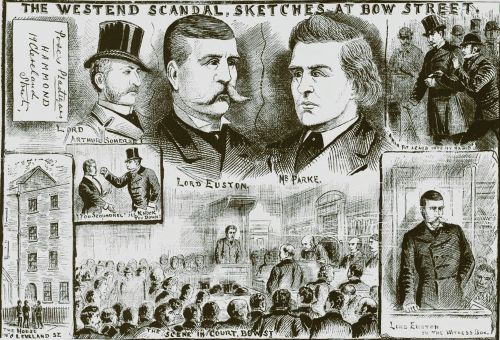
In 1889, a police investigation into a male brothel operating at 19 Cleveland Street in London exposed a network that reached from working-class telegraph boys to members of the aristocracy. The immediate charges centered on payments made to young men employed by the General Post Office, some of whom admitted to engaging in sexual acts with older male clients. Under the Criminal Law Amendment Act of 1885, particularly the Labouchere Amendment criminalizing acts of “gross indecency,” such conduct was prosecutable regardless of class. Yet the unfolding of the scandal quickly revealed that legal vulnerability did not fall evenly across social rank. From the beginning, the case unfolded within a society rigidly structured by hierarchy.
The asymmetry of exposure became apparent as lower-level participants faced arrest, interrogation, and public scrutiny, while high-status names circulated largely as rumor rather than formal charge. One of the principal organizers, Charles Hammond, fled to France before trial, thereby avoiding direct prosecution in Britain. Telegraph boys were questioned, some detained, and in certain instances prosecuted, their names reported with far less hesitation. Meanwhile, allegations touching aristocratic figures, and most explosively the name of Prince Albert Victor, Duke of Clarence, entered the public sphere in oblique and contested ways. Parliamentary debate acknowledged the scandal and raised questions about the scope of investigation, yet officials declined to confirm or publicly pursue the most politically sensitive claims. The contrast between visible enforcement against the socially vulnerable and caution surrounding elite implication underscored how class shaped investigative momentum. The gap between what was whispered and what was formally charged defined the episode’s trajectory.
Victorian Britain possessed both a sensational press culture and stringent libel laws. Newspapers reported on the case, but editors navigated significant legal and financial risks in publishing unproven accusations against titled individuals. The law of libel, combined with deference toward aristocratic and royal institutions, created structural constraints on what could be printed. As a result, the scandal was neither fully suppressed nor fully exposed. It existed in a state of partial illumination, where public suspicion expanded even as official processes narrowed their focus to those least capable of defending themselves through influence.
The Cleveland Street Scandal provides more than a glimpse into clandestine sexual networks in late nineteenth-century London. It offers a window into how class, law, media management, and political caution intersected when elite reputation was at stake. The episode illustrates a broader dynamic within stratified societies. When powerful interests are implicated, governance often shifts from transparent adjudication to calibrated containment. Exposure becomes selective. Accountability becomes uneven. The scandal’s enduring significance lies in that imbalance.
Victorian Class Hierarchy and Legal Asymmetry
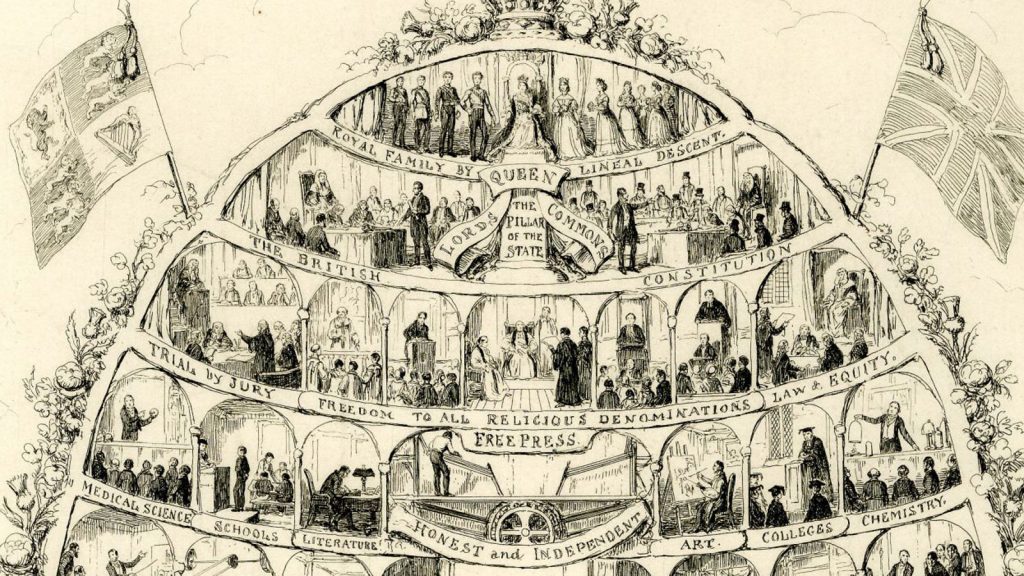
The Cleveland Street Scandal unfolded within a legal system that formally claimed universality yet operated within a deeply stratified society. By 1889, male homosexual acts were prosecutable under Section 11 of the Criminal Law Amendment Act of 1885, commonly known as the Labouchere Amendment. The statute’s language was deliberately broad, criminalizing acts of “gross indecency” between males in both public and private settings. It required no proof of sodomy and no public act, significantly expanding prosecutorial reach. On paper, the law did not distinguish between aristocrat and laborer, nor did it provide exemptions based on title or influence. Yet law does not operate in abstraction. It functions through institutions staffed by individuals embedded within social hierarchies. In late Victorian Britain, those hierarchies were rigid and deeply internalized. Enforcement, discretion, and investigative vigor intersected with class power, social influence, and access to legal protection, shaping how and against whom statutes were applied.
Working-class participants bore the immediate weight of investigation. Telegraph boys employed by the General Post Office were interrogated and, in some cases, prosecuted with their names entering public record. Their vulnerability was structural. As wage earners with limited resources, they lacked the means to mount prolonged legal defenses or negotiate discreet settlements. Employment dependency compounded risk. Exposure threatened not only prosecution but social ostracism and economic ruin. Legal universality masked asymmetrical consequences.
By contrast, aristocratic figures implicated in rumor benefited from layers of insulation. Elite status provided access to influential networks, experienced legal counsel, and the capacity to shape narrative indirectly through intermediaries. More importantly, prosecuting a titled individual carried reputational and political implications extending beyond the courtroom. A case involving prominent names could destabilize confidence in institutions associated with governance and monarchy. Investigative restraint functioned as a form of systemic caution rather than overt exoneration.
The differential handling of Charles Hammond further illustrates legal asymmetry. Although identified as a central organizer of the brothel, Hammond fled to France before he could be compelled to stand trial in Britain. His departure effectively removed him from immediate legal reach, and extradition was not aggressively pursued. The episode highlights how mobility and access to resources could blunt enforcement. Those with financial means or connections could relocate beyond immediate jurisdiction, complicating efforts at prosecution. In contrast, the telegraph boys had neither the wealth nor the international mobility to evade scrutiny. Legal accountability was shaped not only by statutory definition but by practical capacity to resist or escape its application. The uneven pursuit of suspects reflected differential leverage within a system ostensibly committed to equal enforcement.
Victorian legal culture also embedded class deference within courtroom dynamics. Magistrates, juries, and police officials operated within a social order that normalized hierarchy. The credibility assigned to testimony could reflect implicit assumptions about status and respectability. Lower-class witnesses faced skepticism, while gentlemen were presumed honorable absent definitive proof. Such cultural bias did not require formal policy. It operated through habit and expectation, reinforcing uneven exposure even when law appeared neutral.
The Cleveland Street Scandal reveals a system in which legal universality coexisted with functional asymmetry. Statutory language criminalized behavior without reference to rank, yet enforcement unfolded within networks shaped by wealth, influence, and institutional caution. Working-class participants encountered visible sanction. Elite figures encountered procedural hesitation. The law functioned, but it functioned unevenly, reflecting the stratified society in which it operated.
The Press, Libel Law, and Managed Disclosure

The Cleveland Street Scandal unfolded at a moment when the Victorian press was both expansive and constrained. By the late nineteenth century, newspapers circulated widely, shaping public opinion and amplifying political controversy. Sensational reporting was not uncommon, particularly in cases involving crime or sexual impropriety. Yet the same press culture operated under stringent libel laws that imposed substantial financial penalties for publishing unproven allegations against identifiable individuals. Editors navigated a narrow corridor between commercial appetite for scandal and legal exposure to ruinous litigation. The result was a pattern of partial disclosure.
Libel law functioned as both shield and restraint. Wealthy individuals possessed the means to pursue defamation suits aggressively, and newspapers understood that even the threat of litigation could produce crippling expense. The burden of proof in libel cases often fell heavily on publishers, requiring them to substantiate allegations with documentary certainty before naming prominent figures. In practice, this created a chilling effect when rumors implicated aristocrats or those connected to the royal household. Reports referenced unnamed “persons of high rank” or relied on indirect phrasing that suggested impropriety without formal accusation. This coded language allowed suspicion to enter public consciousness while maintaining plausible deniability. Editors could signal awareness of elite involvement while avoiding explicit claims that might trigger legal reprisal. Managed ambiguity became not simply a stylistic choice but a structural necessity within a press environment shaped by class power and legal vulnerability.
The contrast between coverage of working-class defendants and elite implication was stark. Telegraph boys were identified, described, and publicly scrutinized in ways that high-status suspects were not. Lower-level participants lacked the legal leverage to intimidate publishers. Their prosecution offered newspapers concrete, documentable proceedings to report. By contrast, the involvement of aristocrats remained anchored in rumor, parliamentary questioning, and guarded commentary. The press amplified visible legal action while muting unproven elite association.
Political caution further shaped disclosure. Allegations touching Prince Albert Victor heightened sensitivity around institutional stability and public confidence in the monarchy. Government officials did not formally charge him, and no conclusive evidence was publicly presented linking him directly to prosecutable acts. In this environment, newspapers operated with heightened awareness that scandal could ripple outward into constitutional anxiety. The monarchy functioned as a symbol of national continuity, and unverified accusations carried implications far beyond individual misconduct. Publishing explicit claims against a royal figure risked not only libel but broader political backlash, including loss of access to official information or informal pressure from political actors. Editors calibrated tone and content carefully, balancing public curiosity with perceived responsibility to avoid destabilizing institutions. The boundaries of print reflected an understanding that exposure was not merely a journalistic act but a political intervention with potentially far-reaching consequences.
The Cleveland Street episode demonstrates how media management operates within legal and political frameworks. The press neither fully suppressed nor fully exposed the scandal. It mediated disclosure, calibrating language to avoid catastrophic liability while sustaining reader interest. This dynamic produced a landscape in which suspicion flourished without definitive resolution. Managed disclosure became a mechanism through which elite reputation was buffered, illustrating how law, media, and hierarchy intersected to contain rather than conclusively adjudicate controversy.
Political Risk and Monarchical Sensitivity
The Cleveland Street Scandal assumed heightened significance because it unfolded in proximity to the monarchy. Late Victorian Britain treated the royal family not merely as private individuals but as symbolic anchors of national stability and imperial continuity. The reign of Queen Victoria had cultivated an image of moral seriousness and domestic propriety that stood in deliberate contrast to earlier Hanoverian reputations for personal excess. The monarchy’s authority rested less on executive power than on symbolic legitimacy, which depended heavily upon public perception of virtue and restraint. Any allegation that threatened this carefully maintained image carried implications beyond personal misconduct. It raised concerns about institutional credibility at a time when Britain presided over a vast empire and faced ongoing political reform at home. In such a context, scandal was not solely a matter of criminal law. It became a question of constitutional prudence and reputational preservation.
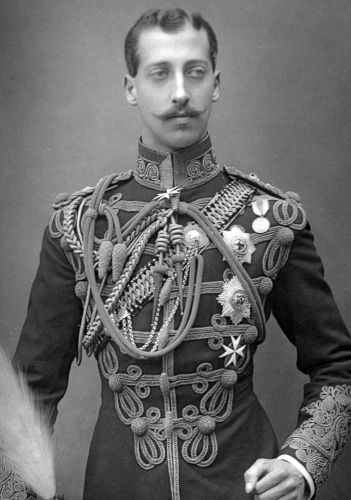
Rumors linking Prince Albert Victor, Duke of Clarence, to the Cleveland Street network intensified these sensitivities. Although no formal charge was brought against him, his name circulated in political and journalistic discourse. Parliamentary questions raised the issue of whether investigations had been curtailed or evidence suppressed to avoid embarrassment. Government responses were measured and limited, affirming the integrity of official inquiry without validating specific allegations. The handling of the matter illustrates how political actors sought to contain potential damage while avoiding explicit confrontation with unproven claims.
The British constitutional framework further complicated response. The monarchy operated within a delicate balance of ceremonial authority and political neutrality, a balance sustained by convention rather than rigid codification. Public prosecution of a royal figure could destabilize this equilibrium, particularly in an era when republican sentiment, though limited, persisted in segments of political culture. The late nineteenth century witnessed ongoing debates over franchise expansion, Irish Home Rule, and imperial governance, all of which heightened sensitivity to institutional fragility. Political leaders confronted layered risks. Aggressive investigation might satisfy demands for transparency, yet it could also inflame public controversy, encourage partisan exploitation, or erode confidence in the monarchy’s symbolic function. Prudence favored minimizing exposure rather than escalating uncertainty. In this environment, restraint was interpreted as preservation of order, and caution became a governing principle when royal reputation intersected with criminal inquiry.
Containment did not require overt suppression. It could take the form of narrowed investigative scope, cautious public statements, and reliance on procedural closure. The absence of definitive evidence linking Prince Albert Victor to prosecutable conduct allowed officials to justify inaction without conceding impropriety. The strategy balanced acknowledgment of scandal with maintenance of institutional dignity. Political risk management shaped the boundaries of accountability. Stability remained the overriding objective.
The Cleveland Street episode demonstrates how monarchical sensitivity influences governance during moments of elite scandal. When allegations intersect with national symbols, the calculus of exposure shifts. Legal universality yields to political caution. Investigative zeal is tempered by concern for institutional continuity. The result is not necessarily conspiracy, but calibrated response. In 1889, the preservation of monarchical stability appears to have outweighed the pursuit of full public disclosure, reinforcing the broader pattern of selective containment that defined the scandal.
Selective Consequences: Who Paid the Price
The distribution of legal consequences in the Cleveland Street Scandal reveals a clear pattern of selective exposure. Those at the lower end of the social hierarchy bore the most immediate and visible costs. Telegraph boys employed by the General Post Office were interrogated, dismissed from employment, and in some cases prosecuted under the Criminal Law Amendment Act. Their names entered court records and press accounts, permanently associating them with scandal. For these young men, the combination of criminal charge, public identification, and economic precarity constituted punishment that extended well beyond any formal sentence. Legal action was swiftest where resistance was weakest.
Charles Hammond, identified as a central organizer of the brothel, represents a more complex case. Though implicated through testimony and police inquiry, he fled to France before trial, avoiding direct confrontation with British courts. His departure removed him from immediate jurisdiction and effectively narrowed the focus of prosecution to those remaining within reach. Extradition was theoretically possible but procedurally burdensome, and the British authorities did not pursue it with sustained urgency. Whether interpreted as legal limitation, evidentiary caution, or political convenience, the outcome illustrates how mobility and access to resources could mitigate consequences. Hammond’s position as an intermediary figure, neither aristocrat nor impoverished youth, placed him in a category where flight was feasible and enforcement negotiable. His escape contrasted sharply with the constrained options available to working-class defendants who lacked the means to relocate beyond jurisdictional reach. The divergence in outcomes underscores how geography, capital, and institutional will interacted to shape accountability.
By contrast, aristocratic figures implicated in rumor experienced neither arrest nor public trial. Names circulated in parliamentary debate and private correspondence, yet formal charges did not materialize. The absence of prosecution functioned as a form of silent exoneration, allowing elite reputations to recover through passage of time rather than judicial resolution. In a society attentive to class distinction, lack of indictment could be read as implicit vindication. The reputational damage was diffuse and contested rather than definitive.
This asymmetry underscores the broader logic of containment. Legal universality remained intact in statute, yet its practical application diverged along lines of status and influence. Working-class participants encountered visible sanction, mid-level actors navigated escape or limited pursuit, and elite figures avoided courtroom scrutiny altogether. The scandal produced consequences, but those consequences were unevenly distributed. Accountability fell where it was least politically costly, reinforcing the structural imbalance that shaped the episode from its inception.
Public Suspicion without Institutional Resolution
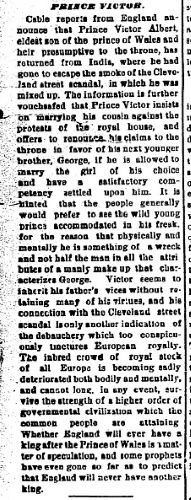
The Cleveland Street Scandal did not conclude with a decisive institutional reckoning. Although prosecutions occurred at lower levels and parliamentary debate addressed aspects of the investigation, no comprehensive judicial resolution clarified the extent of elite involvement. The absence of formal indictment against prominent figures left a residue of uncertainty. Public knowledge existed in fragments: court testimony, guarded press reports, evasive ministerial answers. Suspicion persisted precisely because it was neither fully substantiated nor definitively refuted. The scandal entered public consciousness as a permanently unsettled episode.
Parliamentary exchanges in early 1890 illustrate this ambiguity with particular clarity. Members of Parliament pressed government officials on whether investigations had been curtailed, whether evidence had been deliberately minimized, and whether names of higher-ranking individuals had been shielded from scrutiny. Questions were framed carefully, often relying on press reporting and public rumor rather than formal documentation. The Home Secretary’s responses emphasized procedural integrity and the absence of sufficient admissible evidence to justify broader prosecution. By grounding his defense in evidentiary standards, he redirected the debate from moral suspicion to legal threshold. Such statements neither confirmed nor categorically denied rumor. Instead, they constructed a narrative in which restraint was presented as adherence to due process rather than political protection. The exchange underscored the gap between what was publicly suspected and what could be legally sustained, revealing how institutional language can both address and contain controversy.
The press amplified this unresolved tension while remaining circumscribed by libel constraints. Newspapers reported parliamentary questioning and court outcomes while continuing to allude obliquely to aristocratic implication. Editorial commentary often relied on suggestive phrasing, hinting at broader involvement without crossing the boundary into explicit accusation. Readers encountered a narrative structured around omission and implication rather than full disclosure. Information appeared fragmentary, suggestive but incomplete, inviting interpretation rather than delivering conclusion. This pattern allowed suspicion to circulate in a sustained manner, even as official channels refrained from definitive judgment. In the absence of transparent adjudication, public discourse filled the vacuum with conjecture and inference. The scandal’s meaning shifted from documented criminal case to contested public narrative, shaped by class attitudes, political loyalties, and perceptions of institutional credibility.
The long-term effect was reputational ambiguity rather than institutional transformation. The monarchy remained intact. Aristocratic figures retained position. Legal statutes governing male homosexual conduct remained unchanged. Yet the episode lingered as evidence, for some observers, of unequal justice and managed disclosure. Public suspicion without formal adjudication does not necessarily destabilize a system. It can instead become part of its history, a reminder of tensions between transparency and containment that never fully crystallize into formal reckoning.
Containment as Governance Strategy
The Cleveland Street Scandal illustrates how strategic limitation can function as a deliberate mode of governance in moments of elite vulnerability. Rather than pursuing maximal exposure or dramatic institutional reform, authorities navigated a path that limited legal jeopardy for powerful figures while allowing sufficient action to demonstrate procedural integrity. The objective was not denial of wrongdoing but prevention of systemic destabilization. Prosecutions proceeded where evidence was clear and defendants lacked influence. Allegations that threatened higher institutions were met with caution, evidentiary restraint, and carefully calibrated public statements. Parliamentary responses emphasized due process, and investigative scope remained tethered to demonstrable proof. The state neither denied the existence of misconduct nor permitted its escalation into constitutional crisis. Managed limitation became the operative logic, balancing the appearance of justice with preservation of hierarchy.
This strategy depended upon coordination across legal, political, and media domains. Police investigation, prosecutorial discretion, parliamentary response, and press reporting intersected within a shared awareness of potential instability. Officials emphasized adherence to due process, framing limited prosecution as a matter of legal sufficiency rather than political preference. The press, constrained by libel law and reputational risk, echoed this partial framing. Together, these mechanisms narrowed the scope of the scandal without erasing it. Such limitation did not require conspiracy. It depended upon shared commitment to preserving governing continuity.
Containment also redistributed moral focus. By prosecuting telegraph boys and allowing Hammond’s departure to conclude quietly, authorities presented tangible outcomes that signaled action. Visible consequences at lower levels created the appearance of enforcement, even as higher-level allegations remained unresolved. This redistribution of accountability stabilized the narrative. The public could observe punishment and infer that justice had been served in some measure, reducing pressure for deeper inquiry. Selective enforcement operated as reputational buffer.
The durability of this strategy rests on public thresholds for uncertainty. Victorian society, though attentive to scandal, also valued stability and deference to established institutions. When allegations could not be conclusively proven, restraint could be interpreted as prudence rather than protectionism. Containment functioned effectively because it aligned with broader cultural assumptions about hierarchy and respectability. It reassured without fully revealing. The monarchy and aristocracy emerged formally unscathed, even as suspicion lingered in private discourse.
The Cleveland Street episode therefore offers a revealing lesson about governance in hierarchical systems. When scandal implicates powerful networks, exposure competes with preservation, and preservation often prevails. Institutions tend to calibrate response in proportion to perceived threat, narrowing investigative pathways that risk destabilizing core symbols of authority. Such decisions may avert immediate political upheaval, maintain public order, and protect institutional legitimacy in the short term. Yet they also leave behind a residue of ambiguity. Incomplete adjudication sustains long-term suspicion, embedding unresolved questions within collective memory. This approach preserved the existing order, but it did so by accepting partial transparency and uneven accountability. In 1889, British governance favored stability through managed disclosure, reinforcing patterns of selective exposure that illuminate how class, influence, and political caution shape the boundaries of justice.
Conclusion: Class, Power, and the Limits of Exposure
The Cleveland Street Scandal exposes the tension between statutory equality and entrenched social hierarchy in late Victorian Britain. On paper, the Criminal Law Amendment Act applied without distinction. In practice, enforcement unfolded along lines shaped by class, influence, and institutional caution. Working-class defendants encountered visible sanction. Mid-level organizers navigated flight or limited pursuit. Elite figures remained largely insulated from formal charge. The disparity did not arise from explicit exemption in statute but from the structural environment in which statute operated.
The episode also demonstrates how exposure is conditioned by political calculation. Allegations touching aristocratic and royal circles triggered a shift from investigative expansion to procedural containment. Parliamentary debate, press reporting, and prosecutorial discretion coalesced around preservation of governing equilibrium. Demands for openness collided with political prudence, and prudence ultimately prevailed. The scandal did not disappear, but it was bounded. Disclosure was managed rather than maximized.
This management did not eliminate public suspicion. Instead, it produced an enduring ambiguity. The absence of definitive adjudication left space for rumor, reinterpretation, and retrospective critique. Such ambiguity can function as a stabilizing mechanism. Institutions survive not by resolving every controversy conclusively, but by limiting the degree to which controversy disrupts structural continuity. The monarchy remained publicly unshaken, the legal framework unchanged, yet the episode persisted as a reminder of uneven justice.
The Cleveland Street affair stands as an illustration of how hierarchical systems regulate scandal. When powerful networks are implicated, governance often favors calibrated limitation over comprehensive exposure. Class privilege, legal restraint, and political prudence intersect to shape the boundaries of accountability. Selective exposure arises not through formal exemption, but through the interaction of influence, evidentiary caution, and reputational risk. The limits of exposure are most visible where power is most concentrated, revealing how institutional preservation can supersede full transparency. In 1889, Britain preserved monarchical and aristocratic stability at the cost of exhaustive public reckoning. The result was neither outright suppression nor full disclosure, but a carefully maintained balance that protected core institutions while permitting limited acknowledgment. That equilibrium defines the structural lesson of the scandal.
Bibliography
- Brake, Laurel, and Marysa Demoor, eds. Dictionary of Nineteenth-Century Journalism in Great Britain and Ireland. Ghent: Academia Press, 2009.
- Cannadine, David. Ornamentalism: How the British Saw Their Empire. Oxford: Oxford University Press, 2001.
- Cook, Matt. London and the Culture of Homosexuality, 1885–1914. Cambridge: Cambridge University Press, 2003.
- Dockray, Martin. “The Cleveland Street Scandal 1889–90: The Conduct of the Defence.” The Journal of Legal History 17:1 (1996), 1-16.
- Hansard, HC Deb 28 February 1890, vol. 341, cols. 1003–1056.
- Hindmarch-Watson, Katie. “Male Prostitution and the London GPO: Telegraph Boys’ ‘Immorality’ from Nationalization to the Cleveland Street Scandal.” Journal of British Studies 51:3 (2012), 594-617.
- —-. “Sex, Services, and Surveillance: The Cleveland Street Scandal Revisited.” History Compass 14:6 (2016), 283-291.
- Hyde, H. Montgomery. The Cleveland Street Scandal. London: W. H. Allen, 1976.
- Weeks, Jeffrey. Sex, Politics and Society: The Regulation of Sexuality since 1800. 2nd ed. London: Longman, 1989.
Originally published by Brewminate, 02.23.2026, under the terms of a Creative Commons Attribution-NonCommercial-NoDerivatives 4.0 International license.
About the Author