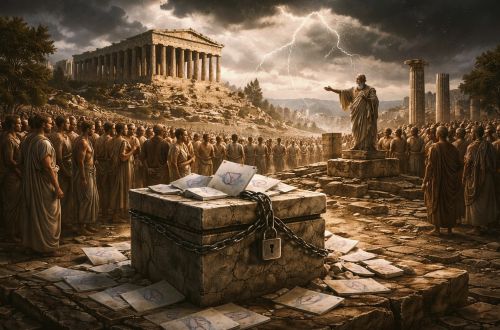
The Athenian experience demonstrates that democracy does not collapse when elections disappear, but when they are emptied of meaning.

By Matthew A. McIntosh
Public Historian
Brewminate
Introduction: Elections as the Machinery of Legitimacy
Elections are often treated as the visible hallmark of democracy, the moment when citizens periodically authorize those who govern them. Yet historically, elections have functioned less as isolated events than as parts of a larger constitutional machine. They distribute legitimacy, structure consent, and define who counts as a political actor. When they operate freely, elections bind power to the people. When they are constrained, supervised, or reengineered, they can continue to exist while no longer performing that essential function. Democracy, in this sense, depends not merely on the presence of elections, but on their relationship to sovereignty.
This distinction matters because democratic collapse rarely announces itself through the abolition of voting. Instead, it proceeds through administrative and rhetorical shifts that redefine the meaning of participation. Control over elections moves gradually from citizens to institutions, from local communities to centralized authorities, and from neutral procedures to partisan oversight. The outward forms of democracy remain intact even as their substance is hollowed out. Legitimacy becomes something managed rather than conferred, produced by process rather than consent.
Historically, elections have been most vulnerable during moments of crisis. War, internal division, economic collapse, and perceived disorder generate powerful incentives to subordinate participation to control. In such moments, political leaders and elites often argue that ordinary democratic processes are too slow, too fragmented, or too easily manipulated to meet existential threats. The language of security and stability displaces the language of sovereignty. What begins as a promise of temporary supervision frequently becomes a permanent restructuring of political authority.
What follows argues that democracy fails not when elections disappear, but when they are transformed into instruments of centralized power. From ancient Athens to modern constitutional states, the decisive shift occurs when authority over elections is removed from the people and consolidated in the hands of those who benefit from their outcomes. By tracing this pattern historically, the essay demonstrates that nationalizing or centralizing electoral control is not a neutral reform. It is a structural redefinition of legitimacy itself, one that allows elections to persist while democracy quietly ceases to function.
Democracy under Siege: Athens after the Peloponnesian War
Athens emerged from the Peloponnesian War militarily defeated, economically exhausted, and psychologically shattered in ways that reached far beyond the battlefield. The loss of its naval supremacy, the collapse of its empire, and the prolonged drain on manpower and public finances destabilized the social compact that had sustained democratic confidence for generations. Citizens who had once believed themselves masters of the Aegean now faced scarcity, humiliation, and uncertainty. Political debate increasingly took place under the shadow of trauma, as memories of plague, siege, and defeat lingered. In this atmosphere, democratic institutions that had once symbolized collective strength began to appear, to many elites, as engines of self-destruction rather than sources of resilience.
Rather than attributing failure to strategic miscalculation or elite ambition, prominent Athenians reframed the war’s outcome as evidence of popular incompetence. The Assembly was depicted as volatile, easily swayed by rhetoric, and structurally incapable of sustained rational judgment. Democratic participation itself was recast as a liability in moments of existential danger. The argument gained traction precisely because it resonated with lived experience. Years of hardship made disorder feel plausible and discipline desirable. Democracy was no longer defended as a moral good or a stabilizing force but questioned as a structural weakness that had exposed Athens to ruin.
What followed was not an immediate rejection of constitutional language but a reframing of political legitimacy. Influential Athenians argued that broad participation was incompatible with survival in a hostile geopolitical environment. They portrayed the decentralized character of democratic decision-making as inherently chaotic, vulnerable to misinformation, and incapable of sustaining disciplined governance during crisis. Calls for “order” and “competence” functioned as critiques of the electorate rather than of policy. The people were reimagined as a risk factor to be managed rather than the sovereign source of authority.
Crucially, this argument did not initially take the form of outright tyranny. Instead, it targeted the mechanisms of participation. Voting was restricted, assemblies were sidelined, and political power was consolidated into narrower bodies said to possess superior judgment and loyalty. The claim was not that democracy should vanish permanently, but that it must be suspended or supervised until stability was restored. This temporary logic proved decisive. Once electoral sovereignty was treated as conditional, it ceased to function as a constraint on power.
The Coup of the Four Hundred: Emergency Governance as Electoral Suspension
The coup of the Four Hundred in 411 BCE marked a decisive shift from democratic crisis to oligarchic intervention, one carefully engineered to appear constitutional rather than revolutionary. Its leaders emerged from Athens’s political and military elite at a moment when defeat and desperation had eroded public confidence. They claimed that democratic governance had proven unequal to the demands of war and diplomacy, especially in negotiations with Persia and Sparta. Crucially, they did not argue that Athens should abandon its traditions, but that it must temporarily entrust power to those best equipped to preserve the state. By framing their actions as an emergency measure rather than a permanent transformation, the conspirators exploited widespread anxiety while minimizing the appearance of illegitimacy.
Central to the coup was the suspension of electoral sovereignty rather than its formal abolition. The broad citizen Assembly was displaced by a narrowly defined council of four hundred men, selected not by popular vote but by elite coordination. Voting rights were restricted to a small subset of citizens deemed financially and politically reliable. This move transformed participation from a civic right into a conditional privilege. Elections continued to exist in name, but their substance was emptied by redefining who could legitimately take part.
The Four Hundred justified this restructuring through appeals to wartime necessity. Athens, they argued, could not afford the inefficiency of mass deliberation while facing external threats and internal instability. Democratic debate was cast as a luxury of peacetime, unsuited to moments of existential danger. In this framework, centralized supervision was presented as rational governance rather than authoritarian seizure. The claim was not that the people should never rule, but that they should not rule now.
What makes the coup historically significant is the precision with which it targeted procedure rather than ideology. The conspirators did not outlaw democratic language, civic rituals, or constitutional vocabulary. Instead, they reengineered the machinery through which political will was expressed, ensuring that outcomes could be controlled without visibly discarding tradition. By narrowing electoral access and concentrating decision-making authority, they rendered popular participation largely symbolic. This procedural approach delayed resistance, as many Athenians struggled to identify the precise moment at which democracy had been functionally displaced. Power shifted quietly, not through proclamation, but through administrative redesign.
The experiment was short-lived, collapsing under internal division, military setbacks, and popular backlash. Yet its significance lies not in its duration but in the precedent it established. The Four Hundred demonstrated how democratic systems could be neutralized without overt violence, mass repression, or formal constitutional abolition. Electoral suspension, justified as emergency governance, normalized the idea that participation could be postponed in the name of survival. Once this logic took hold, it lowered the threshold for more extreme forms of oligarchic rule. The later imposition of the Thirty Tyrants would be bloodier and more explicit, but it rested on conceptual groundwork already laid in 411 BCE.
The Thirty Tyrants: Centralized Authority without Consent
The collapse of the Four Hundred did not restore democratic stability to Athens. Instead, it revealed how deeply electoral sovereignty had already been compromised once participation was treated as conditional rather than foundational. Democratic forms could be reinstated temporarily, but the underlying legitimacy of popular rule had been damaged by repeated suspensions and restrictions. In 404 BCE, following Athens’s final defeat by Sparta, this vulnerability was exploited decisively. A far more explicit oligarchic regime was imposed, one that no longer bothered with the language of supervision or emergency stewardship. Known as the Thirty Tyrants, this government did not claim to protect democracy during crisis. It dispensed with the premise of popular consent altogether.
Unlike the Four Hundred, the Thirty did not present themselves as reluctant caretakers of constitutional order. Installed with Spartan backing, they derived authority from military force and elite coordination rather than civic endorsement. Their legitimacy was external and coercive, not internal and participatory. Political rights were restricted to a list of three thousand approved citizens, carefully curated to exclude the majority of the population. Those outside the list were stripped of legal protections and political standing, rendering them effectively invisible to the state. This was not a procedural adjustment but a radical redefinition of who constituted the political community. Citizenship ceased to be a shared status and became a revocable license granted by the regime.
Centralization under the Thirty extended beyond electoral exclusion into the structure of law and violence. Courts ceased to operate independently, and legal protections were withdrawn from those outside the approved citizen list. Arrests, executions, and confiscations of property were conducted without due process. Political authority was enforced through fear rather than persuasion, replacing debate with decree. Where earlier oligarchic interventions had preserved the language of emergency, the Thirty normalized repression as governance.
What distinguishes the regime of the Thirty is not merely its brutality but its administrative clarity. Elections were irrelevant because legitimacy no longer flowed from participation at all. The regime made explicit what had previously been implicit. Once electoral control was centralized, popular consent could be dispensed with entirely. The transition from supervised democracy to outright tyranny was not abrupt. It followed a logical progression that began when participation was first treated as negotiable.
The social consequences were immediate and corrosive. Exile, confiscation, and political murder fractured the citizen body and destroyed trust in public institutions that had once mediated conflict. Fear replaced civic obligation as the glue of political order, and neighbors became potential informants or victims. The Thirty’s rule generated resistance not because it violated abstract democratic theory, but because it rendered daily life unstable and dangerous. Governance without consent proved incapable of sustaining even minimal legitimacy. As repression intensified, centralized authority became increasingly dependent on violence to preserve itself.
The overthrow of the Thirty and the restoration of democracy did not erase the lessons of this period. Athenians emerged with a sharper understanding of how fragile electoral sovereignty could be once administrative control replaced civic participation. The Thirty Tyrants stand as a warning not simply about tyranny, but about the pathway to it. When elections are suspended, restricted, or centralized in the name of stability, consent becomes optional. Once consent is optional, authority no longer requires justification. Democracy does not disappear in a single moment. It is first hollowed out, then ruled unnecessary.
From Chaos to Control: The Rhetoric of Order and National Survival
The Athenian experience reveals that the collapse of democratic governance is rarely justified in openly anti-democratic terms. Instead, it is framed as a necessary response to disorder. Political participation becomes recoded as a source of chaos rather than legitimacy, and the language of survival replaces the language of sovereignty. In moments of perceived emergency, elites consistently argue that the state cannot afford the inefficiencies of broad deliberation. Democracy is depicted not as a system of collective judgment but as a vulnerability that hostile forces can exploit.
This rhetorical shift depends on redefining disorder itself. In Athens, disagreement, debate, and procedural delay were reinterpreted as existential threats rather than ordinary features of self-governance. Political pluralism became indistinguishable from instability. By collapsing dissent into danger, oligarchic actors were able to present centralized control as a rational corrective rather than a seizure of power. The promise was not domination, but restoration. Order would be imposed temporarily, until normal politics could resume. History suggests that such normalcy rarely returns once authority has been consolidated.
Central to this rhetoric is the claim that elections must be supervised or suspended to protect their integrity. Athenians were encouraged to believe that popular decision-making was uniquely susceptible to deception, manipulation, and emotional excess, particularly during wartime. The electorate was no longer imagined as the collective bearer of political wisdom, but as an unstable mass requiring guidance. This reframing subtly inverted the logic of democracy. Citizens were transformed from sovereign participants into objects of administrative management. Once that shift occurred, political debate was no longer about competing visions of policy, but about determining who possessed the competence to decide at all. Authority migrated upward, away from the many and toward the few, under the guise of safeguarding the political system itself.
The appeal to national survival intensified this transformation by narrowing the space of legitimate disagreement. When political questions were framed as matters of existential urgency, procedural safeguards appeared expendable. Delay became dangerous. Dissent became disloyal. In Athens, the fear of annihilation at the hands of foreign enemies made it plausible to treat electoral sovereignty as a temporary luxury. Emergency logic compressed time horizons and discouraged reflection, allowing extraordinary measures to be portrayed as unavoidable. What was lost in this compression was the recognition that democratic processes are not obstacles to survival, but mechanisms for distributing responsibility and legitimacy during crisis.
The lesson of Athens is not that order and security are illegitimate political concerns. It is that the language used to defend them carries enduring structural consequences. When order is defined as the absence of popular control, and survival as the suspension of participation, democracy becomes conditional by definition. Conditional participation is easily withdrawn and rarely restored in full. The rhetoric of chaos does not merely describe political instability. It actively reshapes political expectations, teaching citizens to accept centralized authority as normal and necessary. Once that expectation takes hold, the transition from emergency governance to permanent control requires no further justification.
Structural Parallels in Later Federal Systems
The Athenian pattern did not remain confined to the ancient world. Later federal and quasi-federal systems reveal the same structural vulnerability: democracy erodes not when elections are abolished, but when control over them is centralized under claims of necessity. Federal arrangements are deliberately designed to fragment authority, distributing power across regions, institutions, and procedures so that no single actor can monopolize political legitimacy. This dispersion is not inefficiency but protection. When it is overridden, elections may continue to exist formally while losing their function as expressions of popular sovereignty. The danger lies not in establishing shared norms or standards, but in transferring administrative control itself to a central authority capable of shaping outcomes.
The late Roman Republic offers an early parallel. Rome preserved its assemblies, magistracies, and electoral rituals even as elite actors increasingly manipulated eligibility, procedures, and outcomes. By restricting who could convene assemblies, by intimidating voters, and by concentrating authority in extraordinary commands, republican forms were hollowed out without being repealed. Elections remained visible, but their independence vanished. The lesson was clear: when electoral administration becomes an instrument of centralized power, the republic survives only as spectacle.
Early modern France demonstrates a similar logic operating through administrative consolidation rather than overt electoral manipulation. Provincial estates and municipal bodies once exercised genuine influence over taxation, law, and representation, providing regional counterweights to royal authority. Especially during the seventeenth century, these institutions were not abolished but subordinated. Royal intendants replaced local discretion with centralized oversight, ensuring uniformity in policy while preserving the appearance of consultation. Local participation survived in form but not in effect. Governance became more efficient and predictable, but also less accountable, as political authority flowed upward toward the crown rather than outward toward communities.
The Weimar Republic illustrates how this pattern operates in a modern constitutional framework. Germany’s federal structure was designed to distribute political authority among states, including significant control over policing and elections. Yet repeated reliance on emergency powers allowed executive authority to bypass federal and parliamentary constraints. Elections continued, but they occurred in an environment increasingly shaped by centralized control, intimidation, and administrative override. The formal existence of voting could not compensate for the erosion of local autonomy and procedural neutrality. Federalism failed not because it was abolished, but because it was rendered irrelevant.
The structural parallel is unmistakable. Federal systems collapse democratically when central authority claims supervisory power over electoral mechanisms themselves. Once elections are treated as instruments to be managed rather than processes to be respected, their legitimizing force dissipates. The Athenian experience anticipated this outcome with remarkable clarity. Democracy survives not through uniformity, but through the dispersion of power. When dispersion is replaced by central command, elections may persist, but self-government does not.
Modern Implications: Nationalizing Elections as a Constitutional Threat
A modern call by Donald Trump to nationalize elections draw directly from the historical logic traced from Athens onward. They are rarely framed as power grabs. Instead, they are presented as neutral administrative reforms designed to ensure integrity, uniformity, or security. Yet history suggests that such claims should be treated with skepticism. When electoral authority is transferred from local or state control to a centralized national apparatus, the shift is not merely procedural. It alters the locus of sovereignty itself. Elections cease to be expressions of dispersed civic authority and become instruments managed by the very power they are meant to legitimate.
In constitutional systems built on federal principles, decentralized election control is not a flaw to be corrected but a safeguard against domination. Local administration creates friction, variation, and redundancy, all of which limit the ability of any single authority to dictate outcomes. Nationalization promises efficiency, but efficiency is not a democratic value in itself. When electoral administration is centralized, disputes over legitimacy are no longer mediated through multiple independent institutions. They are resolved, instead, by the same authority whose power depends on the result. This collapse of separation between contestant and referee is precisely the condition that has historically enabled authoritarian consolidation.
The language used to justify nationalized election control is strikingly familiar. Claims of widespread fraud, administrative chaos, or internal enemies echo earlier assertions that popular participation is inherently unreliable. As in Athens, citizens are recast as potential threats to the system rather than its foundation. Oversight becomes supervision. Supervision becomes control. The distinction between setting standards and exercising authority blurs, allowing extraordinary powers to be framed as necessary corrections rather than constitutional violations. What is lost in this process is the principle that legitimacy flows upward from the people, not downward from the state.
The historical record offers a consistent warning. Democracies do not usually fall because people stop voting. They fall because voting stops mattering. When elections are nationalized under executive or centralized control, they may continue to exist in form while losing their capacity to constrain power. Athens demonstrates that once participation is conditional and administration centralized, consent becomes optional. The modern threat is not the disappearance of elections, but their transformation into rituals that ratify authority rather than confer it. In constitutional terms, nationalizing elections is not reform. It is the redefinition of sovereignty.
Conclusion: When Elections Exist but Democracy Does Not
The Athenian experience demonstrates that democracy does not collapse when elections disappear, but when they are emptied of meaning. In the years following the Peloponnesian War, Athenians continued to speak the language of constitutional order even as participation was narrowed, supervised, and ultimately discarded. What changed was not the existence of political procedures, but their relationship to sovereignty. Once authority was centralized and participation treated as conditional, elections ceased to function as instruments of collective self-rule. They became, at best, symbolic remnants of a system that no longer governed itself.
Across time and political systems, the same structural lesson repeats. Democratic breakdown rarely announces itself as such. It advances through administrative consolidation, emergency rhetoric, and claims of superior competence. Elections are preserved in form because they remain useful as sources of legitimacy, but their capacity to constrain power is quietly dismantled. Federal arrangements, local control, and procedural friction are portrayed as obstacles to order rather than safeguards against domination. By the time citizens recognize the loss, the machinery of consent has already been repurposed.
What makes this pattern especially dangerous is its plausibility. Arguments for centralized control are often framed as reasonable responses to disorder, fraud, or crisis. They appeal to fear, exhaustion, and the desire for stability. Athens reminds us that such arguments are not new, nor are they neutral. When the authority to administer elections is concentrated in the same hands that benefit from their outcomes, democracy survives only as ritual. Voting continues, but sovereignty does not.
The enduring warning is structural rather than partisan. Democracy depends not simply on the act of voting, but on who controls the conditions under which votes are cast, counted, and contested. When that control is centralized, participation becomes optional and consent expendable. Elections may still exist, but they no longer govern. History shows that this transformation is not a prelude to authoritarianism. It is authoritarianism, expressed through procedure rather than force.
Bibliography
- Amar, Akhil Reed. America’s Constitution: A Biography. New York: Random House, 2005.
- Arendt, Hannah. The Origins of Totalitarianism. New York: Harcourt, Brace & Company, 1951.
- —-. On Revolution. New York: Penguin Books, 2006.
- Aristotle. The Athenian Constitution. Translated by P.J. Rhodes. London: Penguin Classics, 1984.
- Beik, William. Absolutism and Society in Seventeenth-Century France. Cambridge: Cambridge University Press, 1985.
- Evans, Richard J. The Coming of the Third Reich. New York: Penguin Press, 2003.
- Hamilton, Alexander. The Federalist No. 59. In The Federalist Papers. New York: Signet Classics, 2003.
- Hasen, Richard L. Election Meltdown: Dirty Tricks, Distrust, and the Threat to American Democracy. New Haven: Yale University Press, 2020.
- Krentz, Peter. The Thirty at Athens. Ithaca: Cornell University Press, 1982.
- Levitsky, Steven, and Daniel Ziblatt. How Democracies Die. New York: Crown, 2018.
- Lintott, Andrew. The Constitution of the Roman Republic. Oxford: Oxford University Press, 1999.
- Madison, James. The Federalist No. 10. In The Federalist Papers. New York: Signet Classics, 2003.
- —-. The Federalist No. 39. In The Federalist Papers. New York: Signet Classics, 2003.
- Manin, Bernard. The Principles of Representative Government. Cambridge: Cambridge University Press, 1997.
- Ober, Josiah. Democracy and Knowledge: Innovation and Learning in Classical Athens. Princeton: Princeton University Press, 2008.
- —-. Mass and Elite in Democratic Athens: Rhetoric, Ideology, and the Power of the People. Princeton: Princeton University Press, 1989.
- Osborne, Robin. Athens and Athenian Democracy. Cambridge: Cambridge University Press, 2010.
- Polybius. The Histories. Translated by Robin Waterfield. Oxford: Oxford University Press, 2010.
- Rhodes, P.J. A History of the Classical Greek World: 478–323 BC. Oxford: Blackwell, 2006.
- Schmitt, Carl. Political Theology: Four Chapters on the Concept of Sovereignty. Translated by George Schwab. Chicago: University of Chicago Press, 2005.
- Sebastiani, Breno Battistin. “The Coups of 404 and 411 in Athens: Thucydides and Xenophon on Conservative Turns.” Greek, Roman, and Byzantine Studies 58 (2018): 490-515.
- Snyder, Timothy. On Tyranny: Twenty Lessons from the Twentieth Century. New York: Tim Duggan Books, 2017.
- Stem, Rex. “The Thirty at Athens in the Summer of 404.” Phoenix 57:1/2 (2003): 18-34.
- Thucydides. History of the Peloponnesian War. Translated by Rex Warner. Revised by M.I. Finley. London: Penguin Classics, 1972.
- Tribe, Laurence H. American Constitutional Law. 3rd ed. New York: Foundation Press, 2000.
- Wolin, Sheldon S. Democracy Incorporated: Managed Democracy and the Specter of Inverted Totalitarianism. Princeton: Princeton University Press, 2008.
- —-. Politics and Vision: Continuity and Innovation in Western Political Thought. Princeton: Princeton University Press, 1960.
- Xenophon. Hellenica. Translated by Carleton L. Brownson. Cambridge, MA: Harvard University Press, 1918.
Originally published by Brewminate, 02.05.2026, under the terms of a Creative Commons Attribution-NonCommercial-NoDerivatives 4.0 International license.
About the Author