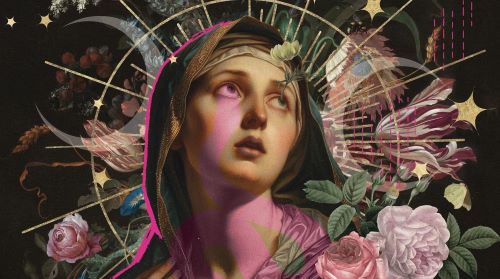
Women have dealt with gatekeeping of their body parts and pleasure for centuries.

By Dr. Helen King
Professor Emerita of Classical Studies
Open University

Art by Alexandra Gallagher
Multidisciplinary Artist
Introduction
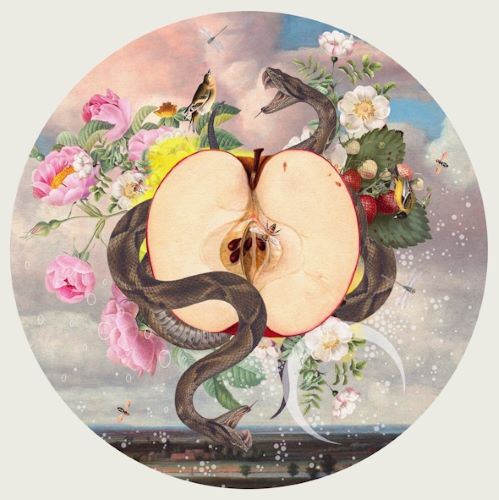
Medical language is not the only way to talk about bodies; in fact, it’s much less common than the myrtle-berries, brides, hills and apples all used as euphemisms for talking more discreetly about a part of the body which women are supposed to have felt guilty even to have found.
While many suggest something about the physical characteristics of the clitoris, the most pervasive of all these euphemisms have been those based on flowers, part of a longer list of words for parts and functions which present the female body as uniquely floral in nature, with all that this implies for the life cycle and sexuality. The menses have long been the “flowers”; to cease to be a virgin is to be “deflowered”; the hymen can be “the flower of virginity”.
Vegetable and floral clitorises were common into 19th-century literature, from Emily Dickinson’s poem on ‘Forbidden Fruit’: “How luscious lies within the Pod/The Pea that Duty locks” – to the 1893 novel ‘Teleny, or The Reverse of the Medal’, possibly by Oscar Wilde, where the clitoris is “a tiny bud – a living flower of flesh and blood” and, when stimulated, it “began to expand its petals and shed forth its ambrosial dew”.
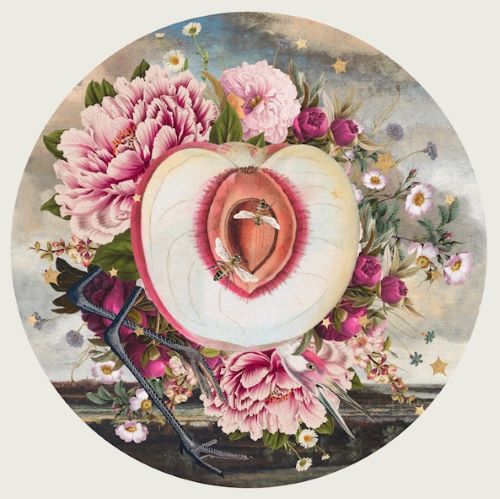
In Dickinson’s work, professor of English Paula Bennett identified 287 “small, round, and frequently hard objects” which she interpreted as clitoral imagery, including jewels, gems, peas, berries and buds; she went on to argue for similar imagery across the work of 19th-century American woman poets.
Talking about women’s bodies in terms of flowers can be simple euphemism, and it may seem like a way of valuing the “floral parts” – even of acknowledging their beauty – but there’s a less body-positive reading of this imagery. The fleeting nature of the flower’s blooming suggests not only fragility but also that, like fruit, it needs to be picked or plucked at the right moment; in the words of a Hippocratic text from ancient Greece, ‘On the disease of virgins’, girls must be married once they are “ripe for marriage”, otherwise they will become sick.
Abnormal Excitement and Destructive Vice
From the late 18th century onwards, women wrote and published guides to how the human body works, aimed at women or girls. In one of these, published in 1887, Anna Longshore-Potts – one of the first American women to practise as a physician – described reproduction in the established, highly floral way.
Longshore-Potts also supported “the flower” (unusually, in the singular) as a euphemism for menstruation because, unlike expressions such as “the terms”, “turns”, “courses” and “being unwell”, it “implies a function justly comparable with that of plants, which seldom yield fruit before they bloom, and woman usually has her menses, or the flower, before she bears offspring”.
Here, although tying menstruation firmly to having children, flowers are used to normalise it: a positive message which would probably have been a welcome change for girls facing their own changing bodies.
Among the external organs, Longshore-Potts listed, illustrated and even labelled the clitoris. In her work, however, this part was not described in the floral language she used for sex but featured in more prosaic terms as “a small, triangular, projecting organ” which is erectile; “the seat of local sexual excitement, and of special sexual pleasure”.
A review in periodical ‘The Hospital’ criticised this and the other anatomical illustrations as “unadvisable” to be issued to the public: “the book might be made a good one if much were omitted. As it now stands, we cannot advise females to read it.” In 1899, Longshore-Potts was damningly described in the press as “a lecturer on indecent subjects to women who call themselves ladies”.
Other late 19th-century advice books, such as Mary Wood-Allen’s ‘What a Young Girl Ought to Know’ (1899) and ‘What a Young Woman Ought to Know’ (1898), mentioned “an abnormal excitement of [a woman’s] organs of sex” but without actually naming these organs.
Such excitement “may be created by mechanical means”, Wood-Allen noted; this was the time when treadle sewing machines were seen as dangerously exciting for their female operators, and even in the 1960s Robert Masters, of Masters and Johnson, was still suggesting that sewing machines could “excite autoerotic manifestations”.
Longshore-Potts was far more direct than Wood-Allen, telling her readers that, when “aroused to its maximum”, the clitoris “results in a peculiar characteristic thrill known as orgasm”.
But just as plants did not need pleasure to reproduce, nor, Longshore-Potts thought, did women. For someone who called a clitoris a clitoris and acknowledged it as an organ of pleasure, she was clearly uneasy about it. In contrast to the “cult of mutual orgasm”, she claimed, sexual pleasure was not necessary for pregnancy; it was more like the pleasure of taste, encouraging us to eat.
Both appetites, she counselled, should be “ruled by wisdom” rather than overriding our reason, because both girls and boys could discover the “peculiar sensations” caused by masturbation – analogous to the “scorpion’s poisonous sting” – and may be “ruined” by overdoing it. Boarding schools were singled out as “the very hot-beds of this terribly destructive vice”.
When Sex Spoils the Bloom
Wood-Allen’s use of flower imagery was restricted to supporting a conservative position about women’s social roles and sexual innocence; she became the national superintendent of the Purity Department of the Woman’s Christian Temperance Union. Her approach to writing about potentially risqué topics was to use “culturally available female roles to present herself in socially acceptable ways”.
Floral imagery was as acceptable as it gets. The sex organs were “like the immature buds of the flower, and need time for a perfect development”, and novels – always condemned, because of the effects which the imagination was thought to have on the body – “are like forcing houses that hurry the buds into blossoms”.
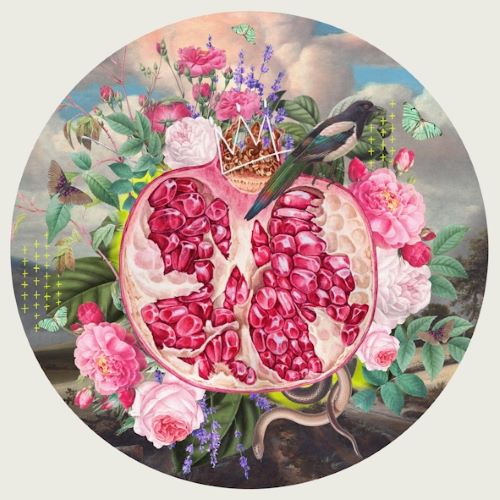
As for premature relationships with boys, “they brush off the bloom of perfect innocence, as rough handling brushes the dew from the flower, and nothing can ever restore it”. The reference to “handling” was a significant reminder of just what those boys could do, while “bloom” was a key word in ideals of womanhood.
Another 19th-century advice writer, the British headmistress and campaigner for women’s education and suffrage Elizabeth Wolstenholme-Elmy, similarly cautioned her young readers against engaging in any “tampering or dalliance”, because it would be like making a bud open prematurely and would injure the flower.
Using the imagery of flowers to warn against pre-marital sex and masturbation does not mean that such things didn’t happen; indeed, the ubiquitous warnings make the reader suspect that they very much did.
Originally published by Wellcome Collection, 01.08.2025, under the terms of Creative Commons Attribution 4.0 International license.
About the Author