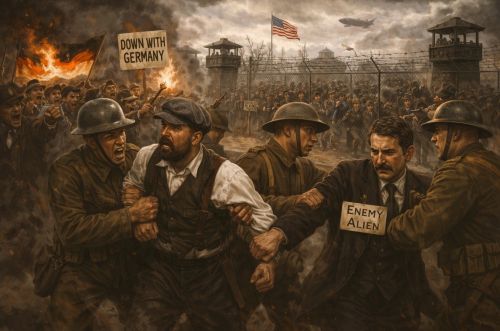
Wartime nationalism during World War I transformed German Americans from an established immigrant community into suspected internal enemies, revealing how fear can erode pluralism.

By Matthew A. McIntosh
Public Historian
Brewminate
Introduction: War, Nationalism, and the Politics of Suspicion
When the United States entered World War I in April 1917, the conflict transformed American political culture almost overnight. The declaration of war against Germany mobilized not only the nation’s military and economic resources but also its emotional and ideological energies. Wartime nationalism intensified rapidly as government officials, newspapers, civic organizations, and propaganda campaigns called upon citizens to demonstrate loyalty and unity. Public displays of patriotism multiplied, and communities across the country organized rallies, bond drives, and patriotic ceremonies designed to reinforce national solidarity. In this atmosphere, dissent and cultural difference increasingly came to be interpreted as potential threats to the war effort. The political language of loyalty, patriotism, and national security reshaped public discourse, creating conditions in which ethnic identity could become closely associated with suspicion.
German Americans occupied a particularly vulnerable position. Before the war, Americans of German descent formed one of the largest and most culturally influential immigrant communities in the United States. German-language newspapers circulated widely, ethnic associations flourished, and Lutheran and Catholic congregations maintained strong cultural ties through language and tradition. Yet once the United States entered the war against Germany, these same cultural markers began to attract suspicion. Practices that had once represented the diversity of American immigrant life were reinterpreted as signs of possible sympathy with the enemy. The rapid shift from cultural acceptance to political distrust demonstrated how quickly wartime anxieties could transform the meaning of ethnic identity.
The transformation of German-American identity during the war did not occur spontaneously. It emerged through a combination of government policy, organized propaganda, and widespread public mobilization. Federal agencies such as the Committee on Public Information produced massive propaganda campaigns designed to encourage patriotic unity and mobilize support for the war. Posters, films, newspaper articles, and public speeches portrayed Germany as an aggressive and dangerous enemy while emphasizing the moral necessity of American participation in the conflict. Within this rhetorical environment, expressions of German culture within the United States became increasingly difficult to separate from the broader political conflict unfolding overseas. Cultural traditions, language, and religious institutions associated with German communities were gradually recast as potential indicators of divided loyalty.
The experience of German Americans during World War I reveals an important dynamic within democratic societies during periods of national crisis. Wartime nationalism often generates powerful pressures toward cultural conformity and suspicion of minority communities perceived as connected to foreign adversaries. In the United States, the mobilization of public opinion and the expansion of federal authority during World War I created a climate in which ethnic and religious identity could become entangled with accusations of disloyalty. Examining this episode illustrates how propaganda, political rhetoric, and national security concerns combined to transform a long-established immigrant community into a suspected internal threat.
The patterns visible in this moment would reappear in later conflicts, demonstrating the enduring tension between national security and the protection of pluralism in American society. During times of war governments often expand their authority while citizens become more willing to tolerate restrictions on civil liberties in the name of national security. In such environments, minority communities connected by language, religion, or heritage to foreign nations can become targets of suspicion even when they have long been integrated into the national community. The wartime experience of these communities offers a revealing case study of how quickly democratic societies can reinterpret cultural diversity as a potential security risk. Understanding this transformation helps illuminate the recurring challenges faced by pluralistic societies when fear, nationalism, and political mobilization converge during moments of international conflict.
German America before the War: Assimilation and Cultural Confidence

Before the United States entered World War I, German Americans were among the most prominent and well-established immigrant communities in the country. During the nineteenth century millions of migrants from the German states settled across the United States, forming one of the largest ethnic populations in American society. By the early twentieth century, individuals of German descent constituted a significant portion of the population in regions such as the Midwest, including states like Wisconsin, Missouri, and Minnesota. German immigrants and their descendants participated actively in American political life, commerce, agriculture, and industry. Their presence had become so deeply integrated into the fabric of American society that German culture was widely regarded as a respected and influential part of the nation’s broader cultural landscape.
German-American communities maintained vibrant ethnic institutions that allowed them to preserve cultural traditions while participating fully in American civic life. German-language newspapers circulated widely in major cities and smaller towns alike, providing news from both the United States and Europe. These publications also served as important platforms for political discussion and cultural expression within immigrant communities. In addition to the press, they organized social clubs, gymnastic associations known as Turnvereins, musical societies, and mutual aid organizations that reinforced communal identity. These institutions reflected a broader pattern of immigrant association that helped newcomers adapt to American life without abandoning the cultural practices that defined their communities.
Religion played a central role in the cultural life of German America. Many German immigrants belonged to Lutheran congregations, though Catholic communities were also significant in certain regions. Churches frequently conducted services in the German language, reinforcing both religious tradition and linguistic continuity across generations. Religious institutions also served as community centers where families gathered for social events, education, and charitable activities. Through church networks they maintained strong communal bonds while simultaneously participating in the religious diversity that characterized American society.
Education provided another important foundation for German-American cultural life. In many areas, especially in the Midwest, German-language instruction existed alongside English-language education. Some communities established bilingual schools that taught both languages, reflecting a belief that cultural heritage and American citizenship could coexist without contradiction. German-language classes were also common in public schools and universities, where the study of German literature, philosophy, and science was widely respected. During the late nineteenth and early twentieth centuries Germany itself was internationally recognized as a center of academic scholarship and scientific advancement, and American educators frequently admired German intellectual traditions. German universities such as those in Berlin, Heidelberg, and Göttingen served as models for modern research institutions, and many American scholars traveled to Germany for advanced study. The influence of German educational methods helped shape the development of American graduate education and scientific research. The German language and German intellectual culture were not viewed as foreign or threatening but rather as sources of scholarly prestige and intellectual innovation within American academic life.
This combination of cultural preservation and civic participation contributed to a widespread sense of confidence within German-American communities. Ethnic identity did not appear to conflict with loyalty to the United States, and many considered themselves both proudly American and culturally German. German-language institutions flourished openly, and ethnic festivals, music, and traditions were celebrated publicly in cities and towns across the country. The visibility of these cultural expressions reflected a broader American acceptance of immigrant diversity during the decades before World War I.
The stability of German-American cultural life before 1917 illustrates how thoroughly this community had integrated into American society. German Americans had developed institutions that allowed them to preserve their heritage while contributing actively to the nation’s economic, political, and cultural development. Their language, churches, schools, and civic organizations formed a complex network that connected immigrant identity with American citizenship. Precisely because these institutions were so visible and well established, however, they would later become targets of suspicion once the United States entered the war against Germany. The confidence and cultural openness that had characterized German America before the war would soon give way to a period of intense pressure toward conformity and the suppression of ethnic identity.
The Shock of War: Propaganda, Loyalty, and Public Opinion
When the United States declared war on Germany in April 1917, the conflict required not only military mobilization but also the rapid reshaping of public opinion. The Wilson administration understood that a nation historically divided over intervention in European conflicts would need to be persuaded that participation in the war was both necessary and morally justified. In response, federal authorities launched an unprecedented campaign to mobilize public sentiment in favor of the war effort. Through speeches, publications, posters, and public events, the government and its allies encouraged Americans to interpret the conflict as a struggle between democratic liberty and authoritarian aggression. This effort transformed the war into a moral crusade and created a political climate in which expressions of doubt or cultural ambiguity could easily be interpreted as disloyalty.
Central to this campaign was the establishment of the Committee on Public Information (CPI), created in 1917 under the leadership of journalist George Creel. The CPI coordinated a massive propaganda effort that sought to shape public understanding of the war and cultivate patriotic unity. Government-sponsored pamphlets, news releases, and films emphasized German militarism and depicted the United States as a defender of democratic civilization. The agency distributed materials to newspapers across the country and produced widely circulated posters that portrayed the enemy in stark and often dehumanizing terms. Through these media campaigns the government helped construct a narrative in which loyalty to the United States was defined not only by support for the war but also by vigilance against perceived internal enemies.
The CPI also organized a nationwide network of speakers known as the Four Minute Men, volunteers who delivered brief patriotic speeches during public gatherings such as movie screenings and civic meetings. These speeches encouraged citizens to support war bonds, enlistment, and patriotic initiatives while reinforcing a sense of collective national purpose. The Four Minute Men delivered millions of speeches across the country, helping to create a shared language of patriotism that emphasized unity and vigilance. Their talks frequently emphasized themes of loyalty, sacrifice, and vigilance against those who might weaken the war effort from within. In communities where immigrant populations were visible, these speeches sometimes reinforced the idea that patriotic citizens had a responsibility to remain alert to potential signs of disloyalty. Although the official purpose of the program was to mobilize support for war policies, its broader effect was to create a cultural environment in which public demonstrations of patriotism became expected markers of civic belonging.
As propaganda campaigns intensified, public attitudes toward German culture in the United States began to shift dramatically. Cultural practices that had previously been regarded as harmless expressions of immigrant heritage were increasingly viewed through the lens of wartime suspicion. German-language newspapers came under scrutiny, and public use of the German language was sometimes criticized as evidence of divided loyalty. Churches that conducted services in German faced pressure to adopt English, while communities began to question whether ethnic institutions maintained ties to the enemy abroad. In this climate, the boundaries between cultural identity and political allegiance became increasingly blurred.
Newspapers and civic organizations often amplified these anxieties by encouraging Americans to monitor their neighbors for signs of disloyalty. Patriotic leagues and local committees urged citizens to demonstrate visible support for the war effort through public rituals, flag displays, and participation in patriotic events. Rumors and accusations circulated about individuals suspected of harboring pro-German sympathies. Although many of these claims lacked credible evidence, they contributed to a broader atmosphere in which suspicion toward German Americans became normalized within public discourse. Civic groups sometimes distributed lists of behaviors that citizens were encouraged to report, ranging from public criticism of the war to the continued use of the German language in social settings. In some communities these campaigns produced a form of informal surveillance in which neighbors, coworkers, and local organizations monitored one another’s behavior for signs of insufficient patriotism. Such pressures blurred the line between voluntary civic participation and coercive conformity.
The wartime transformation of public opinion illustrates how propaganda and political rhetoric can reshape perceptions of cultural identity during periods of national crisis. Government messaging and popular media encouraged Americans to interpret the war not only as an international conflict but also as a test of internal loyalty. Within this framework, ethnic communities connected to the enemy nation could quickly become objects of suspicion. Their experience during this period demonstrates how rapidly wartime nationalism could redefine cultural difference as a potential security threat, preparing the ground for policies and social pressures that would soon restrict the public expression of German-American identity.
Law and Surveillance: The Espionage Act and Sedition Act

The mobilization of American society for World War I was accompanied by a significant expansion of federal authority over speech, dissent, and political expression. As the United States prepared for a prolonged and demanding war effort, government officials argued that national security required strict vigilance against activities that might undermine military recruitment or weaken public support for the conflict. These concerns led Congress to pass a series of wartime laws that broadened the federal government’s ability to monitor and prosecute individuals suspected of obstructing the war effort. Among the most significant of these measures were the Espionage Act of 1917 and the Sedition Act of 1918, both of which became central instruments in the policing of loyalty during the war.
The Espionage Act, passed shortly after the United States entered the war, was designed to prevent interference with military operations and recruitment. The law criminalized actions such as providing information that could aid the enemy, obstructing military enlistment, or interfering with the draft. Although the legislation was originally framed as a measure against espionage and sabotage, its broad language allowed federal authorities to interpret dissenting speech as a potential threat to national security. Under the act, individuals who criticized the war or expressed sympathy for Germany could be investigated or prosecuted if officials believed their statements might hinder the war effort. Federal prosecutors used the law to pursue cases against political activists, labor organizers, and individuals who publicly opposed military conscription. The legislation extended the reach of federal authority beyond traditional espionage to encompass a wide range of public expression that officials believed might weaken national unity. In practice, the law created a legal environment in which criticism of government policy could be interpreted as interference with the war effort.
In 1918 Congress expanded these powers with the passage of the Sedition Act, which amended the Espionage Act by criminalizing certain forms of speech deemed disloyal or abusive toward the United States government, the Constitution, the military, or the national flag. The legislation made it illegal to publish or speak words that might undermine public confidence in the government or discourage support for the war. Critics of the law argued that its vague language allowed authorities to punish dissenting opinions rather than genuine threats to national security. Nevertheless, federal prosecutors used the Sedition Act aggressively during the final years of the war, bringing hundreds of cases against individuals accused of disloyal speech or antiwar activism.
The enforcement of these laws was supported by a growing network of federal surveillance and investigation. The Department of Justice expanded its intelligence operations, often working alongside local authorities and private patriotic organizations to identify suspected subversives. Groups such as the American Protective League, a volunteer organization that cooperated with federal investigators, conducted informal surveillance and reported individuals believed to hold pro-German sympathies or antiwar views. Members of these organizations sometimes conducted raids, monitored public meetings, and questioned individuals about their political beliefs or ethnic associations. Although they were not formal government agents, their activities were frequently tolerated or encouraged by federal officials who viewed them as useful partners in maintaining wartime vigilance. The involvement of these groups blurred the boundary between official law enforcement and private activism, contributing to a climate in which suspicion toward dissenters and ethnic minorities could easily spread through local communities.
Together, the Espionage Act and Sedition Act illustrate how wartime pressures reshaped the relationship between civil liberties and national security in the United States. In the atmosphere of patriotic mobilization that characterized the World War I home front, legal restrictions on speech and expanded surveillance were widely defended as necessary tools for protecting the nation during a moment of crisis. Yet these policies also demonstrated how easily legal frameworks designed to address external threats could be used to monitor and suppress dissent within the nation itself. The expansion of federal authority reinforced a climate in which cultural identity, language, and political expression could become objects of official suspicion.
Cultural Repression: Language, Education, and Public Expression
As wartime nationalism intensified after 1917, suspicion increasingly focused on cultural practices associated with language, education, and public expression. Institutions that had previously been viewed as ordinary features of immigrant life suddenly became objects of scrutiny. German-language newspapers, schools, churches, and cultural societies found themselves under pressure to demonstrate their loyalty to the United States. The war transformed the meaning of cultural identity by linking the German language and other symbols of heritage with the enemy nation overseas. Expressions of German culture that had long been accepted as part of American diversity began to be interpreted as signs of possible disloyalty.
One of the most immediate targets of wartime suspicion was the German-language press. Before the war, hundreds of German-language newspapers circulated throughout the United States, serving communities that had maintained linguistic ties to their immigrant heritage. These publications reported on local events, international developments, and issues relevant to German-American communities. During the war, however, federal authorities and patriotic organizations increasingly viewed foreign-language publications with suspicion. Newspapers that continued to print articles in German risked being accused of spreading pro-German sentiment or undermining public support for the war. In some cases postal regulations and informal pressure from federal officials limited the ability of these newspapers to distribute their publications freely. Editors faced public criticism and sometimes direct threats from community members who viewed the continued use of German as evidence of disloyalty. Many German-language papers closed entirely, while others shifted to English publication in an effort to avoid accusations of disloyalty. The disappearance of these newspapers marked the collapse of an important communication network that had previously connected German-American communities across the country.
Educational institutions became a focal point for efforts to suppress German cultural expression. Prior to the war, German-language instruction was common in many American schools, particularly in regions with large German-American populations. Public schools in several Midwestern states offered German courses as part of their regular curriculum, and universities maintained strong programs in the language and literature. With the onset of the war, these programs faced intense criticism. Critics argued that teaching German in American schools encouraged sympathy for the enemy or divided loyalties among students. School boards and state legislatures across the country began eliminating German-language instruction from public education.
Churches that conducted services in German were affected by wartime pressure to demonstrate loyalty. Lutheran congregations in particular faced demands to abandon German-language worship and adopt English services instead. Some congregations voluntarily adopted English services to avoid public criticism, while others faced direct pressure from local authorities or community activists. Religious leaders found themselves navigating a delicate balance between preserving their congregations’ cultural traditions and responding to accusations that German-language worship reflected political disloyalty. In many communities church leaders issued statements affirming their loyalty to the United States and that their congregations supported the war effort. Congregations sometimes altered hymnals, sermons, and church publications to emphasize English-language communication and patriotic themes. These changes reflected genuine expressions of national loyalty as well as pragmatic responses to the intense scrutiny directed toward institutions associated with German culture. The war accelerated a transition toward English-language services that might otherwise have occurred gradually over several generations.
Cultural symbols associated with Germany became targets of public hostility. German street names were changed, music was temporarily removed from concert programs, and businesses with German names sometimes altered their branding to avoid harassment. Popular culture participated in this transformation. Foods associated with German cuisine were renamed with patriotic labels, and public celebrations of German heritage were discouraged or abandoned. These symbolic acts reflected pressure placed on them to distance themselves visibly from the culture of the enemy nation.
The suppression of German language during World War I illustrates how wartime nationalism can reshape public attitudes toward cultural diversity. In a society that had previously accommodated immigrant languages and traditions, the pressures of war encouraged conformity to a narrow definition of national identity. For many, the safest response was to abandon visible expressions of culture and adopt English language and American symbols as quickly as possible. The result was a dramatic contraction of cultural institutions that had flourished for decades before the war, leaving lasting effects on the cultural landscape of the United States.
Violence, Vigilantism, and Social Pressure
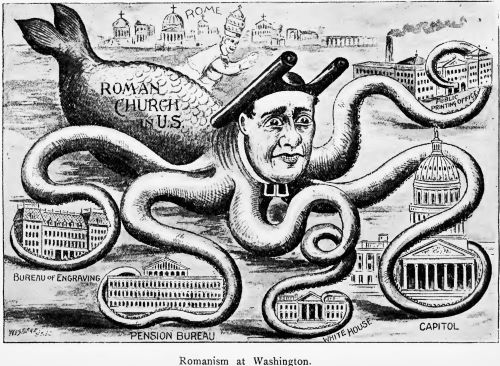
While legal measures and cultural suppression reshaped the public life of German Americans during World War I, informal violence and vigilantism also played a powerful role in enforcing conformity. Wartime propaganda and nationalist rhetoric helped create an atmosphere in which private citizens felt justified in policing the loyalty of their neighbors. Patriotic organizations, local committees, and self-appointed guardians of Americanism monitored public behavior and sometimes took direct action against individuals suspected of sympathizing with Germany. These acts ranged from social intimidation to physical violence, demonstrating how wartime fear could erode the boundary between civic participation and mob coercion.
Organizations such as the American Protective League (APL) helped legitimize this culture of surveillance. Although technically a private organization, the APL operated with the encouragement of federal authorities and cooperated closely with the Department of Justice. Founded in 1917, the league rapidly expanded into a nationwide network of volunteers who claimed to assist federal investigators in identifying threats to national security. Its members conducted unofficial investigations, monitored suspected disloyal individuals, and organized “slacker raids” intended to identify men who had allegedly avoided military service. These raids often involved the detention and questioning of hundreds of men in public places such as factories, streetcars, or workplaces. Participants frequently lacked legal authority to carry out such actions, yet the atmosphere of wartime patriotism provided them with a sense of legitimacy. While the organization claimed to protect national security, its activities often blurred the line between lawful authority and extralegal intimidation. People perceived as insufficiently patriotic sometimes found themselves subject to questioning, public humiliation, or community suspicion, even when no credible evidence of disloyalty existed.
Vigilante violence represented the most extreme expression of wartime hostility toward German Americans. In several well-known incidents, individuals accused of pro-German sympathies were attacked by mobs seeking to demonstrate their patriotic zeal. The most infamous case occurred in 1918 in Collinsville, Illinois, where Robert Prager, a German-born coal miner, was lynched by a crowd that accused him of disloyalty. Although Prager had publicly expressed support for the United States and even attempted to enlist in the American military, rumors about his background and political views spread rapidly through the community. A mob seized him, paraded him through the streets wrapped in an American flag, and eventually murdered him. The perpetrators were later acquitted, a verdict that reflected the powerful influence of wartime nationalism on public opinion and the judicial process.
Beyond such dramatic acts of violence, they also faced widespread social pressure to demonstrate loyalty. Communities organized public ceremonies in which individuals were expected to purchase war bonds, participate in patriotic rallies, or publicly condemn the German government. Refusal to participate in these rituals could lead to accusations of disloyalty or social ostracism. Employers sometimes dismissed workers suspected of harboring pro-German sentiments, while neighbors and community leaders monitored everyday behavior for signs of insufficient patriotism. The resulting climate encouraged individuals to perform visible expressions of loyalty to avoid suspicion.
Public humiliation also served as a tool for enforcing conformity. Individuals accused of disloyalty were sometimes forced to kiss the American flag, sing patriotic songs, or participate in parades designed to demonstrate their allegiance to the nation. In some communities, suspected “disloyalists” were compelled to purchase war bonds or contribute publicly to patriotic fundraising campaigns as proof of their loyalty. Those who refused could face harassment, boycotts of their businesses, or exclusion from community institutions. Such spectacles blurred the line between patriotic celebration and coercive ritual. The goal was not simply to punish individuals but to send a broader message to immigrant communities that visible displays of American identity were necessary for social acceptance during wartime. These acts of humiliation reinforced the broader transformation of ethnic identity into a potential marker of political suspicion and created powerful incentives for rapid cultural assimilation.
Violence, vigilantism, and social pressure created a powerful informal system of enforcement that operated alongside formal government policies. Even when individuals were not directly targeted by legal measures such as the Espionage Act or Sedition Act, the threat of social reprisal encouraged rapid assimilation and the abandonment of visible German cultural practices. The experience of German Americans during World War I demonstrates how wartime fear can mobilize not only state power but also popular participation in the policing of national loyalty. In such moments, communities themselves can become agents of repression, enforcing ideological conformity through intimidation and violence.
Internment and the State: German Nationals in Wartime Camps
Although public hostility and vigilante intimidation played an important role in shaping the wartime experiences, the federal government also implemented formal policies directed at German nationals living within the United States. After the declaration of war in April 1917, the Wilson administration classified German citizens residing in the country as “enemy aliens.” This designation placed them under special surveillance and subjected them to legal restrictions on travel, communication, and employment. While most were citizens and not subject to internment, thousands of German nationals found themselves under suspicion simply because of their legal status. The resulting system of detention camps reflected broader wartime concerns about espionage, sabotage, and national security. Federal officials argued that the extraordinary conditions of global war required heightened vigilance against potential internal threats, particularly in a country with millions of residents who had been born in enemy nations. Even when concrete evidence of wrongdoing was limited or nonexistent, the mere possibility that enemy agents might exploit immigrant networks contributed to a climate in which preventive detention appeared to many policymakers as a necessary precaution.
The legal framework for these policies drew on long-standing wartime statutes. The Alien Enemies Act of 1798 allowed the federal government to regulate and detain citizens of enemy nations during periods of armed conflict. When the United States entered the First World War, federal authorities revived these powers and issued new regulations governing the behavior of German nationals. Enemy aliens were required to register with the government, carry identification papers, and report changes of residence. They could be prohibited from entering certain restricted zones, particularly near military installations, transportation hubs, or coastal areas considered strategically sensitive. Although many of these regulations were framed as precautionary measures, they reinforced the perception that German nationals constituted a potential internal threat.
Federal authorities established several internment camps to detain individuals considered especially suspicious or dangerous. The largest and most well-known facility was located at Fort Oglethorpe in Georgia, where hundreds of German nationals were held during the war. Other camps operated at locations such as Fort Douglas in Utah and Fort McPherson in Georgia. The detainees included merchant sailors captured from German ships, civilians accused of espionage or sabotage, and individuals whose political views or personal associations raised suspicion among federal investigators. In many cases, the evidence against these individuals was limited or ambiguous, reflecting the difficulty of distinguishing genuine security threats from rumors or patriotic anxieties.
Life within the internment camps varied considerably depending on the location and circumstances of detention. Prisoners were generally housed in military facilities under guard and subject to strict regulations governing movement and communication. Some camps allowed internees to organize cultural activities, educational programs, and recreational events to maintain morale during long periods of confinement. Nevertheless, the experience of detention imposed significant psychological strain. Many internees had lived peacefully in the United States for years and struggled to understand why they had suddenly become objects of suspicion. Families were often separated, with breadwinners detained while spouses and children attempted to navigate uncertain economic circumstances outside the camps. Correspondence between prisoners and relatives was monitored, reinforcing the sense that detainees were living under constant scrutiny. The camps served not only as instruments of security policy but also as powerful symbols of wartime distrust and the fragile boundaries of belonging within a society at war.
The scale of German internment during World War I remained relatively limited compared with later wartime detention programs, particularly the mass incarceration of Japanese Americans during the Second World War. Only several thousand German nationals were ultimately interned, and most German Americans who held citizenship were not subject to detention. Even so, the existence of the camps reflected a broader transformation in the relationship between the state and immigrant communities during wartime. Government officials increasingly treated ethnic identity and national origin as indicators of potential political loyalty or disloyalty, blurring the distinction between foreign nationality and cultural heritage.
The internment of German nationals during World War I demonstrates how the machinery of the modern state could be mobilized in response to wartime fears about internal enemies. While federal officials justified these measures as necessary precautions against espionage and sabotage, the policies also reflected the climate of suspicion that permeated American society during the war. The detention camps formed part of a larger system of surveillance, propaganda, and social pressure that encouraged immigrants to demonstrate their loyalty to the United States in visible and unmistakable ways. The experience of German nationals during the First World War foreshadowed later episodes in which wartime nationalism reshaped the boundaries of citizenship, belonging, and political trust.
The Transformation of German-American Identity
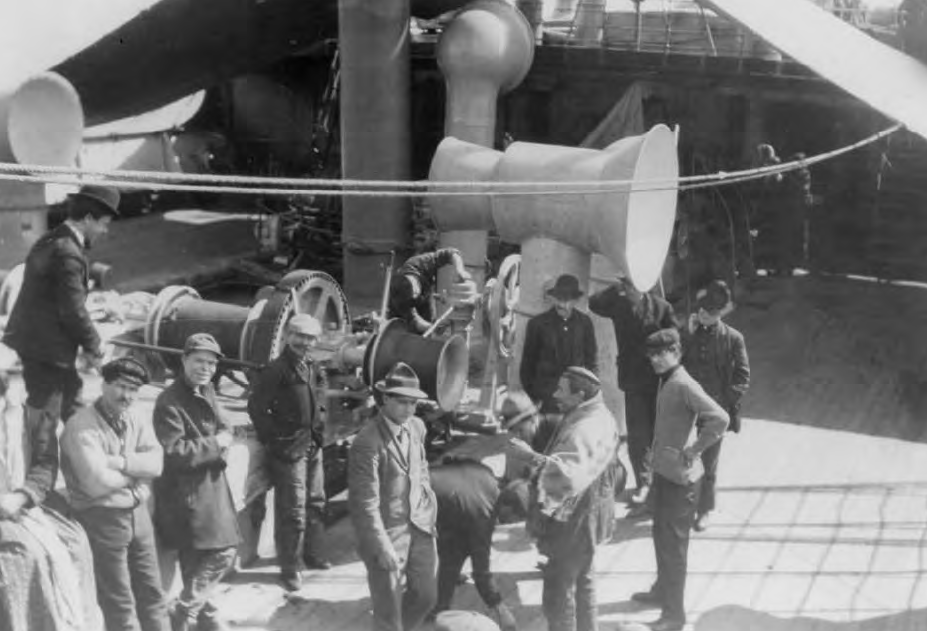
The wartime pressures experienced by these communities during World War I produced profound changes in the public expression of ethnic identity. Communities that had long maintained strong cultural institutions suddenly faced an environment in which the visible preservation of German language and traditions could invite suspicion. In response, many adopted strategies of rapid assimilation designed to demonstrate loyalty to the United States. Public celebrations of German heritage declined, German-language publications disappeared, and ethnic associations reoriented their activities toward overtly patriotic causes. The war did not eliminate German-American identity altogether, but it fundamentally altered the ways in which that identity could be expressed in public life.
Language represented one of the most visible markers of this transformation. Prior to the war, German was the most widely spoken immigrant language in the United States, and bilingualism had been common in many communities across the Midwest, Texas, and other regions with large German populations. German-language schools, church services, newspapers, and social clubs reinforced this linguistic environment, allowing immigrants to maintain cultural continuity while participating in American economic and political life. The wartime backlash against the German language accelerated a shift toward English that had already begun among younger generations. Parents increasingly encouraged children to speak English at home and in public to avoid attracting suspicion or harassment. In many families the deliberate abandonment of German became a conscious strategy to protect social standing and economic security. Churches, schools, and social organizations gradually abandoned German-language programming, often under pressure from local authorities or community expectations. The war marked a turning point in linguistic assimilation, contributing to the rapid decline of German as a community language in the United States and reshaping the cultural transmission of heritage across generations.
Cultural institutions also underwent significant restructuring during and after the war. German-American clubs, singing societies, and social organizations had previously played an important role in maintaining ethnic solidarity and preserving connections to European traditions. During the war, many of these groups either dissolved or deliberately redefined their missions. Some organizations adopted English-language names, while others shifted their focus toward explicitly American civic activities such as war bond drives and charitable work for soldiers. By aligning themselves publicly with patriotic causes, these institutions sought to counter accusations that ethnic associations encouraged divided loyalties.
The transformation of German-American identity was also shaped by generational dynamics. Younger people who had grown up in the United States often adapted more quickly to the pressures of wartime nationalism than their immigrant parents. For these individuals, participation in American civic life, military service, and patriotic rituals offered opportunities to assert belonging within the national community. Military enlistment in particular became a powerful demonstration of loyalty. Thousands of men of German descent served in the United States armed forces during the war, and communities frequently highlighted their service as evidence that German heritage did not equate to political sympathy for Germany. Participation in wartime mobilization, including Liberty Loan campaigns and local patriotic organizations, also provided opportunities for younger immigrants to publicly affirm their identification with the United States. These experiences accelerated generational shifts in identity, encouraging many individuals to embrace a more explicitly American self-understanding while gradually distancing themselves from older forms of ethnic cultural expression.
By the end of the war, the cumulative effects of repression, assimilation, and generational change had significantly reshaped German-American identity. Although individuals of German descent remained a large and influential segment of the American population, the distinct cultural institutions that had once defined German-American life had weakened considerably. In many cases, the pressures of wartime suspicion accelerated processes of assimilation that might otherwise have unfolded gradually over several decades. The First World War marked a critical moment in the history of German-American communities, demonstrating how international conflict and nationalist politics could transform the boundaries of ethnic identity within the United States.
Historical Patterns: Wartime Fear and Minority Suspicion
The experience of German Americans during World War I illustrates a broader historical pattern in which periods of war or geopolitical crisis intensify suspicion toward minority populations associated with foreign powers. When nations mobilize for conflict, governments and citizens alike often seek clear boundaries between loyalty and disloyalty. In such circumstances, cultural identity, religion, language, or ancestry can become markers used to identify potential internal enemies. These dynamics rarely arise solely from government policy. Instead, they develop through a combination of official action, media rhetoric, and popular participation that collectively transform social attitudes toward minority communities.
Throughout history, governments have frequently justified restrictions on minority groups by framing them as necessary responses to national security threats. Wartime propaganda encourages the public to view foreign adversaries as existential dangers, and this portrayal can extend suspicion toward individuals perceived as culturally connected to the enemy. The result is a powerful tendency to conflate ethnic identity with political allegiance. In the United States during World War I, they became targets of suspicion not primarily because of demonstrable acts of espionage or sabotage, but because their cultural heritage was associated with the nation against which the United States was fighting. This dynamic reflected a broader logic in which symbolic connections to a foreign power could be interpreted as evidence of divided loyalty. Even long-established immigrant communities could suddenly be viewed through the lens of national security anxiety, particularly when political leaders and media outlets emphasized the threat posed by the enemy nation. Under such conditions, cultural markers such as language, religion, and ethnic institutions were easily recast as indicators of political allegiance rather than expressions of heritage.
This pattern reflects a deeper tension within pluralistic societies during moments of crisis. Democratic states often celebrate diversity and individual liberty in times of peace, yet those same principles can come under strain when national survival appears to be at stake. Under such conditions, governments may adopt policies that prioritize unity and conformity over civil liberties. Legal frameworks designed to protect free expression and cultural diversity may be reinterpreted or temporarily suspended in the name of national security. Social pressure can reinforce these policies by encouraging citizens to monitor and discipline their neighbors. Communities may develop informal expectations that individuals demonstrate their loyalty through visible acts of patriotism, such as participation in rallies, military service, or public denunciations of the enemy. The boundary between legitimate concern for national security and unjustified suspicion toward minority communities becomes increasingly difficult to maintain when political rhetoric and wartime mobilization emphasize unity as a moral obligation.
Historical comparisons reveal that the treatment of German Americans during the First World War formed part of a recurring cycle of suspicion directed at immigrant populations in the United States. Earlier episodes of anti-Catholic nativism in the nineteenth century and later events such as the internment of Japanese Americans during World War II demonstrate how quickly wartime fear can reshape public perceptions of loyalty. In each case, cultural or religious differences became linked to geopolitical rivalries, producing narratives that portrayed minority communities as potential threats to national security.
These episodes also illustrate the role of political rhetoric and media narratives in amplifying public anxiety. Wartime propaganda, patriotic campaigns, and sensational reporting often reinforce simplified images of the enemy that leave little room for recognizing the complexity of immigrant identities. Newspapers, political speeches, and public messaging campaigns frequently portrayed the enemy nation as morally corrupt or fundamentally incompatible with national values. When such narratives dominate public discourse, individuals associated with the enemy’s culture may become convenient symbols of the perceived threat. Even communities with long histories of residence and participation in national life can find their loyalty questioned under such circumstances. The resulting atmosphere encourages suspicion not only toward individuals but toward entire cultural communities, reinforcing social divisions that can persist long after the war itself has ended.
Understanding these patterns provides valuable insight into the relationship between war, nationalism, and minority rights. Suspicion toward minority communities does not arise solely from genuine security concerns. It also reflects broader social dynamics in which fear, propaganda, and political rhetoric reshape perceptions of belonging. By examining these historical patterns, scholars can better understand how societies negotiate the tension between national security and the protection of civil liberties during moments of crisis.
Conclusion: Wartime Nationalism and the Fragility of Pluralism
The experience of German Americans during World War I reveals how quickly the boundaries of national belonging can shift during moments of international crisis. Communities that had lived in the United States for generations suddenly found their cultural heritage interpreted as a potential sign of political disloyalty. Wartime propaganda, government surveillance, and popular vigilantism collectively transformed German identity from a familiar element of American diversity into a perceived national security concern. The resulting climate of suspicion reshaped everyday life for millions of people, demonstrating how fragile the acceptance of cultural pluralism could become under the pressures of war.
The episode also illustrates how wartime nationalism encourages societies to redefine loyalty in increasingly narrow terms. In times of peace, the United States had often celebrated its identity as a nation of immigrants, where diverse cultural traditions could coexist within a shared political framework. During the war, however, public expectations shifted toward visible demonstrations of conformity and patriotic enthusiasm. Those who had once maintained bilingual communities, ethnic organizations, and cultural institutions faced strong incentives to abandon these traditions in favor of rapid assimilation. The transformation was not simply the result of government policy but also of social pressure, as communities themselves enforced expectations about what it meant to be “fully American.”
The consequences of this wartime environment extended well beyond the end of the conflict in 1918. Many German-language institutions never recovered, and the dramatic decline of German as a widely spoken language in the United States accelerated during this period. Cultural organizations that had once celebrated German heritage either disappeared or reinvented themselves in ways that emphasized American identity over ethnic continuity. The war marked a decisive turning point in the history of one of the largest immigrant groups in the country, reshaping patterns of assimilation that had developed gradually throughout the nineteenth century. In many regions where German communities had once maintained dense networks of newspapers, schools, churches, and cultural associations, these institutions faded rapidly in the postwar years. The pressure to avoid public identification with Germany remained strong even after the armistice, encouraging families to abandon older forms of cultural expression in favor of a more exclusively American public identity. This transformation contributed to the erosion of collective memory within German-American communities, as later generations grew up with fewer institutional connections to the language and traditions that had once defined immigrant life.
Viewed in a broader historical perspective, the wartime treatment of German Americans highlights a recurring challenge faced by pluralistic societies. Periods of geopolitical conflict often generate intense pressure to define the nation in unified and exclusive terms, leaving little room for the complexities of immigrant identity. The First World War demonstrates how quickly suspicion toward minority communities can emerge when national security concerns intersect with cultural difference. Understanding this history underscores the importance of safeguarding civil liberties and cultural pluralism even during moments of crisis, when the temptation to equate diversity with disloyalty becomes particularly strong.
Bibliography
- Capozzola, Christopher. Uncle Sam Wants You: World War I and the Making of the Modern American Citizen. Oxford: Oxford University Press, 2008.
- Conzen, Kathleen Neils. Immigrant Milwaukee, 1836–1860: Accommodation and Community in a Frontier City. Cambridge: Harvard University Press, 1976.
- Creel, George. How We Advertised America: The First Telling of the Amazing Story of the Committee on Public Information. New York: Harper & Brothers, 1920.
- Faust, Albert Bernhardt. The German Element in the United States. Boston: Houghton Mifflin, 1909.
- Kazal, Russell A. Becoming Old Stock: The Paradox of German-American Identity. Princeton: Princeton University Press, 2004.
- Kennedy, David M. Over Here: The First World War and American Society. Oxford: Oxford University Press, 1980.
- Krammer, Arnold. Undue Process: The Untold Story of America’s German Alien Internees. Lanham, MD: Rowman & Littlefield, 1997.
- Luebke, Frederick C. Bonds of Loyalty: German-Americans and World War I. DeKalb: Northern Illinois University Press, 1974.
- Mock, James R., and Cedric Larson. Words That Won the War: The Story of the Committee on Public Information. Princeton: Princeton University Press, 1939.
- Ngai, Mae M. Impossible Subjects: Illegal Aliens and the Making of Modern America. Princeton: Princeton University Press, 2004.
- Nolt, Steven M. Foreigners in Their Own Land: Pennsylvania Germans in the Early Republic. University Park: Pennsylvania State University Press, 2002.
- Stone, Geoffrey R. Perilous Times: Free Speech in Wartime from the Sedition Act of 1798 to the War on Terrorism. New York: W. W. Norton, 2004.
- U.S. Committee on Public Information. How the War Came to America. Washington, DC: Government Printing Office, 1917.
- U.S. Congress. Espionage Act of 1917, Public Law 65–24 and Sedition Act of 1918, Public Law 65–150.
- Wilcox, Clifford. “World War I and the Attack on Professors of German at the University of Michigan.” History of Education Quarterly 33:1 (1993), 59-84.
- Wittke, Carl. “American Germans in Two World Wars.” The Wisconsin Magazine of History 27:1 (1943), 6-16.
Originally published by Brewminate, 03.20.2026, under the terms of a Creative Commons Attribution-NonCommercial-NoDerivatives 4.0 International license.
About the Author