

By Dr. Noémie Beck / 12.04.2009
Professor of Irish Studies
Concordia University
Introduction
Irish mythology and Gallo-British archaeology are clearly evocative of a worship rendered to the Earth and Nature. The Irish legends illustrate the concept of an otherworld realm, called sídh, situated beneath the earth, the mountains or water.599 The Lebor Gabála Érenn [‘The Book of Invasions’] relates that the Tuatha Dé Danann, after being defeated by the mortal Son of Míl, retreated beneath the earth and dwelt in ancient cairns and tumulus*.600 From that time on, the world was divided in two: human beings inhabited the surface of the earth, while gods and goddesses lived in the Underworld. This explains why caves, hills, springs, lakes and rivers were regarded as entrances or doors towards the supernatural world. In Gaul and Britain, votive offering wells, generally excavated on religious centres, may be a reflection of such a concept.
Iron Age sanctuaries were generally surrounded by a ditch and enclosed by a fence, in the middle of which a pit or ‘hollow altar’ was dug. The pits could be a rectangular, circular, oval or indefinite shape. Their width could vary from 1 to 5 metres and their depth from 1 to 3 metres.601 Archaeological evidence reveals that those concave altars served for the deposit of food offerings, which were part of a whole complex of religious rites. The digging of a well was a concrete way to reach and make contact with the gods and goddesses, who were believed to dwell beneath the ground. Such sacred cavities are found in the 3rd/2nd-century BC sanctuary of Gournay-sur-Aronde (Oise), where entire bovids were left to decompose in nine pits situated in the heart of the enclosure, and in the polygonal enclosure of the 3rd c. BC sanctuary of Ribemont-sur-Ancre (Somme), which had a pit filled in with carcasses of domestic animals in its centre. The most significant example of this type is undoubtedly the 3rd c. BC open-air oval ditched enclosure of Libenice (Czech Republic), which covers a surface of 1600 m2 and has an impressive 2-metre deep subterranean edifice of 11×8 metres, composed of two oval rooms, in its south-east part (fig. 1).602 This sacrificial pit could be reached by means of a sort of banister or stairs flanked by two walls. The presence in the first cavity of bones of breeding and domestic animals, such as bulls, pigs, sheep, goats and dogs, points to a cult rendered to a pastoral, agrarian and chthonian* deity. Some parts of the sacrificed animals were roasted and eaten in the enclosure, while the non-comestible rest were deposited in the pit and left to rot so as to feed the deity, ensuring the fertility of the ground, and pay homage to her.603 An iron ploughshare, interred at the bottom of a votive post in the 4th-2nd c. BC ditched circular enclosure of Frilford, Berkshire (Oxfordshire, GB), may be also indicative of a fertility cult rendered to an earth deity.604
The offering wells of those Iron Age sanctuaries provide proof of a cult devoted to deities of fertility. Carcasses of animals were dedicated to them and left to decompose in the earth in gratitude of their presents. This rite was also a way of ensuring the future fertility of the land. As the Celts did not write, inscriptions identifying those deities of prosperity cannot be found. As a consequence, the deities invoked remain anonymous. With regard to the various mythologies of the world, it is clear that fertility is mainly achieved and watched over by female deities.605 The goddess is actually the archetype of prosperity. This can be explained by the fact that the land has been regarded as a divine mother who nurtures her people since time immemorial. The characters of the Matres and Matronae, widely evidenced in the epigraphy and iconography of Britain and the Continent, significantly illustrate the tradition of ‘Mother-Goddesses’ feeding and protecting the human race. The babies and horns of plenty they hold in their arms also evidence such a role. As demonstrated in Chapter 1, the cult of the Matres particularly flourished in Gallo-Roman times and probably replaced ancient Celtic goddesses of abundance in certain areas. What evidence is there in Irish medieval literature and Gallo-British archaeology of specific goddesses embodying the Earth and purveying fertility? Who were they? What were their functions and how were they honoured?

The first part of this chapter will be devoted to goddesses personifying the land and possessing agrarian features, such as Irish Ériu, Macha, Tailtiu – all of earlier Celtic derivation – and Gaulish Litavi and Nantosuelta. The second part will then analyze the literary, epigraphic, etymological and iconographical data proving the existence of goddesses purveying natural riches, such as Irish Mór Muman and Danu, and Gaulish Rosmerta, Cantismerta and Atesmerta. The third part will examine the essence of goddesses attached to specific natural elements, such as animals, trees or mountains – the rivers and springs will be studied in the following chapter. Existing theories concerning the existence or nature of some goddesses, such as Gaulish Arduinna, who is universally understood as a woodland boar goddess, or Irish Flidais, who is generally said to be a woodland deer goddess, will also be considered.
The Goddesses as the Embodiment of the Land
Gaulish Litavi (‘the Earth’)
In Gaul, there are five inscriptions from Mâlain and Aignay-le-Duc (Côte d’Or), in the territory of the Lingones, dedicated to a goddess called Litavi, whose name in Gaulish literally signifies ‘Earth’, meaning: ‘the Vast One, the Broad One’.606 Rudolf Thurneysen has demonstrated that Litavi’s name was similar to that of the Indian goddess of the Earth Prthvī, Prthivī, ‘Earth’ in Sanskrit.607 The ancient names designating Brittany or Armorica, i.e. Welsh Llydaw, Old Breton Letau, Old Irish Letha and the Latinized form Letavia, all come from a Celtic *Litavia, ‘the Earth par excellence’, ‘the Country’.608 As for Le Bohec, he proposes to gloss Litavi’s name as ‘the door towards the otherworld’, but he does not explain this etymology*.609
The first inscription discovered in Mâlain reads: Marti Cicolluis et Litavi […], ‘To Mars Cicolluis and to Litavi (…)’.610 Another dedication, dating from the 2nd c. AD, was found there: [Marti Cicollui] e[t] Li[t]a[vi] Cresce[ns ?] Sen(n)i(i) M[ar]tialis [fil(ius)] [v(otum) s(olvit) l(ibens) m(erito) ?],‘To Mars Cicolluis and to Litavi, Crescens (?), son of Sennius Martialis, paid his vow willingly and deservedly (?)’.611 Crescens and Martialis are Latin cognomina*, while Sennius is a Latinized gentilice* of Celtic origin.612 Another altar, dating from the 2nd c. AD, was found at a place known as ‘En Magnotte’ in Mâlain in 1884: [Ma]rti Ci[co]llui et Litavi L. Mattius Aeternus Ex voto, ‘To Mars Cicolluis and to Litavi, L. Mattius Aeternus (offered this monument) after making a vow’.613 The dedicator bears the tria nomina of Roman citizens, but his gentilice* Mattius may be of Celtic origin.614 An inscription engraved on a monument, probably dating from the 2nd c. AD, was discovered in 1637, in the cemetery of ‘Sous la croix dressée’ in Mâlain: [Marti Cicolluis] et Litavi ex voto suscepto v(otum) s(olvit) l(ibens) m(erito), ‘To Mars Cicolluis and to Litavi, having made a vow, paid his vow willingly and deservedly’.615 The dedicator is anonymous, unless his name was written at the beginning of the inscription, but this is highly unlikely, for this practice was uncommon. Finally, an altar in yellow limestone, dating from the end of 2nd c. or the beginning of 3rd c. AD, was found in re-employment* in the cemetery at Aignay-le-Duc: Aug(ustis) sac(rum) deo Marti Cicolluis et Litavi P. Attius Paterc[l]u[s] [v(otum) s(olvit) l(ibens) m(erito)], ‘Sacred to the August deities, to the god Mars Cicolluis and to Litavi, P. Attius Paterculus paid his vow willingly and deservedly’.616 The dedicator bears the tria nomina of Roman citizens. His gentilice*Attius and cognomen*Paternus are Latin.617 It is worth noting that Attius is also attested as a Celtic name in other parts of Gaul.618
As the dedications show, Litavi is always partnered with Mars Cicolluis, whose epithet, attested in other inscriptions from Mâlain, Xanten (Germany) and Dijon (Côte d’Or), might mean the ‘Fierce Striker’ or the ‘Very Muscular’.619 Four of the inscriptions being discovered in Mâlain, it can be induced that this city was the chief place of worship of the divine couple. Interestingly, Mars Cicolluis is associated with the Roman goddess Bellona in a dedication from Mâlain: [Mar]ti Cic[ollui] [e]t Bell[onae], ‘To Mars Cicolluis and to Bellona’.620 From this, it can be deduced that Litavi was assimilated to Bellona in Gallo-Roman times.621 In Roman mythology, Bellona is the personification of war, as her name derived from bellum, ‘war’ indicates. According to various traditions, Bellona is the sister, daughter or wife of the Roman war god Mars.622 She escorts him on the battlefield, takes part in the fighting and enjoys the carnage. She is often represented brandishing a spear or sword in her hand, wearing a helmet and driving Mars’s cart. Bellona is similar to the Greek goddess Ényo, the messenger of Ares who delights in hearing the screams and pain of the wounded or dying warriors.623 The lack of information does not enable us to affirm that Litavi is a goddess related to war. The association of Mars Cicolluis and Bellona could be due to the fact that Cicolluis was certainly a war god as his name tends to prove.
Another interesting Celtic epithet related to Litavi is that of Apollo Cobledulitavus, mentioned in a single inscription from Périgueux (Dordogne): Deo Apollini Cobledulitavo, ‘To the god Apollo Cobledulitavus’.624 According to Delamarre, his byname* can be broken down as Cob-ledu-litavus (*Com-lēdu-litavus), with com, ‘with’, ledu, of unknown significance, and litavus, ‘earth’.625 As for Olmsted, he less convincingly proposes to gloss his name as ‘With Great Feasts’.626
As her name evidences, Litavi is the embodiment of the Earth par excellence. This aspect is greatly illustrated in Irish medieval literature, which portrays a trio of goddesses incarnating the isle of Ireland and bearing names directly referring to the land: Ériu, Banba and Fótla.
The Isle of Ireland: Ériu, Banba and Fótla
The earlier designation of Ireland, Ériu, the anglicised form of which is Éire, dative Éirinn, genitive Éireann, derives from a Celtic form *Iveriu, signifying ‘land’.627 It is equated with Old Irish íriu, genitive írenn, meaning ‘land’ or ‘ground’, which was certainly the primary form of Ériu. The designation is already attested in Antiquity, for Greek writers used the word Iernē, e.g. Strabo (Ίέρνη), and later Iwernia, e.g. Ptolemy (Ίουερνία), to refer to Ireland.628 Moreover, the term Érainn ‘land-dwellers’, which is related to Ériu and is similar to Ptolemy’s Iverni (Ίoύερνοι),629 was used to designate several Celtic tribes living on the isle and more particularly in the south.630
From Ériu, Thomas O’Rahilly reconstructs the goddess name *Ēvernā or *Ēveriū. He maintains that Ériu is a Sun Goddess whose name must be understood as ‘the one who travels regularly, who moves in a customary course’, that is ‘the Regular Traveller’,631 an etymology* which is rejected by Osborn Bergin.632 O’Rahilly’s theory is all the more unlikely asÉriu does not bear any solar imagery in the literature.633 She is never described wearing circlets or rings inferring a connection with the sun or the moon. It is actually her lover, the Formorian king Elatha (‘Art’ or ‘Science’), who is portrayed in Cath Maige Tuired with golden-yellow hair, wearing five golden ‘wheels’ on his neck and travelling across the sea in a vessel of silver, possibly standing for the barque of the sun.634 These attributes may evidence that Elatha is the embodiment of the Sun. Moreover, in the Lebor Gabála Érenn [‘The Book of Invasions’], Ériu is partnered with a warrior-king, who may be the personification of the sun, since his name Mac Gréine signifies (‘Son of the Sun’).635 The imagery of those accounts tends to illustrate the archaic belief in the union of the Land-Goddess with the Sun God symbolizing the eternal cycle of Nature: the sun indeed fertilizes and grows the fields.636 As the following account exemplifies,Ériu is therefore not a sun-goddess but an earth-goddess par excellence.
In verse, Ireland is generally called by two other poetic names: Banba, originally Banbha meaning ‘[place of] women’s death’, and Fódla, earlier form Fótla, signifying ‘Swarded One’.637 As their names point out, they personify the land of Ireland. Banba may have primarily been the sovereign land-goddess of south Leinster and the plain of Meath, for old place names are reminiscent of her name in those areas.638 The Lebor Gabála Érenn [‘The Book of Invasions’] stages Ériu, Banba, Fótla as a trio of queen-goddesses, respectively married to the three Kings of the Tuatha Dé Danann, Mac Gréine (‘Son of the Sun’), Mac Cuill (‘Son of Hazel’) and Mac Cécht(‘Son of the Plough’), whose names reflect ancient solar, natural and agrarian functions completing the earth aspect of the goddesses.639
‘Trī meic Cermada Milbeōil meic Eachach Ollathair .i. Mac Cuill 7 Mac Cecht 7 Mac Grēine: .i. Mac Cuill, coll a dea 7 Ethur a ainm 7 Banba a ben ; Mac Cecht īarom, cecht a dea, Tethur a ainm, Fotla a ben ; Mac Grēne didiu, grīan a dea, Cethur a ainm, Hēriu a ben.
The three sons of Cermat Milbel s. Eochu Ollathair were Mac Cuill, Mac Cecht, Mac Grene. Mac Cuill, the hazel god, Ethur his name, Banba his wife: Mac Cecht thereafter, the ploughshare his god, Tethur his name, Fotla his wife: Mac Greine further, the sun his god, Cethur his name, Eriu his wife.640 ’
The Lebor Gabála Érenn [‘The Book of Invasions’] recounts that, after the defeat of the Tuatha Dé Danann by the human Sons of Míl, the three goddesses personifying the island met the three Kings and accepted their sovereignty, provided that their name would be on the island from that time on. Ériu met the Kings at Uisneach (Ushnagh, in County Westmeath), the ritual centre of Ireland, Banba at Sliabh Mis (Slieve Mish, County Kerry) and Fótla at Sliabh Eibhlinne (Slieve Felim, east County Limerick). This legend is obviously a medieval dramatization, but it illustrates the ancient belief of the land envisaged as a goddess:
‘Imacallsat Meic Mīled i Slēib Mis 7 Banba. Asbert Banba friu: Mās do gabāil hĒrenn tāncabair nīr bo chōir in sēn i tāncabair. Is dō ēcin, ol Amairgen Glūngel, in fili. Ascaid damsa ūaib dana, ol sī. Cia ascid, or siat. M’ainm for in innsi seo or sī. Caidhi t’ainm? or iat. Banba, or sī. Bīd ainm dond indsi seo, ol Amairgen.
The sons of Míl had colloquy with Banba in Sliab Mis. Said Banba unto them: If it be to take Ireland ye have come, not right were the good-fortune in which ye have come. It is by necessity, said Amorgen Gluingel, the poet. A gift from you to me then, said she. What gift? said they. That my name may be on this island, said she. Let it be a name for this island, said Armorgen.
Acallsat Fotla in Eblinniu. Atbert a cētna friu, 7 cuinchid a hainm for in n-insi. Atbert Amairgen: Bud ainm dond insi seo, Fotla.
They had colloquy with Fotla in Eblinne. She spake with them in like manner, and desired that her name should be upon the island. Said Amorgen: Let Fotla be a name upon this island.
Acallsat hĒrind in Uisniuch. Asbert friu: A ōcu, or sī, is mochen dūib; cian ōtā oc fāidib far tuidecht. Bud lib co brāth ind insi seo, 7 nī bia co airther in domuin inis bus ferr. Nī bia ciniud bas chomlāniu inda for [c]ciniud-si. Is maith sen, ol Amairgen; is maith ind fāstine. Nī ria bud maith a buide, ol Ēber Donn, sinser Mac Mīled, acht riar ndēib 7 riar cumachta fēin. Cumma duit, ol Ēriu; nī ba duit tarba na hindsi seo, 7 nī ba dot chlaind. Ascidh damsa, a Maccu Mīled 7 a chland Bregoin, ol sī; .i. m’ainm for in n-insi seo. Bid ē bas prīmainm dī, ol Amairgen.
They had colloquy with Ériu in Uisnech. She said unto them: Warriors, said she, welcome to you. Long have soothsayers had [knowledge of] your coming. Yours shall be this island for ever; and to the east of the world there shall not be a better island. No race shall there be, more numerous than yours. Good is that, said Amorgen; good is the prophecy. Not right there it to thank her, said Éber Donn, eldest of the sons of Míl; thank our gods and our own might. To thee ’tis equal, said Ériu; thou shalt have no profit of this island, nor shall thy progeny. A gift to me, ye sons of Míl, and ye children of Breogan, said she; that my name shall be on this island. It shall be its principal name, said Amorgen.641 ’
Significantly, the Lebor Gabála Érenn [‘The Book of Invasions’] relates that the first invader of Ireland was a woman, called Cessair. Her name was used in poetry to designate Ireland; she is thus another emanation of the goddess embodying the isle.642 It recounts that Cessair fled the Flood and arrived with fifty women and three men at Dún na mBarc, on Bantry Bay, in County Cork, forty days before the Flood. One week after, she died with her fifty maidens of a disease in Cul Cessrach in Connachta. The five invaders who came to Ireland after her were Partholon, Nemed, The Fir Bolg, the Tuatha Dé Danann and the Sons of Míl. The text is the following:
‘Do gabāil Cassrach andso sīs, 7 dia scēlaib rīa ndīlinn. Ceist: Cia cēta rogab Hērinn ar tūs, īar Tustin talman? Ninsa. Cessair, ingen Betha meic Nōe meic Lāmiach, dalta-side Sabaill meic Manūail […].
Of the Taking of Cessair here below, and of the tales told her of her before the Flood. Who first took Ireland in the beginning, after the Creation of the World? Cessair, daughter of Bith s. Noe s. Lamech; fosterling was she of Saball s. Manual […].643 ’
The Lebor Gabála Érenn [‘The Book of Invasions’] also stipulates that the first woman who invaded Ireland was Banba. Similarly, it recounts that she came with one hundred and fifty women and that she gave her name to Ireland after dying of an illness:
‘Cia didida cia [sic] ragab Erinn iar tusmid talman? Is ed isbert Lebar Droma Snechta comad Banba ainm na ced ingine fogabad Erinn ria ndílind, .i. comad uaithi nobet Banba for Erinn. Tri cόicait ogh do dechaid 7 triar fer. […] Catracha bliadan badar is an indsi: dosainic iaram galar, conerbailtar uili an aen sechtmain.
Now who (was the first) who took Ireland after the creation of the world? This is what the Book of Druim Snechta says, that Banba was the name of the first woman who found Ireland before the Flood, and that from her Ireland is called ‘Banba’. With thrice fifty maidens she came and three men. […] Forty years were they in the island: thereafter a disease came upon them, so that they all died in one week.644 ’
It is of great interest to note that this paragraph (167) of the Lebor Gabála Érenn [‘The Book of Invasions’] is an extract from the Leabhar Droma Sneachta [‘The Book of Drumnat’], also called Cín Droma Sneachta [‘Quire of Druim Snechta’]. This manuscript, which has been lost since the Middle Ages, was written in County Cavan in the early 8th c.645 This early text offers an independent account of the story of the Antediluvians and attests of the antiquity of Banba as a divine figure, who was later supplanted by the humanized character of Cessair.646 Another interesting point is the idea of the goddess dying and giving her name to the land. It explains and illustrates how the goddess literally becomes the land. This pattern is well-known in Irish mythology and the texts sometimes describe the land as though it was the body of the goddess.
The Land as the Body of the Goddess
In Irish literary tradition, other goddesses have marked agricultural features and bear names referring to the earth. Legends tell of their death and their burial in the land, which then became called after them. From that moment on, earth and goddess were as one and parts of her body could be seen in the landscape.
The Irish goddess Clidna is etymologically related to the land, for she has a name meaning ‘the Territorial One’.647 Moreover, she is associated with Cúan Dor (‘Harbour of Gold’), the bay of Glandore, in Co. Cork, and remembered as Tonn Chlíodhna (‘Clíodhna’s Wave’), because she was drowned there. She will be studied in more detail in Chapter 4.
Another noteworthy example is the queen-goddess Tailtiu, who was married to the last Fir Bolg King Eochaid mac Eirc and is sometimes said to be the foster mother of the powerful Lugh Lámfhota.648 De Vries explains that Tailtiu’s name was originally *talantiu, cognate with Irish talam, ‘earth’, from IE *tel, ‘flat, flat floor’.649 Tailtiu thus means ‘Earth’ or ‘Plain’. In the Metrical Dindshenchas, she is said to be the daughter of Mag Mór (‘Great Field’) and to have cleared the forests and dug the plain of Brega, situated between the Boyne and the Liffey (mostly Co. Meath). This is indicative of a significant agrarian character. The legend tells of her death, due to exhaustion, and of her interment in a field which became called after her: Mag Tailtiu (‘Plain of Tailtiu’), now Teltown, in County Meath. On her deathbed, she asked to have a feast held in her honour each year. It is known as Óenach Tailten (‘Tailtiu Fair or Assembly’). The legend is the following:
‘A chóemu críche Cuind chain éitsid bic ar bennachtain; co n-écius duíb senchas sen, suidigthe óenaig Thalten.
Trí chét blíadan, fodagaib, teora blíadna do blíadnaib co gein Críst, coistid rissein, ón chét-óenuch i Taltein.
Taltiu ingen Magmóir maill, ben Echach gairb maic Dúach daill, tánic sund ria slúag Fer mBolg co Caill Cúan iar cath chomard. […]
Mór in mod dorigned sin al-los túagi la Taltin athnúd achaid don chaill chóir la Taltin ingin Magmóir.
Ó thopacht aicce in chaill chain cona frémaib as talmain, ria cind blíadna ba Bregmag, ba mag scothach scoth-shemrach.
Scaílis a cride ‘na curp iarna rige fo ríg-brutt; fír nach follán gnúis fri gúal, ní ar fheda ná fhid-úal.
Fota a cuma, fota a cur i tám Thalten iar trom-thur; dollotar fir, diamboí i cacht, inse h-Érend fria h-edacht.
Roráid-si riu ‘na galur, ciarb énairt nírb amlabur, ara n-derntais, díchra in mod, cluiche caíntech dia caíniod.
Im kalaind Auguist atbath, día lúain, Loga Lugnasad; imman lecht ón lúan ille prím-óenach h-Erend áine.
Dorairngert fáitsine fír Taltiu tóeb-gel ina tír, airet nosfaímad cech flaith ná biad h-Ériu cen óg-naith.
O nobles of the land of comely Conn, hearken a while for a blessing, till I tell you the legend of the elders of the ordering of Tailtiu’s Fair!
Three hundred years and three it covers, from the first Fair at Tailtiu to the birth of Christ, hearken!
Tailtiu, daughter of gentle Magmor, wife of Eochu Garb son of Dui Dall, came hither leading the Fir Bolg host to Caill Chuan, after high battle.
Great that deed that was done with the axe’s help by Tailtiu, the reclaiming of meadowland from the even wood by Tailtiu daughter of Magmor.
When the fair wood was cut down by her, roots and all, out of the ground, before the year’s end it became Bregmag, it became a plain blossoming with clover.
Her heart burst in her body from the strain beneath her royal vest; not wholesome, truly, is a face like the coal, for the sake of woods or pride of timber.
Long was the sorrow, long the weariness of Tailtiu, in sickness after heavy toil; the men of the island of Erin to whom she was in bondage came to receive her last behest.
She told them in her sickness (feeble she was but not speechless) that they should hold funeral games to lament her—zealous the deed.
About the Calends of August she died, on a Monday, on the Lugnasad of Lug; round her grave from that Monday forth is held the chief Fair of noble Erin.
White-sided Tailtiu uttered in her land a true prophecy, that so long as every prince should accept her, Erin should not be without perfect song.650 ’
Likewise, the goddess Macha is closely related to the land, agriculture and fertility, for her name can be glossed as ‘a marked portion of land’.651 In Irish, the singular word macha, plural machada, signifies ‘an enclosure for milking cows, a milking yard’, while machaire is ‘a large field or plain’.652 M. J. Arthurs relates her name to Irish mag, Gaulish magos, ‘field’ and supposes that the original form of Macha is *Magosia (‘Plain’, ‘Field’ or ‘Earth’).653
A poem of the Metrical Dindshenchas, entitled Ard Macha [‘The High Place of Macha’], relates that the first Macha, the wife of the third invader of Ireland, Nemed, was murdered and then buried in one of the twelve plains which her husband had cleared:
‘In mag imríadat ar n-eich, do réir Fíadat co fír-breith, and roclass fo thacha thig in mass, Macha ben Nemid.
Nemed riana bail ear blaid dá sé maige romór-slaid: ba díb in mag-sa, is maith lemm, dara rag-sa im réim rothenn.
Macha, robráena cach mbúaid, ingen ard Áeda arm-rúaid, sund roadnacht badb na mberg, dia rosmarb Rechtaid rig-derg.In the plain where our horsemen ride, there, by the will of the right-judging Lord, was buried in fair seclusion a lovely woman, Macha wife of Nemed.
Twice six plains did Nemed clear before his home, to win renown; of these was this plain, to my joy, across which I shall wend my steady way.
Macha, who diffused all excellences, the noble daughter of red-weaponed Aed, the raven of the raids, was buried here when Rechtaid Red-Wrist slew her.654 ’
The Lebor Gabála Érenn [‘The Book of Invasions’] gives the same account and indicates that her name was given to the plain where she was buried: Ard Macha, modern Ard Mhacha, anglicised Armagh, understood by mediaeval writers as ‘The High Place of the goddess Macha’. Actually, this place name would have originally meant no more than ‘the high point of the plain’, with ard signifying ‘height’, ‘raised point’ and macha, ‘plain’. The reversion to goddess-imagery in the context of such a placename is significant. Such imagery was enduring:
‘Acht is muchu atbath Macha ben Nemid oldās Andind, .i. in dara lāithe dēc īar tiachtain dōib in Hērinn atbath Macha, 7 issī cēt marb Ērenn do muintir Nemid. Ocus is ūaithe ainmnigter Ard Macha.
But Macha wife of Nemed died earlier then Annind; in the twelfth year after they came into Ireland Macha died, and hers is the first death of the people of Nemed. And from her is Ard Macha named.655 ’
In those two legends, Macha is clearly associated with the land and agriculture. And yet, Dumézil, who relies on the Edinburgh Dinnshenchas, asserts that Macha does not have an agrarian character. According to him, she has an obvious function of ‘seer’.656 If this attribute is indeed plainly described in the poem, it seems yet difficult to dismiss the idea that Macha is linked to the land. It must be borne in mind that the Edinburgh Dinnshenchas date from the 15th c., which means they are later than the Metrical Dindshenchas. Despite their late date, the Edinburgh Dinnshenchas remain interesting, for they speak of the three Machas and relate how they were killed and buried in a land which was then named after them. The first part on Macha, wife of Nemed, is the same as the one related in the Metrical Dindshenchas and the Lebor Gabála Érenn [‘The Book of Invasions’], apart from the function of foreseeing attributed to her. The second part of the poem depicts how Macha Mong Ruadh (‘Red-haired’) was slain and interred in the field now bearing her name: Mag Macha (‘the Plain of Macha’), surrounding Emain Macha. Finally, the third part tells of Macha, wife of Crunniuc mac Agnomain, who engendered the debility on the Ulstermen and was buried in a place known as Ard Macha (‘Macha’s Height’). The poem is the following:
‘Ard Macha, cid dia ta? Ni ansa.
Macha ben Nemidh meic Agnomain atbath ann, 7 ba he in dara magh deg roslecht la Nemhead, 7 do breatha dia mhnai go mbeith a ainm uasa, 7 is i adchonnairc i n-aislinge foda reimhe a techt ina ndernad do ulc im Thain bho Cuailngi ina cotludh tarfas di uile ann rocesad do ulc and do droibhelaib 7 do midhrennaib, go ro mhuidh a cridhe inti. Unde Ard Macha.Atchonnairc Macha marglic tri fhis,
ratha na raidmid,
tuirthechta trimsa Cuailghne
fa gnim ndimsa nimuaibre.Nó Macha ingen Ædha Ruaidh meic Baduirnn, is le rotoirneadh Eomuin Macha, 7 is and roadnacht día ros-marbh Rechtaid Rígderg, is dia gubhu rognídh ænach Macha. Unde Macha magh.
Ailiter, Macha dano bean Cruind meic Agnomhain doriacht ann do comrith ann ri heocho Conchobair, ar atbert a fear ba luathe a bean inaid na heocho. Amlaidh dano bai in bean sin, inbhadach, go ro chuindigh cairde go ro thæd abru, 7 ní tugadh di, 7 dogní in comhrith iarum 7 ba luaithiamh si, 7 o roshiacht cend in chede berid mac 7 ingin, Fir 7 Fíal a n-anmann, 7 atbert go mbeidis Ulaidh fo cheas oitedh in gach uair dos-figead eigin, conid de baí in cheas for Ultu fri re nomaide o re Conchobhair go flaith Mail meic Rocraide, 7 adberar ba si Grian Banchure ingean Midhir Bri Léith, 7 adbeb iar suidhiu 7 focreas a fert i nArd Macha, 7 focer a gubha, 7 roclannad a lía. Unde Ard Macha.Ard Macha, whence is it? Not hard (to say).
Macha, wife of Nemed, son of Agnoman, died there, and it was the twelfth plain which was cleared by Nemed, and it was bestowed on his wife that her name might be over it, and ’tis she that saw in a dream, long before it came to pass, all the evil that was done in the Driving of the Kine of Cualnge. In her sleep there was shown to her all the evil that was suffered therein, and the hardships and the wicked quarrels: so that her heart broke in her. Whence Ard Macha, ‘Macha’s Height.’Macha, the very shrewd, beheld
Through a vision — graces which we say not —
Descriptions of the times (?) of Cualnge —
’Twas a deed of pride, not of boasting.Or, Macha, daughter of Aed the Red, son of Badurn: ’tis by her that Emain Macha was marked out, and there she was buried when Rechtaid Red-arm killed her. To lament her Oenach Macha, ‘Macha’s Assembly,’ was held. Whence Macha Magh.
Aliter. Macha, now, wife of Crunn, son of Agnoman, came there to run against the horses of King Conor. For her husband had declared that his wife was swifter than the horses. Thus then was that woman pregnant: so she asked a respite till her womb had fallen, and this was not granted to her. So then she ran the race, and she was the swiftest. And when she reached the end of the green she brings forth a boy and a girl — Fír and Fíal were their names — and she said that the Ulaid would abide under debility of childbed whensoever need should befall them. So thence was the debility, on the Ulaid for the space of five days and four nights (at a time) from the era of Conor to the reign of Mál, son of Rochraide (A.D. 107). And ’tis said that she was Grian Banchure, ‘the Sun of Womanfolk,’ daughter of Midir of Brí Léith. And after this she died, and her tomb was raised on Ard Macha, and her lamentation was made, and her pillar-stone was planted. Whence is Ard Macha, ‘Macha’s Height.’657 ’
It is interesting to note that Macha is etymologically related to epithets of Gaulish Mother Goddesses. The byname* of the Matres Mageiae, mentioned in an inscription from Anduze (Gard), may be derived from Celtic *magos, cognate withOld Irish mag, gen. maige, meaning ‘field’, ‘plain’.658 Could the Matres Mageiae be understood as ‘The Mother Goddesses of the Field/Plain’? The inscription is the following: Q. Caecilius Cornutus Matris Mageis v(otum) s(olvit) [l(ibens) m(erito)], ‘To the Mothers Mageiae, Q. Caecilius Cornutus paid his vow willingly and deservedly’. The dedicator bears the tria nomina of Roman citizens.
This root is also found in the name of the goddesses Magiseniae, known from some graffiti engraved on a goblet discovered in Strasbourg (Bas-Rhin): Deabus Magiseniis, ‘To the Goddesses Magiseniae’ (fig. 2).659 Their name seems to be composed of Gaulish magi-, ‘broad’, ‘big’, ‘vast’ (*magos ‘field’) and seno-, seni-, sena-, ‘old’, ‘ancient’.660 The Magiseniae might therefore mean something like ‘The Broad Ancient Ones’ or ‘The Old Fields’. From this etymology*, it follows that the Magiseniae were land-goddesses and ancestresses; an aspect reflected in the story of Irish Banba, who simultaneously appears as the ancestress of the divine race and the embodiment of the isle itself. On account of the similarity of the names, some scholars have assumed that the Magiseniae were the consorts of Hercules Magusanus/Magusenus of the military camps, venerated in 22 inscriptions from Romania, Germany, Belgium, the Netherlands, Britain and Rome.661 This is actually not the case, for his epithet is to be related to Celtic magus, ‘servant’ and not to *magos, ‘field’. Magusenus, composed of magus and senos, is ‘the Old Servant’.662

The concept of the land as the goddess’s body is mirrored in accounts specifying that Danu’s and the Mórrígain’s breasts are eminences in Co. Kerry and Co. Meath. Danu, the mother and ancestress of the Tuatha Dé Danann, brings prosperity to the province of Munster. The Lebor Gabála Érenn [‘The Book of Invasions’],663 Sanas Cormaic [‘Cormac’s Glossary’]664 and Cóir Anmann [‘The Fitness of Names’]665 mention that two hills in Co. Kerry are called Dá Chích Anann, that is ‘The Paps of Anu’. These two hills, situated 10 miles east of Killarney, near Clonkeen, have the shape of two breasts and cairn burials at their summit (fig. 3 and 4):
‘Nó Muma .i. mó a hana nás ana cach coigidh aili a nEirinn, ar is innti nó adhradh bandía in tsónusa .i. Ana a hainm-sein, 7 is uaithi sidhe isberar Da Chigh Anann ós Luachair Degad.
Or Muma, that is mó, ‘greater’ its ána, ‘wealth’ than the wealth of every other province in Erin; for in it was worshipped the goddess of prosperity, whose name was Ána, and from her are named the Two Paps of Ána over Luachair Degad.666 ’
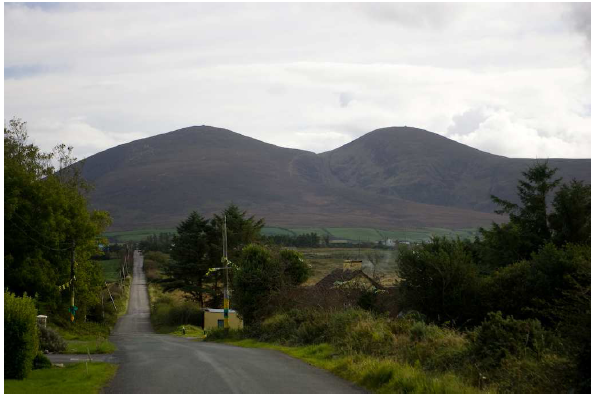

The Mórrígain’s body also shapes the landscape, for two small mounts, near Newgrange, in Co. Meath, are named after her: Dá Chích na Mórrígana, ‘The Paps of the Mórrígain’.667 In the Metrical Dindshenchas, they are alluded to as “the two Paps of the King [Dagda]’s consort”, that is the Mórrígain:
‘[…] Fégaid Dá Cích rígnai ind ríg / sund iar síd fri síd blai síar: / áit rogénair Cermait coem / fégaid for róen, ní céim cían […].
[…] Behold the two Paps of the king’s consort[i.e. the Mórrígain]/ here beyond the mound west of the fairy mansion: / the spot where Cermait the fair was born, / behold it on the way, not a far step […].668 ’
It is worth noting that the Mórrígain is equated with Anu/Danu in the Lebor Gabála Érenn [‘The Book of Invasions’]. This tends to prove that the Mórrígain, who is part of the trio of war-goddesses, was originally a land-goddess possessing fertility and nurturing aspects:
‘Badb 7 Macha 7 Annan .i. Mórrígan .i. diatat Da Chich Anann i l-Luachair, tri ingena Ernbais na bantuathaige 7 de bl aithmn.
Badb and Macha and Anann [i.e. the Morrigu] of whom are the Two Paps of Ana in Luachair, the three daughters of Ernmas the she-husbandman i.e. [….?]669
Tri ingena aile dana oc Ernmais, .i. Badb 7 Macha 7 Mórrigu, .i. Anand a hainmside.Ernmas had other three daughters, Badb and Macha and Morrigu, whose name was Anand.670
In Mor-rigu, ingen Delbaith mathair na mac aile Dealbaith .i. Brian 7 Iucharba 7 Iuchair: 7 is dia forainm Danand o builead Da Chich Anann for Luachair, 7 o builed Tuatha De Danann.The Morrigu, daughter of Delbaeth, was mother of the other sons of Delbaeth, Brian, Iucharba, and Iuchair: and it is from her additional name ‘Danann’ the Paps of Ana in Luachair are called, as well as the Tuatha De Danann.671 ’
The Lebor Gabála Érenn [‘The Book of Invasions’] also stipulates that the Mórrígain and Macha are identical. Fertility is also personified by their mother Ernmas, who is a ‘she-farmer’, like Be Chuille and Dianann:
‘Badb 7 Macha .i. in Mórrígan 7 Anann .i. diata da chích Anann .i. l-Luachair trī ingena Ernbais na bantūathige.
Badb and Macha [i.e. the Morrigu], and Anann of whom are the Two Paps of Anna in Luachair were the three daughters of Ernmas the she-farmer.
Bē Chuille 7 Dianand na dī ban-tūathig.Be Chuille and Dianann were the two she-farmers.672 ’
The Mórrígain is clearly associated with the land and agriculture in an early text, entitled Compert Con Culainn [‘The Conception of Cú Culainn’], dating from the beginning of the 8th c. This legend describes her ploughing a piece of land, which her husband, the Dagda, offered to her. This meadow is called after her: Gort-na-Morrigna (‘Mórrígain’s Field’). It is now identified with Óchtar nÉdmainn (‘Top of Edmand’), situated on the border of Co. Armagh and Co. Louth.673 The text is the following:
‘In Gort na Mórrígnae asrubart is Óchtar nÉdmainn insin. Dobert in Dagdae don Mórrígain in ferann sin 7 ro aired leesi é íarom.
The ploughing/field of the Great Queen which he said is Óchtar nÉdmainn. The Dagda gave to the Great Queen that land and it was ploughed by her after that.674 ’
Finally, the pattern of goddess’s body shaping the landscape is mirrored in an in-tale* of Compert Con Culainn [‘The Conception of Cú Culainn’], entitled Tochmarc Emire [‘The Wooing of Emer’].675 Cú Chulainn describes his journey to his lover Eimhear and gives onomastic* information concerning the places he passed through. He recounts then the story of the River Boyne, flowing to the north of Dublin, and explains how the goddess Bóinn was drowned in the river after making trial of the enchanted well of her husband Nechtan (see Chapter 4). What is particularly interesting in this legend is that parts of the river are clearly described as body-parts of the goddess. A portion of the river is her forearm and her calf, while another is her neck and another her marrow:
‘For Smiur mná Fedelmai asrubrad .i. Bóann insin. Is de atá Bóann fuirri .i. Bóann ben Necthain meic Labrada luid do choimét in topair díamair baí i n-irlainn in dúine la trí deogbairiu Nechtain .i. Flesc 7 Lesc 7 Lúam. 7 ní ticed nech cen aithis ón topur mani tísed na deogbairiu. Luid in rígan la húaill 7 duimmus dochum in topair 7 asbert ná raibhe ní no collfed a deilb nó dobérad aithis fuirri. Tánic túaithbél in topair do airiugud a cumachtai. Ro memdatar íarom teora tonna tairis cor róemaid a dí slíassait 7 a dessláim 7 a lethsúil. Rethissi dano for imgabáil na haithise sin asin tsíth co ticed muir. Cach ní ro reithsi, ro reith in topar ina diaid. Segais a ainm isin tsíth, sruth Segsa ón tsíth co Linn Mochai, Rig Mná Núadat 7 Colptha Mná Núadat íar sin, Bóann i mMidi, Mannchuing Arcait í ó Findaib co Tromaib, Smiur Mná Fedelmai ó Tromaib co muir.
On the Marrow of Fedela’s wife as said i.e. Boánn she was. She is called Boánn from this, i.e. Boánn the wife of Nechtan, son of Labhraidh, who went to observe the mysterious well that was at the verge of the fortress along with the three cupbearers of Nechtan, i.e. Flesc and Lesc and Lúann. And nobody used to come without a blemish from that well except for the cupbearers. The queen went with ostentation and pride to the well, and she said that there was nothing which would damage her appearance or would cause blemish to her. She came left-handwise around the well to feel its power. Then three waves rose up from it, so that her two sides and her right hand and one of her eyes were fractured. She ran then to avoid that blemishing, from the mound until she reached the sea. Wherever she ran, the well ran after her. Segais was its name in the mound – the stream of Segais from the Pond of Mochae, the Forearm of Nuadhu’s wife and the calf of Nuadhu’s wife following that. Boánn in Midhe (Middle), she is the Mannchuing (neck) of Silver from the [rivers] Finn to the [rivers] From. It is the Marrow of Fedhelm’s wife676 from the [rivers] From to the sea.677 ’
This tale undeniably predates the 10th c., for Tochmac Emire [‘The Wooing of Emer’] was continually revised from the 8th c. to the 10th c. The same story is related in the first version of a poem, entitled Bóand, published in the Metrical Dindshenchas (see Chapter 4).678
The Gaulish Goddess Nantosuelta
Overview
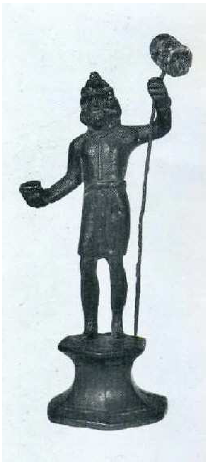
The goddess Nantosuelta is known from a single inscription and two reliefs* which portray her as the consort of the famous Gaulish god Sucellus generally understood as ‘Good Striker’,679 mentioned in ten dedications from France (Ancey-Mâlain, Lyons, Metz, Vichy, Vienne), Switzerland (Yverdon and Augst), Germany (Mainz and Worms) and Britain (York), and is represented on many a relief* with his typical curly hair and beard, long-shafted hammer and olla*(fig. 5).680 Nantosuelta is an atypical goddess who differentiates herself from the other goddesses by characteristic attributes of her own which remain enigmatic. The difficulty in deciphering the essence of Nantosuelta resides in the etymology* of her name, on which scholars disagree, and her attributes, which have been the subject of conflicting interpretations.
Epigraphy and Iconography
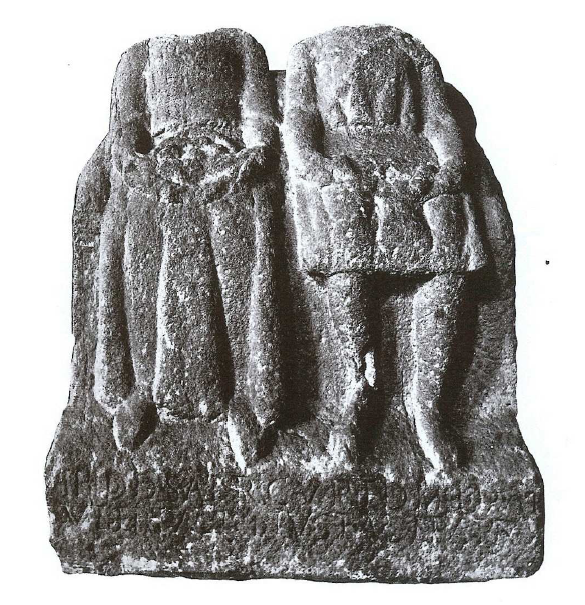
The goddess name Nantosuelta is known from a single inscription, belonging to between 150 and 250 AD, discovered in Sarrebourg, near Metz (Moselle), in the territory of the Mediomatrici. The stone was unearthed in 1895, about 20 metres from a mithraeum*, excavated at the bottom of the Mount Marxberg, on the north side of the Rebberg.681 This shows that oriental and Celtic deities could be worshipped side by side on a same site. The dedication, which makes her the consort of the hammer-god Sucellus, is combined with a portrayal depicting the couple: Deo Sucello Nantosuelt(a)e Bellausus Mass(a)e filius v(otum) s(olvit) l(ibens) m(erito), ‘To the god Sucellus and Nantosuelta, Bellausus, son of Massa, paid his vow willingly and deservedly’ (fig. 6).682 The dedicator, Bellausus, and his mother, Massa, have Celtic names and bear the unique name, which means that they are peregrines.683 The goddess is depicted wearing a diadem and a long tunic, which are typical Classical garments denoting majesty and sovereignty. As for her attributes, they are not clearly identifiable and remain difficult to decipher. What is certain is that they are not of Classical character and that they are quite uncommon. In her left hand, Nantosuelta has a long pole surmounted by an object in the shape of a small house, while in her right hand she probably holds a patera* above an altar.684 Under the niche where the couple stand, the image of a huge crow appears.
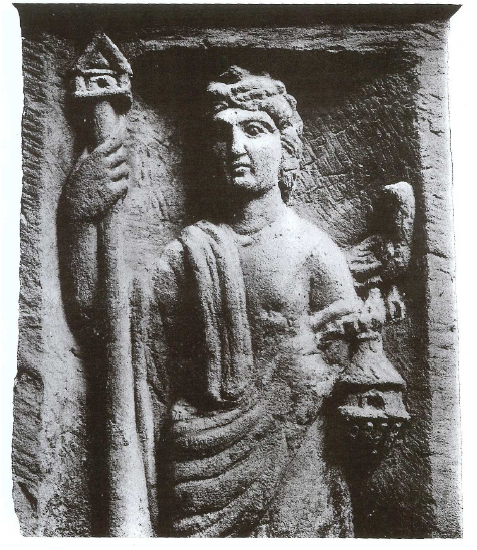
The singularity of her attributes enables us to identify the goddess on anepigraphic* reliefs*, such as the other altar from Sarrebourg (Moselle), discovered on the same site. She is pictured on her own, with the staff-house emblem in her right hand and a cassolette for incense or a beehive surmounted by a crow in her left hand (fig. 6 and 7).685 Three superimposed objects of round-shape, interpreted as honeycombs, honey cakes or paterae*, appear at her feet on the left hand-side.686 The fact that she is portrayed on her own evidences her independence as a goddess and proves that she was worshipped individually. The inscription accompanying the image does not mention her name: In h(ono)r(em) d(omus) d(ivinae), M(arcus) Tignuarius v(otum) s(olvit) l(ibens) m(erito), ‘In honour of the Divine House, Marcus Tignuarius paid his vow willingly and deservedly’.687 The dedicator Marcus Tignuarius bears the duo nomina; a form particularly in use at the end of the 2nd c. AD.688 The abbreviated formula In h. d. d. indicates that the inscription dates from the end of the 2nd c. AD or the beginning of the 3rd c. AD.689

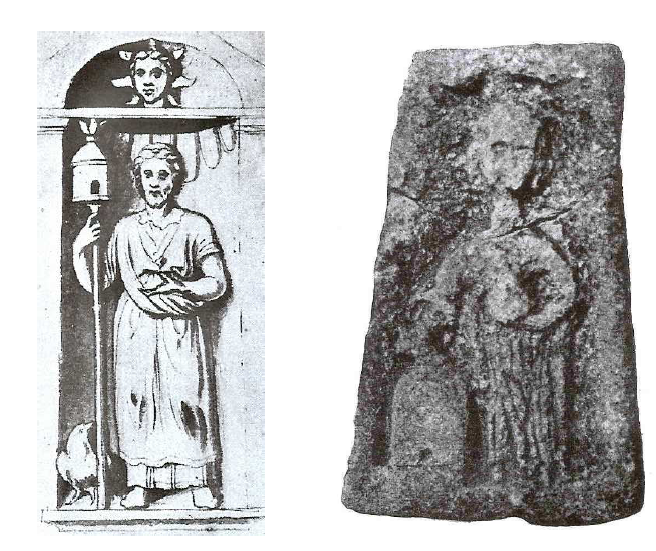
Nantosuelta is recognizable by her staff-house attribute on a lost relief* discovered in Spire, situated south-east of Mannheim (Germany), in the territory of the Nemetes (fig. 8).690The drawing is probably not very faithful to the original relief*. The goddess is accompanied by a crow standing at her feet. She holds a round object, possibly a cake, in her left hand. The peculiar aspect of this relief* is that the goddess is topped by a solar head, which may be indicative of a connection with the sun. Another possible representation of her was discovered in Tetig, located between Metz and Sarrebruck (Moselle).691 The relief* is crude and damaged and seems to be of indigenous character (fig. 8). The goddess holds a huge beehive or house in her right hand and a round object, perhaps a cup or a cake, in her left hand. The fact that the relief* is small (25×17 cm) and was discovered in a modest villa rustica* may attest to Nantosuelta’s protective aspect.692
Other portrayals of the hammer god and a female partner have been discovered in various other places, such as in Oberseebach (Bas-Rhin),693 Grünwinkel,694 Mainz (Germany),695 Jouey,696 Dijon,697 Nuits-Saint-Georges-Les Bolards (Côte d’Or),698 and Besançon (Doubs).699In addition to not being identified by an inscription, the goddess accompanying the hammer god does not possess the distinctive attributes of Nantosuelta. Consequently, contrary to what Green advocates, those reliefs* should not be regarded as depictions of Sucellus and Nantosuelta.700 Sucellus’s female consort is actually the archetype of the Mother Goddess. She is represented seated on a throne beside the god and bearing the classical attributes of the Terra Mater, such as the diadem, the tunic, the patera*, horns of plenty, baskets of fruit, apples, jars or pots, etc. Moreover, it is worth noting that Celtic gods and goddesses are usually polyandrous* figures. Therefore, it is not surprising to find a god associated with different female partners in the images – and vice versa. The Gaulish god of hot springs Borvo is for instance partnered with both Damona and Bormana.701 As for Damona, she has two other consorts: Albius and Moritasgus.702 Similarly, in Irish mythology, the Dagda is described as the husband of the Mórrígain703 and of the river-goddess Bóinn.704 It is thus important not to jump to conclusions as regards the portrayals of Sucellus and Nantosuelta.
Etymology of her name
The term Nantosuelta has given rise to various etymologies, but the meaning of her name remains somewhat obscure. At the end of the 19th c., Henry D’Arbois de Jubainville proposed to relate the first element of her name nanto– to the name of the Irish war god Nét (‘Leader’), genitive neit, derived from Old Irish néit meaning ‘fight’, ‘battle’, an idea which Vendryes seems to support.705 As for the second element suelta, it would to be the past participle of the verbal root suel, ‘to shine’. From this, he suggested to glossNantosuelta as ‘the One brilliant by her courage’, ‘Brilliant in War’ or ‘as brilliant as the god of war’. Accordingly, Nantosuelta would be a warrioress, a function which she definitely does not seem to fulfil, for she is never represented with weapons in the iconography. D’Arbois de Jubainville’s etymology* would seem to be inaccurate and should be definitely dismissed.
Alternative etymologies have also been suggested by scholars. The Celtic theme nantu-, cognate with Welsh nant, ‘valley, water-course, stream’, Breton nant, ‘valley’ and Old Cornish nans, ‘vallis’, designates the ‘valley’, the ‘watercourse’, the ‘stream’, that is the place where the river flows.706 In the Alps, the ‘nant’ is a common appellation of mountain torrents. The second part of her name suelta has given rise to various etymologies. On the one hand, Delamarre and Olmsted suggest it could be related to the IE root *suel designating the ‘sun’.707 Nantosuelta’s name would therefore mean ‘Sun Valley’, that is the one who makes the valley bloom.708 Her association with the sun could be evoked by the radiant head surmounting her image on the relief* from Speyer, but this remains dubious. On the other hand, Vendryes, Schmidt and Lambert maintain that it suelta is derived from verbal theme *swel-, ‘to curve’.709 Moreover, the ending of her name in –ta, found for instance in Rosmerta or Segeta, indicates it is a name of action. Nantosuelta, broken down as *nantos-sweltâ, is generally understood as ‘Winding Brook’ or the ‘Meanders of the Stream’.710
Lambert, who does not dismiss the possibility of this etymology*, nonetheless argues that the term nantu– could not have evolved in a form nanto-. He proposes to see an inflected form of a theme in –u-. Nantōs could then stand for an older *nantous, the genitive of nantu-s, ‘stream’, ‘valley’. He compares the second element of her name -wel-tâ to Welsh gwellt and Breton gueot, ‘hay’ or ‘grass to be cut’. Accordingly, her name would be a ‘juxtaposed’ noun rather than a compound noun – genitive of a possessive phrase + noun in the nominative – and would designate ‘the meadows’, ‘the pasture of the valley’.711 In view of those various etymologies, Nantosuelta clearly stands as a goddess originally embodying the valley, the streams, the fields and the landscape.
Interpretations of her attributes
Nantosuelta is a complicated figure to understand. In addition to the meaning of her name, which, as we have seen, is still controversial, her attributes are of a complex nature, for they are atypical, puzzling and identifiable only with difficulty. Nantosuelta generally holds a long pole surmounted by an object, which for Espérandieu would be the illustration of a beehive.712 As far as Birkhan is concerned, the house-shaped object would represent a tomb or a simple villa rustica* carried on a pole during processions.713 This object also reminds him of the Welsh wren houses, which have an identical shape. Accordingly, it could the representation of an aviary. Emile Lickenheld and Salomon Reinach’s suggestion is the most probable. They identify the object with a small house or a hut which would reflect the protective role of Nantosuelta for the household and the family.714 She might have procured well-being, chance, wealth and blessing for the members of the family.715 She is thus close in the essence to the Matres Domesticae or to the Proxsumae studied in Chapter 1.
As regards the recurrent symbol of the crow, it can be interpreted in various ways. First of all, it is an acknowledged fact that the crow was both a symbol of war and death for the Celts.716 For instance, this bird occurs on some casks of Celtic warriors, such as the cask from Ciumesti (Romania), dating from the beginning of the 3rd c. BC, surmounted by a bronze raven (Chap. 3 – fig. 6).717 Moreover, the Irish war-goddesses and announcers of death, the Mórrígain (‘Great Queen’) and Badb (‘Crow’), can take the shape of a raven when they fly over the battleground looking for dead warriors’ bodies to devour. Despite the attempt of D’Arbois de Jubainville to etymologically link Nantosuelta to the notion of combat, the goddess does not have any war-like traits in the portrayals. Thus, Anne Ross is incorrect when suggesting that the crow should be understood as a war-symbol characterizing the goddess.718
In ancient civilizations, almost all birds were regarded as divine messengers, belonging to the Otherworld and acting as mediators between the supernatural and the natural worlds.719 This is the reason why the oracle, which was an answer from the gods to the questions of human beings, was generally symbolised by a bird, the species of which varies from one country (or area) to another; birds of prey, such as eagles or ravens, doves and water birds.720 Various studies demonstrated that the crow is the Celtic oracular bird par excellence. This bird is often portrayed accompanying gods and goddesses.721 Such a role is also evidenced by two Classical legendary accounts. Clitophon recounts that the foundation of Lugudunum (Lyons) was dictated by a flight of crows:
‘Near the river Arar (the present-day River Saône) is the Mount Lugdunus, which changed of name for the following reason: Mômoros and Atepomaros, chased out by Sèsêronéos, went to this hill to build up a town, according to the order of an oracle. Ditches for the foundations were being dug when suddenly appeared crows, which, flying here and there, covered the surrounding trees. Mômoros, who was clever with the science of augury, called the new city Lugdunum. For in their language, the crow is called lougos and a high place dounon.722 ’
As for Livy, he relates in his History of Rome a duel between a Gaulish leader and a tribune called Marcus Valerius, whose victory was augured by a crow perched on his head, hence his nickname Corvus (fig. 9):
‘Whilst the Romans were passing their time quietly at the out- posts, a gigantic Gaul in splendid armour advanced towards them, and delivered a challenge through an interpreter to meet any Roman in single combat. There was a young military tribune, named Marcus Valerius, who considered himself no less worthy of that honour than T. Manlius had been. After obtain- ing the consul’s permission, he marched, completely armed, into the open ground between the two armies. The human element in the fight was thrown into the shade by the direct interposition of the gods, for just as they were engaging a crow settled all of a sudden on the Roman’s helmet with its head towards his antagonist. The tribune gladly accepted this as a divinely-sent augury, and prayed that whether it were god or goddess who had sent the auspicious bird that deity would be gracious to him and help him. Wonderful to relate, not only did the bird keep its place on the helmet, but every time they en- countered it rose on its wings and attacked the Gaul’s face and eyes with beak and talon, until, terrified at the sight of so dire a portent and bewildered in eyes and mind alike, he was slain by Valerius. Then, soaring away eastwards, the crow passed out of sight. Hitherto the outposts on both sales had remained quiet, but when the tribune began to despoil his foeman’s corpse, the Gauls no longer kept their posts, whilst the Romans ran still more swiftly to help the victor. A furious fight took place round the body as it lay, and not only the maniples at the nearest outposts but the legions pouring out from the camp joined in the fray. The soldiers were exultant at their tribune’s victory and at the manifest presence and help of the gods, and as Camillus ordered them into action he pointed to the tribune, conspicuous with his spoils, and said: `Follow his example, soldiers, and lay the Gauls in heaps round their fallen cham- pion!’ Gods and man alike took part in the battle, and it was fought out to a finish, unmistakably disastrous to the Gauls, so completely had each army anticipated a result corre- sponding to that of the single combat. Those Gauls who began the fight fought desperately, but the rest of the host who come to help them turned back before they came within range of the missiles. They dispersed amongst the Volscians and over the Falernian district; from thence they made their way to Apulia and the western sea.723 ’

In addition, in Irish mythology, the Mórrígain and Badb have sometimes the role of prophetesses.724As regards Germanic and Scandinavian mythology, ravens are the companions of the omniscient gods Wōdan and Óðinn.725 Óðinn’s two crows Hugin (‘Spirit’) and Munnin (‘Memory’) fly all over the world during the day and settle at night on his shoulders to tell him what they have seen and heard; wherefore Óðinn is called Hrafnaguð (‘Raven-God’).726 From this, it can be inferred that Nantosuelta’s crow might have had the role of an oracular divine messenger, reporting the questions, prayers and actions of human beings to her.
Following on from the role of supernatural mediator, the crow also had a funerary dimension, as a conveyor of souls towards the otherworld.727 Nantosuelta’s crow might thus represent the goddess’s ability to accompany the deceased to the supernatural world. Besides, some scholars have interpreted the house symbol appearing at the end of Nantosuelta’s staff as the representation of a funerary ‘house-tomb’.728 Furthermore, the object she sometimes holds in one of her hands might be viewed as a funerary urn or cassolette for incense. It could parallel the olla* of Sucellus, which could contain offerings for the dead.729 All those attributes could thus attest to her connection with death and to her funerary functions.
Another interpretation of Nantosuelta’s aspects can be suggested. If the round object she holds is not a cassolette for incense but a beehive, as suggested by Espérandieu, she might have had a connection with bees and honey.730 Moreover, the three round-shaped objects at her feet on the relief* from Sarrebourg (fig. 6) have been interpreted as honeycombs or honey cakes.731 As will be demonstrated in Chapter 5, honey was a natural product of great importance and sacredness in antiquity. Henry Hubert, who supports that idea, affirms that Nantosuelta is a ‘beehive goddess’, and that her partner, Sucellus, might have been the holder of a sacred beverage of immortality, possibly mead, symbolized by the olla* or cup.732 This theory is interesting, for Sucellus is sometimes portrayed with a barrel, which may be a symbol of brewing.
At any rate, it seems highly likely that Nantosuelta was originally an earth-goddess. Sucellus, with his gobelet and long-shafted mallet, can be compared to the Irish Dagda, whose attributes are a great cauldron and a staff, dispensing death on one side and restoring life on the other.733 According to Dáithí Ó hÓgáin, the name of the Dagda comes from a Celtic dago-Dewios, with dago signifying ‘good’ and Dewios, similar to Indic Dyâus, Latin Deus, Greek Zeus, referring to the ‘sky’.734 In Dagda (‘the Good God’) is therefore the reminiscent figure of the father god or sky-deity of Celtic and Indo-European religions. Being nicknamed Aedh Álainn (‘Fiery Lustrous One’) and Aodh Ruadh Rό-Fheasa (‘The Red Fire (Sun) of Absolute Knowledge’), he was primarily associated with the sun.735 Sucellus and Nantosuelta might originally have been the couple representing the land-goddess mating with the sun/sky deity, for they both represent the forces of nature and of the ground. They were later given domestic and funerary functions, protecting the household and the family in the terrestrial life and accompanying the dead in the afterlife.736
Some remarks on Aericura
The spelling of this goddess name varies greatly: Aericura, Aerecura, Erecura, Eracura, Ericura and Herecura. Her name, the meaning of which remains obscure, is probably not Celtic but Germanic. Delamarre however thinks she is Celtic and proposes to break it down as *Ēri-cūrā, ‘Wind of the West’.737 As far as Olmsted is concerned, the first element of her name eri– might be an intensive prefix meaning ‘to go beyond’, while the second element cura might come from the zero-grade of *kueru– signifying ‘grind, mill, flour’. According to him, Ericura would mean ‘Before the Bread’.738
However, the fact that her worship is concentrated to Southern Germany and the North-West of the Balkans would tend to prove that she is of Germanic origin.739 She is mentioned in inscriptions from Mainz, Sulzbach, Stockstadt, Monterberg, Xanten, Iversheim, Cannstatt, Mautern, (Germany), Beetgum and Holledorn (the Netherlands), Langres (Haute-Marne), Belley (Ain), Rome, Aquileia and Perugia740 (Italy), Verespatak (Romania) and Announa (Thibilis) in Numidia (present-day Algeria), which was a Roman province. Scholars sometimes relate her to the god Arecurius, honoured in an inscription from Corbridge (Northumbria, GB): Deo Arecurio. It must however be borne in mind that this inscription is quite uncertain, and it might be a misreading of Mercurio.741
Two of the inscriptions from Cannstatt are combined with a representation of the goddess. The first one portrays her draped and shod, sitting and holding a basket of fruit in her lap.742 The inscription, engraved at the bottom of her feet, reads: [Her]ecur(a)e sig(num) Val(erius) […] vslm (fig. 10).743 The other relief* is mutilated and only the bottom of it remains.744 The inscription is engraved under a seated goddess, who wears a dress and shoes and holds a basket of fruit on her knees: Herecur(a)e Cottus G[…]i (filius) ex voto suscepto posuit v(otum) s(olvit) l(ibens) l(aetus) m(erito).745 Aericura does not possess any distinctive attributes of her own. She is depicted merely with the attributes of fertility and does not distinguish herself from the iconography of the Matres and Matronae. Several other reliefs* of the same type, representing a similar seated goddess with shoes and basket of fruit were discovered in the area (fig. 10). This type might be figurations of Aericura but it could equally be portrayals of a single Mother Goddess.746

On a mutilated altar from Sulzbach, near Carlsruhe (Germany), discovered in 1813 in a cave, Aericura is represented seated beside the god Dis Pater, as the inscription engraved on the socle indicates: I(n) h(onorem) d(omus) d(ivinae) d(eae) s(anctae) Aericur(ae) et Diti Pat(ri) Veter(ius) Paternus et Adie(ctia) Pater(na) (fig. 11).747Their heads are now missing. The god wears a tunic and holds an object in his hands, possibly an unrolled scroll, while the goddess has a long robe and a tray of fruit in her lap.
As his name shows, Dis Pater (‘Father of Riches’)748 was originally a god of fertility and agriculture.749 He was later attached to the realm of the dead and became the Roman god of the Underworld. He is identical to Roman Pluto (‘the Rich’) and corresponds to the Greek Hades. Linckenheld and De Vries demonstrate that the distribution of Aericura and Dis Pater’s cult is complementary to the distribution of Nantosuelta and Sucellus’s worship.750 In other words, the areas of cult do not tally and thus complete one another. Lickenheld points out that the two divine couples must be emanations of one another, for they possess the same agrarian, chthonian* and funerary functions.751 As far as he is concerned, Ericura and Nantosuelta are one and the same divine character, like Sucellus and Dis Pater are the very same figure. Auguste Allmer and De Vries reject this view and argue convincingly that Dis Pater cannot be regarded as the equivalent of Sucellus, since he does not bear the same attributes, that is the hammer and the olla*.752 Moreover, Nantosuelta has an iconography specific to her which clearly distinguishes her from Aericura. Nevertheless, they probably share similar functions of prosperity and benevolence.
The agrarian attributes in her iconography clearly illustrate Aericura’s role of land-goddess. Her association with Dis Pater supports that idea, insomuch as this god was originally worshipped as a purveyor of riches. As Dis Pater was also the lord of the realm of the dead, Aericura might have been linked to death and endowed with a funerary aspect. Those various elements led Green and De Vries to compare her to the Roman goddess of the dead Hecate, who was originally a goddess dispensing fertility of the ground, luck and victory. They also parallel her with the Greek goddess Persephone, the equivalent of the Roman goddess Proserpina, who primarily presided over crops and the germination of plants before being partnered with Pluto and reigning over the Underworld.753 Those examples show that chthonian* goddesses were closely linked to death. This can be explained by the eternal cycle of nature which consists of birth, death and renewal. Finally, Aericura’s funerary dimension could be evidenced by the fact that reliefs* and inscriptions were discovered in cemeteries, such as in Cannstatt, or associated with funerary stones, for instance in Rottenburg.754
From this it follows that the faith in a goddess embodying the land is ancient and firmly fixed in tradition. According to the places and traditions, she took up various names referring to the earth, land, plain or field. On the Continent, there is evidence of the goddesses Litavi (‘Earth’), the Matres Mageiae (‘the Mother Goddesses of the Field?’), the Magiseniae (‘the Ancient Fields’) and Nantosuelta (‘Winding Brook’ or ‘Meadows’?) and in Ireland of Ériu (‘Land’), Tailtiu (‘Earth’ or ‘Plain’) and Macha (‘Field’). The personification of the land is, besides, well-illustrated in Irish medieval literature which sometimes depicts how the body of a goddess shapes the landscape. Moreover, some legends clearly stress the agrarian functions of the goddesses attached to the land, the most relevant examples being the Mórrígain ploughing her piece of land or Tailtiu dying of exhaustion after clearing the forests and digging the plain of Brega.
The Land-Goddess as a Purveyor of Riches
Introduction
It is stating the obvious to say that human beings remain alive and sustain themselves thanks to the products of the earth. Water, fruit, crops were logically interpreted as offerings from the land-goddess, who was thus envisaged as a nurturer. It was the earth-goddess who was believed to feed the people by providing them with food and water. As studied in Chapter 1, this function is clearly evidenced by the worship of the Matres and Matronae, who are portrayed holding classical attributes denoting the fertility of the earth, such as cornucopiae*, fruit, cakes or patera*. The Nutrices, represented in the Gaulish iconography swaddling or feeding infants, obviously hold the same role. The land is the mother who nurtures her beings.
This role is also evidenced by the worship of single goddesses from Ireland and Gaul who have names literally meaning ‘Nurturer’ or ‘Provider’. This is the case for instance in the name of the goddess presiding over Munster Mór Muman, ‘theMór of Munster’, who presides over the land of Munster (Mumu, later Mumhain). Her name does not signify ‘the Great Mother’, as Olmsted suggests,755 but ‘the Great Nurturer’, as Ó hÓgáin explains.756 Mumain is not to be related to the word muman meaning ‘mother’, but to mumu, later mumhain, signifying ‘nurturer’. Mór Muman is clearly a land-goddess, for the first element of her name mór was used to characterize earth-goddesses, such as the Mórrígain. Moreover, she is described marrying various kings of Munster in Mór Muman Ocus Aided Cuanach Meic Ailchine [‘Mór of Munster and the Tragic Fate of Cuanu Son of Cailchin’],757 a pattern which is characteristic of land-goddesses (see Chapter 3 and 5). Similarly, Sanas Cormaic [‘Cormac’s Glossary’], dated 9th c., explains that the land-goddess Ana/Anu, whose name is a later pet name for Danu, is the mother of the gods of Ireland and that she is the one who feeds them. The Tuatha Dé Danann (‘Tribe of the Goddess Danu’) also bear her name. The equation of her name with Irish anai, ‘wealth’ or ‘abundance’ is however a fanciful and inaccurate interpretation by medieval glossators.758 The image of the land-goddess as a mother nurturing her people clearly illustrates her function as distributor of wealth and food.
‘Ana .i.mater deorum Hibernensium. Robo maith didiu robīathais sī deos; de cuis nominee ana .i. imed, et de cuius nomine Dá Chic[h] hAnund īar Lūachair nominant[ur], ut fibula fertur .i. amail aderait ina scēlaide.
Ana: the mother of the gods of Ireland. It was well she nursed deos i.e. the gods: ana i.e. ‘plenty’, for whom are named the ‘Two Paps of Ana’ beyond Luachair, as the story-tellers say.759 ’
The concept of the land-goddess nurturing her people may also be echoed in the goddess name Alauina / Alauna, mentioned in two inscriptions discovered in Pantenburg (Germany), where she is associated with the goddess Boudina ‘Victory’.760 The inscriptions read: [Bo]udi{i}n{u}ae [et] Alaunae C(aius) Sextilius Sollemnis, ‘To Boudina and Alauna, Caius Sextilius Sollemnis’ and Deo Voroi[o] Boudina E et Alau{i}nae C(aius) Sextilius Sollemnis, ‘To the god Voroio, Boudina (E?) and Alauina, Caius Sextilius Sollemnis’.761 The inscriptions are offered by the same dedicator, who is a Roman citizen on account of his tria nomina. It is worth noting that Alauna may be the feminisation of the god name Alaun(i)us, honoured alone in Notre-Dame-des-Anges (Var): ]us Tacitus [—-] Alaunio [—] sp vslm,762 and equated with Mercurius in Mannheim (Germany): [Ge]nio Mercur(ii) Alaunii Iul(ius) Ac[co]nius Augustinus ex vsllm.763 In addition, Alauna might be cognate with the goddesses Alounae, known from three dedications discovered in the area of Salzburg (Austria), more precisely in Chieming and Seeon: Bedaio Aug(usto) sacr(um) Alounar(um) Setonius Maximianus ; Sacro Alounarum Aug(ustarum) Non(ius) Iu(v)enalis and Bedaio Aug(usto) et Alounis.764 Interestingly, the dedicator Bedaius, who pays homage to those deities in two of the inscriptions, bears a Celtic name.765 Šašel Kos points out that the Alounae can be paralleled to the ethnonym* Alauni, a tribe settled in Noricum*.766 This leads her to think that they may have been the protective goddesses of this sept*. Delamarre and De Bernardo Stempel translate the divine names Alauna and Alounae as ‘Nourisher(s)’, relating them to Old Irish alim and Old Norse ala, derived from an IE root *al– meaning ‘to nourish’.767 If many rivers in Europe bear that name, it is certainly because the river, when it is well-stocked with fish, has the ability of providing its people with food.768 Though interesting, this etymology* remains uncertain, for Alauna and Alounae can also be glossed as ‘the Nomads’, ‘the wandering ones’.769
The role of ‘provider’ is greatly illustrated on the Continent by goddesses bearing names literally referring to the activity of distributing wealth: Rosmerta, the consort of Mercurius, whose cult is attested by a significant number of inscriptions and iconographical devices in the north-east of Gaul; Atesmerta, mentioned in a single inscription from Haute-Marne; and Cantismerta, known from a single dedication discovered in Switzerland. Who were those goddesses of bounty? Apart from nurturing, did they have other functions? Can they be distinguished in the iconography by specific attributes? Were they honoured by dedicators of Celtic or Roman origin?
Solitary Rosmerta (central and north Gaul)
Etymology of her name
The goddess name Rosmerta, mentioned in about thirty inscriptions from Gaul and Germania Superior, is undeniably Celtic. The etymologists agree on the meaning of her name, which is composed of the intensive prefix ro– (*pro) signifying ‘very’, ‘great’,770 and of the element –smertā, ‘distribution’ – a noun of action in –tā – based on the verbal theme *smer-, ‘to distribute’, ‘to give’, ‘to attribute’, denoting bounty and supply.771 Duval explains that this root expresses “the idea of prediction and provision, of preparing and precautions to take, […] of destiny regulated by Providence.”772 Her name has been glossed in various ways, such as ‘the Highly Foresighted’,773 ‘the Very Attentive’,774 ‘Goddess of Plenitude’,775 the most appropriate one being ‘the one who gives or distributes’, i.e. ‘the Great Purveyor or Provider’.776 Her name therefore evokes her primary role of land-goddess supplying her people with all the natural products necessary for them to survive. As for Anwyl’s etymology*, who proposes Rosmerta, ‘the Exceedingly Brilliant One’, from smert ‘shining’, it is definitely inaccurate and irrelevant.777
It is significant that Rosmerta is cognate with other names of gods and goddesses, based on the same root smerto-, smero-, for it indicates the importance and antiquity of a cult devoted to divinities of ‘supply’ and ‘foresight’. In addition to Atesmerta and Cantismerta, such is the case with the gods Smertrios (‘the Purveyor’), venerated in France, Austria, Germany and Great Britain,778 Smertus (Jupiter) honoured in Grignan (Drôme) and Escovilles-Sainte-Camille (Yonne),779 and Smertu-litanus (Mars) (‘The Large Purveyor’) – with litanos, ‘vast’, ‘large’-, known from an inscription found in Möhn (Germany).780
Inscriptions
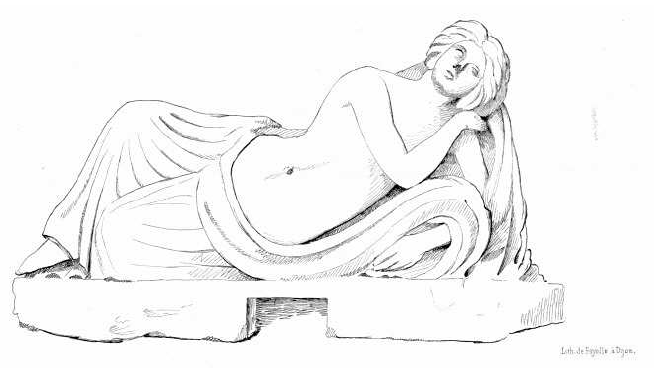
Pierre Lambrechts saw in Rosmerta a mere female duplication of the god Mercurius, explaining that she did not have any peculiar functions or roles, apart from being the consort of the god.781 This is actually incorrect to say, since recent archaeological evidence has proved that Rosmerta was worshipped in her own right. This is the case in five inscriptions, two of which are combined with a figuration. Therefore, it can be affirmed that Rosmerta fulfilled far more important functions in ancient times than being the mere partner of a Gallo-Roman god. In Gissey-le-Vieil (Côte d’Or), in the territory of the Aedui, she was honoured in a now lost inscription: Aug(usto) sa[c(rum)] Deae Rosm[er]tae Cne(ius) Cominius Candidus et Apronia Avitilla v(otum) s(olve)runt l(ibentes) m(erito), ‘Sacred to the August Goddess Rosmerta, Cneius Cominius Candidus et Apronia Avitilla paid their vow willingly and deservedly’ (fig. 12).782 The two dedicators may be husband and wife. While the man is a Roman citizen, for he bears the tria nomina, the woman’s first name Apronia is a patronymic Latin name and her second name Avitilla is Celtic – it is possibly based on avi-, ‘desir’.783 On account of the use of the formula Dea, the inscription was not prior to the mid-2nd c. AD.784 Dr Morelot, who studied the altar in 1843, assumed that Rosmerta was a topical* deity whose cult was attached to the curative waters of Gissey.785 According to him, Gissey is a Celtic name meaning ‘place filled with water’, with Celtic gi, ‘water and cey, ‘full of’. In the same area, a statue of a half-naked woman lying down, probably dating from the end of the 2nd c. AD or the beginning of the 3rd c., was discovered. She may be the personification of the waters of Gissey, for river- and spring-goddesses are very often depicted in such a position, wearing only a cloth around their hips (fig. 13).786 It may be thus inferred that the worship of Rosmerta in this locality was connected to the thermal waters of Gissey-le-Vieil.787

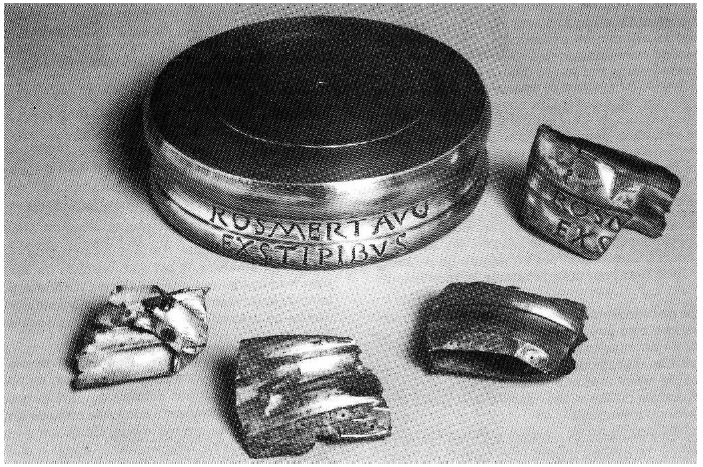
Rosmerta is also invoked by herself in a dedication unearthed in the locality of ‘La plaine au-dessus des Bois’, in Dompierre-sur-Authie (Somme), situated in the territory of the Ambiani. The inscription, engraved on a silver band, belonging to the wooden pedestal of a statuette, was found in 1989 during the excavations of a sanctuary, dating from the end of the 1st c. AD, composed of a fanum* and open-air areas where deposits of offerings were made. This inscription reads: Rosmert(ae) Aug(ustae) Exstipibus, ‘To the August Rosmerta Exstipibus (offered this)’ (fig. 14).788
Furthermore, an early inscription in Gaulish language and Latin lettering, engraved along the inside brim of an earthenware vessel unearthed in Lezoux (Puy-de-Dôme), comprises the divine names Rosmerta and Rigani (fig. 15). The ‘Terrine de Lezoux’ was discovered in 1974 on the site of the Neolithic and Proto-historic necropolis ‘Chassagne’, also called ‘des Religieuses’, excavated between 1972 and 1976 in the ‘Pré Tardy’, which is situated west of Lezoux (Puy-de-Dôme), in the territory of the Arverni. It was found in a funerary well dating to the time of Tiberius (1st half of the 1st c. AD).789 The RIG II.2 gives the following transcription:
‘e[..]o i euri rigani rosmertiac.790 ’
Several interpretations of this inscription have been proposed. On the one hand, Rigani and Rosmerta could be the name of two different goddesses. Rigani is the Celtic equivalent of Latin Regina (‘Queen’). The ‘Queen Goddess’ is honoured in Worringen (Germany),791 Lanchester (GB),792 and Lemington (GB)793 (see Chapter 3). The offering would have thus been made to both Rigani and Rosmerta and the inscription would read:
‘I have offered this to the ‘Queen’ (and) to Rosmerta.794 ’
On the other hand, Rigani and Rosmerta may be two epithets designating the same deity. This is the more likely interpretation, for Regina is a title which is sometimes given in the epigraphy to the Roman goddesses Juno, Minerva and Fortuna and to the Gallo-Roman horse goddess Epona.795 The inscription would then read:
‘I have offered this to Rigani Rosmerta, i.e. the Queen Rosmerta.796 ’
However, Lambert in the RIG II.2 suggests another possible interpretation, which he argues is the most probable one.797 According to him, the coordination between the words Rigani and Rosmerta is definitely not possible. Therefore, it cannot be an offering to two separate deities. He interprets the final word Rosmertiac as an abbreviated form of Rosmertiac[on], a word in –āko- designating a name of feast, that is ‘the feasts of Rosmerta’. Feasts held in honour of land-goddesses are known in Irish medieval literature, such as Óenach Macha (‘Macha’s Assembly’) for Macha and Óenach Tailten (‘Tailtiu Fair’) for Tailtiu, two earth-goddesses par excellence (see above). This theory is thus plausible. Lambert reckons that the word rigani could refer to a (human) queen, who would have made the offering. From this, it follows that the inscription should be read:
‘This I offered, (me) the queen of the feasts of Rosmerta.798 ’

Finally, the name of the goddess may appear on a fragment of vase in marble, found in Austria (Noricum*) between 1980 and 1990 in an unidentified field: [—-Ros]mertai [—-].799This object has been interpreted as an offering to the Goddess.
Iconographical devices combined with an inscription
In addition to those four inscriptions, remarkable images of Rosmerta, combined with a dedication identifying her, are known: the statuette in bronze from Champoulet (Loiret) and the relief* from Escolives-Sainte-Camille (Yonne). In 1935, a hiding-place containing a series of Gallo-Roman bronze statuettes was uncovered in Champoulet, a small village near Saint-Fargeau (Loiret), in the territory of the Carnutes. There was found a bronze statuette of Rosmerta, wearing a coat, a tunic and diadem (fig. 16 and 17).800 René Joffroy suggests she might have held a patera* in her right hand and a caduceus* or cornucopia* in her left hand. The inscription engraved on the pedestal is the following: Aug(usto) saccr(um) d(e)ae Rosmert(a)e Dubnocaratiaci Maross(us) Marulli filius v(otum) s(olvit) l(ibens) m(erito) d(e) s(uo) d(edit), ‘To the Sacred August Goddess Rosmerta Dubnocaratiaci, Marossus son of Marullus paid his vow willingly and deservedly and offered this at his own expense’.801 Interestingly, the dedicator Marossus (maro– ‘great’, ‘big’) and his father Marullus bear Celtic names. Their unique name indicates they are peregrines.802
The substantive Dubnocaratiacius is also attributed to Mercurius and Apollo in three other inscriptions from the same site:803 In h(onorem) d(omus) d(ivinae) deo Merc(urio) Dubnocaratiaco ex stip(endio) eius sub c(ura) Sedati Valloicis ; Aug(usto) sac(rum) Merc(urio) Dubnocaratiaco Messa Marulli v.s.l.m ; Aug(usto) sacr(um) deo Appolino Dunocaratiaco Nobili(s) Titiani f(ilius) v(otum) s(olvit) l(ibens) m(erito).
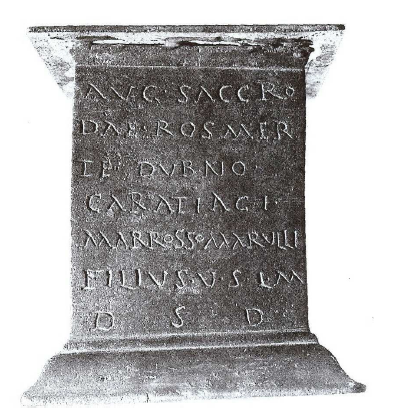
Dubnocaratiacius could mean something like ‘Dear to the World’, with dubno-, ‘dark’, ‘mysterious’, ‘from the (under)world’ and cara-, ‘dear’,804 but Lejeune and Lambert maintain that Dubnocaratiacius is not to be understood as a divine name but as a localizing epithet in –iaco, referring to a place or domain belonging to somebody.805Like Marti Masuciaco is related to the land owned by Masucius806 and Mars Victor Magniacus Vellaunus to a place called Magniacum,807 Rosmertae Dubnocaratiaci should be interpreted as ‘Rosmerta from the place known as Dubnocaratiacum’, that is ‘the property of Dubnocaratius’. It is actually the proper name of the owner of the domain which means ‘Beloved of the World’.808 In the second inscription to Mercurius it is noticeable that the dedicator Messa, who has a Celtic name, is the daughter of Marullus, and thus the sister of Marossus, the dedicator paying homage to Rosmerta.809 From those inscriptions and bronzes, it can be inferred that the property Dubnocaratiacum belonged to the head of the family Marullus and that a place of worship dedicated to Rosmerta, Mercurius and Apollo was located there. This family is of Celtic origin, for all the members (father, son and daughter) have Gaulish names. Bearing the unique name, they are peregrines.
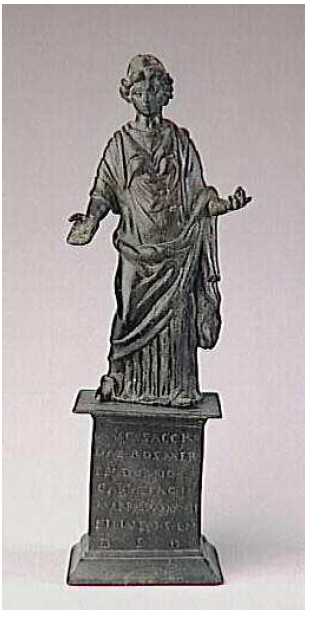
Another relief* with dedication to Rosmerta, dated from the second half of the 1st c. AD, comes from Escolives-Sainte-Camille (Yonne), in the territory of the Aedui. It was found in a place of worship known as ‘Champ-des-Tombeaux’, a sanctuary located near the spring of the Creusot (fig. 19).810 The goddess is represented standing alone in a niche, wearing the usual long robe and diadem of the Classical mother goddesses. She holds a huge cornucopia*, full of round fruit – possibly apples – in her left hand and a patera* in her right hand. These are the common attributes of the Greco-Roman divinities of abundance and fertility. The inscription, engraved along the arc of the niche, associates Rosmerta with the Emperor: Dea(e) Rosmertae Iunianu(s). // sac(erdos) Aug(ustis) v(otum) s(olvit) l(ibens) m(erito) // S.H. / XXI / TLL (?), ‘To the goddess Rosmerta, Iunianus, priest of Augustus, paid his vow willingly and deservedly’ (fig. 18).811 Originally, the stone was engraved only with the votive formula v.s.l.m. and the price of the stone SH XXI (21 sesterces).812 The dedicator Iunianus is a peregrine*, since he bears the unique name. According to Monique Dondin-Payre, Iunianus is an indigenous Latin name, based on a root iun– signifying ‘desire’, which is typical of peregrines.813 He indicates his function: he is a priest (sacerdos) of the Emperor Augutus. On the account of the formula Dea, the inscription is not prior to the middle of the 2nd c. AD.814
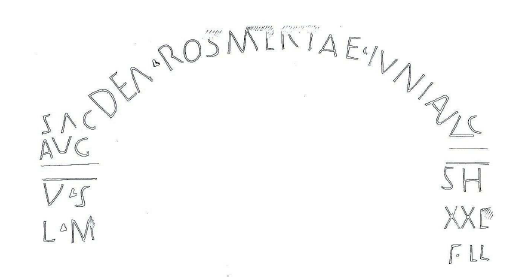

The worship of Rosmerta may be linked to the curative spring of Le Creusot, for excavations carried out at the Champ-des-Tombeaux revealed the foundations of an early 1st-century AD sanctuary and baths. Moreover, anatomical ex-votos* in wood, bronze and stone, similar to those found at the Sources-de-la-Seine, attest to a cult rendered to a healing deity related to the curative spring.815
Atesmerta
The goddess Atesmerta is known from a single inscription, discovered in 1918, at a place known as ‘Combe-du-Champ-Bas’, located in the heart of the Forest of Corgebin, in the commune of Chaumont-Brottes (Haute-Marne), in the territory of the Lingones.816 The altar was found together with bones, fragments of pottery and coins from the mid-3rd c. AD: Atesmert(a)e Magiaxu(s) Oxtaeoi f(ilius) v.s.l.m., ‘To Atesmerta, Magiaxus, son of Oxtaeus/Oxtaius paid his vow willingly and deservedly’ (fig. 20).817 The goddess name Atesmerta is composed of the intensive prefix ate-, ad-, ‘very’ and of the root smerto-, ‘distribution’.818 Atesmerta is therefore equivalent in meaning to the goddess name Rosmerta and can also be glossed as ‘Great Purveyor’. The names of the dedicators Magiaxus, based on magi, ‘great’, ‘big’,819 and of his father Oxtaeus or Oxtaius,820 are Gaulish. This attests of the indigenous character of her cult. Her name is seemingly the feminine version of the god names Atesmertius (Apollo) venerated in Le Mans (Sarthe),821 Atesmerius honoured in Meaux (Seine-et-Marne)822 and Adsmerius mentioned in Poitiers (Vienne).823

Excavations carried out unofficially by Luc Thomas between 1989 and 1992 revealed a 15-metre deep chasm, called the ‘Gouffre des Bonshommes’, and a subterranean river, where a bowl in ash wood and 300 Roman coins and a few Gaulish coins were found.824When the water-level rises, the river gushes from the chasm and provokes a sort of geyser, rising sometimes up to 1.50m and flooding the valley over several kilometres (fig. 21). Nearby, a small rectangular temple, called cella*, probably built over a primitive place of worship in wood, evidenced by the alignment of five pole holes of previous date, was unearthed (fig. 22 and 23).825 In the area of the temple was discovered a much damaged 1.55m high statue of a woman, which may be the representation of the goddess Atesmerta (fig. 24). Various anatomical ex-votos*, such as a webbed hand, a leg, heads and busts, similar to those from the Sources-de-la-Seine, were also found (fig. 25).826 Thomas explains that other alignments of pole holes discovered on the site could be indicative of a place where the ex-votos were deposited.827 A study of the coins revealed that the sanctuary was in use from c. 50 BC to the second half of the 3rd c. AD, when it was then destroyed. It seems clear that the sanctuary was erected in connection with the ‘geyser’, the appearance of which was limited in time and unidentifiable, and thus mysterious and sacred. It must have been understood as a divine manifestation or a benediction from the gods. The altar dedicated to Atesmerta clearly proves that she was the goddess presiding over the place and the anatomical ex-votos* suggest that people came to pray her so as to have their pains soothed. From this, it can be affirmed that Atesmerta was a local healing spring-goddess.

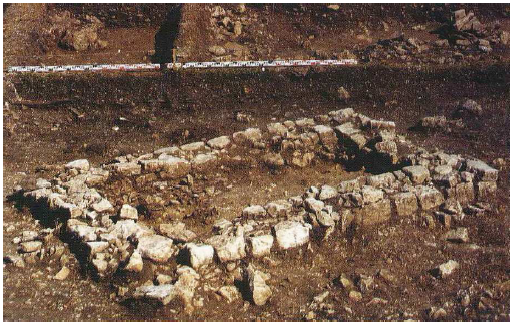

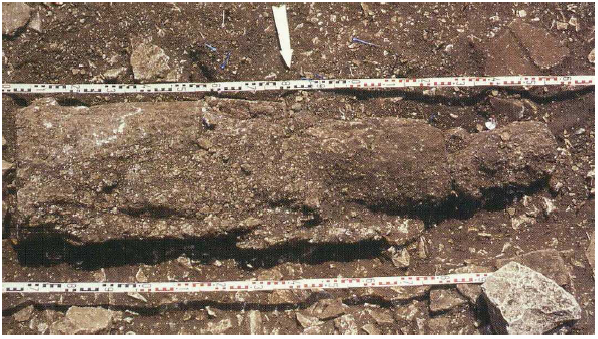
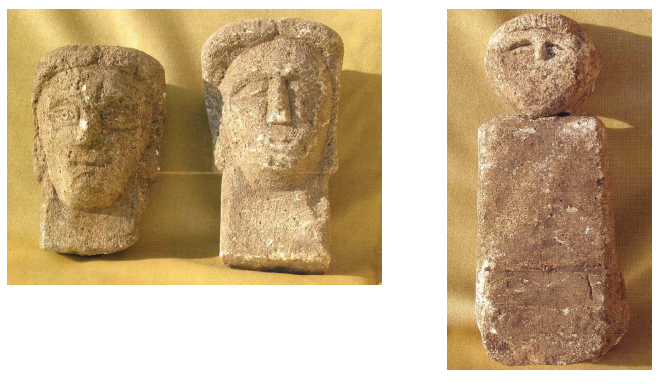
Cantismerta
The goddess Cantismerta is mentioned in a single inscription discovered in 1858 in Lens (Switzerland), near the Chapelle Saint-Clément: Cantismerte L(ucius) Quartillius Quartinus [v(otum) s(olvit)] l(ibens) m(erito), ‘To the goddess Cantismerta, Lucius Quartillius Quartinus paid his vow willingly and deservedly’ (fig. 26).828 Her name might be found again in a graffiti engraved on a pottery bowl discovered during excavations carried out in the new cemetery of Vannes (Morbihan) in 1899-1900. The graffiti being very difficult to read, its significance remains uncertain and hypothetical. Lambert proposes two possible readings: C]antismertis srl or ]I Atesmertisrl.829

Her name is composed of smertā, ‘distribution’ and of a prefix canti-, the significance of which has still not been determined with certainty. The translation proposed by Jean-Jacques Hatt of canti-, ‘white’ and Cantismerta, ‘Purveyor of Whiteness’ is improbable.830 This etymology* put him on the wrong track. He supposed that Cantismerta was the primary goddess lying behind the goddess Candida Regina, who was honoured in two damaged steles* combining images and inscriptions found in Ingwiller (Alsace) – destroyed in 1870. The first one was engraved above the depiction of a man and a woman standing in a niche: D(e)ae Can[…] Reginae Io[…] c[…] a[…] ex [v]oto p(osuit) l(ibens) l(aet…) m(erito), ‘To the goddess Can(?) Regina Io(?) (offered this) in accomplishment of a vow’ (fig. 27).831 The second one was engraved above the relief* of three personages standing in a niche: D(eae) C(an…) R(eginae) Divixta Terentiani (filia) v(otum) s(olvit), ‘To the Goddes Can(?) Regina Divixta, daughter of Terentianus paid her vow willingly and deservedly’ (fig. 27).832 The dedicator Divixta is a woman peregrine* who bears a typical Celtic name, based on the root divic-, ‘to avenge, to punish’.833 At first, Hatt thought he could reconstruct the name Cantismerta from the damaged altar, but he later acknowledged that this reconstitution was inaccurate.834 There is clearly not enough space between Can[…] and Regina for nine other letters. The discovery of an inscription dedicated to the goddess Candida Regina in Heddernheim (Germany) in 1965 allowed him to restore the name of the goddess honoured in steles* from Ingwiller: Candida.835 He believed Candida could have replaced Cantismerta, because Candida and Cantismerta both had names referring to ‘brightness’, but this theory is not admissible on account of the inaccuracy of his suggested etymology*.

As far as Schmidt and Lejeune are concerned, they suggest relating canti– to a Celtic canto- meaning ‘wheel’. Cantismerta would thus be a ‘Purveyor having the wheel for emblem’.836 In view of this etymology*, Hatt suggests that Cantismerta could be the divine warrrioress represented on a coin of the Ambiani riding two horses and holding a torque* in her right hand and a wheel in her left hand (Chapter 3, fig. 13).837 However, when comparing this coin with others of the same style, the round object brandished by the female rider is clearly not a wheel but a shield.838 As for Evans, he relates canti– to *canto-, ‘hundred’,839 which leads Olmsted to gloss Cantismerta as ‘With Hundred Foresight’.840 Finally, Lambert and Delamarre argue convincingly that canti– should be understood as a preposition *kanta/kanti meaning ‘with’.841 Cantismerta would thus be a ‘Great Purveyor’ like Rosmerta and Atesmerta, but her name has a slight difference in meaning. Lambert explains that Rosmerta embodies “the achieved and definitive distribution”, while Cantismerta symbolises “the general and continuous distribution in space and time”.842
The Divine Couple: Rosmerta and Mercurius
In addition to the four dedications venerating her alone, Rosmerta is honoured in a significant number of inscriptions (twenty-five) with the Gallo-Roman god Mercurius in the north-east of Gaul and on the right bank of the Rhine valley.843 As regards the iconography, there are only two monuments combining a portrayal of the divine couple and a dedication identifying them. About forty other anepigraphic* reliefs* from the east and the centre of Gaul, representing Mercurius with a goddess of plenty, are generally interpreted as figurations of Mercurius and Rosmerta, but, as it will be argued, these attributions are uncertain and problematic, for Rosmerta does not distinguish herself in the iconography by typical attributes of her own. Moreover, Mercurius is a polyandrous god, partnered with other goddesses, such as Maia, Fortuna or Visucia, who, when depictions exist, bear the exact same Classical attributes of fertility as Rosmerta.
Inscriptions
Northeast of Gaul – Treveri
Rosmerta and Mercurius were honoured particularly by the tribe of the Treveri. Seven inscriptions indeed pay homage to them, such as in Reinsporth: In h(onorem) d(omus) d(ivinae), Deo Mer[c]urio et Rosme[r]te Docci(i) Apr[o]ssus et Accep[t]us IIIIIIviri (seviri) A[u]gusta[l(es)] v(otum) [solverunt] l(ibentes) [m(erito)] ;844 Wasserbillig: Deo Mercurio [et deae Ros]mertae aedem c[um signis orna]mentisque omn[ibus (fecit or restituit?) Acceptus tabul[arius sevir] augustal[is], item hospitalia [sacrorum cele]brandorum gr[atuita sibi poste]risque suis ded[icavit] ;845 Niedaltdorf: Mercurio et Rosmer[tae] Messor Cani libertus, ‘To Mercurius and Rosmerta, Messor, freed from Canus’ ;846 Niederemmel: In h(onorem) d(omus) d(ivinae), D[eo] Me[rc]urio [et] Ro[s]me[rtae aed?]em […] da[…] n[tiu]s Pr[ud]ens [e]x iu[ss]u posuit ; [In h(onorem) d(omus) d(ivinae)] Deo Mer[curio e]t Rosm[ertae A]diuto[rius Ur]sulus [v. s.] l. m. ; In h(onorem) d(omus) d(ivinae) Deo Mercurio et d(e)ae [R]osmertae Mer[curiali]s Aug(usti) lib(ertus), [adiutor t]abula[riorum v.] s. l. m. 847 and Andernach: In h(onorem) d(omus) d(ivinae) Mer[urio et ] Rosmertae a[ram cum] signi du[obus] Flavia Pri[mula] v(otum) s(ovit) l(ibens) [m(erito)], ‘In the honour of the Divine House, to Mercurius and Rosmerta, an altar with two statues in bronze Flavia Primula offered (this) paying his vow willingly and deservedly’.848 Most of the dedications beginning with the votive formulas In h.d.d. and deo/dea, they can be dated from the first half of the 3rd c. AD.849
Germania Superior
Rosmerta and Mercurius were also venerated in Germania Superior, such as in Spechbach, on the right bank of the Rhine: [Mercu]rio [et Ros]mert(a)e [sac(rum) vi]cani [vici N]ediens(is),874 and in the territory of the Vangiones, such as in Alzey: [In hono]rem d(omus) d(ivinae) [deo Merc]urio et R[osmerte Se]cundius […ex] voto pos[uit laetu]s lib. [m.],875 and in Worms: Deo Mercuri(o) et Rosmerte L(ucius) Servandius Quietus ex voto in su(o) p(osuit). The dedicator L(ucius) Servandius Quietus bears the tria nomina of Roman citizens.876
In Cleinich (Neumagen), Mercurius is given a title of Celtic origin Abgatiacus. The inscription is the following: In hono[rem] d(omus) d(ivinae) Mercur[io] Abgatiac[o? et] Rosmertae aedem qu[e… ?], ‘In Honour of the Divine House and to Mercurius Abgatiacus and Rosmerta (the dedicator) had this temple erected and […]’.877 The votive formula In h.d.d. indicates that the inscription dates from the end of the 2nd c. AD or the first half of the 3rd c. AD.878 Abgatiacus could be seen as an indigenous divine epithet or name, but, as Lambert clarifies, words ending in –iaco are localizing epithets which refer to a place owned by a person or to the name of a landowner.879 Like Mercurius Dubnocaratiacus and Rosmerta Dubnocaratiacusin Champoulet are ‘Mercurius’and ‘Rosmerta of the property of Dubnocaratius’, Mercurius Abgatiacus must be ‘Mercurius of the domain of Abgatiacus’. The proper name Abgatiacus is undoubtedly Celtic but is not attested anywhere else.
In the dedication from Ueß (Mayen), Mercurius is associated with a Celtic epithet Excingiorigiatus: In h(onorem) d(omus) d(ivinae) deo Mercurio Excingiorigiati et Ro[s]mert(a)e C. Satu[r]ninius Viriaucus v(otum) s(olvit) l(ibens) l(aetus) m(erito). Aedem d(ono) d(edit), ‘In Honour of the Divine House, to Mercurius Excingiorigiatus and Rosmerta, C. Satuninius Viriaucus paid his vow willingly, gladly and deservedly. He offers this temple at his own expense’.880 The use of the votive formulas In h. d. d. and deo prove that the inscription dates from the first half of the 3rd c. AD.881 The first element of this byname* ex-cingo-, with ex-, ‘out of’ and cingo-, ‘warrior’ or ‘hero’, means ‘the one who leaves to attack’ or ‘the one who goes forward’.882 It seems clear that the second element rigiatis is cognate with Gaulish rix, ‘king’ (< *rīx, *rīgos).883 Excingiorigiatus may therefore be glossed as ‘King of Warriors’ or ‘He who Rules the Attackers’.884 Excingiorigiatus could be interpreted either as an epithet given to Mercurius or as the name of an individual indigenous god, later juxtaposed to Mercurius through the process of the interpretatio Romana. Lambert, however, points out that Excingiorigiatus is derived from a proper name Excingiorix or a gentilice* Excingiorigius, which would be the name of the owner of the property to which Mercurius belonged.885 The dedicator bears the tria nomina of the Roman citizens; his cognomen* is Celtic though: Viriaucus (<*Viriāco-).886 This must indicate that his father was a peregrine* of Celtic origin.
Romania
Finally, an inscription, dated c. 236-238 AD, recently discovered in Sarmizegetusa (Romania), shows that the cult of Mercurius and Rosmerta was brought as far as Dacia by the Romans: Invicto Mithrae Marti Camulo Mercurio Rosmertae Q(uintus) Axius Aelianus u(ir) e(gregius) proc(urator) Aug[g(ustorum)] Ioni.887 The dedicator Quintus Axius Aelianus was financial procurator in Dacia Apulensis under Maximinus Thrax (236-8 AD) and probably at the beginning of the reign of Gordian III (238-244 AD). In this dedication, oriental (Mithra), Roman (Mars and Mercury) and Gallo-Roman deities (Camulus and Rosmerta) are invoked. The dedicator probably knew the Gallo-Roman deities from the time when he was financial procurator in Belgica and in Germania Superior and Inferior.
Iconography and Inscriptions
One clear portrayal of the couple accompanied by a dedication naming them is the altar discovered in Eisenberg, located near Göllheim and Grunstadt (Germany) (fig. 30).888 The inscription engraved under the figuration is the following: Deo Mercu(rio) et Rosmer(tae) Marcus Adiutorius Memmor d(ecurio) c(ivitatis) st(…) ex voto [v(otum)] s(olvit) l(ibens) m(erito), ‘To the god Mercurius and to Rosmerta, Marcus Adiutorius Memmor, decurio civitatis, st(…)? offered this and paid his vow willingly and deservedly’. The dedicator bears Latin names and the tria nomina of Roman citizens. He is a member of the ruling class, since he is a decurio civitatis*, that is a member of a city senate who was in charge of public contracts, religious rituals, order, local tax collection, etc.
The Roman god Mercurius, counterpart of the Greek god Hermes, is easily recognizable on this relief*. Naked and beardless, he bears the attributes which are characteristic of him, such as the petasus* or winged hat and the caduceus*, a herald’s staff crowned with two snakes, standing for his role as messenger of the gods. The purse he holds in his right hand symbolises his functions as protector of commerce, merchants and travellers – his role being illustrated by his name derived from Latin merx, ‘merchandise’ and mercari, ‘to trade’, ‘to traffic’.889 As for the goddess standing beside him, she wears a tunic and a coat, and holds a patera* in her right hand and a purse in her left hand. This typifies her role of land-goddess and echoes the functions of her consort. Another anepigraphic stele* of the same type was discovered in Eisenberg.890 The god bears the exact same attributes and the goddess probably holds a patera* with her two hands. A goat, which is, with the cock and the tortoise, the emblematic animal of Mercurius, is placed between the two divinities. In view of the other portrayal with inscription, it can be inferred that this altar is a representation of Mercurius and Rosmerta.
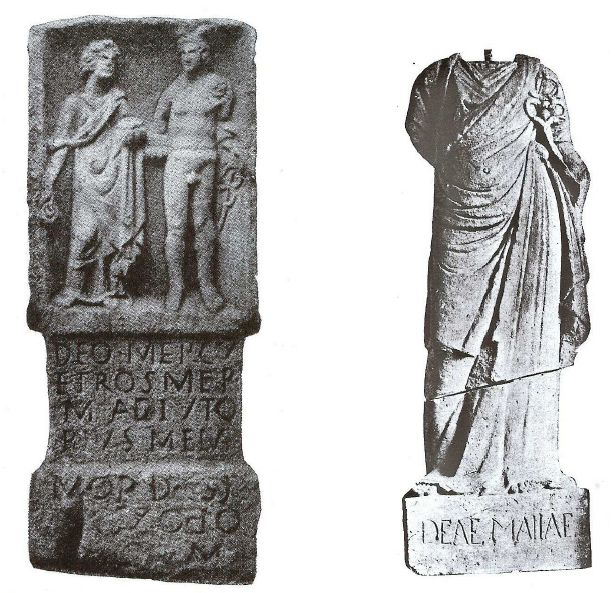
The second epigraphic stele* was discovered in 1615 in Langres, in the territory of the Lingones.891It is now lost and only a somewhat doubtful drawing, made by Montfaucon, remains. It represents the busts of a god with petasus* and a goddess wearing a coat on her shoulders, under which the following inscription is engraved: Deo Mercurio et Rosmerte Cantius Titi filius ex voto, ‘To the god Mercurius and Rosmerta, Cantius son of Titi according ot his vow’ (fig. 31). According to Dondin-Payre, the name of the dedicator Cantius is an indigenous Latin unique name, while the name of his father Titi is Celtic.892Cantius and Titi are peregrines.

As one can notice, the two epigraphic reliefs* from Eisenberg and Langres do not shed light on the nature and functions of Rosmerta, who appears as a mere goddess of prosperity beside the god Mercurius.
Mercurius and other female partners
Mercurius and Maia
The Roman goddess Maia, ‘mother’ or ‘nurse’,893 is the other usual consort of Mercurius, mainly in Alsace, the valley of the Rhine and in the south-east of Gaul. In Greek mythology, Maia, who is the eldest of the seven Pleiades, the daughters of Atlas and Pleione, is a minor figure.894 She is actually not the wife of Hermes/Mercury, as depicted in the Gallo-Roman iconography, but her mother. The Romans held her in high esteem and added to her legend the persecution by Juno and her transformation into a star by her lover.
Mercurius and Maia are honoured together in dedications from Germany895 and from the territory of the Allobroges, notably in Villaz (Haute-Savoie): Mercurio et Maiae T(itus) Coelius, ‘To Mercurius and Maia, Titus Coelius (offered this)’,896 and in Saint-Hillaire (Isère): Mercurio et Maiae G. Verrius Aurelius ex voto, ‘To Mercurius and Rosmerta, G. Verrius Aurelius offered (this stele*).897 In those two inscriptions, the dedicators are Roman citizens, for they bear the duo and tria nomina. The couple is also venerated in the valley of the Rhine, such as in Mertzwiller (Bas-Rhin): Mercurio et Maiae sacrum Sennaus Le[…] filius Gnata Lutevi filia […]ratulla filia Rufino et Quadrato cos.898 This altar is interesting, for the dedicator Sennaus (*Sennāgo-) has a Celtic name,899 as well as his mother Gnata (‘Daughter’)900 and his grandfather Lutevius (‘Swamp Dweller’).901 A fragment of a stele*, discovered in 1845 between the villages of Pfaffenhoffen and Ringeldorf (Bas-Rhin), might have represented the heads of Mercury and Maia with an inscription identifying them: [Mer]c(urio) et Maiae [I]lliomarus [Toc?]issae filius vslm, ‘To Mercurius and Maia, Illiomarus son of Tocissa(?) paid his vow willingly and deservedly’.902 This relief* is now destroyed. The name of the dedicator Illiomarus ‘Great- (?)’ is Celtic,903 as well as the name of his mother: Tocissa is mentioned in another inscription from Strasbourg.904 Their unique name indicates they were peregrines.
Like Rosmerta, Maia is sometimes venerated on her own, such as in the inscriptions from Germersheim (Germany),905 Neustadt (Germany) (see fig. 30),906 Saintes (Charente-Maritime),907 Grenoble (Isère)908 and Lyons (Rhône).909 In Lyons, the inscription [M]aiae aug(ustae) s(acrum), ‘Sacred to the August Maia’, is engraved under a very damaged relief* representing the goddess seated and draped, wearing shoes and probably holding a basket of fruit in her hands.910 Interestingly, Maia is honoured in triple form in a stele* from Metz (Moselle), which echoes the cult of the Matres and Matronae: In Honore[m] Domus Divinae Dis Maiiabus Vicani Vici Pacis.911 Under the inscription stand three veiled goddesses; the two on the left used to hold an apple in their hands. This is the only existing example of a tripled Maia.
Mercurius and Fortuna
A stele* from Glanum (Bouches-du-Rhône) represents a goddess with a huge cornucopia* and a rudder surmounting a sphere, partnering a Mercurius with purse, petasus*, caduceus*, tortoise and goat. Contrary to what Green asserts, this goddess is clearly not Rosmerta, but Fortuna.912 Fortuna is a Roman goddess who personifies Fate and its unknown factors.913 She distinguishes herself by characteristic attributes of her own, such as the rudder, the globe or sphere, the wheel and the bow. Many a relief* from Mayence, Grand, Châtelet, etc, depict her.914 She is sometimes crowned and winged, standing or sitting. In Gaul, she is mentioned in about thirty dedications, generally made by soldiers.915 In addition to Mercurius, she is sometimes associated with healing deities, notably in Germania Superior, or with the Matronae, especially in Germania Inferior.
Mercurius Visucius and Visucia
It is significant that Mercurius is given a Celtic divine epithet Visucius and partnered with a goddess Visucia in an inscription found in 1832 in Köngen, situated to the east of Stuttgart (Germania Superior): Deo Mercurio Visucio et sa(n)ct(a)e Visuci(a)e P(ublius) Quartionius Secundinus decu(rio) c[ivi(tatis)] Suma(locennensis) ex iu(ssu) v.s.l.m, ‘To the god Mercurius Visucius and to the sacred Visucia Publius Quartionius Secundinus decurio civitatis of Sumalocennensis according to an order paid his vow willingly and deservedly’.’ 916 This inscription is engraved on a socle of a statue, but only the feet of the two deities remain (fig. 32). The dedicator bears the tria nomina of the Roman citizen and is part of the political class, for he is a decuriocivitatis*, i.e. the person in charge of public contracts, religious rituals, order, local tax collection, etc.
Visucia undeniably is the female doublet of the god Visucius. She is generally held to be mentioned in another inscription discovered in Trier, but the stone is very damaged and the reading is thus very uncertain: DAE V[…] IÉ CI CVI. 917 In this inscription, she is given the title of sancta, ‘venerable’ or ‘sacred’, which is sometimes given to goddesses in the dedications from the two Germanies. This formula was in use from the middle of the 2nd c. AD to the end of the 3rd c. AD.918 As for Visucius, he is honoured alone in three inscriptions from Heidelberg, Pfalsbourg and Herapel (Germany),919 and associated with Apollo in an inscription from Saverne (Germany)920 and with Mercurius in six dedications from Bordeaux (Gironde), Agoncillo (Spain), Esthal, Hockenheim, Trier and Varuswald (Germany).921
The meaning of their names remains obscure and is still much debated. Delamarre suggests that Visucius might mean ‘crow’, visuco– being possibly cognate with Old Irish fiach, derived from *uisuco– or *uesākos, ‘voracious’ – from an IE root *ues-, ‘to eat one’s fill’.922 As far as Olmsted is concerned, he glosses Visucius and Visucia as ‘the Worthy’ from an IE root *vēsu, ‘good’ or ‘worthy’.923 Visucius and Visucia might also be derived from the root *visu (<IE weid, ‘to know’) meaning ‘who knows’, ‘who foretells’, ‘who sees’, also found in the goddess name Visuna, mentioned in an inscription from Baden-Baden (Germany).924
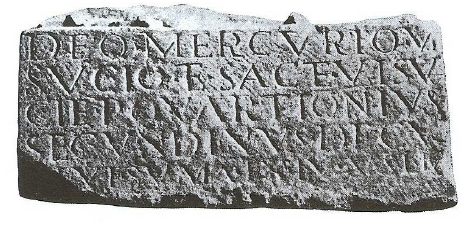
Mercurius with a nameless female consort: Rosmerta?
It seems that many figurations without any inscription are attributed to Mercurius and Rosmerta without firm evidence.925 While Mercurius is easily recognizable by his petasus*, purse, caduceus* and typical animals,926 Rosmerta does not possess any attributes peculiar to her, but generic characters of fertility usually attributed to deities of abundance and prosperity, such as the Matres / Matronae and Classical figures, such as Maia, Fortuna, Venus, etc. While some goddesses can be distinguished in anepigraphic images by typical attributes of their own, such as Nantosuelta with her distinctive pole-house emblem and crow, Rosmerta cannot. Moreover, Mercurius is often partnered in the iconography with other goddesses, such as Maia and Fortuna or mother goddesses of plenty, who bear, like Rosmerta, mere attributes of fertility and abundance. Accordingly, on reliefs* without inscription, such as the ones from Autun (Saône-et-Loire), Auxerre (Yonne), Saint-Moré (Yonne) or Vertault (Côte d’Or),927 it is not possible to assert that the consort of Mercurius is Rosmerta. Similarly, the couple from Néris-les-Bains (Allier), often attested as being a representation of Mercurius and Rosmerta, are actually a figuration of Mercurius with a Nymph or Venus.928 By the same token, Green and Graham Webster both tall into this trap when they claim that Rosmerta was venerated in British water sanctuaries, such as in Bath and in Gloucester, for there is no evidence that the goddess accompanying the god Mercurius on the reliefs* is actually Rosmerta.929 Rosmerta is never attested in the epigraphy from Britain. Moreover, the goddess accompanying Mercurius in the British iconography is often attributed with a sort of small bucket or wooden tub, interpreted as a symbol of plenty, comparable to the cauldron of renewal.930 And Rosmerta is never associated with such an attribute on the Continent. Therefore, this goddess with a bucket should be understood as a different type.
It is nonetheless possible to identify anepigraphic reliefs* with Mercurius and Rosmerta when dedications to the couple were discovered in the same area. Thus, Colette Bémont, who has studied the various non-inscribed iconographical monuments possibly representing the couple, attributes the monuments from Niedaltdorf (Germany),931 Kirkelneuhäusel (Germany),932 Eisenberg (Germany),933 Metz (Moselle),934 Dijon (Côte d’Or), Autun (Saône-et-Loire) and Sens (Yonne – lost)935 to Mercurius and Rosmerta.936 In Niedaltdorf for instance, the inscription to the couple – given above – was found among the ruins of a small temple together with the fragments of a relief* representing Mercurius and a draped goddess. On account of the dedication, the goddess is undoubtedly Romserta.937 Similarly, a stele* found in Metz has Mercurius, naked, with petasus* and caduceus*, offering a purse to a goddess of plenty, who wears a long dress and a coat and holds a cornucopia* in her left hand (fig. 33). The portrayal is combined with an inscription mentioning Mercurius only: In h(onorem) d(omus) d(ivinae) De[o Mercur]io Iu[…], ‘In honour of the Divine House, to the god Mercurius […]’.938 As the relief* was discovered in the same street as the inscription to Mercurius and Rosmerta, engraved on a socle of a statue, the figuration is certainly that of Mercurius and Rosmerta.939
Outside the ‘areas of inscriptions’, it is difficult to determine whether the images of Mercurius with a goddess are representation of Mercurius and Rosmerta. Bémont explains the impossibility – due to the lack and uncertainty of the iconographical evidence – to establish a distinction between Rosmerta and Maia in their attributes.940 The iconographical types she distinguishes are Maia-Rosmerta holding a basket of fruit or a cornucopia*, such as in Niedaltdorf or Kirkelneuhäusel, and Maia-Rosmerta bearing Mercurius’s attributes, such as the purse, for instance in Metz and Eisenberg, or the caduceus* and purse, for instance in Nöttingen and Schorndorf.941
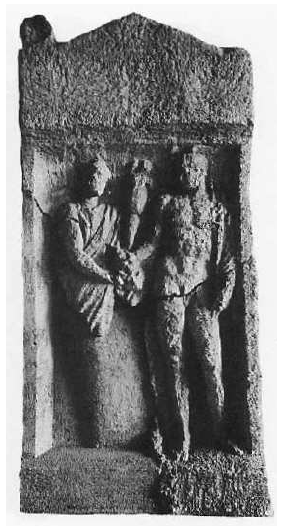
Conclusion
From this study, it follows that Rosmerta is honoured on her own in the centre of Gaul (Aedui, Carnurtes and Arverni) in four inscriptions, two of which are combined with portrayals – a statue in bonze and a relief* in stone. Being mentioned in an inscription coming from the territory of the Ambiani (Somme) and possibly in another from the territory of the Bellovaci (Oise), it can be assumed that her cult was extended to the north of Gaul. As for the worship of the divine couple Rosmerta-Mercurius, attested by twenty-five inscriptions, two of which are accompanied by images, it was particularly concentrated in the north-east of Gaul (Treveri, Mediomatrici, Leuci, Lingones) and Germany Superior (fig. 35). It is interesting to note that the north-east of Gaul seems to have been an area where the cult of Celtic divine couples was important, for Nantosuelta and Sucellus’s worship is also evidenced in this region.
Unlike Nantosuelta, Rosmerta does not distinguish herself in the iconography by peculiar attributes and attitudes. Her representation is very Classical; she is depicted with cornucopiae* and paterae*, representing prosperity and symbolising her role as provider of fertility. Sometimes she holds her partner’s attributes – purse and caduceus* – but these images are not combined with inscriptions identifying her with certainty. While Nantosuelta has a distinctive iconography and a Celtic god Sucellus for partner, Rosmerta has a Classical and basic iconography and is coupled with a Gallo-Roman god, Mercurius: does this mean she is not a Celtic goddess and that her cult is Gallo-Roman? First of all, her name, which is etymologically linked and similar in meaning to Atesmerta and Cantismerta, is undeniably Celtic. The existence of goddesses, whose names refer to the notion of distribution, attests to a significant worship rendered to bounteous goddesses. As for her partner Mercurius, he may have replaced some indigenous god(s), who was/were originally coupled with the goddess. It is true that the epithets Abgatiacus, Excingiorigiatus and Dubnocaratiacus, given to him in Cleinich (Neumagen), Ueß (Mayen) and Champoulet (Loiret) do not support that argument, since they are not divine epithets or names belonging to a previous indigenous god, but names of properties and owners. However, the inscription from Köngen, which associates Mercurius with a Celtic divine name Visucius, coupled with Visucia, clearly proves that Mercurius was linked to indigenous gods through the process of the interpretatio Romana and probably replaced a certain number of them. This could be evidenced by a figuration from Trier,942 which has Mercurius wearing the Celtic torque*, and the statue from Néris-les-Bains (Allier) where he holds a ram-horned snake in his hand:943 these two elements are characteristic of Celtic deities.944
As regards the dedicators (and their father or mother) honouring Rosmerta, a significant number of them have names of Celtic origin. They generally bear the unique name, which indicates they are peregrines. Magiaxus, son of Oxtaeus or Oxtaius, honours the goddess Atesmerta in the forest of Corgebin (Haute-Marne). In Champoulet, a whole family of Celtic origin, owner of a property with a Celtic name, Dubnocaratiacum, pays homage to Rosmerta, Mercurius and Apollo: Marullus, the head of the family, Marossus, his son, and Messa, his daughter. In Saxon-Sion (Meurthe-et-Moselle), Langres (Haute-Marne) and Magny-Lambert (Côte d’Or), the dedicators and their father or mother bear Celtic names: Carantus and Sacer, Cantius and Titi, Oassos (?) and Varadilla. In Morelmaison (Vosges), the dedicator Regalis is a Celtic peregrine*, while in Soulosse (Vosges), an inscription is offered by a woman Albucia and another by Cintusmus, son of Samotalus. Cintusmus is mentioned again in the dedication from near Grand (Vosges). In Metz (Moselle), it is interesting to note that the dedicator Musicus is a peregrine* with a Latin name and that his father bears a Celtic name: Lillutus. The fact that the father chose a Latin name for his son attests to his desire to become Romanized. In Ueß (Germany), the dedicator C. Satu[r]ninius Viriaucus bears the tria nomina of Roman citizens, but his cognomen*, Viriaucus, is undeniably of Celtic origin. By keeping a Celtic name, the dedicator displays his attachment to his indigenous roots. In Gissey-le-Vieil (Côte d’Or), Apronia Avilla bears the duo nomina; she is thus a Roman citizen. While her gentilice* is Latin, her cognomen* Avilla is Celtic. Romanized women often kept a cognomen* which reminded of their Celtic origin and culture, probably because they were somehow the guardians of tradition.
Some of the dedicators are also Roman citizens. They bear either the duo nomina, such asAelius Vestiusnear Grand (Vosges), or the tria nomina, such as L(ucius) Quartillius Quartinus, who pays homage to Cantismerta in Lens (Switzerland), Cneius Cominius Candidus, the probable husband of Apronia Avilla in Gissey-le-Vieil (Côte d’Or) and L(ucius) Servandius Quietus in Worms (Germany). Some of them fulfil civic duties or functions, such as Marcus AdiutoriusMemmorin Eisenberg (Germany), who is a decurio*, Acceptus in Wasserbilig (Germany), who is tabularius sevir augustalis* and the dedicator in Niederemmel, who is a freed tabularius*.
In comparison with men, women are not much represented. Out of four, two of them are peregrines with Celtic names: Albucia in Soulosse and Vadarilla (the dedicator’s mother) in Magny-Lambert. The two other ones bear the duo nomina and are thus Roman citizens: Apronia Avilla in Gissey-le-Vieil (Côte d’Or) and Flavia Pri[mula] in Andernach (Germany).
From this, it follows that Rosmerta was mainly honoured by a population of peregrines of Celtic origin, particularly in the north-east of Gaul, and by Roman citizens or freed slaves in the territory of the Treveri and Germany Superior.
With regard to the functions of Rosmerta, several hypotheses can be suggested. First and foremost, on account of her name and her iconography, it is clear that Rosmerta is a land-goddess fulfilling the role of distribution and sustenance. By dispensing the products of the earth to her people, she offers them prosperity and benevolence. As a certain number of inscriptions and images were discovered in water sanctuaries or near famous curative springs, such as in Gissey-le-Vieil, Escolives-Sainte-Camille, Mont-Sion and Genainville, it can be assumed that Rosmerta had some functions of protection, care and cure. In the inscription from Mont-Sion, the formula pro salute used by Carantus, a Celt who asks for the safety of his son Urbicus, supports that idea. Moreover, the sanctuary of Atesmerta, erected near the source-geyser of the Forest of Gorgebin, where anatomical ex-votos* were discovered, provides evidence of a healing cult rendered to the goddess. Finally, Rosmerta may have endorsed a funerary role, accompanying, protecting and sustaining the deceased in the afterlife, for the inscription near Grand was found inside a tumulus*-tomb where three corpses were interred. Moreover, the Gallo-Latin graffiti from Lezoux, probably mentioning ‘the feasts of Rosmerta’, was unearthed in a funerary well on the necropolis of Chassagne, which would suggest chthonic* and funerary functions.
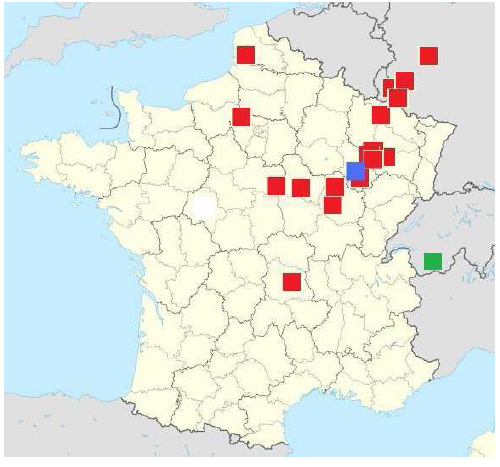
From the 1st c. AD, in certain areas, the cult of Romserta was certainly replaced by the cult of the Roman goddess Maia, who accompanies Mercurius in several inscriptions and depictions from the valley of the Rhine and the centre-east of Gaul (territory of the Allobroges). What is interesting to note is that Maia is sometimes honoured by people of Celtic stock, as the inscriptions from Mertzwiller (Bas-Rhin) and Pfaffenhoffen (Bas-Rhin) show. This attests to the process of Romanization in the religious sphere. The tradition of Maia and Rosmerta in general, indeed, is intermingled and difficult to distinguish geographically and iconographically.
Goddesses Embodying Particular Natural Elements
Introduction
The etymology* of divine names, Gallo-British iconography and Irish literature tend to prove that, while certain goddesses embody the earth and its fertility, others personify particular elements of nature, such as trees, forests, plants and animals, or are attached to particular features of the landscape, such as hills or mountains. While there is epigraphic and iconographical evidence of bear goddesses, the existence of a deer goddess can be questioned. Then, the data indicating evidence of a worship rendered to goddesses of vegetation will be assembled and analyzed. Finally, attention will be payed to goddesses whose names refer to highness or high places, for this evidences the sacredness of mounts. Were those goddesses simple deification of animals, trees and mounts? What were their essence and functions? Which cults might have been attached to them?
It is interesting to note that both in Ireland and Gaul some goddesses must have personified hills or mounts. The notion of ‘highness’ seems to have had an important part in the cults of the Celts, for goddesses bearing names denoting highness and eminence are of a quite significant number. The goddesses Arduinna, Brigit, Briganda, Brigindona, Bergusia, Bergonia all have indeed names referring to elevation, while Andei, Soio and Alambrima may be the personification of specific mounts, for their epithets can be related to names of hills or mountains, located in the area where the inscriptions were discovered. Who were those goddesses of high places?
Animal Goddesses?
Artio (‘the Bear’), Andarta (‘the Great/Powerful Bear’)
The goddess Artio is attested in the territory of the Treveri by three inscriptions found in Weilerbachthal (Luxembourg): Artioni Biber, ‘To Artio Biber (offered this)’,945 in Daun (Germany): Artio Agritius, ‘To Artio Agritius (offered this)’,946 and in Stockstadt (Germany): [deae A]rtioni Sacr(um) S. Sexti S[…] [d ]e sv[o pos, ‘To the Sacred goddess Artio, S. Sextus S[…]?’.947 The two first dedicators Biber and Agritius are peregrines, since they bear the unique name, but have Latin names. They are thus in the process of becoming Romanized. In the inscription from Stockstadt, the dedicator bears the tria nomina of Roman citizens. The fourth inscription was discovered in 1832 in Muri, near Bern (Switzerland), in the territory of the Helvetii. It is the most interesting one, for it is engraved on the socle of a famous bronze group, dated 2nd c. AD: Deae Artioni Licinia Sabinilla, ‘To the goddess Artio, (from) Licinia Sabinilla’.948 The bronze group shows a seated goddess, facing a huge bear, which is looking at her with its mouth open. The bear is situated beneath a tree probably symbolizing the forest where it lives (fig. 35). The dedicator is a woman, who bears the duo nomina and Latin names. She is thus a Roman citizen.

The goddess Artio has the common posture and attributes of plenty of the Classical Mother Goddesses. She wears a long tunic and a diadem and was originally seated on a throne. She has a patera* and fruit in her lap and holds a sort of stick surmounted by a basket of fruit in her left hand. Therefore, she does not have any particular attributes indicative of her indigenous character.
As regards the bear, it cannot be taken for a particular Celtic feature characterizing the goddess. It is for instance the characteristic emblem of the Greco-Roman divine huntresses Artemis and Diana.949 Although the bear was a widespread animal in western and northern Europe during the Iron Age, probably hunted by the populations for prestige and for its fur and skin, bear imagery is almost nonexistent in Romano-Celtic iconography, except for a few representations on coins950 and some jet bear-shaped amulets principally discovered in tombs from North Britain, such as in Bootle (Lancashire), Malton (Yorkshire) and York (Yorkshire) (fig. 36).951 The bear does not seem to have held an important part in death-rituals either, for bones of bears are not found where important amounts of skeletons of other animals, such as oxes, pigs, sheep, goats and horses, are.952 The only data to date are claws and teeth of bears discovered in the La Tène sepulchres of Mont-Troté, Acy-Romance and Clémency (Ardennes), which can be understood as talismans or ornaments for the deceased.953
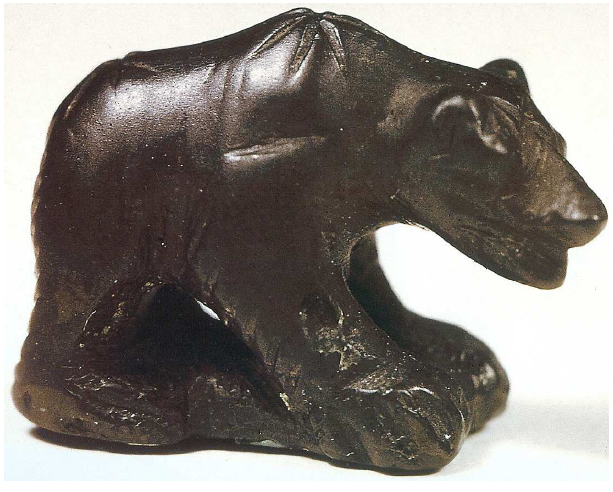
If the iconography of Artio is not of indigenous character, her name is undoubtedly Celtic. In the Celtic language, two words designate the bear. The first one matu-, cognate with Old Irish math, ‘bear’, is for instance comprised in the Gaulish proper name Matugenos (‘Born of the Bear’), in the Welsh hero’s name Math von Mathonwy (‘Bear son of a Bear Cub’) and in the Irish personal name Mathghamhain (‘Bear’) and surname Mac Mathghamhna (Mac Mahon, ‘Son of the Bear’).954 Interestingly, a Diana Mattiaca is honoured in an inscription from Wiesbaden (Germany): Dianae Mat[ti]acae [ex] voto, ‘To Diana Mattiaca (this monument) was offered’.955 Mattiaca can be viewed either as a descriptive epithet, based on matu, mati, matiacos, ‘favourable’, or as a divine name referring to a goddess in bear-shape.956 Diana Mattiaca could therefore mean either ‘Diana the Favourable’ or ‘Diana the Bear-Shaped’. Such is also the case of the god Matunus, mentioned in a single inscription from High Rochester (Northumbria), whose name can be glossed as ‘Bear’ or ‘Favourable’.957 Most of the scholars would opt for a descriptive epithet,958 but the idea of a goddess in the shape of a bear should not be ruled out. Given that one of Diana’s emblematic animals is the bear in Roman mythology, she might have replaced an indigenous bear-goddess originally venerated in the area. Mattiaca may also be an ethnonym* referring to the tribe of the Mattiaci ‘the Good People (?), who lived in the area of today’s Wiesbaden, the southern Taunus mountain range and the tract of Wetterau, on the right side of the Rhine.959 As the inscription was found in Wiesbaden, Diana Mattiaca may have been the goddess presiding over the Mattiaci. The strong likelihood is that this word for a bear reflects an ancient taboo* concerning the animal: mat- meant ‘good’ and thus reference to the bear was in terms of ‘the good beast’.
The other, and original, word for ‘bear’ in Celtic was artos. It is cognate with Old Irish art, Welsh arth and Old Breton ard, arth-, simultaneously signifying ‘bear’ and ‘warrior’.960 The goddess Artio (‘Bear’) is etymologically related to the goddess Andarta, whose cult is very certainly local, for the eight inscriptions honouring her come from Die and the area of Die (Drôme), in the territory of the Vocontii.961 Her name is composed of the intensive prefix ande-, ‘very, great, big’ and of the root arta, ‘bear’. Andarta is thus the ‘Great Bear’.962 In five inscriptions, Andarta is attributed the title August, which is redolent of her sacredness and potency and indicates that her cult was made official in the Roman pantheon, probably towards the end of the 1st c. AD. The use of the votive formula dea indicates that the dedications are not prior to the middle of the 2nd c. AD. As for the dedicators, they all bear the tria nomina of Roman citizens. The three following dedications were discovered in Die: Deae Aug(ustae) Andartae L. Carisius Serenus (…?) vir aug(ustalis) v(otum) s(ovlit) l(ibens) m(erito), ‘To the August Goddess Andarta, L. Carisius Serenus […] augustal sevir (?) paid his vow willingly and deservedly’ ;963 Deae Aug(ustae) Andartae T. Dexius Zosimus, ‘To the August Goddess Andarta T. Dexius Zosimus (offered this)’964 and De(ae) Aug(ustae) Andartae M. Iulius Theodorus, ‘To the August Goddess Andarta M. Iulius Theodorus (offered this)’.965 An inscription was found in Aurel, a town situated 15 kms from Die: Deae Andartae Aug. Sext. Pluta[ti]us Paternus ex voto, ‘To the August Goddess Andarta Sext(ius) Plutatius Paternus offered this’,966 while another was unearthed in Sainte-Croix, located about 9 kms from Die: Deae Aug(ustae) Anda[rtae], ‘To the August Goddess Andarta’.967 The following inscription was discovered in Le Cheylard, situated 40 kms from Die: Deae Andar[tae], ‘To the Goddess Andarta’.968 A dedication comes from Deam, a hamlet nearby Die: Deae Aug(ustae) Andartae M. Pomp. Primitivus ex voto, ‘To the August Goddess Andarta M. Pomp(ius) Primitivus offered this’.969 The final inscription, coming from Luc-en-Diois, was reconstructed by Pierre Wuillemier: [D]eae Aug(ustae) [Andartae] [S]ex(tus) Matici[us, ‘To the August Goddess Andarta Sextus Maticius (offered this)’.970
Some god names might also refer to the bear. Such is the case of Artaius who is equated with Mercurius in an inscription from Beaucroissant (Isère).971 His name is generally regarded as meaning ‘Bear’(Arta-ius), but Delamarre proposes to break it down as Ar-tāius, that is ‘Great Thief’.972 The god Artahe, Artehe, venerated in seven inscriptions from Ourde and St-Pé-d’Ardet (Haute-Garonne) might also signify ‘Bear’, but his name is likely to be more Iberian than Celtic.973
It is difficult to decide on the nature of Artio and Andarta, for the peaceful representation from Muri is probably misleading and not representative of the original functions of those goddesses, who are generally understood as personifications and protectresses of the bear or as patronesses of the forest and hunting.974 The bear, which was a dangerous and difficult animal to hunt, was certainly praised for its strength and majesty. It must have thus been a symbol of war and kingship. Significantly, famous kings in Welsh, British and Irish medieval literatures bear names literally signifying ‘bear’, such as the mythical King of Ireland Art, the son of Conn Céadchathach and the illustrious KingArthur, who appears in the 11th- and 14th-century Welsh legends Culhwch and Olwen and The Mabinogi. 975 On account of their name and the bronze group from Muri, it is clear that Artio and Andarta are bear-shaped goddesses protecting the animal. Nonetheless, as Jacques Lacroix and Ross give us to understand, those goddesses were certainly more than simple ‘woodland-goddesses’.976 They must have been prayed to and honoured for the magnificence and force the bear incarnated and originally had war or royal functions. To support that idea, some scholars attempted to relate Andarta to the war-goddess Andraste, mentioned in Dio Cassius’s History of Rome (LXII, 6, 7) (see Chapter 3).977 This is however highly unlikely, for their names do not seem to be similarly constituted. And-arta (‘Great Bear’) is definitely different from An-drasta (‘the Invincible’), composed of a negative prefix an, ‘non’ and a root drastos, ‘to vanquish, to oppress’.978
A Celtic Deer Goddess?
Flidais, in Modern Irish Fliodhais, is usually understood as a woodland deer-goddess, presiding over the wild animals, forests and hunting, which is why she is generally compared to the Greek Artemis and Roman Diana. The analysis of the various texts mentioning her will however demonstrate that these ideas are inaccurate and give a misleading image of the goddess.
First of all,Flidais is remembered in Irish medieval literature for her cattle called buar Flidais (‘cattle of Flidais’), mentioned for instance in the Lebor Gabála Érenn [‘The Book of Invasions’], in which she is said to be one of the Tuatha Dé Danan and the mother of four daughters:
‘Flidais, diatá buar Flidais; a cethri ingena, Airgoen 7 Bé Chuille 7 Dinand 7 Bé Theite.
Flidais, of whom is the ‘Cattle of Flidais’ ; her four daughters were Argoen and Be Chuille and Dinand and Be Theite.979 ’
In T á in B ό Flidais [‘The Cattle Raid of Flidais’], the earliest versions of which date from the 9th and 10th c., she is made the wife of Fergus Mac Rόich and is similarly associated with cattle and cows. Here is an extract of the earliest version (9th c.) contained in the Book of Lecan:
‘Et doberat Flidais assin dún, 7 dobreth a m-bái di chethrai and .i. cét lulgach 7 secht fichit dam, 7 tricha cét di chethrai olchena.
And they took Flidais out of the fortress and they took all the cattle that were there and a hundred calved cows and seven twenties calving cows and thirty hundred of cattle in general. It was after that that Flidais went to Fergus Mac Róich.980 ’
As for the translation by Olmsted of the 10th-century version of T á in B ό Flidais, comprised in the Book of the Dun Cow, it is inaccurate and misleading.981 Flidais is indeed not identified with cows and does, as he maintains, but with cows and bullocks (damaib):
‘7 toberat Flidais leo assin dun […] 7 oberat a m-bái di cethrib and .i. cet lulgach, 7 da fichit arc et do damaib, 7 tricho cet di mincethri olchenae […] Ba sé sin búar Flidais.982
And they took Flidais out of the fortress […] And they took all of the cattle that were there, that is a hundred calved cows and a hundred and forty of bullocks and thirty hundred of small cattle in general […] That was the cattle of Flidais.983 ’
Flidais is once again paired with cows in a text entitled Benn Boguine [‘The Peak of Bogun’],984 dated 9th c., mentioned in the Metrical Dindshenchas:
‘Fecht dia tánic sunda, mar cach ngábit ngalla, ón mnaí cen lúaig lumma bó da búaib dar Banna.
Flidais ainm na mná-sin ingen Gairb maic Grésaig ind fairenda fial-sin, ben Ailella fésaig.
Co rothόed in bó-sin dá lόeg ar in lúth-sin, gnό garb, nárbu gnáth-sin, bό ocus tarb don túr-sin.Hither came, once on a time, as it were any foreign […] straying from a woman, a beast of price, one of her cows, across the river Bann.
Flidais was the name of that woman, daughter of Garbh son of Gréssach; that well-accompanied generous one, wife of bearded Ailill.
That cow dropped two calves on that run; a rough business, which was not unusual, a cow and a bull on that journey.985 ’
Thurneysen believes that Flidais is the archetype of the woodland-goddess, guardian of the forests and wild animals, comparable to Diana or Artemis.986 To support this idea, he proposes to relate the name Flidais to the word os signifying ‘faun’. This theory would imply that Flidais is written in two words, that is Flid Ois, ‘wetness of faun’, with the significance of ‘untamed’. This would give a genitive buar Flid Ois. It is however noticeable that this form never appears in the texts. In addition to always being written as one word, Flidais is never spelt with the letter ‘o’. Therefore, it is clear that Flidais cannot be connected to the word os, ‘faun’ and be envisaged as a woodland-goddess. Besides, Ó hÓgáin points out that the antiquity and genuineness of Flidais is problematic, for her name is never declined in the texts, whereas all the other divine names are.987 Indeed, Flidais should be Flidaise in the genitive, and buar Flidais (‘Cattle of Flidais’) should be written buar Flidaise, but these forms are never encountered in the texts. This must be indicative of a medieval invention. In view of this, it must be acknowledged that Flidais is highly likely not to be a genuine goddess. To support that idea, it is necessary to study her relation to Niad Ségamain, to which her association with cows and does is actually due.
In the c. 9th-century Corpus Genealogiarum Hiberniae [‘Corpus of the Geneaologies of Ireland’], a corpus containing all the important Irish pedigrees and genealogical material from the earliest literary period down to c. 1,500 AD, Flidais is said to be the mother of Niad Ségamain and they are both associated with milking, cows and does:
‘Niad-Segamain lasa mbligtis diabulbuar .i. baī 7 elti. Flidais Foltchaīn a māthair diambtar bāe elti
Niad-Segamain, by whom were milked double cattle, that is cows and does. Flidais ‘the Fine-haired’, his mother, to whom does were cows.988 ’
If the name Flidais seems not to be genuine, Niad Ségamain undoubtedly is. The antiquity of his name is certain, for the first element Niad, known in Old Irish as nía, genitive niath, ‘warrior’, is derived from a Celtic form *netos meaning ‘leader’ or ‘warrior’, attested as a divine name in inscriptions from Spain (Lusitania): Neto in Conimbriga and Netoni in Trujillo.989 Similarly, the second element of his name Segamain is similar to the god name Segomo(ni), known from various dedications found in Gaul.990 Segamain and Segomoni are both based on the Celtic root sego- meaning ‘force’, ‘vigor’, ‘victory’.991 Finally, the name of Niad Ségamain appears in two Ogam scripts, dated 5th or 6th c. AD, discovered in Waterford: Neta Segamonas and Netta Segomonas.992
The fanciful etymology* proposed for the name Nia Ségamain in the c. 13th-century Cóir Anmann [‘The Fitness of Names’] is obviously due to the inability of the medieval writers to understand its significance. This misled them to relate Ségamain to words, such as seg ‘milk’, segamail, ‘milk-producing’ or ségnat, ‘little deer’, extrapolating from this that Nia Ségamain was connected to the milking of cows and does, which is pure medieval speculation.993 The text explains that his father is Adammair and his mother Flidais:
‘Niadh Séghamain .i. is ségh a maín, ar is cuma nόblighthea bai 7 eillti fon aenchumai cach día ré linn, ar bá mόr in main dό na neiche sin sech na righu aili. Ocús is sí in Flidhais sín máthair Níadh Ségamain maic Adamair, 7 do bhlightheá a flaith Niadh Ségamain in búar sin .i. diabulbhúar .i. bá 7 eillti do bhliaghan re linn Níadh Ségamain, 7 issí a máthair tuc in cumhachta tsidhamail sin dó.
Nia Ségamain, that is, ség ‘deer’ is a máin ‘his treasure’ ; for during his time cows and does were milked in the same way every day, so to him beyond the other monarchs great was the treasure of these things. And it is that Flidais (above-named) who was the mother of Nia Ségamain son of Adammair ; and in Nia Ségamain’s reign those cattle were milked, that is, double cattle, cows and does, were milked in the time of Nia Ségamain, and it was his mother that gave him that fairy power.994 ’
And in the Lebor Gabála Érenn [‘The Book of Invasions’], it is worth noting that his father is called:
‘Adamair Flidais de Mumain .i. mac Fhir Chorb.
Adamair Flidais of Mumu, son of Fer Corb.995 ’
This tends to indicate that Flidais was originally an epithet for Adamair and must have been misunderstood by some glossators as a separate name designating the wife of Adamair. From this was invented the supernatural female figure Flidais to whom were given the same fanciful functions of milking and protecting cattle, cows and does as her son Niad ; those attributes actually ensuing from the medieval speculations over the significance of Niad Ségamain’s name.
From this, it follows that Flidais is a pure invention of medieval writers and therefore not a goddess in origin. Moreover, she is not a deer-goddess, protecting and reigning over the wild animals and the forest, as it is often claimed by scholars,996 but presides over domestic animals, for medieval literature associates her with cattle and cows. She is sometimes related to does because of her filiation to Niad Ségamain, but as pointed out, this relation in only due to an etymological speculation in the medieval period. Her association with does might also have been encouraged by an equation with Greek Artemis, who is usually accompanied by a doe in the iconography.997 As for the belief, advanced by Marie-Louise Sjoestedt, in Celtic Gods and Heroes – which has unfortunately been repeated in many works – that Flidais is a woodland deity reigning over the beasts of the forests and travelling in a chariot drawn by deers, there is no textual evidence for such an idea.998 This assumption by modern scholars must come from the discovery of votive models of carriages, pulled by stags, oxen or swans, sometimes with a divinity standing in the middle, such as the bronze model cult wagon, dated 7th c. BC, from Strettweg (Austria). In the centre, a female deity supports a massive vessel with her head and two hands and is surrounded by deer, horses and soldiers (fig. 37).999 The theory of Flidais driving a cart led by deer may have also sprung from a fanciful assimilation with Diana, who is sometimes represented on coins driving a chariot drawn by does (fig. 38).1000

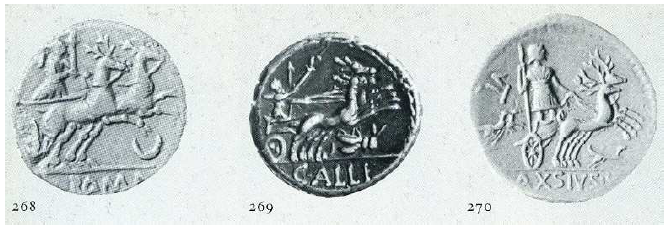
As regards Gaulish mythology, the deer cult seems to be represented mainly by gods, the most significant example being Cernnunos, whose name is generally accepted as meaning ‘the Horned One’.1001Cernunnos is known from a single inscription engraved on one of the four sides of the Nautes Parisiacae monument, dated c. 14-37 AD, discovered under the choir of the Cathedral Notre Dame de Paris, in Paris.1002 The name Cernunnos is engraved above the representation of a bearded god wearing two antlers, from each of which a torque* hangs (fig. 39).1003 This representation is very similar to the god figured on one of the plaques of the Gundestrup Cauldron (fig. 40).1004 The god is seated cross-legged and has long antlers coming out of his skull. He wears a torque* around his neck and holds another one in his right hand. In his left hand is a ram-headed snake, which is a typical Celtic mythological animal. The god is surrounded by various animals: a huge stag with long antlers stands on his right-hand side. On account of those two representations, it seems that the antlers, the torque* and the cross-legged sitting position are the attributes particularizing Cernunnos. It is nonetheless difficult to assert with certainty that all the portrayals of antlered gods, such as the relief* from Reims, the statuette from Autun or the relief* from Vendoeuvres (fig. 41) are figurations of Cernunnos.1005 The cult of a god in the shape of a stag may be reflected in Irish tradition in the supernatural figure of Derg Corra, a weird servant of Fionn mac Cumhaill, dismissed after one of Fionn’s lovers had fallen for him. Fionn went to search for him one day in the forest and saw him in a tree partaking a meal with a stag, a blackbird and a trout. This legend, dating from the 8th century, entitled The Man in the Tree, relates that Derg Corra went about the forest “on shanks of deer”, which is redolent of his shape-shifting power.1006 It is also worth noting that his name means ‘the Red Peaked One’. This, according to Ó hÓgáin, relates him to Cernunnos (‘the Horned or Peaked One’).1007 Other names in the Fianna lore may be evocative of such a cult. When he was young, the hero Fionn mac Cumhaill was called Demne, which is seemingly a corruption of damne, ‘little stag’.1008 Furthermore, the name of his son Oisín, earlier Oiséne, is a diminutive of the word os, ‘fawn’: Oisín is therefore the ‘Little Fawn’.1009 Finally, the name of the grand-son of Fionn mac Cumhaill, Oscar, may signify something like ‘deer-love’.1010 It is clear that deer cults and names particularly survived in the Fianna lore because of Fionn’s passion for deer-hunting.1011
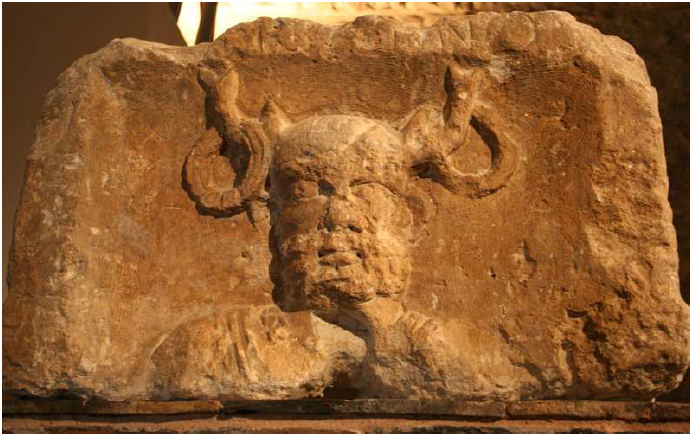


Representations of female deities with deer antlers are almost non-existent. There are only two instances, the place of discovery of which is imprecise and uncertain. The first example come from the Puy-de-Dôme and is now in the Musée de Clermont-Ferrand (fig. 42),1012 while the other example was found in Besançon (Doubs) and was then believed to be lost, but it is actually the statuette housed in the British Museum (fig. 42).1013 Those antlered goddesses are portrayed seated cross-legged, holding a patera* and a sort of bowl in their hands. Two other horned or antlered goddesses may be depicted on a fragment of pottery from Richborough (Kent), showing the bust of a goddess, and on the stone from Ribchester (Lancashire), but those instances remain questionable.1014 Wearing antlers and sitting cross-legged, those atypical goddesses could be viewed as the female equivalent and consort of Cernunnos. This might indeed be the case, for female partners can bear the attributes of their consort. As we noted above, the goddess accompanying Mercurius on some reliefs* from the east of Gaul sometimes has a purse and caduceus*.1015 However, Stéphanie Boucher points out that while the cross-legged antlered god is sometimes associated with a goddess in the imagery, the latter is never pictured crouching or antlered.1016 The goddess is a mere Mother Goddess bearing attributes of fertility.1017 Consequently, the two antlered goddesses from Clermont-Ferrand and Besançon cannot be envisaged as consorts ofCernunnos.

Their nature and functions are thus somewhat puzzling. They are undoubtedly not fountain- or river-goddesses as Camille Jullian suggests.1018 In Roman mythology, rivers are indeed personified by powerful bearded gods with two horns on their forefront or in the shape of bulls, such as the river god Achelous.1019 In Mosella, Ausonius also specifies that the river Mosel is horned.1020 Being female deities, definitely not wearing horns but antlers, those two goddesses cannot be viewed as personifications of rivers. According to Boucher, the cross-legged position and the antlers can be interpreted as “supplementary powers” magnifying the nature of the Mother Goddess,1021 but it must rather be the survival of some ancient belief in deities in deer-shape. In support of that idea comes an inscription engraved on a column discovered at Dobrteša vas, near Šempeter, in the territory of Celeia (Croatia), dedicated to the goddess Carvonia, whose name literally means ‘Doe’. It is based on the Celtic word carvo signifying ‘stag’, ‘deer’, cognate with Irish carr, Welsh carw, Old Cornish caruu, Breton karo.1022 The significance of her name implies that the goddess was worshipped in the shape of a deer, just as Artio (‘Bear’) must have been in bear shape or Damona (‘Cow’) and Bóinn (‘Cow White Goddess’) in bovine shape. The inscription reads: [Ca]rvoniae Aug(ustae) sacr(um) p[r]o salute C[n.] Atili Iuliani, ‘Sacred to the August Carvonia for the safety of C[n.?] Atilius Iulianus’ (fig. 43).1023 The fact that the dedication was made for the safety of Cn. Atilius Iulianus, who bears the tria nomina of Roman citizens, tends to indicate that Carvonia was a protective and salutary goddess. Šašel Kos compares her to Artemis/Diana and makes a woodland hunting goddess of her.1024 This dedication to a deer-goddess serves to illustrate the representations from Clermont-Ferrand and Besançon, where the goddesses have only kept the distinctive elements of the deer, that is the antlers.
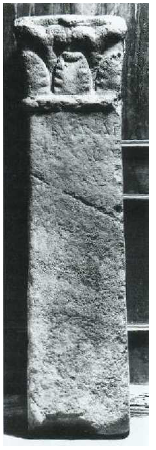
Moreover, the concept of a deer-shaped goddess is well represented by several legends of Irish medieval literature which relate that certain female characters have the ability to transform into a doe. An 11th-century legend belonging to the tradition of Fionn mac Cumhaill tells that Blái Dheirg,1025 the mother of Oisín, generally appeared in the shape of a doe and gave birth to Oisínin this form, justifying thus his name ‘Little Fawn’:
‘Ticed i rricht eilte
hi comdáil na díbergge.
co ndernad Ossine de
ri Blai nDeirgg i rricht eilte.1026Blái used to come in the shape of a doe
And join the díbherg-band
So that Oisín was thus begotten
Of Blái Derg in the shape of a doe.1027 ’
The legend survived in 18th- and 19th-century popular oral versions of both Ireland and Scotland with some folk variants. They relate that Fionn’s wife was turned into a doe after being enchanted by a nasty personage and that she gave birth to Oisín while hunted by Fionn.1028 The pattern of the supernatural lady transformed into a deer appears in another 12th-century text of the Fianna cycle, Accallamh na Senórach [‘The Colloquy of the Old Man’], in which Caoilte mac Rónáin, a loyal friend of Fionn mac Cumhaill,1029 is told by the underworld lord (‘The Dark One’)1030 on a visit to the otherworld ráth (fortified place) that he sent the lady Máil to him in the form of a deer so as to allure him to his place. The meaning of that legend is that Donn had attracted Caoilte and a Fianna troop to visit him by using the ‘deer’ as a decoy, while the Fianna were hunting. They conversed with Donn and the Tuatha Dé Danann, feasted with them, and spent the night in the ráth:
‘[…] 7 ro chuirsemar in ingin Máil út ar do chennsa co Toraig thuaiscirt Eirenn, ar-richt baethláig allaid, 7 ro lensabairsi hé co rangabair in síd sa, 7 in maccaem út atchithi 7 in brat uaine aendatha uimpi ac in dáil, issí sin hí’, ar Donn.
[…] and we sent that maiden Máil to meet you [i.e. Caoilte] to Tory (Island) in the north of Ireland, in the shape of a young wild deer-calf, and ye followed her until ye reached this dwelling, and the young one that ye see with the fully green mantel on her, that is her’, said Donn.1031 ’
This aspect is also mirrored in a 12th-century poem, entitled Faffand, comprised in the Metrical Dindshenchas, which recounts how the supernatural woman Aige was changed into a wild doe by the evil spirits:
‘Broccaid brogmar co n-gním gíall do chiniud gorm-glan Galían, dó ba mac Faifne in file, ní gó taithme tiug-mire.
Ba hí máthair in maic maiss Libir ind láthair lond-braiss; ingen dóib in dían dírmach ind Aige fhíal il-gnímach.
Oll-mass in cethrur cáem cass; ba clethchur sáer co sognass; athair is máthair co n-áib, ingen is bráthair bláth-cháin.
Tucsat na siabra side– nír gním tiamda téithmire– delbsat i n-deilb láig allaid Aigi sáir co serc-ballaib.
Roshír h-Érinn or i n-or re cach n-albín rúad rogor, corchúardaig Banba m-brethaig co calma fo chaém-chethair.
Tarnic a gním is a gal, fríth sund co sír a sernad; tucsat i m-brianna i m-bine fianna Meilgi Imlige.
Broccaid the powerful with winning of hostages, of the bright and famous race of the Galian, he had a son, Faifne the poet; the record of his final madness is no falsehood.
It was she was the mother of the comely son,– even Libir quick and eager of mood: their daughter was the swift lady of the hosts Aige, the noble and skilful.
Exceeding fair were the four, curled and gentle; they were a noble kin, of virtuous behaviour, the father and the lovely mother, the daughter and the brother soft and fair.
The evil spirits made an onset (it was no feeble deed of wanton folly):–they changed into the form of a wild doe the noble Aige of the love-spots.
She traversed Erin from shore to shore fleeing before all the fierce and fiery packs; so that she coursed round Banba, land of judges, bravely, four fair times.
Her doings and her valiance had an end, here came to pass her final dissolution; they tore her in pieces in their wickedness, did the warriors of Meilge of Imlech.1032
The two Gaulish statues of antlered goddesses from Clermont-Ferrand and Besançon, the inscription from Dobrteša (Croatia) dedicated to the goddess Carvonia, whose name literally means ‘Doe’, and the 11th- or 12th-century Irish legends telling of deer-shape-shifting goddesses are suggestive of a belief in the existence of a Deer Goddess in Celtic times. Flidais, however, cannot be understood as an indication of such a cult, for, as demonstrated, she is not a genuine goddess and is clearly not related to does but to cattle. Her presumable association with deer is actually due to fanciful and inaccurate medieval and modern interpretations.’
Goddesses of the Plant Kingdom
The plant kingdom was particularly revered in ancient times, as proved by legends, classical accounts, iconographic and archaeological evidence, and by divine, proper and tribal names.1033 The sanctity of plants and trees can be explained in several ways. First and foremost, vegetables and the fruit of some trees, such as those of oak, apple-tree or hazel, were highly-valued foodstuffs, being both nourishing and easily-accessible. Secondly, some species of plants and trees were specifically used for curing pains and illnesses. The wood of certain trees was also used in the making of habitations, weapons and tools, enabling people to grow food, hunt and protect themselves. In times of storm and rain, trees and forests could also serve for shelter to the population. Finally, as Paul Friedrich demonstrates in his analysis of tree names in Indo-European languages, certain trees seem to have held a peculiar and significant place in the religious and cultural sphere: yew, beech, birch, linden and more particularly oak.1034
The ‘Cosmic Tree’: the Axis of the World
The mysticism of the tree springs from its longevity, its great presence, its imposing majesty and its impressive height and size: it overhangs the valley and dominates the world. Moreover, the tree reunites and links the three parts of the cosmos in itself. Rooted in the chthonic* world, it stands out with its trunk and boughs in the terrestrial world, while its foliage spreads towards the celestial world. The tree thus represents the intermediary between the divine and human worlds and symbolizes the axis of the world. The ‘world tree’ or ‘cosmic tree’ is a recurrent theme in world mythologies.1035 The most suggestive example is the Norse ash tree Yggdrasil, which is said to be situated at the centre of the world.1036 Its branches spread all over the earth and towards the sky, the gods gather at its foot and springs, giving access to absolute knowledge, gush forth from its three roots, as this extract from the Edda by Snorri illustrates:
‘Þriðja rót asksins stendr á himni, ok undir þeiri rót er brunnr sá e heilagr er heitir Urðar brunnr. Þar eigu guðin dómstað sinn.
The third root of the ash extends to heaven, and beneath that root is a well which is very holy, called Weird’s well. There the gods have their court.1037 ’
In Irish mythology, four trees – Bile Tortan (‘Tree of Tortu’), situated in Ardbraccan, near Navan (Co. Meath), Eó Mughna (‘Yew of Mughain’) at Mughain (Co. Clare), Craobh Uisnigh (‘Bough of Uisnigh’) at Uisneach (Co. Westmeath), Eó Rosa (‘Yew of Ros’) at Old Leighlin (Co. Carlow)and Craobh Dháithí (‘Bough of Dháithí’) at Farbill (Co. Westmeath) – were believed to be sacred. 1038 Bile Tortan, a gigantesque 150 metre-high and twenty-five metre-wide ash tree, situated in the territory of the Uí Tortan sept*, is sometimes described as the ‘world tree’. This tree, which fell down in the 7th c. AD, is said to have existed since the beginning of times and its branches, full of birds and fruit, spread up to the sky.1039 The bile, ‘large tree’, ‘tree trunk’ or ‘post’, from Celtic *bilios, generally had an atypical form and was believed to be the dwelling of the gods.1040 The chiefs of tribes and kings were inaugurated under its branches.1041 The ash tree Craobh Uisnigh was also regarded as the ‘world tree’ because it was believed to be situated at the exact centre of Ireland; hence its nickname ‘the navel of Ireland’. According to tradition, it fell down in the 7th c. AD.1042
Nell Parrot, analyzing the representations of sacred trees on monuments from Mesopotamia and Elam, explains: “There is no cult of the tree in itself; under such a figuration always lies a spiritual entity.”1043 In a poem of the Rennes Dindshenchas, entitled Éo Rossa, which depicts the five sacred Irish trees and tells how they fell, the Tree of Ross is described as “a firm strong god”:
‘Eó Rossa 7 Eó Mugna 7 Bili Dathi 7 Craeb Uisnig 7 Bili Tortan, coic crand sin.
Eo Rosa, ibar é. Sairtuath co Druim Bairr dorochair, ut Druim Suithe cecinit: Eo Rosa, roth ruirech recht flatha, fuaim tuinni, dech duilib, diriuch dronchrand, dia dronbalc […].The Tree of Ross and the Tree of Mugna and the Ancient Tree of Dathe and the Branching Tree of Uisnech and the Ancient Tree of Tortu – five trees are those.
The tree of Ross is a yew. North-east as far as Druim Bairr it fell, as Druim Suithe (‘Ridge of Science’) sang: Tree of Ross, a king’s wheel, a prince’s right, a wave’s noise, best of creatures, a straight firm tree, a firm-strong god […].1044 ’
The belief in Tree-Gods is evidenced in the epigraphy of Gaul. A MarsBuxenus, whose namemight be derived from a Celtic stem *box-, *bux meaning ‘wood’,1045 is mentioned in an inscription from Velleron (Vaucluse).1046 The god Fagus, honoured in Tibiran (Hautes-Pyrénées), St-Béat (Haute-Garonne) and Générest (Hautes-Pyrénées), has a Latin name signifying ‘Beech’ which is undeniably the transcription of an indigenous theonym*.1047 The god Expercennius, mentioned in a dedication from Cathervielle (Haute-Garonne), might be an oak god.1048 In the area of Angoulême (Charente), a god called Robori was worshipped. His name is generally glossed as ‘Sessile Oak’, but Delamarre suggests it rather means ‘Very Furious’ (Ro-bori).1049
As their names indicate, some goddesses are also the personification of a tree. A Celtiberian goddess called Drusuna is closely related to the tree, since her name is based on the stem dru– meaning ‘tree’, ‘oak’.1050 Drusuna (‘Divine Tree or Oak’) is venerated in a dedication from Segobriga (Catalogne): D[-]sunae [–] L(ucius) V[—] H[—]A v(otum) s(olvit) l(ibens) m(erito), ‘To Drusuna L(ucius) V[…] H[…] paid his vow willingly and deservedly’,1051 and in two inscriptions from San Esteban de Gormaz (Vieille-Castille): Drusune Cisa Dioc(um) Suattan(i filia) v(otum) s(olvit) l(ibens) m(erito), ‘To Drusuna Cisa Diocum(?) daughter of Suattanus paid her vow willingly and deservedly’,1052 and Atto Caebaliq(um) Elaesi f(ilius) D(rusunae) v(otum) s(olvit) l(ibens) m(erito), ‘To Drusuna, Atto Caebaliqum(?) son of Elaesus paid his vow willingly and deservedly’.1053 In the inscription from Segobriga, the dedicator has a Latin name and certainly bears the tria nomina of Roman citizens. In the two inscriptions from San Esteban de Gormaz, the dedicators’s fathers Suattanus and Elaesus are peregrines bearing Celtic names and the praenomen* of the dedicator Atto is Celtic.1054 The stem dru-, ‘tree’ is found again in the epithet of the possibly Germanic Matronae/Matres Andrustehiae, venerated in Germania Inferior, in Cologne, Bonn and Godesberg.1055 Delamarre proposes to split down their name as *and-dru-st-ya-, that is ‘The Ones who stand by the Big Tree (of the World)’, with ande, ‘very, big’, dru-, ‘tree’ and –sto-, ‘who stands’.1056 In this divine epithet might thus be reflected the concept of the Cosmic Tree, at the foot of which deities used to gather and meet.
Oak Goddesses: the Dervonnae
The existence of Mother Goddesses personifying oak is evidenced by an inscription found in Milan (Italy), in the territory of the Insubres, dedicated to the Matronae Dervonnae, whose byname* is Celtic, for it is based on the Gaulish root dervo-, ‘oak’, similar to Old Irish daur, genitive daro/dara, Welsh dâr and Old Breton dar, ‘oak’, derived from a common Celtic word *daru designating oak. The inscription is the following: Dervonnae Matronis Dervonnis C(aius) Rufinus Apronius vslm, ‘To the Dervonnae Matronae, C(aius) Rufinus Apronius paid his vow willingly and deservedly’.1057 The same Mother Goddesses are given the Roman divine title of Fatae in an inscription from Brescia (Italy): Fatis Dervonibus vslm M(arcus) Rufinius Severus, ‘To the Fatae Dervonae, Marcus Rufinius Severus paid his vow willingly and deservedly.1058 In these two inscriptions, the dedicators are Roman citizens bearing the tria nomina. Without going into detail, it is clear that oak was a sacred tree for the Celts and played a prominent role in their religion, tradition and imagery.1059 Pliny indeed reports that the Gaulish people held nothing more sacred than oak (robur).1060 He specifies that the druids chose oak-woods for their groves and used oak-boughs to perform the religious rites. Moreover, Lucan states that the druids ate the fruit of oak (acorn) in rites of divination.1061 It is also worth noting that the ex-votos discovered at the Source-de-la-Seine are all made out of oak-wood. This wood was certainly chosen on purpose for its symbolic, sacred and magical qualities. Because of its imposing size, its large trunk, boughs and dense foliage, its impressive longevity and its majesty, oak symbolized force and wisdom and was regarded as the ‘Axis of the World’ in many ancient religions (fig. 44).1062 It is therefore not surprising to find goddesses personifying the strength, wisdom and sacredness of this tree.

Yew Goddesses: the Eburnicae
Another tree held a significant place in Celtic tradition and belief: the yew.1063 The tree was embodied by the Matres Eburnicae (‘Mother Goddesses of the Yew’), honoured in a single inscription discovered in Yvours-sur-le-Rhône (Rhône). Their name is based on Gaulish eburos signifying ‘yew’.1064 The inscription is the following: Matris Aug(ustis) Eburnicis Jul(ius) Sammo[…] et […], ‘To the August Mother Goddesses Eburnicae, Julius Sammo[…]? et […]’.1065 The Matres Eburnicae are eponymous of the tribe of the Eburones (‘People of the Yew’), who were situated in the area north of the Ardennes, between the Main and the Rhine.1066
Francisco Marco Simón mentions a yew god, known from an inscription discovered in Duratón (Segovia), Spain: Eburianus.1067 As the inscription is engraved on a tombstone and as it is not combined with the word deo or any other votive formula, it can be inferred that Eburianus is a proper name rather than a divine name. In other words, this inscription is actually not a votive dedication but a funerary inscription. As for the inscription discovered in Macquenoise (Hainaut, Belgium), it is difficult to determine whether the name IVIIRICCI, possibly Ivericus or Iverix (‘King of the Yew’), is a proper or divine name.1068 The inscription is engraved on the socle of a statue representing a hooded man holding a snake in his right hand and a bowl in his left hand. This statuette could be the figuration of a god or the portrayal of some king or chief.
Beech Goddesses?: the Baginatiae
Furthermore, ‘Beech Mother Goddesses’ might be worshipped in the south-east of Gaul (fig. 45). The Matres Baginatiae are known from four inscriptions found in Provencal Drôme, in Bellecombe: Baginatiabus [v]slm, ‘To the Baginatiae, [the dedicator] paid his vow willingly and deservedly’, and in Sainte-Jalle: Baginatiab(us) Primula Quinti f(ilia) vslm, ‘To the Baginatiae, Primula daughter of Quintus paid her vow willingly and deservedly’; Baginiatiabus C(aius) Girubius Cato vslm ‘To the Baginatiae, Caius Girubius Catus paid his vow willingly and deservedly’ and Baginatiabus Ioventius Lemisonis f(ilius) vslm, ‘To the Baginatiae, Ioventius son of Lemisonis paid his vow willingly and deservedly’.1069 The Baginatiae are etymologically related to gods, such as Baginatis (Jupiter), venerated in Morestal (Isère),1070 Baginus in Tarendol and Bellecombe (Drôme)1071 and less convincingly Baco – written with the letter c -, honoured in Chalon-sur-Saône (Saône-et-Loire).1072

The meaning of their epithet is still controversial. On the one hand, it might be derived from a Gaulish word *bagos designating ‘beech’.1073 On the other hand, it may come from a root bag– signifying ‘to fight’.1074 Lambert however explains that the ending of their name in –atis indicates a close and special relation to a place.1075 Like Mercure Dumiatis is ‘the inhabitant of Dumion (Puy-de-Dôme)’, the Baginatiae would be ‘the inhabitants of the bagino-’, that is of the wood of bago-’, or ‘the inhabitants of Mount Vanige’ (Drôme).1076 Their epithet is therefore to be understood as a topical adjective, rather than a name referring to the beech tree or to the notion of war.
The Duilliae and the Vroicae
Significant goddesses of the plant kingdom may be the Duilliae, who are venerated in two dedications from Palencia (Vieille-Castille), in the Iberian Peninsula:1077 Annius Atreus Caerri Africani F(ilius) Duillis V(otum) S(olvit) L(ibens) M(erito), ‘Annius Atreus Caerrus son of Africanus to the Duillae paid his vow willingly and deservedly’,1078 and Cl(audius) Latturus Duillis v(otum) s(olvit) l(ibens) m(erito) [e]x vi(su), ‘Claudius Latturus to the Duillae paid his vow willingly and deservedly after having a vision’.1079 The two dedicators are Roman citizens, since they bear the tria and duo nomina. The goddess name derives from a Gaulish root dulio-, dulli- meaning ‘leaf’, cognate with Irish duille, duillén, ‘leaf’.1080 The Duilliae may therefore be glossed as the ‘Leaves’ or the ‘Leafy’. They may be related to the god Dulovius, worshipped both in Gaul and Celtic Hispania. He is indeed honoured in two lost inscriptions discovered in Vaison-la-Romaine (Vaucluse). The first one, probably found at the beginning of the 17th c., read: Dullovio M(arcus) Licinius Goas v.s.l.m., ‘To Dullovius Marcus Lucinius Goas paid his vow willingly and deservedly’.1081 The second inscription: Dulovio, ‘To Dullovius’ was engraved on an altar, which had the engraving of a god surrounded by palm leaves on the other side.1082 In the Iberian Peninsula, he is venerated in Cáceres (Estramadure): M(arcus) F(abius) […] Scelsus Aram Qua(m) Donavit [P]os(uit) Anim(o),1083 and in Villaviciosa (Grases), where he is given the epithet Tabaliaenus: [Dul]ovio Tabaliaeno Luggoni Arganticaeni haec mon(umenta) possierunt.1084 Like the Dulliae’s name, Dulovius’ name signifies ‘the Leafy’ or ‘the One of the Leaves’; an aspect illustrated by the palms leaves surrounding the god in the relief* from Vaison.1085
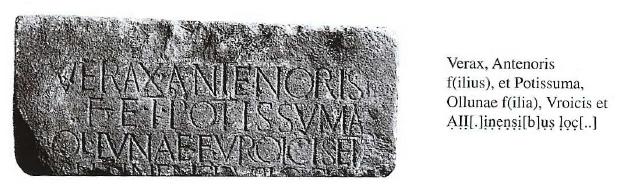
Even though the nature and etymology* of the Vroicae remain unsure, they are worth mentioning here. They are honoured along with the Aldemehenses (?) in a dedication from Rogues (Bouches-du-Rhônes). Their name literally means ‘heather’ in Celtic – an old form *vroica survived into the Old Irish froích, fróech, ‘heather’.1086 The inscription was found in the park of the Château de Beaulieu in 1887, 3.5 kms to the south-east of Rognes: Verax Antenoris f(ilius) et Potissuma, Ollunae f(ilia), Vroicis et AII[.]inensi[b]us loc[..], ‘Verax, son of Antenor, and Potissuma, daughter of Olluna, to the Vroicae and to the A[…]inenses […]’ (fig. 46).1087 As their unique name indicates, the two dedicators are peregrines, who bear Celtic names: Antenor and Potissuma.1088 Potissuma’s mother, Olluna, has a Celtic name and Antenor’s father, Verax, has a Germanic name according to Dondin-Payre.1089 Being known by this single inscription, those deities remain difficult to apprehend. Their gender was even questioned, but today they are commonly accepted as female deities.1090 Allmer suggests the Vroicae and the Aldemehenses are rural deities, while Yves Burnand maintains they are protective deities of the place.1091 As for Paul Aebischer, he has argued that the Vroicae were water-goddesses, whose cult survived in some hydronyms* of Switzerland.1092 They could be etymologically related to the god Vorocios, whose name is evidenced on a bronze ring found in a well in Vichy (Allier) and survived in the antique name of Vouroux, Vorocium, situated 20 kms from Vichy.1093 His name might indeed be a deformation of Vroici, Vroicae, ‘heather’, but its composition does not seem to support that idea.1094
The Black Forest: Abnoba (Diana)
The name, functions and attributes of the goddess Abnoba, known from nine inscriptions discovered in the area of the Black Forest in Germany, remain somewhat obscure. It is significant that both Pliny and Tacitus gave her name to the mountain of the Black forest: Montis Abnovae or Abnobae.1095 It tends to prove that Abnoba was the personification of this peak, like the god Vosegus was the embodiment of the Vosges Mountains. The meaning of her name is indefinite. Alfred Holder proposes to relate it to theCeltic word abona signifying ‘river’, cognate with Old Irish aba, abainn (standard spelling abha, abhainn), Welsh afon, Breton aven, ‘river’, all coming from an IE root *ab– designating ‘the waters’ as supernatural beings.1096 Several rivers in Britain, such as the various rivers Avon and the Scottish River Awe, are derived from Abona.1097 Two other goddess names from Portugal and Austria are based on the same root ab-, ‘divine water’. The goddess Abna is known from a single inscription discovered in Santo Trison (Douro Littoral, Portugal)1098 and the goddess Abiona is honoured in Sankt Peter in Holz, Austria: Abionae Albanus […], ‘To Abiona, Albanus […]’ (fig. 47).1099 The dedicator Albanus has a Celtic name, derived from the root alb-, ‘celestial’.1100
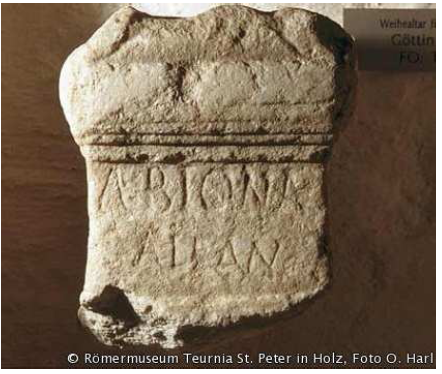
Abnoba is venerated on her own in dedications from Cannstatt: Abnobae sacrum M. Proclinius Verus Stator v. s. l. l. m ; [a]bn[obae] [s]a[crum],1101 from Pforzheim: In h(onorem) [d. d.] Abn[obae et] Quad[rubis] ; [Ab]nob(a)e […] Iulius […],1102 from Waldmössigen: Abnobae Sacrum L Vennon[i]us Me[…],1103 and from Rötenberg: Abnobae Q. Antonius Silo leg(ionis) I aduitricis et leg(ionis) II adiutricis et leg(ionis) III Aug(ustae) et leg(ionis) IIII F(laviae) f(elicis) et leg(ionis) XI C(laudiae) p(iae) f(idelis) et leg(ionis XXII p(iae) f(i)d(elis) v.s.l.l.m (dated 89-96 AD).1104
Abnoba is equated with the Roman woodland-goddess Diana in two dedications. The one from Mühlenbach reads: In h(onorem) d(omus) d(ivinae) Deanae Abnobae Cassianus Casati v(otum) s(olvit) l(ibens) l(aetus) m(erito) et Attianus frater Falcon(e) et Claro co(n)s(ulibus).1105 The dedicator bears the duo nomina; he is thus a Roman citizen. His gentilice* Cassianus is a Latinized name of Celtic origin and his cognomen* Casatus is Celtic.1106 The votive formulas In h. d. d. and dea indicate that the inscription dates from the first half of the 3rd c. AD.1107 The second inscription was discovered in the ruins of a Gallo-Roman thermal establishment, in Badenweiler. Dianae Abnob[ae], ‘To Diana Abnoba’ was engraved on the socle of a statue which had disappeared.1108 Excavations carried out by Werner Heinz and Rainer Wiegels around 1980 at Badenweiler revealed other fragments from this altar. The archaeologists were then able to reconstruct the complete dedication: Dianae Abnob[ae] M(arcus) Senn[i]us [F]ronto s[—] ex voto, ‘To Diana Abnoba, Marcus Sennius Fronto offered (this altar)’.1109 The dedicator bears the tria nomina of Roman citizens. While his praenomen* Marcus and cognomen* Fronto are Latin,1110 his nomen* is Celtic: Sennius (‘Old’).1111 This proves that the Celtic origin of the dedicator and his attachment to his roots and cults. Jacqueline Carabia argues that Abnoba was given curative water functions specifically in Badenweiler, like Diana Tifatina had a famous healing water sanctuary in Capoue.1112
In Mühlburg, near Carlsruhe, the dedication Deae Abnob(a)e Lucius Moderatus v.s.(l.) m., ‘To the Goddess Abnoba Lucius Moderatus paid his vow willingly and deservedly’, is engraved on the socle of a statue, the head of which is missing, found in 1850 (fig. 48).1113 The dedicator Lucius Moderatus is a Roman citizen. He bears the duo nomina, a form particularly in use at the end of the 2nd c. AD.1114 The goddess is represented in the features of Diana, but the style is crude and of indigenous character.1115 The proportions are not respected and the goddess does not have the acknowledged grace of Diana. Carabia adds that “the male features of the goddess evoke the stocky Gaulish women who participated in the fighting”.1116 The subject is nevertheless very similar to the statue in bronze of Artemis/Diana housed in the Musée des Beaux-Arts de Lyons (fig. 48).1117 In the Carlsruhe statue, Abnoba wears a short tunic (chiton*) and small boots. She leans her left hand on a sort of mound of round fruit or a rock and plunges her right hand into a quiver tied up on her back. A dog holding a hare in its paws lies at her feet.
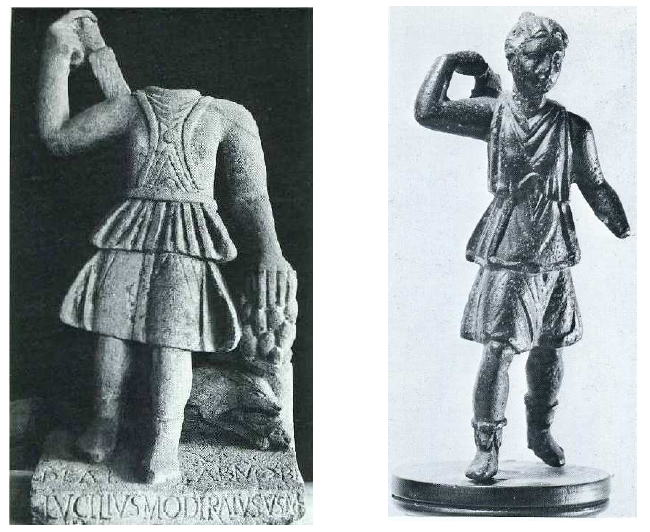
As her name might mean ‘divine waters’ and is given to the mountain of the Black Forest and as she is equated with Diana in two inscriptions and a portrayal, it can be assumed that Abnoba was the embodiment and protectress of the mountain, the Black Forest and its rivers, perhaps even the Danube which rises in the forest.
Goddesses of ‘High Places’
Arduinna (‘the High One’)
Inscriptions
The goddess name Arduinna is known from an inscription discovered on the road from Düren to Montjoye, near Gey (Germany): Deae Ardbinnae T(itus) Iulius Aequalis [v]slm, ‘To the goddess Arduinna, T. Julius Equalis paid his vow willingly and deservedly’.1118 Spickermann explains thatthe letter b accounts for the letter u. Ardbinna must be a presumably regional variant of Arduinna.1119 Arduinna is generally said to be honoured with the Celtic god Camulus and the three Roman deities Jupiter, Mercury and Hercules in a dedication from Rome engraved under a relief* representing the five deities: Arduinne, Camulo, Iovi, Mercurio, Herculi, M(arcus) Quartinius M(arci) f(ilius) cives Sabinus Remus, miles coh(ortis) VII pr(aetoriae) Antoniniane p(iae) v(indicis) v(otum) l(ibens) s(olvit) (fig. 49).1120 In this now lost figuration,Camulus (‘Champion’ or ‘Servant’) is unsurprisingly depicted as the Roman god of war, for he is generally associated with Mars in the inscriptions.1121 As for Arduinna, she is portrayed in the features of Diana with a bow and a quiver. Despite its relatively puzzling character, the authenticity of this document had never been questioned or contested until Claude Sterckx pointed out that it was actually a fanciful reconstitution of a relief*, which originally depicted Saturnus and Mars instead of Arduinne and Camulus.1122 Therefore, this document does not mention Arduinna and her representation as a Roman Diana is erroneous.
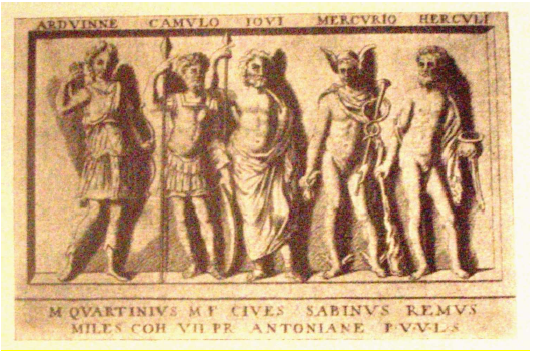
A third fragment of inscription, engraved on a silver dish from La Rocque d’Anthéron (Bouches-du-Rhône), could allude to Arduinna: …]tialniarduinn[…, but the reading remains uncertain and hypothetical.1123Only one dedication thus mentions the goddess Arduinna, that is the inscription from Düren.
Etymology of her name
Her name is obviously similar to the Ardennes, the name of the massif and of its vast surrounding forest situated in the north-east of France and the south of Belgium. The Celticity of Arduinna’s name has been challenged by some scholars, such as G. Dottin, who questioned whether the divine names Vosegus, Abnoba and Arduinna were of Celtic origin.1124 Spickermann, Sterckx and Delamarre however argue it is related to a Celtic root arduo– signifying ‘high’ or ‘eminent’, cognate with Old Irih ard, ‘high’ or ‘big’, Welsh ardd, ‘hill’ and Old Breton ard, art, ‘high, steep’.1125 Arduinna would thus mean ‘the High One’ or ‘the Eminent One’.As for Olmsted, he connects the second element of her name binna, vinna, venna to a Celtic stem *benno– meaning ‘summit, hill’, similar to Welsh bann and Old Irish benn, ‘mountain, summit, hill’.1126 He suggests then to gloss her name as ‘the High Hills’, which is dubious, for Gaulish banna, benna, ‘point’, ‘tip’, ‘peak’, ‘summit’ seems to be a different word.1127 Arduinna’s name having nothing to do with woods or forests, the translation of her name as ‘Wooded Height’, which is sometimes encountered in the works of certain scholars, has no justification.1128
Sterckx compares Arduinna to an Irish goddess called Áirdean, whose name, coming from an ancient *Arden, would also mean ‘the High One’.1129 Yet, in the Lebor Gabála Érenn [‘The Book of Invasions’], her name is not Áirdean but Airgoen, the daughter of Flidais and the sister of Bé Chuille, Bé Théite and Dianann. Áirdean does not actually exist and Airgoen’s name is not etymologically related to Arduinna’s:
‘Flidais diatà buar Flidais; a cethri ingena, Airgoen 7 Bé Chuille 7 Dinand 7 Bé Theite.
Flidais, of whom is the ‘Cattle of Flidais’; her four daughters were Argoen and Be Chuille and Dinand and Be Theite.1130 ’
Arduinna’s connection with the Iranian goddess Arddvī Sūra Anāhitā, as suggested by Heinrich Wagner, is not possible either, for Arddvī Sūra Anāhitā does not mean ‘elevated’, ‘high’ but ‘the wet one’.1131
The boar-goddess statue: Arduinna?
It has always been taken for granted that the statue in bronze representing a divine huntress riding astride a huge boar, is the figuration of the goddess Arduinna (fig. 50).1132 The goddess, whose head is missing, bears the traditional costume and weapons of Diana. She is dressed with boots, called cothume, and wears a short tunic tied up with a belt at waist level, known as a Dorian chiton*. She has a quiver on her back and holds a small spear or knife in her hand. While Diana has generally a bear as an emblem and is often accompanied by a dog or a doe (fig. 51), here the goddess is associated with a boar.1133 The boar is probably the only element of indigenous character in this image, insomuch as it was a sacred animal for the Celts.1134
The essence of this statuette has been misinterpreted because of a series of inaccuracies which accumulated and were never questioned, thus putting scholars on the wrong track.1135 The origin of this statuette is actually uncertain. Contrary to what is generally asserted, it was apparently not unearthed in the Ardennes but in the Jura.1136 It must have been confused with the Ardennes because this area was inhabited by boars and because the goddess bore a similar name. It was actually the second owner who speculated over its nature and origin and arbitrarily labelled it ‘Arduinna’; a theory which was never challenged.1137 This statuette is not accompanied by a dedication identifying the goddess. It could be the representation of any goddess or spirit of the forest, and this boar-goddess statue in bronze is therefore not a portrayal of the goddess Arduinna. The presence of the boar nonetheless indicates that it is the figuration of a Celtic goddess with the features of the Roman goddess Diana. The statuette being anepigraphic, her name remains unknown.


Interestingly, Gregory of Tours, in his 6th-century History of the Franks, mentions the destruction of a huge statue of Diana on Mont-Saint-Walfroy (Ardennes). He reports his meeting with Deacon Walfroy (Vulfilaic), a stylit or pillar-saint1138 who preached to Christianize the local population of Yvois, a town located near the Belgian frontier in the Ardennes.1139 Saint Walfroy had his monastery built at the top of Mont-Saint-Walfroy, a 350-metre high hill overhanging the valley of the Chiers and the Pays d’Yvois, situated eight miles from Yvois. He explained to Gregory of Tours that the local population worshipped a statue of Diana erected on this mount and how he persuaded them to abandon that pagan cult in favour of the Christian God. With his help, they had decided to destroy the pagan idol. It is highly likely that Diana had replaced a previous Celtic goddess. As Arduinna was venerated in the area, it is probable that it was her whom Diana had superseded. It can be thus assumed that Mount-Saint-Walfroy was originally a place of worship for the goddess Arduinna, but this theory remains conjectural.1140 The text is the following:
‘15. Conversion of deacon Vulfilaic.
We started on the journey and came to the town of Yvois and there were met by deacon Vulfilaic and taken to his monastery, where we received a very kind welcome. This monastery is situated on a mountain top about eight miles from the town I have mentioned. On this mountain Vulfilaic built a great church and made it famous for its relics of the blessed Martin and other saints. While staying there I began to ask him to tell me something of the blessing of his conversion and how he had entered the clergy, for he was a Lombard by race. But he would not speak of these matters since he was quite determined to avoid vain glory. But I urged him with terrible oaths, first promising that I would disclose to no one what he told and I began to ask him to conceal from me none of the matters of which I would ask. After resisting a long time he was overcome at length by my entreaties and protestations and told the following tale: “When I was a small boy,” said he, ” I heard the name of the blessed Martin, though I did not know yet whether he was martyr or confessor or what good he had done in the world, or what region had the merit of receiving his blessed limbs in the tomb; and I was already keeping vigils in his honor, and if any money came into my hands I would give alms. As I grew older I was eager to learn and I was able to write before I knew the order of the written letters [before I could read]. Then I joined the abbot Aridius and was taught by him and visited the church of Saint Martin. Returning with him he took a little of the dust of the holy tomb for a blessing. This he placed in a little case and hung it on my neck. Coming to his monastery in the territory of Limoges he took the little case to place it in his oratory and the dust had increased so much that it not only filled the whole case but burst out at the joints wherever it could find an exit. In the light of this miracle my mind was the more on fire to place all my hope in his power. Then I came to the territory of Trèves and on the mountain where you are now built with my own hands the dwelling you see. I found here an image of Diana which the unbelieving people worshiped as a god. I also built a column on which I stood in my bare feet with great pain. And when the winter had come as usual I was so nipped by the icy cold that the power of the cold often caused my toenails to fall off and frozen moisture hung from my beard like candles. For this country is said to have a very cold winter.” And when I asked him urgently what food or drink he had and how he destroyed the images on the mountain, he said: “My food and drink were a little bread and vegetables and a small quantity of water. And when a multitude began to flock to me from the neighboring villages I preached always that Diana was nothing, that her images and the worship which they thought it well to observe were nothing; and that the songs which they sang at their cups and wild debauches were disgraceful; but it was right to offer the sacrifice of praise to all-powerful God who made heaven and earth. I often prayed that the Lord would deign to hurl down the image and free the people from this error. And the Lord’s mercy turned the rustic mind to listen to my words and to follow the Lord, abandoning their idols. Then I gathered some of them together so that by their help I could hurl down the huge image which I could not budge with my own strength, for I had already broken the rest of the small images, which was an easier task. When many had gathered at this statue of Diana ropes were fastened and they began to pull but their toil could accomplish nothing. Then I hastened to the church and threw myself on the ground and weeping begged the divine mercy that the power of God should destroy that which human energy could not overturn. After praying I went out to the workmen and took hold of the rope, and as soon as I began to pull at once the image fell to the ground where I broke it with iron hammers and reduced it to dust. But at this very hour when I was going to take food my whole body was so covered with malignant pimples from sole to crown that no space could be found that a single finger might touch. I went alone into the church and stripped myself before the holy altar. Now I had there a jar full of oil which I had brought from Saint Martin’s church. With this I oiled all my body with my own hands and soon lay down to sleep. I awoke about midnight and rose to perform the service and found my whole body cured as if no sore had appeared on me. And I perceived that these sores were sent not otherwise than by the hate of the enemy. And inasmuch as he enviously seeks to injure those who seek God, the bishops, who should have urged me the more to continue wisely the work I had begun, came and said: ‘ This way which you follow is not the right one, and a baseborn man like you cannot be compared with Simon of Antioch who lived on a column. Moreover the situation of the place does not allow you to endure the hardship. Come down rather and dwell with the brethren you have gathered.’ At their words I came down, since not to obey the bishops is called a crime. And I walked and ate with them. And one day the bishop summoned me to a village at a distance and sent workmen with crowbars and hammers and axes and destroyed the column I was accustomed to stand on. I returned the next day and found it all gone. I wept bitterly but could not build again what they had torn down for fear of being called disobedient to the bishop’s orders. And sincc then I am content to dwell with the brothers just as I do now.1141 ’
What emerges from all this is that Arduinna is never depicted, as it is often asserted, as a woodland-goddess or a divine huntress, presiding over the forest, wild animals, game and hunting.1142 She does not have the boar as an emblem either. This confusion arose from the misinterpretation of the boar-goddess statuette from the Jura, which is not a representation of Arduinna, and the fanciful depiction from Rome featuring her as a Classical Diana. On account of her name, she must have originally been a personification of the ‘high steep slopes’ and reigned over the ‘sacred heights’, that is hills or mountains.1143 Given that the inscription to her was discovered in Düren and given that her name is cognate with that of the massif of the Ardennes, she must have been the personification and patroness of this mountain and thus of its forest. She is thus similar to the goddess Abnoba, who presided over the massif of the Black Forest in Germany. As a goddess of the ‘Mountain’ or of the ‘High Place’, she is linked to the goddesses Bergusia and Brigantia.
Bergusia / Bergonia (‘the Hill’)
The goddess name Bergonia is known from a single inscription discovered in 1847 in the area of Viens, a commune located on the Monts de Vaucluse, a massif of the South PreAlps, between Apt and Céreste (Vaucluse), in the territory of the Albiques, where important oppida* have been unearthed. The inscription is the following: Bergoni(a)e G(aius) L(—) Calvo v(otum) s(olvit) l(ibens) m(erito), ‘To Bergonia Gaius L(—) Calvus paid his vow willingly and deservedly’ (fig. 52).1144 The dedicator is a Roman citizen, for he bears the tria nomina.

According to Guy Barruol, Bergonia is etymologically linked to the goddess Bergusia,1145 who is venerated with the god Ucuetis in a single inscription engraved on the neck of a bronze vase, discovered in the crypt of an antique monument dating from the 1st c. BC, excavated between 1908-1911 and 1961-1962 on Mont-Auxois, the hill overhanging Alise-Sainte-Reine (Côte d’Or), in the territory of the Mandubii.1146The dedication reads: Deo Uceti et Bergusiae Remus Primi fil(ius) donavit v.s.l.m., ‘To the god Ucetis and to Bergusia, Remus, son of Primus, offered (that vase) and paid his vow willingly and deservedly’ (fig. 53).1147 The dedicator is a peregrine*, since he has a unique name, but his name and his father’s name are Latin.

The god Ucuetis is venerated on his own in two other dedications from Burgundy. The first inscription was found in Entrains-sur-Nohains (Nièvre) and reads: In hono[rem domus divinae] deo Ucu[eti—], ‘In honour of the Divine House and to the God Ucuetis […]’.1148 The use of the abbreviated formula In h.d.d. indicates the inscription dates from the beginning of the 3rd c. AD.1149 The second dedication was discovered in 1839 on the same site as the bronze vase: Martilis Dannotali ieuru Ucuete sosin celicnon etic gobedbi dugiíontiío Ucuetin in Alisia, ‘Martialis, son of Dannotalos offered to Ucuetis this building (celicnon), and this with the smiths who honour Ucuetis in Alise’.1150 This dedication is of great interest, for it is in Gaulish language and Latin lettering and mentions the erection of a monument in homage to the god. This monument was excavated during the two campaigns of excavations in 1908 and 1960.1151 The edifice, probably dating from the 3rd c. AD, is composed of a 25mx13m rectangular yard, surrounded by a 4-metre portico, of various buildings and rooms, where many iron and bronze tools and debris were found,1152 and of an underground crypt, where the bronze vase dedicated to Ucuetis and Bergusiawas discovered (fig. 54 and 55).1153 The dedicators being smiths (gobedbi), these iron scraps were interpreted as votive offerings deposited in the sanctuary to honour the patrons of smiths and metal work. Roland Martin and Pierre Varène, who were in charge of the 1960 excavations, explain:
‘Unless the building is to be understood as a workshop or a shop, all these objects – which are grouped together in series (keys, locks, rings, adorned handles, hinges and split hinges, etc.) – cannot be considered to have had a merely practical purpose, since the two rooms do not have enough doors or enough furniture to explain this accumulation of objects. We would suggest that most of them were ex-votos or offerings deposited near an altar, in a room with a ritual use. They represent tokens of favour or recognition towards deities affording protection for smiths, and for bronze- and other metal-workers, whose skills were a source of considerable wealth and fame for the town of Alésia.1154 ’
Lambert adds that this monument must have been a place of worship as well as a place where the guild of smiths could gather, meet and work.1155
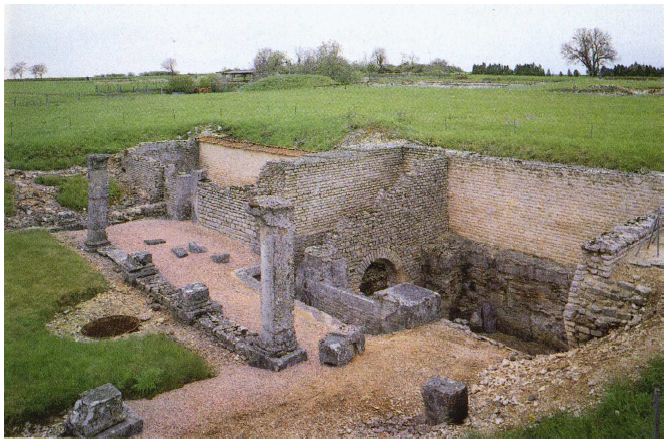
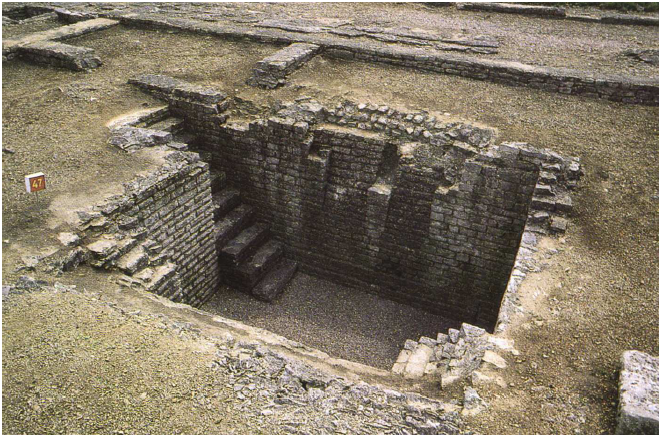
Scholars do not agree on the significance of Ucuetis and diverse etymologies have been suggested. At the end of the 19th c. and the beginning of the 20th c., several etymologies, now dismissed, were put forward. A radical uc-, ‘elevation’ was first recognized andUcuetis was glossed as ‘the god of the summit’.1156 Then, John Rhys proposed to relate Ucuetis to a verbal theme ucu– meaning ‘act of choosing’, ‘choice’. Ucuetis was translated as ‘the Loving or Choosing One’.1157 Léon Berthoud, on the other hand, denied the Gaulish origin of this divine name,1158 Georges Poisson recognized in Ucuetis a Celtic root *cuet– signifying ‘to beat the metal’ or ‘to forge’, derived from an IE root (but which one?) meaning ‘to strike’ or ‘to beat’, which gave in Middle Irish cuad and in Latin cudo, ‘to beat’.1159 According to him, Ucuetis would thus be ‘the (Good) Striker’. This would illustrate his role of metal beater and relate him to the hammer-god Sucellus. As for the theory of Eugène van Tassel Graves that Ucuetis means ‘Swift Flyer’ and is a horse-god, it is fanciful and baseless, as Lambert points out.1160 The etymology* advanced by Olmsted is not convincing either. He considers Ucuetis a purely local god, whose name would be a toponym* meaning ‘Pine Saplings’.1161 As for Schmidt, he proposes ‘the One who is invoked’, relating his name to the verbal theme *uekw– / *ukw, ‘to speak’ or ‘to invoke’.1162 Finally, Lambert suggests to see a theme in *okuo-, ‘sharp’ or ‘pointed’ – cf. Latin accus – with an agent name in –ti-. Ucuetis would thus be ‘The Sharpener’; an etymology* perfectly suiting his function of patron of smith craft.1163 Lambert’s etymology* is the most cogent, but Schmidt’s cannot be ruled out.
Seven stone reliefs* representing a seated hammer-god and a goddess bearing the traditional symbols of abundance and fertility were discovered from 1803 to 1923 in Alise-Sainte-Reine.1164 It is generally agreed that those reliefs* are depictions of Ucuetis and Bergusia, but this is not possible to assert, for they all are anepigraphic. Moreover, those images do not differ from the various depictions of divine couples found throughout Gaul. It could be for instance the portrayal of the god Sucelluswith a Mother Goddess, notably when the god is represented with a hammer.
While Ucuetis is clearly a guardian of metalwork, Bergusia must have originally been a goddess attached to the Heights, Mounts or Mountains, for her name is based on a Celtic root berg(o), bergusia, literally signifying ‘mount’, from an IE root *bherĝh, ‘high’.1165 It is besides interesting to note that the root brig-, ‘high’, ‘eminent’, comprised in the divine names Brigantia, Brigit and Brigindona, comes from the same IE root.1166 They are thus goddesses of the same type and essence. The goddess name Bergonia and the epithet of the Germanic Matronae Berguiahenae, venerated in Gereonsweiler, Bonn and Tetz (see Chapter 1), are also derived from the root berg-.1167 Berg– is found again in the epithet of Damona Matuberginis, mentioned in a dedication from Saintes (Charente-Maritime). This attributive byname* can be either descriptive and mean ‘The High Favourable’, with matu-, ‘favourable, good’, or topographical and designate a local mount where the goddess would have been specifically venerated, possibly ‘the Hill of the Bear’(?), with matu-, ‘bear’ (see Chapter 4 for more details).1168
Bergonia and Bergusia are therefore to be understood as goddesses personifying and reigning over the mount. While Bergonia was certainly linked to the Monts de Vaucluse, situated near Viens, Bergusia was undoubtedly worshipped in Alise-Sainte-Reine in connection with Mount-Auxois. Poisson’s theory that Bergusia was more than a mere goddess of mounts, because she was coupled with a god of metal work, is somewhat unlikely but is worth reporting here.1169 Poisson argues that the root berg– must have by extension designated the mining riches of the mountains. From this, he assumes that Bergusia was ‘a Goddess of Mines’, protecting ores and completing the role of her metal-worker partner.
Goddesses in Brig- (‘the High One(s)’)
In Great Britain, seven inscriptions are dedicated to the goddess Brigantia. Three come from South West Yorkshire, while the four others come from about a hundred miles away, in the region of Hadrian’s Wall. Brigantia is obviously cognate with the name of the tribe of the Brigantes, who inhabited the region where the inscriptions were found (see Chapter 3). The inscription from Brampton (Hadrian’s Wall) describes her as a nymph,1170 while the dedications from Birrens, Greetland, Castleford and Corbridge equate her with Roman goddesses of war, such as (Minerva) Victory and (Juno) Caelestis.1171 The last two inscriptions are significant, for they are offered by dedicators of Celtic stock, although they come from Roman military camps or sites (Adel and South Shields). This shows the attachment of indigenous people to their roots and religious beliefs. The first one, discovered on the Roman site at Adel, north-west of Leeds (Yorkshire), is dedicated by a woman Cingetissa, whose name means ‘warrior’ or ‘attacker’.1172 It is engraved on a sandstone altar which has a serpent on its left side: Deae Brigan(tiae) d(onum) Cingetissa p(osuit), ‘To the goddess Brigantia, Cingetissa set up this offering’ (fig. 56).1173 The use of the formula dea indicates that the dedication is not prior to the mid-2nd c. AD.1174 The second altar, discovered in 1895 south of the fort at South Shields, Co. Durham, bears the following inscription: Deae Brigantiae sacrum Congenn(i)ccus u(otum) s(olvit) l(ibens) m(erito), ‘Sacred to the goddess Brigantia, Congennicus willingly and deservedly fulfilled his vow’ (fig. 56).1175 On the back of the altar is engraved a bird, on the right side a patera* and on the left side a jug; elements which may represent the functions of fertility of the goddess. The name of the dedicator Congennicus is Celtic and appears in other inscriptions from Narbonne and Nîmes.1176
Brigantia’s name is undeniably Celtic. It comes from the Gaulish word briga, cognate with Old Irish brí, Cornish, Welsh and Breton bre, ‘hill’, denoting highness and designating a high place, that is a hill or a mount.1177 These words come from an Old Indo-European adjective *bherĝh signifying ‘high’. By extension, the word briga, brigant– took on the significance of ‘fortified mount’ or ‘hill fort’, describing then the mount where the tribes had settled and built their fortified city. For instance, the oppidum* situated on Mount-Avrollot, overhanging the city of Avrolles (Yonne), was called Eburobriga (‘Mount or Fort of the Yew’).1178 In a recent study, Juan Luis García Alonso demonstrated that briga was very frequent in Celt-Iberian toponymics.1179 Being far less attested in Gaul, Delamarre advances that briga may have had the same significance as the word dunum, ‘hill fort’ found in many a Gaulish place name, such as Lugdunum.1180

Brigantia is etymologically linked to the Matres Brigaecae, who are venerated in an inscription from Peñalba de Castro, in Celtic Hispania: Ma(tribus) Brigaecis Laelius P[h]ainus v(otum) s(olvit) l(ibens) m(erito), ‘To the Mothers Brigeacae Laelius Phainus paid his vow willingly and deservedly’.1181The epithet of the Matres is clearly composed of the root brig-, ‘high’ and of the suffix –ko, which is probably localizing.1182
Brigantia is also related to the goddess Brigindona, honoured in a dedication engraved on a stone found in re-employment* in the building of an old funerary vault in Auxey (Côte d’Or), in the territory of the Aedui. The inscription is in Gaulish language and Latin lettering: Iccavos Oppianicnos ieuru Brigindon cantalon, ‘Iccauos son of Oppianos offered (this) cantalon (circular monument or pillar) to Brigindona’ (fig. 57).1183 As the name Brigindona is not preceded by the word dea ‘goddess’, it is difficult to determine whether Brigindona is a divine or proper name. However, the use of the dedicatory verb IEVRV, similar to Gallo-Greek ειωρου and signifying ‘(who) offered’ or ‘(who) dedicated’, is revealing.1184 Inscriptions or monuments were usually offered and dedicated to deities rather than to people. As the inscription was discovered at the bottom of the plateau of Montmélian, the worship of Brigindona (‘The High One’) must have been in relation to this mount. A Gaulish city might have been situated on this hill, but no archaeological data evidencing such a theory have been discovered so far.1185 Lacroix specifies that Brigindona’s name may have survived in the toponym* Brigendonis, the ancient name of the city of Brognon or Broindon (Côte d’Or), situated about 40 kms from Auxey.1186
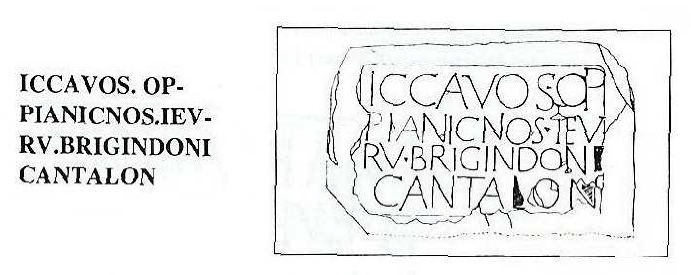
British Brigantia, Celtiberian Matres Brigiacae and Gaulish Brigindona are etymologically related to the Irish goddess Brigit; the loss of unstressed ‘n’ in such words being typical of the Irish variety of Celtic. Brigit is described in the Lebor Gabála Érenn [‘The Book of Invasions’] as the daughter of the Dagda and listed among the Tuatha Dé Danann.1187 Very little information about Brigit has survived in Irish mythology. In Cath Maige Tuired, she is said to be the wife of Breas (‘Brave’), with whom she begot a son called Ruadhán (‘Red-Haired’).1188 When her son was murdered by Goibhniu the Smith, she wept him and gave thus the first lament (caoineadh) of Ireland. This legend clearly illustrates her in her role of mother-goddess. Sanas Cormaic [Cormac’s Glossary], dated c. 900, gives a hint of her functions and describes her as a threefold goddess. She is said to have had two sisters of the same name fulfilling specific roles:
‘Brigit .i. banfile ingen in Dagdae. Isī insin Brigit bē n-ēxe .i. bandēa no adratis filid. Ar ba romōr 7 ba roán a frithgnam. Ideo eam deam uocant poetarum. Cuius sorores erant Brigit bē legis 7 Brigit bē Goibne ingena in Dagda, de cuius nominibus pene omnes Hibernenses dea Brigit uocabatur.
Brigit, i.e. lady poet, the daughter of the Dagda. It is she who was Brigit the woman of poetry, i.e. the goddess whom the poets adored. Because very great and very famous was her protection. Accordingly, they call her the goddess of the poets. Whose sisters were Brigit the woman of curing and Brigit the woman of smith craft, daughters of the Dagda, from whose names among all the Irish a goddess was called Brigit.1189 ’
In this text, Brigit appears as a goddess who possesses filidhecht, that is ‘poetry, divination and prophecy’, and protects poets. The two other Brigits respectively preside over medicine and metal work. The three Brigits are the triplication of the very same figure.1190 As studied in Chapter 1, triplism emphasizes and sublimates the various abilities and powers of the gods. Brigit is thus the patroness of arts, crafts and healing. In view of those attributes, it can be assumed that the word briga could have taken on a different meaning. In addition to its original geographical dimension, briga must have had a figurative sense as in Irish brí, signifying ‘vigour’ or ‘meaning’. It must have denoted force, vigour, nobility and sacredness, especially when referring to deities.1191 It is also interesting to note that briga is the same word as Sanskrit brhatī and Avestic bərəzaiti, signifying ‘high’ or ‘noble’.1192 It gave terms referring to kinship and nobility in the Celtic languages, such as Old Welsh breenhin, ‘king’, Cornish brentyn, ‘noble’ and Old Breton brientin, ‘noble person’. Therefore, the goddess names Brigantia, Brigit, Brigindona and Matres Brigiacae can be glossed either as ‘the High or Eminent Ones’ or ‘the Noble or Exalted Ones’.1193 Highness can thus refer to a high place or to the spirituality of the soul. By their summit rising toward the sky, mounts and mountains stand out in the landscape and compel respect and sacredness. It is thus not surprising that highlands became invested with spirituality and exaltation.
All those occurrences show that Ireland, Britain, Gaul and Celtic Hispania shared the worship of a ‘High, Exalted’ goddess. Brigit being described as a goddess of arts and crafts in Irish mythology, she is likely to correspond to the goddess Minerva, mentioned by Caesar in Book 6 of De Bello Gallico [The Gallic War] as one of the five deities honoured by the Gauls. He indeed stipulates that Minerva has the knowledge of craftsmanship and bestows it on her people:
‘Deum maxime Mercurium colunt. Huius sunt plurima simulacra: hunc omnium inventorem artium ferunt, hunc viarum atque itinerum ducem, hunc ad quaestus pecuniae mercaturasque habere vim maximam arbitrantur. Post hunc Apollinem et Martem et Iovem et Minervam. De his eandem fere, quam reliquae gentes, habent opinionem: Apollinem morbos depellere, Minervam operum atque artificiorum initia tradere, Iovem imperium caelestium tenere, Martem bella regere.1194
They worship as their divinity, Mercury in particular, and have many images of him, and regard him as the inventor of all arts, they consider him, the guide of their journeys and marches, and believe him to have very great influence over the acquisition of gain and mercantile transactions. Next to him they worship Apollo, and Mars, and Jupiter, and Minerva; respecting these deities they have for the most part the same belief as other nations: that Apollo averts diseases, that Minerva imparts the invention of manufactures, that Jupiter possesses the sovereignty of the heavenly powers; that Mars presides over wars. To him when they have determined to engage in battle, they commonly vow those things they shall take in war.1195 ’
As we know, the Roman goddess Minerva also possesses the ability of healing. She was venerated in Rome with the epithet Medica (‘the Physician’).1196 This is another quality that Minerva shares with Brigit, who is said to preside over curing. Minerva is also a goddess of war in Roman mythology1197 and the goddess Brigantia, equated with Victory in three inscriptions and represented as a warrioress in a relief* from Birrens (Dumfries and Galloway, Scotland),1198 has a pronounced war-like aspect.
As for the possible connection between the goddess Brigit and Saint Brigit (later, Brighid) of Kildare (c. AD 439 – c. 524), whose cult was widespread in Ireland, Scotland, Wales, Cornwall, the Isle of Man and Brittany, it will not be considered in detail here, but it can be noted that on account of the similarity in names, feasts, attributes and functions, some scholars believe that the goddess and the saint were one, while others take them for two different characters.1199 Green even challenges the historicity of the Saint, arguing that:
‘Although Brigit is said to have been the founder-abbess of Kildare, there is no firm evidence for the abbess as a historical figure; descriptions of her life are based almost entirely on legend, which gives rise to the suspicion that she may be a mythic figure who underwent a humanisation-process and was thus endowed with a false historicity.1200 ’
On account of their name, the syncretism between the two characters must have been uncomplicated and inevitable. Some attributes and functions of the ancient goddess, such as healing, the protection of farm animals and Imbolc, the 1st February Irish feast, were associated with Saint Brigit in later times and survived in her imagery. It is most likely, in fact, that the saint and the goddess are two different characters: one a mythical personage, while the other is recorded as a historical saint who was traditionally claimed to have founded the convent at Cill Dara (Kildare) and to have died in the year 524 AD. From that time onwards, many miracles and legends were attributed to her.1201 She would have been known in living memory for at least two generations after her death. The earliest reference to her is in a text which has been dated on linguistic evidence to the 6th c. AD. It occurs in the form of a prophecy, in a somewhat obscure rhetorical style, in a genealogical tract concerning the Fotharta people in Leinster.1202 The prophecy is represented as given to a fanciful prehistoric chieftain Eochaidh Find, brother of the mythical Conn Céadchathach, and it therefore reflects an attempt by the Fotharta to present themselves as related to the Tara kings. The prophecy is the following:
‘Cain gein cain orddan iartain dodoticfa dit genelgib clann. Condingerthar dia mor-buadaib Brig-eoit fhir-diada. Bid ala-Maire mar-Choimded mathair.
A fair birth, fair dignity, afterwards which will come to you from your children’s progeny. Who will be called due to her great virtues Brig-eoit the truly holy. She will be another Mary, of the great Lord the mother.1203 ’
Although an invention of the 6th c., this text would imply that Brigit (Brig-eoit) was well-known at that time, perhaps recently deceased. It would hardly make sense to people unless it referred to a real person who was known, or had been known recently, to the listeners. All the other texts, such as the c. 650 AD Vita Brigitae by the priest Toimtenach – who used the pen name Cogitosus – are however replete with legendary and unhistorical stories of the deeds and miracles of the saint.1204 Some of these deeds and miracles may indeed be fallout from the lore of the goddess.
Andeis (‘the Great One’?): Plateau of Plech
The goddess Andeis is known from a single inscription, engraved on an altar in white marble, discovered at the beginning of the 19th c. in the old cemetery situated on the southern side of the hill of the Plech, situated near Caumont, in the canton of Saint-Lizier (Ariège), in the territory of the Consoranni.1205 The inscription reads: Deae Andei Laetinus Laeti f(ilius) v(otum) s(olvit) l(ibens) m(erito), ‘To the goddess Ande, Laetinus, son of Laetus, paid his vow willingly and deservedly’ (fig. 58).1206 A guttus* is drawn on the left side of the altar and a patera* on the right side. Andeis’s name can be related to the intensive Celtic root and-, ande, signifying ‘very’ or ‘great’, comprised for instance in the divine name Andarta (‘Great Bear’).1207 Her name might therefore mean ‘The Great One’, an epithet denoting divine grandeur and strength as well as geographical height.1208 On account of this possible etymology* and the place of discovery of the stone, it might be inferred that Andeis was worshipped in relation with the mount of the Plech, where a sanctuary may have been situated, but this remains a conjecture as long as excavations are not carried out at this location.1209

Alambrima: Mont-Alambre
The goddess Alambrima is known from a single inscription engraved on an altar discovered in La Piarre, near Serres (Hautes-Alpes), in the territory of the Vocontii.1210 The inscription reads: Alambr[i]mae Severus Perpetui fil(ius) exs voto, ‘To Alambrima, Severus, son of Perpetuus, (willingly erected this altar) in accomplishment of his vow’.1211 For a long time, the altar served as a stand to the stoup of the village church, but it is now housed in the Musée Départemental de Gap.1212 Alambrima’s name is cognate with Mont Alambre or Mont Arambre, a mountain situated in the area of La Piarre, between the communes of Serres, Savournon and La-Bâtie-Mont-Saléon (fig. 59). Alambrima must therefore have been the personification and protectress of Mont Alambre, which stands out in the landscape and conveys a feeling of grandeur and potency.1213 Alambrima is an oronym, i.e. a name of mountain, the significance of which remains obscure. Delamarre proposes to break down her name as *ar-ambr- (?), composed of ar- or are-, ‘in front of, near’ or ‘to the east of’, and of the root ambr-, probably cognate with Indo-European *(h3)mbhro- signifying ‘rain’.1214 Accordingly, Alambrima might be ‘the one who is to the east of the rain’ or ‘the one in front of the rain’; an etymology* which would refer to the situation of Mont Alambre.

Soio: Plateau of Malpas
The goddess Soio is mentioned in a single inscription engraved on an altar, dating from the middle of the 2nd c. AD. It was discovered in 1848 in the ruins of the chapel Saint-Gervais, located on the culminating point of the plateau of Malpas, overhanging the village of Soyons, situated south of Valence (Ardèche) (fig. 60). The dedication is the following: Deae Soioni Aug(sutae) Luccius Marcia(nus) et Sennius Marianus de suo posuerunt loco privato Upeior(um) pupillor(um), ‘To the Auguste goddess Soio, Luccius Marcianus and Sennius Marianus erected (this altar) on the property belonging to the wards of the Upeii’ (fig. 61).1215 On top of that dedication, various archaeological elements were unearthed on the plateau, which tends to prove that a sanctuary dedicated to the goddess was located there.1216 An oppidum*, excavated on the hill, is supposedly the pre-Roman fortified city of the tribe of the Segovellauni, mentioned by Pliny, or of the Segallaunii, mentioned by Ptolemy.1217 The name of the village of Soyons is reminiscent of the name of the goddess: its ancient form Soïo survived until the 13th c.1218 As the inscription was found on the plateau of the Malpa, Soio can be regarded as the embodiment of the mount and the protectress of the fortified city unearthed at its top. For Delamarre and Olmsted, the significance of her name remains obscure, but Lacroix suggests that Soio could be derived from a root soio-, *sogio-, possibly related to the Celtic root seg– meaning ‘victory’ and ‘strength’, comprised in the divine names Segeta or Segomanna (see Chapter 3).1219 This idea is interesting, for the place where the inscription was discovered was the chief centre of the Segovellauni or of the Segallaunii, whose names are based on the same root.
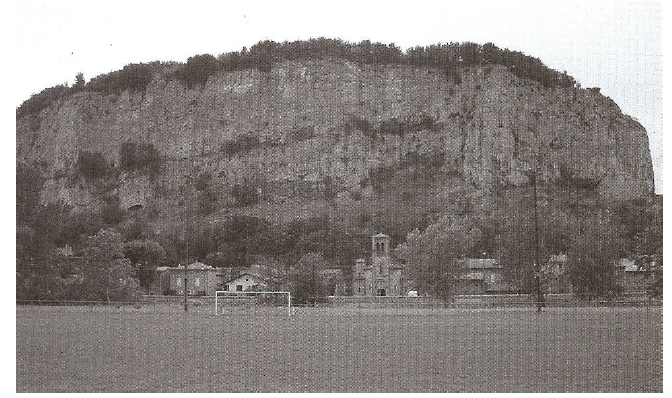
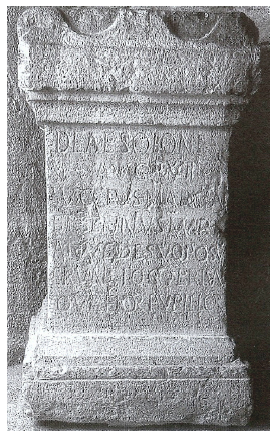
Conclusion
Belief in a goddess embodying the earth is widely illustrated in Irish mythology and Gallo-British archaeology. The Irish accounts tell of divine ancestresses personifying the island, the fields or the ground, such as Ériu, Banba, Fótla, Tailtiu, Macha, the Mórrígain or Danu, who possess pronounced agrarian features and whose body shapes the landscape. In Gallo-British and Celt-Iberian epigraphy, a certain number of goddess names or epithets refer directly to the land or to peculiar natural elements, such as animals, trees or mounts: Litavi (‘Earth’), Nantosuelta (‘Winding Brook’ or ‘Meadows’?), Artio (‘Bear’), Matres Eburnicae (‘Yew Mother Goddesses’), Duilliae (‘Leaves’), Bergusia, Bergonia (‘Hill’), Arduinna (‘High One’), etc. This suggests that Nature was worshipped as a divine entity by the Celts and that every single natural element was deified. Animal and plant species were sacred because they were part of a system maintaining and ensuring the survival of the human race. Animals were hunted or bred for food, while fruit, vegetables and plants were easily picked up and prized as food. Hill-tops and mountains seem to have been particularly revered. Their majesty, mystery, impressive size and potency in the landscape certainly inspired a feeling of smallness and admiration. Hills and mountains were often chosen as a place of ritual observance or habitation where fortified cities or sanctuaries were built.
It is evident that the earth was mainly presided over by female deities, whose main function was to provide food and nurture the peoples. Such a role is exemplified by Irish Mór Muman of Munster (‘the Nurturer’) and Danu/Anu/Ana, the ancestress and mother of the Tuatha Dé Danann and Gaulish Rosmerta, Cantismerta and Atesmerta, whose names signify ‘Great Providers’. It is significant that a certain number of dedicators paying homage to those land-goddesses on the Continent were of Celtic stock and not Roman citizens yet. It proves that, despite the influence of Roman religion after the conquest, local people did not renounce their culture and religious beliefs and went on praying to, worshipping and honouring their ancient deities. It is conspicuous that the goddesses presiding over the ground and its riches, such as Rosmerta, Atesmerta, Cantismerta and Nantosuelta, were mainly honoured in the north, north-east and centre-east of Gaul. The possibility of a worship dedicated to them in other parts of Gaul is not to be dismissed, insomuch as the potentiality of further archaeological discoveries is considerable and undeniable.
The earth-goddesses must have intervened in various aspects of life and been honoured in different ways according to social rank. Their role as providers of fertility indisputably relates them to the rural community, which was in charge of working the soil and breeding cattle. Their cult must have been based on the cycle of the seasons, settling on the agrarian calendar and varying from sowing time to harvest time. Irish medieval literature is reminiscent of four important Celtic agrarian feasts which punctuated the pastoral year.
Samain (standard spelling Samhain), on October 31st, marked the starting point of a new year and the renewal of the seasons, symbolized in mythology by the coupling of the sky god with the land-goddess.1220 Cath Maige Tuired relates that the Dagda mated with the Mórrígain at the Ford of the river Uinsinn (Co. Sligo) at Samhain,1221 while the Metrical Dindshenchas describes his tryst with the river-goddess Bóinn on that very night.1222 This concept has its reflection in the Gaulish divine couples of Litavi and Cicolluis, Rosmerta and Mercurius, Nantosuelta and Sucellus, etc. Metaphorically speaking, the seed of the god and the fecundity of the goddess ensure the abundance and richness of the forthcoming crops which will guarantee the preservation of the vitality of the tribe and the survival of the community. Imbolc, on February 1st, was in the patronage of the goddess Brigit and marked the beginning of the lactation of ewes.1223 It was a ceremony of purification as the cold period drew to a close and a celebration of cattle breeders, farmers and shepherd boys. It was later Christianized as Saint Brigid’s Day. Beltaine, on May 1st, announced the beginning of the summer, open-pasturing harvest and cattle-raising.1224 Various rites of fertility were held, such as the lighting of huge fires or the driving of the livestock between two bonfires. Finally, the feast of Lughnasad, held on August 1st, celebrated abundance, the ripening of fruit and the maturing of grain.1225 It announced the end of the summer and the storage of the crops.
Óenach Tailten, the fair held in honour of Tailtiu during the whole month of August, clearly glorifies the fertility of the ground ensured by the earth-goddess.1226 Similarly, Irish mythology mentions a feast called Óenach Macha celebrating prosperity ensuing from the goddess Macha. Significantly, the graffiti discovered in Lezoux might refer to a feast held in honour of the purveyor of riches Rosmerta. It is highly likely thus that those various goddesses of fertility presided over specific times of the agrarian year. In The City of God, the 4th-century Christian historian Saint Augustine, speaking of the ancient Roman pagan rites, describes that the fertility of the land was not in the hands of a single goddess. The period of sowing was patronized by the goddess Seia, the period of growth was presided over by Segetia – which is etymologically related to the Gaulish Segeta – and harvest time and storage was supervised by the goddess Tutilina.1227
This reference has its correspondence in the feasts of Imbolc, which was the period of sowing, Beltaine, which was the time of the growth of the crops and Lughnasad, which was harvest time and the beginning of storage. It is very probable thus that several goddesses were respectively associated with those times of the pastoral year. The lack of sources in Gaul does not allow us to determine precisely which earth-goddesses presided over sowing, growing and harvesting. In view of Lambert’s etymologies, the only possible suggestion is that Cantismerta might have represented the whole sowing-growth period, since her name refers to “the general and continuous distribution in space and time”, while Rosmerta might have presided over harvest time and storage, for her name indicates an “achieved and definitive distribution”.1228
In Irish mythology, it is significant that goddesses, such as Flidais, Brigit or the Mórrígain, are associated with cattle or cows. The Irish river-goddess Bóinn, from Celtic *Bouvinda (‘the Cow White Goddess’), the Gaulish spring-goddess Damona (‘Cow’) and possibly the British river-goddess Verbeia (‘Cow’) have names which indicate that they were worshipped in bovine shape. This illustrates the importance of breeding animals in ancient times. In addition to the crops, goddesses of fertility protected the growth and well-being of cattle.
From this, it can be induced that the earth-goddesses were invoked throughout the year by the pastoral community in various rites and customs. They certainly had a protective role in the everyday life of the farmers at work as well as at home. Nantosuelta’s house-pole emblem for instance points to a significant domestic cult. The offering wells found in the Iron Age sanctuaries, filled in with food and carcasses of domestic and breeding animals, also provide evidence of a cult rendered to chthonian* and agrarian deities. In this case, the cult was surrounded by sacredness and taboos* and left in the hands of the servers of religion, who were allowed to enter the sacred part of the enclosure to make contact with the deities.
Other functions may have been fulfilled by the ground goddesses according to the contexts and places. The fact that inscriptions to Rosmerta and Atesmerta were unearthed near sacred springs must indicate they could preside over curing and be prayed to for benevolence. Furthermore, they may have been sometimes endowed with a funerary role. Nantosuelta’s crow attribute could be interpreted as a symbol of death and would thus typify the goddess’s funerary dimension. As for Rosmerta, it is not insignificant that inscriptions to her were discovered in tombs or on necropolises. She might have watched over the deceased, accompanied them in their voyage to the otherworld and ensured their sustenance in the afterlife. Finally, the land-goddess clearly achieved a role of sovereign. The royal aspect is exemplified by Ériu, Banba and Fótla, the trio of land-queen-goddesses, who are married to the three Kings of the Tuatha Dé Danann. In addition to embodying and protecting the bear, the Gaulish goddesses Artio (‘Bear’) and Andarta (‘Great Bear’) must have symbolized royal powers and functions. As for theMórrígain, who was originally a land-goddess before being turned into a war-goddess, she bears a name which denotes sovereignty, for it literally means ‘Great Queen’ or ‘Phantom-Queen’. The sovereign role held by the land-goddess involves protection of the territory and of the tribe. Gallo-British epigraphy and Irish mythology are reminiscent of goddesses patronizing a specific part of the territory and presiding over a particular sept*. In their role of protectress, they were then invested with martial attributes and functions and turned into powerful and dreaded war-goddesses.
Notes
599. Dillon & Chadwick, 1973, pp. 182-192 ; Green, 1992a, p. 190 ; Mackillop, 2004, pp. 359-360, 386 ; Beck, 2003, pp. 76-86 ; Sims-William, Patrick, 1990, pp. 57-81 ; Wagner, 1981, pp. 1-28 ; Spaan, 1969 ; Löffler, 1983.
600. Macalister, 1956, pp. 14-39 ; Ó hÓgáin, 2006, pp. 478-481 ; Mackillop, 2004, pp. 414-416.
601. Brunaux, 1986, p. 33.
602. Lantier, 1963, pp. 272-280.
603. Lantier, 1963, p. 279.
604. The Iron Age sanctuary consisted of two rows of six posts each, see Lewis, 1966, pp. 2, 7, 81-82 and fig. 15, 86 ; Cunliffe, 2005, p. 563 and fig. 20.3. For details on the Roman sanctuary, see Henig, 1984, p. 39 ; Hingley, 1982, pp. 305-309.
605. See Husain, 2001.
606. Delamarre, 2003, pp. 204-205 ; Delamarre, 2007, p. 225 ; De Vries, 1963, p. 138 ; O’Rahilly, 1946a, p. 13 ; Holder, ACS, vol. 2, p. 423 ; Olmsted, 1994, p. 421 ; Hatt, MDG, 2, pp.106, 108, 131.
607. Thurneysen, in Indogermanische Forschungen, 4, pp. 84-85.
608. Delamarre, 2003, p. 204 ; Lambert, 2006, p. 54 ; Mackillop, 2004, p. 297 ; Anwyl, 1906a, p. 37: a lake lying at the bottom of Mount Snowdon, the highest mountain in Wales, is also calledLlyn Llydaw.
609. Le Bohec, 2003, p. 44 refers to Guyonvarc’h, Christian-Jacques, in Ogam, XX, 1-2, 1968, pp. 490-494.
610. CIL XIII, 5599 ; Drioux, 1934, p. 74, n° 263 ; Le Bohec, 2003, pp. 45-46, n°28
611.CIL XIII, 5600; Drioux, 1934, p. 74, n° 265; Le Bohec, 2003, pp. 44-45, n°25.
612. Delamarre, 2007, p. 165 ; Le Bohec, 2003, p. 45.
613. CIL XIII, 5601 ; Drioux, 1934, p. 74, n° 266 ; Le Bohec, 2003, p. 44, n°23.
614. Delamarre, 2007, p. 129 ; Solin & Salomies, 1994, p. 115.
615. CIL XIII, 5602 ; Drioux, 1934, p. 74, n° 264 ; Le Bohec, 2003, p. 44, n°27.
616. CIL XIII, 2887 ; Drioux, 1934, p. 74, n° 267 ; Le Bohec, 2003, p. 176, n°295.
617. Solin & Salomies, 1994, pp. 26, 376.
618. Delamarre, 2007, p. 32.
619. CIL XIII, 5597, 5598, 5604 (Mâlain), 5479 (Dijon) ; AE 1981, 690 (Xanten) ; Delamarre, 2003, p. 116 ; Delamarre, 2007, p. 65 ; Olmsted, 1994, p. 343.
620. CIL XIII, 5698 ; Drioux, 1934, p. 74, n° 262; Le Bohec, 2003, p. 45, n°26. Bellona is also partnered with an indigenous Mars in Trier (CIL XIII, 3637) and in Mayence (CIL XIII, 6666). Other dedications to Bellona come from the sanctuary of Villard d’Hériat: CIL XIII, 5337, 5352 ; see Hatt, MDG 2, p. 134.
621. Le Bohec & Sapin, in Bulletin de la société archéologique et historique de Langres, XXII, 324, 1996, pp. 64-681996, pp. 64-68.
622. Brill’s, vol. 2, pp. 589-590 ; Roescher, I, 1884-1890, col. 774-777 ; LIMC, III, pp. 92-93.
623. Guirand & Schmidt, 2006, pp. 249, 632, 681 ; Reinach, 1913, p. 255.
624. CIL XIII, 939.
625. Delamarre, 2007, pp. 68, 224, 225 ; Anwyl, 1906a, p. 38.
626. Olmsted, 1994, pp. 396-397.
627. O’Rahilly, 1946a, p. 10 ; Ó hÓgáin, 2006, p. 191 ; Vries, 1963, p. 136.
628. Strabo, in his Geography, 1.4.3, written in c. 19 AD, was the first to use the term Iernē (Ίέρνη), the most common and long-lasting name for Ireland among the Greek writers, used until the end of the Roman empire. For Ptolemy, Geography, 1.2, see Freeman, 2001, pp. 38-39, 66-67. In Latin, it became Hibernia by the contamination of the word hibernus (e.g. Caesar, Pliny and Tacitus).
629. Ptolemy, Geography, 8.3 ; see Freeman, 2001, pp. 74-75: “Ptolemy himself notes that the town of Iwernis has the same basic name as Ireland (Iwernia).”
630. Ó hÓgáin, 2006, pp. 204-206
631. O’Rahilly, 1946, p. 297 ; O’Rahilly, 1946a, p. 26 sees a root *ēv < *ēiv and compares it to Sanskrit ēva, which signifies ‘to hasten’ or ‘course’, ‘habit’ and thus believes in a solar deity moving according to her usual course.
632. Bergin, 1946, pp. 147-53 ; Vries, 1963, p. 136, note 1.
633. O’Rahilly, 1946, p. 305 ; Mackillop, 2004, p. 192.
634. Elatha and Ériu’s union gave birth to the King Eochaid Bres and triggered the war between the Tuatha Dé Danann and the Fomhoire off. Gray, 1982, § 16-24 and p. 123 ; O’Rahilly, 1946a, p. 27 ; O’Rahilly, 1946, pp. 304-305 ; Mackillop, 2004, p. 177.
635. Macalister, 1941, pp. 152-153, 122-123, 182-183 ; Ó hÓgáin, 2006, p. 192 ; Mackillop, 2004, p. 318.
636. Ó hÓgáin, 2006, p. 192.
637. Ó hÓgáin, 2006, p. 30 (Banba) and p. 191 (Fótla) ; Hogan, 1910, p. 95. For instance, Fótla is used as the personification of Ireland in the poetry of Tadhg Dall Ó hUiginn (1550-1617) ; see Mackillop, 2004, p. 237.
638. Ó hÓgáin, 2006, p. 30 ; Makillop, 2004, p. 33.
639. Vendryes, 1997, p. 44 ; De Vries, 1963, pp. 164-165 ; O’Rahilly, 1946, p. 304 ; Mackillop, 2004, pp. 317-318.
640. Macalister, 1941, pp. 152-153 and 122-123, 182-183.
641. Macalister, 1956, pp. 34-37, 76-79.
642. Mackillop, 2004, p. 86.
643. Macalister, 1939, pp. 180-183.
644. Macalister, 1939, pp. 176-177, § 167, also told pp. 184-185, § 175, pp. 196-197, § 187.
645. Macalister, 1939, p. 167.
646. Carey, 1987, p. 40.
647. Ó hÓgáin, 2006, pp. 85-86.
648. Mackillop, 2004, pp. 395-396.
649. De Vries, 1963, p. 138 ; Olmsted, 1994, pp. 292-293, 379.
650. Gwynn, 1924, pp. 146-159 ; Stokes, 1893, pp. 486-487.
651. Ó hÓgáin, 2006, p. 325
652. RIA Dictionary, M, 11-12 ; Olmsted, 1994, pp. 169, 378.
653. Arthurs, 1952-1953, pp. 25-29 ; Le Roux, 1983, pp. 135-143.
654. Gwynn, 1924, pp. 124-125.
655. Macalister, 1940, pp. 132-133.
656. Dumézil, 1954, p. 17.
657. Stokes, 1893, pp. 480-481.
658. AE 1963, 116 ; Gallia, 20, 1962, p. 628. Neither Olmsted nor Delamarre mention these mother goddesses. This interpretation is my own.
659. The inscription was found Rue du Faubourg de Pierre, in Strasbourg. AE 1980, 653a ; Gallia, 38, 1980, pp. 454-455 ; Delamarre, 2007, p. 123.
660. Delamarre, 2003, pp. 213-214, 270 ; Demalarre, 2007, pp. 225, 231 ; Lambert, 1995, pp. 34, 37.
661. The connection is suggested in Gallia, 38, 1980, pp. 454-455. For the various inscriptions dedicated to this god, see RDG, p. 50 ; Delamarre, 2007, p. 124.
662. Lambert, 1995, p. 60 ; Delamarre, 2003, p. 214 ; Delamarre, 2007, p. 225: e.g. magu-senus with magus ‘servant’.
663. Macalister, 1941, pp. 122-123, 160-161, 188-189.
664. Meyer, 1912, p. 3 ; O’Donovan, 1868, pp. 4-5.
665. Stokes & Windisch, 1897, pp. 288-289. Cόir Anmann is a document explaining the significance and associations of many personal names from early Ireland, like the Dindshenchas elucidates the meaning of place-names.
666. Stokes & Windisch, 1897, pp. 288-289.
667. Hennessy, 1870, p. 55 ; Ó hÓgáin, 1999, p. 66 ; Ó hÓgáin, 2006, p. 361 ; Olmsted, 1994, p. 161.
668. Gwynn, 1906, pp. 18-19, 62-63.
669. Macalister, 1941, pp. 160-161.
670. Macalister, 1941, pp. 130-131.
671. Macalister, 1941, pp. 188-189.
672. Macalister, 1941, pp. 122-123.
673. Hennessy, 1870, p. 55 ; Van Hamel, 1933, p. 172 ; Gray, 1982, p. 129 ; Ó hÓgáin, 1999, p. 66.
674. Van Hamel, 1933, p. 37, §37.
675. Van Hamel, 1933, pp. 16-68.
676. Fedelm is another cognomen* for Nuadu.
677. Van Hamel, 1933, pp. 37-38.
678. Gwynn, 1913, pp. 26-33, 480-481.
679. Lambert, 2006, p. 57 argues that this etymology* is actually not possible, for the verb *kell, ‘to strike’ is not attested in this form in Celtic.
680. For the references of the inscriptions, see RDG, p. 63. For studies of the iconography, epigraphy and etymology* of Sucellus, see among others Germain, R., Le dieu au maillet, Comité d’édition de la Société culturelle et de recherches du pays gannatois, Gannat, 1970 ; Chassaing, Marcel, Une passion: l’archéologie: Le Dieu au maillet, Imp. Rozé, Orbec, 1986 ; Lussien-Maisonneuve, Marie-Josèphe, ‘Un dieu-au-maillet dans le Nord de la France’, in Bulletin des musées royaux d’art et d’histoire, 1974, pp. 101-110 ; Flouest, Ed. & Gaidoz, M. H., Le Dieu gaulois au maillet sur les autels à quatre faces. I. L’Autel de Mayence, II. Les Autels de Stuttgart, E. Leroux, Paris, 1890 ; Pilane, Alfred, Pro Segora. Le Dieu au maillet (gallo-romain) expliqué par les monnaies des Segours de l’Evre et par les trouvailles des mines de Bélié, Farré et Frelon, Cholet, 1940 ; Blanchet, A., Note sur deux représentations de Sucellus et sur l’aire de répartition des figures de ce dieu celtique, Imp. Nationale, Paris, 1953 ; Toulec, Daniel, Le Silvanus gallo-romain: l’assimilation Silvanus-Sucellus. Epistemologie, Méthodes et Sources, Thèse de Doctorat, Histoire, Université Paris 1, Paris, 1993 ; Green, 2001, pp. 75-86 ; Thévenot, 1968, pp. 131-142 ; Deyts, 1992, pp. 85-93 ; Duval, 1957, pp. 60-63 ; De Vries, 1963, pp. 99-105 ; Lajoye, 2008, pp. 53-59 ; Vendryes, 1997, p. 44 ; Olmsted, 1994, pp. 300-304 ; Linckenheld, 1929, pp. 50-55 ; Reinach, 1896, pp. 49-50 ; Evans, 1967, pp. 257-258 ; Drexel, F., ‘Die Götterverehrung im römischen Germanien’, in BRGK, 14, 1923, p. 22 ; Schmidt, 1957, p. 170.
681. CAG, 57.1, Moselle, 2004, p. 713-714.
682. RG 4566 ; CIL XIII, 4542 ; CAG, 57.1, Moselle, 2004, p. 715, n° 80 and fig. 457 ; Reinach, 1896, p. 46 ; Birkhan, 1999, p. 258, n° 396 ; Green, 2001, pp. 47-48.
683. Delamarre, 2007, pp. 39, 127.
684. RG 4566, p. 36.
685. RG 4568 ; CAG, 57.1, Moselle, 2004, p. 715 ; Reinach, 1896, p. 47 ; RE, vol. 5, p. 110 ; Green, 2001, p. 26.
686. RG 4568, p. 38 ; Reinach, 1986, p. 47.
687. RG 4568 ; Reinach, 1896, p. 46.
688. Lhote-Birot, 2004, vol. 2, pp. 8-9, vol. 1, p. 152.
689. Raepsaet-Charlier, 1993, pp. 9-11.
690. RG 6000.
691. RG 7534.
692. Lickenheld, 1929, p. 61.
693. RG 5564 ; see also RA 1879, I, planche XII et p. 337 ; Green, 2001, p. 49.
694. RG 352 ; Green, 2001, p. 49. It is not far from Oberseebach.
695. RG 5752 ; Green, 2001, p. 49.
696. RG 2039. It was found in 1865 in the place known as ‘la Queue-des-Mouilles’, in the woods of Promenois. The god is bearded; he holds a hammer in his left hand and a patera* in his other hand. On his left hand-side, a purse is at his feet. The goddess holds a cornucopia* in her left hand. The attribute in her right hand is missing.
697. RG 3441.
698. Planson & Lagrange, 1972, pp. 119-128.
699. RG 5277. The damaged relief of undetermined origin, discovered near Besançon, depicts the hammer-god with a goddess wearing a garment composed of a long robe and a tunic and holding a sort of vase with a narrow neck in her left hand.
700. Green, 2001, pp. 48-54. Lambrechts, 1942, published an analytical map of the cult of the hammer god and his consort, see Green p. 47, Map 5.
701. Borvo is attested by twenty-two dedications in Gaul and two in Portugal. For more information about him, see Beck, 2007, pp. 5-9. For Bormana and Damona, see Chapter 3.
702. CIL XIII, 11233 in Aignay-le-Duc ; AE 1965, 181 in Alise-Sainte-Reine.
703. Their respective trysts are told in Cath Maige Tuired, see Gray, 1982, § 84, pp. 44-45; and in the Dindshenchas, see Gwynn, 1906, pp. 18-19 and 1924, pp. 196-201.
704. Gwynn, 1906, pp. 10-11, 18-21.
705. Ó hÓgáin, 2006, p. 374 ; Reinach, 1896, pp. 51-52 and see note 1 for D’Arbois de Jubainville’s explanation ; Vendryes, LEIA, N-7 ; Holder, ACS, vol. 2, p. 686.
706. Lambert, 1995, p. 203 (Glossaire d’Endlicher: nanto, ‘valley’) ; Delamarre, 2003, pp. 231-232 ; Delamarre, 2007, p. 228 ; Evans, 1967, pp. 236-237.
707. Delamarre, 2007, p. 233 ; Olmsted, 1994, pp. 300-303.
708. Olmsted, 1994, pp. 300-303.
709. Vendryes, 1997, p. 109, note 44 by Lambert ; Schmidt, 1957, p. 274 ; Olmsted, 1994, p. 302.
710. Ross, 1996, p. 43, Green, 2001, p. 47.
711. Lambert (March 2009): personal communication.
712. RG 4566, p. 36.
713. Birkhan, 1999, p. 86. In Roman times, a villa rustica, as opposed to villa urbana ‘urban villa’, was set in the open countryside, often as the hub of a large agricultural estate.
714. Reinach, 1896, p. 45 ; Lickenheld, 1929, pp. 60-61 ; Green, 2001, pp. 47-48 ; Mackillop, 2004, p. 342.
715. Lickenheld, 1929, pp. 60-61 ; Green, 2001, p. 48 ; Mackillop, 2004, p. 342.
716. Green, 1992a, pp. 69 ; Mackillop, 2004, p. 113 ; Green, 1992, pp. 177-181 ; Green, 2001, pp. 26-27, 142-144 ; Ross, 1996, pp. 311-330, 366-368 ; Duval, 1987, pp. 20-21 ; Chevalier & Gheerbrant, 1969, pp. 85-86.
717. Duval, 1977, pp. 78, 106 ; Kruta, 2000, pp. 548, 522 ; Birkhan, 1999, p. 380, n° 731.
718. Ross, 1996, p. 313 thinks that Nantosuelta is a ‘raven-goddess’, who is related to war on account of the imagery of the crow.
719. Guyonvarc’h, 1986, p. 129 ; Mackillop, 2004, p. 42 ; Ross, 1996, pp. 302-377.
720. Benoit, 1970, pp. 66-67. The distribution of the species is conformed to the geography of the country: the crow, which is the prophetic Celtic bird par excellence, is replaced in the marsh areas of the river valleys by the wading bird.
721. Green, 2001, pp. 26-27, 142-144 ; Cooper, 1978, p. 47 ; Brunaux, 2000, pp. 175-177 ; Grenier, 1945, p. 341 ; Reinach, 1908-1909, p. 457 ; Haggerty-Krapp, 1936, pp. 242ff ; Linckenheld, 1929, pp. 72, 85 gives some examples of goddesses in the company of crows, such as the bronze figure with two ravens in the Museum of Saint-Germain and the stone mother goddess with ravens at Saintes.
722. Clitophon (Pseudo-Plutarch), a Greek historian, born in Rhodes, considered to be fictitious by some critics. De Fluviis VI, 4 (3rd of 4th c. AD).
723. See Appendix 1. Livy, Ab Urbe Condita, 7.26 ; Canon Roberts, 1912. See also Dio Cassius, Roman History, (Zonaras) 7.25 ; Dionysius of Halicarnassus, Roman Antiquities, 15.1 ; Appian, Celtica, 10 (fragment).
724. See Chapter 3.
725. Wagner, 1970, pp. 22-25 ; Chevallier & Gheerbrant, 1991, pp. 285-286.
726. Wagner, 1970, pp. 24-25.
727. Brunaux, 2000, p. 175.
728. Reinach, 1896, p. 47 ; Linckenheld, 1929, pp. 67-68, 85 ; Olmsted, 1994, p. 301.
729. Linckenheld, 1929, p. 85.
730. RG 4568, p. 38.
731. RG 4568, p. 38 ; Reinach, 1986, p. 47.
732. Hubert, 1912, p. 281 ; Green, 2001, p. 42.
733. Ó hÓgáin, 2006, pp. 151-154 ; Green, 1992a, p. 75 ; Mac Cana, 1983, pp. 64-66 ; Olmsted, 1994, pp. 43-47 ; Ross, 1996, pp. 213-214. The great inexhaustible cauldron of the Dagda (coiri an Dagdai), from which “no company ever went away unsatisfied”, is described in Cath Maige Tuired [‘The Second Battle of Mag Tuired’], see Gray, 1982, pp. 24-25 ; Stokes, 1891a, pp. 58-59. For a physical description of the Dagda and a mention of his staff, which can kill on one side of it and restore life on the other, see Mesca Ulad [‘Intoxication of the Ultonians’], Hennessy, 1884, pp. 32-33: “In his hand was a terrible iron staff, on which were a rough end and a smooth end. His plays and amusements consisted in laying the rough end on the heads of the nine [men], whom he would kill in the space of a moment. He would then lay the smooth end on them, so that he would animate them in the same time.”
734. Ó hÓgáin, 2006, p. 151 ; Delamarre, 2003, p. 204.
735. Aodh, earlier Aedh, from Celtic aedos, ‘fire’, found in names of tribes, such as the Aedha and Aedhnai in Ireland, and the Aedui in Gaul, is an ancient appellation for the sun deity ; ruadh, ‘ruddy’ or ‘red-haired’ ; Rό-Fheasa (‘the all-knowing’). In Dagda (‘The Good God’) is also called Ollathair (‘Eochaid the Great Father’) – the name Eochaid is derived from ech, ‘horse’. See Ó hÓgáin, 2006, pp. 17, 19.
736. Lickenheld, 1929, p. 73.
737. Delamarre, 2007, pp. 13-14, 221.
738. Olmsted, 1994, pp. 303-304.
739. Linckenheld, 1929, p. 49 ; De Vries, 1963, p. 89 ; Green, 2004, p. 124.
740. Perugia was situated in the Estruscian territory.
741. RIB 1123 ; Olmsted, 1994, p. 304 ; Mackillop, 2004, p. 4.
742. RGGerm., 562.
743. CIL XIII, 6439.
744. RGGerm, 564.
745. CIL XIII, 6438.
746. RGGerm, 560, 565, 569, 634.
747. CIL XIII 6322 ; RG Germ., 347 ; Green, 2001, p. 69 ; Allmer, vol. 5, p. 107, n°32. In the museum at Karlsruhe.
748. dis is a contraction of dives, ‘riches’.
749. Guirand & Schmidt, 2006, pp. 220, 258, 810-811 ; Grant & Hazel, 2002, pp. 116, 148-149, 276.
750. Linckenheld, 1929, pp. 49-50, 59 ; De Vries, 1963, pp. 88-89.
751. Lickenheld, 1929, p. 74.
752. RE, vol. 5, p. 107, n°32 ; De Vries, 1963, p. 89.
753. Green, 2001, p. 41 ; Green, 1992a, p. 26 ; Mackillop, 2004, p. 4 ; De Vries, 1963, p. 89 ; Guirand & Schmidt, 2006, pp. 221-222, 704-705, 802-803, 810-811 ; Grant & Hazel, 2002, pp. 151-152, 264-265 ; Brill’s, vol. 6, pp. 38-40.
754. Lickenheld, 1929, pp. 48, 63
755. Olmsted, 1994, pp. 162-209.
756. Ó hÓgáin, 2006, p. 359.
757. O’Nolan, 1912, pp. 261-282.
758. Ó hÓgáin, 2006, p. 159.
759. Meyer, 1912, p. 3 ; O’Donovan, 1868, pp. 4-5.
760. Evans, 1967, pp. 156-158 ; Delamarre, 2003, pp. 83-84 ; Delamarre, 2007, p. 214.
761. F 82, 83 ; AE 1982, 667.
762. CIL XII, 1517.
763. CIL XIII, 6425
764. CIL III, 5572, 11779 ; ILLPRON, 1546.
765. Delamarre, 2007, p. 38.
766. Šašel Kos, 1999, p. 144 ; Scherrer, 1984, pp. 134-135.
767. Delamarre, 2003, p. 37 ; Delamarre, 2007, p. 210 ; De Bernardo Stempel, 2005, pp. 21-22.
768. Rivet & Smith, 1979, pp. 239-478.
769. Delamarre, 2003, p. 37.
770. Delamarre, 2003, pp. 261-262.
771. Meillet, 1923, pp. 183-184 ; Vendryes, 1933, pp. 376-377; Vendryes, 1937, pp. 133-136 ; Vendryes, 1997, p. 42 thinks that the original and basic meaning must have been ‘fate’, c.f. Greek μέρος and μοιρα ; Lambert,1987, p. 529 ; Lambert, 1995, p. 148 ; Delamarre, 2003, p. 277 ; Delamarre, 2007, p. 232 ; Sterckx, 1998, p. 25 ; De Bernardo Stempel, 2005, p. 21 ; Rivet & Smith, 1979, pp. 460-461 study the tribal names Smertae and Smerti.
772. Duval, 1953-1954, p. 230.
773. Olmsted, 1994, pp. 406-408.
774. Delamarre, 2003, p. 261.
775. De Vries, 1963, p. 127.
776. Duval, 1953-1954, p. 230 ; Webster, 1986, p. 57 ; Lambert, 1987, p. 529 ; Lambert, 2006, p. 57 ; Bémont, 1969, p. 24 ; LIMC, VII.1, p. 645.
777. Anwyl, 1906a, p.39.
778. AE 1950, 98 (Grossbuch, Carinthie, Austria) ; CIL XIII, 3026: SMERT (the Nautes Parisiacae monument, Paris) ; CIL XIII 11975: Marti Smertrio (Liesenich, Germany) ; RIB 804 (Moresby, GB) ; Duval, 1953-1954, pp. 219-238 ; De Vries, 1963, pp. 66-68 ; Delamarre, 2007, p. 170 ; Olmsted, 1994, p. 340 ; Hatt, MDG 2, pp. 33-35 ; De Bernardo Stempel, 2005, p. 21.
779. AE 1987, 756 (Grignan, France) ; AE 1967, 317 (Escolives-Ste-Camille, France): SMERTU[…].
780. CIL XIII, 4119 (Möhn, Germany) ; Delamarre, 2007, p. 224 ; Delamarre, 2003, p. 204.
781. Lambrechts, 1942, p. 185.
782. CIL XII, 2831 ; Lothe-Birot, 2004, vol. 2, p. 101, n°133.
783. Dondin-Payre, 2001, pp. 234 ; Delamarre, 2007, pp. 34, 212 ; Delamarre, 2003, p. 61.
784. Raespeat-Charlier, 1993, p. 12.
785. Morelot, 1843-1844, pp. 210-211, 215. At this time, no other inscriptions to Rosmerta had been discovered.
786. Morelot, 1843-1844, pp. 222-226.
787. Bonnard, 1908, pp. 160-161 ; Thévenot, 1968, p. 89 ; Green, 1995, p. 127.
788. AE 2002, 1003 ; Piton, 1993, p. 87 and picture p. 88 ; Gachelin, 2002, pp. 57-62 ; Fauduet, 2005, p. 96. The translation is my own. Exstipibus must be a proper name, but Delamarre, 2003 & 2007 does not refer to it.
789. CAG, 63.2, Le Puy-de-Dôme, 1994, pp. 131-132, 152-153.
790. RIG II.2, 67, p. 181.
791. CIL XIII, 8518.
792. RIB 1084.
793. AE 1950, 134.
794. Lambert, 1995, pp. 145-146 ; Olmsted, 1994, p. 362.
795. Lejeune, in Hatt, 1981, p. 31 ; Hatt, 1981, pp. 17-18 ; CIL XIII, p. 115, 85 (Juno) ; CIL XIII, 177 (Minerva) ; CIL XIII, 6677 (Fortuna). Epona is given the title of Regina in Alba Iulia, Dacia (Romania), CIL III, 7750: Epon(a)e Regina(e) sanct(ae) ; in Dulca (Dalmatia), Euskirchen, 1993, n° 278 and CIL III, 12679: Epona Re[g(inae)] ; I. O. M. Epon(a)e Regin(ae) Genio Loci P. Bennius Eg[…] Regius Mil. Coh. Vol. Adiu[t(or)] princ(ipis), b(ene)f(iciarus) co(n)s(ularis) v(otum) s(olvit) ; in Razgrad (Bulgaria), AE 1993, 1370 and Ivanov, R., in Arheologija (Sofia), 35, 3, 1993, pp. 27-29: [—Dea?]e Eponae Reg(inae) pro salu(te) d(omini) n(ostri) M. Aur(elii) Antonini [Pii] Fel(icis) Aug(usti). Valerius Ruf(—) b(ene)f(iciarius) co(n)s(ularis) leg(ionis) XI Cl(audiae) Antoninianae V[—] Lae(to) II et Ceria[le c(o)ns(ulibus)] ; in Szentendre (Hungary), Euskirchen, 1993, n° 281: Epon(a)e Reg(inae).
796. Hatt, MDG 2, p. 159.
797. RIG II.2, 67, pp. 181-183.
798. RIG II.2, 67, p. 183.
799. AE 2005, 1157 ; Annona epigraphica Austriaca, 2005, p. 239, n° 114 and pp. 366-367.
800. AE 1980, 643 ; LIMC, VII, p. 645, n°2 ; Joffroy, 1978, pp. 799-802 ; Lejeune, 1978, p. 810 ; Joffroy, 1983, pp. 5-12.
801. AE 1980, 643.
802. Delamarre, 2007, pp. 127, 226 ; Dondin-Payre, 2001, pp. 300, 304-305.
803. AE 1980, 641, 642, 644 ; CAG, 45, Le Loiret, 1988, p. 46 ; Lejeune, 1978, pp. 806-812 and fig. 9, 10, 12 ; Joffroy, 1978, pp. 795-799 and fig. 1-2.
804. Lejeune, 1978, p. 813 ; Delamarre, 2003, p. 151 ; Delamarre, 2007, p. 215, 220 ; Olmsted, 1994, p. 330.
805. Lejeune, 1978, p. 814 ; Lambert, 1995, p. 39 ; Lambert, 2008, pp. 1-2.
806. CIL XII, 1565 ; Gallia, 27, 1969, pp. 210-213.
807. CIL XII, 2373 ; ILN V, Vienne, 559.
808. Lambert, 2008, p. 1.
809. Dondin-Payre, 2001, p. 300.
810. Kapps, 1967, pp. 3-6 ; Bémont, 1969, pp. 30-31 ; Deyts, 1992, p. 120 ; CAG, 89.1, L’Yonne, 2002, pp. 345, 350.
811. AE 1968, 306 = AE 1975, 617 ; Bémont, 1969, pp. 25-28 ; LIMC, VII. 1, pp. 644-645, n°1 ; Lothe-Birot, 2004, vol. 2, p. 100, n°132 ; Green, 2001, p. 42 ; Green, 1995, p. 127.
812. The sestertius or sesterce was an ancient Roman coin, which was a small silver coin, occasionally issued during the Roman Republic, and was a large brass coin during the Roman Empire.
813. Dondin-Payre, 2001, pp. 291, 299, 303.
814. Raepsaet-Charlier, 1993, p. 12.
815. CAG, 89.1, L’Yonne, 2002, pp. 345-354 ; Lothe-Birot, 2004, vol. 1, p. 92 ; Kapps, 1974 ; Laurent, 1990, pp. 9-20 ; Laurent, 1995, pp. 2-8 ; Laurent, 1996, pp. 54-59.
816. CAG, 52.1, La Haute-Marne, 1997, p. 143 ; Thomas, 2003, pp. 14-18.
817. AE 1925, 98 ; ILTG 414 ; Le Bohec, 2003, p. 340, n° 623 ; Drioux, 1943, p. 68, n° 216 ; Blanchet, 1921-1930, pp. 169-171 & 1924, pp. 327-330.
818. Delamarre, 2003, p. 57 ; Delamarre, 2007, p. 211 ; Evans, 1967, pp. 128-131.
819. Delamarre, 2003, p. 213 ; Delamarre, 2007, pp. 123, 211, 225 ; Holder, ACS, vol. 2, p. 375 ; ILTG, n°414.
820. Delamarre, 2003, p. 208 ; Delamarre, 2007, pp. 147, 212, 228 ; Holder, ACS, vol. 2, p. 896 ; ILTG, n° 414. Oxtaius is probably a ‘local’ name, because it is known from other inscriptions of the same area, see CIL XIII, 5408, 5441, 12240.
821. AE 1984, 641 (Le Mans) ; Aubin, 1983, pp. 15-18.
822. CIL XIII, 3023 (Meaux) ; Sterckx, 1998, pp. 35-36 ; Sterckx, 1996, pp. 58-59.
823. AE 1967, 301 (Poitiers) ; CIL XIII, 1125 (Poitiers) ; Sterckx, 1998, p. 25 ; Gallia, 25, 1967, pp. 262-263.
824. Some Lingones coins and a Sequani coin in silver of the Gaulish chief Togirix, see Thomas, 1992, pp. 100-101 & 1993, pp. 84-86 ; Thomas, 2003, pp. 19-28, 59-61, 68.
825. Thomas, 2003, pp. 35-38.
826. Thomas, 1993, p. 86 ;Thomas, 2003, pp. 43-58.
827. Thomas, 2003, p. 38.
828. CIL XII, 131 ; RIS, n° 249 ; Anwyl, 1906a, p. 40.
829. RIG II-2, 83, see Lambert, 1995, pp. 147-148.
830. Hatt, 1981, p. 16 ; Holder, ACS, vol. 1, p. 171.
831. RG 5642 = CIL XIII, 6021.
832. RG 5612 = CIL XIII, 6022.
833. Delamarre, 2003, pp. 145-146 ; Delamarre, 2007, pp. 87, 220.
834. Hatt, 1971, p. 213: Cantismerta Regina ; Hatt, 1981, p. 16 corrected his mistake: Candida Regina.
835. Hatt, 1981, pp. 15-16: Deae Candidae Reginae L. Augustius Iustus C. cohort II Raetorum v.s.l.l.m.
836. Schmidt, 1957, p. 91, 162 ; Lejeune, in Hatt, 1981, p. 29.
837. De la Tour, 1892, pl. XXXIII, n°10379 ; Hatt, 1981, p. 24, fig. 1 ; Hatt, 1989, pp. 41-43, fig. 18a ; Hatt, MDG 2, pp. 159-160 ; Hatt, 1984, pp. 317-320.
838. Duval, 1987, pp. 49-64 and see Chapter 3 for more details.
839. Evans, 1976-1978, pp. 235-245: *canto– ‘a hundred’.
840. Olmsted, 1994, p. 406.
841. Lambert, 1987, p. 529 ; Delamarre, 2003, pp. 103-104 ; Delamarre, 2007, p. 215.
842. Lambert, 1987, p. 529.
843. Paulys, vol. 1.A (1), pp. 1129-1146 ; RDG, p. 60 ; Delamarre, 2007, p. 155 ; Hatt, MDG 2, pp. 182, 187, 205.
844. CIL XIII, 4192.
845. CIL XIII, 4208.
846. CIL XIII, 4237 ; Lhote-Birot, 2004, vol. 2, p. 10.
847. CIL XIII, 4193, 4194, 4195.
848. CIL XIII, 7683 ; Hatt, MDG 2, p. 205.
849. Raepsaet-Charlier, 1993, pp. 9-11.
874. CIL XIII, 6388.
875. CIL XIII, 6263.
876. CIL XIII, 6222.
877. F. 80 ; Delamarre, 2007, p. 9. Lambert, Delamarre and Olmsted do not suggest an etymology* for this name.
878. Raepsaet-Charlier, 1993, pp. 9-11.
879. Lambert, 2008, pp. 1-2.
880. AE 1935, 29 ; N. 137 ; Delamarre, 2007, p. 99.
881. Raepsaet-Charlier, 1993, pp. 9-11 ; Raepsaet-Charlier, 2001, p. X.
882. Delamarre, 2003, pp. 169, 116 ; Delamarre, 2007, pp. 99-100: excingo-, ‘warrior’ or ‘attacker’ is very frequent in Celtic onomatics, e.g. Excingus, Excingomarus, Exciggorigis, etc.
883. Delamarre, 2003, pp. 260-261. For example: Ver-cingeto-rix, ‘Supreme King of Warriors’.
884. Olmsted, 1994, p. 338 proposes ‘He who Rules through Striding’, which is less probable.
885. Lambert, 2006, p. 54.
886. N 137 ; Delamarre, 2007, p. 201.
887. AE 1998, 1100.
888. RG 6039 ; CIL XIII, 11696 ; LIMC, VII.1, p. 645, n° 6 ; LIMC, VII.2, p. 497 ; Bémont, 1960, pp. 31-33 and fig. 1; Deyts, 1992, p. 119 ; Olmsted, 1994, p. 406 ; Hatt, MDG 2, p. 187.
889. LIMC, VI.2, pp. 270-306 ; DNP, vol. 8, pp. 1-4 ; Grant & Hazel, 2002, pp. 173-174 ; Guirand & Schmidt, 2006, pp. 254, 273, 762-763 ; Lhote-Birot, 2001, pp. 4-5 ; Lhote-Birot, 2004, pp. 60-61.
890. RG 6054 ; Hatt, MDG 2, p. 187.
891. CIL XIII, 5677 ; RG 3220 ; CAG, 52.2, Langres, 2001, p. 67 ; Paulys, vol. 8, p. 1131 ; LIMC, VII.1, p. 645, n° 7. It was found in Langres at ‘rue des Piliers’.
892. Dondin-Payre, 2001, pp. 290 ; Delamarre, 2007, pp. 56, 182, 215, 234.
893. Grant & Hazel, 2002, p. 210.
894. Grant & Hazel, 2002, pp. 210, 275-276 ; Guirand & Schmidt, 2006, pp. 190, 273. Zeus loved her in a cave on Mount Cyllene, and she gave birth to Hermes (Mercury). She was also the nurse of Arcas, son of Zeus and Callisto. An obscure passage of Ambrosius Theodosius Macrobius’s Saturnalia (I, 12, 16) tells that she is the goddess after whom the month of May (Maius) is called, see Fowler, William Warde, The Roman festivals of the period of the Republic, London, Macmillan and Co., 1899, p. 100 ; Webster, 1986, p. 58.
895. Hatt, MDG 2, pp. 165-166 ; CIL XIII, 1769, 6157, 7532, 7533, 11678b.
896. CIL XII, 2557. Villaz is situated between Aoste and the Lake Léman. The stone is in the Musée Château d’Annecy. Coelius could be either Celtic or Latin, see Delamarre, 2007, p. 69.
897. CIL XII, 2570. Saint-Hilaire is situated between Aoste and the Lake Léman.
898. CIL XIII, 6025.
899. Delamarre, 2007, p. 165.
900. Delamarre, 2007, pp. 105, 222 ; Delamarre, 2003, pp. 181-182.
901. Delamarre, 2007, p. 121 ; Delamarre, 2003, pp. 211-212.
902. RG 5623 ; CIL XIII, 6018 ; LIMC, vol. VII.1, p. 645, n°13.
903. Delamarre, 2007, p. 109.
904. CIL XIII 5969 ; Delamarre, 2007, p. 182 ; Delamarre, 2003, pp. 189, 218.
905. CIL XIII, 6095: DEAE MAIIAE / AEDEM A SOLO FE / CIT G ARRIVS PA / TRVITVS BF COS / V S L L M.
906. CIL XIII, 6095 ; RG 5977.
907. CIL XIII, 11064: Mai(a)e (H)el(e)nu(s) A(uli) Lycii s(ervus).
908. CIL XII, 5867, 5870, 2194.
909. CIL XIII, 1748.
910. RG 1751. The relief was discovered at ‘rue Pareille, quartier St-Vincent’ in 1873.
911. CIL XIII, 4303.
912. Salviat, 1979, p. 49 ; Green, 1995, pp. 126-127 ; Green, 2001, pp. 59-60, fig. 23 ; Webster, 1986, p. 58. It is in the Musée des Alpilles, St-Rémy-de-Provence.
913. Guirand & Schmidt, 2006, pp. 259-260 ; Brill’s, vol. 5, pp. 506-507.
914. RG 5727, 5746, 5752, 5757, 5766, 5887 (Mayence), 7526 (Châtelet), 4899, 4903 (Grand), etc.
915. See the list by Hatt, MDG 2, pp. 112, 173, 178-179, 182, 187, 196-199, 208-209.
916. CIL XIII, 6384 ; RG Germ. 595.
917. CIL XIII, 3665.
918. Raepsaet-Charlier, 1993, p. 22.
919. CIL XIII, 6404, 5991, 4478.
920. CIL XIII, 5991.
921. CIL XIII, 577, 6118, 6347, 6384, 3660, 4257 ; AE 1976, 327.
922. Delamarre, 2003, p. 322.
923. Olmsted, 1994, pp. 330-331 sees a root *vīsu cognate with Irish fíu, ‘worthy’ and Welsh gwiw, ‘suitable’.
924. Delamarre, 2007, p. 236 ; Delamarre, 2003, pp. 318-319 ; Hatt, MDG 2, p. 200 ; Olmsted, 1994, p. 423 ; CIL XIII, 11714.
925. Hatt, MDG 2, pp. 205-207 ; Green, 2001, pp. 54-61.
926. LIMC, VI.2, pp. 270-306 ; DNP, vol. 8, pp. 1-4.
927. RG 1825, 1833, 1834, 1859, 2201, 2883, 2926, 3375.
928. RG 1573 ; Lambrechts, 1942, p. 46, n° 9 and picture n°12 affirms that this is a representation of Mercurius and Rosmerta ; Thevenot, 1968, p. 88 ; Green, 2001, pp. 55-56. It is housed in the Musée de Saint-Germain-en-Laye.
929. The works by Green, 1995, pp. 125-128 ; Green, 1992a, p. 180 and Webster, 1986, pp. 57-61 are cursory and mostly inaccurate, in so much as they consider that all the figurations representing Mercurius with a goddess are representations of Mercurius and Rosmerta. For the relief from Gloucester, see Rhodes, 1964, p. 24, n°9 ; Webster, 1986, chapter 3, pl. 6. ; Green, 2001, p. 58, fig. 22 ; LIMC, vol. VII.1, p. 646, n°20. The relief represents Mercurius with caduceus* and cockerel, and a goddess with sceptre, ladle and bucket. For the relief from Bath, see Cunliffe, 1971, pl. 37 ; Webster, 1986, chapter 3, pl. 7 ; Green, 2001, p. 57. It represents Mercurius with petasus*, caduceus* and purse, and a goddess with her own caduceus* and a bucket, box or casket. Under the couple, there are three geniicucullati and possibly a goat or a dog.
930. Green, 1992a, p. 180.
931. RG 5105, 5106 ; LIMC, vol. VII.1, p. 645, n°3, 9: an inscription to the couple was found in Niedaltdorf, cf. above.
932. RG 4488
933. RG 6054
934. RG 4288, with an incomplete inscription, CIL XIII, 4312: In h(onorem) d(omus) d(ivinae) d[…]io […], see LIMC, vol. VII.1, p. 645, n°5. An inscription without figuration dedicated to the couple was found in Metz, cf. above.
935. RG 7519, 1836, 2785 ; Bémont, 1960, pp. 32, 35, 40 ; Bémont, 1969, pp. 28, 31-32, fig. a and b
936. For a complete list of the steles*, without dedications, probably representing Mercurius and Rosmerta, see Bémont, 1960, pp. 29-43 ; Green, 2001, pp. 54-61
937. RG 5105, 5106 ; Bémont, 1960, p. 35
938. RG 4288 ; CAG, 57.2, Metz, 2005, p. 182, A66.1 ; Hupe, 1977, p. 173, n°106 and pl. 7, fig. 2. In the museum of Metz.
939. See above for the inscription: CIL XIII, 4311
940. Bémont, 1960, pp. 35-38.
941. RG 350 (Nöttingen) ; Hatt, MDG 2, p . 206: the goddess holds a patera* in her left hand and a purse in her right hand. RG 655 (Schorndorf), Hatt, MDG 2, p. 206: the goddess holds a caduceus* with her two hands. See Bémont, 1960, pp. 39-43 for a catalogue of the various possible representations of Rosmerta-Maia and Mercurius.
942. RG 4929 ; Wightman, 1985, p. 178 ; Green, 2001, p. 55. It is housed in the Landesmueum Trier. It is a mutilated block found in 1895. On one side, it shows Mercurius and a goddess separated by an altar. The god wears the Celtic torque*, a purse and caduceus*, and a cock may be standing between his feet. On another side of the altar, there is a beardless man cutting down a tree, possibly Esus (?), with three cranes and a head of bull. On the left side of the altar, there is mutilated image of a draped goddess.
943. RG 1573 ; Lambrechts, 1942, p. 46, n° 9 and picture n°12 affirms that this is a representation of Mercurius and Rosmerta ; Thevenot, 1968, p. 88 ; Green, 2001, pp. 55-56. It is housed in the Musée de Saint-Germain-en-Laye.
944. Green, 1992a, pp. 195-196, 211-212 ; Green, 1992, pp. 142-144, 146-148, 159-160, 227-229 ; Green, 2001, pp. 25-26, 55-57, 64-65, 86-96, 105-106, 114-115 ; Ross, 1996, pp. 117-118, 430-434.
945. CIL XIII, 4113.
946. CIL XIII, 4203.
947. CIL XIII, 11789.
948. CIL XIII, 5160 ; Reinach, 1900, p. 289, pl. 1 ; Boucher, 1976, p. 161, fig. 291 ; Lacroix, 2007, p. 114.
949. Guirand & Schmidt, 2006, pp. 153-154.
950. Dottin, 1915, p. 338 ; Jullian, HG, vol. 2, 1908, p. 348.
951. Green, 1978, pp. 23ff ; Corder, 1948, pp. 173-177 ; Green, 1992, p. 217 ; Green, 1992a, p. 41 ; Ross, 1996, p. 435 and fig. 198, p. 433.
952. Meniel, 2006, pp. 165-175.
953. Meniel, 1987a, pp. 357-361 ; Meniel, 1987, pp. 101-143 ; Meniel, 1992, p. 113 ; Meniel, 2001, p. 13 ; Green, 1992, pp. 45, 54, 125.
954. Maccullogh, 1911, pp. 212-213 ; De Vries, 1963, p. 117 ; Mackillop, 2004, p. 36.
955. CIL XIII, 7565.
956. Evans, 1967, pp. 228-232 ; Delamarre, 2003, p. 221 ; Delamarre, 2007, p. 226.
957. RIB 1265 ; Olmsted, 1994, p. 433 ; Delamarre, 2003, p. 221.
958. Schmidt, 1957, p. 239 ; Olmsted, 1994, p. 430 ; Delamarre, 2003, p. 221.
959. Olmsted, 1994, p. 430.
960. Delamarre, 2003, pp. 55-56.
961. The Vocontii were a Celtic sept* located in today’s Provence, between the rivers Durance and Isère. Their western neighbours were the Allobroges and their eastern neighbours the Cavares. See Barruol, 1999, pp. 282-283 ; Kruta, 2000, p. 864.
962. Lacroix, 2007, p. 113 ; Delamarre, 2003, pp. 45-46, 56 ; Olmsted, 2004, p. 430.
963. CIL XII, 1556.
964. CIL XII, 1557.
965. CIL XII, 1558.
966. CIL XII, 1559.
967. CIL XII, 1555.
968. CIL XII, 1554.
969. CIL XII, 1560.
970. ILGN 230.
971. CIL XII, 2199: Mercurio Aug(usto) Artaio sacr(um) Sex(tus) Geminius Cupitus ex voto ; Olmsted, 1994, p. 431 ; Delamarre, 2003, p. 56.
972. Delamarre, 2007, pp. 27, 233.
973. CIL XIII, 70, 71 (Ourde) ; CIL XIII, 64, 73 (St-Pé-d’Ardet) ; ILTG 36, 37, 38.
974. Green, 1992, pp. 217-218 ; Olmsted, 1994, pp. 429-430 ; De Vries, 1963, pp. 122-123 ; Duval, 1957, pp. 48-49.
975. For details on Art, see Ó hÓgáin, 2006, pp. 25-26 ; Mackillop, 2004, p. 25 and on Conn Céadchathach, see Ó hÓgáin, 2006, pp. 115-118 ; Mackillop, 2004, pp. 101-102. For Arthur’s name, see Guyonvarc’h, 1967, pp. 215-238 ; Walter, 2002 ; Mackillop, 2004, pp. 26-27. For Arthur’s appearance in Culhwch and Olwen, see Mackillop, 2004, pp. 118-120 and in The Mabinogion, see Gantz, 1976 ; Mackillop, 2004, pp. 312-317. For details on Arthur’s romance, see Green, 1992a, p. 34 ; Luttrell, 1974 ; Alcock, 1971 ; Ashe, 1968 ; Cavendish, 1978. For studies of the Celtic aspects in the character of Arthur, see the bibliography given by Mackillop, 2004, pp. 26-27.
976. Lacroix, 2007, pp. 113-118 ; Ross, 1996, p. 435.
977. Green, 1995, p. 32 ; Webster, 1986, p. 54 mentions that this idea was put forward by Ross, but he does not give his reference.
978. Holder, ACS, vol. 1, p. 151.
979. Macalister, 1941, pp. 122-123, § 314 and pp. 132-133, § 317.
980. Windisch, 1884, pp. 208-216 edited three various copies of the earliest version of Taín Bό Flidais, dating from the 9th c. (Middle Irish), while Dobbs, 1916-1917, pp. 133-152 published three copies of the later version, dated 14th or 15th c. (Early Modern Irish).
981. Olmsted, 1994, p. 54.
982. Windisch, 1884, p. 215.
983. Translation by Ó hÓgáin.
984. This place has not been definitely identified, but there is such a placename. It is a mountain peak over Inver Bay in Co. Donegal, called Bewnbawn in English. See Hogan, 1910, p. 108.
985. Gwynn, 1924, pp. 70-75, 391-393.
986. Thurneysen, 1921, pp. 317-320.
987. Ó hÓgáin, 2006, p. 257.
988. O’Brien, 1962, vol. 1, pp. 362-363.
989. CIL II, 365, 5278 ; Olmsted, 1994, p. 344 ; Delamarre, 2007, p. 141.
990. CIL XIII, 2846 (Nuits-Saint-Georges, 5340 (Arinthod), 1675 (Lyon), 2532 (Culoz) ; AE 1994, 1224 (Les Bolards) ; AE 1999, 1067 (Ara Romae et Augusti) ; CIL V, 7868 (Cimiez).
991. Ó hÓgáin, 2006, pp. 376-377 ; Delamarre, 2007, p. 231.
992. Macalister, 1945, pp. 257-260, 290-291, n°263, 300 ; Olmsted, 1994, p. 327 ; Ó hÓgáin, 2006, p. 376 ; Sterckx, 1995, pp. 67-69.
993. Ó hÓgáin, 2006, p. 377.
994. Stokes, 1897, pp. 294-295.
995. Macalister, 1956, pp. 282-283.
996. Green, 1992, pp. 65, 168 ; Green, 1995, p. 167 speaks of a “deer-goddess, herder and hunter of deer and other wild creatures, the personification of raw nature” ; Ross, 1996, pp. 277, 286, 295, 420 ; Sterckx, 1995, pp. 65-67.
997. Guirand & Schmidt, 2006, p. 154.
998. Sjoestedt, 1949, pp. 36-37, 46 does not actually give her references ; Makillop, 2004, p. 238 ; Ross, 1996, p. 277.
999. Birkhan, 1999, p. 261, n° 407 ; Green, 1995, p. 1 ; Green, 2001, p. 137, fig. 56.
1000 .LIMC, vol. II.1, p. 829, n°268, n°269, n°270, and vol. II.2, pl. 616, pictures 268-270 ; Carabia, 1999, p. 27.
1001. Delamarre, 2003, p. 106 ; Olmsted, 1994, pp. 335-337.
1002. CIL XIII, 3026. For an interpretation of this monument, see Jacomin, 2006.
1003. Olmsted, 1979b, pl. 95 ; Thévenot, 1968, pp. 145-146.
1004. Goudineau, 2006, p. 62.
1005. Duval, 1963, pp. 42-46 and fig. 13, 14 ; Ross, 1961, pp. 63-86 ; Boucher, 1976, pp. 174-178 ; Thévenot, 1968, pp. 144-149 ; Green, 2001, pp. 86-96 ; Lajoye, 2008, pp. 30-36.
1006 Meyer, 1904, pp. 344-349 ; Ó hÓgáin, 1988, pp. 46-47, 78 ; Ó hÓgáin, 2006, pp. 162-163, 239-240. The text in translation from the Irish is the following: The fianna carried off captive women from Dún Iascaigh [Cahir] in the territory of the Dési. A beautiful maiden was taken by them. Fionn desired this woman for himself. She set her mind on a servant who was with them, that is Derg Corra son of Daighre’s descendant. For this was his custom: While food was being cooked by them the servant used to leap to and fro over the hearth. It was because of that that the maiden loved him, and she asked him one day to come and lie with her. Derg Corra did not accept that on account of Fionn, who desired her as a wife. She brought accusations against him to Fionn and said that he had raped her. Then Fionn said to him: ‘Begone from my presence. You shall have a respite of three days and three nights, and after that beware of me!’ Then Derg Corra went into exile and dwelt in the forest, and he used to go about on shanks of deer (si verum est) he was so light. One day when Fionn was in the forest searching for him Fionn saw a man on the top of a tree with a blackbird on his right shoulder and a bright bronze vessel in his left hand, with water in it, in which was leaping a trout. And a stag was at the foot of the tree. And what the man was doing was cracking nuts, and he was giving half the kernel of a nut to the blackbird on his right shoulder while he himself ate the other half. And he would take an apple out of the bronze vessel in his left hand and divide it in two, and throw half to the stag at the foot of the tree. He himself would then eat the other half. And he would wash it down with a sip of water from the bronze vessel in his hand, so that he and the trout and the deer and the blackbird were drinking together. Then his company asked Fionn who he in the tree was, for they did not recognise him because of the cloak of concealment which was about him. Fionn put his thumb in his mouth. When he took it out again, his imbas [great knowledge] illumined him and he sang an incantation and said ‘It is Derg Corra son of Daighre’s descendant’, he said, ‘who is in the tree’.
1007. Ó hÓgáin, 2006, p. 162.
1008. This is mentioned in the 12th-century bibliography of Fionn, see Weisweiler, 1954, p. 39 ; Ó hÓgáin, 1988, p. 77.
1009. Meyer, 1910, Dublin, p. xviii ; RIA Dictionary, s.v. oisén ; Ó hÓgáin, 1988, pp. 77-78.
1010. Ó hÓgáin, 1988, p. 77.
1011. Ó hÓgáin, 2006, pp. 163, 238-249.
1012. Deyts, 1992, p. 40 ; Boucher, 1976, pp. 174, 342, pl. 66, fig. 318 ; Lambrechts, 1942, n° 30, p. 25.
1013. Deyts, 1992, p. 40 ; Boucher, 1976, pp. 174, 342, pl. 66, fig. 317 ; Lambrechts, 1942, n° 31, p. 25 ; Duval, p. 45, fig. 16.
1014. Ross, 1996, p. 295 and p. 192, fig. 103, 144.
1015. Gassies, 1907, p. 184.
1016. Boucher, 1976, p. 177.
1017. Gassies, 1907, pp. 364-368.
1018. Jullian, 1907, pp. 185-186.
1019. Guirand & Schmidt, 2006, p. 199 ; Grant & Hazel, 2002, p. 2.
1020. Ausonius, Mosella, 470-472 Corniger externas celebrande Mosella per oras / Nec solis celebrande locis, ubi fonte superno / Exeris auratum taurinae frontis honorem / “O Moselle, you horned river! Far and wide your reputation / Should be spreading, and not only where on high spring-waters issue, / Where you show your golden bull-face […]”
1021. Boucher, 1976, p. 178.
1022. Delamarre, 2003, p. 108 ; Delamarre, 2007, p. 215 ; Evans, 1963, pp. 329-330 ; Šašel Kos, 1999, p. 137 ; Sterckx, 2005, pp. 29-30 ; De Bernardo Stempel, 2003, p. 44.
1023. CIL III, 5115 ; Scherrer, 1984, p. 121, n°27.
1024. Šašel Kos, 1999, pp. 137-138.
1025. For details onBlái Dheirg, see Ó hÓgáin, 2006, pp. 410-411 ; Mackillop, 2004, pp. 354-355, 376 ; Green, 1992a, p. 166.
1026. Best & O’Brien, 1957, p. 729.
1027. Ó hÓgáin, 1988, pp. 77-78.
1028. Some references are in Murphy, 1953, p. xxi ; Campbell, 1872, pp. 198-200 ; Ó hÓgáin, 1988, pp. 78-79 ; McKay, 1932, pp. 144-174.
1029. For details about Caoilte, earlier Caílte, see Ó hÓgáin, 2006, pp. 64-66 ; Mackillop, 2004, p. 70.
1030. For details about Donn, see Ó hÓgáin, 2006, pp. 178-181 ; Mackillop, 2004, pp. 147-148 ; Green, 1992a, p. 85. Donn ‘dark’ presides over the obscure kingdom of the dead.
1031. Stokes, 1900, p. 139.
1032. Gwynn, 1906, pp. 66-67.
1033. Ó hÓgáin, 2003, pp. 46-60 ; Vendryes, 1997, pp. 50-52 ; Ross, 1996, pp. 59-65 ; Maccullogh, 1911, pp. 198-207 ; De Vries, 1963, pp. 195-199 ; Green, 2001, pp. 100-106, 151-155 ; Mackillop, 2004, pp. 12, 41, 27, 42, 265-266, 412 ; Green, 1992a, pp. 212-214.
1034. Friedrich, 1970.
1035. Eliade, 1983, pp. 231-237 ; Brosse, 2001, pp. 32-38 ; Chevalier & Gheerbrant, 1982, pp. 62-64.
1036. Eliade, 1983, pp. 238-239 ; Brosse, 2001, pp. 14-24 ; Guirand & Schmidt, 2006, p. 873 ; Mortensen, 2003, pp. 24-25, 27 ; Bek-Pedersen, 2007, pp. 64-65, 85-86, 91-93.
1037. Faulkes, 1982, p. 17 ; Bek-Pedersen, 2007, pp. 90-91 for this poem, and pp. 64-65, 85-86, 91-93 for other references to Yggdrasil. See also the poem on the Nornes in Chapter 1.
1038. Henry, 1978, p. 145 ; Gwynn, 1913, pp. 144-149, 505 ; Stokes, 1905, pp. 258-259 ; Stokes, 1894, p. 420 ; Vendryes, 1953, p. 4 ; O’Hanlon, 1875, vol. 4, p. 218 ; Stokes, 1887, p. 185 ; Stokes, 1895, p. 279 ; Gwynn, 1913, pp. 148-149 & 1924, pp. 240-247, 440-441 ; Bieler, 1979, pp. 162-163 ; Hennessy, 1866, p. 77.
1039. Ó hÓgáin, 2003, p. 56.
1040. Delamarre, 2003, p. 75.
1041. Mackillop, 2004, p. 41.
1042. Ó hÓgáin, 2003, pp. 56-57.
1043. Parrot, 1937, p. 19.
1044. Stokes, 1895, p. 277.
1045. Evans, 1967, pp. 316-317 ; Lacroix, 2007, p. 37 ; Olmsted, 1994, p. 346.
1046. CIL XII, 5832.
1047. CIL XIII, 223, 224, 225 ; Rodriguez, 2008, pp. 178-179, n° 147 ; De Vries, 1963, p. 195 ; Vendryes, 1997, pp. 50-51.
1048. CIL XIII 329 ; Rodriguez, 2008, pp. 210-212: the prefix ex– would be Celtic.
1049. CIL XIII, 1112 ; De Vries, 1963, p. 195 ; Vendryes, 1997, p. 51 ; Delamarre, 2003, p. 94.
1050. Olivares, Carlos, 2002, p. 124 ; Blázquez, 2001, pp. 65-66 ; Marco Simón, 1999, p. 151 ; Sopeña, 2005, p. 353 ; Sterckx, 2005, pp. 41-42.
1051. Hep 2000, 178 ; Abascal & Cebrían, 2000, pp. 199-200, n°1, fig. 1.
1052. Hep 1996, 893 ; AE 1995, 868 ; Gómez-Pantoja & García Palomar, 1995, pp. 187-188.
1053. Hep 1996, 894 ; AE 1995, 869 ; Gómez-Pantoja & García Palomar, 1995, pp. 187-188.
1054. Delamarre, 2007, pp. 173 (Suattanus), 94 (Elaesus), 32, 212 (Atto).
1055. AE 1981, 669 ; AE 1956, 245 ; CIL XIII, 8212 ; AE 1931, 23 ; CIL XIII, 7995.
1056. Delamarre, 2007, pp. 22, 211, 220, 232.
1035. Eliade, 1983, pp. 231-237 ; Brosse, 2001, pp. 32-38 ; Chevalier & Gheerbrant, 1982, pp. 62-64.
1036. Eliade, 1983, pp. 238-239 ; Brosse, 2001, pp. 14-24 ; Guirand & Schmidt, 2006, p. 873 ; Mortensen, 2003, pp. 24-25, 27 ; Bek-Pedersen, 2007, pp. 64-65, 85-86, 91-93.
1037. Faulkes, 1982, p. 17 ; Bek-Pedersen, 2007, pp. 90-91 for this poem, and pp. 64-65, 85-86, 91-93 for other references to Yggdrasil. See also the poem on the Nornes in Chapter 1.
1038. Henry, 1978, p. 145 ; Gwynn, 1913, pp. 144-149, 505 ; Stokes, 1905, pp. 258-259 ; Stokes, 1894, p. 420 ; Vendryes, 1953, p. 4 ; O’Hanlon, 1875, vol. 4, p. 218 ; Stokes, 1887, p. 185 ; Stokes, 1895, p. 279 ; Gwynn, 1913, pp. 148-149 & 1924, pp. 240-247, 440-441 ; Bieler, 1979, pp. 162-163 ; Hennessy, 1866, p. 77.
1039. Ó hÓgáin, 2003, p. 56.
1040. Delamarre, 2003, p. 75.
1041. Mackillop, 2004, p. 41.
1042. Ó hÓgáin, 2003, pp. 56-57.
1043. Parrot, 1937, p. 19.
1044. Stokes, 1895, p. 277.
1045. Evans, 1967, pp. 316-317 ; Lacroix, 2007, p. 37 ; Olmsted, 1994, p. 346.
1046. CIL XII, 5832.
1047. CIL XIII, 223, 224, 225 ; Rodriguez, 2008, pp. 178-179, n° 147 ; De Vries, 1963, p. 195 ; Vendryes, 1997, pp. 50-51.
1048. CIL XIII 329 ; Rodriguez, 2008, pp. 210-212: the prefix ex– would be Celtic.
1049. CIL XIII, 1112 ; De Vries, 1963, p. 195 ; Vendryes, 1997, p. 51 ; Delamarre, 2003, p. 94.
1050. Olivares, Carlos, 2002, p. 124 ; Blázquez, 2001, pp. 65-66 ; Marco Simón, 1999, p. 151 ; Sopeña, 2005, p. 353 ; Sterckx, 2005, pp. 41-42.
1051. Hep 2000, 178 ; Abascal & Cebrían, 2000, pp. 199-200, n°1, fig. 1.
1052. Hep 1996, 893 ; AE 1995, 868 ; Gómez-Pantoja & García Palomar, 1995, pp. 187-188.
1053. Hep 1996, 894 ; AE 1995, 869 ; Gómez-Pantoja & García Palomar, 1995, pp. 187-188.
1054. Delamarre, 2007, pp. 173 (Suattanus), 94 (Elaesus), 32, 212 (Atto).
1055. AE 1981, 669 ; AE 1956, 245 ; CIL XIII, 8212 ; AE 1931, 23 ; CIL XIII, 7995.
1056. Delamarre, 2007, pp. 22, 211, 220, 232.
1057. CIL V, 5791 ; Olmsted, 1994, p. 423 ; Vendryes, 1997, p. 46 ; Lacroix, 2007, p. 27 ; Delamarre, 2007, pp. 84, 219 ; Delamarre, 2003, p. 141: see the name Dervorix (‘King of the Oak’). See Chapter 5.
1058. CIL V, 4208.
1059. Brunaux, 2000, pp. 136-137 ; Mackillop, 2004, p. 350 ; Green, 1992a, p. 164 ; Chevalier & Gheerbrant, 1969, p. 221 ; Lacroix, 2007, pp. 23-28 ; Maccullogh, 1911, pp. 198-200.
1060. Pliny, Natural History, XVI, 95: “Upon this occasion we must not omit to mention the admiration that is lavished upon this plant by the Gauls. The Druids – for that is the name they give to their magicians – held nothing more sacred than the mistletoe and the tree that bears it, supposing always that tree to be the robur.Of itself the robur is selected by them to form whole groves, and they perform none of their religious rites without them – ploying branches of it; so much so, that it is very probable that the priests themselves may have received their name from the Greek name for that tree. In fact, it is the notion with them that everything that grows on it has been sent immediately from heaven, and that the mistletoe upon it is a proof that the tree has been selected by God himself as an object of his especial favour.”
1061. Scholia known as Bernoises to The Pharsalia of Lucan, commentum ad versum I 451.
1062. Chevalier & Gheerbrant, 1969, p. 221 ; Delamarre, 2003, p. 150.
1063. Mackillop, 2004, pp. 430-431 ; Lacroix, 2007, pp. 28-32 ; Maccullogh, 1911, pp. 201-203 ; Ó hÓgáin, 2003, pp. 49-56 ; Chevalier & Gheerbrant, 1969, p. 518.
1064. Delamarre, 2003, p. 160 ; Lambert, 2006, p. 55.
1065. CIL XIII, 1765 ; Vendryes, 1997, p. 46. The inscription was discovered near the wall of the garden of the Castle of Yvourt, near Lyon. It had been re-used* in the wall of the castle. See Chapter 5 for more details.
1066. Guyonvarc’h, 1959, pp. 39-42 ; Caesar, De Bello Gallico, V, 24, 26, VI, 31, 34-35 ; Kruta, 2000, pp. 526, 594.
1067. Marco Simón, 2005, p. 297 ; CIL II, 2764a ; Delamarre, 2007, p. 92.
1068. AE 1994, 1234 ; Sterckx, 1998, pp. 92-93 ; Delamarre, 2007, p. 113 ; Sterckx, 1994, pp. 255-273.
1069. AE 1889, 183 ; ILGN, 251; AE 2000, 867, 886, 889 ; Desaye, Lurol, & Mège, 2000, pp. 178-193.
1070. CIL XII, 2383.
1071. CIL XII 1377 ; AE 1889, 183.
1072. CIL XIII, 2603 ; Delamarre, 2003, p. 64 ; Guyonvarc’h, 1964, pp. 195-199 ; Lacroix, 2007, p. 37 ; Lajoye, 2008, pp. 24-27.
1073. Delamarre, 2003, p. 64.
1074. Delamarre, 2007, p. 212 ; Sterckx, 2000, pp. 30-31 ; Olmsted, 1994, p. 299.
1075. Lambert, 2006, p. 53.
1076. Lacroix, 2007, p. 130 ; Barruol, 1999, p. 283, note 5 ; Anwyl, 1906a, p. 32.
1077. Blázquez, 1975, pp. 90-92.
1078. Blázquez, 1962, p. 67 and pl. 4, fig. 8 ; Fita, 1900, pp. 508-511.
1079. Blázquez, 1962, p. 67 ; Fita, 1900, p. 507 ; Albertos, 1952, p. 54.
1080. Delamarre, 2007, p. 220 ; Blázquez, 1962, p. 68 ; Sterckx, 1998, p. 71 ; Birkhan, 1970, p. 518.
1081. CIL XII, 1280 ; CAG, 84.1, Vaison-la-Romaine et ses campagnes, 2003, pp. 114-115, n° 30.
1082. CIL XII, 1279 ; CAG, 84.1, Vaison-la-Romaine et ses campagnes, 2003, pp. 114-115, n° 31.
1083. Blázquez, 1962, pp. 97-98 ; Fita, 1900, p. 505 ; AE 1900, 119.
1084.AE 1965, 109.
1085. Sterckx, 1998, pp. 71-72 ; Scarlat Lambrino, 1966, pp. 1353-1357.
1086. Delamarre, 2003, p. 329 ; Degrave, 1998, p. 462 ; Dottin, 1920, p. 360.
1087. AE 1891, 42 ; ILN-III pp. 304-305, n°240.
1088. ILN-III p. 305.
1089. Holder, ACS, vol. 3, 455 ; Dondin-Payre, 2001, p. 290.
1090. Sterckx, 1998, p. 140.
1091. RE 3, 1890, p. 51 ; Burnand, 1975, p. 191.
1092. Aebischer, 1931, pp. 312-324.
1093. CIL XIII, 1497.
1094. Sterckx, 1998, pp. 137-138 ; Thévenot, 1955, pp. 25-26 ; Olmsted, 1994, p. 348 ; Degrave, 1998, pp 324, 460.
1095. Pliny, Naturalis Historiae, 4, 79 ; Tacitus, Germania, 1.
1096. Holder, ACS, vol. 1, p. 89 ; Delamarre, 2003, pp. 29-30.
1097. Sterckx, 2000, p. 19 ; Hamp, 1991-1992, pp. 15-20.
1098. Prósper, 1997, pp. 271-280 ; D’Encarnação, 1975, pp. 77-78 ; Sterckx, 2000, p. 19.
1099. Šašel Kos, 1999, p. 40 ; Glaser, 1992, p. 68, n°51 ; Scherrer, 1984, n°1 ; De Bernardo Stempel, 2005, p. 18.
1100. Delamarre, 2007, pp. 16, 210.
1101. CIL XIII, 11746, 11747. In the Museum of Stuttgart.
1102. CIL XIII, 11721, 6332.
1103. CIL XIII, 6356.
1104. CIL XIII, 6357 ; Raepaert-Charlier, 1975, p. 247.
1105. CIL XIII, 6283.
1106. Rémy, 2001, p. 151.
1107. Raepsaet-Charlier, 2001, p. X.
1108. CIL XIII, 5334 ; Bonnard, 1908, pp. 176-177.
1109. Heinz, 1982, pp. 37-41 ; Wiegels, 1982, pp. 41-43.
1110. Solin & Salomies, 1994, pp. 82, 334: Fronto is attested as a gentilice* and a cognomen*.
1111. Delamarre, 2007, pp. 165, 231.
1112. Carabia, 1999, pp. 27-29.
1113. CIL XIII, 6326 ; RG Germ. 345 = LIMC, II.2, n°48, p. 628 ; LIMC, II.2, pp. 854-855, n° 418.
1114. Lhote-Birot, 2004, vol. 2, pp. 8-9, vol. 1, p. 152.
1115. RGGerm, 345, p. 214.
1116. Carabia, 1999, pp. 28-29.
1117. LIMC, vol. II.1, p. 814, n°85 & vol. II.2, p. 603, n°85.
1118. CIL XIII, 7848.
1119. Spickermann, 2005, p. 139.
1120. CIL VI, 46 ; Krüger, 1917, p. 11. Originally the bas-relief was housed in the Vatican.
1121. For the meaning of the name Camulus, see Delamarre, 2003, p. 101 ; Delamarre, 2007, p. 214 ; Olmsted, 1994, pp. 334-335 ; Lambert, 2006, p. 55. For the various inscriptions dedicated to Camulus, see RDG, p. 32 ; Delamarre, 2007, p. 55.
1122. Sterckx, 1995, p. 55 and p. 83, fig. 12 ; Sterckx, 1998, p. 34.
1123. Sterckx, 1995, p. 54, note 35 ; Whatmough, 1970, p. 71.
1124. Dottin, 1915, p. 327.
1125. See also Latin arduus, ‘high, ‘steep’ and Greek orthos, ‘raised’, ‘upright’. Delamarre, 2003, pp. 51-52 ; Spickermann, 2005, p. 139 ; Sterckx, 1995, pp. 52-59 ; Sterckx, 1998, p. 33 ; Lacroix, 2007, p. 14.
1126. Olmsted, 1994, p. 429.
1127. Delamarre, 2003, p. 66.
1128. Sterkx, 1995, pp. 52-53 refers to Lebel, P., ‘Appelatifs forestiers dans le nord de la France’, in REA, XLVI, 1944, p. 135 ; Pokorny, Julius, ‘Zu keltischen Namen’, in Beiträge zur Namenforschung, II, 1950, p. 34 ; Michel, J., L’onomasitque belge chez César, Viré, 1981, p. 142 affirms that the word Ardenne refers to the forest, while Herbillon, J., ‘Ardenne, Ardennais’, in Les Dialectes Belgo-Romans, VIII, 1950-1951, p. 48 demonstrates that the word Ardenne does not denote woods at all.
1129. Sterckx, 1995, pp. 62-69 ; Sterckx, 1998, p. 26.
1130. Macalister, 1938-1956, IV, p. 122, 132.
1131. Wagner, 1981, p. 7 ; Sterckx, 1995, pp. 72-73.
1132. Boucher, 1976, pl. 61, fig. 292 ; Pollini, 2002, pl. 61, fig. 292 ; Duval, 1957, p. 50, fig. 19.
1133. Guirand & Schmidt, 2006, p. 154 ; Carabia, 1999, p. 23 ; see also Carabia, 1966. Such representations are known in Gaul, e.g. the bronze statues from Lyon and Châlon-sur-Saône, see Boucher, 1977, n°31 and 32 (Lyon) ; Babelon , Blanchet, 1895, n° 17 (Châlon).
1134. Mackillop, 2004, pp. 45-46 ; Green, 1995, p. 166 ; Green, 1992, pp. 46-49, 116-119, 157-160, 164-166, 169-171 ; Green, pp. 139-141.
1135. Boucher, 1976, pp. 161, 179 ; Duval, 1957, p. 50 ; LIMC, II.1, p. 853, n° 407 ; Green, 1992a, pp. 33-34 ; Green, 2001, pp. 27-28.
1136. Sterckx, 1995, p. 58.
1137. Ibid, p. 58.
1138. Stylits stood on pillars preaching, fasting and praying, believing that the mortification of their bodies would help ensure the salvation of their souls. Saint Walfroy is the only occidental stylist known.
1139. Yvois has been called Carignan since 1662.
1140. Sterckx, 1998, p. 34 ; Sterckx, 1995, pp. 55-56
1141. Dalton, 1927, Book VIII, 15.
1142. De Vries, 1963, pp. 98, 123 ; Green, 1992a, pp. 33-34 ; Green, 2001, pp. 27, 132 ; Green, 1995, pp. 165-166 ; Olmsted, 1994, p. 429 ; Vendryes, 1997, p. 52 does not say anything about Arduinna expect that she has a boar for emblem ; Maccullogh, 1911, p. 211 ; Hatt, MDG 2, p. 129.
1144. CIL XII, 1061 ; CAG, 84.2, Le Lubéron et Pays d’Apt, 2004, pp. 367-368, fig. 453 ; ILN, IV, Apt, pp. 108-109, n°63.
1145. Barruol, 1958, 24.2, p. 244.
1146. The Mandubii were a small tribe of the centre-east of Gaul. They had Alésia for their chief oppidum* and were the neighbours of the Aedui and Lingones. See Kruta, 2000, p. 720.
1147. CIL XIII, 11247 = AE 1908, 187 ; Berthoud, 1908-1909, pp. 385-390, 412-417 and pl. LI, LII, LIII ; Morillot, 1909, p. 335.
1148. AE 1995, 1095.
1149. Raepsaet-Charlier, 1993, pp. 9-11.
1150. RIG II-1, 13 ; Lambert, 1995, pp. 98-102. It was discovered in the cemetery Saint-Père, situated 120 metres from the monument with crypt where the inscription to Ucuetis and Bergusia was discovered. It is clear however that this stone was re-employed and originally came from the same sanctuary.
1151. Martin & Varène, 1962, pp. 1119-1133 ; Martin & Varène, 1973, pp. 23-127 and pl. 31-57 ; Grenier, 1931, vol. 4.2, pp. 664-667.
1152. Martin & Varène, 1973, pp. 157-159.
1153. Grenier, 1931, vol. 4.2, p. 666.
1154. Martin & Varène, 1973, p. 159 ; Thévenot, 1968, p. 125 ; Tassel Graves, 1963, p. 227 ; Lambert, 1995, pp. 98-102 ; Green, 2001, pp. 45, 52 ; Green, 1992a, p. 43 ; Mackillop, 2004, p. 41.
1155. Lambert, 1995, p. 99 ; Poisson, 1929, pp. 2-3.
1156. De Belloget, 1872, p. 283.
1157. Rhys, 1906, pp. 6-7.
1158. Berthoud, 1908-1909, pp. 413-414.
1159. Poisson, 1929, pp. 3-6.
1160. Tassel Graves, 1963, pp. 225-228 ; Lambert, 1995, p. 101.
1161. Olmsted, 1994, pp. 433-434.
1162. Schmidt, 1986, pp. 1-4.
1163. Lambert, 1995, p. 101 ; Lambert, 1987, pp. 529-530.
1164. RG 2347 (in 1803), 2348 (in 1834), 2353 (in 1907), 7114 (in 1911), 7118 (in 1913), 7121 (in 1913), 7127 (in 1923).
1165. Delamarre, 2003, p. 73 ; Delamarre, 2007, p. 213 ; Olmsted, 1994, p. 420 ; Toutain, 1920, p. 295 and note 4 ; Thévenot, 1968, p. 218 ; De Vries, 1963, p. 191 ; Anwyl, 1906a, p. 33 ; Berthoud, 1908-1909, p. 417 and Poisson, 1929, p. 8 think that Bergusia is prior to Gaulish and is a proto-Celtic or Ligurian word.
1166. See the following section on Brigantia. Delamarre, 2003, p. 87 ; Lambert, 1995, p. 96 ; Poisson, 1929, p. 8 ; Anwyl, 1906a, p. 33.
1167. CIL XIII, 12013, 12014 ; AE 1984, 694 ; CIL XIII, 7878.
1168. AE 1919, 49 ; ILTG, 155 ; Olmsted, 1994, p. 356 ; Delamarre, 2003, p. 221.
1169. Poisson, 1929, p. 8.
1170. RIB 2066.
1171. RIB 2091, 627, 628, 1131. For a study of those inscriptions, see Chapters 1 and 3.
1172. Delamarre, 2007, p. 65.
1173. RIB 630.
1174. Raespeat-Charlier, 1993, p. 12.
1175. RIB 1053.
1176. Delamarre, 2007, p. 72 ; Joliffe, 1941, p. 42. Narbonne: CIL XII, 4883 ; Nîmes: CIL XII, 3529.
1177. Delamarre, 2003, pp. 87-88 ; Lambert, 1995, p. 96 ; Lambert, 2006, p. 55 ; Lacroix, 2007, p. 17.
1178. Duval, 1979, pp. 37-38 ; Duval, 1984, p. 145-147.
1179. García Alonso, 2006, pp. 689-714 ; Júdice Gamito, 2005, p. 586 and figure 5 (map).
1180. Delamarre, 2003, p. 87.
1181. CIL II, 6338 1 ; Sopeña, 2005, p. 350 ; Blázquez, 1962, pp. 129-130 ; Gómez-Pantoja, 1999, p. 423, n° 6a.
1182. Lejeune, 1978, p. 814 ; Lambert, 1995, p. 39 ; Lambert, 2008, pp. 1-2.
1183. CIL XIII, 2638 ; RIG II-1, 9 ; Lambert, 1995, p. 96 ; Hatt, MDG 2, p. 134.
1184. Lambert, 1995, p. 91: there are ten Gallo-Latin inscriptions including the dedicatory verb IEVRV.
1185. Lacroix, 2007, pp. 16-17.
1186. Lacroix, 2007, pp. 16-17.
1187. Macalister, 1941, pp. 132-133, 158-159, 196-197.
1188. Gray, 1982, pp. 56-57, 119. For details about Breas and Ruadhán see Ó hÓgáin, 2006, pp. 43-44, Mackillop, 2004, pp. 54-55, 374.
1189. Meyer, 1912, p. 15.
1190. Ó hÓgáin, 2006, p. 50 ; Mac Cana, 1983, p. 34.
1191. Delamarre, 2007, p. 214 ; Lambert, 1995, pp. 37, 190 ; Ó hÓgáin, 2002, pp. 12, 15, 26 ; Joliffe, 1941, p. 34 ; Green, 1995, p. 196.
1192. Lambert, 1995, p. 96.
1193. Ó hÓgáin, 2006, p. 50 ; Sterckx, 1998, p. 55 ; Green, 2005, p. 196 ; Guyonvarc’h & Le Roux, 1970-1973, pp. 226-227.
1194. Caesar, De Bello Gallico, Book 6, XVII.
1195. De Quincey, 1923.
1196. Brill’s, vol. 8, p. 941 ; CIL VI 30980: Minerva Medica.
1197. Brill’s, vol. 8, pp. 939-944.
1198. RIB 2091 and plate XIX. See the section on Brigantia in Chapter 3.
1199. O’Cathasaigh, D., ‘The Cult of Brigid: a Study of Pagan-Christian Syncretism in Ireland’, in Preston, J. J. (ed.), Mother Worship: Theme and Variations, Chapel Hill, 1982, pp. 75-94 ; Bowen, E. G., ‘The Cult of Saint Brigit’, in Studia Celtica, 8-9, 1973-1974, pp. 33-47 ; Bowen, E. G., Saints, Seaways and Settlements in the Celtic Lands, University of Wales Press, Cardiff, 1977, pp. 113-114 ; Green, 2005, pp. 198-209. For more information about the saint, see Ó hÓgáin, 2006, pp. 51-55 and his bibliography ; McCone, Kim, ‘Brigid in the seventh century – a saint with three lives’, in Perítía, 1, pp. 107-145 ; McCone, Kim, Pagan Past and Christian Present in Early Irish Literature, An Sagart, Maynooth, 1990, pp. 161-166 ; Bray, D. A., ‘The image of Saint Brigit in the early Irish Church’, in EC, 24, 1987, pp. 209-215, etc.
1200. Green, 2005, p. 198.
1201. Ó hÓgáin, 2006, pp. 51-55.
1202. O’Brien, 1962, pp. 80-81.
1203. Ó hAodha, 1978, p. 42.
1204. Bollandus, Johannes & Henschenius, Godefridus, Acta Sanctorum, Paris, 1863, pp. 135-141.
1205. For details on the tribe of the Consorani, see Lizop, 1931 ; Lizop, 1931a.
1206. CIL XIII, 15 ; Delamarre, 2007, p. 21.
1207. Delamarre, 2003, pp. 45-46 ; Delamarre, 2007, p. 211.
1208. Toutain, 1920, p. 293, note 2.
1209. CAG, 9, L’Ariège, 1997, p. 95.
1210. The Vocontii were a Celtic sept* located in today’s Provence, between the rivers Durance and Isère. Their western neighbours were the Allobroges and their eastern neighbours the Cavares, see Barruol, 1999, pp. 282-283 ; Kruta, 2000, p. 864.
1211. CIL XII 5848 ; Liou, 1991, p. 267, n° 219.
1212. CAG, 5, Les Hautes-Alpes, 1995, p. 135.
1213. RE, vol. 1, p. 379, n°425 ; Toutain, 1920, p. 294 ; Barruol, 1963, p. 363 ; Lacroix, 2007, pp. 9, 130.
1214. Delamarre, 2007, pp. 16, 210, 211 ; Delamarre, 2003, p. 52.
1215. CIL XII, 2656 ; RE, vol 2, p. 337 ; Toutain, 1920, p. 294 and note 9 ; CAG, 07, Ardèche, 2001, p. 403.
1216. CAG, 07, Ardèche, 2001, p. 403.
1217. Pliny, Natural History, III, 3, 4 ; Ptolemy, Geography, II, 9 ; Courtial, 1999 ; Blanc & Valette, 1958, pp. 74-79 ; CAG, 07, Ardèche, 2001, pp. 395-404 ; Barruol, 1999, pp. 267-272.
1218. Lacroix, 2007, p. 15 ; CAG, 07, Ardèche, 2001, p. 396.
1219. Barruol, 1999, p. 284, note 2 ; Lacroix, 2007, p. 15.
1220. Le Roux, 1961, pp. 485-506 ; Guyonvarc’h, 1995a, Chapter 1 ; Guyonvarc’h, 1991, pp. 167-168 ; Mackillop, 2004, pp. 377-378 ; Green, 1992a, pp. 185-186 ; De Vries, 1963, pp. 237-238 ; Mac Cana, 1983, pp. 127-128. As regards folklore and customs attached to this feast, see among others Danaher, 1972 ; McNeill, Marian, Hallowe’en: Its Origin, Rites and Ceremonies in the Scottish Tradition, Edinburgh, 1970.
1221. Gray, 1982, pp. 44-45, § 84.
1222. Gwynn, 1913, pp. 36-37, l. 25-40.
1223. Guyonvarc’h, 1995a, pp. 83-96 ; Guyonvarc’h, 1991, p. 168 ; Mackillop, 2004, p. 270 ; Sjoestedt, 2000, p. 53 ; Green, 1992a, p. 125 ; Vendryes, 1924, pp. 241-244. For details on Saint Brigit Day’s, see Danaher, 1972 ; Ó Catháin, Séamas, The Festival of Saint Brigit, Dublin, 1995 ; Bray, Dorothy, ‘The Image of Saint Brigit in the Early Irish Churches’, in EC, 24, 1987, pp. 209-215.
1224. Guyonvarc’h, 1995a, pp. 99-111 ; Guyonvarc’h, 1991, p. 168 ; Binchy, 1958, pp. 113-138 ; Mackillop, 2004, p. 39 ; Green, 1992a, pp. 42 ; De Vries, 1963, pp. 334-335 ; Ross, 1996, p. 83. For information on the folklore and customs attached to this feast, see Rhys, 1901, pp. 308-310.
1225. Guyonvarc’h, 1995a, pp. 131-146 ; Guyonvarc’h, 1991, p. 168 ; Green, 1992a, p. 136 ; Sjoestedt, 2000, p. 30 ; Makillop, 2004, pp. 309-310 ; De Vries, 1963, pp. 58, 163, 236 ; McNeill, 1962 ; Rhys, 1901, p. 312.
1226. Guyonvarc’h, 1995a, pp. 114-130 ; Mackillop, 2004, pp. 395-396 ; McNeill, 1962, pp. 311-338 ; Binchy, 1958, pp. 113-138 ; Westropp, 1920, pp. 109-141 ; Nally, 1922.
1227. Bettenson & Evans, 2003, pp. 144, 166. The text is given in Chapter 3 in the section on Segeta.
1228. Lambert, 1987, p. 529.
Originally published by HAL Open Science under an Open Access license.
About the Author