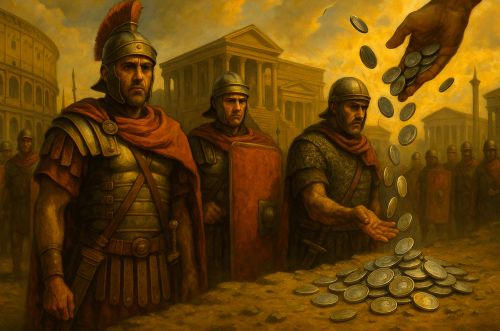
The experience of the barracks emperors demonstrates the point at which military authority overwhelmed the fiscal mechanisms that had long sustained Roman governance.

By Matthew A. McIntosh
Public Historian
Brewminate
Introduction: Military Accession and Monetary Fragility
By the early third century CE, the Roman Empire entered a political environment in which imperial authority could be created and destroyed by the will of the army. Emperors no longer rose primarily through dynastic succession, senatorial ratification, or carefully managed adoption, but through direct acclamation by troops in frontier zones. Modern historians have labeled these rulers “barracks emperors,” a retrospective term that captures the central reality of their power without reflecting any contemporary Roman designation. Their reigns were shaped by an urgent need to secure military loyalty immediately upon accession, often in the absence of broader political legitimacy.1
This transformation in the mechanics of imperial power carried profound fiscal consequences. The Roman state had long depended on a monetized economy in which silver coinage, especially the denarius and later the antoninianus, functioned as the primary medium for paying soldiers, collecting taxes, and facilitating long-distance trade. That system relied not only on administrative capacity but on trust in the intrinsic value of the currency itself. Once confidence in the silver content of imperial coinage eroded, the stability of the wider economy became vulnerable in ways that could not be easily reversed.2
The reign of Maximinus Thrax, beginning in 235 CE, marked a decisive break with earlier imperial norms. Elevated directly by the army and lacking meaningful senatorial support, Maximinus governed almost entirely through military authority. His position was not unique for long. Over the next five decades, emperors would rise and fall with extraordinary speed, many ruling for only months or a few years before being replaced by rivals backed by other armies. In this environment, military pay and donatives were no longer periodic rewards but essential tools of survival.3
The fiscal strain produced by this political order did not emerge in isolation. The Roman Empire faced mounting pressures along its frontiers, increased administrative costs, and disruptions to traditional revenue streams. What distinguished the third century crisis was the state’s growing reliance on monetary manipulation to bridge the gap between obligation and capacity. Coinage debasement was not an accidental byproduct of mismanagement but a deliberate response to immediate financial demands that outpaced available silver reserves.4
As debasement accelerated, the consequences extended far beyond the mint. Inflationary pressures destabilized prices, discouraged commercial exchange, and altered patterns of payment across the empire. In some regions, monetary transactions gave way to payments in kind, not because money ceased to exist, but because it ceased to be trusted. These developments compounded existing political and military instability, producing a feedback loop in which fiscal weakness and political fragmentation reinforced one another.5
This essay examines how the rise of the barracks emperors contributed to the breakdown of Rome’s monetary system and how that breakdown, in turn, intensified the Crisis of the Third Century. Rather than treating economic collapse as an abstract or inevitable process, it analyzes the specific decisions, constraints, and structural pressures that linked military accession to monetary fragility. By doing so, it seeks to explain not merely how Rome’s economy suffered in this period, but why its traditional mechanisms for managing crisis ultimately failed.
The Pre-Crisis Monetary System and Its Limits

For much of the early imperial period, Rome’s monetary system functioned with remarkable consistency despite its geographic scale. The denarius served as the principal silver coin for state payments, taxation, and commercial exchange, forming the backbone of imperial finance from the late Republic into the third century CE. Although gold aurei circulated among elites and for large transfers, silver coinage remained the practical medium through which soldiers were paid and markets operated. This system depended on the widespread assumption that imperial coinage retained a stable relationship between face value and precious metal content, an assumption reinforced by long-standing minting conventions and state authority.6
By the early third century, however, the limits of this system were already visible. Even before the accession of Maximinus Thrax, emperors of the Severan dynasty had increased military expenditures substantially, particularly under Septimius Severus, who raised soldiers’ pay and expanded donatives. These increases were funded in part through modest debasement of the denarius and, later, the introduction of the antoninianus under Caracalla, a coin tariffed at two denarii but containing significantly less than twice the silver.7 While these measures strained monetary credibility, they did not immediately destabilize the economy, largely because silver content, though reduced, remained sufficient to sustain confidence.
The Roman state lacked modern fiscal instruments capable of absorbing sudden expenditure shocks. There was no system of public debt in the modern sense, nor an independent banking apparatus capable of underwriting imperial spending. Revenue was drawn primarily from taxation, tribute, and requisitions, all of which were limited by administrative capacity and political tolerance. When expenditures exceeded revenue, coinage manipulation became one of the few tools available to the state, especially in moments of military crisis.8 This structural constraint would become decisive once emperors were compelled to secure loyalty through rapid and repeated payouts.
Mint administration itself was not inherently chaotic in the early third century. Central mints operated under imperial supervision, and provincial mints followed established standards. Metallurgical studies of coinage from the late second and early third centuries indicate deliberate and controlled reductions in silver content rather than irregular or fraudulent practices.9 This suggests that debasement was initially a calculated policy choice rather than evidence of systemic breakdown. The problem lay not in the existence of debasement, but in its cumulative acceleration under conditions of political instability.
Confidence in Roman money depended not only on silver content but on predictability. As long as reductions occurred gradually and uniformly, economic actors could adjust prices and contracts accordingly. Once debasement became frequent and uneven, however, that predictability vanished. Hoarding of older, higher-silver coins began to remove sound currency from circulation, leaving newer, debased issues to dominate everyday transactions.10 This process undermined the integrative function of money without immediately eliminating its use, creating distortions that would worsen over time.
By the eve of the Crisis of the Third Century, Rome’s monetary system remained operational but increasingly fragile. It could still support trade, taxation, and military logistics under stable conditions, yet it lacked resilience against sustained political upheaval. The rise of emperors whose authority rested almost entirely on military backing exposed these vulnerabilities. Once military pay became the primary mechanism of legitimacy, the existing fiscal framework proved incapable of sustaining the empire without eroding the very currency on which it depended.11
Military Acclamation and the Cost of Loyalty

Imperial accession in the third century increasingly bypassed traditional mechanisms of legitimacy. Emperors were proclaimed not in Rome but on frontiers, elevated by troops whose primary concern was material security rather than constitutional continuity. Military acclamation was not new to Roman politics, but its frequency and decisiveness increased sharply after 235 CE. Once the army became the primary arbiter of power, imperial authority ceased to rest on senatorial recognition or dynastic continuity and instead depended on the continued satisfaction of armed forces stationed across the empire.12
This shift transformed the economic meaning of loyalty. Soldiers no longer expected payment merely as compensation for service but as a condition for recognizing an emperor at all. Donatives, once extraordinary rewards following victories or accessions, became routine instruments of rule. The sums involved escalated as rival claimants competed for support, each needing to outbid the last. These payments were immediate and nonnegotiable, leaving little room for fiscal planning or gradual revenue collection.13
Maximinus Thrax exemplified the new logic of military rule. Rising from the ranks and lacking senatorial support, his authority depended almost entirely on the army that proclaimed him emperor. Contemporary sources emphasize his reliance on military backing and his indifference to traditional elite approval, a posture that made sustained financial commitment to the troops unavoidable.14 Unlike earlier emperors who could balance military and civilian constituencies, Maximinus faced a narrower political calculus in which failure to satisfy soldiers risked immediate overthrow.
The consequences of this political order extended beyond individual reigns. Rapid turnover among emperors intensified fiscal pressure, as each new ruler felt compelled to secure loyalty through fresh payments even when resources were already strained. The absence of stable succession meant that financial obligations accumulated without long-term continuity. Coinage debasement thus became not merely a response to high costs but a structural feature of an imperial system trapped in perpetual reacclamation.15
Military acclamation also altered the geographic distribution of power and spending. Emperors ruled where their armies were stationed, often far from Rome, redirecting fiscal resources toward frontier zones at the expense of civic infrastructure and urban economies. This reallocation further weakened traditional revenue centers while amplifying the financial demands of the military. By tying political survival to immediate monetary rewards, the barracks emperors embedded fiscal instability at the core of imperial governance.16
Maximinus Thrax and Fiscal Extraction

The reign of Maximinus Thrax illustrates how military accession translated directly into extraordinary fiscal pressure. Proclaimed emperor by frontier troops in 235 CE, Maximinus never entered Rome and showed little interest in cultivating senatorial or urban support. His legitimacy rested almost entirely on the army, and his fiscal policies reflected that reality from the outset. Maintaining loyalty required sustained and generous military pay, a burden that exceeded the capacity of normal taxation mechanisms.17 The emperor therefore turned to aggressive forms of revenue extraction that disrupted existing economic relationships across the empire.
Ancient sources attest to widespread confiscations and intensified demands placed upon provincial elites during Maximinus’ reign. Property seizures, forced contributions, and the targeting of wealthy individuals became central tools of imperial finance, not as temporary expedients but as routine practices.18 These measures alienated civilian populations while failing to produce stable long-term revenue. Unlike taxation, which depended on administrative continuity, confiscation provided immediate resources but undermined future fiscal capacity by destabilizing local economies and eroding cooperation between the state and provincial communities.
The scale of military expenditure under Maximinus also forced the state to increase reliance on coinage output. Rather than reducing obligations, the regime sought to meet them through expanded minting and declining silver content. Numismatic evidence indicates that debasement accelerated during this period, not as an abstract monetary experiment but as a practical response to cash shortages.19 The production of coinage substituted nominal quantity for intrinsic value, allowing payments to continue while shifting the economic cost onto the wider population through inflation.
These fiscal strategies exposed the fundamental incompatibility between military autocracy and monetary stability. Maximinus’ extraction policies succeeded in the short term by keeping the army loyal, but they deepened civilian resistance and weakened the economic base of the empire. When his regime collapsed in 238 CE, it left behind neither restored confidence nor fiscal recovery. Instead, it set a precedent in which future emperors inherited an economy already strained by emergency measures that had become permanent features of imperial rule.20
Coinage Debasement as State Policy

Coinage debasement during the third century did not emerge as an accidental byproduct of administrative collapse but as a conscious response to fiscal pressure. Roman authorities understood the relationship between silver content and public confidence yet repeatedly chose to reduce intrinsic value in order to meet immediate obligations. The antoninianus, introduced earlier under Caracalla, became the primary instrument through which this policy was implemented, as its tariffed value allowed the state to stretch limited silver supplies further than the denarius had permitted.21 The decision to favor quantity over quality reflected the state’s prioritization of short-term liquidity over long-term stability.
Numismatic and metallurgical analyses demonstrate that debasement followed a discernible trajectory rather than random fluctuation. Silver content declined steadily across successive issues, with particularly sharp reductions occurring during periods of rapid imperial turnover.22 These changes required coordinated mint activity and access to bullion supplies, indicating centralized control rather than mint-level improvisation. Debasement thus functioned as an extension of fiscal policy, enabling emperors to finance armies without first securing additional revenue through taxation or confiscation.
The economic consequences of this strategy were uneven but cumulative. Prices adjusted upward as coinage lost intrinsic value, while contracts and wages lagged behind monetary change. Evidence from documentary sources suggests increasing reluctance to accept newly minted coinage at face value, especially in private transactions.23 As trust eroded, older, higher-silver coins were hoarded or removed from circulation, intensifying reliance on debased issues and accelerating inflationary pressures within the market.
By treating coinage as an expandable fiscal resource, the imperial government undermined the very mechanisms that sustained exchange across the empire. Debasement solved the immediate problem of paying soldiers but transferred the cost to merchants, taxpayers, and provincial economies. Over time, this redistribution of burden weakened commercial networks and reduced the effectiveness of monetary exchange as a tool of governance.24 The policy achieved its immediate aims while eroding the foundations of imperial finance, leaving subsequent rulers with fewer viable options.
Inflationary Dynamics and Market Response

The inflation produced by sustained debasement did not operate as a uniform or immediately catastrophic phenomenon. Instead, it emerged unevenly across regions and sectors, shaped by local supply conditions, administrative practices, and degrees of monetization. As silver content declined, prices expressed in coin rose, but not always proportionally. Some goods adjusted rapidly, while wages and fixed obligations lagged behind, producing distortions that disproportionately affected soldiers, urban laborers, and provincial taxpayers.25 Inflation therefore functioned less as a single economic shock than as a cumulative destabilizing force that strained everyday transactions.
Market responses reflected rational adaptation rather than irrational panic. Merchants increasingly differentiated between older and newer coinage, valuing high-silver issues above their nominal equivalents. Evidence from Egyptian papyri indicates growing reliance on price recalculation and commodity valuation independent of official tariffs, particularly in private contracts.26 These practices did not signal the disappearance of money but its declining usefulness as a reliable unit of account. As predictability eroded, economic actors sought alternative means to preserve value and manage exchange.
Hoarding intensified as a consequence of declining trust. Coins with higher silver content were withdrawn from circulation and retained as stores of value, leaving debased issues to dominate everyday trade. Archaeological evidence from coin hoards shows a marked concentration of earlier issues retained together, suggesting deliberate selection rather than random loss.27 This phenomenon further reduced the effective money supply of reliable currency, amplifying inflationary pressures and reinforcing dependence on increasingly debased coinage.
In response to monetary instability, payments in kind became more common in certain contexts, particularly in tax collection and local exchange. This shift did not represent a wholesale abandonment of money, but a pragmatic adjustment to its diminished credibility.28 Grain, oil, and other commodities offered stability where coinage no longer could, especially in regions with strong agrarian production. The expansion of such practices signaled not economic primitivism, but the limits of a monetary system undermined by fiscal necessity and political instability.
Trade Contraction and the Erosion of Monetary Trust

Long-distance trade within the Roman Empire depended on a shared monetary framework that allowed goods, labor, and obligations to be valued consistently across regions. As debasement intensified and inflation destabilized prices, this framework weakened. Merchants operating beyond local markets faced increased uncertainty when assessing costs, profits, and risk, particularly when transactions involved newly issued coinage of unpredictable silver content. The result was not an immediate collapse of trade, but a gradual contraction as exchange became more costly and less reliable.29
Archaeological evidence supports this pattern of uneven decline rather than sudden disappearance. Reductions in the circulation of certain goods, especially mass-produced items such as pottery and coinage itself, suggest shrinking commercial networks rather than the end of exchange altogether.30 Trade persisted at regional and local levels, where familiarity and repeated interaction mitigated uncertainty, but interprovincial commerce proved more vulnerable to monetary instability. The erosion of trust in currency thus narrowed the geographic scope of economic integration.
State demand further distorted commercial priorities. As military and administrative needs absorbed increasing shares of available resources, private trade faced competition from requisitions and compulsory supply arrangements. These practices diverted goods from open markets into state-controlled channels, reducing availability and discouraging voluntary exchange.31 Over time, this shift altered production incentives, as producers oriented output toward predictable state demands rather than fluctuating market conditions.
The decline of monetary trust also affected credit relationships. Loans, deferred payments, and long-term contracts became riskier in an environment where repayment in debased coin threatened real losses. Documentary evidence indicates shorter contract durations and increased insistence on repayment in kind or in higher-quality coinage where possible.32 These adjustments constrained commercial flexibility and reduced the capacity of markets to absorb shocks, reinforcing economic fragmentation.
By the mid-third century, the Roman economy exhibited signs of structural contraction rather than simple stagnation. Trade routes remained in use, but at diminished intensity and scale. The weakening of monetary trust did not eliminate commerce, but it undermined the integrative role that money had long played in sustaining imperial cohesion.33 As economic exchange retreated into narrower and more localized forms, the empire’s ability to mobilize resources across vast distances diminished, compounding the political and military challenges of the age.
Monetary Breakdown within the Broader Crisis of the Third Century
The monetary instability of the third century cannot be isolated from the broader political and military disruptions that defined the period. Economic breakdown did not occur in a vacuum, nor did it single-handedly cause imperial fragmentation. Instead, fiscal weakness interacted with rapid imperial turnover, external pressure, and administrative strain, each reinforcing the others. As coinage lost credibility, the state’s capacity to respond effectively to crisis diminished, constraining both military logistics and civilian governance.34
Rapid succession among emperors exacerbated these pressures by preventing long-term fiscal planning. Each new ruler inherited not only depleted resources but also expectations of immediate military reward. Short reigns discouraged investment in monetary stabilization, as the political payoff lay in survival rather than reform. This dynamic encouraged continued reliance on debasement even as its consequences became increasingly visible across the empire.35 Economic instability thus became embedded within the structure of imperial politics rather than treated as a problem to be solved.
External threats compounded these difficulties. Frontier warfare against Germanic groups in the west and the Sasanian Empire in the east demanded sustained military expenditure at precisely the moment when monetary reliability was eroding. Supplying armies over long distances required functioning markets and predictable exchange, yet inflation and declining trust made procurement more difficult and expensive.36 Military necessity therefore intensified reliance on fiscal expedients that further weakened the monetary system.
Regional fragmentation also reflected the limits of economic integration under monetary strain. Breakaway regimes such as the Gallic Empire and Palmyrene Empire developed partially autonomous fiscal practices, redirecting resources to local military and administrative needs. These regimes did not abandon coinage, but their separation from central authority disrupted imperial-wide circulation patterns.37 The fragmentation of political authority thus mirrored the fragmentation of monetary trust across regions.
Administrative continuity suffered alongside these developments. Tax assessment, collection, and redistribution depended on stable valuation of currency. As inflation intensified, tax burdens became harder to calculate and enforce, leading to arrears, renegotiation, or substitution with payments in kind.38 These adaptations allowed the state to function at a basic level but reduced efficiency and increased reliance on coercion, further alienating civilian populations.
By the late third century, Rome faced not a single crisis but an accumulation of interlocking failures. Monetary breakdown magnified political instability by constraining imperial responses, while political instability accelerated monetary decline by prioritizing short-term survival over systemic repair.39 The Crisis of the Third Century emerged from this interaction, not as a sudden collapse, but as a prolonged erosion of structures that had once sustained imperial cohesion.
Attempts at Stabilization before Diocletian

By the mid-third century, imperial authorities recognized that unchecked debasement and fiscal improvisation had weakened the state’s ability to govern effectively. Several emperors attempted limited corrective measures, not to restore earlier monetary standards, but to slow further deterioration. These efforts focused primarily on restoring discipline to mint operations and curbing the most extreme abuses rather than addressing the structural drivers of instability. Such initiatives reflected an awareness of crisis without offering a durable solution.40
The most notable of these attempts occurred under Aurelian, whose reign marked a brief moment of consolidation amid continuing turmoil. Aurelian undertook reforms aimed at reasserting central control over minting practices and improving the quality of silver coinage. Numismatic evidence suggests a partial restoration of silver content and clearer marking of official issues, signaling an effort to rebuild confidence without abandoning debasement entirely.41 These measures, however, remained limited in scope and depended heavily on continued military success to sustain authority.
Despite these initiatives, the underlying fiscal pressures persisted. Military expenditures remained high, and the political logic of military acclamation continued to demand immediate rewards for loyalty. Even where reforms temporarily improved coin quality, they did not resolve the imbalance between revenue and obligation. The absence of administrative continuity meant that stabilization efforts were vulnerable to reversal with each change of regime.42 Monetary reform thus remained subordinate to political survival.
The failure of pre-Diocletian reforms underscores the depth of the crisis confronting the empire. Incremental adjustments to coinage and mint discipline could not compensate for a system in which legitimacy rested on constant military payment. Without restructuring the relationship between the state, the army, and the economy, monetary stability remained unattainable. These limitations set the stage for more comprehensive transformations at the end of the third century, when reform would move beyond adjustment and toward systemic reorganization.43
Conclusion: Military Power and the Limits of Monetary Manipulation
The experience of the barracks emperors demonstrates the point at which military authority overwhelmed the fiscal mechanisms that had long sustained Roman governance. When emperors derived legitimacy primarily from the army, monetary policy ceased to function as a stabilizing instrument and became a tool of immediate survival. Coinage debasement allowed rulers to meet urgent obligations, but only by undermining the credibility of the currency that enabled imperial administration in the first place. This transformation marked a fundamental shift in the relationship between power and money within the Roman state.44
What distinguished the third century was not merely the scale of debasement, but the absence of institutional constraints capable of halting it. Earlier emperors had used monetary manipulation sparingly and within a framework of political continuity. By contrast, the barracks emperors operated in a system where short reigns, constant threat of overthrow, and competitive military loyalty made restraint politically irrational. Fiscal decisions that might have been temporary expedients hardened into structural practices, eroding the economic foundations of imperial cohesion.45
The economic consequences of this shift extended beyond inflation and trade contraction. As monetary trust declined, the empire’s capacity to coordinate resources across regions weakened. Payments in kind, localized exchange, and fragmented fiscal practices were not signs of regression, but adaptations to a monetary system that no longer performed its integrative role. These adaptations allowed the empire to persist, yet at the cost of reduced efficiency, diminished commercial reach, and increased reliance on coercive extraction.46
The Crisis of the Third Century thus emerged not from a single catastrophic failure, but from the cumulative effects of political militarization and fiscal improvisation. The barracks emperors exposed the limits of monetary manipulation as a substitute for sustainable governance. Their reigns revealed that when legitimacy depends on constant payment rather than institutional continuity, currency becomes a casualty of power rather than its foundation. The eventual reforms of the late third century would acknowledge this reality by reshaping the relationship between the state, the army, and the economy, marking the end of an era in which silver alone could hold the empire together.47
Appendix
Footnotes
- Herodian, History of the Empire from the Death of Marcus Aurelius, Book VII, on the accession of Maximinus Thrax.
- Kevin Butcher and Matthew Ponting, “The Roman Denarius under the Julio-Claudian Emperors,” Numismatic Chronicle 172 (2012).
- David S. Potter, The Roman Empire at Bay, AD 180–395 (London: Routledge, 2004).
- Andrew Burnett, “Coinage in the Roman World,” in The Oxford Handbook of Roman Studies (Oxford: Oxford University Press, 2010).
- Peter Temin, The Roman Market Economy (Princeton: Princeton University Press, 2012).
- Andrew Burnett, Coinage in the Roman World (London: Seaby, 1987), 28–35.
- Kevin Butcher and Matthew Ponting, The Metallurgy of Roman Silver Coinage: From the Reform of Nero to the Reform of Trajan. Cambridge: Cambridge University Press (2014): 349–352.
- Richard Duncan-Jones, Money and Government in the Roman Empire (Cambridge: Cambridge University Press, 1994), 3–7.
- Butcher and Ponting, “The Roman Denarius under the Julio-Claudian Emperors.”
- Temin, The Roman Market Economy, 124–129.
- Potter, The Roman Empire at Bay, 146–152.
- Herodian, History of the Empire from the Death of Marcus Aurelius, Book VII.
- Potter, The Roman Empire at Bay, 145–148.
- Herodian, History of the Empire from the Death of Marcus Aurelius, Book VII; Historia Augusta, Life of Maximinus Thrax.
- Duncan-Jones, Money and Government in the Roman Empire, 32–36.
- Clifford Ando, Imperial Rome AD 193 to 284: The Critical Century (Edinburgh: Edinburgh University Press, 2012), 87–92.
- Potter, The Roman Empire at Bay, 150–153.
- Herodian, History of the Empire from the Death of Marcus Aurelius, Book VII; Historia Augusta, Life of Maximinus Thrax.
- Butcher and Ponting, “The Metallurgy of Roman Silver Coinage in the Third Century.”
- Ando, Imperial Rome AD 193 to 284, 94–98.
- Burnett, Coinage in the Roman World, 88–92.
- Butcher and Ponting, The Metallurgy of Roman Silver Coinage.
- Temin, The Roman Market Economy, 130–136.
- Duncan-Jones, Money and Government in the Roman Empire, 41–45.
- Temin, The Roman Market Economy, 137–142.
- Roger S. Bagnall, Egypt in Late Antiquity (Princeton: Princeton University Press, 1993), 68–72.
- Andrew Burnett, “The Roman Coinage of the Third Century,” in The Cambridge Ancient History, vol. 12 (Cambridge: Cambridge University Press, 2005), 292–296.
- Duncan-Jones, Money and Government in the Roman Empire, 52–55.
- Temin, The Roman Market Economy, 143–148.
- Andrew Wilson, “Urban Development in the Third Century,” in The Cambridge Ancient History, vol. 12 (Cambridge: Cambridge University Press, 2005), 257–262.
- Ando, Imperial Rome AD 193 to 284, 101–106.
- Bagnall, Egypt in Late Antiquity, 74–78.
- Duncan-Jones, Money and Government in the Roman Empire, 61–64.
- Potter, The Roman Empire at Bay, 156–160.
- Ando, Imperial Rome AD 193 to 284, 109–113.
- Pat Southern, The Roman Empire from Severus to Constantine (London: Routledge, 2001), 58–63.
- Jerome Mairat, “The Coinage of the Gallic Empire,” Doctoral Thesis, Wolfson College, 2014.
- Duncan-Jones, Money and Government in the Roman Empire, 66–70.
- Temin, The Roman Market Economy, 149–154.
- Ando, Imperial Rome AD 193 to 284, 118–122.
- Burnett, Coinage in the Roman World, 108–112.
- Potter, The Roman Empire at Bay, 163–167.
- Duncan-Jones, Money and Government in the Roman Empire, 74–77.
- Temin, The Roman Market Economy, 155–158.
- Ando, Imperial Rome AD 193 to 284, 125–129.
- Duncan-Jones, Money and Government in the Roman Empire, 78–82.
- Potter, The Roman Empire at Bay, 170–173.
Bibliography
- Ando, Clifford. Imperial Rome AD 193 to 284: The Critical Century. Edinburgh: Edinburgh University Press, 2012.
- Bagnall, Roger S. Egypt in Late Antiquity. Princeton: Princeton University Press, 1993.
- Burnett, Andrew. Coinage in the Roman World. London: Seaby, 1987.
- —-. “The Roman Coinage of the Third Century.” In The Cambridge Ancient History, Vol. 12: The Crisis of Empire, AD 193–337, edited by Alan K. Bowman, Peter Garnsey, and Averil Cameron, 292–296. Cambridge: Cambridge University Press, 2005.
- —-. “Coinage in the Roman World.” In The Oxford Handbook of Roman Studies, edited by Alessandro Barchiesi and Walter Scheidel. Oxford: Oxford University Press, 2010.
- Butcher, Kevin, and Matthew Ponting. The Metallurgy of Roman Silver Coinage from the Reform of Nero to the Reform of Trajan. Cambridge: Cambridge University Press (2014): 349–352.
- —-. “The Roman Denarius under the Julio-Claudian Emperors.” Numismatic Chronicle 172 (2012).
- Duncan-Jones, Richard. Money and Government in the Roman Empire. Cambridge: Cambridge University Press, 1994.
- Herodian. History of the Empire from the Death of Marcus Aurelius. Translated editions vary. Originally composed third century CE.
- Mairat, Jerome. “The Coinage of the Gallic Empire.” Doctoral Thesis, Wolfson College, 2014.
- Potter, David S. The Roman Empire at Bay, AD 180–395. London: Routledge, 2004.
- Southern, Pat. The Roman Empire from Severus to Constantine. London: Routledge, 2001.
- Temin, Peter. The Roman Market Economy. Princeton: Princeton University Press, 2012.
- Wilson, Andrew. “Urban Development in the Third Century.” In The Cambridge Ancient History, Vol. 12: The Crisis of Empire, AD 193–337, edited by Alan K. Bowman, Peter Garnsey, and Averil Cameron, 257–262. Cambridge: Cambridge University Press, 2005.
Originally published by Brewminate, 12.16.2025, under the terms of a Creative Commons Attribution-NonCommercial-NoDerivatives 4.0 International license.
About the Author