By Dr. Martha S. Jones
Society of Black Alumni Presidential Professor and Professor of History
Johns Hopkins University
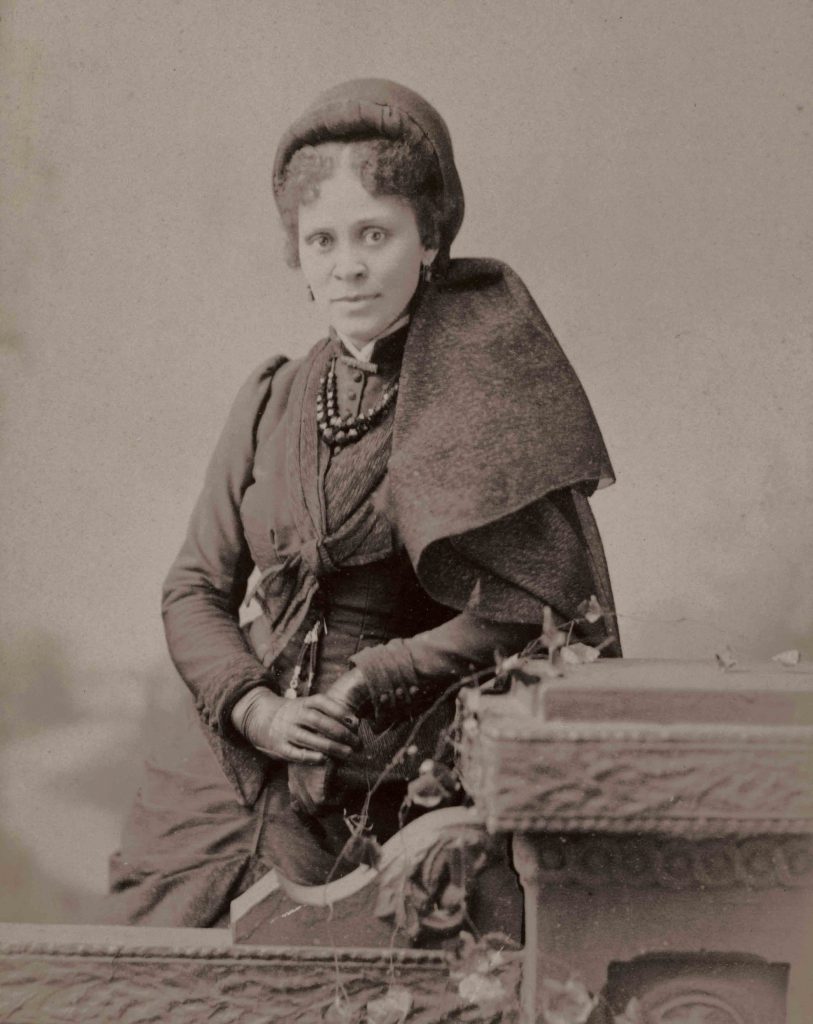
Hallie Quinn Brown knew the power of black women and urged anyone who heard her to let it flourish.
Read her remarks from 1889 and you might believe she saw the future or at least had the capacity to call it into being: “I believe there are as great possibilities in women as there are in men. . . . We are marching onward grandly. . . . We love to think of the great women of our race—the mothers who have struggled through poverty to educate their children. . . . There are many wives who are now helping to educate their husbands at school, by taking in sewing and washin. . . I believe in equalizing the matter. Instead of going to school a whole year, he ought to stay at home one half, and send his wife the other six months. . . . I repeat, we want a grand and noble womanhood, scattered all over the land. There is a great vanguard of scholars and teachers of our sex who are at the head of institutions of learning all over the country. We need teachers, lecturers of force and character to help to teach this great nation of women.”
These remarks, delivered before a conference of the African Methodist Episcopal (AME) Church, marked a debut for Brown as an advocate of women’s rights, including the right to vote. If finding the start of a suffragist’s career in a church sanctuary surprises, it is only because the route to women’s suffrage taken by black women is still too often relegated to the margins or obscured by misunderstanding. Consider how black women did not take part in the mythical 1848 women’s meeting in Seneca Falls, New York. When we look for them in that year, we find that, instead, some of them were already at work demanding women’s rights, but they were doing so in black churches rather than in women’s conventions. And what about 1920 and ratification of the Nineteenth Amendment? Study of that hallmark moment reveals that, while some black women in the North and West had reason to celebrate, it was but a brief pause in their ongoing struggle for voting rights. Especially for black women in southern states, the struggle for the vote extended for decades more, to 1965, when the Voting Rights Act would finally topple barriers constructed by Jim Crow.
Hallie Quinn Brown’s call for a vanguard that would empower a “great nation” of black women expressed a vision that would guide her to yet another pivotal moment in the history of black women and the vote. In 1923, in the wake of the Nineteenth Amendment’s ratification, Brown took pen to paper and denounced a proposal by the United Daughters of the Confederacy (UDC) to dedicate a monument to the mythical black mammy of the South—a figure in servant’s garb cradling a white infant. Her words cut: Rather than loyal supplicants, “slave women were brutalized, the victims of white man’s caprice and lust. Often the babe torn from her arms was the child of her oppressor.” As president of the National Association of Colored Women (NACW), Brown spoke the thoughts of many thousands, descendants of enslaved women who derided the hypocrisy of white southerners who in “one generation held the black mammy in abject slavery [and in] the next would erect a monument to her fidelity.” She doubted the “deep reverence and gratitude” professed to undergird the monument. White southern women would better “make restitution,” Brown advised, by interceding with their husbands and fathers to “with one hand upraised . . . stop mob rule and lynching.”
The “mammy” figure, rather than new, was part of a long-standing Lost Cause myth that relied on the fiction that enslaved people had been docile, content, and loyal to slaveholders. But by 1922, the notion of a “Monument to the Faithful Colored Mammies of the South” won the interest of Congress, where a bill had proposed to authorize the Washington, D.C., chapter of the UDC to install such a figure on public grounds “as a gift to the people of the United States.” Black Americans saw through to the irony of such a framing and cried foul. The monument was mere propaganda aimed to distract the nation from real, twentieth century needs: adequate homes, schools, and heath care. Brown joined others in opposition—from grassroots activists to leaders like W.E.B. DuBois—and the bill died of inaction.
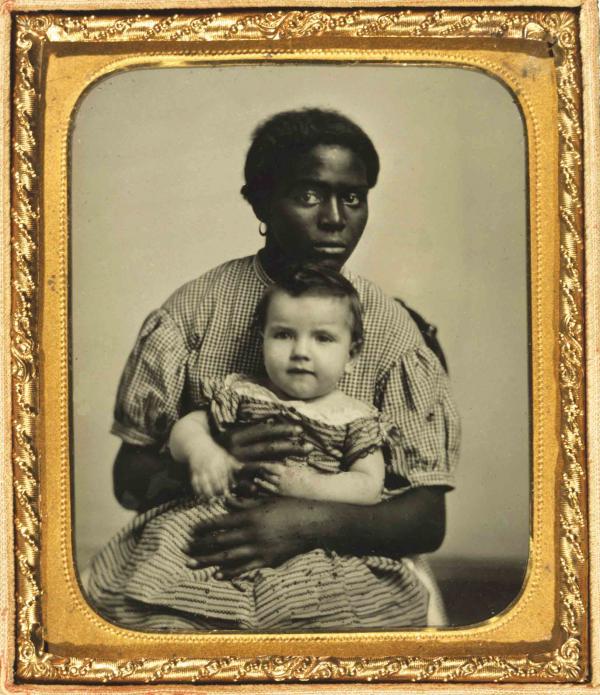
The “mammy” monument controversy erupted at a historic crossroads. It was one part a story about how the UDC promoted the Lost Cause. It was also a story about the emerging power of the NAACP. Hallie Quinn Brown’s role points to yet one more story about how black women organized to win political power, including the vote, and then used it. As leader of the era’s largest organization of black women, the NACW, Brown condemned the monument for its degrading caricature of an African-American woman. Her insight derived from the spirit expressed in Anna Julia Cooper’s 1892 black feminist manifesto: “Only the black woman can say when and where I enter, in the quiet, undisputed dignity of my womanhood, without violence and without suing or special patronage, then and there the whole Negro race enter[s] with me.”
I recently revisited the life of Hallie Quinn Brown after having long known her as part of a generation of black women activists who battled Jim Crow in its early decades. Students of African-American women’s history know Brown best by way of her 1926 edited collection of biographical essays, Homespun Heroines and Other Women of Distinction, which remains a useful reference. But finding Brown leading a challenge to the “mammy” monument made me rethink what I knew. I am at work on a history of black women and the vote, and one thing has already become clear: I must always look for early twentieth-century black suffragists in unexpected places. The racism they encountered in better remembered suffrage organizations, such as the National American Women’s Suffrage Association (NAWSA) or the National Women’s Party (NWP) meant that too few women like Brown worked through those organizations. To tell their stories, I must follow their lead.
Brown and women like her came to the cause of women’s suffrage by paths that ran through African-American-led institutions: Antislavery societies, churches, and women’s clubs. Committed to winning political rights in the early twentieth century, most black women remained just where they had begun, in black-led institutions, testing ideas and building political savvy. Those that could—mostly women in northern and western states, where Jim Crow did not exclude them from politics—signed on as supporters of the Republican party. Their purpose was often distinct. Black women sought the vote to further what they termed human rights, meaning the rights of women and men alike. They were rarely single-issue in their concerns; they battled for political rights while also advocating for temperance, education, prison reform, and the rights of working people. They especially attended to troubles that arose at the crossroads of race and gender. When Brown railed against the prospect of a “mammy” monument in the nation’s capital, she did so knowing that the promotion of such a false and degrading image undercut black women’s political aspirations. She was part of a “great vanguard” prepared to fight back and further empower a “great nation of women.”
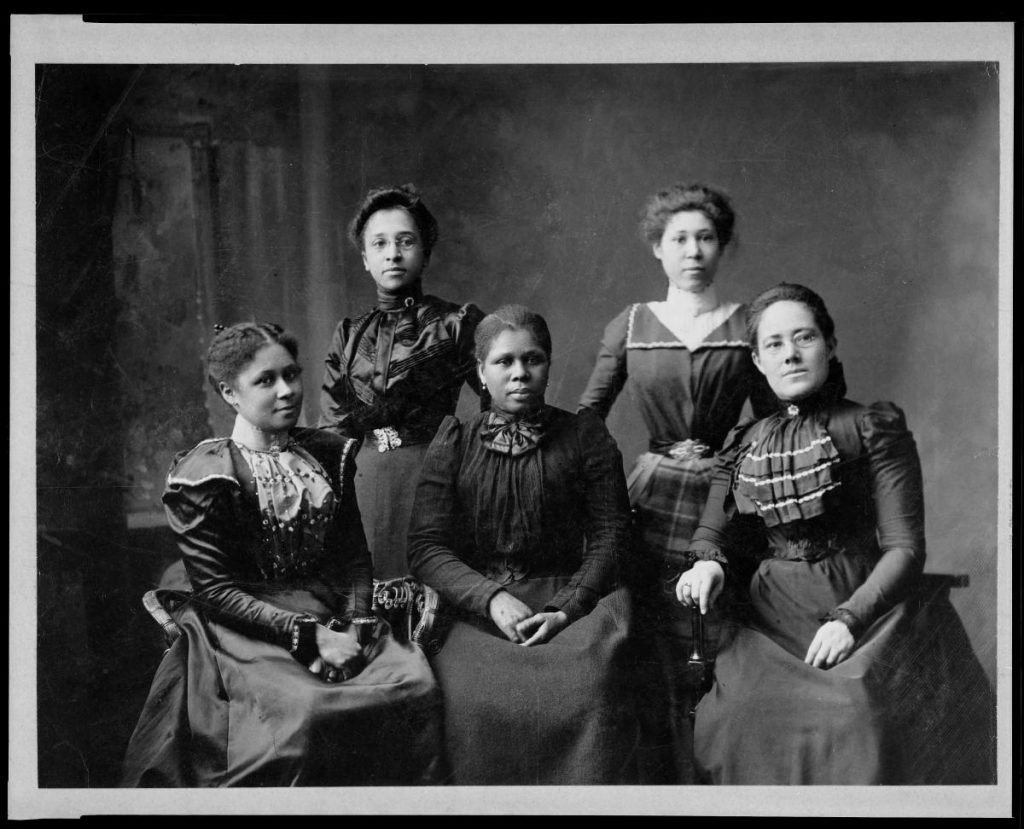
For Brown, women’s education was foundational. Though she was free born in 1849 in Pittsburgh, Brown’s parents had been enslaved. To better educate their children, the household migrated to Chatham in Canada during Brown’s teen years, where the family lived alongside fugitive slaves and dissident black emigrants who had abandoned the United States. By 1870, in the wake of the Civil War and during early Reconstruction, Brown returned to the U.S., where she enrolled at Wilberforce University in Ohio. After graduation, Brown’s career as an educator took her to public schools, north and south, and to Allen University in South Carolina and Alabama’s Tuskegee Institute. Along the way, she studied elocution, and in 1893 Brown settled in as a professor at her alma mater, Wilberforce. It would be her institutional home for the next decade.
“Give her your votes,” insisted Gertrude Bustill Mossell, referring to Brown in 1892. Mossell admonished those men who saw Brown’s womanhood as a bar to her holding the office of the secretary of education in the AME Church: “Let the sex have its representation for we all know they willingly accept more than their share of the taxation.” With that—a run for office—Brown was baptized into women’s politics, part of a maelstrom in which, alongside her, other churchwomen were claiming the right to hold office by way of ordination into the ministry. The resulting debates consumed and nearly tore apart the AME Church community. Brown learned valuable lessons: In her aim to assume power she had allies, women like Mossell, and, at the same time, she could expect opposition.
Brown’s early political education was earned in battles over the public representation of black women. At stake was whether black women would exercise rights as full citizens. As with many of her generation, Brown was drawn out from familiar settings such as the classroom and church, as their benevolent work took a sharply political turn and their leadership consolidated at a national level. First, there was a controversy during the planning of the 1893 Chicago World’s Fair, when the sponsors failed to include African-American planners or themed exhibits. Brown managed to be appointed a clerk in the fair’s department of publicity and promotion and then used her position to expose the degree to which those in charge intended to leave black Americans invisible and unaccounted for. In the same years, Brown led the women of the Colored League of Washington, D.C., to the first meeting of what would become the National Association of Colored Women. The women had been galvanized when James Jacks, then president of the Missouri Press Association, publicly ridiculed Ida B. Wells and her antilynching campaign and then impugned all black women, branding them prostitutes, thieves, and liars. Jacks’s letter ignited a “pressing . . . need of our banding together if only for our protection.”
In the decades leading to passage of the Nineteenth Amendment, Brown grew to be a sophisticated activist who moved along intertwined paths, the sort of journey shared by many black suffragists. She appears to have avoided any sustained association with NAWSA or the NWP. The antiblack racism that ran through such organizations likely kept her at a distance. Brown did not, however, operate in deference to a divide between black and white women, nor did she avoid suffrage politics. Temperance brought her to London, where she spoke at the 1895 convention of the World’s Woman’s Christian Temperance Union, one of only three black American women to do so. In the summer of 1900, Brown was in London to attend the International Congress of Women, where she heard women’s suffrage debated and reported favorably on an exchange in which antiwomen’s suffrage ideas were “torn to shreds.”
Black women’s clubs became the heart of Brown’s public work. There, by 1899, leaders were heralding the movement for women’s suffrage as “the pioneer force for woman’s emancipation and progress.” By 1901, NACW president Mary Church Terrell won an “ovation” for her remarks on “The Justice of Women Suffrage”: “Woman’s rights were not protected as they should be. Not until woman . . . had the ballot to be used for her protection and self-defence [sic] can she hope to secure the rights and privileges to which she is entitled.” Brown, in 1904, helped write a resolution which provided “that the women of our Association prepare themselves by the study of civic government and kindred subjects for the problems of city, State, and National life that they may be able to perform, intelligently, the duties that have come to some and will come to others in the natural progress of the Woman Suffrage movement.” In 1911 and 1912, she headed the NACW’s “Suffrage” department and, in 1920, Brown assumed the association’s presidency.
Looking ahead from 1920, Brown charged the women of the NACW with picking up where the movement for the Nineteenth Amendment had left off. The enfranchisement of hundreds of thousands of black women, the majority in the American South, was not yet complete. Brown led thousands of clubwomen with the same vision that had initially drawn her to the podium in 1889. Historian Nikki Brown explains that Brown’s aim was to harness black women’s votes and thus win them influence in the Republican party and in Washington, D.C. Brown urged black women to regard the ratification of the Nineteenth Amendment as an opening for an acquisition of power: “Let us remember that we are making our own history. That we are character builders; building for all eternity. Woman’s horizon has widened. Her sphere of usefulness is greatly enlarged. Her capabilities are acknowledged. . . . Let us not ask: what shall we do with our newly acquired power? Rather, what manner of women are we going to be?” She framed women’s votes as a next chapter in the long struggle for black political rights: “We stand at the open door of a new era. For the first time in the history of this country, women have exercised the right of franchise. The right for which the pioneers of our race fought, but died without the sight.”
Brown’s opposition to the UDC’s “mammy” monument fit precisely at the confluence of a victory for women’s suffrage and the ongoing work of civil rights. And a new moment demanded a new strategy. Homespun Heroines and Other Women of Distinction, published in 1926, leveled one of Brown’s most robust and enduring shots at those who doubted black women’s suitability as voters. The book was styled as what historian Brittney Cooper has termed a “listing.” It was a disruptive volley that countered limited visions of the body politic as one consisting of white women and also of men, black and white. Brown collaborated with more than 25 other women to produce—across 250 pages and more than 60 biographical sketches, essays, and poems—an argument about the past, present, and future of black women. The book demolished myths and brought to light the lives of real women—their ideas and their activism. As Brown put it in her introduction, Homespun Heroines aimed to inspire young people to “cleave more tenaciously to the truth and to battle more heroically for the right.” On the horizon, Brown suggested, was a time when universal womanhood suffrage would be realized.
Mammy—as a subservient, content and enduringly loyal slave—was exposed as pure fiction. The biographies in Homespun Heroines introduced enslaved women who recognized their exploitation, resisted at great personal risk, and were committed to their own families rather than to those of slaveholders, even when subjected to forced, prolonged separation. Dinah Cox battled in court for over 14 years when her late owner’s family refused to free her as his will provided. Upon her manumission, Charlotta Gordon MacHenry Pyles and her family risked a treacherous journey from Kentucky, through Missouri, finally arriving in the free state of Iowa. Once settled, Pyles set out to purchase family members who remained enslaved and reunited loved ones separated by sale. Harriet Tubman freed herself, returned at great risk to liberate her family and neighbors on Maryland’s Eastern Shore, and then aided Union army officials, working as a “scout,” and “outwitting the Confederates.” Lucretia Harper Simpson had been separated from her entire family while enslaved in Kentucky and, when the war came, she and three other young women took their chance and crossed the river into Ohio. These women were neither docile nor content. Nor were they loyal, at least not to those who had held them in bondage.
Citizenship was a birthright for which black women were prepared. The women of Homespun Heroines were paradigmatic voters, women of independence and integrity. For many, formal education had bestowed the insight, reason and discernment that suited them for citizenship. Others, especially those born enslaved, still managed to make manifest qualities—piousness, fidelity, benevolence, selflessness, and compassion—that evidenced their suitability as citizens and voters. Elizabeth Smith had won her education despite violent opposition to the presence of young black women at Prudence Crandall’s school in Canterbury, Connecticut. Caroline Sherman Andrews-Hill, though enslaved, stole learning as the household’s white children were being taught, only to be banned from working nearby during lesson time. Anne E. Baltimore, Mary Burnett Talbert, and Mary J. Patterson attended Oberlin College. So did Fannie Jackson Coppin, who took the “gentleman’s course,” despite advice that she do otherwise.
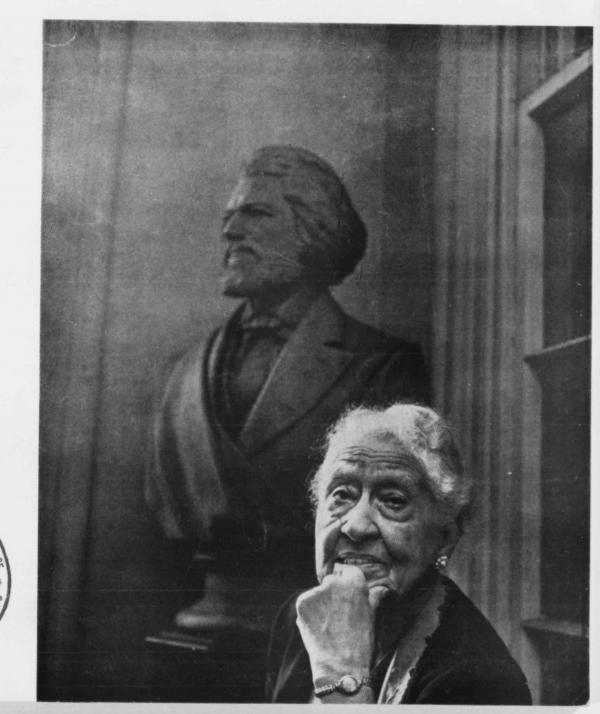
Black women had earned the vote, Homespun Heroines argued. They had as suffragists aided all American women to secure a constitutional amendment. Sojourner Truth had been a “zealous advocate for the enfranchisement of women” who “saved the day and won the victory for women,” at an 1851 suffrage convention. Harriet Tubman had taken up the cause of women’s suffrage, allied with the Empire State Federation of Colored Women’s Clubs to whom she sent a last message before her death: “Tell the women to stick together. God is fighting for them and all will be well!” Journalist Mary Ann Shadd Cary toured with white antislavery lecturers who also spoke on women’s rights, including Abby Kelley, Lucretia Mott, and Lucy Stone. Cary’s commitment sustained itself through the 1880s, when she joined the National Woman’s Suffrage Association. Sarah J. S. Garnet was the woman behind Brooklyn’s Equal Suffrage Club and Superintendent of the NACW’s suffrage department. Eliza Ann Gardner helped found Boston’s Woman’s Era Club and championed women’s rights in the AME Zion Church. Amanda Berry Smith preached in pulpits across the globe and “wherever she went there always sprang up an eager discussion on the subject of women’s right to preach.” Laura A. Brown was, during the administration of President Warren Harding, appointed a member of the executive board of the Republican Women’s Committee of Allegheny County in Pennsylvania, and in 1922 she ran for the state legislature, perhaps, Brown suggested, the first black woman in the United States to do so.
Hallie Quinn Brown was a suffragist. She was simultaneously an educator, church worker, temperance advocate, and club movement leader. She was a Republican party activist and she was a writer. Homespun Heroines may not have rivaled in page count the six-volume History of Woman Suffrage, begun by Elizabeth Cady Stanton, Susan B. Anthony, and Matilda Joslyn Gage in the 1880s. But it was no less an effort to chronicle the history of women’s activism and then mobilize that history for political ends. As the celebration in 1920 of the Nineteenth Amendment faded, Brown and the women of the NACW were left with serious work in front of them. Jim Crow still kept too many of their sisters away from the polls, and untruths wrought of racism and sexism sustained their disenfranchisement. The way forward was fraught—with competition in black politics from an increasingly influential NAACP, and with indifference on the part of women’s suffrage organizations like the National Women’s Party. The NACW would be hampered internally by an elite politics of respectability that kept it distant from black women of the working class. Other black women activists would take an internationalist view of politics, rejecting the vote and parties as too tainted by racism to take them forward. Still, Brown’s book endured, aiding those activists who followed her, and historians like me, to better understand and build upon that “great nation of women” of which she was a part.
Originally published to the public domain by Humanities, the Magazine of the NEH 40:3 (Summer 2019).
About the Author