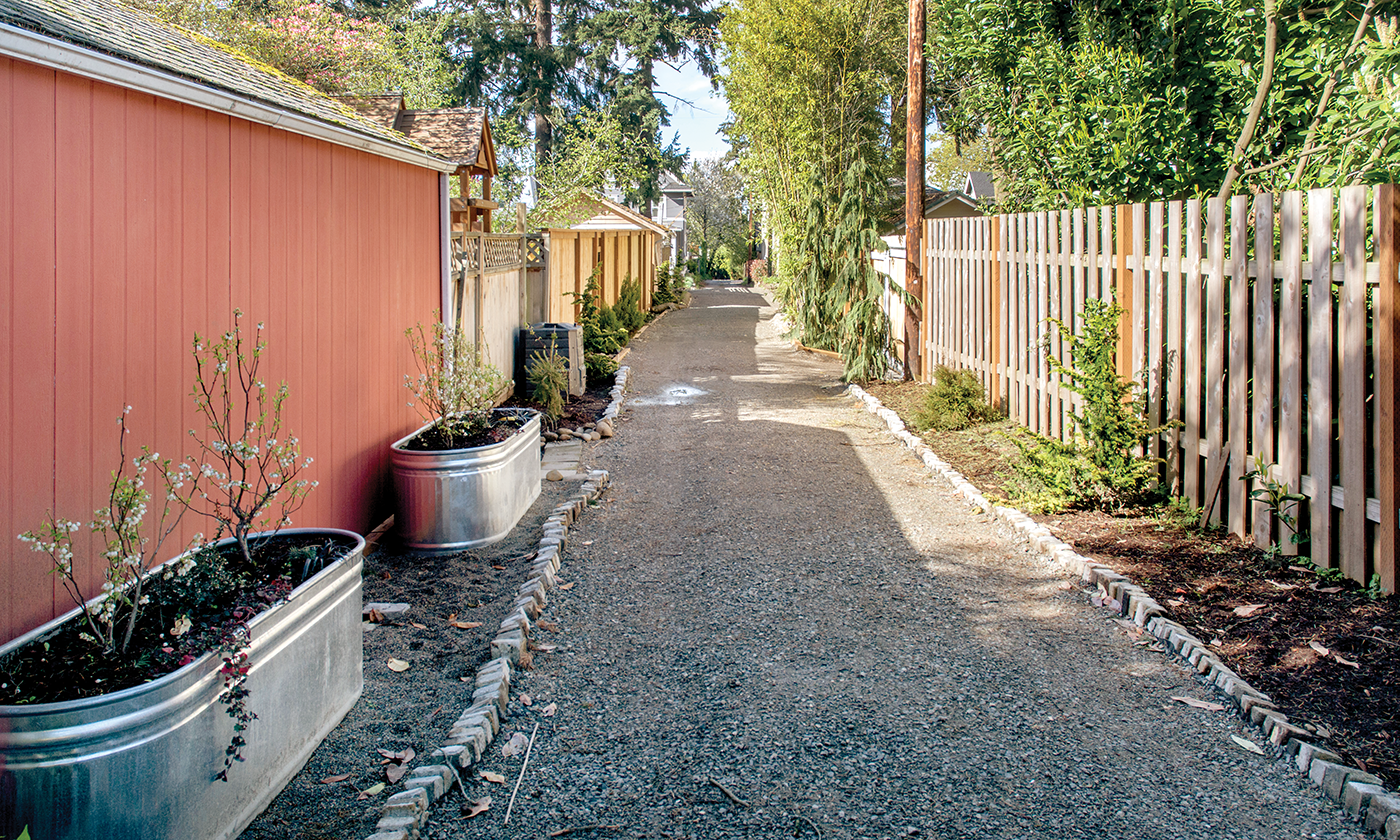

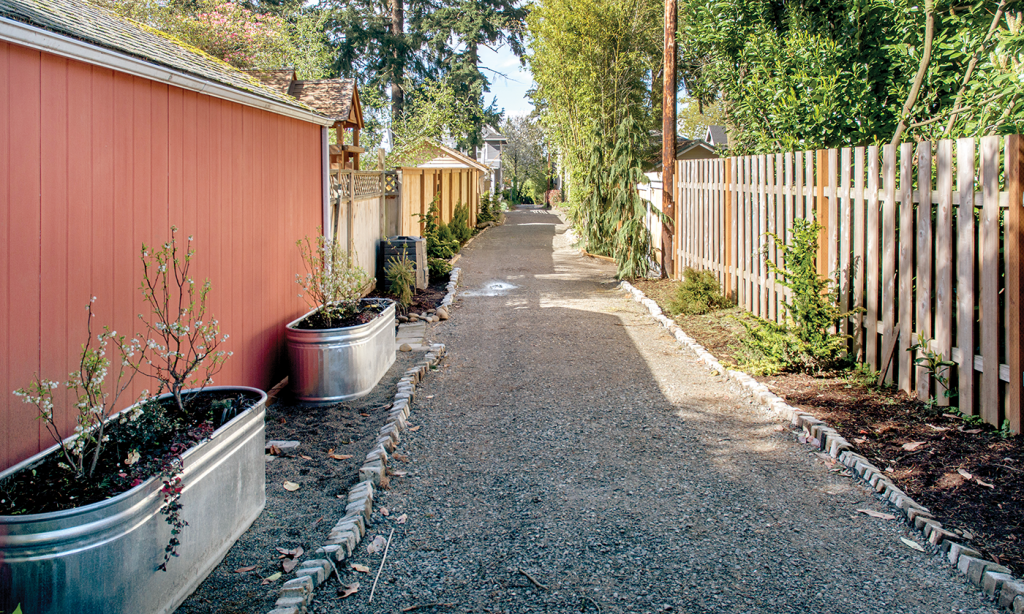
Greening alleys reclaims public space, reconnects urban dwellers to one another, and invites nature deep into cities.

Rachel Schutz hated watching the kids play outside, and not because she was a curmudgeon. As director of an after-school program in a Latino neighborhood near Portland, Oregon, she likes the outdoors, the piney tang that hangs in the damp air.
But the kids’ shoes would thump on the asphalt, the pounding echoing against metal dumpsters along the alley. That was their play space. When a neighbor’s pine tree shed its needles, she watched the kids sweep them together and build them into a nest or fort. Otherwise, they were limited to games with chalk or a ball hoop.
The kids wanted something different for the Inukai Family Boys and Girls Club’s 5,000 square feet of alleyside space. They talked about a soccer field or a traditional playground—but surprised Schutz by choosing a nature park. They imagined dirt, logs, and boulders to climb on, raised beds to grow flowers and veggies, and hundreds of trees and plants throughout.
Schutz just had to figure out how to remove the pavement.
Doing so introduced her to a soften-our-cities movement in which cities such as Nashville, Tennessee, Montreal, and Detroit are rethinking all that cement. Alleys and alleysides in particular are being effectively reimagined as people-friendly pathways, parks, and lushly planted urban habitat.
Schutz and the kids she serves understand why the idea has been spreading. The day before they strong-armed the asphalt up, one girl asked her, “Miss Rachel, does this mean we get real grass we can touch?”
Some things about alleys
Practically every city’s got alleys, passageways behind or between buildings or homes. They can be wide or narrow, pedestrian-only or open to vehicles. They date back to medieval times in many world cities, where some still host commerce and neighborhood gatherings and others stay hushed.
U.S. city planners purposefully laid dirt alleys to accommodate horses and carriages. Garbage pickup was done there (and still is today). Alleys were improvised living areas, notably for immigrants and newly freed slaves—there’s an especially strong history of that in Washington, D.C., where 300,000 people took refuge after the Civil War, according to author Grady Clay in Alleys: A Hidden Resource.
But post-World War II, Americans wanted their large cars parked out front, visible tokens of affluence. By the 1960s, The Community Builder’s Handbook pronounced alleys obsolete: “one of the advances which has been made in land planning during the motor age.” Paving was considered progress, even as it made cities impermeable. And now, as climate change brings record rains, pavement is contributing to toxic stormwater runoff and dangerous flooding. Asphalt drew cars deeper into the city and reduced urban community gathering spots. Lack of dirt cut down on a neighborhood’s trees, plants, and animal habitat.
Studies show access to nature is associated with good health—but it also correlates with wealth. The families with large front yards and backyards and lush neighborhood parks are wealthier. Less-expensive homes, multifamily structures, and dense housing often sit next to asphalt alleyways. These residents share their outdoor space with traffic and trash bins and can’t easily grow food or relax in the shade of trees.
In a 2014 study published in the Annals of Behavioral Medicine, a team of researchers found also that this is true for neighborhoods with greater concentrations of Black or Hispanic people, who “lack health-promoting and activity-inviting environmental resources.”
That was certainly the case for the Inukai Family Boys and Girls Club, in a predominantly Latino neighborhood where residents had to trek a full mile to the nearest park.
Recently, cities have been rethinking their hard alleys. Montreal has an official Ruelle Verte (“Green Alley”) program encompassing more than 250 back routes that have been turned into gardens, play spaces, and neighborhood gathering spots. And in Detroit, a green-business incubator and a brewery teamed up to do a demonstration Green Alley project with absorbent pavers and native plants. It went so well, the neighborhood treats the area like a minipark—people even take formal photos there.
Softening the cities
Reclaiming paved spaces like alleys sometimes means just planting gardens along the edges of the concrete. Other times, it means ripping out asphalt entirely.
The official depave movement began with a single Portland lot in 2007. A man named Arif Khan moved into a house whose backyard was completely paved over, but Khan wanted a garden. He and some friends discussed how to go about it, then hit on the idea of just taking it out by hand themselves. Ted Labbe was one of those friends, and he still serves on the board of what is now Depave Portland.
Over the past decade, the nonprofit has inspired other Depave organizations around the U.S., plus in Canada and the United Kingdom.
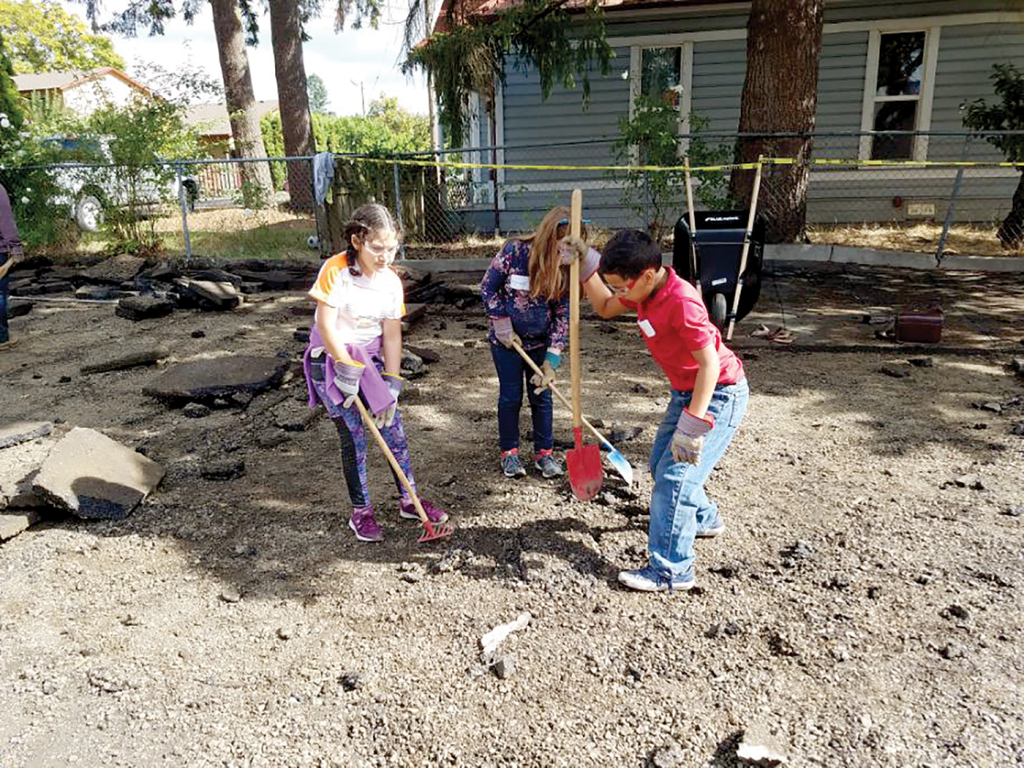
The original chapter has now done more than 125 depavings, according to Labbe, most recently the Inukai Family Boys and Girls Club in October. Following what has become its playbook, Depave helped raise $38,000 for the project and secured the proper permits. The asphalt was scored into square “brownies” the day before. Around 100 people fueled up with donated coffee, juice, and bananas, and as speakers blared Latin pop, pried up the asphalt with huge crowbars. They flipped the squares over, broke them up, and wheeled the chunks to dumpsters.
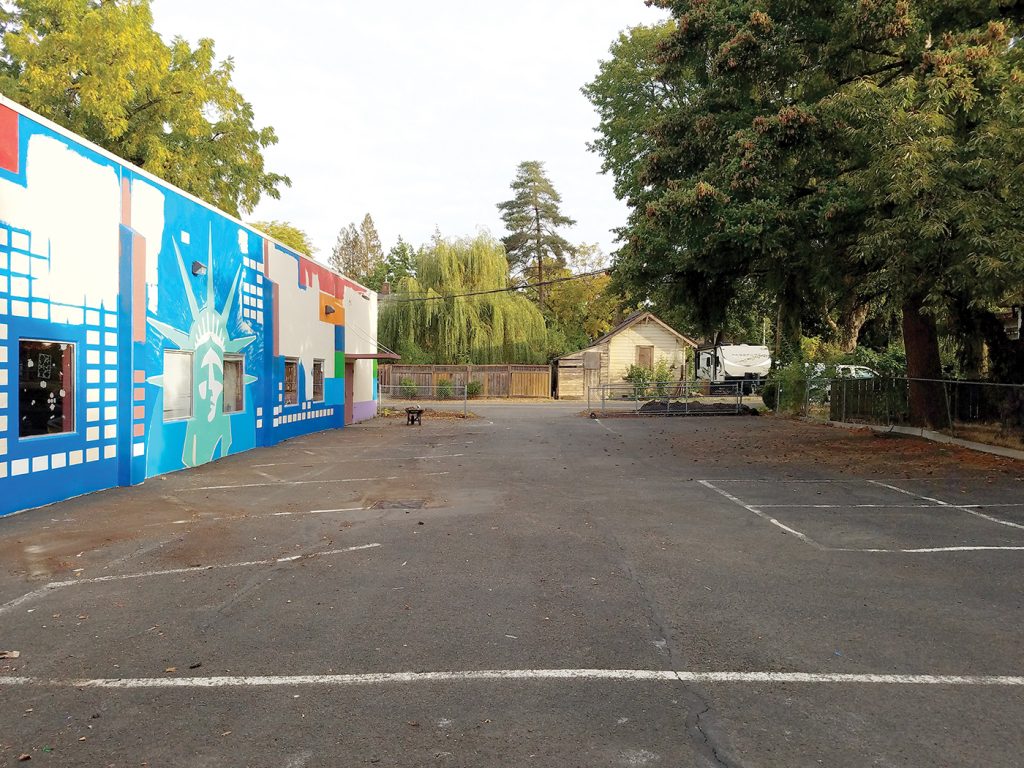
The Boys and Girls Club sought out a local artist, Arturo Villaseñor, to paint a mural on the building wall along the area. Villaseñor was surprised when people started walking along the alley and snapping pictures as he worked. The lot is still dirt and waiting for plantings, but he believes the green space will serve as a combination community plaza and garden.
“There is a tradition, especially in Latin American cities, of a plaza with maybe a gazebo. It’s important for the community,” he says.
Reducing flooding
The idea of returning alleys to nature has taken hold in Nashville. Record flooding in 2010 made the city reevaluate its use of alleys and adjacent paved spaces. The Cumberland River Compact launched a Green Alley program to plant rain gardens along 150 alleys to help absorb increasing stormwater.
Along an alley on a humid Tennessee summer day, Compact’s program manager, Will Caplenor, gave a tour, showing off coneflower and echinacea as carpenter bees circled for a landing. Nearby, a resident walked a dog.
“Here locally there’s a big endeavor to make our streets more complete, to make our streets more walkable, bikeable, livable,” he said. “There’s no reason alleys can’t be part of that, can’t be part of your walkable thoroughfares in your neighborhoods.”
The nonprofit has undertaken some depaving. Caplenor traveled to Portland to learn from the Depave team there before launching Depave Nashville. Both Nashville’s green alleys and adjacent depaved spaces “are accomplishing the same goals,” Caplenor says. “Beyond stormwater capturing, I see wildlife habitat and aesthetic sense of place [for people] as the real benefits.”
The Cumberland River Compact completed its first depaving with the Greater Nashville Unitarian Universalist Congregation, which had a parking lot on top of a hill that caused flooding problems. Nathanael Reveal, the church’s board president, also wanted churchgoers and neighborhood residents to feel more connected to the natural world. And so, on a hot Saturday, 40 volunteers ripped out 150,000 pounds of asphalt.
At the end of the sweaty day, Reveal was walking across the freshly exposed dirt with an 8-year-old student when they saw a butterfly touch down. “We’d both been through that space hundreds of times and never seen anything like that. That was a profound moment,” Reveal says.
“We thought, It’s already starting. Nature is already showing up and getting back to work.”
Country lanes in the city
Researchers agree that green alleys are good for both nature and community.
Michael Martin, a landscape architecture professor at Iowa State University, began studying “soft” alleys nearly three decades ago. Observing the unpaved back routes of the cities where he had lived—Eugene, Oregon, and Ames, Iowa—gave him rich research material. He found he could ramble along them like country lanes. A soft alley might be 11 feet wide but usually had a soil edge of several more feet along the pavement. That strip of earth could host both wild and cultivated plants, from buckthorn to blackberry bushes.
There are downsides to raw back alleys, to be sure.
Susan Jasper, Martin’s neighbor in Ames, plants hostas on the fence along hers, but they’re often run over by neighbors. Dust and potholes annoy her, too. Still, “When I go for walks, I choose to go down alleys,” she says. “They are fun and offer behind-the-scenes looks at life.”
Martin agrees, calling them “an important cultural landscape resource.” Kids tend to play and adults socialize and plant gardens along them. “It provides a connection with people of your block … a really interesting mix of culture and nature.”
Back in Portland, Schutz says she can’t wait to watch the Boys and Girls Club kids play outside in their new alleyside space, even digging in the dirt. “It’s healing, and they’ll go on in their lives to want to engage with nature.”
The project, she says, is “the most incredible thing I’ve ever been a part of.”
Originally published by Yes! Magazine, 12.18.2019, under a Creative Commons Attribution-NonCommercial-NoDerivatives 4.0 International license.