When workers began digging into his grandfather’s grave, Sidonius Apollinaris intervened. His account raises difficult questions about who protected the dead and who bore the blame.

By Matthew A. McIntosh
Public Historian
Brewminate
Introduction: A Grave That Could No Longer Be Recognized
An occupied grave could disappear from view without the person buried beneath it having been moved. During a journey from Lyon toward Clermont in the later fifth century, Sidonius Apollinaris discovered men excavating the burial place of his grandfather, Apollinaris the Elder. According to the letter in which he described the encounter to his nephew Secundus, the cemetery had long been crowded with remains, while snow and persistent rain had reduced its burial mounds to an apparently level surface. Ground that contained the dead could resemble an unused plot. Sidonius reported seeing the disturbance from a neighboring height, riding urgently toward it, and stopping the workers before violently punishing them at the grave. He subsequently instructed Secundus to arrange the restoration of the mound and the provision of an inscribed stone at his expense. The threatened burial belonged to a former prefect whose public distinction had endured in family recollection, but whose resting place had become difficult for others to recognize.
Sidonius’s explanation of the cemetery’s condition complicates the accusation through which he introduced the episode. He condemned the workers’ actions as a profanation, yet supplied a reason why they might have mistaken occupied ground for an available space. Their intentions cannot be recovered independently, and the letter reports neither the removal of his grandfather’s remains nor the destruction of his bones. What survives is an account written by the relative who intervened, imposed punishment, and then explained why his conduct deserved approval. Its force as evidence depends on taking both his indignation and his admissions seriously.
Responsibility for the grave extended beyond the moment when digging began. Sidonius’s instructions to Secundus identify continuing commemoration as a family obligation, raising questions about how the burial had reached such an unrecognizable condition before this intervention. His response also reveals resources that could make a threatened claim effective. He could finance a monument and entrust its execution to someone who remained nearby after his departure. More immediately, he had been able to punish the workers without first submitting the dispute to the bishop whose judgment he acknowledged as relevant. He reported that the bishop subsequently praised his anger, although that endorsement is preserved only in Sidonius’s telling. Such an exchange demonstrates the importance of episcopal authority without establishing that the bishop owned the cemetery or directed its workforce. As Éric Rebillard’s scholarship has emphasized, the involvement of Christian clergy in matters concerning burial should not be equated automatically with comprehensive ecclesiastical administration. The episode instead invites investigation of obligations that intersected without necessarily forming a coherent system of supervision. Respect for burial could be widely affirmed while the means of securing recognition and redress remained unevenly distributed.
The proposed monument would also do more than prevent another excavation. Its epitaph presented Apollinaris as a distinguished public servant and celebrated his place as the family’s first Christian ancestor, giving future observers a carefully composed account of the man beneath the stone. Joop van Waarden has interpreted the letter through Sidonius’s efforts to rehabilitate his grandfather’s public reputation, suggesting that restoring the burial could also renew an ancestor’s political significance. That interpretation adds another dimension to the encounter without resolving its practical uncertainties. Family devotion could coexist with reputational ambition, just as justified concern for a burial could coexist with disproportionate punishment. The unequal protection of the dead emerges here through the relationships that made some claims enforceable and some explanations durable, leaving open the difficult question of who should answer when a grave ceased to be recognized.
Sidonius and the Family Whose Grave He Defended
Sidonius was born at Lyon around 430 into a household accustomed to service at the highest levels of Roman government. His senatorial standing connected him to an aristocracy whose influence extended beyond any single city through landed property and relationships with imperial officials. Membership in this group provided advantages before an individual had acquired an administrative record of his own. It also created expectations that descendants would justify their ancestry through comparable achievement. Writing to his friend Filimatius, Sidonius invoked the offices held by his father and grandfather, together with those of his wife’s relatives, when explaining his own ambitions for advancement. His language approached the assertion of an ancestral entitlement, although the positions he sought were conferred through appointment rather than inherited by law. The distinction matters because family history supplied an argument for promotion, while obtaining promotion still required access to those empowered to grant it.
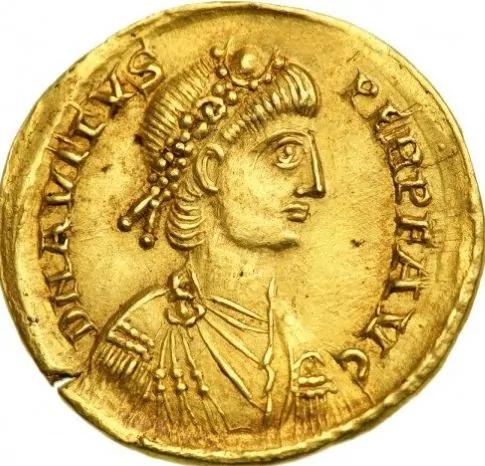
Apollinaris the Elder had held the praetorian prefecture of Gaul under Constantine III in 408–409, placing him among the leading civilian administrators of an imperial regime whose legitimacy remained contested. Sidonius’s father, whose name cannot be established securely, occupied the Gallic prefecture in 448–449 under Valentinian III. These appointments belonged to different political circumstances, separated by roughly forty years, and should not be compressed into an uninterrupted family possession of authority. Their recurrence gave Sidonius a powerful precedent against which to measure his own prospects, joining the grandfather buried at Lyon to the administrative world in which the grandson had grown up.
An unusually revealing recollection shows how that upbringing operated in practice. In a letter to Namatius, Sidonius remembered attending the ceremonies associated with Astyrius’s consulship in 449, when his father was governing the Gallic prefecture. He described himself as too young to claim a seat but sufficiently distinguished by birth to stand near the consul’s chair. His position within the gathering made social precedence physically apparent before he possessed an office that could independently authorize it. The occasion also exposed him to Nicetius, whose oratory he recalled with admiration and whose advice his father valued. Public speaking appeared there as an accomplishment exercised before officials and provincial representatives, with administrative judgment and ceremonial honor providing its immediate setting. Sidonius’s later account is shaped by adult recollection, but it preserves a concrete illustration of how an aristocratic youth could learn the practices of government through privileged proximity. The education available to him included admission to occasions at which eloquence received recognition from people capable of making that recognition consequential.
Marriage widened these connections while strengthening Sidonius’s attachment to the Auvergne. In the early 450s he married Papianilla, daughter of Eparchius Avitus, who became western emperor in 455. The union linked the Lyonnais family of the Apollinares with another prominent Gallic household and brought Sidonius into the immediate family of a ruler. His association with the estate of Avitacum, near Clermont, also gave domestic substance to relationships that might otherwise appear only as names in a political genealogy. Papianilla’s importance should remain visible even though the surviving correspondence provides much fuller access to her husband’s public activities than to her own decisions.
Imperial kinship offered distinction without guaranteeing security. On January 1, 456, Sidonius delivered a panegyric at Rome celebrating Avitus’s consulship, publicly committing his literary abilities to his father-in-law’s regime. Avitus’s overthrow later that year exposed the vulnerability of an affiliation that had briefly brought the family exceptionally close to supreme power. Sidonius subsequently reached an accommodation with Majorian, delivering another imperial panegyric at Lyon in late 458. A decade later he praised Anthemius at Rome on the occasion of that emperor’s second consulship and obtained the urban prefecture during 468. His own account of this success identifies the influential Basilius as an intermediary who encouraged the performance and facilitated its reception at court. Literary competence became effective within a relationship of patronage, rather than operating as an independent route to office. The urban prefecture differed from the Gallic praetorian prefectures of his ancestors, but it allowed Sidonius to claim a distinction commensurate with their achievements. His career demonstrates how ancestral standing had to be renewed through service under successive rulers, even when changes at the summit of government unsettled earlier commitments.
His eventual appointment as bishop of Clermont, around 470, makes the chronology of the cemetery incident important. The letter to Secundus has usually been placed somewhere in the 460s, while Joop van Waarden has proposed the more specific setting of 469/470, shortly before Sidonius’s episcopal consecration. That reconstruction remains an interpretation rather than a date supplied by the document itself. Reading the confrontation through the authority Sidonius later exercised as bishop would risk assigning him an institutional position he may not yet have held when he encountered the workers.
The family relationships behind his intervention also extended across collateral branches and successive generations. Apollinaris the Elder was Sidonius’s grandfather and Secundus’s great-grandfather, making the recipient a younger relative connected to the same ancestor rather than simply an agent engaged to carry out a commission. Elsewhere, Sidonius’s letter to Aquilinus presents friendship itself as something descendants should preserve, recalling the companionship of their grandfathers and fathers before urging its continuation among their sons. The repeated ancestral names of Apollinaris and Rusticus helped make that continuity recognizable, although names alone could not ensure that later generations reproduced earlier loyalties. Such correspondence reveals a family culture in which predecessors remained relevant to present relationships and future ambitions. Against this background, the threatened burial concerned a man whose prefecture still helped explain his grandson’s claim to distinction. The grandfather’s standing had retained a place in Sidonius’s account of his own career even as the location containing his remains became uncertain.
Reading the Letter as Evidence and Self-Defense

The communication sent to Secundus served an immediate purpose, but its surviving form also belongs to a deliberately assembled literary collection. Sidonius’s opening letter to Constantius describes the selection and correction of correspondence, placing revision within his own account of how the collection came into existence. Expressions of urgency in the cemetery letter must be read against that editorial background. References to the previous day’s discovery and the need for prompt action establish temporal closeness without demonstrating that the text remained unchanged after its initial composition. Secundus needed instructions that he could carry out, while readers encountering the letter within the collection received an explanation of conduct that Sidonius anticipated might require defense. These functions reinforce one another, since the practical commission provides an occasion for the narrator to demonstrate why his actions should be understood favorably.
Providence enters the account before its circumstances are explained. Sidonius announces that God prevented a grave offense, giving the encounter a religious interpretation before describing the conditions under which excavation began. His later statement that he happened to pass the cemetery introduces contingency at the level of human experience without displacing that opening claim. The arrangement encourages readers to understand his arrival as timely deliverance, so that the righteousness of intervention is established before they confront the more difficult question of whether his subsequent behavior exceeded what prevention required.
Changes in vocabulary further direct the reader’s assessment. The men initially appear as corporum baiuli, a designation identifying them through their work with the dead, but Sidonius subsequently calls them latrones, placing them within the language of criminality. Occupational description gives way to condemnation as the narrative approaches punishment. His characterization of the disturbance as publicum scelus, a public outrage, likewise enlarges the significance of an injury involving his own ancestor. The expression asserts that more than a private interest has been threatened, although it cannot establish the procedural status of the incident. Physical details assist this movement from observation to judgment, with newly exposed soil making the disturbance visible and the rider’s rapid approach giving the passage its momentum. Rodie Risselada’s analysis of the letter’s narrative organization helps explain how such details operate within a structured progression toward intervention and resolution. Description provides the setting, but the accelerating action makes delay appear increasingly intolerable. The workers’ hesitation when confronted then occupies the place where their explanation might otherwise have entered, allowing the account to proceed from discovery to punishment without an exchange in which competing understandings of the ground could be tested.
The admission confiteor errorem introduces a carefully bounded interruption in this accusatory movement. Sidonius acknowledges fault in his inability to postpone punishment, while retaining his identification of the men as offenders. His concession makes his own conduct available for criticism, but directs that criticism toward the handling of the encounter rather than the justification for condemning their actions. Such an acknowledgment can strengthen a narrator’s credibility by presenting him as willing to expose an unfavorable feature of his behavior. Its evidentiary value lies in revealing the difficulty he recognized in defending immediate coercion, rather than supplying a formal legal confession or an unrestricted reconsideration of what had occurred.
The bishop’s reported response provides the account with a further reversal. Sidonius explains his decision to withhold the matter from episcopal judgment through an anticipated imbalance, expecting excessive gentleness toward the workers and excessive severity toward himself. He thereby presents his departure from the procedure he recognized as a means of securing a more appropriate result. Once informed, the bishop reportedly transforms the anger for which Sidonius sought pardon into a reason for commendation. The quality most exposed to censure becomes a mark of praiseworthy indignation. Michael Hanaghan’s discussion of reported speech in Sidonius’s correspondence offers a useful methodological caution here, because another person’s voice remains selected and transmitted by the letter writer who reproduces it. The episcopal endorsement may preserve a genuine response, yet its placement gives that response a precise argumentative function. Within the document, an authoritative judgment validates the narrator’s conduct after the reader has already been led through the circumstances that supposedly made it necessary.
Attention to authorial reputation continues in the instructions concerning the epitaph. Sidonius describes the poem as composed amid the demands of travel and offers a conventional qualification about its polish, but he insists that Secundus prevent mistakes during engraving. He anticipates a hostile reader who would attribute a stonecutter’s errors to the author, whether those errors arose deliberately or through carelessness. That concern identifies an audience capable of judging the finished inscription and shows how closely he associated its accuracy with his own standing as a writer. It also limits the force of his profession of haste, which concerns the poem’s circumstances of composition rather than establishing that the accompanying narrative was artless. The letter can disclose material arrangements for commemoration while displaying sustained attention to the judgments its author might face. Historical interpretation must assess its claims separately, giving due weight to concrete instructions without allowing the confidence of Sidonius’s moral language to settle questions that his narrative leaves unanswered.
An Overcrowded Cemetery and the Disappearance of Burial Boundaries
By the time of Sidonius’s journey, the burial ground he described had accommodated the dead for a considerable period. His account presents a campus, a tract of ground whose capacity for additional graves had already been exhausted. The statement that it could no longer receive another burial pit conveys the pressure of accumulated occupation, although it supplies neither a count of interments nor a measured description of their distribution. It also leaves open how those using the cemetery determined that no further space remained. Sidonius reports a physical condition rather than an official decision to close the site, and the distinction prevents his description from becoming evidence for an administrative arrangement that the letter never records. What matters initially is the relationship between a densely occupied interior and a surface increasingly unable to communicate where previous burials lay.
The combination of funerary ashes and interred bodies gives this landscape a historical depth that a single episode of excavation might otherwise obscure. Sidonius’s wording brings the results of different methods of treating the dead into the same description, without establishing when each had been practiced. Archaeological investigation at Saint-Just offers a useful local comparison. Jean-François Reynaud distinguishes cremations belonging to earlier Roman phases from the varied forms of inhumation represented in the fourth and fifth centuries. This sequence makes it unnecessary to interpret the ashes mentioned in the letter as evidence of continuing cremation in Sidonius’s lifetime. An older burial ground could retain the material results of customs that had ceased to prevail among its more recent users. Its accumulated contents belonged to a longer history than the visible arrangement encountered by any one generation, with older deposits remaining beneath terrain subsequently used and understood in different ways.
Weather supplied Sidonius with an explanation for the loss of recognizable differences in height. He referred to burial mounds in the plural, describing their settlement under the weight of snow or prolonged rainfall rather than presenting his grandfather’s grave as an isolated instance of damage. The process he envisaged reduced raised earth toward an earlier level, allowing the shape created by burial to become progressively less distinct from the surrounding ground. His explanation identifies an alteration above the remains, leaving the continued presence of those remains compatible with the disappearance of their most readily perceptible indication.
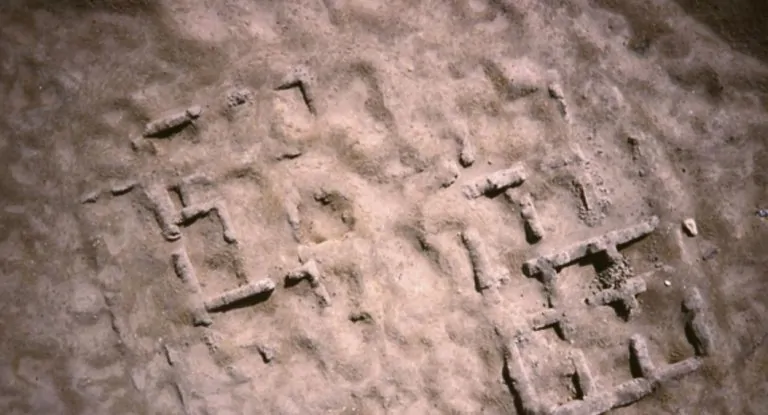
Such changes mattered because the recognition of a burial depended partly on the relationship between its features and those around it. A mound could distinguish an interment without supplying the occupant’s name, while a more substantial structure could preserve a location through a different kind of physical presence. Excavations in the Saint-Irénée–Saint-Just area demonstrate that Lyon’s funerary surroundings contained considerable architectural variety. The published evidence includes mausolea as well as earth burials, some bordered with pebbles, alongside numerous sarcophagi. These findings establish alternatives to a landscape composed entirely of similar earthen rises, but they cannot determine what remained visible at the place Sidonius described. A border detected through excavation need not have been exposed to someone walking across the ground centuries earlier. Conversely, a feature that has left little archaeological trace might once have helped visitors distinguish one burial from another. The disappearance of boundaries must be understood here as a failure of recognizable indications, rather than the documented destruction of fences or formally surveyed plots.
The precise relationship between this archaeological evidence and the letter’s setting remains uncertain. Sidonius located his discovery through the circumstances of a journey toward Clermont and a view from a nearby height, but he did not name Saint-Just or identify an adjacent religious building. The traditional association of the episode with that vicinity belongs to scholarly reconstruction. Reynaud’s work provides a detailed account of Lyon’s southwestern funerary landscape, making it possible to place the incident within a locally grounded history of burial rather than a generic picture of Roman cemeteries. It does not permit the identification of an excavated tomb as Apollinaris’s resting place, or the transfer of every feature recorded nearby into Sidonius’s description.
The digging introduced a second and more immediate alteration into ground whose earlier contours had already faded. Sidonius distinguished the green covering from the dark earth exposed by the workers and placed fresh clods above an older burial, providing evidence of a newly disturbed surface. Those details locate the interference without establishing how deeply the excavation had penetrated or what form of container, if any, enclosed his grandfather’s remains. They also separate two processes that should not be collapsed into a single act of destruction. The gradual reduction of the mounds had made previous occupation harder to discern before the workers disturbed the turf, while their activity created a fresh intrusion that Sidonius could observe. The resulting problem was one of continuity between buried contents and their indications above ground, since the presence of the dead endured after the terrain had become less capable of announcing it.
Protecting Graves in Roman Law
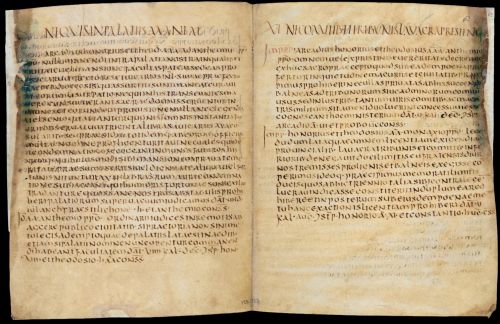
ancestors. Interference with a tomb could attract proceedings even when the immediate dispute concerned materials of modest value, because the recognized injury exceeded the loss of ordinary possessions. The surviving evidence for these protections comes from sources produced at different dates and for different purposes. Earlier juristic discussions were preserved in Justinian’s Digest, compiled in 533, while fourth-century imperial enactments concerning graves were collected in the Theodosian Code of 438. Valentinian III’s legislation of 447 provides a closer chronological comparison with Sidonius’s experience. These texts illuminate an inherited legal framework, but they cannot be combined into a single, unchanging rule demonstrably applied at the cemetery near Lyon.
Within the juristic tradition, the presence of the dead helped distinguish a burial place from a structure erected solely to preserve someone’s memory. Ulpian’s discussion, preserved in Digest 11.7, identifies a sepulchrum through the deposition of a human body or bones, while distinguishing the commemorative purpose of a monumentum. The same discussion records Aristo’s opinion that the burial of an enslaved person could make a location religiosus, a legally significant designation that should not be confused with Christian ecclesiastical consecration. Recognized protection extended beyond the remains of people who had possessed public office or senatorial ancestry. Celsus further distinguished the ground actually occupied by burial from the larger area intended for funerary use. These distinctions make the existence of a protected burial separable from the prominence of its occupant, while also preventing the assumption that every part of a cemetery necessarily possessed an identical legal character.
The action for violation of a grave likewise involved questions beyond the identity of the deceased. In the praetorian provisions preserved by Ulpian in Digest 47.12, priority belonged to the person with the relevant interest, but another claimant could receive permission to proceed if no such person acted. Where several applicants sought that opportunity, the praetor was to select the one whose claim appeared strongest. The arrangement recognized a concern reaching beyond a single household, although it offered no guarantee that potential claimants possessed equal means of pursuing it. Equally important, this action required dolus malus, and Ulpian expressly excluded those who approached without an intention to violate the burial. That qualification gives legal importance to the distinction between knowingly interfering with a grave and acting without recognizing its presence. It cannot decide the workers’ case retrospectively, since their understanding remains uncertain and the precise procedure available locally is unrecorded. It does show why the visible fact of digging would not, by itself, resolve every question that Roman jurists considered relevant to liability.
Imperial legislation addressed the destruction of funerary structures alongside interference with remains. Constitutions preserved under Theodosian Code 9.17 prohibited extracting columns or marble from monuments, including the removal of stone for burning into lime or reuse in private construction. Yet an enactment of 349 distinguished such appropriation from authorized dismantling undertaken to repair a deteriorating tomb, placing genuine restoration under official supervision. Legal protection required attention to the purpose and circumstances of an alteration, rather than treating every physical intervention at a burial place as equivalent misconduct.
Valentinian III’s Novel 23 renewed the condemnation of grave violation in 447 through an unusually expansive statement of its religious and moral significance. Issued at Rome to the praetorian prefect Albinus, it represented the destruction of tombs as suffering inflicted upon the dead and affirmed the continuing attachment of departed souls to the places containing their bodies. Its accusations fell with special force upon clerics who disturbed burials and then approached sacred altars. Rangar H. Cline’s study places these features within the interaction of imperial and ecclesiastical interests at mid-fifth-century Rome, showing why the decree requires attention to its immediate political setting. The attack on offending clergy did not make religious office incompatible with the protection of graves, but it rejected any automatic identification of clerical standing with proper conduct. The law’s concern with bodily remains also prevents its reduction to a measure protecting valuable architectural materials alone.
The penalties prescribed by the novel reveal a different form of inequality from the uneven practical defense of burial places. Enslaved offenders and those designated coloni were exposed to torture and potentially execution under the conditions specified in the decree. Impoverished freeborn plebeians found guilty of the offense were likewise threatened with death. More distinguished persons, including those recognized through their official dignities, faced confiscation of half their property and permanent infamy. Clerical offenders were assigned loss of office, confiscation, and perpetual exile, with the text expressly refusing exemption to bishops. These provisions arranged punishment according to social position even while condemning grave violation in broadly shared moral terms. They demonstrate that inequality could be incorporated into the prescribed sanctions themselves, rather than arising only when influence frustrated enforcement. The workers confronted by Sidonius cannot securely be assigned to one of these categories, and their occupation alone does not establish whether they were enslaved, free, or subject to another legal condition.
Enforcement was entrusted to officials whose failures could themselves attract punishment. Novel 23 required provincial governors, supported by local communities, to act against offenders and to report cases beyond their effective coercive reach to superior authorities. A governor who neglected either responsibility risked losing his property and office, while accusations concerning such neglect could be brought even after his departure from authority. The decree anticipated that some defendants might be difficult to punish, but answered that difficulty through an administrative chain of responsibility rather than a general authorization for injured relatives to impose whatever sanction they considered deserved.
The relationship between these provisions and Sidonius’s conduct remains a matter of historical assessment rather than retrospective adjudication. His letter names no enactment under which the workers were charged and preserves no examination establishing the knowledge or intention relevant to their actions. Severe penalties elsewhere in Roman legislation cannot supply the missing authority for his decision to punish them immediately. Nor does the bishop’s reported commendation demonstrate that a statutory sentence had been lawfully imposed. Jill Harries’s analysis of late Roman law is useful here because it directs attention toward the ways legislation operated through some institutions and relationships, without making every departure from formal procedure evidence that public justice had disappeared. Changing conditions in Gaul require caution about the precise operation of imperial rules, but Sidonius’s own acknowledgment of an alternative judgment shows that his immediate response was not presented as procedurally inevitable. Roman law supplies substantial grounds for recognizing the threatened injury to the grave, while leaving the justification of the punishment as a separate question.
Family Responsibility after the Funeral
The departure of mourners did not settle every obligation associated with a burial. Relatives might still need to provide a memorial inscription or attend to a grave whose condition had changed since the funeral. Sidonius’s appeal to Secundus places such work within the conduct expected of descendants, giving practical expression to the language of familial piety. The service requested concerned an ancestor several generations removed, showing how obligations could be understood to extend beyond the people who had originally arranged an interment. Éric Rebillard’s emphasis on family initiative in late antique commemoration helps situate this expectation without turning it into a universal maintenance rule. Christian relatives could retain substantial responsibility for their dead while drawing upon assistance from people outside the household.
An example elsewhere in Sidonius’s correspondence shows commemorative work continuing after the burial ceremony. In Letter 2.8, Philomathia’s bereaved father requests an epitaph for his daughter after her funeral has taken place. Relatives and clergy had participated in her burial, while Sidonius’s contribution as a literary friend supplied an additional means of honoring her. The same communication calls upon Desideratus to offer consolation, distributing services among people whose relationships to the deceased and her survivors differed. The completion of the funeral left opportunities for further assistance, with family initiative bringing other participants into the work of remembrance.
Physical absence could likewise alter the manner of participation without terminating the relationship that made participation meaningful. Sidonius acknowledged missing the funeral of Claudianus Mamertus, yet subsequently composed an epitaph and sent it to the deceased man’s nephew Petreius. His closing concern with fidelity to dead friends presents continued service as a response available after attendance at the burial had become impossible. The arrangements made with Secundus translated a comparable problem of distance into an assignment of local supervision. Sidonius anticipated remaining involved while away, expressly joining his absence to the expectation that the work should proceed. Secundus would provide the attention that the departing relative could no longer supply in person. Delegation in this setting preserved a connection between the person commissioning the monument and those able to carry the undertaking forward.
Financial provision made that arrangement more definite. Sidonius stated that he had left Gaudentius money covering both the stone and payment for the work, distinguishing the material purchase from the remuneration needed to turn it into a monument. Gaudentius appears as an entrusted intermediary connecting the commission with its execution, although the letter does not establish his occupation or a formal responsibility for the cemetery. By identifying funds already deposited, Sidonius gave Secundus a practical basis for acting rather than leaving him to determine how the proposed expenditure would be met.
The nephew’s contribution was treated as a service deserving acknowledgment. Sidonius promised to thank him as though no praise or glory would accrue to Secundus himself, recognizing that the undertaking also offered the younger man an occasion to demonstrate devotion to the family. Gratitude operated within an obligation that the writer believed already existed. His appeal to Secundus’s degree of descent supplied a reason why the nephew should accept the assignment even if his uncle were absent. The description of themselves as the third and fourth heirs similarly placed their actions within a succession of generations, while leaving the actual transmission of property unrecorded. It would be misleading to extract from these expressions a precise order of legally enforceable maintenance duties. Their more immediate force was to make the care requested appear appropriate to the recipient’s place among the ancestor’s descendants.
Belatedness exposed a less reassuring aspect of that succession. The epitaph characterized the new poem as late, bringing the interval between Apollinaris’s burial and this commemorative undertaking into the tribute itself. Its reference to Sidonius’s father and paternal uncles has received different grammatical interpretations, but Joop van Waarden understands the passage as identifying an offering left unperformed by the preceding generation. Even on that reading, the omission of this inscription cannot establish that those relatives had undertaken no care of any kind. Ian Wood’s discussion of funerary commemoration in the Rhône valley draws attention to the dependence of epitaphs upon relatives or other interested successors, including cases in which their provision was delayed. Such delay reveals the need for someone to initiate commemorative work, but its causes require evidence beyond the eventual decision to act. Sidonius gives no account of earlier arrangements sufficient to determine who had assumed responsibility before him or why those arrangements had failed to preserve an adequately recognizable burial.
The proposed response brought greater specificity to obligations whose earlier performance remains obscure. One relative supplied the text and financing, while another was expected to oversee the local work. That allocation made it possible to ask whether identifiable tasks had been carried out, giving the appeal a form more concrete than a general injunction to honor one’s forebears. It did not establish a permanent mechanism through which later descendants would continue the same attention. Family responsibility after the funeral depended upon obligations being accepted anew, with certain people converting an inherited relationship into an undertaking they were prepared to perform.
Burial Workers and the Practical Business of Finding Space
Sidonius identified the men at the cemetery through an occupation that encompassed more than the excavation he interrupted. His designation corporum baiuli describes bearers of bodies, while the activity he observed places these same men at work with funerary digging tools. Carrying the dead and preparing ground could overlap within the labor performed by the people he encountered. This evidence supports a broader understanding of their tasks than a narrowly specialized category of gravediggers would suggest. It supplies much less information about how those tasks were organized, since Sidonius named neither a business proprietor nor anyone who had commissioned the excavation. Describing them as an undertaker’s employees can be a convenient rendering, but it risks supplying an employment relationship more definite than the surviving terminology warrants.
Better-documented arrangements elsewhere demonstrate why the distinction between performing work and directing it matters. John Bodel’s analysis of the earlier funerary regulations from Puteoli and Cumae identifies contractual relationships connecting service providers with municipal authorities and private customers. At Puteoli, a concession combined commercial privileges with specified obligations, including requirements concerning personnel and the provision of services. The contractor’s involvement in an individual funeral could be mediated through other people, making the person carrying out a task only one participant in its organization. Bodel also emphasizes differences between the Campanian towns themselves, resisting the reconstruction of a uniform Roman funeral establishment. These records provide a useful comparison for distinguishing responsibilities, while offering no basis for assigning the same contractual structure to fifth-century Lyon.
The social valuation of this labor could diverge sharply from its necessity. Sarah Bond’s Trade and Taboo examines how contact with corpses became a basis for occupational disrepute, while tracing changes in the institutions and attitudes that sustained it. Sidonius himself drew upon such associations in Letter 3.13, intensifying a grotesque insult through the image of a corpse repellent even to a mortuary attendant. The comparison presupposed familiarity with work involving bodily conditions from which other people recoiled. Its insulting force reveals an elite use of occupational stereotypes, rather than establishing the character or conduct of the workers at his grandfather’s burial.
Christian institutions could alter the position of funerary personnel without producing a single model of employment. Bond’s study of late antique mortuary associations describes arrangements at Constantinople in which workers providing burial services acquired privileges and ecclesiastical connections. Their relationship with episcopal patrons could give them standing and support unavailable through an ordinary commercial transaction. The occupational category included people whose institutional advantages differed considerably from the stigma suggested by hostile literary descriptions. Such evidence makes it important to establish local circumstances before identifying a burial workforce as clerical, municipally employed, or privately hired. Sidonius’s reference to a bishop whose judgment he anticipated does not resolve those questions about the men performing the excavation.
Their immediate undertaking required a decision about where work could begin. A space capable of receiving digging tools was not necessarily available for a new interment, and familiarity with a cemetery could matter as much as the ability to excavate it. Previous use had to be recognized through whatever indications remained accessible or through information supplied by people who knew the ground. Sidonius’s account places the workers at precisely the point where such recognition had become difficult, but it does not describe an inspection or explain the procedure by which the location was selected. His statement that they treated it as vacant identifies the practical assumption under which the work proceeded. It leaves uncertain whether that assumption originated with the men themselves or with instructions they had received. Occupational experience might have helped someone interpret ambiguous ground, yet the letter provides no measure of these workers’ experience or the information available to them. The decision to excavate must be examined separately from the question of who possessed authority to make that location available.
The demand for burial space also needs to be distinguished from a reconstruction of the job. Sidonius named no newly deceased person awaiting interment, and he recorded neither a bereaved customer nor a deadline pressing the men to complete their work. Their funerary occupation makes service to another burial a reasonable possibility, but it does not establish the circumstances or urgency of that service. Cemetery congestion supplies the setting for their activity without demonstrating that they were implementing a recognized policy of reusing graves or responding to an unavoidable immediate need.
The expectation that burial workers should protect existing tombs could itself make them vulnerable to suspicion when those tombs were disturbed. Bond draws attention to this occupational predicament, in which proximity to graves combined necessary access with opportunities for interference. Sidonius’s account concentrates responsibility upon the men whose tools had entered the ground, leaving the organization behind their activity largely out of view. That emphasis establishes their direct participation but cannot determine whether responsibility should also have extended to someone who selected the location or instructed them to work there. Recognizing this gap neither removes their obligation to exercise care nor establishes that they knowingly disregarded it. It brings the practical business of burial into the analysis, requiring attention to the decisions behind an excavation as well as to the people visibly performing it.
Punishment at the Graveside

Stopping the excavation and punishing the workers were successive actions in Sidonius’s account. He reported that his shout checked the disturbance before he reached the burial, after which the men hesitated between flight and remaining where they stood. His arrival brought apprehension and immediate bodily punishment, introducing a retaliatory stage after the digging had been interrupted. The statement that he could not postpone punishing those he had caught makes the refusal of delay central to his conduct. His response requires assessment beyond the immediate necessity of preventing further damage, because the account itself distinguishes the cessation of work from the treatment subsequently imposed upon its performers.
The practical capacity to compel submission is clearer than the means through which Sidonius exercised it. His first-person description attributes the punishment to himself, accepting responsibility for what happened without identifying who administered individual blows. Neither personal delivery of every injury nor the intervention of accompanying retainers can be reconstructed securely. Ralph Mathisen interprets the episode as an instance of the summary authority exercised by wealthy people over those in a less privileged position. That reading draws attention to an imbalance enacted in the encounter, rather than simply inferred from Sidonius’s ancestry. The men whom he accused became subject to a penalty before any examination of their explanation appears in the record. Their subjection demonstrates what this powerful relative represented himself as able to accomplish, while leaving a separate question concerning the entitlement under which he acted.
Even the nature of the penalty resists an entirely confident description. Joop van Waarden considers flogging the most probable interpretation, but notes that the vocabulary of supplicia, torsi, and caesos leaves the possibility of killing unresolved. Rendering the episode as a beating is defensible when appropriately qualified, whereas specifying a whipping instrument or the wounds inflicted would give the narrative a precision it does not possess. The language communicates severe coercion more securely than it establishes the workers’ ultimate fate.
Its location, by contrast, receives unusually pointed emphasis. Sidonius placed the punishment upon the very covering of the ancestor’s burial, binding the bodily treatment of the workers to the ground they had disturbed. His reference to “our old man” also addressed Secundus through their shared relationship to the deceased, making the scene intelligible within the family’s own understanding of its loss. The choice of setting gave the retaliation a meaning that punishment elsewhere would not have carried in quite the same form. Control was asserted at the place where the family’s claim had been disregarded, with the accused men subjected to force in immediate relation to the burial. The grave remained an active element of the confrontation after excavation had stopped. Reading this placement as a demonstration of renewed protection is consistent with the account’s organization, although the intention belongs to Sidonius’s presentation rather than an independently recorded explanation. It made the treatment of living bodies part of the response offered on behalf of a dead relative.
Sidonius further characterized the punishment as sufficient for its purpose, introducing a claim of adequacy without providing a measure of its extent. No duration or count of blows allows that assertion to be tested, and his admission of impatience supplies no reliable upper limit to the violence. The narrative accommodates both an inability to wait and a conviction that the penalty served an appropriate end. A stated protective purpose can explain how he justified his conduct, but cannot establish that the force used was proportionate.
The beneficiaries named in that justification were the surviving relatives in their care for the dead and the dead in their security. Punishment was assigned a prospective function, intended to discourage interference beyond the act already interrupted. The plural formulation allowed the response to acquire a significance wider than the immediate injury to Apollinaris’s burial, though it supplies no evidence that other graves subsequently became safer. Its effectiveness remains an expectation expressed by the person imposing the penalty. Nor does the account follow the workers beyond their punishment to describe their condition or the consequences for their ability to continue their occupation. This omission need not be converted into a claim about everything Sidonius did afterward, but it shapes what can be recovered from his report. He explained the intended benefit to those whose burial interests he defended while leaving the bodily cost to those he punished largely unrecorded.
The Bishop’s Judgment and the Limits of Ecclesiastical Control
The ecclesiastical figure mentioned in Letter 3.12 is unnamed, although the setting has led scholars to identify him as Patiens, bishop of Lyon. Other correspondence connects Patiens with Sidonius through activities that made episcopal patronage visible within the city. In Letter 2.10, Sidonius described a church brought to completion through the bishop’s efforts and explained that Patiens had requested an inscription from him. Constantius and Secundinus supplied additional verses, placing aristocratic literary accomplishment within a project sponsored by religious leadership. Their participation reveals cooperation through which the bishop’s achievements received public recognition. The authority invoked in the cemetery dispute belonged to someone whom Sidonius also represented as a patron capable of mobilizing resources and securing distinguished contributions to ecclesiastical projects.
Patiens’s influence extended beyond the buildings associated with his office. A later letter celebrated his distribution of grain after Gothic devastation, describing supplies conveyed along roads and accumulated in granaries beside the Rhône and Saône. Sidonius praised assistance reaching communities beyond the bishop’s immediate territory, including Clermont, presenting generosity as effective across considerable distances. Although the account is celebratory, it identifies material resources and connections that help explain the standing of the person whose assessment Sidonius considered important. Such reach establishes a substantial capacity to assist and influence others without defining the administrative limits of every undertaking that came to his attention.
Episcopal intervention in disputes also possessed recognized legal forms. An enactment of 408, preserved in Theodosian Code 1.27.2, confirmed the validity of episcopal decisions for those who had agreed to submit their affairs to a bishop and provided for assistance from public officials in enforcing the result. Consent was relevant to the arrangement described by this constitution. Jill Harries’s analysis of episcopal hearings emphasizes the range of activities concealed by a general reference to a bishop’s judgment. Bishops might adjudicate according to Roman law, act as arbitrators, or seek reconciliation through mediation. These functions could overlap in practice, while differing in the relationship established between the person hearing a dispute and those bringing it forward. The legal recognition of episcopal decisions accordingly supplies an important context for Sidonius’s expectations, but it cannot identify the procedure contemplated in his letter. Nothing in the cemetery account records an agreement by both sides to submit their case, or the steps through which a specific form of hearing would have occurred.
A separate appeal to Bishop Pragmatius illustrates the importance of reconciliation within this range of activity. Writing on behalf of the widow Eutropia, Sidonius described a dispute involving the presbyter Agrippinus and explained that his own efforts had secured only a partial accommodation. He asked Pragmatius to use episcopal authority to pacify the adversaries, presenting escape from litigation as a desirable outcome even if it required concessions. The requested intervention concerned relationships already strained by competing claims, with religious leadership expected to help produce an agreement that persuasion had not yet completed. This example gives concrete substance to episcopal involvement without requiring the bishop to possess or administer the property around which a grievance arose.
The same separation of responsibilities is essential when considering burial. Rebillard’s account of late antique funerary arrangements preserves a substantial place for relatives in determining and organizing commemoration, even where clergy participated in the treatment of the dead. Bond’s research demonstrates more extensive ecclesiastical involvement in some mortuary services, while insisting that local circumstances differed and that episcopal patronage did not automatically confer clerical status upon workers. These findings support investigation of relationships rather than the assumption of comprehensive church management. The Christian identity of a deceased person cannot identify the owner of the ground containing his remains. Neither does a complaint reaching a bishop establish that the people whose actions occasioned it belonged to his staff. Cemetery ownership and the supervision of excavation require evidence distinct from an acknowledged concern with conduct at a burial place.
Sidonius’s communication with the bishop is most informative when its timing and manner are retained. He explained that he sent an account while continuing his journey, presenting himself as someone making an explanation after having acted. The letter describes no return to Lyon for a confrontation of parties, and its claim to relate the entire sequence cannot substitute for testimony from everyone involved. Episcopal assessment could still affect the standing of the person who sought it, making Sidonius answerable to an authority he considered worthy of respect. In his telling, the response instead gave religious weight to his defense of the grave. That outcome shows how family action and episcopal approval could reinforce one another, without establishing habitual favoritism or a predetermined alliance. The bishop’s opinion mattered after the confrontation, while the arrangements through which anyone might have supervised the earlier decision to dig remain unidentified.
Commissioning a Monument and Assigning the Work
Sidonius’s instructions began with the reconstruction of the burial’s raised form. He asked that the scattered material rise again into a moles, giving the proposed work a relationship to what had previously occupied the site. In the context of his description of subsiding earth, this material is most securely understood as the dispersed mound, rather than the ruins of an elaborate masonry structure. The wording provides no dimensions or architectural plan through which its intended appearance could be recovered. It identifies a construction task that preceded the provision of an inscription, since the restored mass was to receive a prepared stone element. Renewed recognition would depend upon an arrangement of materials at the existing burial place.
The intended inscription medium is more definite than the monument’s overall design. Sidonius referred explicitly to marble when discussing the execution of the lettering, while describing the surface that would cover the reconstructed mound as smoothed or polished. These specifications concern both the substance selected and the finish it should receive. They leave the marble’s provenance and any decorative treatment unspecified, but establish that the commission required a prepared surface suitable for carrying the supplied text.
The poem constituted a considerably fuller specification than the directions for construction. Sidonius introduced it as the composition following his prose and requested its transfer onto the slab, connecting the written communication with an object to be made elsewhere. The craftsman was expected to execute a verbal composition already supplied by the commissioner. That arrangement did not eliminate the decisions involved in making the text fit its destination. The manuscript presentation through which the poem survives cannot establish the arrangement of its lines on the intended stone. Authorship determined the words, while their material presentation remained a further part of the undertaking.
Jonathan Edmondson’s study of Roman inscription production distinguishes the arrangement of a text on its surface, or ordinatio, from the subsequent cutting of the letters, or sculptio. His examples show the practical decisions involved in accommodating wording within a defined field, including the relationship between letter size and available space. Guidelines or preliminary lettering could assist this work, although many epitaphs were executed without such aids. A verse inscription also required attention to the relationship between poetic lines and the space in which they would appear. Edmondson discusses Sidonius’s commission as an example of a customer providing the text he wanted reproduced, making the letter relevant to the history of manufacture as well as composition. His broader evidence explains what inscription production could involve without furnishing a reconstruction of the unidentified workshop responsible for this project.
The occupational vocabulary similarly supplies functions without revealing a complete organization of labor. Sidonius called the person responsible for execution a lapidicida and elsewhere used quadratarius, terms associated with stoneworking. Their alternation does not establish that two separate craftsmen had been appointed or that shaping the slab and cutting its text belonged to distinct contracts. It does place the realization of the family’s design within a skilled occupation whose contribution was necessary to turn the supplied language into a monument.
Placement would then determine how the finished object related to the burial and to people encountering it. Although the slab was intended to cover the reconstructed mass, Christian Stein rightly emphasizes that its precise orientation remains uncertain. A confidently imagined upright marker or horizontal tablet would exceed the information preserved. Its proposed function can still be assessed through the combination of a renewed mound and an inscribed surface. Stein’s discussion draws attention to the difference between recognizing a marked burial and understanding the full commemorative argument presented upon it. Someone might identify the place as a grave receiving continuing attention without possessing the knowledge needed to appreciate its poetry. The material arrangement could communicate a demand for recognition at a different level from the meaning conveyed by its words.
Marble offered greater resistance to deterioration than an unsupported heap of earth, but the survival of stone did not ensure the preservation of its original purpose. Archaeological discoveries at Lyon provide a concrete reminder of that distinction. Reynaud, Helly, and Le Glay documented earlier funerary stones reused in later burials, including a monument hollowed into a sarcophagus in a process that destroyed the central portion of its previous inscription. The material remained useful after the message it had carried was partly removed. Such evidence does not identify the subsequent history of Apollinaris’s monument, whose completion is not documented by the commissioning letter. It shows why manufacturing an inscribed object could extend the reach of commemoration without placing its future treatment entirely within the commissioner’s control.
The Epitaph and the Claims Made upon the Passerby
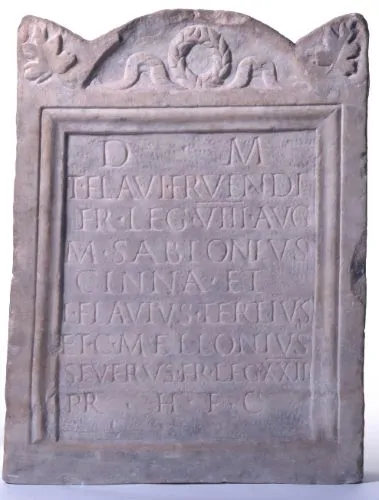
The poem introduces its dedicating grandson before naming the person whose burial it commemorates. Sidonius presents himself as haud indignus avo nepos, a grandson not unworthy of his grandfather, making the tribute an assertion about the living representative as well as the deceased ancestor. The formulation claims an appropriate relationship between the distinction being remembered and the person undertaking its remembrance. It gives the act of dedication a place within the family’s account of its own worth. Étienne Wolff identifies the composition as twenty Phalaecian hendecasyllables, a compact poetic form through which Sidonius could combine personal acknowledgment with a carefully ordered account of ancestral merit. The opening establishes the grandson’s fitness to speak before asking an unfamiliar audience to accept what follows.
That audience first appears as a traveler imagined approaching the burial at some future time. Sidonius explains that the dedication should prevent this passerby from unknowingly treading upon unmounded earth, linking the inscription’s purpose to an ordinary movement across the ground. The phrase ignorans reverentiam sepulti concerns ignorance of the reverence owed to the buried man, extending the problem beyond failure to recognize a name. No deliberate hostility is necessary for the warning to apply, because the conduct being anticipated could arise through unawareness of what lay beneath the traveler’s feet.
Public distinction enters with the statement praefectus iacet hic Apollinaris, placing prefectural rank before the grandfather’s personal name. The accompanying hic, “here,” gives the intended inscription a location from which to identify the person buried below. Former authority is brought into direct relation with a body now resting in a certain place. The description of Apollinaris received into the embrace of his mourning homeland enlarges that relationship beyond the affections of his descendants. His native community becomes a participant in bereavement through poetic personification, although the line cannot document a publicly financed funeral or an official expression of civic grief. Superlatives praising judgment and usefulness then present qualities through which his distinction should be evaluated. The phrase ruris militiae forique cultor extends this portrait across the countryside and the sphere of public service, including the activities associated with the forum. Its breadth should not become an exact reconstruction of his career, since late Roman militia could encompass imperial service without establishing military campaigns, while reference to the forum does not identify a particular professional appointment. The cumulative portrait makes the man’s usefulness to a community a reason for respecting the place containing him.
A more compressed claim follows in the description of Apollinaris as free beneath dominating tyranni. Freedom here supplies a quality retained under conditions that threatened it, allowing moral independence to coexist within an account of high office. The term tyranni could designate usurpers in late Latin, giving the language a political significance more specific than a general complaint against cruel government. Yet the rulers remain unnamed, and the epitaph presents a dangerous example without explaining the decisions through which Apollinaris had supposedly maintained his freedom.
The poem then establishes a higher distinction through the explicit declaration that what follows is his greatest dignity. Baptism receives a bodily description, with the forehead marked by the cross and the limbs purified through the font. This language connects the grandfather’s Christian identity with the person whose remains the monument was intended to protect. His significance also becomes genealogical, since Sidonius identifies him as the first among his ancestral line to renounce the rites described as sacrilegious. Wolff draws attention to the patterned language of sacris sacrilegis, whose verbal resemblance sharpens the religious judgment being made. Practices presented through the vocabulary of sacred observance are simultaneously condemned, enabling the poet to define the change of allegiance through the sound and meaning of closely related words. Conversion becomes an achievement that reorganizes the ancestral portrait after the celebration of civic service.
The concluding comparison makes that reorganization explicit through a distinction between earthly titles and merits beyond this life. Ancestors who were equals in rank “here” could be surpassed “there,” giving the final hic a wider reference than the earlier word locating Apollinaris at his grave. The poem preserves inherited honors as a meaningful measure of comparison while placing Christian hope above them. Its language of superiority does not pronounce the eternal fate of every predecessor, but it does prevent equality in office from remaining the final judgment upon their respective worth.
The passerby is offered more than sufficient information to identify an occupied burial place. Sidonius supplies reasons why this occupant should command attention, asking someone outside the family to encounter Apollinaris through the distinctions his descendants selected for remembrance. The traveler need not share the grandson’s relationship to the deceased for respectful conduct to become possible. Nor does the poem prescribe a prayer or attach an explicit penalty to disregard, leaving its appeal to operate through the authority of the commemorative portrait. The requested response remains grounded in restraint toward the burial even as the account of its occupant reaches into public service and Christian expectations beyond death. Family devotion acquires an outward address, seeking recognition from people whose presence could not be governed by the obligations binding Secundus to his ancestor.
Restoring the Reputation of Apollinaris the Elder
Service under Constantine III placed Apollinaris’s distinction within a political history whose interpretation changed as competing imperial claims succeeded or failed. His prefecture remained an achievement that descendants could invoke, but its connection with a defeated regime complicated the honor attached to it. Michael Kulikowski’s account emphasizes that Constantine negotiated recognition from Honorius and received imperial regalia, illustrating the instability concealed by a simple retrospective division between legitimate emperors and usurpers. Administrative service occurred amid these shifting settlements, rather than under conditions in which every subsequent judgment of legitimacy was already apparent. The epitaph’s identification of Apollinaris through his office preserved its prestige while leaving the ruler under whom he had exercised it unnamed. That omission allowed the grandfather’s standing to enter the commemorative portrait without requiring an explanation of every allegiance associated with his appointment.
Letter 5.9 offers a more explicit example of Sidonius arranging this difficult inheritance. Addressing Aquilinus, he recalled the friendship between their grandfathers, Apollinaris and Rusticus, through shared accomplishments and shared dangers. He also attributed to them a common dislike of the political figures among whom their careers had unfolded. Constantine appeared through his inconstancy, Jovinus through his irresolution, and Gerontius through his treachery, while Dardanus became the concentration of the faults distributed among the others. This characterization gave the ancestors a moral consistency that survived their involvement in unstable governments. It did not reproduce their contemporary declarations or explain precisely how disapproval had affected their decisions. Sidonius could preserve their administrative dignity while placing responsibility for political disorder upon the leaders around them, presenting ancestral judgment as superior to the circumstances in which service had been undertaken.
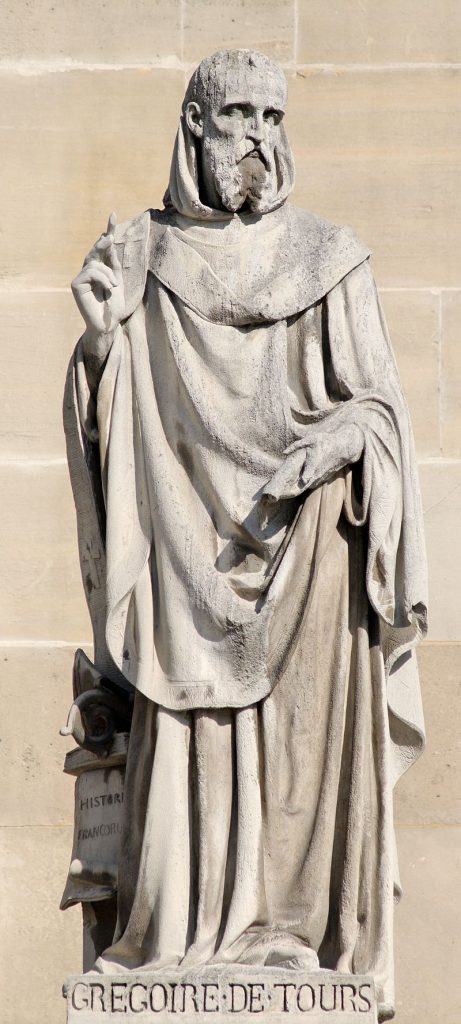
The dangers of those circumstances are independently visible, but Apollinaris’s individual fate remains disputed. Gregory of Tours, preserving an account from the earlier historian Frigeridus, names Decimius Rusticus and Agroecius among nobles captured in the Auvergne and killed by Honorius’s commanders during the reprisals associated with the defeated usurpations. Apollinaris does not appear by name in that report, leaving his inclusion among the victims dependent upon inference. Van Waarden favors a violent death in this setting, whereas Mathisen’s prosopographical account allows that he survived the purges, a disagreement that prevents the restoration of his grave from being treated securely as the rehabilitation of an executed man.
Rehabilitation is most defensible here as a description of reputational work. No surviving evidence establishes an official reversal of condemnation or a formal restoration of honors occasioned by the proposed monument. Sidonius had already invoked his grandfather’s office when discussing his own ambitions in Letter 1.3, so the ancestor had not become wholly unavailable as a source of pride. The funerary commission offered another setting in which that pride could be expressed, addressing an audience beyond those already familiar with the family’s interpretation of its past. Its significance lay in presenting a favorable account of a politically complicated career, with the commemorative form determining which features deserved public emphasis.
Van Waarden has proposed a specific occasion that would sharpen the relevance of this undertaking. He places the letter in 469/470, between Sidonius’s return from his urban prefecture and his consecration as bishop of Clermont, interpreting the restoration as part of a renewed assertion of family cohesion. The Arvandus affair supplies a documented setting for the recent strains upon Sidonius’s relationships. In Letter 1.7, Sidonius acknowledged the hostility attracted by his friendship with the accused prefect and described his involvement while prominent Gallic figures pursued the prosecution. That account demonstrates the difficulty of preserving personal connections when political loyalties became matters of accusation. If the proposed dating is accepted, the celebration of an eminent ancestor could have accompanied Sidonius’s movement from Lyon’s Burgundian political orbit toward leadership at Clermont under growing Visigothic pressure. The grandfather’s Christian prominence would have acquired additional relevance during the grandson’s transition toward episcopal office. The connection between these circumstances and the monument remains a reconstruction, since the cemetery letter does not explain its commission as a response to Arvandus or announce an impending change of profession.
The political value of the monument lay in the version of ancestry it made available for recognition. A funerary tribute could foreground a man’s public usefulness without narrating the full sequence of compromises through which his career had passed. In this case, the assertion of freedom under dominating rulers encouraged an interpretation of moral independence that could accommodate service within contested regimes. The account of injury to his burial also placed Apollinaris before readers as someone whose dignity required defense, bringing attention to an obligation owed to him. These effects do not depend upon establishing a coordinated campaign or resolving the disputed circumstances of his death. The same intervention that demanded care for his remains supplied a carefully selected account of the conduct for which his descendants wanted him remembered.
Classical Precedents for Neglected Graves and Belated Honor
Pliny’s Letter 6.10 supplies an earlier account of distinguished memory inadequately represented at a burial place. Visiting his mother-in-law’s villa at Alsium, which had once belonged to Verginius Rufus, Pliny found that familiar surroundings renewed his affection for its former owner. He then inspected Verginius’s monument and regretted having done so. A decade had elapsed since the death, yet the work remained unfinished and the ashes lacked their intended identifying inscription. Pliny expressly rejected difficulty of construction as an explanation, describing the undertaking as modest and attributing its failure to the inertia of the person entrusted with it. The discrepancy between widespread renown and deficient commemoration transformed a visit prompted by affection into an accusation concerning neglected responsibility.
Pliny carried that accusation beyond the individual case. The unfinished monument suggested that fidelity among friends was unreliable and that duties left to heirs might remain unperformed. His practical conclusion was that people should anticipate those duties by arranging their own burial places while alive. The letter does not describe Pliny completing Verginius’s monument, leaving its moral force concentrated upon the failure he observed and the insecurity it exposed.
The inscription embedded within Pliny’s prose added a political dimension to that insecurity. Verginius had directed that a couplet crediting him with preserving imperial power for his country, rather than taking it for himself, should appear upon the tomb. Pliny preserved the requested wording without claiming to have composed it. The letter transmitted an interpretation of the deceased’s conduct that the unfinished monument had failed to display. Sidonius’s combination of prose narrative and enclosed epitaph belongs within this recognizable epistolary pattern, although his account additionally directed remedial work. In both compositions, the missing or inadequate material tribute became an occasion for presenting the virtues through which the dead should be remembered.
Van Waarden identifies another, more specific literary relationship in Sidonius’s instructions for rebuilding the mound. The phrase resurgat in molem sparsa congeries recalls a cluster of words near the end of Lucan’s eighth book, where the poet describes the vulnerable burial of Pompey in Egypt. Lucan places the rising moles beside the anticipated scattering of a congeries, while Sidonius brings related forms into the instruction that the dispersed material should rise again. The correspondence involves recognizable vocabulary in a comparable sequence, rather than an unchanged quotation. Its significance depends upon the surrounding funerary scene. Lucan depicts hurried arrangements for Pompey’s ashes, secured beneath a stone bearing a brief identification. The contrast between that improvised burial and Pompey’s former eminence gives the modest mound a political importance disproportionate to its construction. Read against this passage, the proposed restoration at Lyon enters a poetic history in which the treatment of a grave exposes the vulnerability of a defeated public figure.
Lucan’s conclusion gives the disappearance of Pompey’s mound a meaning different from the reconstruction Sidonius requested. The poet imagines a happier future in which the loss of material evidence will allow people to disbelieve Egypt’s claim to contain Pompey’s tomb. Elsewhere in the same passage, an appeal to Rome envisages an honorable return of the remains, but does not narrate a completed transfer. Sidonius’s instructions seek renewed identification at the existing burial, making the proposed Lucanian relationship an adaptation whose changed direction matters as much as its verbal resemblance.
The letter’s closing appeal to Alexander and Achilles makes the defense of late commemoration explicit. Sidonius places his own undertaking beside Alexander’s honors to a hero separated from him by centuries, giving chronological distance a prestigious precedent. Ancient accounts of Alexander’s visit also associated the tomb with the preservation of fame through literature. Arrian reports that Alexander crowned Achilles’s burial and called the hero fortunate in possessing Homer as the herald of his achievements. That account offers a useful comparison without establishing which source Sidonius followed. The example concerns the continuing worth of honor paid across a long interval, and does not require Achilles’s grave to have been unidentified or abandoned before Alexander approached it.
Caesar’s relationship with Hector provides an even closer comparison with the imagined traveler in Sidonius’s epitaph. In Lucan’s ninth book, Caesar walks through the remains of Troy, encountering places whose significance depends upon interpretation by a local inhabitant. His steps enter high grass before the guide warns him against treading upon Hector’s remains. The scene presents a consequential burial that an eminent visitor fails to recognize without assistance, making the transmission of local knowledge decisive at the moment of possible interference. Sidonius’s warning to the future passerby addresses a comparable danger through an inscription intended to provide enduring identification. Lucan then celebrates poetry’s capacity to resist oblivion, placing the survival of remembered persons within the achievements of writers. Sidonius’s statement that Caesar honored Hector as though he were his own ancestor adds an affinity through which the living could claim obligations toward the heroic dead. These are relationships constructed within literary representations, and Lucan’s Trojan episode cannot independently verify Caesar’s historical itinerary or the rites attributed to him.
The precedents offer several kinds of justification for returning attention to an old burial. Pliny makes neglected commemoration a failure of fidelity, while the heroic visitors invoked at the letter’s close give belated attention an honored place within exemplary conduct. The Lucanian passages place vulnerable remains within a larger argument about how recognition survives political catastrophe and the loss of identifying features. Their relevance helps explain why Sidonius could present a practical commission through language carrying associations far beyond the cemetery near Lyon. Such associations strengthen the claim that his intervention deserved remembrance, while leaving the circumstances of Apollinaris’s death and the earlier distribution of family duties to be assessed through other evidence.
Whose Graves Could Command Effective Protection?
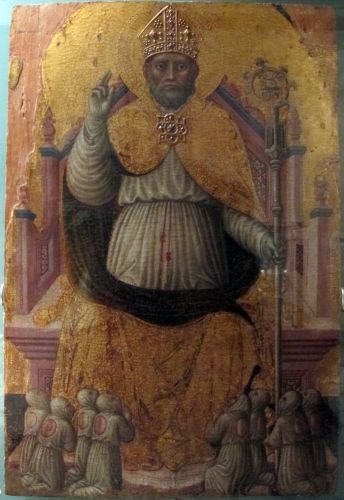
Sidonius acknowledged the uneven conditions under which a grievance might receive attention in Letter 3.9 to Riothamus. Its bearer complained that Britons had enticed away people whom he held in slavery, seeking assistance against opponents whose advantages exceeded his own. Sidonius described the petitioner as obscure and of limited means, emphasizing his isolation in unfamiliar surroundings. The opposing group possessed weapons and the confidence supplied by numbers and fellowship. These circumstances appeared capable of influencing whether the complaint received impartial consideration before its merits had been established. Sidonius expressly withheld certainty about the allegation, asking that the parties be brought together and the matter examined fairly. The recommendation sought an opportunity for judgment, exposing a difficulty that the possession of a potentially valid claim did not itself overcome.
The petitioner’s disadvantaged position was relational. His asserted ownership of enslaved people placed him within structures of domination even while stronger opponents could threaten his interests. Describing him as poor requires attention to the comparison Sidonius was making, rather than an assumption that he lacked property or exercised no authority over others. The passage reveals differences within the population below the highest aristocracy, where someone capable of commanding dependants might still need an influential intermediary to secure consideration against a better-supported group.
The recommendation was itself an attempt to correct that imbalance. It placed Sidonius’s standing behind a request that the bearer could not advance with comparable confidence through his own reputation. Mathisen’s survey of the people carrying Sidonius’s correspondence identifies a range extending from senators to enslaved persons, demonstrating that these communications connected individuals occupying markedly different positions. Access to an aristocrat’s written support could become a practical resource for someone outside his immediate social circle. In the opening of Letter 3.9, Sidonius also presented intercession as a responsibility attached to his own position, since speaking might attract hostility while silence could constitute neglect of duty. That formulation made assistance an expected use of distinction, although the surviving recommendation establishes neither equal access to such help nor a successful outcome in this case.
Religious difference did not invariably prevent Sidonius from making an introduction. In Letter 6.11, he commended an unnamed Jewish bearer to Bishop Eleutherius, leaving the man to explain business that the correspondence does not specify. Sidonius combined hostility toward his religion and hope for his conversion with the acknowledgment that a Jew could possess a just claim in worldly affairs. The recommendation demonstrates a possible channel of assistance across a confessional boundary, while preserving the unequal assumptions through which its Christian author understood that relationship.
These examples sharpen the significance of Sidonius’s position at the cemetery. The petitioner approaching Riothamus required someone else to arrange a prospective examination, whereas Sidonius represented his own response to the disturbance as immediately enforceable. He could determine that an offense had occurred and bring bodily consequences upon the people he identified as responsible before their explanation entered any proceeding preserved in his account. His social advantage concerned the timing and form of the response as well as the resources available afterward. He still considered episcopal assessment important, but approached that authority after acting, under circumstances substantially shaped by his intervention. The contrast does not establish that the two disputes presented identical facts or required identical procedures. It does reveal different capacities to make a grievance significant, with the defense of his ancestor’s burial proceeding through an initiative that the disadvantaged bearer of Letter 3.9 could scarcely have expected to reproduce against his opponents.
Funerary assistance also reached people through arrangements that cannot be reduced to the independent wealth of a single descendant. Rebillard’s survey identifies civic provision, the contributions of affluent patrons, and collective associations among the channels through which burial could be supported, alongside churches acting as intermediaries for gifts. Such arrangements complicate an interpretation in which modest households possessed no means of obtaining help. They also distinguish resources organized collectively from those commanded directly by a prominent relative. Assistance in arranging an interment, though, did not necessarily provide the continuing attention required to keep its location identifiable decades afterward. The existence of a route to burial cannot by itself establish how an older grave would be defended when its occupant’s immediate survivors were gone.
The question of effective protection concerns the renewal of a claim when recognition or respect had failed. Apollinaris’s prefectural standing had not maintained his mound, but a descendant’s ability to intervene gave the family substantial means of responding to its deterioration. Other households could draw upon communal support or an advocate’s goodwill, with their opportunities depending on relationships that the cemetery letter does not document. The evidence cannot measure how frequently graves of different social groups suffered interference, and it does not show that modest burials lacked legitimate claims upon the living. What it makes unusually apparent is the advantage enjoyed by a family able to obtain a prompt response and organize renewed commemoration once an old burial had become vulnerable.
The Survival of Sidonius’s Account
Sidonius’s account reached later generations through a body of correspondence whose preservation required deliberate work. His description of preparing the ninth book makes the material conditions of that process unusually explicit. In Letter 9.16, he recalls searching through old, deteriorating papers for drafts and arranging for recovered material to be transcribed quickly. A copyist appears in the accompanying description of winter cold, struggling with ink that would scarcely flow. Although this scene supports the author’s request for indulgence toward hurried composition, it also acknowledges the labor necessary to produce a readable volume. The continued existence of his writing depended upon locating scattered documents and making further copies, activities that could fail even while their author remained alive.
The collection itself emerged through successive decisions about what to retain and when to stop. Writing to Constantius at the end of Book 7, Sidonius claims that he found comparatively few letters because he had not previously preserved them with publication in mind. This statement belongs to his presentation of the work and should not be treated as a complete inventory of his correspondence. Book 8 opens with another explanation, addressed to Petronius, for recovering additional letters after an earlier collection had already appeared. Firminus subsequently supplied a literary reason for extending the sequence again, urging that a ninth book would match the example of Pliny. These passages establish stages of expansion without allowing historians to reconstruct every intermediate arrangement or to identify precisely when Letter 3.12 acquired its surviving form. They also explain how a communication addressed to Secundus became available to readers outside the immediate family. Its place within a cultivated author’s collected correspondence gave the cemetery dispute a readership that a practical instruction about a monument could scarcely have secured by itself.
Circulation involved expectations that recipients would help reproduce what they received. Ralph Mathisen’s study of Sidonius’s earliest reception illustrates this practice through Letter 9.11, in which Bishop Lupus objected that a volume had been sent through him rather than to him, and Sidonius answered that he had enjoyed ample opportunity to copy it. Evidence from Ruricius of Limoges extends this picture beyond the author’s own descriptions. Ruricius lent Sidonian writing to Sidonius’s son Apollinaris for transcription, showing that access within the family could depend upon books circulating through other households. Later, Gregory of Tours used several letters as historical sources, including the epitaph for Abbot Abraham preserved in Letter 7.17. These examples demonstrate continuing use of the correspondence, although Gregory’s treatment of those other passages does not establish that he knew the account of the grandfather’s grave. The evidence concerns the preservation of a collection through borrowing and copying, rather than an uninterrupted family archive devoted to this single incident. The manuscripts available today introduce a further interval between composition and surviving physical evidence. Franz Dolveck dates the oldest extant witnesses to the first half of the ninth century, several centuries after Sidonius’s lifetime. His survey also identifies a much larger concentration of copying in the twelfth and early thirteenth centuries. Such evidence records renewed reproduction of the works, while leaving many earlier stages recoverable only through comparison and inference. One manuscript supplies a concrete example of the accidents affecting this process. Oxford, Bodleian Library, Digby 61 has lost its opening gatherings and now begins in the middle of Letter 3.12. Other witnesses preserve the missing material, allowing the letter to be read in full despite the damage to that volume. Agreement among copies can help establish what the transmitted text said, but those copies remain descendants of a written account rather than additional testimonies from the cemetery.
Within that account, the epitaph enjoys a form of preservation independent of the proposed monument’s archaeological identification. Its wording can be examined because Sidonius incorporated the verses into his letter, although their transmission does not establish that the inscription was completed exactly as requested. This setting also preserves information that the verses alone would not convey. A surviving slab bearing only the commemorative poem would offer little basis for reconstructing the encounter with the burial workers or the punishment Sidonius described. The correspondence joins the honor intended for Apollinaris to the dispute that prompted its renewed expression, allowing the historian to investigate both through a single, carefully composed document.
This history of preservation affects whose actions can be recovered with any precision. Secundus and Gaudentius retain names and identifiable places within Sidonius’s arrangements, while the men digging in the cemetery remain an occupational group encountered through another person’s accusations. Their anonymity in this record establishes neither illiteracy nor an inability to explain themselves elsewhere. It reflects the limits of the text that survives, together with the absence of an independent account against which its characterization might be tested. Nor can the collection’s preservation tell us how many comparable interventions went unrecorded, or how often other households resolved difficulties without producing literature that later readers chose to copy. Yet Sidonius’s success in transmitting his account did not secure permanent agreement with his interpretation. Because he included circumstances that complicate his allocation of responsibility, the same document that carried his defense into later centuries also preserves grounds for challenging it.
Had Sidonius Misidentified the Real Failure?
The following video from DAILY SAINTS PODCAST discusses Sidonius Apollinaris:
The strongest objection to an interpretation centered on unequal protection is that Sidonius may have directed punishment toward people who encountered a problem his family had failed to prevent. His account explains how occupied ground came to resemble an available burial space, yet treats the excavation as an offense whose culpability required no investigation. A competing reading would place the decisive breakdown before the workers began digging, when knowledge retained within the family ceased to correspond to anything readily distinguishable on the ground. Sidonius’s proposed remedy gives this objection substantial force. Rebuilding the mound and supplying an inscribed stone addressed a difficulty that punishing the men could not resolve. His arrangements acknowledged that future security required a more dependable means of identification, making the adequacy of earlier provision relevant to the incident even though his account concentrated indignation upon the excavators.
That challenge becomes less secure if it assumes that a conspicuous monument was the recognized measure of proper family care. Christian Stein interprets the grave’s initially unobtrusive appearance as consistent with an earlier pattern of elite funerary practice, suggesting that Sidonius introduced a more emphatic form of commemoration rather than simply restoring an established expectation. On this reading, the difference between generations concerned the purposes assigned to a burial place as much as the diligence exercised in maintaining it. Such an interpretation cannot prove that the family consciously accepted the eventual disappearance of this grave, but it cautions against equating modest provision with indifference. The letter offers no continuous history of visits, repairs, or earlier markers from which abandonment could be demonstrated. Even the poem’s acknowledgment of lateness does not settle how sharply Sidonius meant to criticize his predecessors. Joop van Waarden hears understanding toward the earlier generations where another reading might detect embarrassment, while noting disagreement about the relevant Latin construction. The evidence establishes delayed commemorative action more firmly than it establishes a culpable refusal to act.
Occupational familiarity with burial grounds might still have given the workers reasons for caution that a casual visitor would not possess. If they knew that this portion of the cemetery contained older interments, the disappearance of raised earth would not necessarily justify treating it as unused space. Yet the account does not reveal their knowledge, the instructions under which they worked, or the precautions available for distinguishing an old burial from genuinely unoccupied ground. Their possible good faith deserves serious consideration, as Stein observes, while a judgment about their actual responsibility remains beyond what this account can securely support.
A further difficulty concerns the scale of the historical claim drawn from the confrontation. An important family’s grave had become vulnerable despite its ancestry, demonstrating that social distinction did not automatically preserve a burial’s physical identity. The letter supplies no comparison through which to calculate whether less influential households suffered more frequent disturbance or obtained less satisfactory remedies. It cannot establish a general episcopal policy of protecting aristocratic graves at other people’s expense. Nor does the possibility of family promotion make Sidonius’s distress insincere. Van Waarden’s interpretation of the episode as an act of public rehabilitation can coexist with an immediate emotional response to seeing the burial disturbed. Sidonius’s willingness to describe the misleading condition of the ground also deserves evidentiary weight, since he preserved circumstances that complicate his own accusation. His account may combine candid observation with an unjust assessment of blame without requiring either the encounter or his attachment to his grandfather to have been fabricated.
These objections require a narrower understanding of what unequal protection means in this case. The clearest evidence concerns the capacity to respond once danger became apparent, including the ability to impose punishment and finance a more durable memorial. Whether those capacities were exercised justly remains a separate question from whether Sidonius possessed them. His grandfather’s exposure to disturbance shows that privilege could require renewed assertion, while the treatment of the workers raises doubts about who absorbed the cost when existing arrangements proved inadequate. The family’s contribution to that vulnerability must remain part of the explanation, even though neither deliberate neglect nor the laborers’ innocence can be established. Sidonius recognized the practical defect in his instructions for repair, but his allocation of blame gave much less attention to the arrangements that had allowed recognition to fail.
Conclusion: Who Answered for the Unprotected Dead?
As Sidonius tells the story, the burial workers answered for the immediate threat, while the relatives’ responsibility took the form of an undertaking to improve the grave. These responses operated on different terms. Punishment followed discovery without the delay that might have allowed an examination of the men’s understanding, whereas the arrangements for lasting commemoration depended upon further work entrusted to Secundus. The contrast reveals how readily accountability could attach to an identifiable act of digging, even when the circumstances permitting that act had developed across generations. Sidonius’s intervention stopped the excavation, but safeguarding the burial afterward required him to address conditions that force alone could not correct. His letter joins a successful assertion of family authority to an acknowledgment, expressed through the repair instructions, that the existing means of distinguishing the grave had become inadequate.
Roman legal protections supplied standards for condemning interference with the dead, but applying those standards required judgments about conduct and responsibility. The bishop’s reported endorsement gave Sidonius’s response additional moral standing without establishing how the workers’ possible explanations had been considered. Ecclesiastical authority appears here through its relationship with a forceful lay protector, whose actions preceded the approval he subsequently received. The episode demonstrates the importance of that relationship while leaving the cemetery’s administrative arrangements uncertain.
Commissioning a monument offered a different way of securing compliance from those who might encounter the burial in the future. A recognizable structure could communicate occupation without requiring strangers to share the family’s knowledge of the location. The accompanying epitaph would also explain whose remains deserved their attention, placing Apollinaris’s public service within an account of inherited distinction and Christian precedence. Through this undertaking, the grandson sought to make respect for the burial less dependent upon his own timely presence. Yet the proposed inscription did more than solve a problem of identification. As van Waarden’s interpretation emphasizes, commemoration could renew the public standing of an ancestor whose career required careful representation. Sidonius’s response brought practical protection into conjunction with a selective account of the family’s past, giving the threatened grave a significance extending beyond the preservation of its occupant’s resting place. The investment promised continuity for a lineage as well as greater security for a burial, although the surviving letter establishes the commission rather than its completed execution.
Historical assessment must give the workers’ exposure to punishment as much attention as the ancestor’s escape from disturbance. Their intentions remain unresolved, but Sidonius describes moving directly against them and preserves no explanation of what they believed themselves to be doing. His family possessed the resources to turn the encounter into an occasion for renewed commemoration, and his correspondence carried his interpretation to readers far removed from the cemetery. That success cannot establish that those punished bore sole responsibility for the danger he discovered. The episode’s enduring significance lies in the separation between the work necessary to protect the dead and the authority to determine who would answer when that protection failed.
Bibliography
- Arrian. Anabasis of Alexander. Vol. 1, Books I–IV. Translated by P. A. Brunt. Loeb Classical Library 269. Cambridge, MA: Harvard University Press, 1983.
- Bodel, John. “The Organization of the Funerary Trade at Puteoli and Cumae.” In Libitina e dintorni, edited by Silvio Panciera, 147–172. Rome: Edizioni Quasar, 2004.
- Bond, Sarah E. “Mortuary Workers, the Church, and the Funeral Trade in Late Antiquity.” Journal of Late Antiquity 6:1 (2013), 135–151.
- —-. Trade and Taboo: Disreputable Professions in the Roman Mediterranean. Ann Arbor: University of Michigan Press, 2016.
- Cline, Rangar H. “Valentinian III’s Novel 23: Pilfering Priests, Religious Sensibilities, and Power Dynamics in Mid-Fifth Century Rome.” In Fide non Ficta: Essays in Honor of Paul B. Harvey, Jr., edited by John D. Muccigrosso and Celia E. Schultz, 129–46. Bari: Edipuglia, 2020.
- Dolveck, Franz. “The Manuscript Tradition of Sidonius.” In The Edinburgh Companion to Sidonius Apollinaris, edited by Gavin Kelly and Joop van Waarden, 479–507. Edinburgh: Edinburgh University Press, 2020.
- Edmondson, Jonathan. “Inscribing Roman Texts: Officinae, Layout, and Carving Techniques.” In The Oxford Handbook of Roman Epigraphy, edited by Christer Bruun and Jonathan Edmondson, 111–30. New York: Oxford University Press, 2015.
- Gregory of Tours. The History of the Franks. Translated by Lewis Thorpe. London: Penguin Books, 1974.
- Hanaghan, M. P. Reading Sidonius’ Epistles. Cambridge: Cambridge University Press, 2019.
- Harries, Jill. Law and Empire in Late Antiquity. Cambridge: Cambridge University Press, 1999.
- —-. Sidonius Apollinaris and the Fall of Rome, AD 407–485. Oxford: Clarendon Press, 1994.
- Henke, Rainer. “Der Brief 3,12 des Sidonius Apollinaris an Secundus: Eine Novelle in einer Epistel?” Hermes 140:1 (2012), 121–125.
- Justinian. The Digest of Justinian. Edited by Theodor Mommsen and Paul Krueger. Translated by Alan Watson. 4 vols. Philadelphia: University of Pennsylvania Press, 1985.
- Kelly, Gavin, and Joop van Waarden, eds. The Edinburgh Companion to Sidonius Apollinaris. Edinburgh: Edinburgh University Press, 2020.
- Kulikowski, Michael. “Sidonius’ Political World.” In The Edinburgh Companion to Sidonius Apollinaris, edited by Gavin Kelly and Joop van Waarden, 197–213. Edinburgh: Edinburgh University Press, 2020.
- Lucan. Civil War, book 8, Loeb Classical Library.
- Mathisen, Ralph W. “Sidonius’ Earliest Reception and Distribution.” In The Edinburgh Companion to Sidonius Apollinaris, edited by Gavin Kelly and Joop van Waarden, 631–42. Edinburgh: Edinburgh University Press, 2020.
- —-. “Sidonius’ People.” In The Edinburgh Companion to Sidonius Apollinaris, edited by Gavin Kelly and Joop van Waarden, 29–75. Edinburgh: Edinburgh University Press, 2020.
- Pharr, Clyde, trans., in collaboration with Theresa Sherrer Davidson and Mary Brown Pharr. The Theodosian Code and Novels and the Sirmondian Constitutions. Princeton, NJ: Princeton University Press, 1952. Especially Theodosian Code 9.17 and Valentinian III, Novel 23.
- Pliny the Younger. Letters and Panegyricus. Translated by Betty Radice. 2 vols. Cambridge, MA: Harvard University Press, 1969.
- Rebillard, Éric. The Care of the Dead in Late Antiquity. Translated by Elizabeth Trapnell Rawlings and Jeanine Routier-Pucci. Ithaca, NY: Cornell University Press, 2009.
- —-. “Les formes de l’assistance funéraire dans l’Empire romain et leur évolution dans l’Antiquité tardive.” Antiquité tardive 7 (1999), 269–282.
- Reynaud, Jean-François. Lugdunum christianum: Lyon du IVe au VIIIe s. Topographie, nécropoles et édifices religieux. Documents d’archéologie française 69. Paris: Éditions de la Maison des sciences de l’homme, 1998.
- Reynaud, Jean-François, Benoît Helly, and Marcel Le Glay. “Nouvelles inscriptions de Lyon.” Gallia 40:1 (1982), 123–148.
- Risselada, Rodie. “Applying Text Linguistics to the Letters of Sidonius.” In New Approaches to Sidonius Apollinaris, edited by Johannes A. van Waarden and Gavin Kelly, 273–303. Leuven: Peeters, 2013.
- Sidonius Apollinaris. The Letters of Sidonius. Translated by O. M. Dalton. 2 vols. Oxford: Clarendon Press, 1915. Letter 3.12.
- Stein, Christian. “Épigraphie et mise en scène de la domination sociale dans la Gaule méridionale tardive (IVe–VIe s.). À propos de la tombe du grand-père de Sidoine Apollinaire.” In Signa et tituli: Monuments et espaces de représentation en Gaule méridionale sous le regard croisé de la sculpture et de l’épigraphie, edited by Sandrine Agusta-Boularot and Emmanuelle Rosso, 191–205. Aix-en-Provence: Publications du Centre Camille Jullian; Arles: Éditions Errance, 2015.
- Van Waarden, Joop. “The Death and Public Rehabilitation of Apollinaris the Elder: Intertextuality with Lucan in Sidonius Apollinaris, Epist. 3.12.” Classical Quarterly 74:1 (2024), 309–314.
- —-. “Sidonius’ Biography in Photo Negative.” In The Edinburgh Companion to Sidonius Apollinaris, edited by Gavin Kelly and Joop van Waarden, 13–28. Edinburgh: Edinburgh University Press, 2020.
- Wolff, Étienne. “Sidoine Apollinaire et la poésie épigraphique.” In Memoria poetica e poesia della memoria: La versificazione epigrafica dall’antichità all’umanesimo, edited by Antonio Pistellato, 207–18. Venice: Edizioni Ca’ Foscari–Digital Publishing, 2014.
- Wood, Ian. “Sépultures ecclésiastiques et sénatoriales dans la vallée du Rhône (400–600).” Médiévales 31 (1996), 13–27.
Originally published by Brewminate, 11.17.2026, under the terms of a Creative Commons Attribution-NonCommercial-NoDerivatives 4.0 International license.
About the Author