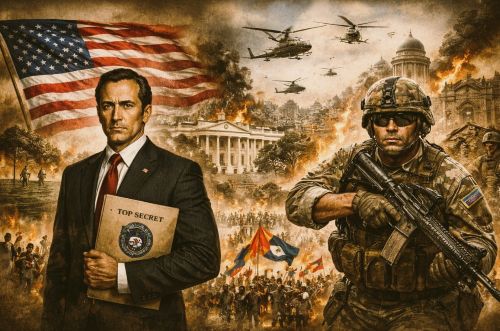
When viewed across more than a century of intervention, the most striking feature of U.S. foreign policy is not transformation but continuity.

By Matthew A. McIntosh
Public Historian
Brewminate
Introduction: Power, Pretext, and the Language of Intervention
The history of United States foreign intervention is marked less by open declarations of empire than by persistent denials of imperial intent. From the late nineteenth century to the present, American power has expanded outward through military force, economic leverage, diplomatic pressure, and legal coercion, yet it has almost never been described by its architects as imperial. Instead, intervention has been framed as necessity, obligation, or moral duty. Democracy must be defended and stability must be restored white criminality must be punished. Chaos must be contained. The language changes, but the structure beneath it remains strikingly consistent.
I begin from the premise that intervention is not merely an act of power but an act of narration. Force alone rarely suffices. It must be explained, justified, and rendered palatable to domestic audiences and international observers alike. The United States has excelled at this rhetorical labor. It has cultivated a vocabulary in which coercion appears reluctant, domination appears temporary, and material interest appears incidental. Military action is described as limited. Control is described as transitional. Resource access is described as collateral rather than central. In this way, intervention is repeatedly severed from the language of empire even as it performs many of empire’s core functions.
The refusal to acknowledge empire has been one of the defining features of American global power. Unlike European colonial regimes, the United States rarely sought formal annexation or permanent territorial rule. Instead, it developed a system of influence that operated through client governments, security guarantees, debt regimes, trade dependencies, and selective applications of force. This model allowed American leaders to insist, often sincerely, that they were not imperialists at all. Empire, in this telling, belonged to others. The United States merely responded to crises, defended order, or upheld universal values.
Yet historians have long noted that the outcomes of these interventions often aligned closely with strategic and economic interests, particularly access to resources, trade routes, and geopolitical positioning. From early interventions in the Pacific and Caribbean to Cold War coups and post-Cold War military actions, material considerations consistently shaped where and how the United States intervened. Oil, minerals, shipping lanes, and financial stability recur as silent constants beneath shifting ideological justifications. The rhetoric of democracy, anti communism, anti narcotics, or humanitarian protection has functioned less as a cause than as a cover, translating power into moral necessity.
This does not mean that all American interventions were driven by cynical calculation alone, nor that policymakers uniformly acted in bad faith. Ideology mattered. Fear mattered. Domestic politics mattered. But the coexistence of sincere belief and structural interest does not absolve outcomes, nor does it erase patterns. The central question is not whether American leaders believed their own rhetoric, but whether that rhetoric systematically obscured the material and strategic logic of intervention from public scrutiny.
The language of intervention also performs a crucial legal and ethical function. By framing actions as law enforcement rather than warfare, or as temporary stabilization rather than regime change, the United States has repeatedly expanded its latitude to act without formally declaring war or acknowledging sovereignty violations. Criminal indictments, sanctions regimes, and extraterritorial prosecutions have increasingly blurred the line between military power and judicial authority. These tools allow regime pressure to appear procedural rather than coercive, even when backed by overwhelming force.
What follows situates contemporary debates about intervention within a long historical continuum. From nineteenth century Samoa to twentieth century Panama and into twenty-first century Venezuela, the United States has repeatedly justified coercive actions through moralized language that masks enduring structural aims. The goal here is not polemic but historical clarity. By tracing the recurring grammar of intervention across time, this study seeks to illuminate how power operates most effectively when it denies its own nature. Empire, in the American case, has rarely announced itself. It has spoken instead in the reassuring language of necessity, virtue, and temporary control.
The Architecture of Informal Empire: Control without Colonies
By the late nineteenth century, the United States had developed a distinctive model of power projection that diverged sharply from the formal colonial empires of Europe. Rather than extensive territorial annexation or long-term colonial administration, American expansion favored influence without incorporation. Control could be exercised through treaties, military presence, economic dependency, and diplomatic coercion while leaving nominal sovereignty intact. This approach allowed the United States to deny imperial intent even as it shaped the political and economic destinies of other nations. Empire, in this form, did not require flags planted permanently in foreign soil. It required leverage.
Central to this architecture was the strategic use of economic power. Trade agreements, investment flows, and debt structures often preceded or followed military intervention, binding weaker states to American markets and financial institutions. The so-called Open Door policies of the late nineteenth and early twentieth centuries exemplified this logic, asserting a commitment to free trade while ensuring American access to foreign markets without the burdens of colonial governance. Economic penetration functioned as a quieter but no less effective mechanism of control, one that normalized dependency while preserving the appearance of independence.
Military force remained an essential, if selectively applied, component of informal empire. Rather than permanent occupation, the United States favored episodic interventions designed to discipline governments, protect commercial interests, or install favorable regimes. These actions were frequently framed as temporary necessities, undertaken only until stability could be restored. The promise of withdrawal played a crucial rhetorical role, allowing intervention to appear reluctant and finite even when its effects proved long-lasting. Bases, training missions, and security assistance programs extended this presence indirectly, embedding American influence within local military structures.
Legal and institutional tools further reinforced this system. Treaties, executive agreements, and later international financial institutions provided frameworks through which American preferences could be advanced under the guise of multilateralism or legal obligation. Extraterritorial rights, arbitration mechanisms, and sanctions regimes expanded U.S. authority beyond its borders while minimizing domestic political costs. By shifting coercion into administrative or legal forms, the United States blurred the distinction between governance and domination, making power appear procedural rather than imposed.
What distinguished this architecture was not merely its effectiveness but its deniability. Because control was exercised through intermediaries, contracts, and conditional assistance, it could be represented as partnership rather than domination. This structure proved remarkably durable, surviving shifts in ideology from expansionism to anti-communism to globalization. While the language surrounding intervention evolved, the underlying framework of informal empire remained intact. Control without colonies was not a transitional phase in American history. It was, and remains, a defining strategy.
Early Precedents: Samoa, the Caribbean, and the Normalization of Intervention (1880s–1930s)
The late nineteenth century marked the moment when American intervention abroad shifted from episodic assertion to routinized practice. The United States emerged from continental expansion with new commercial ambitions and a growing naval doctrine that emphasized overseas presence. This transition did not announce itself as imperial conquest. Instead, it unfolded through crises framed as protective or stabilizing, particularly in regions deemed strategically or economically significant. The Pacific and the Caribbean became early laboratories for this approach, where intervention could be tested without provoking the international backlash associated with European colonialism.
Samoa offers one of the clearest early examples of this pattern. In the 1880s and 1890s, the islands became the site of competition among the United States, Germany, and Britain, each seeking influence over trade routes and naval coaling stations. American involvement was justified as necessary to preserve order and protect commercial interests amid local political instability. The eventual partition of Samoa formalized U.S. control over the eastern islands while maintaining the appearance of international agreement rather than unilateral seizure. What mattered most was not sovereignty in name but strategic positioning in the Pacific, secured without the trappings of traditional colonial rule.
In the Caribbean, intervention took on an even more regularized form. Following the Spanish-American War, the United States asserted itself as the dominant external power in the region, framing its actions as guardianship rather than domination. Cuba’s formal independence was constrained by legal mechanisms that granted the United States broad rights of intervention. Elsewhere, military occupations in places such as Haiti and the Dominican Republic were justified as efforts to restore stability, manage debt, and prevent European interference. These occupations were presented as temporary measures, yet they reshaped local political institutions in ways that endured long after American troops withdrew.
Nicaragua exemplified the fusion of military force and economic interest that defined this era. Repeated interventions in the early twentieth century were undertaken to protect American investments and influence the trajectory of government. Marines were deployed not to annex territory but to enforce favorable outcomes, particularly regarding customs revenues and political succession. The pattern reinforced a broader lesson for policymakers: control could be exercised efficiently without permanent administration, provided that force was available when local conditions diverged from American priorities.
What unified these early precedents was the gradual normalization of intervention as an acceptable instrument of policy. By the 1920s, the deployment of troops, the restructuring of foreign finances, and the supervision of elections had become familiar tools rather than extraordinary acts. Each intervention was narrated as a response to unique circumstances, yet collectively they established a durable framework in which American involvement in the internal affairs of other nations was no longer exceptional. The repetition itself reduced the need for justification, as precedent began to substitute for principle.
This period also fixed key rhetorical habits that would persist for generations. Intervention was consistently described as reluctant, defensive, and temporary, even when driven by long-term strategic considerations. Appeals to order and responsibility masked the asymmetry of power at work, while the absence of formal colonies reinforced the belief that the United States stood apart from imperial traditions. The groundwork for informal empire had already been laid. The interventions of the 1880s through the 1930s were not aberrations but foundational episodes, shaping both the methods and the mindset of American power in the century to follow.
Cold War Rationalizations: Anti-Communism as Universal Alibi
The Cold War provided the United States with a justificatory framework of extraordinary flexibility. Anti-communism did not merely explain intervention. It normalized it. Across diverse regions and political contexts, the presence or even the suspicion of leftist influence was sufficient to trigger economic pressure, covert action, or outright military force. This ideological lens collapsed local histories and political complexities into a single binary, transforming internal social struggles into extensions of a global existential conflict. Within this framework, intervention appeared not as choice but as obligation.
What made anti-communism such a powerful alibi was its elasticity. Governments pursuing land reform, nationalization, or independent foreign policy could be framed as communist threats regardless of their actual ideological orientation. This allowed American policymakers to intervene in states that posed no military danger to the United States but threatened established economic arrangements. In practice, the definition of communism expanded to include any movement that disrupted access to resources, challenged U.S. corporate interests, or resisted political alignment with Washington.
The 1953 overthrow of Iran’s elected government demonstrated how this logic operated. Although the primary catalyst was the nationalization of oil assets, intervention was justified through the language of communist containment. The Cold War frame transformed a dispute over resource sovereignty into a security crisis, masking economic motivations behind ideological necessity. The result was a durable lesson for U.S. foreign policy: economic interests could be advanced most effectively when recast as ideological imperatives.
A similar pattern emerged in Guatemala the following year. Agrarian reform and challenges to foreign corporate landholdings were reinterpreted as evidence of communist infiltration. Covert operations destabilized the government, replacing it with a regime more amenable to American interests. The long-term consequences, including decades of political violence, were treated as unfortunate but secondary to the immediate goal of ideological containment. Anti-communism thus functioned not only as justification but as moral insulation, deflecting responsibility for outcomes that followed.
By the 1970s, this logic was firmly entrenched. In Chile, a democratically elected socialist government was portrayed as an intolerable threat despite operating within constitutional frameworks. Economic pressure, political destabilization, and eventual military takeover were rationalized as necessary to prevent the spread of communism in the Western Hemisphere. Democracy itself became conditional, protected only when its outcomes aligned with acceptable ideological and economic boundaries.
What is striking across these cases is not merely the recurrence of intervention but the consistency of its narrative structure. Each episode was framed as defensive, reluctant, and reactive. American power appeared as a response to external provocation rather than as an initiator of change. This narrative minimized the agency of local actors while magnifying ideological threat, allowing intervention to be perceived as stabilization rather than disruption.
The Cold War did not invent American interventionism, but it systematized and globalized it. Anti-communism provided a universal language capable of translating diverse local conflicts into a single moral script. When the Cold War ended, this script did not disappear. It was adapted. The vocabulary shifted from communism to terrorism, criminality, or authoritarianism, but the underlying logic remained intact. Those years represent not an aberration but a crucial phase in the maturation of informal empire, refining the rhetorical tools that would sustain intervention long after the ideological conflict that gave them cover had faded.
Panama and the Logic of Capture: The Noriega Precedent
The 1989 U.S. invasion of Panama marked a critical inflection point in the evolution of American interventionism, one that fused military force with criminal prosecution in a way that would have lasting implications. Unlike earlier Cold War interventions justified primarily through ideological threat, Panama was framed as a law enforcement action on an international scale. The stated objective was not territorial control or ideological containment, but the arrest and prosecution of Manuel Noriega, a former U.S. ally accused of narcotics trafficking. This framing allowed the United States to recast regime change as judicial necessity, transforming invasion into apprehension and war into arrest.
The logic of capture represented a significant shift. Noriega was not merely removed from power; he was seized, transported to the United States, and tried in an American court. This act asserted an expansive interpretation of U.S. jurisdiction, one that effectively subordinated Panamanian sovereignty to American legal authority. While Noriega’s criminal conduct was real and well documented, the method of response raised profound questions about proportionality and precedent. Military force was deployed not to repel an invasion or defend territory, but to enforce U.S. criminal law abroad.
Equally important was the narrative discipline surrounding the operation. The invasion was described as limited, precise, and regrettable, undertaken only because all other options had failed. Civilian casualties and infrastructure damage were minimized in official accounts, while the swift installation of a friendly government reinforced the impression of success. Yet the broader message was unmistakable. The United States had demonstrated its willingness to remove a foreign head of state unilaterally and to redefine regime change as a policing function rather than an act of war.
The Noriega precedent reverberated far beyond Panama. It established a model in which criminalization could serve as a gateway to intervention, especially in cases where ideological justifications had lost their potency. By merging law enforcement rhetoric with military capability, the United States expanded its repertoire of coercive tools while preserving moral legitimacy in domestic discourse. Panama thus occupies a crucial place in the history of informal empire. It revealed how sovereignty could be overridden not in the name of ideology or occupation, but in the name of justice defined by the aggressor.
Venezuela in Context: Oil, Sovereignty, and Contemporary Claims of Intervention
Venezuela occupies a singular place in the history of U.S. foreign interest in the Western Hemisphere, not because of ideology alone, but because of resources. Possessing some of the largest proven oil reserves in the world, the country has long been entangled in global energy markets and external political pressure. Any analysis of contemporary U.S.–Venezuelan relations that neglects oil as a central factor risks mistaking rhetoric for causation. The language surrounding democracy, criminality, or humanitarian concern must therefore be read alongside the material realities that have consistently drawn foreign attention to Venezuelan sovereignty.
Since the early twentieth century, Venezuela’s political trajectory has been shaped in part by its relationship with foreign energy interests, particularly those tied to the United States. Nationalization efforts and state control over oil revenues repeatedly generated tension with external actors accustomed to preferential access. These disputes did not begin with the Bolivarian Revolution, nor were they unique to any single administration. Rather, they reflect a longer struggle over who controls extraction, pricing, and profit from Venezuela’s natural wealth. Sovereignty, in this context, has always been contested.
Contemporary claims of U.S. intervention must be situated within this historical pattern. Under Donald Trump, Venezuela has been framed as both a criminal state and a humanitarian catastrophe, language that collapsed complex economic, political, and social crises into a simplified moral narrative. Public statements emphasized narcotics trafficking using the word “narcoterrorism,” corruption, and authoritarianism, while policy measures included sanctions, diplomatic isolation, and overt discussions of regime change. As in earlier eras, moral urgency functioned to narrow debate, presenting intervention as response rather than initiation.
The targeting of Nicolás Maduro and Cilia Flores through criminal indictments and public accusations illustrates the continued evolution of the logic of capture first seen in Panama. While the specific allegations and legal processes differ, the broader pattern remains recognizable. Criminalization becomes a mechanism through which sovereignty is weakened and coercive pressure is legitimized. Legal discourse does not replace power; it reframes it.
At the same time, U.S. discourse has openly acknowledged strategic interests in Venezuela’s oil sector, particularly amid global energy volatility. Statements suggesting temporary control or oversight of Venezuelan oil resources, even when framed as stabilization or protection, echo earlier justifications used in other interventions. Resource access is rarely presented as the primary motive, yet it consistently appears as a stated benefit or consequence. The separation between moral justification and material outcome grows increasingly thin.
What distinguishes Venezuela is not the novelty of interventionist logic, but its transparency. The convergence of criminal law, economic sanctions, and explicit strategic interest reveals the underlying structure with unusual clarity. Venezuela thus serves as a contemporary case study in how informal empire operates in the twenty first century. Sovereignty is not dismantled through annexation, but through layered pressures that render independent governance increasingly untenable. In this sense, Venezuela is less an exception than a culmination, illustrating how old patterns persist under new names.
Democracy as Performance: The Rhetorical Script of Intervention
Across more than a century of U.S. foreign interventions, democracy has functioned less as a fixed principle than as a performative script. It is invoked selectively, emphasized when useful, muted when inconvenient, and redefined when outcomes diverge from acceptable parameters. In this sense, democracy operates not as a universal standard to be upheld consistently, but as a legitimizing language through which power is narrated. Intervention is framed not as domination, but as guardianship, with the United States cast as reluctant steward of political order rather than its enforcer.
This performative quality is most visible in the conditional nature of democratic support. Elections are celebrated when they produce compliant governments and questioned when they do not. Political movements are labeled democratic or authoritarian less by their adherence to constitutional norms than by their alignment with U.S. strategic interests. When democratic processes threaten resource access, military positioning, or economic influence, they are reclassified as instability, corruption, or extremism. Democracy thus becomes outcome oriented rather than procedural, judged by results rather than rules.
The rhetoric of intervention reinforces this logic by emphasizing rescue over disruption. Military action is described as restoring democracy rather than suspending it. Sanctions are framed as pressure on regimes rather than punishment of populations. Covert operations are narrated as support for civil society rather than interference. These formulations allow intervention to appear corrective rather than transformative, even when it dismantles existing political institutions. The language of democracy smooths over the violence and coercion embedded in these processes, rendering them abstract and morally sanitized.
Media and official discourse play a crucial role in sustaining this performance. Complex political landscapes are reduced to binary struggles between freedom and tyranny, reform and repression. Local actors are stripped of historical context and agency, recast as symbols within a moral drama authored elsewhere. This simplification not only facilitates public consent but also limits the range of permissible debate. To question intervention becomes, by implication, to oppose democracy itself, collapsing critique into disloyalty or naivete.
The enduring power of this rhetorical script lies in its familiarity. Repeated across decades, it has become a reflex rather than an argument. Democracy is no longer something to be demonstrated through consistent practice, but something to be asserted through declaration. In this way, the language of intervention does not merely justify power after the fact. It actively produces a moral reality in which coercion appears virtuous and resistance appears illegitimate. Democracy, performed rather than practiced, becomes one of the most effective tools of informal empire.
Continuity Over Time: What Changes and What Does Not
When viewed across more than a century of intervention, the most striking feature of U.S. foreign policy is not transformation but continuity. Technologies change. Ideological vocabularies evolve and enemies are renamed. Yet the underlying structure of intervention remains remarkably stable. The United States continues to exert power without formal annexation, to prioritize strategic and economic interests while denying imperial ambition, and to rely on moralized language to legitimate coercion. What changes is the idiom, not the architecture.
One of the most consistent elements is the relationship between material interest and rhetorical justification. In the late nineteenth century, intervention was framed through commerce and civilization. During the Cold War, it was reframed through anti-communism. In the post-Cold War and post September 11 eras, it has been recast through democracy promotion, counterterrorism, anti-corruption, and criminal enforcement. Each framework reflects contemporary anxieties and political needs, yet each performs the same essential task: translating power into necessity. The justification adapts to the moment, but the alignment of intervention with strategic advantage persists.
Equally consistent is the denial of permanence. American interventions are repeatedly described as temporary, limited, and exceptional. Control is presented as transitional, influence as advisory, presence as reluctant. This insistence on impermanence allows policymakers to evade the moral and legal implications of sustained dominance. Even when interventions last decades or produce enduring dependencies, they are narrated as unfinished responsibilities rather than structural commitments. The language of temporariness thus becomes a mechanism through which continuity disguises itself as restraint.
What has perhaps changed most is not policy but transparency. Earlier interventions relied on secrecy and plausible deniability. Contemporary interventions increasingly operate in full view, articulated openly by officials and amplified through media. Yet this visibility has not diminished their effectiveness. On the contrary, familiarity has dulled scrutiny. The repetition of interventionist logic has rendered it normal, even banal. Continuity, in this sense, is sustained not only by power but by habit. What remains unchanged is the central paradox of American intervention: an empire that insists it is not one, exercising enduring control while narrating each act as an isolated exception.
Conclusion: Empire in Denial and the Cost of Forgetting
The history traced in this essay reveals an enduring pattern of power exercised without acknowledgment. From Samoa to Panama to Venezuela, the United States has repeatedly intervened in the internal affairs of other nations while denying imperial intent. This denial has not been incidental. It has been essential. By refusing the language of empire, American policymakers have preserved moral legitimacy at home while maintaining strategic freedom abroad. Intervention, framed as necessity rather than choice, becomes insulated from democratic accountability, its consequences diffused across time and geography.
The cost of this denial is historical amnesia. Each intervention is narrated as unprecedented, each crisis as exceptional, each use of force as reluctant. In the absence of continuity, responsibility dissolves. Failures are attributed to local dysfunction rather than structural design, and long-term instability is treated as accidental rather than produced. This pattern erodes both international norms and domestic trust, as the gap between rhetoric and reality becomes increasingly visible. An empire that cannot name itself cannot reckon with its effects.
Historical clarity does not require moral absolutism, nor does it deny the complexity of global power. It requires only honesty about patterns that persist across generations. To remember is not to indict reflexively, but to understand structurally. The refusal to forget is itself a political act, one that challenges comforting myths in favor of accountability. Until the language of intervention aligns with its material and historical realities, empire will continue to operate most effectively where it is least acknowledged, and its costs will continue to be borne by those farthest from the narratives that justify it.
Bibliography
- Bacevich, Andrew J. The New American Militarism: How Americans Are Seduced by War. New York: Oxford University Press, 2005.
- Chomsky, Noam. Hegemony or Survival: America’s Quest for Global Dominance. New York: Metropolitan Books, 2003.
- Coatsworth, John. “United States Interventions. What For?” ReVista: Harvard Review of Latin America IV, no. 2 (2005).
- Cullinane, Michael Patrick and Alex Goodall. The Open Door Era: United States Foreign Policy in the Twentieth Century. Edinburgh: Edinburgh University Press, 2017.
- David Rivera Roche, Félix. “Oil, Dollars, and Power: Rethinking the U.S.–Venezuela Conflict Beyond the Myth of Resource Theft.” SSRN (2025).
- Gallagher, John, and Ronald Robinson. “The Imperialism of Free Trade.” The Economic History Review 6, no. 1 (1953): 1–15.
- Grandin, Greg. Empire’s Workshop: Latin America, the United States, and the Rise of the New Imperialism. New York: Metropolitan Books, 2006.
- Hoganson, Kristin L. Fighting for American Manhood: How Gender Politics Provoked the Spanish-American and Philippine-American Wars. New Haven, CT: Yale University Press, 1998.
- Immerwahr, Daniel. How to Hide an Empire: A History of the Greater United States. New York: Farrar, Straus and Giroux, 2019.
- Kaplan, Amy. “Violent Belongings and the Question of Empire.” American Quarterly 56, no. 1 (2004): 1–18.
- Kinzer, Stephen. Overthrow: America’s Century of Regime Change from Hawaii to Iraq. New York: Times Books, 2006.
- LaFeber, Walter. America, Russia, and the Cold War, 1945–2006. New York: McGraw-Hill, 2008.
- —-. The New Empire: An Interpretation of American Expansion, 1860–1898. Ithaca, NY: Cornell University Press, 1963.
- Ma, Frances Y. F. “Noreiga’s Abduction from Panama: Is Military Invasion an Appropriate Substitute for International Extradition Appropriate Substitute for International Extradition.” Loyola of Los Angeles International and Comparative Law Review 13, no. 4 (1991): 925-953.
- Maier, Charles S. Among Empires: American Ascendancy and Its Predecessors. Cambridge, MA: Harvard University Press, 2006.
- McCoy, Alfred W. In the Shadows of the American Century: The Rise and Decline of U.S. Global Power. Chicago: Haymarket Books, 2017.
- Reeder, Jessie. The Forms of Informal Empire: Britain, Latin America, and Nineteenth-Century Literature. Baltimore: Johns Hopkins University Press, 2020.
- Said, Edward W. Culture and Imperialism. New York: Vintage Books, 1994.
- Smith, Tony. America’s Mission: The United States and the Worldwide Struggle for Democracy. Princeton, NJ: Princeton University Press, 2012.
- U.S. Energy Information Administration. “Venezuela Country Analysis Brief.” Washington, DC.
- U.S. Navy Department. Annual Reports of the Navy Department, 1890–1905. Washington, DC: Government Printing Office.
- Weisbrot, Mark, and Jeffrey Sachs. “Economic Sanctions as Collective Punishment: The Case of Venezuela.” Center for Economic and Policy Research, 2019.
- Westad, Odd Arne. The Global Cold War: Third World Interventions and the Making of Our Times. Cambridge: Cambridge University Press, 2005.
- Williams, William Appleman. The Tragedy of American Diplomacy. New York: W. W. Norton, 1959.
Originally published by Brewminate, 01.05.2026, under the terms of a Creative Commons Attribution-NonCommercial-NoDerivatives 4.0 International license.
About the Author