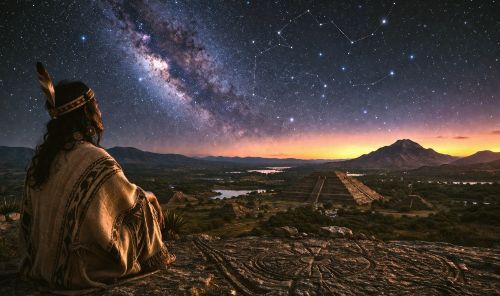
Indigenous astronomy across the Americas reveals a sophisticated, place-based science in which celestial observation shaped agriculture, architecture, navigation, and cosmology.

By Matthew A. McIntosh
Public Historian
Brewminate
Introduction: Astronomy as Lived Knowledge
Astronomy in Native American cultures was not an abstract or isolated field of inquiry but a lived and integrated system of knowledge embedded within daily life. Observations of the sky were inseparable from agricultural practice, seasonal movement, ritual timing, and social organization. Rather than existing as a specialized discipline detached from other forms of understanding, celestial knowledge functioned as part of a broader epistemological framework in which environment, community, and cosmology were deeply interconnected. This integration challenges modern categorizations that separate science from culture, suggesting instead that astronomical knowledge in Indigenous contexts operated through a holistic and relational mode of thought.
The precision of Indigenous astronomical observation is evident in the careful tracking of solar and lunar cycles, as well as in the alignment of structures and landscapes with celestial events. Across diverse regions, Native American groups identified solstices, equinoxes, and lunar phases with a level of consistency that enabled the development of reliable calendar systems. These systems were not merely symbolic but served practical functions, guiding planting and harvesting cycles, coordinating communal activities, and marking significant ceremonial periods. The repeated and sustained observation required to produce such systems indicates a long-term commitment to empirical engagement with the natural world, grounded in both continuity and adaptation. In many cases, this knowledge was refined over generations through cumulative observation, with each cycle reinforcing or adjusting prior understandings based on environmental variation. The ability to correlate celestial patterns with terrestrial outcomes, such as rainfall timing or seasonal animal behavior, further demonstrates the applied nature of this observational practice. Rather than existing as static knowledge, these systems were dynamic, evolving in response to shifting ecological conditions while maintaining a consistent underlying framework of interpretation.
This knowledge was transmitted and preserved through oral traditions, narrative structures, and embodied practice rather than through written records. Stories about constellations, seasonal change, and cosmic order functioned as mnemonic devices, encoding complex observational data in forms that could be remembered, taught, and adapted across generations. This method of transmission ensured both stability and flexibility, allowing knowledge to remain responsive to environmental variation while maintaining coherence within cultural frameworks. The absence of written documentation does not indicate a lack of rigor but rather reflects a different approach to knowledge preservation, one that prioritizes lived experience and communal participation.
Understanding Native American astronomy as lived knowledge requires a shift in analytical perspective. It demands recognition that scientific insight can emerge through diverse methodologies, including those grounded in observation, memory, and cultural practice. By examining these systems on their own terms, rather than through externally imposed standards, historians can better appreciate the sophistication and adaptability of Indigenous knowledge. This approach not only enriches our understanding of the past but also invites broader reflection on the nature of knowledge itself, emphasizing its capacity to exist in multiple, equally valid forms.
Celestial Observation and Cyclical Time
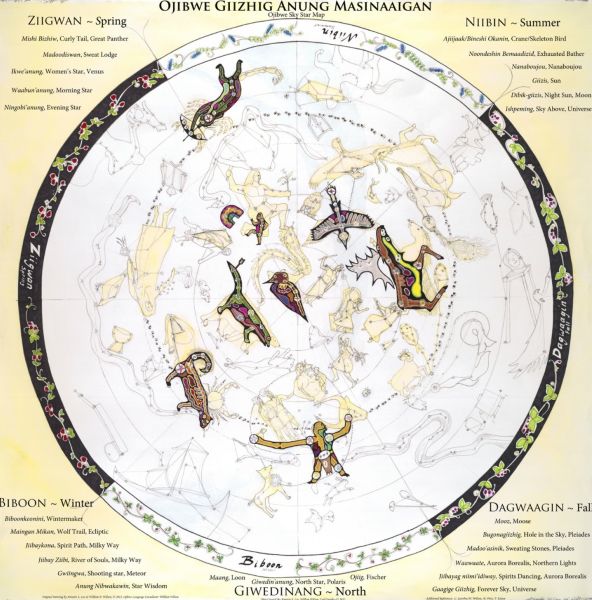
The foundation of Native American astronomy lay in sustained and careful observation of cyclical patterns in the sky. These cycles, particularly those of the sun and moon, provided a framework for understanding time not as an abstract linear progression but as a repeating sequence of natural events. Indigenous observers recognized the regularity of solar movement along the horizon, noting the shifting points of sunrise and sunset throughout the year. By marking these changes, they were able to identify solstices and equinoxes with considerable accuracy, establishing fixed reference points within an otherwise fluid temporal landscape.
Lunar observation played an equally significant role in structuring time. The phases of the moon offered a visible and predictable cycle that could be tracked without specialized instruments. Many Indigenous cultures developed lunar-based or lunisolar calendars, dividing the year into months associated with environmental or cultural events. These designations often reflected ecological realities, such as the timing of animal migrations, plant growth, or seasonal weather patterns. The naming of lunar months functioned as both a temporal marker and a repository of environmental knowledge, reinforcing the connection between celestial observation and lived experience.
Horizon-based observation techniques further enhanced the precision of these systems. By identifying specific landmarks where the sun rose or set at key times of the year, observers could create a reliable calendar anchored in the physical landscape. These horizon markers, whether natural features such as mountains or constructed alignments, allowed for the consistent recognition of seasonal transitions. The use of fixed observation points also facilitated intergenerational continuity, as knowledge could be transmitted through repeated demonstration at the same locations. The landscape itself became an instrument of measurement, integrating geography with astronomy. The reliability of such systems depended on careful long-term observation, often spanning generations, in which slight variations in solar position were noted and incorporated into communal knowledge. These practices also required an understanding of how atmospheric conditions, terrain, and seasonal changes could affect visibility, ensuring that observations remained accurate under varying circumstances. By embedding astronomical markers within familiar surroundings, Indigenous observers created systems that were both accessible and enduring, reinforcing the connection between place and time.
The cyclical understanding of time that emerged from these practices had profound implications for social organization and ritual life. Seasonal ceremonies, agricultural activities, and communal gatherings were often synchronized with celestial events, ensuring that human actions remained aligned with environmental rhythms. This synchronization was not merely practical but also symbolic, reflecting a worldview in which cosmic order and human activity were interconnected. The regular return of celestial patterns reinforced a sense of continuity and stability, even in the face of environmental variability.
These observational practices demonstrate a sophisticated approach to timekeeping grounded in empirical evidence and cultural meaning. Native American astronomers did not separate the measurement of time from its application but integrated both into a unified system that guided daily life and long-term planning. The emphasis on cycles rather than linear progression highlights a different conceptualization of time, one that prioritizes recurrence, balance, and relationship. This cyclical framework allowed communities to anticipate change rather than merely react to it, fostering a proactive engagement with seasonal and environmental dynamics. It also encouraged a holistic understanding of time in which celestial, ecological, and social rhythms were interwoven, producing a system that was both scientifically grounded and culturally meaningful. In recognizing and adapting to these cycles, Indigenous communities developed systems of knowledge that were both precise and deeply attuned to the natural world.
Solar Observatories and Light-Based Markers

Across North America, Indigenous communities developed sophisticated methods for tracking solar movement through constructed spaces and carefully selected natural sites. These solar observatories were not “observatories” in the modern institutional sense but integrated features of the landscape, architecture, and ritual environment. By aligning structures with solar pathways, Indigenous observers created systems that could mark key moments in the annual cycle, particularly solstices and equinoxes. These alignments were neither accidental nor purely symbolic but reflected sustained empirical observation over long periods.
One of the most well-known examples of such practices is found at Chaco Canyon, where architectural alignments and petroglyphs appear to correspond with solar events. The so-called “Sun Dagger” site at Fajada Butte demonstrates how shafts of sunlight could be used to mark seasonal transitions with remarkable precision. At specific times of the year, light passes through rock formations to illuminate spiral carvings, creating patterns that correspond to solstices and equinoxes. While interpretations of the site remain debated, the evidence suggests a deliberate effort to integrate solar observation into both constructed and natural features of the landscape. The precision required to produce these light-and-shadow interactions indicates a long process of experimentation, in which observers refined placements to ensure consistency. Scholars have also noted that the site’s design reflects an awareness of solar extremes, capturing both the longest and shortest days of the year through distinct visual effects. This suggests not only observational accuracy but also a conceptual framework in which solar cycles were understood as meaningful markers within a broader cosmological system.
Similar principles can be observed at other sites, such as Cahokia, where the arrangement of wooden posts known as “Woodhenge” likely functioned as a solar calendar. These circular configurations allowed observers to track the position of sunrise throughout the year, providing a visual reference for seasonal change. By standing at a fixed central point, individuals could observe the alignment of the sun with specific posts, marking key dates within the agricultural and ceremonial calendar. Such systems demonstrate an understanding of solar movement that was both practical and embedded within communal space.
Light-based markers were not limited to large ceremonial centers but also appeared in smaller, localized contexts. In various regions, petroglyphs and rock alignments were positioned to interact with sunlight in ways that signaled particular times of year. These interactions often depended on precise angles of light and shadow, requiring careful placement and long-term observation to achieve accuracy. The use of light as a marker transformed the environment into a dynamic instrument, where the passage of time could be read through shifting patterns of illumination. In some cases, these markers were subtle and required specific vantage points, suggesting that knowledge of their function was restricted to trained observers or transmitted within particular groups. The interplay of light and shadow also introduced a temporal dimension to otherwise static features, allowing them to “activate” only at certain moments, thereby reinforcing their significance within ritual or calendrical contexts. This blending of visibility, timing, and meaning underscores the sophistication of these systems, which relied as much on human interpretation as on physical alignment.
The integration of solar observatories into social and ceremonial life further underscores their importance. These sites were not merely tools for measurement but spaces of gathering, ritual, and meaning. Observations of solar events often coincided with ceremonies that reinforced communal identity and cosmological understanding. The act of observing the sun was inseparable from its cultural significance, blending empirical knowledge with symbolic interpretation in a unified practice.
These examples reveal a consistent pattern of innovation grounded in close attention to the natural world. Indigenous solar observatories and light-based markers demonstrate a high degree of precision achieved without mechanical instruments, relying instead on the interplay of light, landscape, and human perception. They challenge assumptions about the limits of pre-modern science, showing that accurate and reliable systems of observation can emerge from deeply rooted relationships with place. These systems were not static but adaptable, capable of being maintained and refined across generations, ensuring their continued relevance within changing environmental and social contexts.
Architecture and Astronomical Alignment

Indigenous architecture across the Americas frequently incorporated deliberate alignments with celestial phenomena, transforming built environments into instruments of observation. These alignments were not incidental but reflected an intentional effort to embed astronomical knowledge within the physical structure of communities. Buildings, plazas, and ceremonial spaces were often oriented to correspond with solar, lunar, or stellar events, allowing architecture itself to function as a guide to time and season. This integration of design and observation demonstrates a sophisticated understanding of how spatial organization could be used to track celestial cycles.
Among the Pueblo peoples of the American Southwest, architectural orientation often reflected solar considerations, particularly in relation to seasonal light and heat. Structures were positioned to maximize or minimize sunlight depending on the time of year, balancing practical concerns with observational opportunities. Doorways, windows, and wall alignments sometimes allowed sunlight to enter at specific angles during solstices, creating visible markers within interior spaces. These features suggest that astronomical awareness was not confined to ceremonial contexts but embedded within everyday living environments.
In Mesoamerica, monumental architecture provides further evidence of precise astronomical alignment. At sites such as Teotihuacan and Chichén Itzá, large-scale constructions were oriented in relation to solar and planetary movements, reflecting both observational precision and cosmological symbolism. The Pyramid of Kukulcán at Chichén Itzá, for example, produces a shadow effect during equinoxes that resembles a serpent descending the structure’s steps. While interpretations of such phenomena vary, the alignment itself indicates a deliberate relationship between architecture and celestial events, one that required careful planning and sustained observation. The scale of these constructions also implies coordinated labor and centralized knowledge systems, suggesting that astronomical expertise was held by specialists who could translate celestial patterns into architectural form. Furthermore, the integration of visual spectacle, such as the equinox serpent, indicates an awareness of how astronomical events could be made visible and meaningful to broader audiences, blending technical precision with cultural communication.
North American mound-building cultures also demonstrated an awareness of astronomical alignment in their construction practices. At Cahokia, the layout of the city, including its central plaza and surrounding mounds, appears to reflect cardinal directions and solar pathways. The relationship between mound placement and horizon markers suggests that builders incorporated celestial considerations into urban planning. This alignment would have allowed for the coordination of ceremonial activities with seasonal changes, reinforcing the connection between built space and temporal cycles.
The incorporation of astronomical alignment into architecture also served social and political functions. Structures aligned with celestial events could legitimize authority by associating leaders or rituals with cosmic order. Ceremonial buildings often acted as focal points where astronomical knowledge was displayed and enacted, reinforcing communal identity and shared understanding. The visibility of these alignments, especially during significant celestial events, created moments of collective experience that strengthened social cohesion. In some cases, access to certain spaces or knowledge of specific alignments may have been restricted, further enhancing the authority of those who controlled or interpreted these phenomena. This dynamic suggests that astronomical alignment was not only a scientific or observational practice but also a means of structuring power and reinforcing social hierarchies within the community.
These examples reveal that Indigenous architecture was not merely functional or aesthetic but deeply informed by astronomical knowledge. By embedding celestial alignment into the design of their environments, Indigenous communities created spaces that were both practical and cosmologically meaningful. These structures demonstrate a capacity to integrate observation, symbolism, and social organization into a cohesive system, challenging modern distinctions between science, architecture, and ritual. The result was a built environment that actively participated in the interpretation and experience of the sky.
Medicine Wheels and Landscape Astronomy

Among the most striking examples of Indigenous astronomical knowledge in North America are the stone constructions commonly referred to as medicine wheels. Found primarily in the northern Plains, particularly in present-day Wyoming, Montana, and Alberta, these structures consist of central cairns connected to outer stone circles by radiating lines. While their exact functions varied across regions and communities, many medicine wheels display alignments that correspond to significant celestial events, suggesting their use as instruments for observing the sky within a broader ceremonial landscape. The scale and durability of these constructions further indicate that they were intended for repeated use over long periods, serving as stable reference points within shifting environmental and social contexts. Their presence across multiple regions also suggests a shared or parallel development of observational practices, even as specific meanings and uses remained locally distinct.
The Bighorn Medicine Wheel in Wyoming provides one of the most extensively studied examples of such alignments. Researchers have identified sightlines from the central cairn to specific horizon points that correspond with the summer solstice sunrise and sunset. Additional alignments appear to mark the rising positions of certain bright stars, including Aldebaran, Rigel, and Sirius, at particular times of the year. These correlations indicate that the builders possessed a detailed understanding of both solar and stellar cycles, integrating multiple forms of celestial observation into a single constructed space.
The design of medicine wheels reflects a combination of geometric organization and environmental awareness. The placement of cairns and spokes was not arbitrary but carefully arranged to create lines of sight that intersected with key points on the horizon. This required not only knowledge of celestial movement but also an understanding of the local terrain, including elevation changes and distant landmarks. The resulting structures functioned as fixed reference systems, allowing observers to track changes in the sky relative to stable features in the landscape. Such precision suggests that these sites were developed and refined over extended periods, incorporating accumulated observational knowledge.
Beyond their observational function, medicine wheels were deeply embedded within cultural and spiritual practices. The circular form itself carried symbolic meaning, often associated with cycles, balance, and the interconnectedness of life. Ceremonies conducted at these sites likely coincided with the celestial events marked by the alignments, reinforcing the relationship between cosmic patterns and communal life. Participation in these ceremonies would have reinforced collective memory, ensuring that knowledge of the site’s significance was transmitted across generations. The integration of ritual and observation also suggests that these spaces functioned as centers of teaching and learning, where younger members of the community could be introduced to both the practical and symbolic dimensions of astronomical knowledge.
The use of landscape as an integral component of astronomical observation distinguishes medicine wheels from more localized or enclosed observatories. Rather than isolating observation within a built structure, these sites expanded it across the surrounding environment, incorporating distant horizon features into their function. This approach required a deep familiarity with the landscape and an ability to perceive subtle changes in the position of celestial bodies. It also allowed for a form of observation that was both precise and adaptable, capable of accommodating variations in local geography.
Medicine wheels exemplify a form of landscape astronomy that integrates construction, observation, and cultural meaning into a unified system. They demonstrate that Indigenous knowledge systems were capable of achieving a high degree of astronomical accuracy through methods that differed fundamentally from those of later scientific traditions. By embedding observation within the land itself, these structures reveal an approach to astronomy that is both empirically grounded and deeply relational, emphasizing the connections between people, place, and the cosmos. Their continued study has also prompted a reevaluation of how knowledge is defined and recognized, challenging earlier assumptions that overlooked or misunderstood Indigenous scientific practices. Medicine wheels are not only archaeological features but enduring testimonies to intellectual traditions that remain relevant and deserving of careful interpretation.
Astronomy and Agricultural Systems

Indigenous agricultural systems across the Americas were closely tied to careful observation of celestial cycles, particularly those of the sun and moon. Rather than relying on abstract calendars detached from the environment, many communities used astronomical markers to determine the appropriate timing for planting, cultivating, and harvesting crops. This integration of sky observation with agricultural practice allowed for a high degree of adaptability, enabling farmers to respond to seasonal variations while maintaining a consistent framework for organizing labor and resources.
Solar movement played a central role in structuring agricultural activity. The progression of the sun along the horizon provided clear indicators of seasonal change, allowing communities to anticipate shifts in temperature, daylight, and weather patterns. Observations of solstices and equinoxes, often marked through architectural alignments or landscape features, served as anchor points within the agricultural year. These moments were not only practical markers but also carried ceremonial significance, reinforcing the connection between agricultural cycles and broader cosmological understandings. In many communities, these solar turning points were embedded within ritual calendars, ensuring that agricultural decisions were synchronized with communal observances. This integration reinforced both ecological awareness and social cohesion, as collective participation in seasonal ceremonies helped transmit knowledge across generations while maintaining a shared sense of temporal order.
Lunar cycles also contributed to agricultural timing, particularly in regions where planting and harvesting were coordinated with phases of the moon. The predictability of lunar phases made them useful for tracking shorter intervals within the broader solar year, offering a secondary system of measurement that complemented solar observation. In some traditions, specific lunar phases were associated with optimal conditions for planting or harvesting, reflecting an accumulated body of knowledge linking celestial patterns with ecological outcomes. While the scientific basis of such practices remains debated, their persistence suggests that they were grounded in long-term empirical observation.
In Mesoamerica, the relationship between astronomy and agriculture reached a high level of complexity, particularly within Maya civilization. The development of detailed calendrical systems, such as the Haab’ and Tzolk’in, allowed for the coordination of agricultural activities with both solar and ritual cycles. These systems incorporated precise observations of solar movement, including zenith passages in tropical regions, which provided additional markers for seasonal change. The integration of multiple calendrical cycles created a flexible yet structured framework for managing agricultural production, ensuring that activities remained aligned with both environmental conditions and cultural practices. This dual system also allowed for redundancy and cross-checking, reducing the likelihood of error in timing critical agricultural tasks. The sophistication of these calendars reflects not only technical precision but also a deep cultural investment in maintaining harmony between celestial order and human activity.
In the North American Southwest, Pueblo communities developed agricultural systems that were similarly attuned to celestial observation. Farming in arid environments required careful timing to maximize limited rainfall and growing seasons. By aligning planting schedules with solar markers and seasonal indicators, these communities were able to optimize crop yields despite challenging conditions. The use of horizon markers and architectural alignments provided reliable reference points for determining when to begin planting, illustrating how astronomical knowledge could be adapted to specific environmental contexts.
These examples demonstrate that Indigenous agricultural systems were deeply informed by astronomical knowledge, integrating observation, experience, and cultural meaning into a cohesive practice. The reliance on celestial cycles allowed for a form of agriculture that was both systematic and responsive, capable of adapting to environmental variability while maintaining continuity across generations. This approach challenges modern assumptions that separate scientific observation from practical application, revealing instead a model in which knowledge of the sky was inseparable from the sustenance of human communities.
Navigation, Mobility, and the Night Sky

For many Indigenous cultures across the Americas, the night sky functioned as a reliable guide for movement across both familiar and unfamiliar landscapes. While much of the scholarly attention has focused on agricultural and ceremonial uses of astronomy, celestial observation also played a critical role in navigation and mobility. By tracking the positions of stars, constellations, and the Milky Way, Indigenous travelers were able to orient themselves during long-distance journeys, particularly in environments where terrestrial markers were limited or constantly shifting. This reliance on the sky provided a stable reference system that could be used regardless of changes on the ground, offering continuity in regions affected by seasonal transformation or environmental disruption. The portability of this knowledge also meant that it could be applied across vast territories, enabling movement between distant communities while maintaining a shared framework of orientation.
The use of stellar navigation required a detailed understanding of the night sky and its seasonal changes. Different constellations became visible at different times of the year, providing temporal as well as spatial information. By recognizing these patterns, travelers could determine direction and approximate time, allowing them to plan routes and anticipate environmental conditions. This knowledge was often transmitted orally, embedded within stories and teachings that encoded both the identity of specific stars and their practical uses.
In the Great Plains and other expansive regions, where landmarks could be sparse or difficult to distinguish, the sky offered a stable and consistent reference system. The North Star, for example, provided a fixed point around which other stars appeared to rotate, making it a crucial indicator of direction. By maintaining awareness of Polaris and the movement of surrounding constellations, travelers could navigate across large distances with a high degree of accuracy. This method did not require precise measurement tools but depended instead on practiced observation and familiarity with celestial patterns. Individuals would develop an intuitive sense of orientation, recognizing subtle shifts in star positions and using them to maintain course even under challenging conditions such as low visibility or changing weather. This adaptability highlights the resilience of celestial navigation systems in diverse environments.
Mobility guided by the night sky was not limited to overland travel but extended to water-based navigation as well. Along coastal regions and large inland waterways, Indigenous communities used stellar positions to guide movement across open water, particularly at night when visual reference points on land were less visible. The reflection of stars on water surfaces could also assist in orientation, creating a dynamic interaction between sky and environment that informed navigation. In such contexts, the ability to read both the sky and its mirrored image added an additional layer of observational complexity, allowing navigators to adjust their course with precision. These practices required not only knowledge of star positions but also an understanding of currents, tides, and weather patterns, demonstrating a comprehensive approach to movement that integrated multiple forms of environmental awareness.
The cultural dimension of celestial navigation further underscores its importance. Stories associated with constellations often contained embedded instructions for travel, linking narrative knowledge with practical application. These stories served as mnemonic devices, ensuring that critical information about direction and seasonal movement could be remembered and passed down across generations. Navigation was not simply a technical skill but part of a broader system of knowledge that combined observation, memory, and cultural meaning.
These practices reveal that Indigenous navigation systems were both sophisticated and deeply integrated with astronomical knowledge. The night sky provided a consistent and adaptable framework for movement, enabling travel across diverse environments without the need for mechanical instruments. This reliance on celestial observation reflects a broader pattern in which knowledge of the sky was applied to multiple aspects of life, from agriculture to architecture to mobility. By understanding the rhythms and patterns of the night sky, Indigenous communities developed navigation systems that were both precise and resilient, grounded in long-term observation and cultural continuity.
Oral Traditions and Constellation Systems

Indigenous constellations across the Americas were embedded within rich oral traditions that preserved astronomical knowledge in narrative form. Rather than treating stars as isolated points of light, many Indigenous cultures understood them as part of interconnected stories that conveyed both cosmological meaning and practical information. These narratives served as frameworks through which celestial patterns could be remembered, interpreted, and transmitted across generations. Oral tradition functioned not merely as storytelling but as a durable and adaptable system of knowledge preservation.
Constellation systems varied widely among different communities, reflecting local environments, cultural priorities, and linguistic traditions. While some patterns overlapped with those recognized in Western astronomy, many Indigenous constellations were entirely distinct, emphasizing different groupings of stars and assigning them unique meanings. For example, what is known in Western astronomy as the Big Dipper appears in numerous Indigenous traditions as a bear, a ladle, or a group of hunters, each interpretation tied to specific cultural narratives. These variations demonstrate that constellations are not universal constructs but culturally mediated interpretations of the night sky. The differences also highlight how observational emphasis could shift depending on ecological context, with certain stars gaining prominence because of their seasonal relevance or symbolic associations within a given community. Constellation systems functioned as localized maps of the sky, shaped as much by cultural experience as by astronomical visibility.
Oral traditions also encoded temporal and seasonal information within constellation narratives. The appearance or disappearance of certain star patterns at specific times of the year signaled changes in season, guiding activities such as hunting, planting, and travel. By embedding these observations within stories, communities created mnemonic systems that linked celestial events with ecological and social practices. This integration ensured that knowledge of the sky remained relevant to daily life, reinforcing its importance across multiple domains.
The transmission of constellation knowledge relied on structured forms of teaching and repetition. Elders and knowledge keepers played a central role in preserving and communicating these traditions, often through storytelling sessions that combined instruction with performance. The use of narrative allowed for flexibility, enabling stories to be adapted while maintaining their core informational content. This adaptability was crucial for sustaining knowledge over long periods, particularly in the absence of written records.
The interpretive nature of Indigenous constellation systems also reflects a broader epistemological approach in which observation and meaning are inseparable. Stars were not only markers of time and direction but participants in a cosmological system that included humans, animals, and the environment. This relational perspective contrasts with the more abstract and object-focused approach of modern astronomy, highlighting different ways of understanding the same celestial phenomena. By situating stars within a network of relationships, Indigenous traditions provided a holistic framework for interpreting the sky. This approach also allowed for multiple layers of meaning to coexist, where a single constellation could simultaneously serve practical, symbolic, and moral functions. Such complexity underscores the depth of Indigenous knowledge systems, which resist simple categorization and instead operate through an integration of observation, narrative, and lived experience.
Oral traditions and constellation systems illustrate the depth and complexity of Indigenous astronomical knowledge. They demonstrate that sophisticated systems of observation and interpretation can be maintained without written documentation, relying instead on memory, narrative, and communal practice. These traditions challenge conventional distinctions between science and storytelling, revealing a mode of knowledge in which empirical observation and cultural meaning are intertwined. They offer valuable insights into alternative ways of understanding and engaging with the cosmos.
Cosmological Mapping and Settlement Design

Indigenous settlement design across the Americas often reflected a deliberate effort to map cosmological principles onto physical space. Communities were not arranged randomly but organized in ways that mirrored understandings of the universe, embedding celestial order within the layout of daily life. This spatial organization frequently incorporated cardinal directions, solar pathways, and symbolic centers, creating settlements that functioned as living representations of cosmological systems. The arrangement of space itself became a form of knowledge, expressing relationships between the earth, the sky, and human society.
Central plazas and ceremonial spaces commonly served as focal points within these cosmological layouts. These areas were often positioned in relation to cardinal directions, with surrounding structures arranged to reinforce spatial orientation. The use of a central point from which other elements radiated reflects a broader conceptualization of balance and order, in which the community was situated within a larger cosmic framework. Such designs allowed for the coordination of movement, ritual, and observation, ensuring that daily activities remained aligned with both environmental and celestial cycles.
In Mesoamerican urban centers, cosmological mapping reached a high level of formalization, with entire cities designed according to astronomical and symbolic principles. Teotihuacan, for example, exhibits a grid layout aligned with specific celestial orientations, suggesting a deliberate integration of urban planning and cosmological meaning. The placement of major structures along central axes created sightlines that may have corresponded with solar or planetary events, reinforcing the connection between built space and celestial observation. This alignment also structured the movement of people through the city, guiding processions and ceremonies in ways that reflected cosmic order.
In the North American Southwest, Pueblo settlements similarly incorporated cosmological principles into their design, though often in ways adapted to local environmental conditions. The orientation of kivas, plazas, and residential structures frequently reflected solar considerations, linking architectural space with seasonal cycles. These arrangements allowed for the observation of celestial events within the context of communal life, ensuring that astronomical knowledge remained embedded within everyday experience. The integration of cosmology into settlement design also facilitated the transmission of knowledge, as spatial relationships could be learned through direct interaction with the environment.
These examples demonstrate that Indigenous settlement design functioned as a form of cosmological mapping, translating abstract understandings of the universe into tangible, lived spaces. By aligning communities with celestial patterns, Indigenous societies created environments that reinforced both practical knowledge and cultural meaning. This integration challenges modern distinctions between urban planning, astronomy, and ritual, revealing instead a holistic approach in which space, time, and belief were inseparably connected.
Comparative Perspective: Indigenous and Global Astronomy

When placed alongside other ancient and pre-modern astronomical traditions, Indigenous American systems reveal both striking parallels and important distinctions. Like the astronomers of Mesopotamia, Egypt, and China, Indigenous observers tracked solar and lunar cycles, identified recurring stellar patterns, and used this knowledge to structure calendars and guide agricultural activity. These similarities reflect a shared human impulse to impose order on the sky through careful observation. Yet the methods and meanings associated with these observations often diverged significantly, shaped by differing cultural priorities and relationships to the environment.
One key distinction lies in the degree of formalization and abstraction within astronomical systems. In many Old World traditions, astronomy became increasingly codified through written records, mathematical models, and institutionalized scholarship. Babylonian astronomers, for example, developed predictive schemes for planetary motion, while Chinese court astronomers maintained detailed records of celestial events for imperial purposes. By contrast, many Indigenous American systems remained embedded within oral traditions and practical activities, emphasizing relational understanding over formal abstraction. This does not indicate a lack of sophistication but rather a different epistemological approach, one that prioritized integration with daily life over the development of specialized disciplines.
Another important difference concerns the relationship between observation and environment. Indigenous astronomical knowledge was often closely tied to specific landscapes, with horizon markers, architectural alignments, and ecological indicators forming part of a unified system. In contrast, some Old World traditions moved toward increasingly generalized models of the cosmos, capable of being applied across different regions. The Indigenous emphasis on place-based knowledge created systems that were highly responsive to local conditions, while also limiting their transferability beyond those contexts. This localization underscores the importance of environmental familiarity in shaping astronomical practice.
Despite these differences, comparative analysis highlights the intellectual depth and adaptability of Indigenous astronomy. Across cultures, the observation of the sky served as a foundation for organizing time, guiding subsistence, and expressing cosmological ideas. The diversity of approaches demonstrates that there is no single path to astronomical knowledge, but multiple ways of interpreting and engaging with the same celestial phenomena. Recognizing these varied traditions expands our understanding of the history of astronomy, challenging narratives that privilege written, mathematical systems while overlooking equally sophisticated forms of knowledge grounded in observation, memory, and lived experience.
Historiography: Misinterpretation and Rediscovery
The following video is a PBS documentary about Native American astronomy:
The study of Indigenous astronomy has long been shaped by patterns of misinterpretation rooted in colonial and Eurocentric assumptions. Early scholars often approached Indigenous knowledge systems with skepticism, interpreting them through frameworks that privileged written records, mathematical formalization, and institutional science. Many Indigenous astronomical practices were dismissed as myth, superstition, or symbolic expression rather than recognized as systematic and empirical forms of observation. This interpretive bias obscured the intellectual rigor underlying Indigenous knowledge and contributed to a broader marginalization of non-Western scientific traditions.
Nineteenth- and early twentieth-century anthropology frequently reinforced these misconceptions by categorizing Indigenous cosmologies as “primitive” or pre-scientific. Researchers documented stories and practices but often failed to recognize their practical and observational dimensions, treating them as cultural artifacts rather than functional systems. Even when alignments or patterns were noted in structures such as medicine wheels or Mesoamerican architecture, they were sometimes explained away as coincidental or exaggerated. This tendency reflected not only a lack of methodological tools but also an unwillingness to attribute scientific capability to Indigenous societies. In many cases, scholars prioritized their own interpretive frameworks over Indigenous explanations, leading to distortions or omissions in the historical record. The reliance on written documentation as a primary معيار of legitimacy further disadvantaged oral traditions, which were often viewed as unreliable despite their consistency and depth. These assumptions contributed to a scholarly environment in which Indigenous knowledge was systematically undervalued or misunderstood.
The mid-twentieth century marked a gradual shift in interpretation, as interdisciplinary approaches began to challenge earlier assumptions. Scholars introduced frameworks that combined archaeology, astronomy, and anthropology, allowing for a more nuanced analysis of Indigenous observational practices. These approaches emphasized the importance of context, recognizing that astronomical knowledge could be embedded in architecture, landscape, and oral tradition rather than confined to written texts. The concept of archaeoastronomy emerged as a field capable of bridging disciplinary boundaries, providing new tools for understanding how ancient and Indigenous peoples engaged with the sky. This shift also encouraged greater methodological rigor, including the use of statistical analysis to evaluate alignments and the incorporation of ethnographic data to interpret their cultural significance. Researchers were better equipped to distinguish between intentional design and coincidental patterning, strengthening the credibility of claims about Indigenous astronomical knowledge.
More recent scholarship has continued this process of reevaluation, incorporating Indigenous perspectives and methodologies into the study of astronomy. Collaborative research with Indigenous communities has helped to recover knowledge that was previously overlooked or misunderstood, highlighting the importance of oral tradition and lived experience. This shift has also prompted a reconsideration of what constitutes “science,” expanding definitions to include forms of knowledge that do not conform to Western models of abstraction and formalization. Scholars have begun to address the historical biases that shaped earlier interpretations.
The historiography of Indigenous astronomy reflects a broader transformation in the study of knowledge systems, moving from dismissal and misunderstanding toward recognition and respect. While earlier interpretations often minimized or distorted Indigenous contributions, contemporary research has revealed the depth and sophistication of these traditions. This ongoing process of rediscovery not only enriches our understanding of the past but also challenges enduring assumptions about the nature of science itself, encouraging a more inclusive and pluralistic view of human intellectual achievement.
Conclusion: Knowledge Written in the Sky and the Land
Indigenous astronomy across the Americas reveals a system of knowledge that is both precise and deeply integrated with the rhythms of the natural world. Through sustained observation of the sun, moon, stars, and horizon, Indigenous communities developed methods for tracking time, organizing agricultural activity, guiding movement, and structuring social life. These practices were not isolated or specialized in the modern sense but embedded within everyday experience, ensuring that astronomical knowledge remained accessible, relevant, and continually reinforced across generations.
What emerges from this study is not merely a catalog of techniques but a fundamentally different approach to knowledge itself. Indigenous astronomical systems did not separate observation from meaning, or measurement from application, but wove these elements together into a cohesive whole. The sky was not an abstract domain to be analyzed from a distance but a living presence, interpreted through relationships with land, community, and culture. This integration allowed for a form of knowledge that was both empirically grounded and symbolically rich, capable of guiding practical decisions while also expressing broader cosmological understandings.
The historical marginalization of these systems reflects more about the limitations of earlier scholarly frameworks than about the knowledge they sought to interpret. As historiography has shifted toward more inclusive and interdisciplinary approaches, the sophistication of Indigenous astronomy has become increasingly clear. Recognizing these traditions challenges long-standing assumptions about the development of scientific thought, demonstrating that rigorous observation and systematic understanding can take multiple forms, each shaped by its cultural and environmental context.
In acknowledging the depth and complexity of Indigenous astronomical knowledge, we are also confronted with broader questions about how knowledge is defined, valued, and preserved. The integration of sky and land within these systems offers a model of understanding that is both holistic and adaptive, emphasizing continuity, relationship, and responsiveness to change. As modern societies grapple with environmental and cultural challenges, the lessons embedded in these traditions remain not only historically significant but enduringly relevant, reminding us that knowledge is not only written in texts, but in the patterns of the sky and the landscapes we inhabit.
Bibliography
- Ashmore, Wendy. “Site-Planning Principles and Concepts of Directionality among the Ancient Maya.” Latin American Antiquity 2, no. 3 (1991): 199–226.
- Aveni, Anthony F. Empires of Time: Calendars, Clocks, and Cultures. New York: Basic Books, 1989.
- —-. Skywatchers of Ancient Mexico. Austin: University of Texas Press, 1980.
- Bender, Herman E. “The Star-Beings and Stones: Petroforms and the Reflection of Native American Cosmology, Myth and Stellar Traditions.” Journal of Lithic Studies 4:4 (2017), 77-116.
- Cardoso, Walmir Thomazi. “Constellations and Time Keeping used by Indigenous Communities in the Northwestern Amazonian Region.” Journal of Astronomy in Culture 1:1 (2016), 23-39.
- Eddy, John A. “Astronomical Alignment of the Big Horn Medicine Wheel.” Science 184, no. 4141 (1974): 1035–1043.
- Finnegan, Ciara. “Indigenous Interests in Outer Space: Addressing the Conflict of Increasing Satellite Numbers with Indigenous Astronomy Practices.” Laws 11:2 (2022), 26.
- Krupp, E. C. Echoes of the Ancient Skies: The Astronomy of Lost Civilizations. New York: Harper & Row, 1983.
- McCluskey, Stephen C. Astronomies and Cultures in Early Medieval Europe. Cambridge: Cambridge University Press, 1998.
- Milbrath, Susan. Star Gods of the Maya: Astronomy in Art, Folklore, and Calendars. Austin: University of Texas Press, 1999.
- Needham, Joseph. Science and Civilisation in China, Volume 3: Mathematics and the Sciences of the Heavens and the Earth. Cambridge: Cambridge University Press, 1959.
- Ortiz, Alfonso. The Tewa World: Space, Time, Being, and Becoming in a Pueblo Society. Chicago: University of Chicago Press, 1969.
- Pauketat, Timothy R. Cahokia: Ancient America’s Great City on the Mississippi. New York: Viking, 2009.
- Rochberg, Francesca. The Heavenly Writing: Divination, Horoscopy, and Astronomy in Mesopotamian Culture. Cambridge: Cambridge University Press, 2004.
- Ruggles, Clive L. N. Ancient Astronomy: An Encyclopedia of Cosmologies and Myth. Santa Barbara, CA: ABC-CLIO, 2005.
- Sofaer, Anna. “The Primary Architecture of the Chacoan Culture: A Cosmological Expression.” In Anasazi Architecture and American Design, edited by Baker H. Morrow and V. B. Price. Albuquerque: University of New Mexico Press, 1997.
- Williamson, Ray A. Living the Sky: The Cosmos of the American Indian. Norman: University of Oklahoma Press, 1984.
Originally published by Brewminate, 04.10.2026, under the terms of a Creative Commons Attribution-NonCommercial-NoDerivatives 4.0 International license.
About the Author