So-called childless women like Davis have shown that they have a stake in children’s welfare, women’s welfare and the nation’s welfare.

By Dr. Anya Jabour
Regents Professor of History
University of Montana
Introduction
Parenting, single people and the U.S. birth rate have assumed a greater place in the 2024 presidential campaign than any race in recent memory.
Republican vice presidential candidate JD Vance was widely rebuked for criticisms he lodged in 2021 against “childless cat ladies,” saying they have no “physical commitment” to the country’s future.
In August 2024, Arkansas Gov. Sarah Huckabee Sanders, also a Republican, piled on, saying Democratic presidential candidate Kamala Harris has no children to “keep her humble,” even though she’s stepmother to two children who call her “Mamala.”
As a historian of women, families and children in the U.S., I see these biological definitions of motherhood as too narrowly conceived. The past can serve as a reminder that other forms of mothering are important, too.
My research offers a broader perspective on women’s experiences of mothering and a deeper understanding of how women without biological children contribute to the nation and its future.
‘Mothers of All Children’
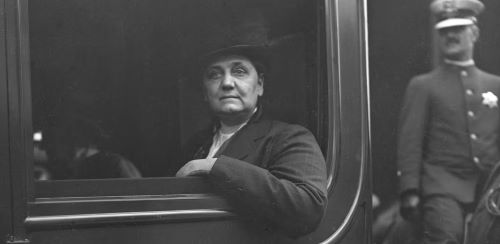
One such woman was Katharine Bement Davis, the subject of my current research.
Born in Buffalo, New York, in 1860, Davis was a member of a generation of “new women” who pursued higher education, built professional careers and fought for political rights.
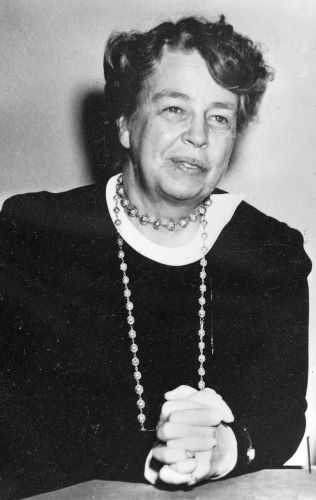
Other women of this generation included Nobel Peace Prize winner Jane Addams, public health nurse Lillian Wald, prison reformer Miriam Van Waters, child welfare advocate Julia Lathrop, social work pioneer Sophonisba Breckinridge and first lady Eleanor Roosevelt – to name just a few.
Of this group, only Roosevelt had children of her own. But all of them saw themselves as “mothers of all children,” as one historian has described juvenile justice advocates. Accepting responsibility for the nation’s welfare, they used their identity as public mothers to shape American politics.
In a 1927 letter to her college classmates, Davis whimsically reflected on her life choices:
“First, I am still an old maid; therefore, I cannot write interesting things about my husband and children, (and) how I have treated him and how I have raised them. First and last, however, I have had a good deal to do in the way of looking after other people’s husbands and children.”
Indeed, Davis’ life illustrated the many meanings of motherhood.
Like many ostensibly childless women, Davis was a doting aunt. With her unmarried sisters, Helen and Charlotte, she helped care for her only niece, Frances, whose mother died when she was just a toddler. In the mid-1920s, Frances lived with all three aunts while attending school in New York City.
Black feminist scholars call this sort of arrangement, long practiced in African American communities, “othermothering.”
Davis and other white women of her generation also engaged in the practice of caring for children, whether through formal adoption or informal caregiving. For instance, Breckinridge helped raise her nieces and nephews, while Van Waters legally adopted a daughter.
‘Maternalism the Coming Great Force in Government’
Throughout her life, Davis used what she called “the methods of motherhood” to promote public welfare.
After teaching school in western New York , establishing a playground in a working-class neighborhood in Philadelphia and supervising young offenders in upstate New York, Davis became New York City’s first female commissioner of correction in 1914.
Only months into her term, male inmates at Blackwell’s Island Penitentiary staged a major riot. Davis quelled the rebellion and established her own authority by addressing the refractory prisoners like wayward children. “You fellows must behave,” she pronounced. “I’ll have it no other way.”
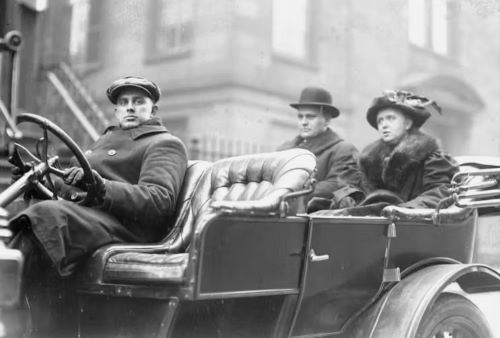
After successfully using “motherly methods” to regain control of “the bad boys of Blackwell’s Island,” Davis proclaimed that “maternalism” was “the coming great force in government.”
Echoing her colleagues in the suffrage movement, Davis used the language of maternalism to promote women’s voting rights. Like other feminist pacifists, she believed that women were “the mother half of humanity.” Finally, like many women activists in the U.S. and Europe, she believed that all women – whether they had children of their own or not – were responsible for all children’s welfare.
Insisting that “wise motherhood” was essential to better government, Davis argued that women needed the vote – and that the nation needed women voters. Maternalist activists also promoted juvenile justice, parks and playgrounds, health care programs and financial assistance for needy families and children, laying the groundwork for the modern welfare state.
Giving Women the Right to Choose
While she promoted public welfare and demanded political rights, Davis also advocated for what she and her contemporaries called “voluntary motherhood” – the idea that women should be able to control their reproductive lives.
Davis supported efforts to overturn the Comstock Act of 1873, which defined contraception and abortion as obscene and made distributing birth control information or devices through the U.S. postal service a federal crime.
States followed federal precedent by adopting “mini-Comstock Laws” criminalizing birth control. By the 1920s, however, some states permitted physicians to prescribe contraceptives – such as diaphragms and spermicides – to protect the health of their female patients.
When she surveyed 1,000 married women for a study of female sexuality in the 1920s, Davis found that most of her study subjects used contraceptives. In addition, nearly 1 in 10 reported having had at least one abortion, even though the procedure was illegal in every state.
And when Davis asked the women about their views on contraception – or as the survey put it, “the use of means to render parenthood voluntary instead of accidental” – she found that about three-quarters of them approved of it.
When the Childless Take Charge
So-called childless women like Davis have shown that they have a stake in children’s welfare, women’s welfare and the nation’s welfare.
Over the past century, maternalists and feminists often have worked together to achieve their aims. Indeed, sometimes they were the same people.
But today, it seems that Republican politicians are attempting to drive a wedge between mothers and others. As a recent New York Times article put it, “the politics of motherhood” have become a “campaign-trail cudgel.”
However, as Davis understood, many issues that affect mothers are important to all women. Moreover, Davis believed that everyone – not just biological mothers – shares the responsibility for the health and welfare of future generations. Finally, she insisted that women should control their own destinies.
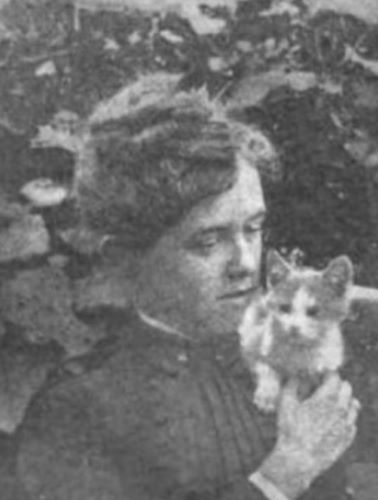
So, was Davis a childless cat lady?
Well, a grainy photo of her cuddling a kitten suggests that she did love cats.
As for her childless status, when you consider the full range of her work on behalf of the nation’s children, the answer becomes a bit more complicated.
Originally published by The Conversation, 10.21.2024, under the terms of a Creative Commons Attribution/No derivatives license.
About the Author