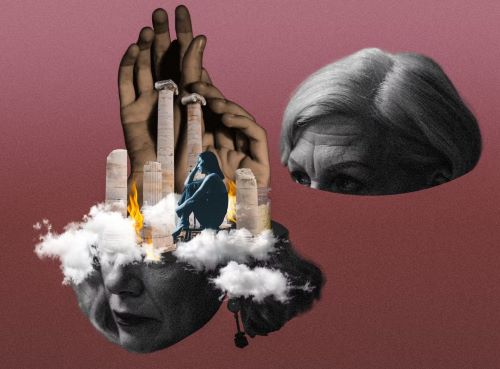
Examining the history of hysteria, an antiquated mental health diagnosis for over-emotional and difficult women.

By Dr. Helen Foster
Wellcome Trust Early Career Research Fellow
East Midlands Oral History Archive
University of Leicester
Hysteria
Hysteria is an archaic and now inappropriate term, first used by Hippocrates in the fifth century BCE to refer to mental illness in women. The Ancient Greeks believed that the condition was caused by “the wandering womb”.
The uterus (hystera in Ancient Greek), according to Hippocrates, would be affected by poisonous and stagnant humours in the body, which in turn produced toxic fumes. It could become ‘restless’ and move around inside the body, causing disorders such as anxiety, a sense of suffocation, tremors, convulsions and paralysis. The word ‘hysterectomy’, describing a procedure where a woman has her womb removed, derives from the Ancient Greek.
At the Mercy of Their Emotions
Hysteria as a medical term continued to be applied to a range of (mostly female) mental disorders that were often linked to what was seen as exaggerated or inappropriate behaviour. As historian Hilary Marland notes, in the 19th century, “women were deemed likely to fall prey to disorders of the mind related to their biological vulnerability and the female life cycle… Many admissions to Ticehurst [a private asylum] were sent there after being diagnosed with gynaecological disorders, as well as conditions tied to their stubborn refusal to conform.”
In the 19th century, women were seen to be at the mercy of their emotions. Before the link between having periods and ovulation was made, it was commonly believed that a woman’s menstrual cycle was nature’s way of helping her to calm her emotions by removing toxic blood from the body.

The permanent ending of the female menses (menstrual cycle) in menopause was believed to bring on “sullenness and excitability, lethargy and hysteria, volubility and melancholy”. In his ‘Manual of Midwifery’, Michael Ryan (1800–40) describes a woman at the ending of her periods as reaching: “Senile sterility [when] [a]ll the characters of puberty and the peculiarities of women cease, the breasts collapse… the skin shrivels… and many diseases develop… in the womb, ovaries and breasts, which had lain dormant for years…”
Women of menopausal age who exhibited signs of mental illness were labelled as suffering with “climacteric insanity” or “climacteric perturbation”, “involutional melancholia” or even “old maids’ insanity”. Climacteric, from the same root as ‘climactic’ (meaning a critical period or event) is a medical term for the period of decreasing fertility that includes the various stages of pre- and post-menopause.
An Incurable Condition
As far back at the 12th century, a medical treatise called ‘Anatomia Porci’ declared that the cessation of menses (menstruation) in women was “not curable”.
It wasn’t until the 19th century that the physician Edward Tilt (1815–93) acknowledged the short-term nature of the mental health issues of women going through menopause. In his book ‘The Change of Life in Health and Disease’, he wrote that, “When the change is effected, the mind emerges from the clouds in which it has seemed lost. Thankful that they have escaped from real sufferings, women cease to torture themselves with imaginary woes, and… they feel the ground grow steadier underfoot.”
Tilt broke new ground in clearly defining menopause as an important and specific life stage for females, but despite noting that they were temporary, he still suggested that their “imaginary woes” during menopause had a psychosomatic basis.
Tilt’s ideas were not well received at the time and many doctors continued to “write off” menopausal women as incurable. Writing in the Lancet in 1873, two years after Tilt’s book was published, Dr Robert Barnes declared that: “At the ‘turn of life’… the nervous system… exhibits frequent and various perturbations. Thus we find giddiness, vertigo… impairment of memory, mental irritability… culminating in some cases… in epilepsy, and even in insanity… many women may have passed through the trials of puberty and of child-bearing without serious nervous disorder, and will break down at the menopause.”
Be Kind to Yourself
In the 20th century, negative attitudes around experiences of menopause persisted. Advice from the Medical Women’s Federation in a 1960s leaflet called ‘The Change of Life’ sought to reassure women suffering with their mental health during menopause, but probably also frightened them a little by talking about ‘breakdowns’ and ‘unsettled glands’:
“You may find yourself a bit irritable and depressed at this time, especially towards the end of the day. This does not mean you are going to have a breakdown. The glands that have so much to do with the smooth wellbeing of your body are settling down to a new balance of work.”
The publication did make some sensible suggestions however, recommending that “you are wise to be a little kind to yourself… take at least half an hour of every day to relax in the way that suits you best. If your work ties you to your home, give yourself a free half day in the week and get out of the house to see friends. See that you get to bed in good time.”
The leaflet goes on to reassure women that this advice will not only make them feel better but also revive their looks: “You will be a better person for doing these things. Best of all, you will be pleased to find how your energy and your outside interests begin to revive and how nice you look. Women over 50 have a very important part to play and can be very attractive people.”
Domestic Harmony
The medical profession often regarded the emotional and mental symptoms of menopause as untreatable and something that the patient and their family would just have to live with. Dr George Savage, writing in the Lancet in 1903, appears to show more sympathy for the husband than for his female patient: “She is restless, she is here, there, and everywhere, upsetting everything and everybody… The unfortunate husband suffers grievously under such conditions.”
Most women are only too aware that emotional and mental stresses related to menopause can result in unpredictable behaviour and how this can have a wider impact on their friends and family. For some, it’s no more than mild moodiness or irritability, but others, like Ronne, can experience uncharacteristic emotional outbursts that affect her deeply.
Originally published by Wellcome Library, 08.24.2023, under the terms of Creative Commons Attribution 4.0 International license.
About the Author