When storms destroyed crops in ninth-century Lyon, people faced accusations of weather magic. Bishop Agobard challenged the claims while defending authority over Christian belief.

By Matthew A. McIntosh
Public Historian
Brewminate
Introduction: Four Captives Beneath an Accusation
Three men and a woman had been held in chains for several days when they were brought before an assembly that threatened to stone them. According to Agobard, bishop of Lyon in the early ninth century, their accusers believed that they had fallen from ships traveling through the clouds. These vessels supposedly came from a region called Magonia, whose aerial sailors purchased crops brought down by destructive weather from the storm-makers believed to have caused it. The four prisoners were presented as people connected to that traffic. Agobard recalled the gathering in On Hail and Thunder, a work attacking beliefs about human control of the weather. His description of the confrontation ends with truth prevailing after prolonged argument and the accusers confounded, although he does not explain precisely how their claims were defeated.
Almost nothing can be established about the people exposed to this danger beyond what the bishop chose to report. Their origins are unknown, as are the circumstances in which suspicion first attached to them. They left no testimony in the surviving account, and Agobard does not explicitly narrate their release or subsequent lives. Their appearance in his work preserves a threatened act of collective violence while withholding the information needed to reconstruct the experience of those who faced it.
The historical problem begins with the distance between an explanation of misfortune and an accusation against identifiable people. Agricultural destruction could be understood through a story in which someone had deliberately caused the damage and someone else profited from it. Such an explanation gave supposed perpetrators a place within events that had deprived cultivators of the expected return on their labor. Identifying actual people with those roles required a further judgment, one whose operation Agobard only partially reveals. The captives’ alleged connection to Magonia made them dangerous outsiders within the accusation, but nothing establishes that they had previously been strangers to the community. Nor can their detention be securely attached to a specific storm described elsewhere in the record. The central inquiry must concern how claims about hostile powers became credible enough to support confinement and threatened punishment, while preserving the distinction between that interpretive question and a sequence of events the evidence cannot fully recover. Payments to supposed weather-protectors extend the investigation beyond the moment of accusation, revealing another way that expectations about human influence over storms could organize conduct.
Agobard challenged these expectations from within a Christian understanding of divine government. His objections included scrutiny of reported testimony and questions about the practical implications of the powers attributed to storm-makers. Much of his argument rested on Scripture and the conviction that people were assigning to human practitioners an authority belonging to God. He accepted that prayer could obtain divine intervention, making the distinction between legitimate dependence on God and misplaced confidence in supposed specialists essential to his position. His opposition to accusations could accordingly protect endangered people while reinforcing his claim to determine what Christians should believe. Giving attention to that combination, On Hail and Thunder reveals a struggle over responsibility for suffering whose human stakes extended beyond the correctness of an explanation. The threatened captives stood where a disputed account of agricultural loss had become grounds for deciding what could be done to someone.
Agricultural Livelihoods under an Uncertain Sky

For a farming household, the significance of a harvest extended well beyond the food immediately available after threshing. Some of the grain had to support the household until another crop matured, while a portion needed to be retained or acquired for subsequent sowing. A serious loss could compromise the next agricultural cycle as well as the current year’s provisions. The stage at which destruction occurred also mattered. A late storm might damage a crop after most of the work of cultivation had already been completed, leaving little opportunity to recover the expenditure within that season. Weather risk was inseparable from the long interval between committing resources to the land and obtaining something usable from it.
Such pressures operated within a countryside marked by substantial differences in property and legal status. Independent cultivators existed alongside households attached to royal, ecclesiastical, or aristocratic estates, and dependence itself encompassed arrangements that varied by locality. Some tenants owed labor on a lord’s land in addition to cultivating their own holdings; other obligations involved produce or monetary payments. Legal freedom did not guarantee prosperity, just as dependence did not reveal precisely how much land or livestock a household possessed. The estate surveys known as polyptychs record some of these distinctions, but their detail can create a misleading impression of completeness. Large institutions generated and preserved documentation far more consistently than independent families. As Adriaan Verhulst emphasizes, the resulting evidence makes extensive estates easier to study than the full range of agricultural households. Conditions recorded on an abbey’s properties elsewhere in the Frankish world provide comparative context for Agobard’s surroundings rather than a ready-made description of every Lyonnais settlement.
Hail could make the unevenness of agricultural fortunes unusually visible. Its path might leave neighboring fields with markedly different damage, while the same storm could affect crops differently according to their stage of growth. A holding with several kinds of production might retain resources that a more narrowly cultivated property lost. These differences created questions about why some land had suffered and other land had escaped, although the physical pattern alone cannot establish what any observer believed had caused it.
The ability to withstand a damaged crop depended partly on resources accumulated before it was struck. Grain remaining from an earlier harvest could make a substantial difference, but possession of a store did not ensure that everyone nearby could draw upon it. The Carolingian royal estate ordinance conventionally called the Capitulare de villis required administrators to account separately for older and newly harvested grain, revealing an interest in supplies carried between agricultural years. Another provision instructed them to secure good seed, whether through purchase or other acquisition. These prescriptions concern the management of royal property and do not measure the reserves available in ordinary homes. They show that provisioning involved deliberate attention to future needs. For an individual household, the possibility of replacing lost grain would also depend on what it could exchange and on whether assistance was available through its relationships with others.
Royal legislation makes the social dimensions of shortage more explicit. At Frankfurt in 794, Charlemagne and the assembled synod established maximum prices for several grains and specified conditions for selling bread. The same enactment instructed holders of royal benefices to ensure that the dependent people attached to those properties did not die of hunger. It expressed an obligation of support within relations that also enabled the collection of resources and service. Neither the existence of price regulations nor a command to provide sustenance demonstrates that relief reached everyone who needed it. The measures do establish that access to food was recognized as a problem requiring decisions about distribution. Timothy Newfield’s research likewise distinguishes lesser shortages from famine and identifies environmental shocks as important triggers of many recorded Carolingian crises. Reduced access to supplies could then worsen and prolong the distress initiated by damage to production. The interaction matters because an explanation confined to the severity of the weather would leave out the relationships determining who could obtain replacement provisions. Conversely, records of major scarcity should not turn every local crop failure into an episode of widespread starvation.
Practical knowledge remained essential throughout these uncertainties. Cultivators had to judge the suitability of seed and respond to the condition of their soil, even when circumstances frustrated their decisions. Agobard himself observes that drought sometimes prevented sowing after the harvest and vintage had been gathered. His argument assumes that readers recognized this difficulty from experience. Familiarity with the material requirements of cultivation could coexist with beliefs about extraordinary intervention, since knowing how rain benefited a field did not settle every question about why it arrived or failed to arrive.
Explanations involving supernatural protection become more intelligible within this combination of experience and insecurity. Jean-Pierre Devroey’s investigation of medieval rural understandings emphasizes the need to recover the coherence of such explanations without accepting the contempt through which educated critics often presented them. Seeking additional protection could accompany competent cultivation rather than replace it. Economic vulnerability cannot, by itself, tell us why one proposed remedy secured trust while another failed to do so. Such choices involved judgments about the credibility of those offering help, formed within local relationships that estate accounts rarely disclose. The material setting of the dispute directs attention toward the channels through which advice and religious instruction reached rural households.
Agobard and the Carolingian Work of Correction

Agobard assumed leadership of a church already involved in the educational ambitions of the Carolingian rulers. His predecessor, Leidrad, had promoted clerical learning and the improvement of worship at Lyon, making the city a center in which reform depended on the cultivation of textual expertise. Agobard’s succession followed Leidrad’s withdrawal from office and received confirmation at Aachen in 816. The transition placed him within an established undertaking, with trained clergy and written authorities available to support episcopal instruction. His surviving works show how insistently he applied those resources to disputes concerning Christian conduct. The weather treatise belongs to this activity, usually being dated near the beginning of his episcopal career, although its precise date remains debated.
The governing ambition is often described by historians through the Latin term correctio, meaning correction or improvement. Its scope extended from the quality of religious books to the conduct expected of those who read and explained them. Charlemagne’s Admonitio generalis of 789 linked the training of clergy with proper worship and the instruction of the Christian population. Learning mattered because errors in understanding could obstruct the performance of responsibilities entrusted by God. A ruler’s concern for the spiritual condition of his subjects and a bishop’s obligation to admonish them belonged to a shared conception of government. Mayke de Jong’s work on the reign of Louis the Pious has shown why this conception is poorly served by separating religious commitments from an otherwise independent political sphere. Bishops could cooperate with a ruler while claiming the duty to criticize actions they believed endangered the community. Correction required judgments about how authority should be exercised, as well as efforts to improve the people subject to it.
Reaching local congregations made the education of priests indispensable to that undertaking. A bishop could issue instructions, but much ordinary teaching depended on clergy whose obligations brought them into recurring contact with households. Carine van Rhijn’s research on episcopal statutes shows reformers investing increasing attention in what these priests knew and how they behaved. The instructors themselves had to be sufficiently prepared to explain the faith and furnish credible examples of Christian conduct. Their position also involved demands arising from the communities in which they served, so the passage from episcopal prescription to local practice was never merely mechanical. Differences in resources and preparation affected what instruction could accomplish. A work supplying reasons against a familiar belief could serve a practical purpose within clerical education, even when the occasion on which a given priest might use it remains unknown.
Membership in a Christian community did not settle every question about acceptable belief. Agobard addressed people whose understanding of divine action he considered seriously defective despite their participation in that community. He sought to change convictions held among the faithful, making instruction an ongoing responsibility rather than a task completed by conversion. The disagreement concerned who could define the implications of a Christian identity already claimed by those being corrected.
The form of On Hail and Thunder suggests how an immediate pastoral concern might be developed for more than one audience. Scholars have proposed that the work began as a sermon and acquired a more extensive learned apparatus as Agobard revised it. Michael Bailey treats this development as a probable reconstruction, and the mixture of direct address with sustained scriptural exposition gives it substantial plausibility. Jean-Pierre Devroey likewise situates the text between theological instruction for educated clergy and the practical needs of persuasion. A clerical reader could follow the biblical authorities in detail, while material suitable for oral explanation could be adapted to another setting. Such a possibility helps explain why the work combines encounters with lengthy demonstrations instead of presenting an abstract doctrinal statement alone. Its passages could furnish an instructor with both recognizable situations and arguments through which to challenge the interpretations attached to them. This does not establish successive versions with securely identifiable audiences, since the stages of composition are not independently documented. The surviving form allows us to identify potential uses without recovering the circumstances of every performance or reading.
Transmission introduces a further distinction between intended use and demonstrable reach. The treatise survives in a single known ninth-century manuscript, now Paris, Bibliothèque nationale de France, Latin 2853. That witness preserves the argument but cannot tell us how many copies once existed or how widely its teaching circulated. Even the familiar expanded title, describing a work against popular foolishness concerning hail and thunder, comes from a manuscript addition rather than a securely authorial heading. The modern prominence of the episode should not supply a measure of its medieval influence.
Limits to Agobard’s authority become more visible in his later correspondence with imperial power. In De insolentia Iudaeorum, written in 826 or 827, he protested the conduct of officials whose support for Jews in Lyon obstructed restrictions he wished to impose on relations between Jews and Christians. He defended preaching that sought to regulate everyday contact, including the employment of Christian servants and the purchase of food. Imperial officials could uphold protections that limited his ability to enforce the boundaries he advocated. Agobard represented that resistance as an injury to the Christian community, turning a dispute about his conduct into an appeal concerning the emperor’s religious responsibilities. His complaints show that a common vocabulary of Christian government did not guarantee agreement about the treatment of those living under it. The bishop’s ability to admonish depended on an acknowledged office, but the acceptance of his judgment remained something he had to seek.
Within this pastoral setting, speaking about the weather became conduct for which a Christian could be held accountable. Agobard’s opening argument treats the attribution of storms to human practitioners as false testimony concerning God, giving an apparently ordinary explanation a grave religious significance. Repeating such a claim could, in his view, implicate the speaker even without participation in any alleged practice. The scope of correction extended beyond those suspected of possessing forbidden powers to the people who credited and circulated reports about them. This helps explain his attention to the language through which a storm was announced as something someone had deliberately raised.
Storm-Makers and the Attribution of Deliberate Harm
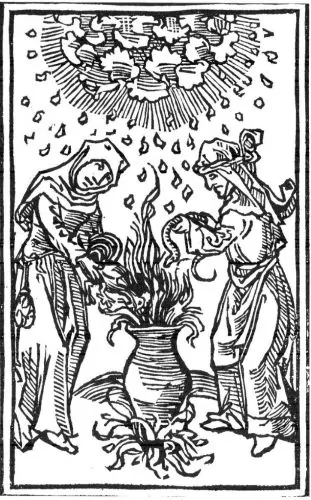
Agobard begins his discussion with a reported expression, aura levatitia, referring to a wind or storm that had been raised. When people heard thunder and saw lightning, he says, they spoke as though someone had set the disturbance in motion. Questioned about that description, they attributed the event to human incantations. The wording placed a voluntary act behind the weather before identifying the person responsible for it. Calling a storm raised supplied more than a description of its arrival, since it treated the disturbance as an effect someone had intentionally produced. Agobard’s opening directs attention to an interpretation already contained in an apparently familiar way of speaking.
The people credited with this capacity were called tempestarii, conventionally translated as storm-makers. The term appears elsewhere in early medieval pastoral and legal writing, placing Agobard’s account within an established vocabulary of suspected powers. Bernadette Filotas’s survey of such literature demonstrates the range of categories through which clerical authors identified activities they wished to regulate, while Juan Antonio Jiménez Sánchez situates allegations of storm-making within a broader history of ecclesiastical responses. A recurring designation could make an allegation recognizable without specifying an identical practice wherever the word appeared. The category itself supplies little information about how its bearers acquired their reputations or what relationship they had to those using it. It cannot establish a distinct occupation or an organized body of practitioners. For the present inquiry, the name matters because it attached a capacity to a kind of person, making the proposed explanation of a storm applicable to human conduct.
Its reported acceptance extended across distinctions that might otherwise be used to explain it away. Agobard includes people of high and low standing, alongside inhabitants of towns and the countryside. His claim is expansive rhetoric rather than a measured assessment of prevalence. He also distinguishes hesitant answers from confident ones, suggesting variation within the assent he describes. Even through his dismissive presentation, the responses emerge as more differentiated than a single, uniformly expressed conviction.
Incantation provided a proposed connection between the alleged operator and the destructive event. Words spoken by a person were credited with an effect far beyond the ordinary reach of that person’s body, allowing weather to be understood as an instrument of injury. Agobard supplies no complete formula through which this was supposedly accomplished, and his account offers no observed performance from which a procedure can be reconstructed. What he preserves is an explanation of efficacy, mediated through his opposition to it. A further passage complicates the relationship between an attributed identity and the convictions of those bearing it. He states that even people regarded as storm-makers shared the belief that such events resulted from wrongful practices. Belief in weather magic appears on both sides of the distinction between those assigning a reputation and those living under it. This still leaves unanswered whether any given person claimed this capacity or was identified against their wishes.
The hostility attached to this explanation is unusually explicit in a curse Agobard reports. His contemporaries directed their anger toward the tongue supposedly responsible for the disturbance, wishing that it would wither and be severed. The bodily target corresponded to the alleged means of harm, since the incantation had made speech the instrument of destruction. This is evidence of an expressed wish to injure the supposed operator, but it does not document an actual mutilation.
Moral judgment also appears in the descriptions through which the bishop develops his rebuttal. In one passage, he represents believers as regarding the supposed operators as evil and deserving punishment. Elsewhere, his own portrayal emphasizes people lacking holiness and wisdom, including individuals hated by their neighbors. These descriptions give the discussion a social setting, but their force must be distinguished from the biographical information they do not supply. Being called wretched does not identify a person’s economic position, and being represented as hated does not establish whether hostility preceded an allegation or followed it. Agobard’s language could draw upon existing contempt while arranging that contempt to serve his argument. He found it incongruous that people portrayed as so deficient should be credited with extraordinary command over their surroundings. His refutation leaves that disparagement largely in place, even as it attacks the capacity on which the allegation depended.
An explanation could identify an action as intentional without specifying why someone had wished to perform it. Agobard’s initial formula leaves that further question open. Malicious purpose might be presumed without a demonstrated grievance against the people whose crops suffered. The narrative he subsequently introduces adds an arrangement in which damage to cultivation is connected to an imagined transaction. That transaction would supply an answer to a question the attribution of power alone could not resolve, namely who might benefit from the loss.
Magonia and the Imagined Removal of the Harvest
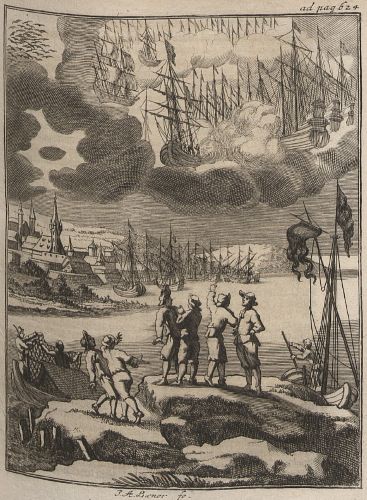
Produce lost in a storm acquired a destination in Agobard’s account of Magonia. The reported belief held that ships arrived through the clouds and transported the affected harvest back to the region from which they had come. What cultivators could no longer gather was represented as something carried away for use elsewhere. The story connected an interruption of agricultural production with an imagined movement of goods, assigning the missing return on cultivation to recipients beyond the fields. Agobard places the account immediately after introducing the supposed powers of the tempestarii, but it adds something those powers alone did not explain. Destruction became part of an arrangement from which other people were understood to benefit.
The direction of payment is essential to that arrangement. According to Agobard, the aerial sailors compensated the storm-makers and obtained grain or other produce. He supplies no monetary denomination or indication of what the payment consisted of, so the passage cannot sustain a reconstruction of prices or commercial procedures. Yet it does distinguish the people credited with producing the destructive weather from those who acquired its supposed cargo. Jean-Pierre Devroey interprets this kind of account through a metaphor of commercial exchange, in which agricultural loss becomes intelligible by reference to transactions between interested parties. The extraordinary means of acquisition coexisted with a recognizable relationship between service and reward. On this reading, the story gave the storm-makers an incentive to act while explaining why recipients from elsewhere should be involved. Its coherence lay in connecting the interests of the participants, even though the account supplied little detail about their dealings. The market analogy is an interpretation of the narrative’s organization, not evidence that an actual clandestine trade operated behind it.
Magonia itself remains remarkably undescribed. Agobard calls it a region and places the visiting ships in the clouds, but he does not explicitly locate their homeland in the sky. The account gives the place a role as an origin and a destination without supplying a route by which it could be reached. A name and a means of transport were sufficient to accommodate the imagined journey, leaving the geography beyond it largely unspecified.
The name’s sparse documentation complicates attempts to reconstruct a widely shared tradition. Earlier Frankish texts refer to maones associated with the removal of crops, and Pirmin’s Scarapsus provides one such parallel. These references do not independently reproduce the entire combination of a named country and ships traveling through the clouds. Florus of Lyon supplies the variant Maonia in a gloss connecting the place with the removal of harvests, although his access to Agobard makes its independence uncertain. Juan Antonio Jiménez Sánchez has examined these relationships and proposed a remote derivation through Hemonia, an ancient name for Thessaly. That reconstruction remains a hypothesis about the development of the vocabulary. The parallels establish that crop-taking figures had a textual history beyond this passage, while leaving the precise formation of Agobard’s account unresolved. They support comparison between related motifs without demonstrating the uninterrupted transmission of a complete story from an earlier period.
Paul Edward Dutton has raised a different possibility by considering whether beliefs about removed harvests could be connected with the concealment of produce and resistance to demands upon it. Such an interpretation directs attention to conflicts over who could claim agricultural resources. It allows the reported story to be examined in relation to interests that Agobard’s condemnation might obscure. Yet the proposal remains speculative, and his account supplies no independent demonstration of a coordinated scheme to withhold grain. Nor does the social usefulness of an explanation establish that those repeating it understood it to be false. Reading Magonia as a representation of contested produce requires fewer assumptions than identifying a specific concealed operation behind the narrative. The possibility of strategic use should remain distinguishable from the broader argument that its imagined exchanges expressed recognizable relationships of gain and deprivation.
One unresolved feature of the account brings its explanatory priorities into focus. Agobard describes produce falling through hail and perishing in storms, then being transported as cargo, without explaining how its damaged condition was reconciled with its value to the recipients. He transmits no detailed account of salvage or transformation that would resolve that physical difficulty. The relationship between loss in one place and acquisition in another is more fully specified than the material process connecting them. That imbalance matters because the narrative furnished positions for supposed beneficiaries even where the means of obtaining the harvest remained obscure. Alleged involvement in the arrangement could become the relevant claim against someone without requiring that person to have raised the storm.
From an Explanation to an Accusation
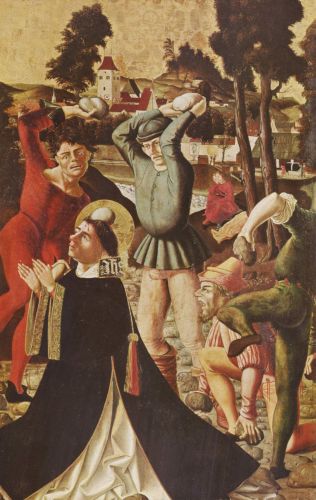
By the time the captives appeared at the gathering Agobard describes, the charge against them had already restricted their freedom for several days. Their chains establish sustained custody before the confrontation whose outcome he records. Whatever had first prompted suspicion, people had acted upon it sufficiently to prevent the four from leaving. The sequence matters because the account places critical debate after coercion had begun. Agobard gives no account of who maintained that custody or what authority those people claimed. His description establishes that the accusation had practical force before its public rejection.
The missing step concerns the selection of these individuals. Accepting that harvest-taking vessels existed would not, by itself, identify the people allegedly traveling in them. An accusation required a further association between a reported kind of intruder and the persons being held. Agobard presents that association as something already asserted when his account reaches the assembly, leaving the grounds on which it rested unrecorded. His wording also keeps the attribution at a distance, describing the prisoners as exhibited as though they had fallen from the ships. That formulation preserves the allegation while withholding the narrator’s assent to it. It cannot tell us how the claim was first expressed or whether different accusers offered different reasons for accepting it. His retrospective framing makes the identification appear untenable, while the reasoning of those who advanced it remains accessible only through his presentation. The text supplies their conclusion without showing how its supporters justified it. Reconstructing those earlier stages would require evidence beyond the coherence of the Magonia story itself.
Public exhibition gave the assertion a tangible focus. The display can be read as an attempt to make the assembled people encounter apparent representatives of figures whose existence the tale asserted. Visible prisoners could lend immediacy to a story about vessels and a distant region, although their presence supplied no independent evidence of the journey attributed to them. The same bodies that demonstrated the captors’ ability to detain someone were being presented as support for a claim about what those detainees had done. This created a potential confusion between possession of suspects and substantiation of an accusation. Agobard’s narrative permits that distinction to be drawn without establishing how every spectator interpreted the spectacle or whether the gathering was initially united.
The recorded group comprised three men and a woman, a detail that gives the presentation a collective dimension. They were exhibited under the same general allegation, but their association in the narrative does not establish a shared journey or a pre-existing relationship. Agobard gives no separate account of the conduct attributed to each captive. A common display brought the four within one public confrontation while leaving the individual grounds of their implication unrecorded.
The prospect of stoning gave the gathering a punitive purpose. According to Agobard, the people exhibiting the prisoners presented them as deserving that treatment, so the meeting concerned what should be done to the accused as well as what should be believed about them. The proposed punishment was addressed to an audience whose presence could potentially contribute to its authorization or execution. Yet the bishop supplies no named judicial officer or sequence of formal proceedings, leaving the assembly’s institutional character unresolved. It would be equally unwarranted to turn the episode into a documented court hearing or to assume that no official participated. What can be established is the conjunction of public accusation with an anticipated lethal response. The threat involved a judgment that the prisoners’ supposed connection made them liable to death, a further claim beyond accepting the possibility of the story itself.
Argument changes the allocation of disgrace within Agobard’s telling. He says that truth prevailed after prolonged discussion, but does not preserve the individual contributions through which that outcome was reached. The people who had exhibited the prisoners then occupy the position of those exposed before others. Agobard describes their humiliation through Jeremiah’s comparison with a thief discovered in the act. In an episode involving the supposed appropriation of harvests, that borrowed image transfers the shame of being caught from the displayed captives to their accusers. The biblical comparison condemns their exposed error without recording a legal penalty against them. Their assertion had lost the authority that its public presentation sought to secure. By assigning victory to truth, the bishop represents the resolution as a defeat of error, while leaving the precise contributions of his own reasoning and that of others indistinct.
The endpoint he chooses measures success through the collapse of the charge. He does not explicitly describe the prisoners’ release or their later treatment, and the failure to record their replies cannot establish that they never spoke. These distinctions separate the reported defeat of an accusation from a complete account of the treatment of those accused. The gathering becomes legible principally through a change in whose claims could command acceptance. Agobard preserves an occasion on which public presentation failed to sustain its proposed conclusion, despite the coercive circumstances already created around it. That emphasis makes the authority of reports, and the means by which they could be challenged, central to understanding the episode.
The Testing of Claims
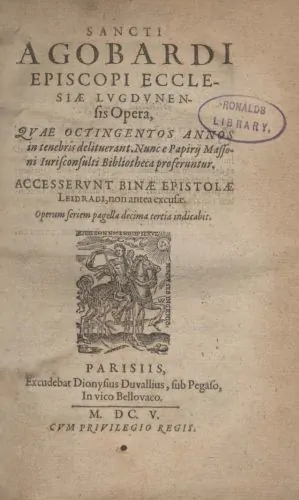
Repeated assurances about storm-making confronted Agobard with a problem of access to events. He says that people often claimed to know that extraordinary feats had occurred, yet he had not encountered someone prepared to attest that he had personally seen them. The distinction concerned the route by which information reached a speaker. Certainty could be expressed by someone repeating an account whose original observer remained beyond the conversation. Agobard sought a point at which such repetition could be connected to a person claiming direct knowledge. When he heard of a man who supposedly possessed that experience, he made an effort to meet him. The encounter allowed him to question the basis of an assurance otherwise passed from one listener to another.
The man initially tried to maintain that he had witnessed the alleged occurrence. Agobard pressed him to speak truthfully, using appeals and adjurations that included threats of divine punishment. Under this questioning, the man named a person and supplied a time and place, continuing to affirm that his account was true. He acknowledged that he had not himself been present. The admission altered the basis on which he could claim authority without necessarily altering his conviction about the event. Agobard’s summary preserves both elements, making it important not to turn the encounter into an uncomplicated confession of invention. Nor does he reproduce the identifying details for his readers, who receive the report of specificity rather than the means to pursue those particulars independently. The passage records what the bishop considered a decisive weakness in the man’s presentation, while leaving his sources of information unexplored. Its immediate result was the separation of an asserted occurrence from a claim to have observed it.
Naming an actor and locating an occurrence in time and place could make a report sound more firmly grounded than an anonymous tale. Those details still did not establish how the speaker knew what he asserted. The man’s continued confidence shows that the distinction Agobard demanded was not equivalent to the one on which the speaker’s own conviction rested. He could surrender his position as an observer while retaining his belief in the occurrence.
Religious obligation shaped the questioning itself. Agobard represented truthful speech as a duty enforceable through consequences beyond the immediate exchange, making the man answer under the pressure of divine accountability. His inquiry operated through the authority of a bishop invoking Christian obligations concerning falsehood. That setting belongs within the explanation of the admission rather than outside an otherwise self-contained exercise in checking facts. The account gives no independent access to the man’s response to those appeals, so it cannot establish whether fear or a clarified understanding of the question prompted his qualification. What Agobard reports is a distinction elicited through repeated insistence on truthfulness. The religious character of that insistence does not erase its informational result, but it helps explain the conditions under which the result was obtained.
Elsewhere in the same passage, he tests the powers described to him by considering what their possessors should be capable of doing. Some people reportedly credited storm-makers with directing widely scattered hail onto a narrowly chosen spot, even a tub beneath which the operator sheltered. Agobard asks why a person capable of such precision would not overwhelm an enemy encountered on a road or in a field. This is a conditional objection, reasoning from an alleged capacity to an expected application of it. He offers no observed demonstration in which a supposed practitioner attempted the feat and failed. Instead, the reported accuracy supplies a premise that he turns against the larger account of destructive power. The question draws attention to a gap between the precision ascribed to practitioners and the forms of attack attributed to them. Its force depends partly on accepting Agobard’s assumptions about what malicious people would want to do with such a capacity. A believer could dispute those assumptions without supplying evidence that the underlying power existed.
Useful rainfall provides a related test from another direction. Agobard argues that anyone able to produce hail should also be capable of bringing rain, and asks why communities did not arrange for those powers to relieve drought. The objection concerns the range of effects that an alleged ability ought to make available. It does not establish, through an independently documented survey, that nobody ever sought such assistance. Rather, the absence he asserts makes the reported capacity appear strangely disconnected from a need that would give people reason to request its exercise.
These procedures placed different demands on accounts that might otherwise circulate together. Questioning the supposed eyewitness concerned the source of one person’s knowledge, while the hypothetical applications challenged the consistency of powers as described. Neither kind of objection depended on recovering every circumstance of an alleged event. Their conclusions also differed in scope, since establishing a speaker’s absence was more direct than inferring that an unused capacity could not exist. Michael Bailey’s analysis gives these practical challenges substantial weight in explaining Agobard’s skepticism, while Jean Jolivet emphasizes the significance of his scrutiny of contemporary testimony within the treatise’s argumentative development. The written work announces its rejection of storm-making before presenting the encounter, arranging the material as a refutation rather than preserving the stages of an undecided inquiry. Its most specific evidential gain is the exposure of a discrepancy between the authority claimed for a report and the access to events its speaker actually acknowledged.
Paying to Keep the Storms Away
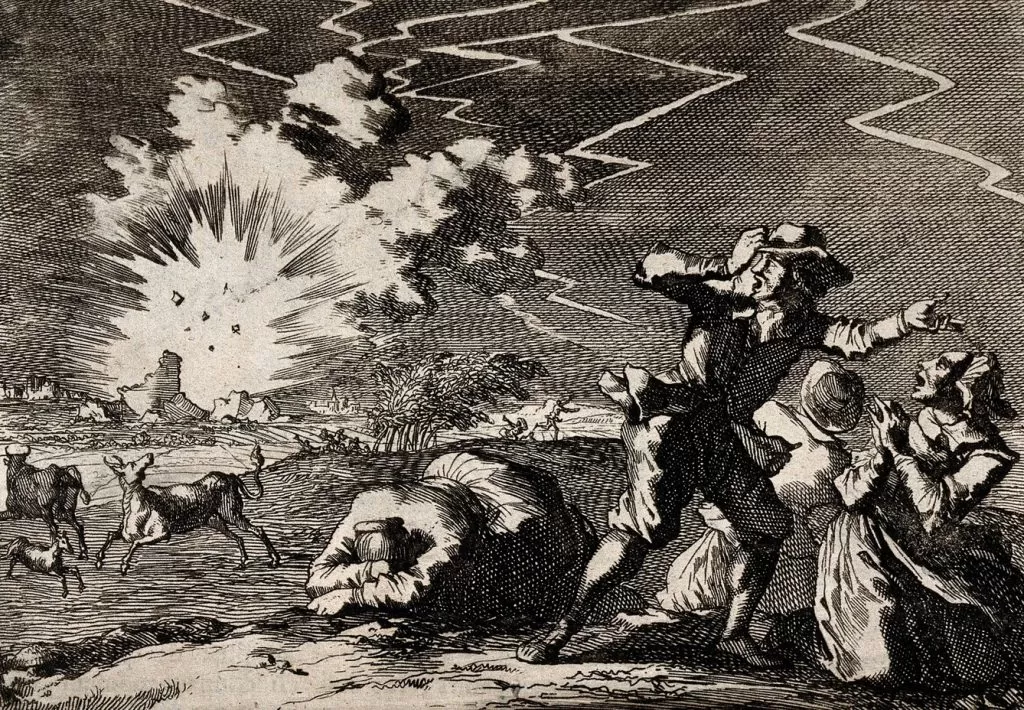
Near the end of On Hail and Thunder, Agobard describes people whose offer was to defend inhabitants against destructive weather. They explicitly disclaimed knowing how to send storms, while asserting that they could keep their effects away. The inhabitants of a locality agreed with them how much of their produce they would give for this protection. Agobard calls the recipients their defenders, using a term that identifies their promised function without explaining the means by which they purported to perform it. This arrangement brought protective competence into a relationship of recompense. The cultivators’ contribution supported a service expected to preserve the crop from which that contribution would be drawn.
Canonicum was the name Agobard records for the payment. Its appearance gives the obligation a recognizable designation, but the passage supplies no fixed fraction of the harvest or schedule for collection. Describing it as an exact tenth, or reconstructing a universally observed annual levy, would add precision absent from the account. What the text does specify is agreement concerning an amount of produce. That detail places the material contribution within a relationship between the inhabitants and those undertaking to defend them. It does not reveal whether every household contributed on identical terms or how the arrangement was maintained when expectations were disappointed. Nor does Agobard preserve a ceremony, spoken formula, or set of objects through which protection was supposed to operate. The economic commitment is more clearly recorded than the activity receiving support. Produce made the payment part of the same agricultural outcome that the service purported to secure.
Preventing damage also presented a problem different from demonstrating that an extraordinary event had occurred. Where no destructive storm arrived, an intact crop would be compatible with both successful intervention and the ordinary course of the weather. The result alone would not decide between those explanations. Agobard describes no season in which clients assessed a defender’s performance, so an account of how favorable outcomes sustained a reputation must remain an inference rather than a reported instance.
The distinction between raising storms and resisting them has generated competing reconstructions of the practitioners’ roles. One reading preserves the division Agobard reports, identifying people credited with destructive powers alongside others claiming a defensive capacity. Another treats the two roles as potentially combined, with payment securing protection from someone believed capable of inflicting the damage being feared. Under the latter interpretation, an apparently beneficial service could conceal a threatening relationship. Such a model is historically conceivable, but it is not a description of an intimidation episode supplied by Agobard. His protectors deny knowing how to raise storms, and the reported agreement does not identify them as the source of the threatened weather. The possibility that reputations overlapped remains open without establishing that inhabitants necessarily feared their own payees. The payment alone leaves the degree of pressure, as well as the convictions of the parties, uncertain.
Rob Meens has proposed that at least some of these figures may have been clerics offering religious protection. This reading draws attention to the ecclesiastical associations of canonicum and to the difficulty of separating supposedly independent magic from Christian protective practices. If the recipients were priests or monks, Agobard’s objection could concern activities within the clergy rather than competition with a wholly external group. Juan Antonio Jiménez Sánchez questions that identification, reasoning that Agobard would probably have criticized clerical participants more explicitly had they been his targets. The objection has weight, but it rests on an expectation about how the bishop would have written. Agobard’s failure to identify the recipients as clergy cannot settle their status any more than the payment’s religious associations can establish it. The name of an obligation could carry connotations that exceeded its institutional setting. Meens’s proposal remains valuable because it brings recognizable Christian forms of protection into the range of explanations, while leaving the identity of these specific recipients unresolved.
Willingness is one feature of the transaction on which the bishop insists. He represents inhabitants as paying these defenders readily, giving their support an importance that does not depend on reconstructing the performers’ occupations. The passage records practical acceptance expressed through the transfer of produce, even though it does not establish the success of the promised protection. Calling the recipients frauds would require further evidence about their own understanding of what they offered. What Agobard challenged was an arrangement that participants treated as worth supporting. His emphasis on their readiness to contribute prepared a comparison with other claims upon agricultural resources, shifting the dispute toward the obligations they accepted and those they resisted.
Claims upon the Crop
The people who supported weather-protectors, Agobard complains, often resisted contributions he regarded as binding Christian duties. He contrasts their readiness to provide the canonicum with an unwillingness to give priests the tithe or offer assistance to people in need. The comparison turns the allocation of produce into evidence about the priorities of those allocating it. His objection concerns more than whether a protective claim could be substantiated, since he also judges the obligations that contributors recognized. The harvest appears as a resource upon which several relationships could make demands. Agobard’s purpose is to establish which demands deserved willing acknowledgment and what a preference for others revealed.
Tithing supplied a claim with a history extending beyond this local controversy. Eric Shuler’s study of its development in late antiquity places the emergence of an articulated ecclesiastical tithe in sixth-century Gaul, showing that its medieval form had developed through changing religious expectations. By 779, the capitulary issued at Herstal required each person to give the tithe and directed its distribution to take place under episcopal authority. This enactment joined royal prescription to a religious obligation, giving the collection and administration of contributions an authoritative framework before Agobard’s episcopate. It does not demonstrate uniform compliance throughout the Frankish territories or identify the arrangements operating in every locality. Its relevance is that the bishop’s demand belonged to an established program of Christian governance, rather than originating as an improvised response to paid protectors. The duty he invoked was already represented as one that rulers and ecclesiastical leaders could require people to fulfill.
Almsgiving introduced recipients whose claims arose from need. Agobard specifically names widows and orphans alongside others requiring assistance, extending his criticism beyond contributions directed to priests. Tithes and assistance to the needy remain distinct in his wording, even though he places both within the conduct Christians ought to undertake. Their juxtaposition gives the complaint a communal reach, joining the support of religious ministry to responsibilities toward people whose circumstances made them dependent on assistance.
Material competition is a plausible dimension of this comparison, but its operation requires careful definition. Produce committed to one purpose could reduce what a household had available for another, making protective payments relevant to the claims of clergy and needy people. But Agobard supplies no accounts from which the scale of that effect can be calculated. His contrast does not establish that payments to defenders caused tithe arrears or displaced a specified quantity of alms. Refusal to give willingly also differs from proof that nothing was ever contributed. The passage arranges behavior into morally opposed categories more clearly than it documents the resources of those being criticized. It establishes the bishop’s perception of misplaced support while leaving the contributors’ own ranking of their obligations unrecorded. Economic pressure can help explain why competing claims mattered without supplying a complete explanation of the choices he condemns.
Repeated instruction sharpened his indictment. These duties, he says, had been preached and read out to their intended audience, which had also received persistent exhortation. The problem was presented as resistance despite instruction, while defenders received support without comparable prompting. Agobard made that discrepancy expose the limited persuasive force of sanctioned obligations in comparison with protective claims that he rejected. His account interprets the difference as religious failure, giving reluctance a significance beyond the practical difficulty of securing contributions.
He develops that significance through the relationship between faith, hope, and charity. The last of these names theological love, a meaning broader than the distribution of alms, although material assistance could express it. According to Agobard, people who credited defenders with preserving their lives placed part of their hope in those human agents. Their payments belonged within a dependency he considered spiritually disordered. A declaration that they trusted God more than their protectors would not satisfy him, because he refused to recognize hope divided between God and an independently effective human power. He invokes Jeremiah’s condemnation of reliance on humanity to make the resulting judgment categorical. Those persisting in this division could not, in his account, be numbered among the faithful. His language of unbelief identifies a defective religious allegiance among people he addressed as Christians. The argument transforms support for protection into a question about whether the giver’s confidence retained the integrity required for Christian belonging.
Jean-Pierre Devroey’s interpretation of compulsory tithing as acknowledgment of a debt to the Creator helps explain the coherence of these demands. Agricultural production, within that understanding, carried obligations that could not be determined solely by the cultivator’s preference for a useful service. Agobard’s position strengthened claims administered through clergy, while his appeal to almsgiving also defended people whose need furnished no promise of reciprocal protection. The institutional interest and the charitable obligation both belong within an assessment of his argument. Treating the complaint simply as a struggle for revenue would leave its judgment about divided hope unexplained, while overlooking resources would detach that judgment from the conduct that provoked it. The obligation to contribute and the obligation to trust could then be presented as expressions of the same dependence on God.
Weather under God’s Authority

Agobard’s scriptural case rests on a demanding account of the relationship between truth and existence. God, he argues, possesses being without having received it from another, while created things owe their existence to him. Falsehood belongs to neither category, since it is neither the Creator nor something possessing reality as his creation. Adhering to a false claim directs a person away from what exists and from the source of existence. Jean Jolivet identifies this passage as the treatise’s most overtly speculative development, extending the criticism of mistaken testimony into theology and ontology. Within that framework, an erroneous account of weather involved more than misidentifying an immediate cause. It could misrepresent the order connecting the world to its Creator. The scriptural passages that follow were intended to demonstrate where human capacities belonged within that order.
Exodus supplied the first sustained example. In the account of the hail sent against Egypt, Moses extends his staff, but the narrative identifies God as the one who sends the destructive weather. Agobard anticipates the objection that the visible human gesture might justify attributing the event to Moses himself. His response separates the servant’s participation from possession of the power producing the result. He also considers the Egyptian magicians, acknowledging the extraordinary acts attributed to them in the biblical account rather than dismissing those acts collectively as inventions. Their transformations of water into blood and production of frogs are treated as accomplished wonders, while their inability to reproduce the plague of gnats establishes a point beyond which they could not proceed. He treats the hail episode, in which they exercise no such command, as evidence against the capacity ascribed to contemporary storm-makers. The inference depends on reading the biblical episode as a measure of what such practitioners could accomplish, not merely as a record of what these magicians happened to do. Moses, in turn, provides an example of legitimate participation whose efficacy remains inseparable from divine action. Agobard uses the same narrative to distinguish an authorized intermediary from an alleged possessor of independent command.
Evil angels introduce a difficulty within this account of agency. A passage from the Latin Psalter, recalling the Egyptian plagues, includes evil angels among the agents of affliction. Agobard cannot preserve his argument by denying the existence of every supernatural intermediary, because the authority he invokes supplies such figures. He explains their involvement by separating their desire to harm from the capability through which that desire becomes effective. Their will is their own, but the power available to it depends on what God permits. This makes them subordinate ministers whose activity remains subject to a superior determination. Michael Bailey observes that divine permission does not, by itself, eliminate the effectiveness of the intermediary to whom permission is granted. Agobard’s repeated insistence that God alone produces the coexists with an acknowledgment of created agents participating in destructive events. The explanation protects divine supremacy while leaving a tension between exclusive authorship and the operative role of others.
The hailstones in Joshua serve a different purpose in his demonstration. There, the biblical narrative presents God striking Israel’s opponents without a human prayer initiating the event. Agobard reads the episode as evidence that destructive weather follows divine judgment rather than the wishes of hostile practitioners. The Book of Wisdom reinforces his picture of the created world serving that judgment. These passages establish the interpretation he gives biblical disasters, without identifying a specific contemporary storm as punishment deserved by the cultivators who suffered it.
Natural processes also find a place within this governed creation. The passages Agobard gathers from Ecclesiasticus, or Sirach, describe atmospheric phenomena as created things operating under divine command. His commentary moves between events in the clouds and changes observable on the ground, including the freezing and thawing of water. He even offers a shared physical explanation for summer hail and winter snow, associating both with clouds rising higher than usual. This statement brings the phenomena within an account of atmospheric conditions while retaining God as their ultimate author. The relationship he constructs allows a description of how something occurs to coexist with a claim about the authority under which it occurs. Explaining a process did not, within his argument, transfer control of that process to an alleged human practitioner.
Job introduces a more troubling relationship between divine rule and suffering. Agobard explicitly acknowledges that God allowed Satan to attack Job’s possessions and household, eventually extending the trial to his body and relationships. The evil agent receives a real capacity to afflict someone presented as God’s faithful servant. That example complicates any simple movement from a person’s suffering to an inference of that person’s guilt. Agobard emphasizes Job’s endurance and the humility required when God confronts him with the immensity of creation. Questions about the origin of rain and the storehouses of hail expose the limits of human understanding, even in someone whose righteousness the narrative affirms. For the bishop, the comparison makes the powers attributed to storm-makers appear presumptuous; they supposedly command what Job could neither locate nor comprehend. Yet the same story also confirms that harmful supernatural action may occur under divine permission. Its usefulness to Agobard depends on the emphasis he places on dependence and human limitation, rather than on a blanket denial that an evil being can act.
Prayer supplies an approved means of seeking changes in the weather. Through the Epistle of James, Agobard recalls Elijah’s prayers and the drought and renewed rainfall that followed them. The epistle identifies Elijah as human and subject to infirmity, placing effective prayer within the capacities of someone sharing the condition of its readers. Agobard interprets the drought as a means of correcting a people who had abandoned divine worship, while the return of rain accompanies their religious restoration. The prophet’s role is effective because God answers him, making petition central to the relationship. This possibility is not confined to a finished biblical age. Elsewhere, Agobard speaks of saints who have obtained and will obtain such interventions, leaving room for continuing divine responsiveness. His restriction concerns the source and manner of efficacy, not the cessation of every extraordinary event involving human participation.
Samuel’s thunderstorm brings that distinction into a communal encounter with fear. In the biblical scene Agobard recounts, Samuel prays during the wheat harvest and God sends thunder and rain. The frightened Israelites ask the prophet to intercede for them, making their acknowledgment of wrongdoing compatible with seeking help. Agobard presents their response as an example for Christians confronted with alarming weather. They were to approach God through prayer and legitimate intercession, accepting a relation of dependence rather than assigning command to people accused of raising storms. Weather under divine authority retained a place for human action, but required that action to take the form he recognized as faithful.
Christian Disagreements about Dangerous Weather
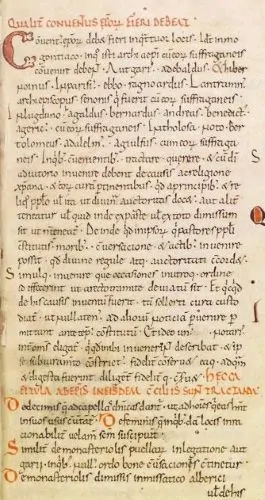
In 829, the bishops assembled at Paris placed alleged weather-working within a program of forceful correction. Canon 69 included claims that practitioners could disturb the atmosphere, send hail, and transfer agricultural produce and milk from one owner to another. Men and women found guilty of such wrongdoing were to be corrected severely through princely authority, because their conduct constituted service to the devil. The council specified no specific penalty in this passage. Its formulation differed substantially from Agobard’s effort to discredit the powers attributed to storm-makers. The bishops presented reports of harmful magic as grounds for disciplinary action without making the impossibility of the reported effects the foundation of their response.
This difference cannot be reduced to a division between Christian teaching and an external body of superstition. Both positions could proceed from the conviction that creation belonged to God and that Christians must reject illicit dealings with spiritual powers. What remained unsettled was how far a human being might participate in destructive acts performed through demonic assistance or divine permission. Agobard’s biblical argument sought to exclude the capabilities ascribed to the people under discussion; the Paris legislation concentrated on identifying and correcting forbidden conduct. Yet condemning a practice did not necessarily commit legislators to every extraordinary accomplishment claimed for it. A person could attempt an offence, deceive others about possessing a power, or engage in prohibited observances without producing the promised result. These distinctions prevent the council’s language from becoming proof that its participants accepted every circulating weather story. They also make comparison more useful than an imagined confrontation, since there is no evidence here that the Paris bishops were answering Agobard’s treatise or that he addressed their formulation.
Disciplinary procedure introduced further differences. A canon associated with the councils of Riesbach, Freising, and Salzburg around 800 required rigorous examination of people accused of raising storms, with pressure directed toward confession. It also stipulated that the examination should be moderated so that those subjected to it did not lose their lives. Confinement was to continue until they promised amendment, while counts and subordinate officials were forbidden to release them for payments without strict examination. The provision joined an express concern for survival to a willingness to use coercion. Its language does not establish which methods investigators employed, and it would be misleading to describe the process as free from physical danger simply because death was forbidden. Equally, the restriction on release for money suggests concern about how officials handled the accused, rather than an uncomplicated delegation of judgment to secular power. Compared with Agobard’s account of exposing an accusation’s false premises, this canon envisaged an institutionally managed search for confession followed by correction of the suspected practitioner.
Herard of Tours prescribed another response in his episcopal instructions of 858. Chapter 3 placed storm-makers among several kinds of prohibited practitioners and required public penance. It did not assign a duration to that penance or specify imprisonment in the passage. The instruction identifies a form of ecclesiastical discipline through which an offender might be corrected within the Christian community, although it cannot tell us whether any accusation resulted in that sentence.
Protection against weather brought the regulation of religious acts into sharper focus. A capitulary conventionally dated to 789, edited as the Duplex legationis edictum, prohibited baptizing bells and hanging writings on poles against hail. The brief clause neither reproduces the writings nor explains the ceremonies performed over the bells. It provides evidence that these protective measures attracted official disapproval, but only limited information about what their users believed made them effective. The wording also requires care in defining the prohibition’s scope, since a condemnation of baptizing bells cannot simply be extended to every blessing of a bell or every occasion on which one was sounded. For communities seeking protection, the contested issue concerned the religious legitimacy of an intervention as well as the likelihood that it would preserve a crop.
Later liturgical evidence shows that a bell’s protective significance could receive a different treatment. John H. Arnold and Caroline Goodson identify a rite, probably originating in Francia and first preserved in pontificals of the late ninth or tenth centuries, that combined preparing a bell for religious service with petitions against destructive weather. Washing, anointing, and incensing accompanied psalms and prayers. The blessings requested protection from storms and lightning while also associating the bell with the gathering and devotion of the faithful. Protection and communal worship could be joined within the same liturgical object. These texts should not be projected backward as a description of the ceremony prohibited in 789, nor do they establish a uniform policy across the Carolingian world. They do demonstrate that prayers for weather protection could acquire a place in books intended for episcopal ritual. The distinction between an illicit operation and an acceptable petition depended on the words and ritual setting through which a protective claim was presented.
A tenth-century prayer preserved at Schäftlarn in Bavaria makes the relationship between protection and hostile spirits still more explicit. The Oratio ad depellendam tempestatem addressed Satan’s angels under the authority of the Lord, demanding that they spare the parish from damaging water, ice, storms, and the murmuring of enchanters. Its speaker did not defend the community by denying that threatening spiritual agents could act. Instead, the formula sought to restrain them through a superior sacred authority. The manuscript belongs to another region and a later period than Agobard’s intervention, so it cannot identify the practices he encountered. Its value lies in documenting a Christian protective response whose assumptions differed from a dismissal of the alleged danger.
These sources reveal disagreement about what authorities should recognize as a credible danger and how Christians should respond to it. Their prescriptions must be distinguished from records of enforcement, just as a surviving prayer cannot establish how regularly a rite was performed. Even with those limits, the differences mattered for the possible treatment of accused people. Recognizing storm-making as an offence supplied an accusation with a category, but it supplied no reliable identification of an offender; a prescription for public penance or princely correction cannot be read as authorization for a crowd to carry out a stoning. Nor did permitting a prayer for protection settle whether a named neighbor possessed the ability to cause the storm. Agobard’s rejection of the accusations should be situated among competing Christian judgments about dangerous agency, rather than treated as the inevitable application of a single ecclesiastical position.
Cattle Deaths and the Accusation of Poisoning

Agobard closes On Hail and Thunder with an episode in which the supposed instrument of destruction was a powder. During a cattle mortality a few years earlier, people had alleged that Grimoald, duke of Benevento, sent agents to scatter a lethal substance across the countryside. His hostility toward Charlemagne supplied the stated motive. The rumor connected deaths in fields and pastures to an operation directed by a distant political adversary. Agobard introduced the account expressly because he considered it comparable to the weather accusations, but its resemblance becomes more revealing when the differences are preserved. Here, an alleged material substance carried the destructive capacity attributed elsewhere to command over the atmosphere.
The livestock losses themselves have substantial support outside this narrative. Timothy Newfield’s comparison of annalistic reports identifies a widespread cattle epidemic in 809–810, the outbreak with which historians associate Agobard’s recollection. Reports from different places establish a geographical reach far beyond a single village or the bishop’s immediate surroundings. Newfield proposed rinderpest as a possible explanation, although the sparse descriptions do not permit a secure identification of the pathogen. The economic danger extended beyond the immediate value of dead animals, since losing working oxen reduced the means of plowing and hauling. A household could survive a mortality and still face difficulty producing its next crop. Recognizing this material emergency gives the accusations their setting without validating the alleged campaign of poisoning.
Benevento supplied a recognizable political setting for the rumor’s account of responsibility. Its Lombard rulers had resisted Carolingian domination in southern Italy, and Grimoald IV’s troubled relations with the Franks made hostility toward Charlemagne a plausible motive to attribute to him. Jean-Pierre Devroey situates the accusation within hostile representations of Benevento cultivated through earlier conflicts, including papal portrayals of its rulers. That interpretation helps explain why an Italian prince could become the organizing figure in a story about dying cattle elsewhere. It does not establish who first circulated the allegation or how a political message reached each community that accepted it. Nor does Agobard identify the arrested people’s actual places of origin. Their supposed connection to Grimoald belonged to the charge and cannot be used as independent evidence that they were Beneventan emissaries. Political enmity supplied a ready explanation of intention, while the existence of individual agents still required proof. Once that distinction disappeared, a person accused of distributing powder could be treated as the accessible representative of an otherwise distant enemy.
People were killed on this basis. Agobard reports arrests and lethal violence, including the drowning of captives fastened to boards, and claims knowledge through both hearing and seeing. Independent evidence appears in a capitulary for imperial envoys issued in 810, which included homicides associated with the supposedly deadly powder among matters requiring attention. This administrative trace confirms that the alarm’s lethal results reached the concerns of central government. The instruction does not establish how effectively officials responded, and Agobard’s account supplies no comparable ending in which argument brought the accusations to a halt.
The accused people’s declarations create a further difficulty. Agobard says they testified against themselves, admitting that they possessed the powder and had scattered it. Such statements could appear to furnish precisely the confirmation that an accusation initially lacked. He nonetheless regarded them as false, despite their apparently self-destructive character. Torture enters his description explicitly, but his explanation requires careful reading, since he says that neither admonition nor torture nor death deterred the captives from maintaining their false testimony. He does not straightforwardly explain their admissions as statements extracted through pain. Instead, he attributes their conduct to the devil, acting under a hidden and just permission from God. Devroey interprets the references to examination and torture as indications that at least some victims passed through judicial proceedings, although Agobard names no court or interrogator. The possibility that coercion shaped the testimony remains essential to historical assessment, but it must be distinguished from the causal explanation the bishop actually supplied. His disbelief in the poisoning charge coexisted with confidence that demonic agency could account for the incriminating speech.
Against the alleged substance, Agobard raised objections about both its effects and its distribution. Why would the powder kill cattle while leaving other animals unaffected, and how could enough of it be carried across the enormous territory supposedly contaminated? His logistical challenge became deliberately extravagant, imagining the whole population of Benevento departing with three loaded carts apiece and still failing to accomplish the task attributed to the agents. The point was to make listeners reckon with the physical requirements concealed by a sweeping allegation. Selective toxicity would not be impossible in principle, so the question about animal species cannot by itself settle the matter. Combined with the problem of distribution, it demanded a more coherent explanation than the accusation provided. A prisoner’s admission that he had scattered powder could not establish that the substance existed with the properties required to explain a widespread mortality.
The comparison broadens the investigation beyond claims to extraordinary powers. An accusation could expose people to lethal punishment through an alleged substance and an unproven political connection, without requiring them to control clouds. It could also acquire apparent confirmation from the very people endangered by it. In this episode, the decisive problem was how to judge incriminating testimony when the larger account of causation remained implausible. Agobard’s refusal to accept confession as decisive gives the cattle story a distinct place in his argument. He offers it as a warning about lethal error, without claiming to have secured a successful intervention in this case.
Does a Pastoral Polemic Reveal How Accusations Actually Worked?
The following video from Bibliothecarius Modernus is a reading of Agobard’s “Book of Hail and Thunder”:
The strongest objection to reconstructing the manufacture of culprits from Agobard’s account concerns the missing history between a circulating explanation and a person’s detention. Rob Meens emphasizes that the bishop’s purpose was criticism and refutation, rather than a sympathetic description of the beliefs he encountered. That difference affects what the text can establish. Agobard presents the alleged passengers after they have been captured, and he does not explain what first made these individuals recognizable as participants in the supposed removal of crops. The account cannot demonstrate whether an existing quarrel prompted their selection or whether some other circumstance directed suspicion toward them. His narrative joins a belief about agricultural loss to an accusation carrying the threat of punishment, but the social steps connecting them remain largely outside the record. A reconstruction that supplied those steps with confidence would risk turning an intelligible interpretation into an undocumented history. The completed accusation is narrated; its formation is only partially recoverable.
Protective payments also require a perspective broader than the bishop’s condemnation. Thomas Kohl’s work on peasant engagement with supernatural forces emphasizes choices made within a religious environment that required people to seek sacred assistance, even while authorities disagreed about acceptable means. On this reading, paying for protection could express an attempt to secure a household’s future through a remedy that its users considered legitimate. Agobard’s judgment that such confidence compromised Christian faith does not recover the explanation a payer would have offered. Nor does an agreement to purchase protection establish participation in an accusation against someone else. The practices assembled within his polemic need not have formed one consistent system for every person involved.
Even the characterization of Agobard’s skepticism as theological needs qualification. Michael D. Bailey argues that the bishop’s encounters and practical objections supplied the underlying basis of his disbelief, while biblical citations strengthened a position reached through other means. This takes seriously the awkwardness of scriptural passages that acknowledged extraordinary acts and permitted demonic intervention. If those authorities did not compel the conclusion Agobard drew, their prominence cannot establish that they alone produced it. Bailey’s interpretation challenges accounts that treat the bishop’s disbelief as a straightforward deduction from doctrine. Its explanatory strength lies in accounting for his selective disbelief and attention to the plausibility of contemporary claims. Yet the surviving composition cannot securely establish the sequence in which experience and exegesis shaped his convictions. Both remain active within the argument he chose to preserve. Theological commitments could guide what he considered possible without making his questions about testimony and practical feasibility intellectually empty. His defense of episcopal authority and his challenge to dangerous assertions could reinforce one another, even when their immediate purposes were different.
These cautions do not require treating the episodes as literary inventions. The 810 instruction concerning killings associated with deadly powder independently supports the existence of a lethal accusation beyond Agobard’s narrative. It does not corroborate every feature of his account, and its support cannot be transferred to the four alleged passengers from Magonia. Equally, the bishop’s personal interest in a successful rebuttal is insufficient reason to declare that encounter fictitious. A source shaped to persuade can preserve events while organizing their meaning around its author’s objectives.
Agobard cannot establish a regular process through which early medieval communities selected outsiders whenever their harvests suffered. He provides evidence for situations in which an explanation of loss had acquired identifiable human targets, together with an interested account of the effort to discredit that connection. The captives’ position as dangerous outsiders should be understood as an effect of the allegation, without assuming an independently documented identity as foreigners or social outcasts. Their beliefs and responses remain unavailable. What can be examined more closely is the disputed passage from asserting that destructive agents existed to accepting that these people were those agents. On that narrower ground, the polemic remains powerful evidence of how claims to explain disaster could become claims to justify punishment, and of how a bishop sought to interrupt that movement.
Conclusion: Who Could Be Held Responsible for the Storm?
Agobard’s rejection of weather magic redirected the question of human responsibility. A cultivator’s loss did not establish that another person had caused it, and attributing such a power to someone demanded justification of its own. For the bishop, false assertions could themselves constitute grave wrongdoing, especially when they diminished God’s authority or exposed people to punishment. Disbelief in storm-making carried obligations concerning speech and judgment. It required Christians to examine what they were prepared to affirm about other people when their livelihoods were threatened. Human accountability belonged within the response to disaster, even when human command over the weather was denied.
An accusation acquired practical force when an explanation of damage was accepted as sufficient reason to act against somebody. The supposed involvement of a distant beneficiary could make an individual’s detention seem part of the defense of a much larger community. Yet the person brought forward still had to be connected to the alleged activity, and an account of that activity’s purpose could not establish the connection. Agobard’s narratives expose this weakness without recovering the circumstances in which each suspect was chosen. They also show why assent mattered, since allegations became more dangerous when others accepted the proposed relationship between a captive and a destructive power. Those who displayed the prisoners acted as if their identification supplied adequate grounds for punishment. The bishop introduced a competing judgment about what the available assertions could sustain. Assigning responsibility depended on contested standards of credibility as well as beliefs about the causes of loss.
That contest also ran through the arrangements by which cultivators sought security. Agobard’s complaint about the canonicum placed economic choices within a demanding account of Christian allegiance. People who paid for protection were committing produce to someone whose claims the bishop rejected, while he defended obligations toward the church and those requiring assistance. The alternatives he promoted were not confined to prohibition. Tithes and almsgiving formed a framework through which agricultural resources could sustain religious ministry and meet human need. His correction sought to redirect resources as well as confidence, joining support for clergy to the duty of aiding the vulnerable. Acknowledging both dimensions gives a fuller account of his intervention than reducing it to financial rivalry or treating its pastoral objectives as detached from material interests. The variety of Christian responses to dangerous weather also prevents his position from representing a uniform ecclesiastical policy. His scriptural commitments could help undermine an accusation without excluding every supernatural explanation or guaranteeing restraint elsewhere. Within that setting, his practical doubts and his insistence on correct belief supported a specific boundary around permissible blame.
The four captives remain unnamed, and the surviving account gives no access to their understanding of the confrontation. Agobard’s report of prevailing argument cannot establish their subsequent fate or a lasting change in the treatment of suspected storm-makers. What it preserves is an effort to deny that a persuasive explanation of agricultural destruction justified condemning the people brought before him. The threatened punishment gives that disagreement its historical urgency. Its significance lies in showing that the authority to explain misfortune and the authority to condemn a person were questions contemporaries could dispute.
Bibliography
Affiliate disclosure: Amazon links on this site are paid links. As an Amazon Associate I earn from qualifying purchases.
- Agobard of Lyon. De grandine et tonitruis. In Agobardi Lugdunensis Opera omnia, edited by Lieven Van Acker, 3–15. Corpus Christianorum, Continuatio Mediaevalis 52. Parisiis, 1666.
- —-. “On Hail and Thunder.” Translated by W. J. Lewis. Internet Medieval Sourcebook. Fordham University, 2001.
- —-. Œuvres. Vol. 1. Edited by Michel Rubellin. Sources chrétiennes 583. Paris: Cerf, 2016.
- Arnold, John H., and Caroline Goodson. “Resounding Community: The History and Meaning of Medieval Church Bells.” Viator 43:1 (2012), 99–130.
- Bailey, Michael D. “Magic and Disbelief in Carolingian Lyon.” In Civilizations of the Supernatural: Witchcraft, Ritual, and Religious Experience in Late Antique, Medieval, and Renaissance Traditions, edited by Fabrizio Conti, 177–202. Budapest: Trivent Publishing, 2020.
- “Capitulare de villis.” In Capitularia regum Francorum, edited by Alfred Boretius, 1:82–91. Monumenta Germaniae Historica, Legum sectio II. Hanover: Hahn, 1883.
- “Capitulare Haristallense.” In Capitularia regum Francorum, edited by Alfred Boretius, 1:47–51. Monumenta Germaniae Historica, Legum sectio II. Hanover: Hahn, 1883.
- Charlemagne. Die Admonitio generalis Karls des Großen. Edited by Hubert Mordek, Klaus Zechiel-Eckes, and Michael Glatthaar. Monumenta Germaniae Historica, Fontes iuris Germanici antiqui in usum scholarum separatim editi 16. Hanover: Hahn, 2012.
- “Concilium Parisiense.” In Concilia aevi Karolini, edited by Albert Werminghoff, 2.2:605–680. Monumenta Germaniae Historica, Concilia. Hanover and Leipzig: Hahn, 1906.
- de Jong, Mayke. The Penitential State: Authority and Atonement in the Age of Louis the Pious, 814–840. Cambridge: Cambridge University Press, 2009.
- Devroey, Jean-Pierre. De la grêle et du tonnerre: Histoire médiévale des imaginaires paysans. Paris: Seuil, 2024.
- —-. “L’économie des intempéries dans l’Arrière-pays des paysans.” Lecture, Collège de France, Paris, March 23, 2022.
- “Duplex legationis edictum.” In Capitularia regum Francorum, edited by Alfred Boretius, 1:62–64. Monumenta Germaniae Historica, Legum sectio II. Hanover: Hahn, 1883.
- Dutton, Paul Edward. Charlemagne’s Mustache and Other Cultural Clusters of a Dark Age. New York: Palgrave Macmillan, 2004.
- Filotas, Bernadette. Pagan Survivals, Superstitions and Popular Cultures in Early Medieval Pastoral Literature. Studies and Texts 151. Toronto: Pontifical Institute of Mediaeval Studies, 2005.
- Franz, Adolph. Die kirchlichen Benediktionen im Mittelalter. 2 vols. Freiburg im Breisgau: Herder, 1909.
- Herard of Tours. “Capitula.” In Capitula episcoporum, edited by Rudolf Pokorny and Martina Stratmann, 2:115–157. Monumenta Germaniae Historica. Hanover: Hahn, 1995.
- Jiménez Sánchez, Juan Antonio. “The Ecclesiastical Fight against Storm-Makers in the Latin West.” Early Medieval Europe 34:2 (2026), 275–298.
- Jolivet, Jean. “Agobard de Lyon et les faiseurs de pluie.” In La méthode critique au Moyen Âge, edited by Mireille Chazan and Gilbert Dahan, 15–25. Bibliothèque d’histoire culturelle du Moyen Âge 3. Turnhout: Brepols, 2006.
- Kohl, Thomas. “Peasant Agency and the Supernatural.” Studia Historica. Historia Medieval 38:2 (2020), 97–116.
- Meens, Rob. “Thunder over Lyon: Agobard, the Tempestarii and Christianity.” In Paganism in the Middle Ages: Threat and Fascination, edited by Carlos Steel, John Marenbon, and Werner Verbeke, 157–66. Leuven: Leuven University Press, 2012.
- Newfield, Timothy P. “The Contours, Frequency and Causation of Subsistence Crises in Carolingian Europe (750–950 CE).” In Crisis alimentarias en la Edad Media: Modelos, explicaciones y representaciones, edited by Pere Benito i Monclús, 117–172. Lleida: Editorial Milenio, 2013.
- —-. “A Great Carolingian Panzootic: The Probable Extent, Diagnosis and Impact of an Early Ninth-Century Cattle Pestilence.” Argos 46 (2012), 200–210.
- Shuler, Eric. “Caesarius of Arles and the Development of the Ecclesiastical Tithe: From a Theology of Almsgiving to Practical Obligations.” Traditio 67 (2012), 43–69.
- “Statuta Rhispacensia, Frisingensia, Salisburgensia.” In Capitularia regum Francorum, edited by Alfred Boretius, 1:226–30. Monumenta Germaniae Historica, Legum sectio II. Hanover: Hahn, 1883.
- “Synodus Franconofurtensis.” In Capitularia regum Francorum, edited by Alfred Boretius, 1:73–78. Monumenta Germaniae Historica, Legum sectio II. Hanover: Hahn, 1883.
- van Rhijn, Carine. Shepherds of the Lord: Priests and Episcopal Statutes in the Carolingian Period. Cultural Encounters in Late Antiquity and the Middle Ages 6. Turnhout: Brepols, 2007.
- Verhulst, Adriaan. The Carolingian Economy. Cambridge: Cambridge University Press, 2002.
Originally published by Brewminate, 11.03.2026, under the terms of a Creative Commons Attribution-NonCommercial-NoDerivatives 4.0 International license.
About the Author