
A rigorous critique of Moon Henry’s pseudo-historical claims, exposing flawed methods, misused theology, and the psychological appeal of timeline reset narratives.

By Matthew A. McIntosh
Public Historian
Brewminate
Introduction: When Interpretation Replaces Evidence
The digital age has not merely expanded access to historical information; it has fundamentally altered the conditions under which historical knowledge is produced, circulated, and judged. Where once interpretation followed evidence, increasingly evidence is bent to fit preexisting interpretation, often driven by suspicion of institutions and a desire for hidden coherence beneath the surface of recorded history. This inversion has given rise to a growing body of pseudo-historical argumentation that mimics the language of research while discarding its methodological foundations. A video by Moon Henry, @realmoonhenry on YouTube, offers a revealing case study of this phenomenon, presenting sweeping claims about biblical chronology, textual transmission, and the fabrication of entire historical periods. The significance of such material lies not in its novelty or credibility, but in what it reveals about the erosion of evidentiary standards in contemporary discourse.
Henry’s presentation, titled “the Medieval ages ARE A LIE!!!!!! history has been changed!”, exemplifies a pattern in which confidence substitutes for verification and interpretive leaps replace disciplined analysis. Assertions regarding the authorship of the Geneva Bible, the collapse or manipulation of historical timelines, and the alleged concealment of “true” chronology are delivered with rhetorical certainty, yet without engagement with the extensive body of scholarship that has examined these subjects in detail. This mode of argumentation does not simply challenge established conclusions; it bypasses the processes by which those conclusions are reached. Evidence must be contextualized and sources must be critically evaluated. Claims must be situated within a broader historiographical framework. When these steps are ignored, interpretation becomes unmoored from reality and history itself becomes vulnerable to reconstruction according to personal or ideological preference.
The methodological breakdown evident in such arguments is not unique to any single individual but reflects a broader shift in epistemic culture. The democratization of information has enabled a wider range of voices to participate in historical discussion, yet it has also weakened traditional markers of authority, such as peer review, archival training, and disciplinary accountability. The appearance of research (citations, references to primary texts, appeals to linguistic detail) can be easily simulated without adherence to the standards that give such practices meaning. The result is a form of pseudo-scholarship that is persuasive not because it is well-supported, but because it aligns with a narrative of hidden knowledge and suppressed truth that resonates with contemporary distrust of institutions.
Here I examine the claims presented by Henry not as isolated errors, but as symptoms of a deeper problem: the collapse of historical method in favor of interpretive assertion. By analyzing his arguments concerning biblical texts, historical chronology, and linguistic evidence, it becomes possible to demonstrate how and why such reasoning fails, and to reaffirm the principles that distinguish disciplined historical inquiry from speculative reconstruction. The issue at stake is not merely the accuracy of specific claims, but the integrity of the methods by which we understand the past. When interpretation replaces evidence, history ceases to function as a field of inquiry and becomes instead a canvas for projection.
I do not know if his name is “Moon Henry” or something else, but I will simply reference him by last name (assumed) from here forward using “Henry.”
The Illusion of Discovery: “Hidden Truth” as Rhetorical Strategy
Following is the video by Moon Henry I am addressing here:
Central to Henry’s presentation is the insistence that his reading is not merely interpretive but uncovering a hidden truth obscured from conventional understanding. His argument is framed as the recovery of knowledge that has been deliberately concealed, a rhetorical move that immediately shifts the burden of proof away from the claimant (him) and onto an imagined structure of suppression (the ever-mysterious “they”). By asserting that “everything that we’ve been taught is a lie” and that accepted history has been altered or hidden, the video constructs a narrative in which disagreement itself becomes evidence of conspiracy. This strategy is not new, but it is particularly effective in digital environments where distrust of institutions already runs high. The claim to uncover hidden truth transforms the speaker from a participant in a debate into a figure of authority who stands outside the supposed deception.
This rhetorical posture relies on a crucial inversion. Instead of presenting verifiable evidence and allowing conclusions to emerge from it, the conclusion is declared at the outset and all subsequent material is arranged to support it. Gaps in evidence are not treated as weaknesses but as confirmation that the truth has been suppressed, and competing explanations are preemptively dismissed as products of the same alleged distortion. Henry repeatedly invokes the idea that conventional sources cannot be trusted, suggesting that the absence of corroboration is itself suspicious and that consensus among historians signals coordination rather than convergence. Such reasoning eliminates the possibility of falsification, which historians (as well as scientists or professionals in every serious field) recognize as essential to any credible argument, and replaces it with a system in which the claim becomes insulated from critique. When a claim cannot, even in principle, be disproven, it ceases to function as historical analysis and becomes instead a closed system of belief that perpetuates itself through rhetorical reinforcement rather than evidentiary support.
The appeal of hidden truth narratives is closely tied to their psychological and cultural resonance. They offer a sense of intellectual empowerment, allowing the audience to feel that they possess knowledge denied to others. This dynamic has been widely examined in studies of conspiracy thinking, where belief is often reinforced by the perception of exclusion from official narratives. Rather than engaging with the complexity of historical evidence, such frameworks simplify the past into a struggle between deception and revelation. Henry’s presentation fits squarely within this pattern, presenting himself as a discoverer who has penetrated layers of distortion to arrive at a singular, unifying explanation.
Equally significant is the way in which this strategy appropriates the language of scholarship while discarding its substance. References to historical texts, linguistic features, and theological concepts are deployed not as part of a disciplined inquiry but as markers of credibility. The appearance of research substitutes for its practice. By invoking recognizable elements of academic discourse, the argument gains a veneer of legitimacy that can be persuasive to non-specialist audiences. Yet without engagement with the broader body of scholarship, these references remain isolated and often misinterpreted. The result is a form of argumentation that looks analytical but functions rhetorically, guiding the audience toward a predetermined conclusion.
In examining Henry’s claims, it becomes clear that the illusion of discovery is sustained not by the strength of evidence but by the structure of the narrative itself. The assertion of hidden truth creates a self-reinforcing system in which doubt is reframed as confirmation and contradiction is dismissed as part of the deception, allowing the argument to expand without ever encountering meaningful constraint. This rhetorical architecture enables disparate claims to be linked together under a single explanatory framework, giving the impression of coherence even when individual components lack support. Such a system not only advances specific assertions but reshapes the criteria by which those assertions are judged, privileging suspicion over verification and narrative consistency over factual accuracy. For historians, whose work depends on the careful weighing of evidence and the willingness to revise conclusions, this represents a fundamental departure from established method. Understanding this dynamic is essential to addressing not only the arguments presented in the video, but the broader appeal of pseudo-historical reasoning in the contemporary world.
Misreading Primary Sources: The Geneva Bible and John Calvin
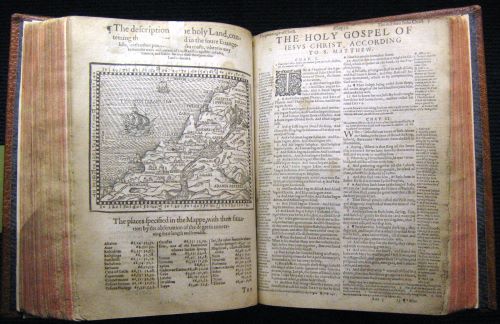
A central pillar of Henry’s argument rests on his treatment of the Geneva Bible and its accompanying annotations, which he attributes directly to John Calvin. This claim, presented with confidence, reflects a fundamental misunderstanding of both the origins of the text and the nature of early modern biblical scholarship. The Geneva Bible, first published in 1560, was the product of English Protestant exiles in Geneva, many of whom were influenced by Calvin’s theology but were not acting as mere conduits for his authorship. Figures such as William Whittingham, Anthony Gilby, and others played leading roles in its translation and annotation. To conflate theological influence with direct authorship is to collapse an entire collaborative intellectual environment into a single name, thereby distorting the historical reality of Reformation-era textual production.
This misattribution is not a minor factual error but reveals a broader methodological issue. Henry treats the marginal notes of the Geneva Bible as if they represent a unified, authoritative voice directly tied to Calvin himself, rather than as interpretive commentary shaped by a community of scholars operating within a particular theological and political context. Early modern biblical annotations were not neutral explanations but interventions in ongoing debates over ecclesiastical authority, governance, and doctrine, often written with explicit polemical intent and aimed at shaping how readers understood both scripture and contemporary power structures. The Geneva Bible’s notes reflect a distinctly Reformed perspective, often critical of monarchical power and supportive of resistance theory, especially in relation to tyrannical rule.¹ To read these annotations without situating them within their historical and intellectual milieu is to strip them of their meaning and repurpose them for entirely different arguments, transforming context-bound commentary into supposed universal declarations detached from their original purpose.
Equally problematic is the treatment of these notes as if they can be directly “translated” into modern claims without regard for linguistic, cultural, or theological context. Henry’s approach assumes a continuity of meaning that does not exist, ignoring the ways in which language evolves and concepts shift over time. The English of the sixteenth century, while recognizable, operates within a different semantic and rhetorical framework than modern usage. More importantly, the interpretive assumptions underlying the annotations are rooted in the specific concerns of the Reformation, including debates over papal authority, scriptural interpretation, and the nature of the Church. To extract isolated phrases and apply them to contemporary conspiratorial frameworks is not an act of translation but of reinterpretation divorced from historical grounding.
The figure of Calvin himself is similarly misrepresented through this process. Calvin was indeed a central theological influence in Geneva, and his writings shaped the intellectual climate in which the Geneva Bible was produced. His relationship to the translation project was indirect, and his own corpus of work, including the Institutes of the Christian Religion and his biblical commentaries, reflects a far more systematic and contextually grounded approach to scripture than the selective readings presented in the video.² To attribute the Geneva annotations wholesale to Calvin is to ignore both the diversity of voices involved in their creation and the specificity of Calvin’s own theological method.
The broader issue at stake is the misuse of primary sources as repositories of hidden meaning rather than as historical artifacts requiring careful interpretation. Historians approach such texts with an awareness of authorship, audience, purpose, and context, recognizing that meaning is not inherent but constructed through interaction between text and reader, and that interpretation must be disciplined by evidence rather than driven by prior assumptions. Henry’s method reverses this process, beginning with a predetermined conclusion and then mining the text for fragments that appear to support it, while disregarding passages that complicate or contradict the desired narrative. This selective engagement creates the illusion of evidence while bypassing the rigorous analysis necessary to establish credible historical claims, substituting assertion for inquiry and reinforcing the broader pattern of methodological breakdown.
In correcting these misreadings, it becomes clear that the Geneva Bible does not support the sweeping conclusions drawn in the video, nor does Calvin’s theology align with the interpretations attributed to him. Instead, both serve as reminders of the complexity of historical texts and the importance of method in their interpretation. The failure to distinguish between influence and authorship, context and application, and analysis and assertion underscores the central problem of the argument. When primary sources are treated not as evidence to be examined but as tools to be manipulated, the result is not historical insight but distortion.
Anachronism and Historical Collapse: The Erasure of Time

One of the most striking features of Henry’s presentation is the collapse of chronological boundaries, in which widely separated historical periods are compressed into a single, continuous narrative. This is most evident in the compression of historical timelines, where figures and events from widely separated centuries are treated as if they belong to a single, unified period. Such claims are not merely incorrect in detail but represent a fundamental breakdown in the basic structure of historical reasoning. Chronology is not an arbitrary construct imposed upon the past; it is derived from a convergence of sources, including textual records, material evidence, and cross-cultural corroboration. To disregard this framework is to remove the scaffolding that makes historical understanding possible.
This collapse of time operates through a process of anachronism, in which concepts, figures, and events are removed from their historical contexts and repositioned according to a predetermined narrative. Henry’s argument depends on treating temporal markers as fluid or deceptive, allowing him to align disparate elements that would otherwise be separated by centuries. The medieval period, for example, is presented as either fabricated or misdated, a claim that ignores the vast body of evidence supporting its existence, from administrative records and legal documents to architectural remains and literary production. By flattening these distinctions, the argument replaces the complexity of historical development with a simplified and ahistorical continuum.
The methodological problem here is profound. Historians rely on multiple, independent lines of evidence to establish chronology, including paleography, numismatics, archaeology, and documentary analysis. These disciplines converge to create a consistent temporal framework that is continually tested and refined. To suggest that such a framework is the product of deliberate manipulation requires not only extraordinary evidence but also an explanation for how such a manipulation could be sustained across cultures, languages, and centuries of independent record-keeping. Henry’s presentation offers no such explanation, instead relying on assertion and selective interpretation to support its claims.
Equally revealing is the treatment of linguistic and textual variation as evidence of chronological distortion. The suggestion that differences in notation or spelling, such as the use of “I” in place of “J,” indicate a rewriting of history reflects a misunderstanding of how language evolves. Early modern texts frequently exhibit orthographic variation, a well-documented feature of the transition from manuscript to print culture, where standardized spelling had not yet been fully established and printers often exercised discretion in typographic choices. In Latin and early vernacular texts, the letters “I” and “J” were not consistently distinguished, with “J” emerging later as a separate character, a development thoroughly documented in the history of writing and print. Such variation is visible across a wide range of sources and regions, further confirming that it reflects common linguistic practice rather than coordinated alteration. These features are not anomalies requiring explanation through conspiracy but expected outcomes of historical processes that have been extensively studied. By interpreting such features as signs of manipulation, the argument transforms ordinary evidence of linguistic change into supposed proof of temporal collapse, substituting suspicion for well-established scholarship.
The broader implication of this approach is the erasure of historical development itself. When time is compressed and distinctions between periods are removed, the past becomes a static landscape in which events and figures can be rearranged at will. This not only undermines specific historical claims but also eliminates the possibility of understanding change over time, which is central to historical inquiry. Henry’s argument replaces history as a discipline with a form of narrative construction that prioritizes coherence over accuracy. The resulting account may appear unified, but it achieves this unity by discarding the very evidence that would challenge it.
In confronting such claims, it becomes necessary to reaffirm the importance of chronology as a foundational element of historical method. Time is not merely a backdrop against which events occur; it is an integral component of how those events are understood and related to one another. The careful reconstruction of temporal sequences allows historians to trace causation, continuity, and transformation, providing a framework within which evidence can be meaningfully interpreted. The collapse of this framework, as seen in Henry’s presentation, does not reveal hidden truths but obscures the processes by which the past can be known. Restoring the integrity of historical time therefore essential to any serious engagement with the claims under consideration.
Linguistic Confusion as Evidence: The “I/J” Argument
A recurring feature of Henry’s presentation is the use of linguistic variation as purported evidence of historical manipulation, most notably in his treatment of the distinction between the letters “I” and “J.” He suggests that variations such as “I560” instead of “1560” signal deliberate alteration of the historical record, implying that orthographic differences conceal a rewritten timeline. This claim reflects a fundamental misunderstanding of the history of writing and typography. In early modern Europe, the letters “I” and “J” were not consistently differentiated, with “J” emerging gradually as a distinct character during the sixteenth and seventeenth centuries. What appears to modern readers as inconsistency is, in fact, a well-documented stage in the development of alphabetic representation.
This misunderstanding is compounded by the assumption that orthographic variation must indicate intentional distortion rather than normal linguistic evolution. Early printed texts exhibit a wide range of spelling conventions, even within the same document, as standardization had not yet been fully established and orthography remained fluid across regions and printers. Printers, scribes, and translators operated within flexible systems of representation, often influenced by regional practices, the availability of type, and the technical constraints of early presses, which did not enforce uniformity in the way modern publishing does. The interchangeable use of “I” and “J,” along with similar variations such as “U” and “V,” reflects these conditions rather than any coordinated effort to obscure meaning, and such variation can be observed consistently across surviving documents from the period. To interpret these features as evidence of manipulation is to impose modern expectations of uniformity onto a period in which such uniformity did not exist, thereby misunderstanding both the nature of the sources and the historical context in which they were produced.
Henry’s argument further assumes that linguistic features can function as independent proof of broader historical claims, detached from their contextual grounding. By isolating the “I/J” distinction and elevating it to a central piece of evidence, the presentation transforms a minor typographic detail into a supposed key to unlocking hidden chronology. This approach disregards the methodological principle that evidence must be evaluated within a network of corroborating sources. Linguistic analysis, when properly conducted, is a powerful tool for understanding historical change, but it cannot bear the weight of sweeping conclusions in isolation. The selective elevation of a single feature to explanatory dominance is characteristic of pseudo-historical reasoning.
The historical study of language offers a clear account of how such variations arise and stabilize over time. Scholars of paleography and the history of the book have traced the gradual differentiation of letter forms, showing how practical considerations, including handwriting styles, scribal conventions, and printing technologies, contributed to the emergence of standardized alphabets. The distinction between “I” and “J,” for example, developed as scribes and printers sought to clarify pronunciation and improve readability, particularly in vernacular texts, and this development unfolded unevenly across different regions and languages. These changes were incremental rather than abrupt, reflecting the decentralized nature of early modern textual production and the absence of centralized linguistic authority. Far from indicating deception, they provide insight into the material and intellectual conditions of the period, illustrating how language adapts in response to both practical needs and cultural shifts. To reinterpret these developments as evidence of historical falsification is to disregard a substantial body of scholarship that has carefully documented these processes.
In examining Henry’s use of linguistic evidence, it becomes evident that the issue is not simply a misreading of specific details but a broader failure to understand how language functions as historical evidence. Linguistic variation is not noise to be decoded into hidden messages, but data to be interpreted within established frameworks of analysis. By treating orthographic differences as signs of conspiracy rather than as products of historical development, the argument substitutes suspicion for scholarship. The result is an interpretation that appears revelatory but rests on a misunderstanding of the very evidence it claims to decode.
The Misuse of Theology: Eschatology Without Context

A further dimension of Henry’s argument involves the reinterpretation of biblical eschatology, particularly his assertion that the Book of Revelation was entirely fulfilled in the first century and that figures such as the Antichrist can be definitively identified within a compressed historical framework. While preterist interpretations of Revelation do exist within theological scholarship, his presentation departs significantly from established approaches by removing these interpretations from their historical and doctrinal contexts. Rather than engaging with the long tradition of exegetical debate surrounding apocalyptic literature, the argument presents a singular, definitive reading that collapses symbolic language into literal historical claims. This approach not only oversimplifies a complex body of literature but also disregards the interpretive frameworks that have been developed over centuries of theological inquiry.
Central to this misuse is the selective appropriation of scriptural passages without regard for their literary genre or historical setting. Apocalyptic texts such as Revelation and Daniel are characterized by symbolic imagery, coded language, and references that were often intelligible primarily to their original audiences. These texts must be read in light of their historical contexts, including the political and religious circumstances of the early Christian communities to whom they were addressed. These communities often faced persecution, marginalization, and internal tensions, conditions that shaped both the urgency and the symbolic density of apocalyptic expression. The imagery of beasts, numbers, and cosmic conflict functioned not as literal predictions to be decoded in isolation but as a language of resistance and reassurance, offering meaning within a specific lived experience. Henry’s interpretation treats these symbols as straightforward historical markers that can be mapped directly onto a reconfigured timeline, ignoring how such imagery operated within its original milieu. By detaching these texts from their historical grounding, the argument strips them of their interpretive depth and reduces them to a series of supposed clues. By ignoring the genre-specific features of apocalyptic literature, the argument transforms symbolic expression into literal evidence, thereby distorting both the text and its intended meaning.
The conflation of theological interpretation with historical reconstruction further complicates the argument. Henry links passages from Revelation, Daniel, and the Pauline epistles into a unified narrative that purports to reveal a hidden chronological scheme. This synthesis overlooks the distinct contexts in which these texts were produced and the different purposes they served within early Christian thought. Theological interpretation has long recognized the diversity of perspectives within the biblical canon, as well as the need to account for historical development in doctrine and practice. By collapsing these distinctions, the argument imposes a false coherence that obscures the richness and complexity of the texts themselves. The result is not a deeper understanding of theology but a reinterpretation driven by external assumptions rather than internal analysis.
In examining this use of theology, it becomes clear that the issue is not merely one of interpretive disagreement but of methodological departure. Responsible theological scholarship requires attention to historical context, literary form, and the interpretive traditions that have shaped understanding over time. Henry’s presentation bypasses these requirements, substituting assertion for analysis and treating scripture as a repository of hidden codes rather than as a body of texts rooted in specific historical circumstances. This approach not only misrepresents the content of the biblical writings but also undermines the principles that guide their interpretation. The misuse of eschatology serves as a broader example of how the abandonment of method leads to distortion rather than insight.
Conflation and Pattern-Seeking: Daniel, Revelation, and Everything Else

A defining feature of Henry’s interpretive method is the conflation of disparate biblical texts into a single, unified narrative that is presumed to encode a hidden historical chronology. Central to this approach is the merging of the books of Daniel and Revelation, along with selective passages from other scriptural sources, into a framework that is treated as internally consistent and historically precise. While both Daniel and Revelation belong broadly to the apocalyptic tradition, they emerge from distinct historical contexts and address different audiences with different concerns. Daniel is rooted in the political and religious crises of the Hellenistic period, particularly the pressures exerted on Jewish identity under foreign rule, while Revelation reflects the experiences of early Christian communities navigating the realities of Roman imperial power. To collapse them into a single interpretive system without regard for these differences is to erase the conditions that gave rise to each text and to impose a coherence that is not supported by historical or textual evidence. Such an approach replaces historically grounded interpretation with a constructed narrative that flattens complexity in favor of apparent unity.
This conflation is reinforced by a pattern-seeking tendency that elevates perceived similarities into definitive connections. Numerical motifs, symbolic imagery, and thematic parallels are treated as evidence of a deliberate, encoded structure rather than as features common to apocalyptic literature more generally. Such reasoning reflects a cognitive bias toward finding patterns, even where none exist in a meaningful or intentional way. Apocalyptic texts frequently employ recurring symbols, including beasts, horns, and cosmic disturbances, not because they are part of a hidden code spanning centuries, but because they draw from a shared symbolic vocabulary rooted in earlier Jewish traditions. To interpret these recurring elements as proof of a unified chronological scheme is to mistake convention for conspiracy.
The interpretive problem is further compounded by the selective inclusion and exclusion of evidence. Passages that appear to support the proposed framework are emphasized, while those that complicate or contradict it are minimized or ignored. This selective reading creates the illusion of coherence by filtering out dissonant material, allowing the argument to proceed without fully accounting for the complexity of the sources. In the case of Daniel and Revelation, significant differences in chronology, symbolism, and theological emphasis are well documented in scholarly literature. Daniel’s visions are generally understood within the context of the Hellenistic period, particularly the persecutions under Antiochus IV Epiphanes, while Revelation reflects the experiences of early Christians under Roman imperial rule. These differences are not incidental but central to the meaning of each text, shaping both their imagery and their message. To treat these texts as interchangeable components of a single system is to disregard the specificity of their historical settings and to overlook the interpretive frameworks that scholars have developed to account for those distinctions.
Henry’s method also relies on the assumption that scriptural texts function as cryptographic documents, designed to conceal rather than reveal their meaning. This perspective shifts the role of interpretation from contextual analysis to code-breaking, encouraging the reader to search for hidden correspondences across unrelated passages. Such an approach departs fundamentally from established hermeneutical practices, which emphasize the importance of historical context, literary form, and authorial intent. By framing scripture as a puzzle to be solved, the argument transforms interpretive uncertainty into apparent discovery, creating a sense of insight that is not grounded in verifiable methodology.
The cumulative effect of this conflation and pattern-seeking is the construction of a self-reinforcing interpretive system. Once the assumption of hidden coherence is accepted, each new perceived connection serves to validate the framework, even when those connections are tenuous or unsupported. This circular reasoning makes the argument resistant to critique, as contradictory evidence can be reinterpreted or dismissed within the same system. The result is not a flexible or evidence-based interpretation, but a closed structure in which conclusions are predetermined by the initial assumptions.
In assessing this approach, it becomes clear that the issue lies not in the recognition of patterns itself, but in the failure to distinguish between meaningful connections and coincidental resemblance. Historical and theological scholarship depends on the careful evaluation of evidence, the acknowledgment of difference, and the willingness to revise conclusions in light of new information. Henry’s conflation of Daniel, Revelation, and other texts bypasses these principles, substituting pattern recognition for critical analysis. The resulting interpretation may appear comprehensive, but it rests on a foundation that prioritizes coherence over accuracy and speculation over substantiated understanding.
The Collapse of Evidence: “Google Doesn’t Show It” as Proof
A final and revealing component of Henry’s argument is the claim that the absence of information in modern search results constitutes evidence of deliberate historical suppression. Statements such as “Google doesn’t show it” are presented not as limitations of a search platform but as confirmation that certain truths have been actively concealed. This reasoning marks a significant departure from established standards of evidence, substituting the mechanics of digital retrieval for the processes of historical verification. The argument collapses the distinction between access to information and the existence of information, treating the former as a direct indicator of the latter.
This collapse is rooted in a misunderstanding of how search engines function. Platforms such as Google do not serve as comprehensive repositories of human knowledge but as algorithmically curated indexes shaped by relevance, popularity, search engine optimization, and user behavior. The absence of a result may reflect a range of factors, including the obscurity of a topic, the phrasing of a query, or the limited digitization of certain materials. Historical scholarship, by contrast, relies on a wide array of sources that extend far beyond what is readily accessible through a simple search, including archival documents, print publications, and specialized databases. To treat a search engine’s output as an authoritative measure of historical reality is to misunderstand both the scope and the limitations of digital tools.
The argument also reverses the burden of proof by transforming absence into confirmation. Rather than requiring positive evidence to substantiate a claim, it interprets the lack of easily accessible information as proof that the claim is true but hidden. This inversion creates a self-sealing logic in which any failure to produce evidence can be reinterpreted as evidence of concealment, thereby insulating the argument from meaningful scrutiny. In such a framework, counterevidence is not engaged but dismissed, and the absence of corroboration becomes a mechanism for reinforcing belief rather than challenging it. This approach stands in direct opposition to the principles of historical inquiry, which depend on the careful evaluation of available sources, the weighing of competing interpretations, and the willingness to revise conclusions in light of new findings. By contrast, a framework that treats absence as validation removes the possibility of falsification, rendering the argument immune to disconfirmation and closing off the iterative process through which historical understanding develops.
In the broader context of Henry’s presentation, this appeal to digital absence serves as a capstone to a pattern of methodological breakdown. Linguistic anomalies, theological reinterpretations, and textual conflations are each presented as independent lines of evidence, but their cumulative force depends on a willingness to accept unconventional standards of proof. When the absence of search results is elevated to evidentiary status, the argument effectively abandons the criteria that distinguish credible historical analysis from speculation. The result is not an expansion of knowledge but a contraction of method, in which the tools designed to access information are mistaken for arbiters of truth itself.
Pseudo-Historical Systems: Cataclysm, Timeline Reset, and the 1700s Reset Theory

A central pillar of Henry’s broader framework is the incorporation of pseudo-historical systems that posit large-scale cataclysms and subsequent “resets” of the historical timeline, particularly the claim that a global event in the seventeenth or eighteenth century effectively erased and rewrote human history. This so-called “1700s reset theory” is presented as a unifying explanation for perceived inconsistencies in historical records, architectural anomalies, and gaps in documentation. Rather than treating these features as the result of ordinary historical processes, including loss, reinterpretation, and uneven preservation, the theory elevates them into evidence of a coordinated and comprehensive restructuring of the past. It replaces the complexity of historical development with a singular, totalizing event that is assumed to account for a wide range of unrelated phenomena.
This framework relies heavily on the reinterpretation of architectural and urban landscapes as remnants of a lost civilization. Buildings from the early modern period are often described as too advanced, too uniform, or too numerous to have been constructed within the accepted historical timeline. Such claims ignore the well-documented evolution of architectural styles, construction techniques, and urban planning across Europe and beyond. The spread of neoclassical design, for example, reflects not a hidden inheritance from a vanished civilization but a conscious revival of Greco-Roman forms, supported by extensive documentary evidence, including plans, contracts, and correspondence. By disregarding this body of evidence, the argument substitutes visual impression for historical analysis, treating unfamiliarity as proof of impossibility.
The notion of a timeline reset also depends on the assumption that historical records are both sufficiently fragile to be erased and sufficiently coordinated to be rewritten on a global scale. This dual assumption is internally contradictory. The historical record is indeed incomplete, shaped by loss, destruction, and selective preservation, but it is also distributed across a vast array of independent sources, including governmental archives, private collections, ecclesiastical records, and material artifacts. These sources are not isolated but interconnected, often corroborating one another across geographic and institutional boundaries, which makes large-scale manipulation exceedingly difficult to sustain without leaving detectable inconsistencies. To propose that all of these sources were simultaneously altered or replaced requires not only an unprecedented level of coordination but also the absence of any surviving contradictory evidence, including regional variations, marginal records, and unintended survivals. The persistence of overlapping and independently verifiable records from different regions undermines the plausibility of such a scenario and demonstrates the resilience of the historical record even in the face of disruption.
Henry’s use of catastrophe as an explanatory device further reflects a preference for dramatic, singular events over gradual, cumulative processes. Historical change is more often the result of incremental developments shaped by economic, social, and political factors. While catastrophic events such as wars, natural disasters, and epidemics have undoubtedly influenced the course of history, they do not produce the kind of total erasure and reconstruction implied by reset theories. Instead, they leave behind traces that can be studied, including physical damage, demographic shifts, and changes in institutional structures. The absence of such comprehensive evidence for a global reset event points not to successful concealment but to the lack of such an event in the first place.
The appeal of the 1700s reset theory lies partly in its ability to provide a single explanatory framework for a wide range of perceived anomalies. By attributing inconsistencies to a hidden catastrophe and subsequent rewriting of history, the theory offers a sense of coherence that may be psychologically satisfying. This coherence is achieved at the cost of explanatory rigor. Rather than engaging with the specific contexts in which anomalies arise, the argument subsumes them under a generalized narrative that resists detailed scrutiny, discouraging closer examination of individual cases. This broad framing allows disparate observations to be grouped together without demonstrating causal relationships between them, creating an impression of unity that is not supported by detailed analysis. The theory shifts attention away from the complexity of historical processes and toward a simplified explanatory model that cannot adequately account for the diversity of available evidence.
In evaluating this pseudo-historical system, it becomes evident that its explanatory power is largely illusory. The theory does not generate testable hypotheses or engage with the methodologies of historical research. Instead, it operates by reinterpreting existing evidence through a predetermined lens, transforming uncertainty into confirmation and absence into proof. The result is a closed interpretive loop in which every anomaly reinforces the central claim, while contradictory evidence is dismissed or reinterpreted. Such a framework stands in stark contrast to the principles of historical inquiry, which depend on openness to revision, engagement with diverse sources, and a commitment to evidence over speculation.
Authority Without Method: The Performance of Expertise
A consistent feature of Henry’s presentation is the projection of authority in the absence of methodological rigor, creating what may be described as a performance of expertise rather than its substance. The argument is delivered with confidence, coherence, and a rhetorical structure that mimics scholarly discourse, giving the impression of careful research and analytical depth. This appearance is not supported by the underlying use of evidence or engagement with established methods. Instead, authority is constructed through tone, certainty, and the selective presentation of information, encouraging the audience to equate confidence with credibility.
This performance is reinforced by the strategic use of technical language and references to specialized knowledge. Terms drawn from history, theology, and linguistics are employed in ways that suggest familiarity with these fields, but they are often detached from their precise meanings and methodological contexts. By invoking the vocabulary of scholarship without adhering to its standards, the argument creates a veneer of legitimacy that can be difficult for non-specialists to evaluate. The effect is not to clarify complex ideas but to obscure the absence of rigorous analysis behind a façade of intellectual sophistication.
Another element of this constructed authority is the positioning of the speaker as a figure who has uncovered hidden truths overlooked or suppressed by mainstream scholarship. This framing casts established historians and theologians not as participants in an ongoing process of inquiry but as gatekeepers who have failed to recognize or have deliberately concealed the truth. Such a narrative enhances the perceived credibility of the speaker by aligning discovery with dissent, suggesting that disagreement with established knowledge is itself evidence of insight. This rhetorical move is particularly powerful because it preemptively reframes criticism as confirmation, allowing any challenge from qualified scholars to be interpreted not as a correction but as resistance to uncomfortable truths. It collapses the distinction between expertise and opposition, encouraging audiences to privilege contrarianism over competence and to view institutional knowledge with suspicion rather than critical engagement. As scholars of historiography and knowledge production have noted, the authority of expertise rests not on claims of exclusivity but on transparent method, peer evaluation, and the cumulative testing of ideas over time. By contrast, the self-positioning of the outsider as uniquely perceptive often relies on disengagement from these processes, substituting narrative appeal for evidentiary accountability.
The absence of method becomes particularly evident in the handling of sources and evidence. Citations, when present, are often incomplete, misinterpreted, or presented without sufficient context to support the claims being made. More frequently, assertions are advanced without any verifiable sourcing, relying instead on the cumulative force of the argument’s presentation. This approach stands in contrast to the principles of historical scholarship, which require transparency in sourcing, careful contextualization, and the ability for claims to be independently verified. Without these elements, the argument cannot be meaningfully evaluated or tested.
In assessing this performance of expertise, it becomes clear that authority in historical and theological inquiry is not derived from confidence or rhetorical skill alone but from adherence to disciplined methods of analysis. The distinction between appearance and substance is crucial. Where genuine expertise invites scrutiny, welcomes correction, and grounds its claims in verifiable evidence, the performance of expertise seeks to preempt critique by substituting certainty for demonstration. Henry’s presentation exemplifies this latter approach, offering a compelling narrative that lacks the methodological foundation required to sustain it.
Why This Persuades: Psychology of Belief in Pseudo-History
To understand the persistence and appeal of Henry’s claims, it is necessary to move beyond questions of accuracy and examine the psychological mechanisms that make such arguments persuasive. Pseudo-historical systems do not succeed solely because of the evidence they present, but because of how they engage the cognitive tendencies of their audience. Humans are predisposed to seek patterns, construct narratives, and resolve ambiguity into coherent explanations. When confronted with complex or fragmented historical material, the promise of a single, unifying framework can be deeply appealing, offering clarity where conventional scholarship emphasizes uncertainty and debate.
One of the most significant factors in this process is confirmation bias, the tendency to favor information that aligns with preexisting beliefs while disregarding contradictory evidence. Henry’s presentation provides a structure within which disparate observations can be interpreted as mutually reinforcing, allowing viewers to integrate new information into an already established worldview. Once this framework is adopted, evidence is no longer evaluated independently but is filtered through the expectations it creates. Belief becomes self-sustaining, as each perceived confirmation strengthens the underlying assumptions.
Closely related to this is the role of pattern recognition, a cognitive ability that is essential to human reasoning but can also lead to false positives. The identification of connections between symbols, texts, or events can produce a sense of discovery that feels intellectually satisfying, even when those connections lack substantive grounding. In pseudo-historical reasoning, this tendency is amplified by the selective presentation of data, which highlights similarities while obscuring differences. The resulting patterns appear meaningful not because they reflect underlying reality, but because they are constructed to do so.
Emotional engagement also plays a crucial role in the persuasive power of such arguments. Narratives that suggest hidden truths, suppressed knowledge, or dramatic revelations tap into a sense of intrigue and empowerment. The idea that one has access to information that others have overlooked or ignored can be both validating and motivating, reinforcing continued engagement with the material. This emotional dimension often operates alongside cognitive processes, making belief resistant to purely rational critique.
Another important factor is the distrust of institutions and expertise that characterizes much of the contemporary information landscape. When traditional sources of authority, including academic scholarship and established media, are viewed with skepticism, alternative frameworks can gain credibility by positioning themselves in opposition to those sources. Henry’s presentation capitalizes on this dynamic by framing its claims as challenges to mainstream understanding, thereby appealing to audiences who are predisposed to question institutional narratives. In such contexts, the rejection of conventional knowledge becomes a marker of independent thinking rather than a potential sign of error.
In examining these psychological dimensions, it becomes clear that the persuasive power of pseudo-history lies not in the strength of its evidence but in its alignment with fundamental aspects of human cognition and emotion. Effective historical scholarship must do more than present accurate information; it must also address the ways in which people process, interpret, and internalize that information. Without this awareness, the gap between scholarly knowledge and popular belief will remain, allowing systems like Henry’s to continue exerting their influence despite their methodological shortcomings.
Conclusion: The Cost of Abandoning Method
The examination of Henry’s claims reveals not a series of isolated interpretive errors but a broader pattern of methodological abandonment. Linguistic variation is misread as evidence of manipulation, theological texts are stripped of context, disparate sources are conflated into artificial coherence, and the absence of easily accessible information is treated as proof of concealment. Each of these moves reflects a departure from the principles that govern historical and theological inquiry. They together form a system that appears internally consistent but is detached from the evidentiary standards required to sustain it.
The cost of this abandonment is not merely academic. When method is replaced by assertion, the distinction between knowledge and speculation becomes increasingly difficult to maintain. Historical understanding depends on the careful evaluation of sources, the acknowledgment of uncertainty, and the willingness to revise conclusions in light of new evidence. These practices are not procedural formalities but the foundation upon which credible interpretation rests, ensuring that claims can be scrutinized, compared, and either supported or challenged through transparent reasoning. Without them, interpretation becomes unmoored from verification, allowing persuasive narratives to take the place of substantiated analysis and encouraging audiences to prioritize coherence over accuracy. This shift has broader implications for how individuals engage with the past, shaping not only what is believed but how belief itself is formed and maintained, often reinforcing closed systems of thought that resist correction.
At a deeper level, the appeal of pseudo-historical systems highlights a tension between the complexity of scholarly knowledge and the desire for clear, definitive answers. Methodologically rigorous history often resists simplicity, presenting a past that is contingent, contested, and multifaceted, requiring sustained engagement and a tolerance for ambiguity. By contrast, frameworks such as Henry’s offer clarity through reduction, replacing ambiguity with certainty and debate with resolution, and doing so in a way that feels immediately accessible and intuitively satisfying. This contrast can create the impression that scholarly approaches are unnecessarily complicated or evasive, while simplified narratives appear more direct and truthful. The danger lies in the ease with which this clarity can be mistaken for truth, particularly when it is reinforced by compelling narrative structures and emotional resonance that make the interpretation feel persuasive even in the absence of evidence.
The preservation of historical understanding depends on a continued commitment to method. This commitment does not guarantee certainty, but it provides the means by which claims can be evaluated, challenged, and refined. In the absence of such a framework, interpretation risks becoming self-referential, sustained not by evidence but by its own internal logic. The critique of Henry’s presentation serves as a reminder that the integrity of historical inquiry rests not only on what is said about the past, but on how those claims are constructed and justified.
Bibliography
- Arnold, Dana. The Georgian Country House: Architecture, Landscape, and Society. Stroud: Sutton Publishing, 1998.
- Aune, David E. Revelation 1–5. Word Biblical Commentary, vol. 52A. Dallas: Word Books, 1997.
- Bieler, André. Calvin’s Economic and Social Thought. Translated by James Greig. Geneva: World Alliance of Reformed Churches, 2005.
- Bloch, Marc. The Historian’s Craft. Translated by Peter Putnam. New York: Vintage Books, 1949.
- Borgman, Christine L. Big Data, Little Data, No Data: Scholarship in the Networked World. Cambridge, MA: MIT Press, 2015.
- Burke, Peter. History and Social Theory. 2nd ed. Ithaca: Cornell University Press, 2005.
- Byford, Jovan. Conspiracy Theories: A Critical Introduction. New York: Palgrave Macmillan, 2011.
- Calvin, John. Institutes of the Christian Religion. Translated by Henry Beveridge. Peabody, MA: Hendrickson Publishers, 2008.
- Carr, E. H. What Is History? London: Penguin Books, 1961.
- Collins, Harry, and Robert Evans. Rethinking Expertise. Chicago: University of Chicago Press, 2007.
- Collins, John J. The Apocalyptic Imagination: An Introduction to Jewish Apocalyptic Literature. 3rd ed. Grand Rapids, MI: Eerdmans, 1984.
- —-. Daniel: A Commentary on the Book of Daniel. Hermeneia. Minneapolis: Fortress Press, 1993.
- Daniell, David. The Bible in English: Its History and Influence. New Haven: Yale University Press, 2003.
- Darnton, Robert. The Case for Books: Past, Present, and Future. New York: PublicAffairs, 2009.
- Evans, Richard J. In Defence of History. London: Granta Books, 1997.
- Fenster, Mark. Conspiracy Theories: Secrecy and Power in American Culture. Minneapolis: University of Minnesota Press, 1999.
- Grafton, Anthony. The Footnote: A Curious History. Cambridge, MA: Harvard University Press, 1997.
- Hall, Basil. “Biblical Scholarship: Editions and Commentaries.” In The Cambridge History of the Bible, Volume 3: The West from the Reformation to the Present Day, edited by S. L. Greenslade, 156–170. Cambridge: Cambridge University Press, (1963), 38-93.
- Howell, Martha, and Walter Prevenier. From Reliable Sources: An Introduction to Historical Methods. Ithaca: Cornell University Press, 2001.
- Kahneman, Daniel. Thinking, Fast and Slow. New York: Farrar, Straus and Giroux, 2011.
- Koester, Craig R. Revelation and the End of All Things. 2nd ed. Grand Rapids, MI: Eerdmans, 2018.
- Kostof, Spiro. A History of Architecture: Settings and Rituals. 2nd ed. New York: Oxford University Press, 1995.
- Le Goff, Jacques. Time, Work, and Culture in the Middle Ages. Chicago: University of Chicago Press, 1977.
- Febvre, Lucien, and Henri-Jean Martin. The Coming of the Book: The Impact of Printing 1450–1800. Translated by David Gerard. London: Verso, 1976.
- Newsom, Carol A. Daniel: A Commentary. Old Testament Library. Louisville: Westminster John Knox Press, 2014.
- Nickerson, Raymond S. “Confirmation Bias: A Ubiquitous Phenomenon in Many Guises.” Review of General Psychology 2, no. 2 (1998): 175–220.
- Parkes, M. B. Pause and Effect: An Introduction to the History of Punctuation in the West. Berkeley: University of California Press, 1992.
- Shermer, Michael. Why People Believe Weird Things: Pseudoscience, Superstition, and Other Confusions of Our Time. New York: Henry Holt, 1997.
- Steinberg, S. H. Five Hundred Years of Printing. New Castle, DE: Oak Knoll Press, 1996.
- Sunstein, Cass R. Conspiracy Theories and Other Dangerous Ideas. New York: Simon & Schuster, 2009.
- Sunstein, Cass R., and Adrian Vermeule. “Conspiracy Theories: Causes and Cures.” Journal of Political Philosophy 17, no. 2 (2009): 202–227.
- Weinberger, David. Too Big to Know: Rethinking Knowledge Now That the Facts Aren’t the Facts, Experts Are Everywhere, and the Smartest Person in the Room Is the Room. New York: Basic Books, 2012.
- Whittingham, William, et al. The Geneva Bible: A Facsimile of the 1560 Edition. Madison: University of Wisconsin Press, 1969.
- Wineburg, Sam. Historical Thinking and Other Unnatural Acts: Charting the Future of Teaching the Past. Philadelphia: Temple University Press, 2001.
- Wright, N. T. Revelation for Everyone. Louisville: Westminster John Knox Press, 2009.
- Yarbro Collins, Adela. Crisis and Catharsis: The Power of the Apocalypse. Philadelphia: Westminster Press, 1984.
Originally published by Brewminate, 04.13.2026, under the terms of a Creative Commons Attribution-NonCommercial-NoDerivatives 4.0 International license.
About the Author