
By Samantha Wesner
PhD Candidate in History
Cornell University
This article, The Revolutionary Colossus, was originally published in The Public Domain Review under a Creative Commons Attribution-ShareAlike 3.0. If you wish to reuse it please see: https://publicdomainreview.org/legal/
As the French Revolution entered its most radical years, there emerged in print a recurring figure, the collective power of the people expressed as a single gigantic body — a king-eating Colossus. Samantha Wesner traces the lineage of this nouveau Hercules, from Erasmus Darwin’s Bastille-breaking giant to a latter incarnation in Mary Shelley’s Frankenstein.
Between thick dungeon walls, a giant lies asleep. He’s chained to the ground, large limbs folded, enmeshed in a web of ropes, a blindfold over his closed eyes. Suddenly, as if touched by a flame, he awakes, and gazes around in amazement. He starts up, shreds the ropes entangling him, breaks chains, smashes walls, and rises to his feet. Towering over the world, shadow stretching out below, he calls out with a voice like thunder.
It could be an early scene in a monster movie. In fact, it’s an image of the French Revolution. The depiction appears in “The Economy of Vegetation”, part one of The Botanic Garden, a mind-bending meditation on life and the universe written by Charles Darwin’s grandfather, Erasmus Darwin:
Long had the Giant-form on GALLIA’S plains
Inglorious slept, unconscious of his chains;
Round his large limbs were wound a thousand strings
By the weak hands of Confessors and Kings;
O’er his closed eyes a triple veil was bound,
And steely rivets lock’d him to the ground;
While stern Bastile with iron cage inthralls
His folded limbs, and hems in marble walls.
Touch’d by the patriot-flame, he rent amazed
The flimsy bonds, and round and round him gazed;
Starts up from earth, above the admiring throng
Lifts his Colossal form, and towers along;
High o’er his foes his hundred arms He rears,
Plowshares his swords, and pruning hooks his spears;
Calls to the Good and Brave with voice, that rolls
Like Heaven’s own thunder round the echoing poles;
Gives to the winds his banner broad unfurl’d,
And gathers in its shade the living world!
Published in 1791 — two years after the abolition of the Ancien Régime, but before the institution of the First Republic and the ensuing chaos — the vignette recounts the beginning of the French Revolution as the story of a Colossus awakening from centuries of feudal slumber. It shows collective action, Leviathan-style, in the movements of an anthropomorphic embodiment of the people, dramatizing their uprising and their destruction of the Bastille. And this figure, of a composite, revolutionary Colossus, can be seen in poetry, political commentary, and printed illustration from the late eighteenth century onwards. We can trace a kind of monstrous genealogy, culminating in what is arguably another representation of the French Revolution, Frankenstein’s creature.
The first great figure in this line of descent is Darwin’s “Giant-form”, who is well beyond human scale. Above his enemies, the giant’s “hundred arms” brandish pruning hooks and plowshares, symbols of a universalized Third Estate. And though he sleeps on “Gallia’s plains”, the giant is not particularly French; he calls out to universal categories of “the Good and Brave”. The vignette describes the awakening of a kind of everyman-Colossus, with no superpowers but the tools of manual labor in his (many) hands.
When Darwin imagined revolutionary France this way, he tapped into a broader cultural imaginary. Two years after the publication of The Botanic Garden, at artist-deputy Jacques-Louis David’s suggestion, the Jacobins chose Hercules as a symbol of revolutionary, republican France. Historian Lynn Hunt writes of how Hercules replaced both the human-scale Marianne and the female figures such as Liberty and Justice from the allegorical pantheon during the most radical years of the revolution.1 In one sketch from this period, the French Hercules tramples a hydra representing “federalism”, the provincial movements of resistance to the revolutionary center.

Like Darwin’s giant, the Jacobin Hercules embodies the contradictions of a mythic everyman. David wanted “work” (travail) written on each hand. And in political cartoons, Hercules became a vrai sans-culotte — this Colossus is nothing other than your average working man, only larger. In a sketch for a statue to be placed on the most embattled French borders, the sans-culotte Colossus holds a tiny king over a flame, Hercules’ club poised to strike; it’s an image of “The People, King-Eater”.

But for all his ordinariness, the fact that this Colossus moved was wondrous, or monstrous, or both. “The tocsin and the cannon of alarm awakened [the people’s] patriotism, announcing that liberty was in danger”, declared Jacobin deputy Joseph Fouché, describing the purging of the moderate Girondins from the Convention, in late May and early June 1793: “The forty-eight sections armed themselves and were transformed into an army”. This was all a straightforward history, albeit recounted in a propagandizing register. But suddenly Fouché slipped into the present tense:
This formidable colossus is standing, he marches, he advances, he moves like Hercules, traversing the Republic to exterminate this ferocious crusade that swore death to the people.2
The Colossus, made up of the forty-eight sections of Paris like so many body parts, on the march, is awe-inspiring and terrifying. In a sense, the sans-culotte Hercules is stepping in to fill a symbolic void at the heart of the new democratic order. This anthropomorphic representation of the people’s collective power drew upon the previous century’s most compelling theories of sovereignty. In Thomas Hobbes’ Leviathan of 1651, written in the context of the English Civil War, the people, by contract, irrevocably ceded sovereign power to an “Artificial Man”, whose every act is in some sense a collective act. In Fouché’s imagery too, the sans-culotte Colossus-Hercules in theory collects the power of the people into a single body, a body whose movements are at once the movements of the people.

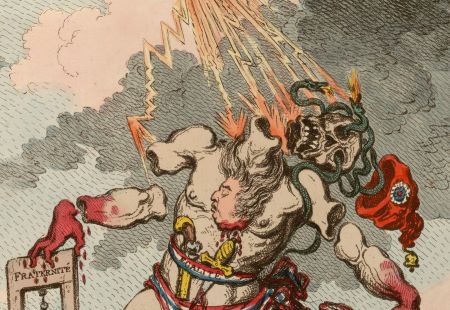
The revolutionary Colossi stood on the edge between miraculousness and monstrousness. After the fall of the Jacobins in July 1749, monstrous depictions of revolution abounded, ushering in the conservative backlash of Thermidor, named for the month in the revolutionary calendar in which Maximilien Robespierre was guillotined. In one example, British caricaturist James Gillray, best known for his satirizing of Napoleon, depicted a French Colossus astride the Mediterranean, hands and feet dripping blood. The skull-like head, crawling with snakes, stands in stark contrast to the decapitated but quite human head of Louis Capet (as the revolutionaries referred to Louis XVI), strung around the Colossus-monster’s neck. From the clouds, a British lightning bolt decapitates this aberration of a body politic. The giant body disintegrates at the same blow, arms and legs falling to pieces as the arms and legs of an enormous clay figurine might. An embodiment of the nation no more, Gillray’s French Colossus comes apart bloodlessly as no real body would. As Louis Sebastien Mercier wrote of a destroyed statue of Louis XV in the early years of the revolution, “Yes, it was all hollow, power and statue!”3

Yet not all sovereign power is hollow in Gillray’s image. “Shall the Lightning not blast the Image, which the destroyers have set up against the God of Heaven & against His Laws?” the caption asks. The illustration appears to answer: yes, it will, by virtue of another Colossus, Great Britain, which emerges from the clouds with a fist full of lighting bolts. As Kevin Duong explores in his 2017 essay “Flash Mob”, though the lightning bolt had long been associated with traditional forms of sovereign power, the French revolutionaries appropriated the device — and all its associations with the scientific ideas so vital to their project — as a key symbol of the all-important people’s will. It seems all the more cutting then that it is lightning, in the hands of the more traditional sovereignty of the British, which rends the French Colossus limb from limb in Gillray’s image.
To the conservative imagination, revolution was not only monstrous but cannibalistic — a Thermidorian variation on “The People, King-Eater”. As Edmund Burke wrote in his Reflections on the Revolution in France of 1790, revolution was “a species of political monster, which has always ended by devouring those who have produced it”.4 French Thermidorian prints reflected this verdict in their own way. In Les Formes acerbes, a human figure stands on a pile of corpses. With a stance befitting a would-be Colossus, he drinks steaming blood, fresh from the guillotine, as if to transform himself into something more than human by the drink. The figure is Joseph le Bon, a Jacobin representative sent from Paris to the provinces during The Terror to bring rebels in the north of France to heel. Furies and leopards stand by, “worthy companions of this Cannibal”, ready to devour the remains of Le Bon’s victims. Terror is written in the gestures and faces of the group to the left, as they supplicate the Convention. Like Gillray, the print depicts another perversion of sovereignty, this time in the figure of the Cannibal representative, a human being who makes himself monstrous.

Sometimes in the conservative imagination, the Jacobin was not himself monstrous, but instead enlisted monsters to “sow Crime and Terror” alongside him. In an anonymous Thermidorian print, it’s not the revolution itself embodied, but Discord, a wiry, snake-haired woman slightly larger than the Jacobin. In an echo of the sans-culotte Colossus, the Jacobin holds Hercules’ club as if to demonstrate his control over the people’s violence, which he might call upon if he has to. He offers up a scroll labeled “Revolutionary Government” authorizing Discord to do her worst. “Nasty Crooks, thanks to God, your reign is over”, the caption reads.

Mary Shelley’s Frankenstein, written in 1818, came decades after the Jacobins and cast a backwards glance toward the revolution’s promise. Mary Shelley, the eighteen-year-old daughter of two late-Enlightenment philosophers, Mary Wollstonecraft and William Godwin, gazed back at the revolution with all the gloomy judgment of a teenager reflecting on her parents’ utopian schemes. Shelley’s parents had seen great potential in the French revolutionary promise. In this they shared the sentiment of a generation of English onlookers inspired by a politics modeled on nature, rooted in rationalism. In the words of the early Romantic poet William Wordsworth,
Bliss was it in that dawn to be alive,
But to be young was very heaven!5
But Mary Shelley’s own youth took place against the backdrop of a violent decade of European warfare, as Napoleon Bonaparte traversed the continent, the self-proclaimed representative of French freedom and liberty. Shelley’s birth in 1797 caused the death of her mother, and coincided with the coup that transformed what was left of French revolutionary democracy into dictatorship. Critics have read Shelley’s story as a parable of the dual nature of the revolutionary moment: the scientific, rational Frankenstein and the lonely, love-lorn, murderous creature, trapped in a struggle to the death.6 As scientist-representatives brought to life a revolutionary Colossus, so Frankenstein, driven by a feverish, misguided impulsion, brought to life a “hideous progeny”.7 The result is a killing spree of innocents as creature and creator crisscross the continent. And like Darwin’s giant, the revolutionary Colossi, and the Thermidorian monsters, Frankenstein’s creature is unnamed.

As in Les Abominables, Theodore Von Holst’s 1831 frontispiece to Frankenstein sets two figures, creator and monster, together in the frame. But here, there is no evil conniving, only shock and creeping horror. Both creator and creature appear almost innocently stunned by what has happened, Frankenstein looking down at his monstrous offspring as he beats a hasty retreat, the creature looking blankly shocked to be alive, in contrast with the skeleton lying supine between his legs.
The crazed Dr Frankenstein of James Whale’s 1931 film adaptation watches the hand of his creature lift and tremble and exclaims, “Look, it’s moving. It’s alive!” That coming-to-life of an artificially assembled creature is the crux of the horror of Frankenstein in cultural memory. A poster for the film has the creature breaking through a kind of black void, emphasizing the terror provoked by the mere fact of his movement. The animation of the revolutionary Colossus is likewise key to its appeal. When Fouché describes the Paris sections coming together to form a body, it’s the liveliness of that body, manifested in its movement, that awes and terrifies. With Darwin too, the revolution begins when the giant awakes and stands.

What moves the monster? What is the animating force? In Frankenstein, though Shelley never made it explicit, there are implications within the text that a kind of galvanic electricity is at work. In addition, her introduction to the revised 1831 text of Frankenstein mentions such concepts: “Perhaps a corpse would be re-animated; galvanism had given token of such things: perhaps the component parts of a creature might be manufactured”. Derived from the late eighteenth-century vitalist theory that living beings were naturally electrical, galvanism fascinated Shelley and her circle.8 No surprise, then, that her creature is brought to life by a vital, electrical spark. In Darwin’s poem too, composed nearly three decades earlier, electricity plays an animating role. If we scan back only a few lines from his giant who is “Touch’d by the patriot-flame”, we learn how this patriot-flame starts a revolution:
The patriot-flame with quick contagion ran,
Hill lighted hill, and man electrised man.
Here Darwin describes the American Revolution, but the flame is the same. From hill to hill and from man to man, this American patriot-flame, with its “electrising” power, reaches the colossal being, chained up in the Bastille.
The Nouveau Dictionnaire Français contenant les expressions de nouvelle Création du Peuple Français, published in Gottingen in 1795, defines a new verb, “to electrify”, as an invention of the French Revolution:
TO ELECTRIFY. V. This verb is used in the same way as the adjective to express great movements of the soul and the tremors that they make others feel in animating the same fervor. (The news of the victories electrified all the hearts of the defenders of the country….The intrepid defenders of the country covered in honorable wounds need only to appear in public scenes to _electrify_ them by their presence. Victory electrified the People. It was the necessity of mounting a defense that electrified the courage and the energy of the Roman People, multiplying its force a hundredfold, turning it into a Colossus.)9
According to this dictionary of new, French-Revolutionary expressions, electrification turns the people into a Colossus, awakening and energizing the body politic, solving the mystery of collective movement. In this case, the Colossus goes to war, electrified by the need for defense. The Colossus, or monster, becomes a way of imagining embodied revolution, set in motion, for better or worse depending on one’s politics, by a vital spark.
Placing the revolutionary Colossi in a genealogy that stretches from Darwin’s Bastille giant through to Frankenstein’s horrific creature invites us to consider the particular emotional register within which each appears. The exercise reveals an inverse relationship between size and degree of horror. In Darwin, the giant is grand and glorious, the size of the earth itself; in Fouché he is scarier and smaller, traversing the republic on a ruthless exterminating mission. In Thermidorian prints and in British caricature, he is a hollow aberration of a body politic, or a would-be Colossus who instead becomes a monstrous cannibal as he drinks the blood of the guillotine. In Shelley’s Frankenstein, the creature is somewhat larger than a man, and downright horrifying, doubly so because we sympathize with him. And there is something else in the shift from Darwin’s titanic giant, awakened by patriot-flame, to Shelley’s creature, jolted into life by a scientist in the grip of a feverish, misguided, creative impulsion. If for Darwin, revolution could be allegorized to the electrified awakening of an embodied Third Estate, then Frankenstein allegorizes a revolution stripped of both its epic scale and its promise. Our attention shifts from the patriot-flame and the Colossus to the “modern Prometheus” of Shelley’s subtitle, who gave fire to mankind and lived to regret it.
Notes
- Lynn Hunt, “The Imagery of Radicalism” in Politics, Culture, and Class in the French Revolution, 20th Anniversary Edition (Berkeley, Los Angeles, London: University of California Press, 1984; 2004).
- Fouché, declaration to citizens in the department of the Aube, June 29, 1793 (Troyes). Quoted in Lynn Hunt, Politics, Culture, and Class in the French Revolution, 20th Anniversary Edition (Berkeley, Los Angeles, London: University of California Press, 1984; 2004), 101.
- Louis-Sébastien Mercier, Paris pendant la Revolution, vol.1 (Paris: Imp. Poupart-Davil et co., 1862), 125.
- Edmund Burke, Reflections on the Revolution in France, ed. Connor Cruise O’Brien (Harmondsworth: Penguin, 1986), 333.
- William Wordsworth, “The French Revolution as It Appeared to Enthusiasts at Its Commencement”, Poetry Foundation, https://www.poetryfoundation.org/poems/45518/the-french-revolution-as-it-appeared-to-enthusiasts-at-its-commencement.
- See especially Lisa Catron, Edgar Newman, and Michel Vovelle, “Frankenstein: les lumières et la révolution comme monstre,” Annales Historiques De La Révolution Française, no. 292 (1993): 203-11. For the revolutionary link and other critical interpretations of the novel, see Jill Lepore, “The Strange and Twisted Life of ‘Frankenstein,’” The New Yorker, February 5, 2018.
- Mary Shelley, Frankenstein (Oxford: World’s Classics, 1980), 10.
- Galvanism – the chemical or animal generation of electricity – was rooted in the vitalist idea of “animal electricity”, developed by the Italian experimenter Luigi Galvani. Galvani sacrificed thousands of frogs to prove that animals were naturally electrical. His cousin Giovanni Aldini took the theory a step further, electrifying the corpse of one George Foster, executed at Newgate Prison, at the Royal College of Surgeons.
- Léonard Snetlage, Nouveau Dictionnaire Français contenant les expressions de nouvelle Création du Peuple Français. (Göttingen: Chez Jean Chretien Dieterich, 1795), 77.
Public Domain Works
- The Botanic Garden; A Poem, in Two Parts, Erasmus Darwin (1791).
- Leviathan, or, The Matter, Forme, and Power of a Common-wealth Ecclesiasticall and Civill, Thomas Hobbes (1651).
- Reflections on the Revolution in France, Edmund Burke (1790).
- Frankenstein; or, The Modern Prometheus, Mary Shelley (1818).
- Trailer for Frankenstein, Dir. James Whale (1931).
- Nouveau Dictionnaire Français contenant les expressions de nouvelle Création du Peuple Français, Léonard Snetlage (1795).
About the Author