

A new data analysis by ProPublica and the Urban Institute shows more than half of older U.S. workers are pushed out of longtime jobs before they choose to retire, suffering financial damage that is often irreversible.

By Peter Gosselin
Tom Steckel hunched over a laptop in the overheated basement of the state Capitol building in Pierre, South Dakota, early last week, trying to figure out how a newly awarded benefit claims contract will make it easier for him do his job.
Steckel is South Dakota’s director of employee benefits. His department administers programs that help the state’s 13,500 public employees pay for health care and prepare for retirement.
It’s steady work and, for that, Steckel, 62, is grateful. After turning 50, he was laid off three times before landing his current position in 2014, weathering unemployment stints of up to eight months.
When he started, his $90,000-a-year salary was only 60 percent of what he made at his highest-paying job. Even with a subsequent raise, he’s nowhere close to matching his peak earnings.
Money is hardly the only trade-off Steckel has made to hang onto the South Dakota post.
He spends three weeks of every four away from his wife, Mary, and the couple’s three children, who live 700 miles away in Plymouth, Wisconsin, in a house the family was unable to sell for most of the last decade.

With Christmas approaching, he set off late on Dec. 18 for the 11-hour drive home. When the holiday is over, he’ll drive back to Pierre.
“I’m glad to be employed,” he said, “but this isn’t what I would have planned for this point in my life.”
Many Americans assume that by the time they reach their 50s they’ll have steady work, time to save and the right to make their own decisions about when to retire.
But as Steckel’s situation suggests, that’s no longer the reality for many — indeed, most — people.
ProPublica and the Urban Institute, a Washington think tank, analyzed data from the Health and Retirement Study, or HRS, the premier source of quantitative information about aging in America. Since 1992, the study has followed a nationally representative sample of about 20,000 people from the time they turn 50 through the rest of their lives.
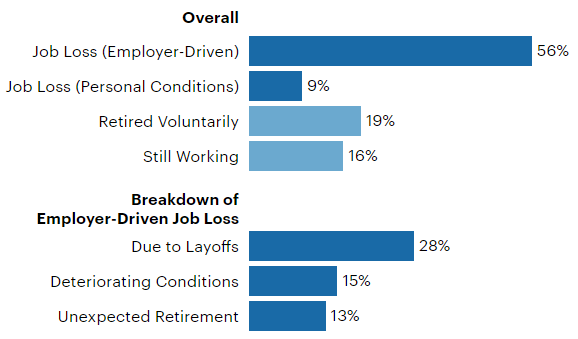
Through 2016, our analysis found that between the time older workers enter the study and when they leave paid employment, 56 percent are laid off at least once or leave jobs under such financially damaging circumstances that it’s likely they were pushed out rather than choosing to go voluntarily.
Only one in 10 of these workers ever again earns as much as they did before their employment setbacks, our analysis showed. Even years afterward, the household incomes of over half of those who experience such work disruptions remain substantially below those of workers who don’t.
“This isn’t how most people think they’re going to finish out their work lives,” said Richard Johnson, an Urban Institute economist and veteran scholar of the older labor force who worked on the analysis. “For the majority of older Americans, working after 50 is considerably riskier and more turbulent than we previously thought.”
The HRS is based on employee surveys, not employer records, so it can’t definitively identify what’s behind every setback, but it includes detailed information about the circumstances under which workers leave jobs and the consequences of these departures.
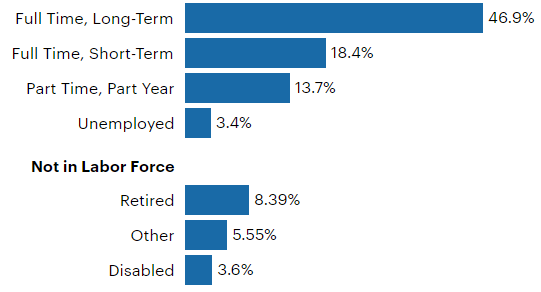
We focused on workers who enter their 50s with stable, full-time jobs and who’ve been with the same employer for at least five years — those who HRS data and other economic studies show are least likely to encounter employment problems. We considered only separations that result in at least six months of unemployment or at least a 50 percent drop in earnings from pre-separation levels.
Then, we sorted job departures into voluntary and involuntary and, among involuntary departures, distinguished between those likely driven by employers and those resulting from personal issues, such as poor health or family problems. (See the full analysis here.)
We found that 28 percent of stable, longtime employees sustain at least one damaging layoff by their employers between turning 50 and leaving work for retirement.
“We’ve known that some workers get a nudge from their employers to exit the work force and some get a great big kick,” said Gary Burtless, a prominent labor economist with the Brookings Institution in Washington. “What these results suggest is that a whole lot more are getting the great big kick.”
A Majority of Older Americans With Stable Jobs Are Pushed Out of Work
Americans who enter their 50s working full-time, long-held positions — the steadiest type of work — report being pushed out of their jobs by their employers.
Note: Estimates are based on a sample of 2,086 respondents employed full time, full year at ages 51 to 54 and who have been with the same employer for at least five years and who are observed at least until age 65. The analysis considers only job departures that were followed by at least six consecutive months of nonemployment or that resulted in at least a 50 percent decline in weekly earnings for at least two years. Some respondents experienced more than one type of involuntary job departure after age 50, but the departure categories are arranged hierarchically so that no more than one type of separation is counted for any worker. / Source: Data analysis by ProPublica and the Urban Institute, based on the Health and Retirement Study survey by the University of Michigan Institute for Social Research.
An additional 13 percent of workers who start their 50s in long-held positions unexpectedly retire under conditions that suggest they were forced out. They begin by telling survey takers they plan to keep working for many years, but, within a couple of years, they suddenly announce they’ve retired, amid a substantial drop in earnings and income.
Jeffrey Wenger, a senior labor economist with the RAND Corp., said some of these people likely were laid off, but they cover it up by saying they retired. “There’s so much social stigma around being separated from work,” he said, “even people who are fired or let go will say they retired to save face.”
Finally, a further 15 percent of over-50 workers who begin with stable jobs quit or leave them after reporting that their pay, hours, work locations or treatment by supervisors have deteriorated. These, too, indicate departures that may well not be freely chosen.
Taken together, the scale of damage sustained by older workers is substantial. According to the U.S. Census Bureau, there are currently 40 million Americans age 50 and older who are working. Our analysis of the HRS data suggests that as many as 22 million of these people have or will suffer a layoff, forced retirement or other involuntary job separation. Of these, only a little over 2 million have recovered or will.
“These findings tell us that a sizable percentage, possibly a majority, of workers who hold career jobs in their 50s will get pushed out of those jobs on their way to retirement,” Burtless said. “Yes, workers can find jobs after a career job comes to an early, unexpected end. But way too often, the replacement job is a whole lot worse than the career job. This leaves little room for the worker to rebuild.”
When you add in those forced to leave their jobs for personal reasons such as poor health or family trouble, the share of Americans pushed out of regular work late in their careers rises to almost two-thirds. That’s a far cry from the voluntary glide path to retirement that most economists assume, and many Americans expect.
What Americans Do for Work as They Enter Their 50s
Labor Force
Steckel knows a lot about how tough the labor market can be for older workers, and not just because of his own job losses. He’s spent much of his career in human resources, often helping employers show workers — including many, like him, over 50 — the door.
In most instances, he said he’s understood the business rationale for the cuts. Employers need to reduce costs, boost profits and beat the competition. But he also understands the frustration and loss of control older workers feel at having their experience work against them and their expectations come undone.
“Nobody plans to lose their job. If there’s work to do and you’re doing it, you figure you’ll get to keep doing it,” he said recently. But once employers start pushing people out, no amount of hard work will save you, he added, and “nothing you do at your job really prepares you for being out” of work.
For 50 years, it has been illegal under the federal Age Discrimination in Employment Act, or ADEA, for employers to treat older workers differently than younger ones with only a few exceptions, such as when a job requires great stamina or quick reflexes.
For decades, judges and policymakers treated the age law’s provisions as part and parcel of the nation’s fundamental civil rights guarantee against discrimination on the basis of race, sex, ethnic origin and other categories.
But in recent years, employers’ pleas for greater freedom to remake their workforces to meet global competition have won an increasingly sympathetic hearing. Federal appeals courts and the U.S. Supreme Court have reacted by widening the reach of the ADEA’s exceptions and restricting the law’s protections.
Meanwhile, most employers have stopped offering traditional pensions, which once delivered a double-barreled incentive for older workers to retire voluntarily: maximum payouts for date-certain departures and the assurance that benefits would last as long as the people receiving them. That’s left workers largely responsible for financing their own retirements and many in need of continued work.
“There’s no safe haven in today’s labor market,” said Carl Van Horn, a public policy professor and director of the Heldrich Center for Workforce Development at Rutgers University in New Jersey. “Even older workers who have held jobs with the same employer for decades may be laid off without warning” or otherwise cut.
In a story this year, ProPublica described how IBM has forced out more than 20,000 U.S. workers aged 40 and over in just the past five years in order to, in the words of one internal company planning document, “correct seniority mix.” To accomplish this, the company used a combination of layoffs and forced retirements, as well as tactics such as mandatory relocations seemingly designed to push longtime workers to quit.
In response, IBM issued a statement that said, in part, “We are proud of our company and our employees’ ability to reinvent themselves era after era, while always complying with the law.”
As an older tech firm trying to keep up in what’s seen as a young industry, IBM might seem unique, but our analysis of the HRS data suggests the company is no outlier in how it approaches shaping its workforce.
The share of U.S. workers who’ve suffered financially damaging, employer-driven job separations after age 50 has risen steadily from just over 10 percent in 1998 to almost 30 percent in 2016, the analysis shows.
The turbulence experienced by older workers is about the same regardless of their income, education, geography or industry.
Some 58 percent of those with high school educations who reach their 50s working steadily in long-term jobs subsequently face a damaging layoff or other involuntarily separation. Yet more education provides little additional protection; 55 percent of those with college or graduate degrees experience similar job losses.
Across major industrial sectors and regions of the country, more than half of older workers experience involuntarily separations. The same is true across sexes, races and ethnicities, although a larger share of older African-American and Hispanic workers than whites are forced out of work by poor health and family crises, the data shows. This could indicate that minority workers are more likely to have jobs that take a bigger toll on health.
Once out, older workers only rarely regain the income and stability they once enjoyed.
Many Older Americans Are Pushed Out Multiple Times
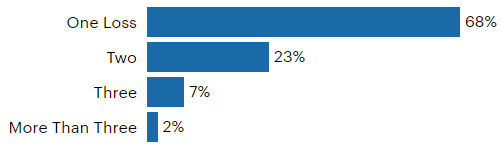
Among workers over 50 who have lost one job, a third go on to lose two or more jobs.
Jaye Crist, 58, of Lancaster, Pennsylvania, was a mid-level executive with printing giant RR Donnelley until his May 2016 layoff. Today, he supports his family on less than half his previous $100,000-a-year salary, working 9 a.m. to 5 p.m. at a local print shop, 7 p.m. to 2 a.m. at the front desk of a Planet Fitness gym and bartending on Sundays.
Linda Norris, 62, of Nashua, New Hampshire, earned a similar amount doing engineering work for defense contractors before being laid off in late 2015. She spent much of 2016 campaigning for then-candidate Donald Trump and is convinced her fortunes will change now that he’s president. In the meantime, she hasn’t been able to find a permanent full-time job and said she has $25 to her name.
The HRS is widely considered the gold standard for information about the economic lives and health of older Americans. It’s funded by the National Institutes of Health and the Social Security Administration and is administered by the University of Michigan. It has been cited in thousands of academic papers and has served as the basis for a generation of business and government policymaking.
Our analysis suggests that some of those policies, as well as a good deal of what analysts and advocates focus on when it comes to aging, don’t grapple with the key challenges faced by working Americans during the last third or so of their lives.
Much public discussion of aging focuses on Social Security, Medicare and how to boost private retirement savings. But our analysis shows that many, perhaps most, older workers encounter trouble well before they’re eligible for these benefits and that their biggest economic challenge may be hanging onto a job that allows for any kind of savings at all.
“We’re talking about the wrong issues,” said Anne Colamosca, an economic commentator who co-authored one of the earliest critiques of tax-advantaged savings plans, “The Great 401(k) Hoax.” “Having a stable job with good wages is more important to most people than what’s in their 401(k). Getting to the point where you can collect Social Security and Medicare can be every bit as hard as trying to live on the benefits once you start getting them.”
Layoffs are the most common way workers over 50 get pushed out of their jobs, and more than a third of those who sustain one major involuntary departure go on to experience additional ones, as the last decade of Steckel’s work life illustrates.
Steckel spent 27 years with the U.S. affiliate of Maersk, the world’s largest container cargo company, working at several of its operations across the country. It was while managing a trucking terminal in Chicago that he met his wife, an MBA student who went on to become the marketing director at Thorek Memorial Hospital on the city’s North Side.
In the late 1990s, Steckel was promoted to a human resources position. It required the family to relocate to the company’s headquarters in northern New Jersey, but the salary — which, with bonuses, would eventually reach about $130,000 — allowed Mary to be a stay-at-home mom.
Steckel saw himself continuing to climb the company’s ranks, but as shipping technology changed and business slumped in the middle of the last decade, Maersk started consolidating operations and laying people off. Steckel flew around the country to notify employees, including some he knew personally.
“It was pretty hard not to notice that many — not all, but many — were over 50,” he said. A Maersk spokesman confirmed Steckel worked for the company but otherwise declined to comment.
In early 2007, Steckel, then 51, was laid off.
He and Mary moved back to the Midwest, where the cost of living was lower and they had relatives.
Layoffs are common in the U.S. economy; there were 20.7 million of them last year alone, according to the Bureau of Labor Statistics. In most instances, those who lose their jobs find new ones quickly. Steckel certainly assumed he would.
But laid-off workers in their 50s and beyond are more apt than those in their 30s or 40s to be unemployed for long periods and land poorer subsequent jobs, the HRS data shows. “Older workers don’t lose their jobs any more frequently than younger ones,” said Princeton labor economist Henry Farber, “but when they do, they’re substantially less likely to be re-employed.”

Steckel was out of work for eight months. The family made do, buoyed by generous severance pay and a short consulting contract. They did without dinners out, vacations or big purchases, but were basically okay.
Steckel was hired again in January 2008, this time as a benefits manager for Kohler, a manufacturer of bathroom fixtures. At about $90,000, his salary was 30 percent lower than what he’d made at Maersk, but Wisconsin was so affordable that the family was able to buy the house and five acres in Plymouth.
Kohler seemed like a safe bet. Many of its employees had never worked anywhere else, following their parents and grandparents into lifetime jobs with the company. But as Steckel started in his new position, the U.S. financial crisis cratered real estate and home construction and, with them, Kohler’s business.
This time, Steckel’s role in executing layoffs was explaining severance packages to the company’s shellshocked factory workers.
“Most of these people were in their late 40s and 50s and there was nothing out there for them,” he said. “They’d come in with their wives and some of them would break down and cry.”
After three years, Kohler’s problems leapt from the factory to the front office. Steckel, by then 54, was laid off again in April 2010. A Kohler spokeswoman did not reply to phone calls and emails.
Still the family’s sole breadwinner, with kids in fourth, eighth and ninth grades, he scrambled for new work and, after a string of interviews, landed a job just four months later as the manager of retirement plans at Alpha Natural Resources.
Alpha, in the coal mining business, was riding a double wave of demand from China and U.S. steel producers, snapping up smaller companies on its way to becoming an industry behemoth.
Steckel’s job was a big one, overseeing complicated, union-negotiated pensions and savings arrangements. At $145,000, the salary represented a substantial raise from what he’d been making at Kohler and was even more than he’d earned at Maersk. The Steckels relocated again, this time to the tiny southwest Virginia town of Abingdon.
“We started thinking: ‘This may be it. This is where we’ll stay,’” Mary Steckel said. “Then, all that changed.”
In January 2011, Alpha bought Massey Energy for $8.5 billion and with it the responsibility for reaching financial settlements with the families of 29 miners killed the previous year in an explosion at Massey’s Upper Big Branch mine in West Virginia. The combination of the settlement costs and a sustained fall in coal prices forced layoffs at Alpha and eventually led to the company’s bankruptcy.
Steckel struggled to collect decades of paper records on wages and years of service in order to calculate pension payments for laid-off miners, virtually all in their 50s and 60s. “There were no jobs for them, but they were owed [pension benefits] and they wanted their money yesterday,” he said. A spokesman for the successor company to Alpha, Contura Energy, did not return phone calls or emails.
Once again, he processed other employees’ layoffs right up until his own, in March 2013. He was 56. The Steckels packed the kids and the family’s belongings into their Mercury Sable station wagon and went back to Wisconsin.
There, Mary took a job at Oshkosh Defense, which builds Humvees and other equipment for the military. Tom was out of work almost six months before landing a consulting contract to work in Milwaukee with Harley-Davidson, the motorcycle maker.
If it had lasted, the position would have paid about $90,000, or about what he’d made at Kohler, and, for a time, it seemed possible that it might turn into a regular job. But it didn’t, and he was out again that December.
Unlike Steckel, Jean Potter of Dallas, Georgia, seemed to leave her longtime job at BellSouth by her own choice, taking early retirement in 2009, when she was 55.
But that wasn’t the full story, she said. Potter, who’d had a 27-year career with the telephone company, rising from operator services to pole-climbing line work to technical troubleshooting, said she only retired after hearing she was going to lose her $54,000-a-year job along with thousands of other employees being laid off as part of the company’s acquisition by AT&T.

Under the law, retirements are supposed to be voluntary decisions made by employees. The 1967 ADEA barred companies from setting a mandatory retirement age lower than 65. Congress raised that to 70 and then, in 1986, largely prohibited mandatory retirement at any age. Outraged by companies’ giving employees the unpalatable choice of retiring or getting laid off, lawmakers subsequently added a requirement that people’s retirement decisions must be “knowing and voluntary.”
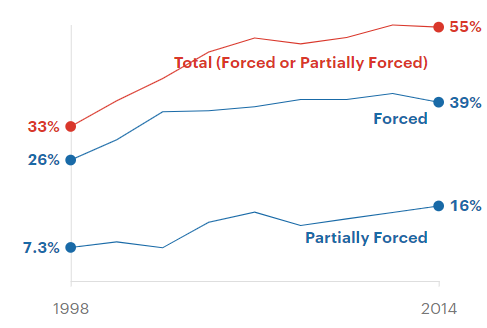
Yet for almost two decades now, when HRS respondents who’ve recently retired have been asked whether their retirements were “something you wanted to do or something you felt forced into,” those who’ve answered they were forced or partially forced has risen steadily. The number of respondents saying this has grown from 33 percent in 1998 to 55 percent in 2014, the last year for which comparable figures are available.
A Majority of New Retirees in 2014 Said They Were Forced to Retire
The percentage of recent retirees who said their retirement was forced or partially forced has risen steadily over two decades and reached 55 percent in 2014, the last year for which comparable figures are available.
Note: Estimates are based on a sample 13,988 respondents who reported being newly retired. Respondents are categorized by the year in which they first reported being retired. Results are only through 2014 because information needed to make 2016 numbers comparable is not yet available. / Source: Data analysis by ProPublica and the Urban Institute, based on the Health and Retirement Study survey by the University of Michigan Institute for Social Research.
“The expectation that American workers decide when they want to retire is no longer realistic for a significant number of older workers who are pushed out before they are ready to retire,” said Rutgers’ Van Horn.
Potter was convinced she’d secured money and benefits by leaving as a retiree that she would not otherwise have received. She felt better for making the decision herself and figured she’d go back to school, get a college degree and find a better job.
“I thought I’d gotten the drop on them by retiring,” she said.
But looking back, Potter acknowledges, her decision to retire was hardly freely chosen.
“If I had to do it over, I’d take early retirement again, but you can’t very well call it voluntary,” she said recently. “All the old people were toast. They were going to get laid off, me included.”
Jim Kimberly, a spokesman for AT&T, said the company could not confirm Potter’s employment at BellSouth because of privacy concerns. Speaking more generally, Kimberly said “We’re recognized for our longstanding commitment to diversity. We don’t tolerate discrimination based on an employee’s age.”
There was a time when older workers thought they could use early retirements as a stepping stone, locking in years of payments for leaving and then adding income from new jobs on top of that.
But many have discovered they can’t land comparable new jobs, or, in many cases, any jobs at all. In the decade since she left Bell South, Potter, now 65, has yet to find stable, long-term work.

After getting her bachelor’s degree in Spanish in 2014, Potter applied to teach in the Cobb County, Georgia, public schools but could only get substitute work. She got certified to teach English as a second language but said she was told she’d need a master’s degree to land anything beyond temporary jobs.
She’s scheduled to receive her master’s degree next June. In the meantime, she tutors grade-school students in math, English and Spanish and works as a graduate assistant in the office of multicultural student affairs at Kennesaw State University. She makes do on $1,129 a month from Social Security and a graduate-student stipend of $634, while applying, so far unsuccessfully, for other work.
She’s applied for jobs selling cellphones in a mall, providing call-center customer service and even being a waitress at a Waffle House. For the Waffle House job, she said she was told she wouldn’t be hired because she’d just leave when she got a better offer.
“Isn’t that what every waitress does?” she recalled replying. “Why hire them and not me?”

As with retirements, our analysis of the HRS data shows that, among older workers, quitting a job isn’t always the voluntary act most people, including economists, assume it to be.
The survey asks why people leave their jobs, including when they quit. It includes questions about whether their supervisors encouraged the departure, whether their wages or hours were reduced prior to their exit and whether they thought they “would have been laid off” if they didn’t leave.
We found that even when we excluded all but the most consequential cases — those in which workers subsequently experienced at least six months of unemployment or a 50 percent wage decline — 15 percent of workers over 50 who’d had long-term, stable jobs quit or left their positions after their working conditions deteriorated or they felt pressured to do so.
Quitting a job carries far greater risk for older workers than for younger ones, both because it’s harder to get rehired and because there’s less time to make up for what’s lost in being out of work.
After a simmering disagreement with a supervisor, David Burns, 50, of Roswell, Georgia, quit his $90,000-a-year logistics job with a major shipping company last February. He figured that the combination of his education and experience and the fact that unemployment nationally is at a 20-year low assured that he’d easily land a new position. But 10 months on, he says he’s yet to receive a single offer of comparable work. To help bring in some money, he’s doing woodworking for $20 an hour.
Burns has an MBA from Georgia State University and two decades in shipping logistics. A quick scan of online job ads turns up dozens for logistics management positions like the one he had in the area where he lives.
When he’d last lost a job at the age of 35, he said it took him only a couple of months and four applications to get three offers and a new spot. But in the years since, he said, he seems to have crossed a line that he wasn’t aware existed, eliminating his appeal to employers.
He keeps a spreadsheet of his current efforts to find new work. Through November, it shows he filed 160 online job applications and landed 14 phone interviews, nine face-to-face meetings and zero offers.
“My skills are in high demand,” he said. “But what’s not in high demand is me, a 50-year-old dude!”
“People can quibble about exactly why this kind of thing is going on or what to do about it, but it’s going on.”
Meg Bourbonniere had a similar experience just as she seemingly had reached the pinnacle of a successful career.
Two weeks after being appointed to a $200,000-a-year directorship managing a group of researchers at Massachusetts General Hospital in Boston in March 2015, Bourbonniere, then 59, said her supervisor called with an odd question: When did she think she’d be retiring?
“I kept asking myself, ‘Why would that be important today?’” she recalled. “The only thing I could come up with was they think I’m too old for the job.‘’
After she answered, “I’ll be here as long as you are,” she said she ran into an array of problems on the job: her decisions were countermanded, she was given what she saw as an unfairly negative job review and she was put on a “personal improvement plan” that required her to step up her performance or risk dismissal. Finally, a year after being hired, she was demoted from director to nurse scientist, the title held by those she’d managed.
Michael Morrison, a spokesman for Mass General’s parent organization, Partners HealthCare, confirmed the dates of Bourbonniere’s employment but said there was nothing further he could share as the company doesn’t comment on individual employees.
Bourbonniere said she accepted the demotion because her husband was unemployed at the time. “I couldn’t not work,” she said. “I was the chief wage earner.”
Through a friend, she found out about an opening for an assistant professor of nursing at the University of Rhode Island that, at about $75,000, paid only a third as much as the Mass General job. She told the friend she’d apply on one condition. “I said she had to tell the dean how old I was so I wouldn’t go through the same experience all over again.”
On paper, Bourbonniere quit Mass General of her own accord to take the position at URI. But, in her eyes, there was nothing voluntary about the move. “I had to go find another job,” she said. “They demoted me; I couldn’t stay.”
Soon after Steckel’s consulting contract ended in late 2013, he got what he saw as a sharp reminder of the role age was playing in his efforts to get and keep a job.
While searching job sites on his computer, Steckel stumbled across what seemed like his dream job on LinkedIn. Business insurer CNA Financial was looking for an assistant vice president to head its employee benefits operation. Best yet, the position was at CNA’s Chicago headquarters, a mere 145 miles from Plymouth. He immediately applied.
The application asked for the year he’d graduated from college.
Older job seekers are almost universally counseled not to answer questions like this. The ADEA bars employers from putting age requirements in help-wanted ads, but as job searches have moved online, companies have found other ways to target or exclude applicants by age. Last year, ProPublica and The New York Times reported that employers were using platforms like Facebook to micro-target jobs ads to younger users. Companies also digitally scour resumes for age indicators, including graduation dates.
Steckel left the field in the CNA application blank, but when he pushed “submit,” the system kicked it back, saying it was incomplete. He reluctantly filled in 1978. This time, the system accepted the application and sent back an automated response that he was in the top 10 percent of applicants based on his LinkedIn resume.
Hours later, however, he received a second automated response saying CNA had decided to “move forward with other candidates.” The rejection rankled Steckel enough that he tracked down the email address of the CNA recruiter responsible for filling the slot.
“Apparently, CNA believes a college application date is so important that it is a mandatory element in your job application process,” his email to the recruiter said. “Please cite a credible, peer-reviewed study that affirms the value of the year and date of one’s college graduation as a valid and reliable predictor of job success.”
He never got an answer.
Contacted by ProPublica, CNA spokesman Brandon Davis did not respond to questions but issued a statement. “CNA adheres to all applicable federal, state and local employment laws, and our policy prohibits any form of discrimination,” it said.
Steckel landed his current job with the state of South Dakota in March 2014.
Going back and forth between Pierre and Plymouth since then, he’s driven the equivalent of once around the world. If, as he hopes, he can hang onto the position until he retires, he figures he’ll make it around a second time.

During his off hours in the spring, when he’s not with his family, he fishes in the Black Hills. In the fall, he goes out with his Mossberg 12-gauge shotgun and hunts duck. The loneliest months are January and February. That’s when the Legislature is in session, so he can’t go home, and it’s usually too cold to do much outside. He spends a lot of time at the Y.
A half-century ago, in a report that led to enactment of the ADEA, then-U.S. Labor Secretary W. Willard Wirtz said that half of all private-sector job ads at the time explicitly barred anyone over the age of 55 from applying and a quarter barred anyone over 45.

Wirtz lambasted the practice in terms that, although backward in their depiction of work as solely a male concern, still ring true for older workers like Steckel and their families.
“There is no harsher verdict in most men’s lives than someone else’s judgment that they are no longer worth their keep,” he wrote. “It is then, when the answer at the hiring gate is ‘You’re too old,’ that a man turns away … finding nothing to look backwards to with pride [or] forward to with hope.”
Asked how the years of job turmoil and now separation have affected her family, Mary Steckel resists anger or bitterness.
“The children know they are loved by two parents, even if Tom is not always here,” she said. She doesn’t dwell on the current arrangement. “I just deal with it.”
As for Tom?
“He hasn’t admitted defeat,” Mary said, although something has changed. “He’s not hopeful anymore.”
Originally published by ProPublica, 12.28.2018, under a Creative Commons Attribution-NonCommercial-NoDerivs 3.0 United States license.
About the Author