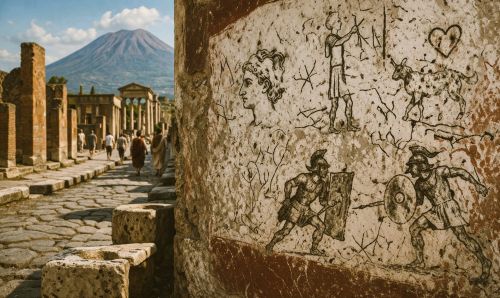
Graffiti in Pompeii reveals a dynamic system of public communication that functioned much like social media, shaping identity, interaction, and community in the Roman world.

By Matthew A. McIntosh
Public Historian
Brewminate
Introduction: Writing on the Wall as a Social System
The city of Pompeii, preserved in volcanic ash after the eruption of Mount Vesuvius in 79 CE, offers an unparalleled archive of everyday communication in the ancient Roman world. Unlike literary texts transmitted through elite copying traditions, the writings across Pompeian walls reflect the voices of ordinary inhabitants: tradesmen, lovers, political supporters, and passersby. These writings, numbering in the thousands, range from crude marks to elaborate messages of persuasion and wit. Far from marginal or incidental, they constitute a dense and dynamic communicative environment within urban life.
For much of modern scholarship, graffiti was treated as ephemera, dismissed as vandalism or vulgar expression. Early archaeological approaches often prioritized monumental inscriptions and elite material culture, leaving informal writing at the margins of serious historical inquiry. Graffiti was frequently catalogued but rarely interpreted, its value reduced to anecdotal illustration rather than analysis. This view has shifted in recent decades as historians and archaeologists have reconsidered the evidentiary value of informal writing. Scholars now emphasize that graffiti must be understood within its spatial context and social setting, as part of a broader system of communication that operated alongside more formal inscriptions and texts. The walls of Pompeii were not passive surfaces but active sites of interaction, where messages accumulated, overlapped, and responded to one another in ways that reveal patterns of engagement rather than isolated acts. This shift reflects a broader methodological change in Roman social history, one that privileges everyday practices and non-elite voices as essential to reconstructing lived experience.
To approach Pompeian graffiti as a social system is to recognize its structural similarities to modern forms of public communication. The walls functioned as accessible platforms where individuals could assert identity, share opinions, promote candidates, and comment on others’ messages. Writing was not confined to a single voice but unfolded through layers of additions, corrections, and replies, producing a visible record of social exchange. This dynamic environment suggests that Pompeian graffiti operated less as static inscription and more as an ongoing conversation, shaped by visibility, proximity, and participation.
The argument advanced here is that graffiti in Pompeii constituted a decentralized, participatory medium that fulfilled many of the same social functions as contemporary digital platforms. While separated by technology and scale, both systems are rooted in the human impulse to communicate publicly, to leave a trace of one’s presence, and to engage with others in shared spaces. By reframing Pompeian graffiti as a form of networked communication rather than incidental writing, we gain a clearer understanding of how ancient communities organized and experienced everyday interaction.
The Physical Wall as a Public Interface
The communicative power of Pompeian graffiti depended fundamentally on the physical environment in which it was inscribed. The urban landscape of Pompeii, with its dense network of streets, shops, and domestic spaces, created a highly visible and accessible canvas for written expression. Walls along major thoroughfares, near intersections, and around commercial establishments accumulated layers of inscriptions, transforming them into focal points of social interaction. These were not hidden or marginal locations but prominent surfaces encountered in the rhythms of daily movement. The placement of graffiti was neither accidental nor incidental; it was shaped by patterns of foot traffic, visibility, and social congregation. Individuals moving through the city would encounter these inscriptions repeatedly, reinforcing their familiarity and extending their reach beyond a single moment of viewing. The wall became part of the lived experience of the street itself, embedded within routines of work, leisure, and exchange.
The wall functioned as a shared interface that mediated communication between individuals who might never meet directly. Unlike formal inscriptions commissioned by elites and positioned for long-term display, graffiti operated within a more fluid and immediate spatial logic. Writers selected surfaces that maximized exposure, often placing messages at eye level or near entrances where they would be easily seen. This spatial awareness suggests a deliberate engagement with audience and context, indicating that graffiti writers understood the wall as a communicative medium rather than a neutral backdrop.
The distinction between public and private space in Pompeii further complicates our understanding of graffiti as a social interface. While many inscriptions appeared on exterior walls facing the street, others were found within the vestibules and atria of private homes, areas that blurred the boundary between domestic and public life. These semi-private zones were accessible to visitors, clients, and passersby, making them ideal sites for communication that targeted specific audiences while remaining broadly visible. Homeowners did not always prevent such writing, and in some cases may have tolerated or even encouraged it, suggesting a level of social acceptance for this form of expression. The permeability of these spaces reflects the interconnected nature of Pompeian society, where private property did not function as a strict barrier to public interaction. The wall served not only as a physical boundary but also as a communicative bridge, linking different spheres of social life.
Literacy levels in the Roman world, while uneven, were sufficient to support widespread engagement with written communication in urban settings like Pompeii. Even those who could not read fluently would have been familiar with common names, slogans, and symbols, allowing graffiti to function effectively within a mixed audience. The repetition of certain phrases and the prominence of recognizable names enhanced legibility and reinforced communal awareness. Writing on walls did not require elite education but instead relied on shared cultural knowledge and visual familiarity, making it an inclusive medium of expression within the urban population.
The accumulation of inscriptions transformed individual walls into dynamic textual landscapes. Messages were added, overwritten, or partially erased, creating a layered record of interaction that unfolded across days, months, or years. This process gave the wall a temporal dimension, as newer inscriptions responded to or displaced earlier ones, generating a sense of continuity and change. The result was not a static collection of isolated texts but an evolving communicative surface, shaped by ongoing participation. Pompeian walls operated as continuously updated social spaces, where visibility, proximity, and repetition structured the flow of information.
Conversation, Reply, and Interaction

Graffiti in Pompeii did not exist as isolated statements but as part of an ongoing, interactive exchange that unfolded across shared surfaces. Many inscriptions reveal clear evidence of response, whether through direct reply, modification, or juxtaposition. Writers engaged with one another by adding comments beneath existing texts, correcting earlier claims, or inserting their own voices into already active spaces. This dialogic quality challenges earlier interpretations that treated graffiti as static and individualistic. Instead, it suggests a communicative environment in which meaning was constructed collectively through visible participation.
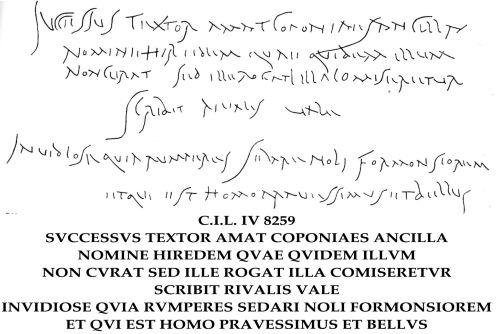
One of the most striking features of Pompeian graffiti is the presence of layered writing, where multiple hands contribute to a single communicative thread. In some cases, a declaration of affection might be followed by a sarcastic rebuttal, or a boast might provoke a mocking response. These exchanges reveal a level of social engagement that extends beyond mere expression into interaction. The wall functioned as a medium through which individuals could address one another indirectly, using shared space as a conduit for communication. Such interactions required not only literacy but also an awareness of prior messages and an intention to participate in an ongoing dialogue.
The physical act of overwriting or writing alongside existing inscriptions further reinforces this sense of conversation. Graffiti was rarely preserved in pristine isolation; instead, it was subject to constant revision as new messages were added. Writers had to negotiate space, choosing whether to place their words near, over, or in contrast to what was already present. This spatial negotiation created visual relationships between texts, linking them into clusters that could be read sequentially or in opposition. In some instances, the positioning of a response directly beneath or beside an earlier inscription made the relationship between the two unmistakable, guiding the reader toward a particular interpretation. In others, proximity alone suggested a connection, leaving readers to infer meaning through context. The result was a layered communicative field in which meaning emerged through proximity as much as through content, with the physical arrangement of words playing a crucial role in shaping interpretation.
Humor and wit played a central role in these interactions, often serving as tools for social bonding or subtle critique. Playful insults, exaggerated praise, and clever wordplay appear frequently in Pompeian graffiti, indicating that writers were attuned to the performative aspects of public writing. These elements suggest that graffiti functioned not only as communication but also as entertainment, inviting readers to engage with the text in ways that extended beyond its immediate content. The presence of humor also points to a shared cultural framework, where certain forms of expression would be recognized and appreciated by a broader audience.
At times, these exchanges could also reflect tension or conflict within the community. Insults directed at named individuals, criticisms of rivals, or dismissive remarks about earlier inscriptions demonstrate that graffiti could serve as a venue for disagreement as well as connection. The public nature of the wall amplified these interactions, making them visible to anyone who passed by. This visibility transformed private sentiments into communal knowledge, reinforcing the role of graffiti as a space where social relationships were negotiated in the open. In some cases, repeated references to the same individuals or topics suggest ongoing disputes or rivalries that played out across multiple inscriptions, turning the wall into a stage for sustained social drama. Such patterns indicate that graffiti was not merely reactive but could sustain longer-term exchanges that contributed to the social fabric of the community.
These features reveal that Pompeian graffiti operated as a form of asynchronous communication, where participants contributed at different times but remained connected through shared space. Unlike spoken conversation, which is immediate and ephemeral, graffiti allowed messages to persist, enabling others to respond hours or even days later. This temporal flexibility created a rhythm of interaction that was both continuous and cumulative. In this respect, the walls of Pompeii functioned as enduring conversational platforms, where voices intersected across time to produce a collective record of social exchange.
Identity, Presence, and Self-Expression

Graffiti in Pompeii provided individuals with a direct means of asserting identity within the shared spaces of the city. Unlike formal inscriptions commissioned by elites, these writings often bore the names of ordinary inhabitants, visitors, and even enslaved persons, offering rare glimpses into voices otherwise absent from the historical record. The simple act of inscribing one’s name on a wall signaled presence and participation, transforming the urban environment into a canvas of lived experience. These marks were not anonymous in the modern sense but frequently deliberate acts of self-identification, suggesting that visibility itself held social value.
Among the most common forms of expression were brief declarations of presence, often reduced to a name accompanied by a verb or phrase indicating arrival or action. Such inscriptions, while seemingly minimal, carried social meaning by situating the writer within a specific place and moment. They functioned as markers of movement and memory, allowing individuals to leave traces of themselves within the city’s fabric. The repetition of names across different locations further reinforced personal identity, creating a form of recognition that extended beyond immediate encounters and into a broader communal awareness.
Graffiti also served as a medium for more elaborate forms of self-expression, particularly in matters of love, desire, and personal relationships. Pompeian walls preserve numerous declarations of affection, ranging from earnest professions to exaggerated or playful statements. These inscriptions often named both the writer and the object of affection, making private sentiments publicly visible. In some cases, they reveal emotional intensity; in others, they suggest a performative aspect, where the expression of desire was crafted for an audience as much as for the individual addressed. This blending of sincerity and performance underscores the role of graffiti as both personal communication and social display. The language of these inscriptions frequently drew on familiar formulas, metaphors, and cultural references, indicating that writers were participating in shared conventions even as they expressed individual feelings. Variations in tone and style reveal attempts to stand out within a crowded communicative space, suggesting that writers were conscious of competition for attention. Expressions of love and desire were not only intimate declarations but also public performances shaped by the expectations and reactions of a wider audience.
The presence of named individuals associated with particular traits or reputations further illustrates how graffiti contributed to forms of social recognition akin to celebrity. Gladiators appear frequently in Pompeian inscriptions, often accompanied by comments praising their attractiveness or prowess. The well-known reference to Celadus as “the sigh of the girls” exemplifies how public writing could elevate individuals into figures of collective admiration. Such inscriptions reveal a shared cultural vocabulary through which individuals could gain visibility and status, reinforcing the idea that identity in Pompeii was shaped not only by personal actions but also by public perception.
These forms of expression demonstrate that Pompeian graffiti functioned as a medium through which individuals negotiated identity, presence, and reputation within their community. Writing on walls allowed people to assert themselves in ways that were both immediate and enduring, embedding personal narratives into the physical environment. While the scale and technology differ, the underlying impulse to present oneself, to be recognized, and to participate in a shared social space reflects patterns that remain deeply familiar. The walls of Pompeii reveal a society in which identity was actively constructed through public interaction, rather than confined to private or institutional domains.
Politics and Public Messaging
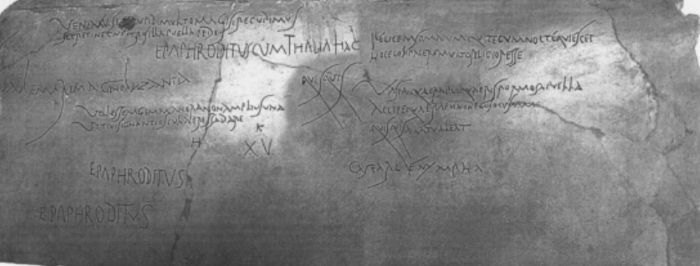
Political communication in Pompeii was deeply embedded in the visual and textual environment of the city, and graffiti played a central role in this process. Alongside more formal painted notices, known as programmata, informal inscriptions contributed to a dense landscape of political messaging that saturated public space. Walls facing streets and intersections became sites where candidates’ names, endorsements, and appeals to voters were displayed in ways that were both highly visible and continuously encountered. This ensured that political discourse was not confined to official announcements or elite gatherings but instead formed part of the everyday experience of moving through the city.
The programmata themselves, often professionally painted, demonstrate a structured approach to political advertising in which candidates sought to maximize exposure and legitimacy. These inscriptions typically included the name of the candidate, the office sought, and endorsements from individuals or groups, such as guilds or neighborhood associations. Their standardized format suggests an organized campaign strategy that relied on repetition and placement to influence public perception. The careful execution of these notices, often in bold lettering and positioned in prominent locations, indicates that candidates invested resources into ensuring their visibility and credibility. Yet these formal notices did not exist in isolation; they were part of a broader communicative field that included more spontaneous and less regulated forms of writing. The coexistence of professional and informal inscriptions created a layered political environment in which different voices and levels of authority intersected within the same visual space.
Graffiti intersected with this formal political landscape by providing a space for more flexible and immediate expressions of support or opposition. Individuals could add their own endorsements beneath or beside official notices, amplifying a candidate’s visibility or, at times, undermining it. These informal contributions often mirrored the language of the programmata while introducing variation in tone and content, reflecting personal or local concerns. Graffiti allowed political messaging to evolve beyond its original formulation, incorporating the voices of ordinary inhabitants into the campaign process.
The use of walls for political communication also reflects the importance of visibility and proximity in shaping electoral influence. Candidates and their supporters selected locations strategically, targeting areas with high foot traffic or particular social significance. Repetition across multiple sites reinforced recognition, ensuring that names and messages remained familiar to voters. This saturation of public space created a form of ambient political presence, where exposure to campaign messages occurred not through deliberate attention but through routine movement within the urban environment. The strategic distribution of inscriptions across neighborhoods also suggests an awareness of local demographics and social networks, as candidates sought to align themselves with specific communities or interest groups. Political messaging in Pompeii was both widespread and targeted, combining broad visibility with localized engagement.
The participatory nature of graffiti introduced an element of unpredictability into political messaging. While programmata conveyed carefully controlled information, graffiti could introduce humor, criticism, or commentary that altered the reception of those messages. This interplay between formal and informal writing suggests that political communication in Pompeii was not entirely top-down but involved negotiation between candidates and the broader community. The wall functioned as both a platform for persuasion and a site of response, where official narratives could be reinforced, contested, or reinterpreted.
These practices reveal that political life in Pompeii was closely tied to the communicative use of public space. The integration of formal notices and informal graffiti created a layered system of messaging that combined structure with spontaneity. By embedding political discourse within the physical environment of the city, Pompeians ensured that it remained visible, accessible, and open to participation. This system underscores the extent to which civic engagement in the Roman world relied not only on institutional processes but also on the everyday interactions of individuals within shared spaces.
Humor, Insult, and Social Tension

Pompeii graffiti frequently employed humor as a mode of communication, revealing a social environment in which wit, playfulness, and irony were integral to public interaction. Many inscriptions display a conscious effort to entertain as well as inform, using wordplay, exaggeration, and rhetorical flourish to capture attention. These humorous elements suggest that writers were aware of an audience and sought to engage it, transforming the wall into a space not only of communication but also of performance. The presence of laughter within these texts points to a shared cultural framework in which certain jokes and references could be widely understood. Humor also functioned as a social lubricant, easing interaction in a public setting where writers and readers were often anonymous to one another. By inviting amusement or recognition, these inscriptions created moments of connection that extended beyond the individual writer, reinforcing a sense of participation in a broader communicative culture.
Humor often overlapped with insult, creating a spectrum of expression that ranged from lighthearted teasing to more pointed criticism. Graffiti includes numerous examples of individuals mocking others by name, questioning their character, or ridiculing their behavior. These insults, while sometimes crude, were part of a broader social practice in which public commentary served to negotiate reputation and status. The visibility of such remarks amplified their impact, exposing individuals to communal judgment and reinforcing the role of the wall as a space where social hierarchies could be both challenged and affirmed.
Sexual humor and explicit language appear prominently in Pompeian graffiti, reflecting a cultural context in which such expressions were not confined to private discourse. These inscriptions often combined humor with commentary on relationships, attraction, and desire, blurring the line between personal expression and public spectacle. While modern sensibilities may interpret these texts as vulgar, within their original context they functioned as recognizable forms of communication that engaged shared norms and expectations. The recurrence of such themes suggests that humor rooted in sexuality was a common and accepted feature of public writing.
The use of graffiti as a medium for insult and satire also reveals underlying tensions within Pompeian society. Disparaging remarks directed at named individuals, professions, or social groups indicate that the wall could serve as an outlet for frustration and conflict. In some cases, repeated references to particular figures suggest ongoing disputes that unfolded over time, with multiple contributors participating in a form of public commentary. This capacity for sustained interaction highlights the role of graffiti in mediating social relationships, allowing individuals to express grievances in a visible and enduring manner. The persistence of these remarks on shared surfaces ensured that conflicts were not easily contained or forgotten, instead becoming part of the communal environment. Graffiti functioned not only as expression but as a mechanism through which social tensions were made visible, negotiated, and, at times, intensified.
The interplay of humor and insult within Pompeian graffiti demonstrates that public writing functioned as a space where social dynamics were actively negotiated. The wall provided a venue for both connection and confrontation, where individuals could assert themselves, challenge others, and engage in shared cultural practices. These expressions, while informal, offer valuable insight into the emotional and social textures of everyday life, revealing a community in which communication was not only informational but also deeply embedded in the processes of interaction, judgment, and response.
Ephemerality, Permanence, and Memory

Pompeian graffiti existed within a paradoxical tension between immediacy and endurance, shaped by the materials and intentions of its creators. Most inscriptions were not designed for longevity but for momentary expression, scratched quickly into plaster or written in charcoal or paint that would naturally fade. Writers did not typically expect their messages to survive beyond the rhythms of daily life, and the act of inscription was often spontaneous rather than deliberate in its permanence. Yet the very act of writing on a wall gave these expressions a physical presence that distinguished them from spoken words, allowing them to persist long enough to be seen, read, and potentially answered by others.
This temporal dimension was further complicated by the constant layering of new inscriptions over old ones. Graffiti accumulated through processes of addition, erasure, and overwriting, creating surfaces that reflected ongoing cycles of communication. Earlier messages might be partially obscured or entirely replaced, while others remained visible alongside newer contributions, producing a palimpsest of social interaction. This layering suggests that Pompeian walls were never fixed texts but evolving records, shaped by continuous engagement rather than static preservation. The wall functioned as a space where memory was both constructed and contested, with visibility determined by the shifting priorities of those who wrote upon it.
The eruption of Mount Vesuvius in 79 CE transformed this otherwise transient medium into an accidental archive. What was intended as ephemeral communication became permanently fixed in ash, preserving a cross-section of Pompeian life at a single moment in time. This sudden preservation interrupts the normal cycle of disappearance that would have characterized graffiti, allowing modern observers access to a form of expression that was never meant to endure. The result is a unique historical record that captures the immediacy of lived experience while freezing it into a static form, creating a tension between the original temporality of the inscriptions and their modern permanence. The extraordinary circumstances of preservation also heighten the evidentiary value of graffiti, as they provide insight into everyday practices that would otherwise leave little trace in the archaeological record. Pompeii offers not merely a collection of texts but a snapshot of communicative habits caught at a specific historical moment, revealing patterns that would normally be lost to time.
This preservation raises important questions about the relationship between memory and materiality in the ancient world. Graffiti, as a form of informal writing, occupied a space between fleeting speech and durable inscription, bridging the gap between momentary expression and lasting record. The survival of these texts challenges assumptions about what constitutes meaningful historical evidence, demonstrating that everyday acts of communication can provide insight into social life when preserved under extraordinary circumstances. The selective nature of this preservation reminds us that what survives is only a fragment of a much larger and continually changing communicative landscape.
Pompeian graffiti reveals the complex interplay between ephemerality and permanence that characterizes many forms of human expression. While the original writers did not intend to create a lasting archive, their inscriptions have become enduring traces of identity, interaction, and memory. This transformation underscores the role of chance in shaping the historical record, as well as the importance of material context in determining what is remembered and what is lost. The walls of Pompeii, preserved against expectation, offer a rare opportunity to examine how transient communication can acquire lasting significance through the contingencies of history. They remind us that the survival of such material is exceptional rather than typical, and that much of the ancient world’s everyday communication has vanished without trace. What remains is not a complete record but a partial one, shaped by both human activity and the unpredictable forces of preservation.
Comparison with Modern Social Media
The following video captures the essence of graffiti in ancient Pompeii:
The comparison between Pompeian graffiti and modern social media rests not on superficial resemblance but on shared structural features rooted in human communication. Both systems operate through publicly visible platforms that allow individuals to project identity, share information, and engage with others beyond immediate interpersonal interaction. In Pompeii, the wall functioned as a communal surface where messages accumulated and circulated; in the modern world, digital platforms provide a virtual equivalent in which posts, comments, and replies form continuous streams of interaction. While the technologies differ dramatically, the underlying impulse to communicate within shared spaces remains consistent. This comparison is not meant to collapse historical differences but to illuminate how certain communicative patterns recur across time, shaped by the available medium yet grounded in enduring social needs. By examining these parallels carefully, it becomes possible to understand ancient graffiti not as a primitive precursor but as a fully developed system of public discourse operating within its own cultural and material constraints.
One of the clearest parallels lies in the construction and presentation of identity. Pompeian graffiti frequently included names, affiliations, and personal statements that allowed individuals to assert their presence within the community. Similarly, social media platforms enable users to curate profiles, share updates, and signal aspects of their identity to a broader audience. In both cases, visibility is central: to write on a wall or post online is to enter a public arena where recognition and response are possible. The act of self-presentation, whether through a name scratched into plaster or a digital profile, reflects a desire to be seen and acknowledged.
Interaction also follows comparable patterns, despite differences in medium and speed. Pompeian graffiti supported asynchronous communication, where responses could be added over time, creating layered exchanges that unfolded gradually. Modern social media accelerates this process, enabling near-instantaneous replies and continuous engagement. Yet the basic structure remains similar: messages invite response, responses generate further commentary, and communication becomes cumulative rather than isolated. In both contexts, the persistence of written content allows interactions to extend beyond the moment of their creation, linking participants across time. This continuity of interaction fosters a sense of shared participation, even when contributors are separated by hours or days, reinforcing the idea of a communal conversation that exists independently of any single individual. The durability of the written medium, whether plaster or digital code, enables these exchanges to accumulate into larger patterns of discourse that shape how communities understand themselves and one another.
The circulation of information and the amplification of particular messages further highlight these parallels. In Pompeii, frequently repeated names, slogans, or references gained prominence through their visibility across multiple locations. This repetition functioned as a form of reinforcement, ensuring that certain ideas or individuals remained salient within the communal environment. Modern social media achieves similar effects through sharing, reposting, and algorithmic amplification, which elevate certain content above others. Although the mechanisms differ, both systems demonstrate how visibility and repetition shape collective awareness.
Important differences distinguish ancient graffiti from contemporary digital platforms. The scale and speed of communication in the modern world far exceed those of Pompeii, where interaction was limited by physical proximity and the pace of urban life. Digital platforms allow messages to reach global audiences instantly, while Pompeian graffiti was confined to those who encountered it in specific locations. Additionally, modern systems often involve layers of mediation, including platform design and algorithmic filtering, that influence what is seen and how it is interpreted. In contrast, Pompeian graffiti operated within a more direct and unmediated environment, where visibility depended primarily on physical placement.
Despite these differences, the comparison underscores a fundamental continuity in human behavior. Both Pompeian graffiti and modern social media reflect a desire to communicate publicly, to engage with others, and to leave a trace of one’s presence within a shared space. By examining these parallels, it becomes clear that technological innovation has transformed the scale and form of communication but not its essential motivations. The walls of Pompeii and the screens of the present reveal different expressions of the same underlying social impulses, shaped by context yet rooted in enduring patterns of interaction.
Conclusion: Ancient Walls and Modern Screens
The graffiti of Pompeii reveals a communicative world that, while materially distant from our own, reflects deeply familiar patterns of human behavior. Writing on walls allowed individuals to participate in a shared social environment, to assert identity, to engage in dialogue, and to shape public perception within their community. These practices were embedded in the physical fabric of the city, transforming ordinary spaces into sites of interaction and expression. The survival of these inscriptions offers a rare and valuable opportunity to examine how communication functioned at the level of everyday life, outside the formal structures of literature and official record.
When placed alongside modern social media, Pompeian graffiti underscores the continuity of these communicative impulses across time. The tools have changed, expanding in scale, speed, and reach, but the fundamental desire to connect, to be seen, and to leave a mark persists. Both systems create environments in which individuals can engage with a broader audience, respond to others, and contribute to ongoing conversations that extend beyond immediate personal interaction. This continuity suggests that the emergence of digital platforms represents not a rupture with the past but an evolution of longstanding social practices shaped by new technologies.
The differences between ancient and modern systems highlight the ways in which technological context influences the form and impact of communication. The localized and relatively slow-moving exchanges of Pompeii contrast sharply with the global, instantaneous networks of the digital age. Modern platforms introduce new dynamics of visibility, amplification, and control, mediated by complex technological infrastructures that shape how information circulates. Algorithms determine what is seen and by whom, often prioritizing engagement over accuracy, while data collection and monetization add layers of economic incentive absent from ancient contexts. These structural differences alter not only the scale of communication but also its consequences, influencing political discourse, social cohesion, and the spread of information in ways that have no direct ancient parallel. While Pompeian graffiti operated within a bounded and relatively transparent environment, modern systems are shaped by opaque mechanisms that can amplify certain voices while marginalizing others, reshaping public conversation in subtle but powerful ways.
Ultimately, the comparison between ancient walls and modern screens invites a broader reflection on the relationship between communication, community, and memory. Pompeian graffiti, preserved by chance, captures a moment in which everyday voices became part of the historical record, revealing the richness and complexity of social life in the ancient world. Modern social media, by contrast, produces vast and continuous archives of interaction, raising new questions about preservation, interpretation, and the nature of public discourse. Together, these systems illuminate both the persistence of human expression and the transformative power of the media through which it is conveyed.
Bibliography
- Beard, Mary. Pompeii: The Life of a Roman Town. London: Profile Books, 2008.
- Benefiel, Rebecca R. “Dialogues of Graffiti in the House of the Four Styles at Pompeii.” American Journal of Archaeology 114, no. 1 (2010): 59–101.
- Benefiel, Rebecca R. “The Culture of Writing Graffiti within Domestic Spaces at Pompeii.” In Ancient Graffiti in Context, edited by Jennifer A. Baird and Claire Taylor, 20–35. London: Routledge, 2011.
- Boyd, Danah. It’s Complicated: The Social Lives of Networked Teens. New Haven: Yale University Press, 2014.
- Clarke, John R. Art in the Lives of Ordinary Romans: Visual Representation and Non-Elite Viewers in Italy, 100 B.C.–A.D. 315. Berkeley: University of California Press, 2003.
- —-. Looking at Laughter: Humor, Power, and Transgression in Roman Visual Culture, 100 B.C.–A.D. 250. Berkeley: University of California Press, 1998.
- Franklin, James L. Pompeis Difficile Est: Studies in the Political Life of Imperial Pompeii. Ann Arbor: University of Michigan Press, 2001.
- Keegan, Peter. Graffiti in Antiquity. London: Routledge, 2014.
- Milnor, Kristina. Graffiti and the Literary Landscape in Roman Pompeii. Oxford: Oxford University Press, 2014.
- Mouritsen, Henrik. Politics in the Roman Republic. Cambridge: Cambridge University Press, 2017.
- Richlin, Amy. The Garden of Priapus: Sexuality and Aggression in Roman Humor. New York: Oxford University Press, 1983.
- van Dijck, José. The Culture of Connectivity: A Critical History of Social Media. Oxford: Oxford University Press, 2013.
- Varone, Antonio. Eroticism in Pompeii. Rome: L’Erma di Bretschneider, 2002.
- Wallace-Hadrill, Andrew. Herculaneum: Past and Future. London: Frances Lincoln, 2011.
- —-. Houses and Society in Pompeii and Herculaneum. Princeton: Princeton University Press, 1994.
Originally published by Brewminate, 04.06.2026, under the terms of a Creative Commons Attribution-NonCommercial-NoDerivatives 4.0 International license.
About the Author