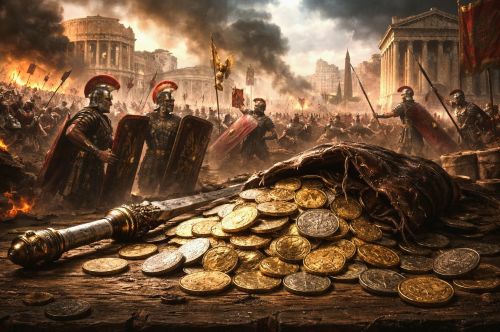
Roman warfare reshaped its economy, driving inflation through supply disruption, military pay pressures, and currency debasement that destabilized markets across the empire.

By Matthew A. McIntosh
Public Historian
Brewminate
Introduction: War Finance and the Fragility of Roman Monetary Stability
Military conflict was one of the most powerful forces shaping the Roman economy. From the expansionist wars of the Republic to the defensive struggles of the late Empire, the Roman state repeatedly faced the challenge of financing large armies across vast distances. Warfare required immense quantities of grain, metal, animals, equipment, and manpower, all of which placed extraordinary pressure on existing economic systems. Armies had to be equipped, transported, and supplied across continents, and the infrastructure required to sustain these operations (roads, ships, storehouses, and administrative systems) demanded constant investment. Even in periods of relative peace, the Roman state maintained large standing forces along its frontiers, meaning that military expenditures remained a permanent feature of imperial governance. The financial demands of sustaining armies did not merely affect state budgets. They reshaped monetary circulation, disrupted trade networks, and altered the relationship between coinage and market prices across the Mediterranean world. As a result, the Roman economy was never fully insulated from the fiscal consequences of war, and periods of intense conflict often triggered broader economic instability.
The Roman monetary system was particularly vulnerable to the fiscal demands of war because it relied heavily on precious metal coinage. Silver and gold coins derived their value not only from imperial authority but also from their intrinsic metal content. When governments faced urgent financial needs, especially during prolonged conflicts, the temptation to stretch limited bullion supplies became difficult to resist. Debasement, the reduction of precious metal content in coinage, allowed the state to produce larger quantities of money from the same reserves. While this strategy offered short-term fiscal relief, it often weakened public confidence in currency and contributed to rising prices.
War also destabilized the supply side of the Roman economy. Large armies consumed enormous quantities of food, animals, metals, and manufactured goods. Military campaigns could redirect shipping capacity toward logistical needs, disrupt agricultural production in contested regions, and interrupt trade routes that normally supplied urban markets. Rome itself depended heavily on imported grain from provinces such as Sicily, North Africa, and Egypt. When warfare interfered with these supply networks, shortages and price volatility could quickly follow. Grain fleets that normally supplied the capital could be delayed, requisitioned, or destroyed, while agricultural land in war zones could be abandoned or devastated by marching armies. Merchants also faced heightened risks when transporting goods across contested regions, which could reduce the overall volume of trade reaching major markets. Inflation in the Roman world was not solely a monetary phenomenon. It often emerged from the interaction between fiscal strain, currency manipulation, and disruptions to the flow of goods. The combined pressure of increased demand from the military and reduced supply in civilian markets created conditions in which prices could rise rapidly even before monetary policy intensified the problem.
These pressures became particularly visible during periods of sustained military crisis. The prolonged struggles of the Second Punic War, the resource demands of late Republican civil wars, and the monetary collapse of the third century all demonstrate how warfare repeatedly strained the Roman financial system. By the time Emperor Diocletian attempted to impose price ceilings in the early fourth century, inflation had already become deeply embedded in the imperial economy. Understanding the relationship between war finance and monetary instability is essential for explaining the broader economic transformations of the Roman world.
War and Supply Disruption: Grain, Trade Networks, and Price Volatility

Warfare in the Roman world frequently produced economic instability not only through fiscal pressures but also through disruptions to the supply systems that sustained urban life. The Roman economy depended heavily on long-distance trade networks connecting agricultural regions, mining centers, and major population hubs across the Mediterranean basin. Grain from Sicily, North Africa, and Egypt flowed toward Rome and other major cities, while metals, textiles, and other commodities circulated through interconnected maritime and overland routes. Military campaigns could rapidly destabilize these networks. Armies required enormous quantities of food, animals, timber, and metal, diverting resources away from civilian markets and placing immediate strain on supply chains that normally maintained price stability.
Grain supplies were particularly sensitive to wartime disruption. Rome’s population, which reached perhaps one million inhabitants during the early Empire, depended heavily on imported grain delivered through the annona system. The state organized large-scale shipments from key producing regions, especially Egypt and North Africa, to maintain urban food security. When conflict interfered with these supply routes, the consequences could be severe. Blockades, naval battles, piracy, or the redirection of transport vessels for military purposes could delay shipments and reduce the volume of grain reaching the capital. Even temporary interruptions could produce noticeable increases in prices within Rome’s markets, where demand remained constant but supply suddenly contracted. In addition, the grain supply chain itself was complex and vulnerable. Harvesting, storage, transportation to ports, shipping across the Mediterranean, and redistribution through Roman markets required coordination across multiple regions. War could disrupt any stage of this process. A damaged harbor, seized transport fleet, or devastated agricultural district could ripple outward through the entire supply system, producing shortages not only in Rome but in other cities dependent on the same networks. The fragility of this system meant that political or military instability in a single province could quickly translate into economic pressure across the broader Roman world.
The Second Punic War offers an early example of how prolonged conflict could strain Mediterranean supply systems. Hannibal’s invasion of Italy disrupted agricultural production across large parts of the peninsula, while Roman military mobilization consumed enormous quantities of food and materials. Fleets and transport vessels were frequently diverted toward military operations, complicating the normal movement of goods. Both Rome and Carthage struggled to secure reliable sources of silver and grain to finance and provision their armies. Although Rome eventually gained access to Spanish silver resources and restored its logistical networks, the prolonged conflict revealed how vulnerable ancient economies were to wartime disruption. Entire regions of southern Italy experienced repeated campaigning, with fields destroyed, livestock seized, and rural populations displaced. Such conditions reduced agricultural output precisely when the demand for military supplies was expanding. Meanwhile, Rome had to sustain large armies not only in Italy but also in Spain, Sicily, and North Africa. These campaigns required complex logistical coordination and drew heavily upon the same resources that normally supported civilian markets. Even when Rome maintained control of key shipping routes, the sheer scale of military mobilization placed enormous pressure on supply systems, creating conditions in which price fluctuations were increasingly likely.
Similar dynamics appeared during the civil wars of the late Republic. Military campaigns led by figures such as Julius Caesar, Pompey, and Mark Antony repeatedly interrupted trade routes and agricultural production. Armies marching through provinces requisitioned supplies, seized ships, and commandeered livestock and grain intended for civilian markets. In some cases, entire regions were stripped of resources to sustain military operations. Such requisitions could create localized shortages that quickly translated into rising prices in nearby urban centers. Because the Roman economy relied heavily on seasonal harvests and predictable transport cycles, even short-term disruptions could produce noticeable volatility in commodity prices.
Maritime trade networks were especially vulnerable during periods of intense conflict. The Mediterranean functioned as the central artery of Roman commerce, but wartime naval operations could easily disrupt shipping. Fleets engaged in combat or blockaded enemy ports often interfered with the movement of merchant vessels. Merchants themselves faced increased risks when transporting goods through contested waters, where piracy, interception, or requisition by military authorities could result in significant losses. As these risks increased, fewer merchants were willing to transport goods, further tightening supply and placing upward pressure on prices.
These examples demonstrate that inflation in the Roman world frequently began with disruptions to supply rather than purely monetary factors. Warfare simultaneously increased demand for resources while reducing the volume of goods reaching civilian markets. Armies consumed food, animals, metals, and manufactured products at a scale unmatched by any other institution in the Roman state. When this increased demand collided with damaged trade networks and interrupted agricultural production, price volatility became almost inevitable. Monetary debasement later intensified these pressures, but the initial shock often originated in the logistical disruptions produced by war itself. Military conflict functioned as both a consumer and a destroyer of economic resources. Armies consumed massive quantities of goods while simultaneously damaging the infrastructure and production systems that generated them. The resulting imbalance between supply and demand created an environment in which prices could rise sharply even before governments intervened through monetary policy or fiscal reforms.
Military Pay and the Fiscal Burden of Permanent Armies

The financial strain created by warfare in the Roman world did not arise solely from supply disruption. It also emerged from the structural costs of maintaining large armies over long periods of time. During the early Republic, Roman military service was largely organized around citizen levies who fought seasonally and returned to their farms when campaigns ended. Rome’s expanding territorial commitments made this system increasingly impractical. Armies began operating far from Italy for extended periods, requiring more consistent funding for equipment, supplies, and eventually salaries. As Rome’s military obligations expanded across the Mediterranean, the cost of sustaining these forces became one of the central fiscal challenges facing the Roman state.
The transformation of the Roman military during the late Republic and early Empire intensified these pressures. The reforms traditionally associated with Gaius Marius in the late second century BCE contributed to the emergence of a more professionalized army whose soldiers expected reliable compensation and long-term service opportunities. By opening recruitment more fully to landless citizens and emphasizing standardized equipment and organization, the Marian system encouraged longer periods of service and strengthened the bonds between soldiers and their commanders. Veterans increasingly expected rewards at the end of their service, including land grants or financial compensation, which placed additional obligations on Roman political leaders. By the imperial period, these expectations had evolved into a regularized system of salaries and retirement benefits administered by the state. Soldiers were paid annual stipends, received periodic donatives from emperors seeking to reinforce loyalty, and could anticipate pensions upon discharge. These benefits helped secure loyalty to the emperor, but they also locked the state into a system of permanent military expenditure. Maintaining legions along distant frontiers, from Britain and the Rhine to Syria and the Danube, required steady flows of money and resources regardless of whether major wars were underway. Even during relatively peaceful decades, the Roman government had to sustain tens of thousands of soldiers stationed across vast distances, creating a constant fiscal burden that could not easily be reduced.
Military salaries alone represented a substantial burden on imperial finances. Augustus established a regularized pay structure for legionaries and auxiliary troops and created the aerarium militare, a special military treasury designed to fund veterans’ pensions. Even with these institutional reforms, however, the financial weight of the army remained immense. Estimates suggest that military pay consumed a large proportion of imperial revenues throughout the early Empire. When additional campaigns or frontier emergencies arose, these costs increased further. The Roman state faced a constant challenge: it needed to maintain an army large enough to defend the empire while also preserving the fiscal stability required to sustain that army.
These pressures became even more pronounced during the third century. Political instability, external invasions, and repeated civil wars required emperors to secure the loyalty of soldiers who increasingly played a decisive role in determining imperial succession. Emperors often relied on financial incentives to maintain the allegiance of the army. One common strategy was raising military pay or distributing large donatives upon accession to the throne. Emperor Caracalla’s decision around 210 CE to increase soldier salaries by roughly fifty percent illustrates this dynamic. While the measure strengthened his standing with the army, it dramatically increased state expenditures. Funding such increases through conventional taxation alone proved difficult, especially during periods when warfare disrupted economic production and trade. As emperors struggled to finance these commitments, they frequently resorted to expanding the money supply or debasing coinage in order to generate additional revenue. These policies did not solve the underlying fiscal imbalance. Instead, they shifted the burden into the broader economy by weakening the value of currency and contributing to rising prices. The cumulative effect of repeated pay increases, donatives, and emergency expenditures created a cycle in which military loyalty depended increasingly on financial reward, forcing emperors to secure ever larger sums of money to maintain political stability.
The fiscal consequences of these policies extended far beyond the military sphere. As the cost of maintaining armies rose, the Roman government faced growing pressure to expand the money supply to meet its obligations. Coinage provided one of the most flexible instruments for addressing this challenge. By reducing the precious metal content of coins while continuing to mint them at high volume, imperial authorities could stretch limited bullion reserves to cover expanding military expenditures. In this way, the fiscal burden of permanent armies contributed directly to the monetary transformations that later fueled inflation across the Roman economy.
Coinage Debasement and the Inflationary Spiral

The mounting fiscal pressures created by warfare and military pay obligations eventually pushed Roman authorities toward one of the most consequential economic strategies available to an ancient state: the debasement of coinage. Because Roman currency was based largely on precious metals, especially silver, the value of coins was closely tied to their metal content. When the imperial government faced growing expenses that exceeded available revenue, it could stretch existing bullion supplies by reducing the amount of precious metal in each coin while maintaining the same nominal value. This practice allowed the state to mint a larger quantity of currency without acquiring additional silver or gold. In the short term, debasement provided a convenient means of meeting military payrolls and financing wartime expenditures.
Early examples of monetary adjustment appeared during periods of intense military pressure in the late Republic, when civil wars strained the Roman financial system. Competing leaders required enormous sums of money to pay troops, purchase supplies, and maintain political alliances. While these early disruptions did not yet produce the systemic inflation seen later, they revealed the vulnerability of Roman coinage to political and military pressures. Once the imperial government assumed responsibility for maintaining a permanent army, the temptation to manipulate the silver content of coins increased.
The process accelerated significantly during the third century CE, when the Roman Empire faced a series of overlapping crises. Foreign invasions along multiple frontiers, internal revolts, and frequent changes in imperial leadership forced successive emperors to secure the loyalty of soldiers under increasingly unstable conditions. Because armies had become the decisive political force in determining imperial authority, rulers often sought to ensure military support through higher pay and generous donatives. Financing these promises required large quantities of currency, yet the empire’s access to precious metal reserves remained limited. Debasement became a practical, if dangerous, solution. Emperors repeatedly reduced the silver content of the denarius, eventually replacing it with coins that contained only trace amounts of precious metal.
As the silver content of coinage declined, the relationship between nominal currency values and real purchasing power began to unravel. Merchants and consumers recognized that newer coins contained less precious metal than earlier issues. In response, they demanded larger quantities of coins in exchange for the same goods. This shift in market behavior produced a gradual but persistent rise in prices across the Roman economy. The problem was compounded by the fact that debased coins continued to circulate alongside older, higher-quality currency. As individuals hoarded the more valuable coins and spent the debased ones, the overall quality of money in circulation declined further.
By the mid-third century, the scale of monetary deterioration had become dramatic. Coins that once contained substantial silver were reduced to thinly plated bronze pieces with minimal precious metal content. Some modern estimates suggest that the silver content of the denarius fell from roughly ninety percent in the early imperial period to almost nothing by the 260s CE. This transformation effectively severed the traditional link between coinage and intrinsic metal value. As trust in the currency weakened, inflation accelerated and prices rose sharply throughout the empire.
The inflationary spiral produced by debasement did not occur in isolation. It interacted with the wartime supply disruptions and fiscal pressures described earlier, amplifying their economic effects. When armies consumed large quantities of resources and trade networks were disrupted by conflict, the supply of goods available in civilian markets already contracted. Debased coinage then increased the volume of money chasing those reduced supplies. The combined effect of higher demand, lower supply, and declining currency quality produced the dramatic price increases that characterized the economic turmoil of the third century. What began as a pragmatic attempt to finance military needs ultimately contributed to one of the most severe monetary crises in Roman history.
State Intervention and the Failure of Price Controls
By the late third century, the Roman economy had entered a period of profound instability. Decades of military conflict, currency debasement, and supply disruption had driven prices steadily upward across the empire. The purchasing power of Roman coinage declined dramatically as silver content collapsed, while merchants increasingly demanded larger quantities of currency for the same goods. Inflation became especially visible in the prices of staple commodities such as grain, clothing, animals, and metal tools. In many regions the rising cost of living created severe hardship for soldiers, laborers, and urban populations whose incomes did not keep pace with rapidly escalating prices. Faced with mounting economic disorder, imperial authorities attempted to impose direct state control over market behavior.
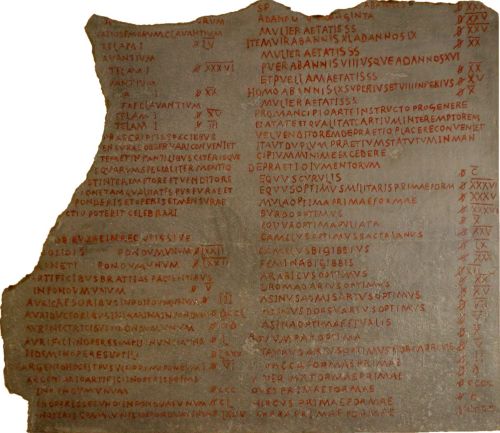
The most ambitious of these interventions came during the reign of Emperor Diocletian in the early fourth century. Determined to stabilize the economy after decades of crisis, Diocletian introduced a sweeping set of reforms designed to restore order to imperial administration, taxation, and monetary circulation. Among these measures was the famous Edict on Maximum Prices, issued in 301 CE. The decree attempted to establish legally enforced price ceilings for an enormous range of goods and services across the empire. More than 1,200 individual items were listed in the edict, including food products, livestock, clothing, transportation services, and wages for skilled and unskilled laborers. The law also imposed severe penalties for violations, including capital punishment for merchants who sold goods above the prescribed limits. The scale of the edict itself illustrates the severity of the inflationary crisis confronting the empire, as Roman authorities attempted to regulate nearly every aspect of everyday commercial exchange in order to halt the rising cost of living.
The rationale behind the edict reflected the Roman government’s understanding of the inflationary crisis. Imperial authorities attributed rising prices largely to greed and profiteering by merchants rather than to deeper structural causes within the monetary system. By imposing strict limits on prices, the government hoped to prevent what it viewed as exploitative behavior while restoring stability to everyday commerce. The edict also attempted to standardize prices across the empire’s vast territories, establishing a unified schedule of allowable costs regardless of regional variation. In theory, this policy would protect consumers from runaway inflation and ensure that essential goods remained affordable to ordinary people.
In practice, however, the price controls proved extremely difficult to enforce. The Roman Empire encompassed vast and diverse economic regions with different production costs, transportation challenges, and local market conditions. A uniform price ceiling that might appear reasonable in one province could be unprofitable in another. Merchants who could not cover their costs under the legally mandated prices often refused to sell their goods altogether. In other cases, traders circumvented the law through informal exchanges or by moving goods into illicit markets beyond the reach of imperial officials. These responses undermined the effectiveness of the edict almost immediately. The rigid ceilings imposed by the government collided with the realities of regional economic variation, making enforcement uneven and encouraging the gradual withdrawal of goods from official markets.
The result was the emergence of widespread black markets. Producers and merchants increasingly conducted transactions outside official channels, where goods could be sold at prices reflecting real supply and demand. While the law attempted to punish violations harshly, enforcement proved inconsistent across the empire’s enormous territory. Local officials often lacked the resources or political authority necessary to monitor every transaction. In many cases, enforcement itself may have discouraged legitimate trade, as merchants sought to avoid the risk of punishment by withdrawing from markets entirely.
Diocletian’s price controls failed to halt inflation or restore confidence in Roman currency. Instead, the edict highlighted the limitations of state intervention when deeper structural problems remained unresolved. The underlying drivers of inflation (currency debasement, military expenditure, and disrupted supply networks) continued to shape the Roman economy. Although Diocletian’s broader reforms helped stabilize imperial administration and taxation in the long term, the attempt to regulate prices directly demonstrated that economic crises rooted in monetary and logistical realities could not be solved simply by decree. The experience revealed a recurring pattern in Roman economic history: when warfare destabilized fiscal systems and disrupted supply, government efforts to control the resulting inflation often produced unintended consequences rather than lasting stability.
Conclusion: War as the Engine of Roman Inflation
The Roman experience demonstrates that inflation in the ancient world was rarely the result of a single economic decision or policy. Instead, it emerged from the cumulative pressures created by prolonged warfare, fiscal strain, and disruptions to supply networks. Military conflict placed enormous demands on the Roman state, forcing emperors and republican leaders alike to secure resources on a scale that ordinary economic structures struggled to sustain. Armies required vast quantities of grain, animals, weapons, and equipment, while soldiers themselves expected reliable pay and rewards for service. These obligations placed continuous pressure on the imperial treasury and encouraged policies that expanded the money supply beyond what the underlying economy could support.
Warfare destabilized the production and distribution systems that sustained Roman markets. Campaigns devastated farmland, redirected shipping capacity toward military logistics, and exposed merchants to heightened risks across contested trade routes. As supply chains weakened, the availability of essential goods declined in urban centers such as Rome. When reduced supplies met the rising demand generated by armies and expanding state expenditures, prices began to climb even before the effects of currency debasement became fully visible. Inflation emerged not simply from monetary manipulation but from the broader economic consequences of sustained conflict.
The fiscal response to these pressures deepened the problem. In order to meet military payrolls and maintain political loyalty among soldiers, Roman authorities repeatedly debased coinage, gradually reducing the precious metal content of their currency. This strategy temporarily allowed the state to finance its obligations, but it undermined public confidence in the monetary system. As the intrinsic value of coins declined, merchants demanded larger quantities of currency for the same goods, accelerating price increases throughout the empire. Government attempts to regulate these rising prices through measures such as Diocletian’s Edict on Maximum Prices ultimately failed because they addressed the symptoms of inflation rather than its underlying causes.
War functioned as the central engine driving inflationary pressure within the imperial economy. Military expansion, frontier defense, and civil conflict repeatedly forced the Roman state to prioritize immediate fiscal survival over long-term monetary stability. The resulting cycle of rising military expenditures, currency debasement, and supply disruption produced recurring periods of economic instability. While the Roman economy possessed remarkable resilience, the persistent demands of warfare ensured that inflation remained a recurring feature of imperial life. The Roman case illustrates a broader historical lesson: when governments finance sustained military commitments through monetary manipulation and strained supply systems, inflation becomes not an accident of policy but a predictable consequence of war itself
Bibliography
- Appian. Roman History, translated by Horace White. Cambridge: Harvard University Press, 1912.
- Biglino, Fabrizio. The War Economy of the Roman Republic (406-100 BCE): The System That Built an Empire. London: Brill, 2024.
- Caesar, Julius. Commentarii de Bello Civili, translated by Arthur George Peskett. Cambridge: Harvard University Press, 1914.
- Cassius Dio. Roman History. Translated by Earnest Cary. Cambridge, MA: Harvard University Press, 1914–1927.
- Diocletian. Edict on Maximum Prices.
- Duncan-Jones, Richard. Money and Government in the Roman Empire. Cambridge: Cambridge University Press, 1994.
- Goldsworthy, Adrian. The Complete Roman Army. London: Thames and Hudson, 2003.
- Gues, Peter, et.al. “Feeding the Roman Army in Britain.” Antiquity 97:395 (2023), e29.
- Lactantius. Of the Manner in Which the Persecutors Died. Translated by J. L. Creed. Oxford: Clarendon Press, 1984.
- Livy. Ab Urbe Condita. Translated by B. O. Foster et al. Cambridge, MA: Harvard University Press, 1919–1959.
- Polybius. The Histories. Translated by Robin Waterfield. Oxford: Oxford University Press, 2010.
- Potter, David. The Roman Empire at Bay, AD 180–395. London: Routledge, 2004.
- Rosenstein, Nathan. Rome at War: Farms, Families, and Death in the Middle Republic. Chapel Hill: University of North Carolina Press, 2004.
- Scheidel, Walter, ed. The Cambridge Companion to the Roman Economy. Cambridge: Cambridge University Press, 2012.
- —-. “The Monetary Systems of the Han and Roman Empires.” In Rome and China: Comparative Perspectives on Ancient World Empires, edited by Walter Scheidel. Oxford: Oxford University Press (2009), 137-208.
- Tacitus. The Annals. Translated by John Jackson. Cambridge, MA: Harvard University Press, 1931.
- Temin, Peter. The Roman Market Economy. Princeton: Princeton University Press, 2012.
Originally published by Brewminate, 03.15.2026, under the terms of a Creative Commons Attribution-NonCommercial-NoDerivatives 4.0 International license.
About the Author