
Hunter-gatherer societies sustained humanity for millennia and still endure, showing how mobility and flexible social organization respond to the limits of local environments.

Curated/Reviewed by Matthew A. McIntosh
Public Historian
Brewminate
Introduction
Overview
A hunter-gatherer society is one whose members obtain most of their food by hunting, fishing, and gathering wild plants rather than by cultivating crops or raising domesticated animals. These societies vary widely, but many organize themselves in relatively small, flexible groups and move seasonally as available resources change; others become partly or fully sedentary where food is abundant. Hunting and gathering was humanity’s predominant way of life before the spread of agriculture and continues among some communities today.
Hunter-Gatherer and Agricultural Societies Compared
These are broad tendencies rather than universal rules. Societies vary by environment and historical period, and many have combined foraging with farming, herding, fishing, or trade.
| Characteristic | Hunter-gatherer societies | Agricultural societies |
|---|---|---|
| Primary subsistence | Hunting, fishing, and gathering wild foods | Cultivating crops and raising domesticated animals |
| Settlement and mobility | Often mobile or seasonally mobile, though some groups are sedentary where resources are abundant | Usually based in permanent or long-term settlements |
| Community size | Often organized in relatively small, flexible groups that may join larger seasonal gatherings | Can support larger and more densely settled populations |
| Food storage | Varies widely; some groups store little, while others preserve substantial seasonal surpluses | More often relies on planned production and long-term storage of crops |
| Labor and skills | Requires extensive ecological knowledge and skilled foraging; specialization varies | Often permits greater occupational specialization beyond food production |
| Social organization | Frequently relatively egalitarian, but leadership and inequality differ among societies | More often develops formal hierarchies and centralized authority, though not in every case |
| Land use | Commonly uses large territories through customary or shared access and may actively manage landscapes | More commonly emphasizes fixed fields, grazing areas, and formalized land tenure |
Historical Context
Archaeological evidence to date suggests that all human beings were hunter-gatherers prior to twelve thousand years ago, before the Neolithic Era. The Neolithic revolution, at the beginning of the Holocene epoch, marks the emergence of agriculture and domestication of animals and the subsequent decline of hunter-gatherer populations.
However, the line between agricultural and hunter-gatherer societies is not clear cut. Many hunter-gatherers consciously manipulate the landscape through cutting or burning inedible plants while encouraging those that can be consumed. In agricultural societies people often continue to hunt and gather. They may farm during the temperate months and hunt during the winter. In developed countries, even today, many people enjoy spending some time hunting for food or for recreation.
Structure of Hunter-Gather Societies
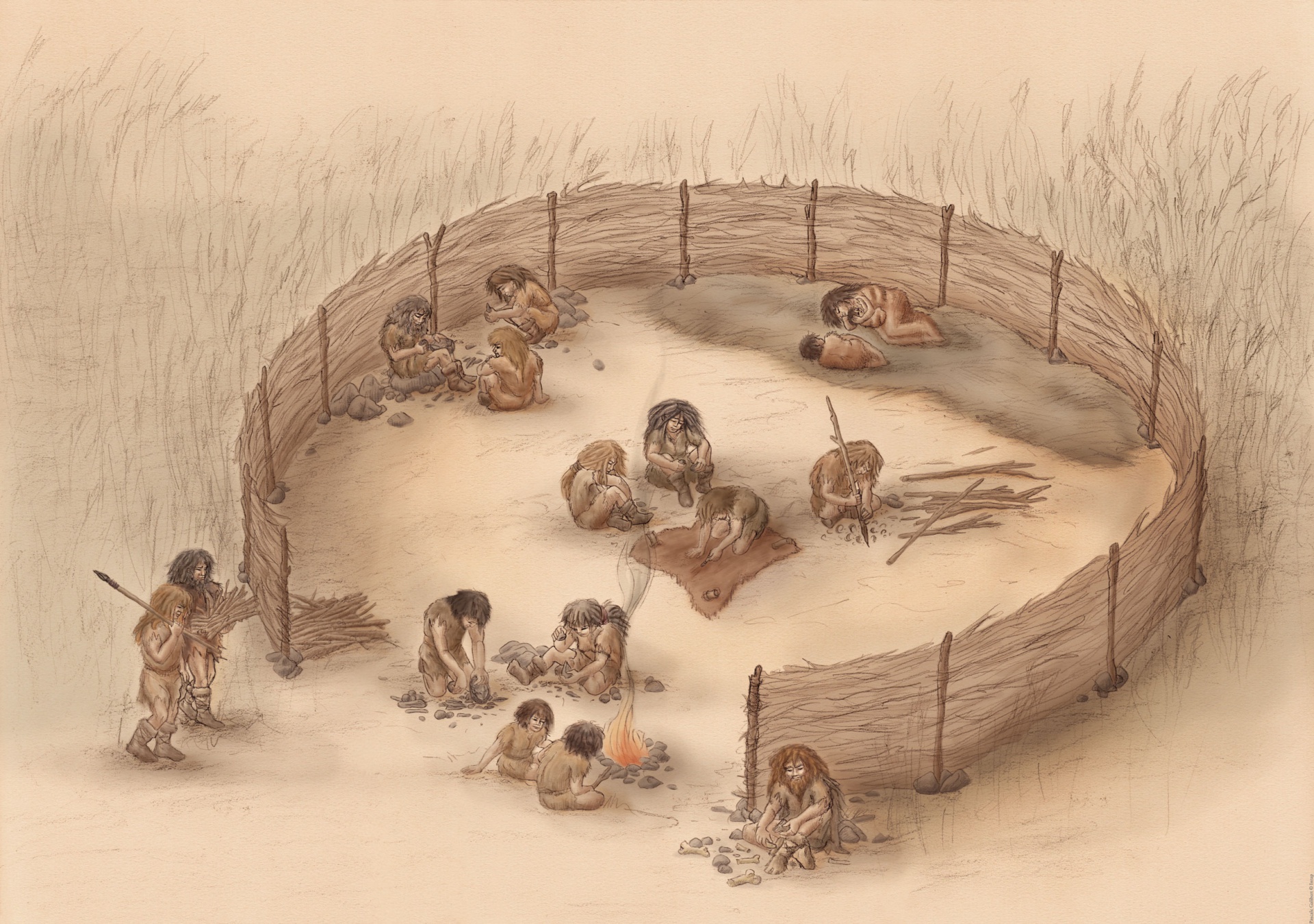
The nature of the available food supplies leads hunter-gatherer societies to develop different specializations. Some hunt big game, or trap animals, while others may fish in lakes, rivers, or along the coast. An older term found in Scandinavian countries is hunter-trapper instead of “gatherer,” signifying their use of complex trap systems involving holes in the ground to catch elks, reindeer, etc.
Hunter-gatherer societies tend to have very low population densities. Only a limited number of people can congregate without quickly exhausting the local food supplies. In climates that can support agriculture, farmland will support population densities 60 to 100 times greater than land left uncultivated.
Nomadic hunter-gatherer societies usually have non-hierarchical social structures, unlike higher-order horticultural, pastoral, and industrial societies. The group usually consists of a small number of family units, often related, comprising a tribe. Typically, men are responsible for hunting and women for gathering.
The male puberty rite of passage often receives greater emphasis in hunter-gatherer societies than the other three ritual occasions celebrated in all human societies (birth, marriage, and death). Their puberty rites, which may take as long as a month, generally include instruction in adult responsibilities, rituals dramatizing changes in relationships between boys and girls and with their mothers, and physical ordeals that often involve hunting.
Characteristics of Hunter-Gather Life
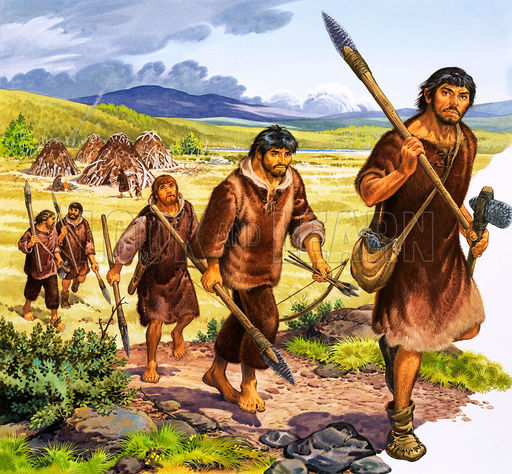
Hunter-gatherers are foragers, dependent upon the natural availability of food. Consequently, they are relatively mobile, moving on as their food supplies become exhausted. This nomadic lifestyle, in which all possessions must be carried, leads hunter-gatherers to rely on materials available in the wild to construct simple shelters. There is rarely any elaborate building of permanent housing or development of cities in such societies.
Their mobile lifestyle generally means that there is no possibility of storing surplus food and thus the society remains at a subsistence level. Specialization of labor does not develop beyond the division of responsibilities between men (hunting) and women (gathering and domestic). Each family acquires only enough food for its own needs and has no surplus to share or trade with others. Thus, full-time leaders, artisans, or other specialists are rarely supported by pure hunter-gatherer societies.
However, in cases where food is abundant and reliable, a hunter-gatherer group may become sedentary. In such cases, a combination of hunting and gathering with agriculture or horticulture, animal husbandry, or herding is common. Moving from the subsistence level to creating surplus provides support for societal development. The existence of surplus relieves individuals, or family units, from the burden of having to procure sufficient food for their needs every day. This frees them to develop skills and talents in ways that benefit others, who in return can share surplus food or other products. In this way, using flour from acorns and smoke-dried salmon for food, natives of the American Pacific Northwest, such as the Haida, were able to become skilled artisans, famous for their woven clothing and elaborately carved items.
Modern Hunter-Gatherers

Today hunter-gatherer groups are found in the Arctic, tropical rainforests, and deserts, where other forms of subsistence production are impossible or too costly. Examples of traditional hunter-gatherers that continue this lifestyle today are the Bushmen of southern Africa, the Pygmies of central Africa, and the Spinifex people of western Australia. Other groups do not have a continuous history of hunting and gathering; in many cases their ancestors were farmers who were pushed into marginal areas as a result of migrations and wars.
There are some modern social movements related to the hunter-gatherer lifestyle:
- freeganism involves gathering of discarded food in the context of an urban environment
- sport hunting and sport fishing are recreational activities practiced by people in developed countries who get the majority of their food by modern means (see also: fox hunt, safari)
- anarcho-primitivism, which strives for the abolishment of civilization and the return to a life in the wild
References
Affiliate disclosure: Amazon links on this site are paid links. As an Amazon Associate I earn from qualifying purchases.
- Lee, Richard B, and Richard Daly (eds). 2004. The Cambridge Encyclopedia of Hunters and Gatherers. Cambridge University Press.
- Panter-Brick, Catherine, Robert H. Layton, and Peter Rowley-Conwy (eds). 2003. Hunter-Gatherers: An Interdisciplinary Perspective. Cambridge University Press.
Originally published by New World Encyclopedia under a Creative Commons Attribution-ShareAlike 3.0 Unported license.
About the Author