The development of these works progressed through a number of eras.

By Dr. Joshua J. Mark
Professor of Philosophy
Marist College
Introduction
Ancient Mesopotamian art and architectural works are among the oldest in the world, dating back over 7,000 years. The works first appear in northern Mesopotamia prior to the Ubaid Period (c. 5000-4100 BCE) and then developed in the south during the Uruk Period (4100-2900 BCE) in Sumer which established the first historical civilization.
According to some scholars, the works of the Indus Valley Civilization (c. 7000 to c. 600 BCE) pre-date those of Mesopotamia, but the Indus Valley developments do not appear until the Early Harappan Period (c. 5500-2800 BCE) by which time Mesopotamian works were already established. Early artwork and construction are evidenced in northern Mesopotamia at sites such as Göbekli Tepe (c. 10,000 BCE) and Ҫatalhöyük (c. 7500 BCE), both in modern-day Turkey, and Tell Brak (c. 6500-5000 BCE), in Syria.
The development of these works then progressed through the following eras, though, owing to space limitations, the Hittite and Kassite periods will not be addressed:
- Ubaid Period – c. 5000-4100 BCE
- Uruk Period – 4100-2900 BCE
- Early Dynastic Period – 2900-2334 BCE
- Akkadian Period – 2334-2218 BCE
- Ur III Period – 2047-1750 BCE
- Old Babylonian Period – c. 2000-1600 BCE
- Hittite Period – 1700-1200 BCE
- Kassite Period – c. 1595 to c. 1155 BCE
- Assyrian Period – c. 1307-912 BCE
- Neo-Assyrian Period – 912-612 BCE
- Neo-Babylonian Period – 626-539 BCE
- Achaemenid Persian-Sassanian Persian Period – c. 550 BCE to 651 CE
Artworks included reliefs, sculpture, statuary cast in metal, ceramics, jewelry, cylinder seals, stele & monuments, obelisks, and wall paintings. Mesopotamian monumental architecture is epitomized by the ziggurat, but the Sumerians were also responsible for the first large-scale palaces and temples, as well as urban planning, the arch, canals, and aqueducts, landscaped gardens, and architectural ornamentation. These early innovations would become more refined in the region through succeeding periods and influence the works of other cultures in the Near East and Mediterranean regions.
Earliest Sites and Base Materials
Although the Göbekli Tepe site is dated to c. 10,000 BCE, the first permanent settlements in that area are thought to have been established earlier, and, possibly, for the sole purpose of building the structure which most scholars believe was a temple. Göbekli Tepe is among the earliest sites, along with others such as Nevalı Çori (also in modern-day Turkey), to feature monumental architecture – including the oldest known megaliths in the world at Göbekli Tepe – as well as reliefs.
Architecturally, the site is comprised of circular areas and rectangular buildings with T-shaped pillars of limestone, some carved with images of wildlife in low and high relief. There is little evidence of human activity in the sculptures which seem to emphasize the natural world and, in some interpretations, the people’s relationship with their gods. Some scholars associate the site with the later settlement of Ҫatalhöyük, though this claim has been challenged as the design of Göbekli Tepe, and the tools found there, differ from the later site.
Whatever purpose Göbekli Tepe originally served, it was a communal site associated with ritual, while Ҫatalhöyük was entirely residential. No public buildings have been found at the site which is comprised of tightly clustered mudbrick residences accessed by ladders or steps from a hole in the roof. Artwork from the site includes murals and statuary – such as the famous Seated Woman of Ҫatalhöyük – as well as ceramics. The artwork seems to focus on the natural world and the concept of fertility as several pieces represent female figures and erect phalluses.
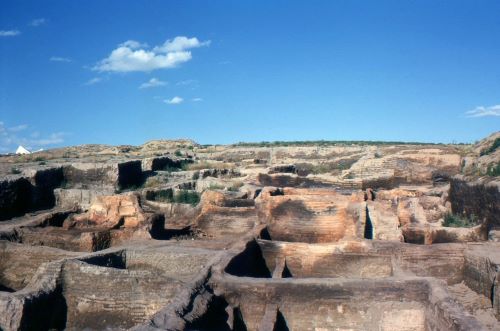
The people of Ҫatalhöyük used clay, limestone, marble, and other materials for their statuary and paint created from natural substances. The figurines, statuary, and murals are usually interpreted as representing religious concepts, but this claim is not universally accepted. There is no evidence of urban planning at the site; it seems to have developed organically with buildings attached to each other and people using the rooftops for communal activities and movement as there are no streets, courtyards, or public squares.
Ubaid and Uruk Periods
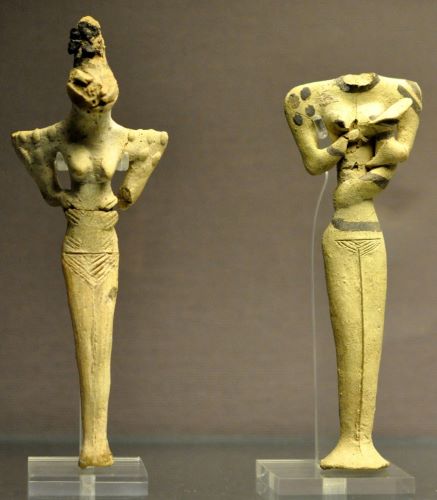
It is thought that the people of the region around Ҫatalhöyük migrated south at the same time, or earlier, than the unknown people (possibly the Sumerians) of the mountains who moved down to the Mesopotamian plains sometime around c. 5000 BCE. The art of the Ubaid Period is characterized chiefly by the ceramics decorated in circular bands of paint and zigzag patterns as well as images of animals. Other works include statuary – such as the famous ‘lizard people’ figurines – and stamp seals which, according to some scholars, were the earliest form of the cylinder seal.
Among the best-known stamp seals is the one discovered in the ruins of the ancient Sumerian city of Girsu depicting a human figure with arms outstretched toward an animal on either side. This motif, known today as the ‘Master of the Animals’ (or ‘Mistress of the Animals’), is thought to relate to the concept of the gods establishing order through animal husbandry, the control of the wild. The motif has been found on artworks throughout the Near East, including Egypt, and in Mediterranean cultures such as Greece and Rome.
Ubaid architecture resembles that of Ҫatalhöyük in rectangular residences built of mudbrick or of reeds, but the people of this era raised the first public buildings, including temples, which, according to modern-day scholars featured an early version of the arch inspired by the construction of reed houses. Bundles of reeds were bent over to form the roof of a home which may have suggested using the same shape for doorways in structures made of mudbrick, thereby producing the earliest archways.
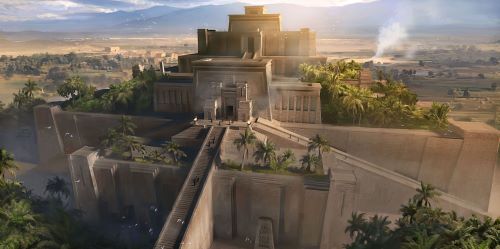
It is thought that the people of the Ubaid Period also built the first ziggurats, but if so, this monumental architecture was more fully developed during the Uruk Period. The architecture of the Uruk Period seems similar to the site of Tell Brak in regard to building techniques and urban planning. During the Uruk Period, the first cities rose, and, according to the Sumerians, the earliest of these was Eridu, the site where the gods established kingship and the ordered world.
Palaces, temples, industrial sites, public buildings, and upper-class housing during this era were made of mudbrick while lower-class homes were made of reeds. Walls, with watchtowers, surrounded most cities and the use of the arch is evident in the design of these and of buildings. Walls and structures were made of rounded mudbrick either baked in ovens or set to dry in the sun.
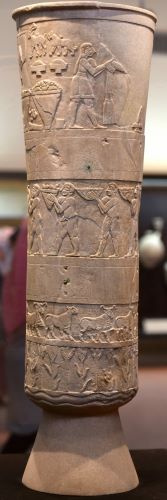
Artwork from this period, which also saw the creation of writing in c. 3500 BCE, includes cylinder seals, ceramics, statuary, decorative tablets, reliefs, and amulets. Among the most famous pieces are the Mask of Warka and the Warka Vase, both found in the ruins of Uruk, and both associated with the goddess Inanna. Artworks were made of clay, alabaster, quartz, or other stone, and some continue the motif of the ‘Master of the Animals’, while others clearly depict narratives concerning the gods or the natural world or both. Statuary of nobility in the form of the priest-king also appear during this era, many in great detail.
Early Dynastic and Akkadian Periods
During the Uruk Period, canals and aqueducts were built and, as noted, cities began to rise with their great ziggurats. All these developments continued and became more widespread during the Early Dynastic Period when the kingship and priesthood divided into their separate spheres of responsibility and writing, which had been revised c. 3200 BCE, came to be taught in the scribal schools established across Sumer and toward the north. Art and architecture flourished during this era as did other crafts. The artist – whether architect, poet, sculptor, or other craftsperson – created some of the most memorable works up to that time. Scholar Stephen Bertman comments:
Today, when we think of an artist, we tend to think of an individualist who uses his or her talent for the purpose of self-expression, a non-conformist who may defy tradition even at the cost of financial security. Those who succeed are known by their names. While this may be true of modern artists, it was not generally true of ancient ones except in Greece, where individualism shone. Rather than individualists and nonconformists, most ancient artists were the servants of society and tradition. Their employers were the state, centered in temple or palace, and the public at large, whose everyday needs they supplied. It may therefore be more useful to conceive of Mesopotamia’s artists as craftsmen and artisans whose livelihoods were guaranteed by the utility and beauty of the objects their skill and talent produced: pottery, wall paintings, mosaics, glass, cylinder seals, carved ivory, and jewelry, as well as sculpture for the glorification of their kings and gods. Because of their subservient role, the great artists of Mesopotamia remain anonymous; only through their work does their identity survive. (214)
While this is generally true, the names of several artists are known, inscribed in their works or referenced by later scribes, and the artist and artisan was generally a well-respected position. The works of the Early Dynastic Period surpassed earlier efforts in quality and quantity as trade in ancient Mesopotamia flourished and the city-states prospered.
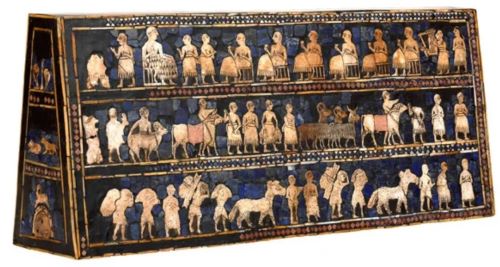
Among the best-known works from this era are the Standard of Ur, the Stele of the Vultures, the Ram in a Thicket, the headdress of Queen Puabi (l. c. 2600 BCE), and the other treasures excavated from her grave in the ruins of Ur, including the Queen’s Lyre with the Bull’s Head. The Standard of Ur depicts scenes of Mesopotamian warfare on one side and peace on the other through three registers (horizontal bands of figures telling a story) on each – a technique also used earlier on the Warka Vase. The figure of the king is larger than the others, signifying his status, a device also used earlier which would continue to depict gods and kings throughout Mesopotamia’s history.
This motif is used to effect during the Akkadian Period and, most notably, in the Victory Stele of Naram-Sin (r. 2261-2224 BCE), one of the best-known pieces from this era. The stele depicts the larger-than-life monarch ascending a mountain as he tramples on the bodies of his defeated enemies. This same device appears in other Akkadian works such as the Victory Stele of Rimush (r. 2279-2271 BCE), Naram-Sin’s uncle. Among the other famous Akkadian works is the Bronze Head of Akkadian Monarch interpreted by some scholars as a depiction of Sargon of Akkad (Sargon the Great, r. 2334-2279 BCE), founder of the Akkadian Empire. The head is thought to have once been part of a life-sized statue and is an example of a hollow-cast figure in which a piece is created by pouring material, in this case bronze, into a mold. This type of casting is alluded to in written works including the literary piece Sargon and Ur-Zababa.
Ur III and Old Babylonian Periods
By the time of the Ur III Period, palaces and temple complexes were fully developed structures ornamented with statuary carved from stone or using this same method of casting metal figures. The architecture of the palace matured during the Akkadian Period, and by Ur III, it was fully formed, as described by Bertman:
[The palace] consisted of two courtyards connected by a throne room that doubled as an audience hall. The outer courtyard was used for public events; the inner, for private ceremonies. Surrounding the outer courtyard were rooms that served as offices, workshops, and storage areas; surrounding the inner were residential quarters for the royal family and facilities to serve their domestic needs …The walls of the palace might be decorated with paintings of ceremonial scenes … and the entire structure was usually surrounded by its own defensive wall. (198)
Ur-Nammu (r. 2047-2030 BCE), the first king of the Third Dynasty of Ur, would have reigned from a palace along these lines as he commissioned his many building projects which were ornamented by gardens and nearby orchards. His son and successor, Shulgi of Ur (r. 2029-1982 BCE), continued and expanded upon his policies, building roads, establishing schools, and creating the first roadside inns with landscaped gardens. Shulgi also completed the Great Ziggurat of Ur commissioned by his father, as well as other projects, and had his accomplishments immortalized in writing and artwork.
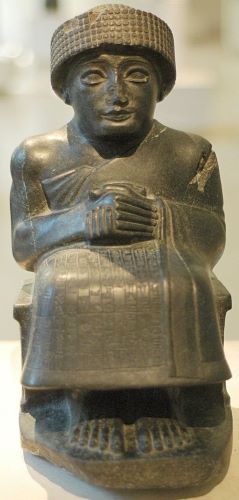
Shulgi, and his father, are depicted in statuary known as foundation figures, cast in copper, and usually standing a foot tall, that were driven into the foundations of a palace or temple to honor the king who commissioned it or the god it was raised to honor. Votive figures, which first appeared during the Early Dynastic Period, were more refined by Ur III. These were anthropomorphic figures of varying sizes with large eyes (sometimes known as the ‘eternal gaze’) standing in an attitude of prayer. They were commissioned by wealthy patrons and their purpose was to stand in the temple and pay homage to the god while the patron went about his or her business. The patron was thereby understood to be in constant communion with the divine as each piece is thought to have been made in their likeness.
Among the most famous works from this period are the many statues of Gudea of Lagash (r. 2080-2060 BCE), always depicted in a prayerful, meditative pose in keeping with his reputation as a devout ruler, associated especially with the worship of Nisaba, goddess of writing. Reliefs from this period, whether high or low, follow the same established form of a ruler or deity given as larger than the others in the piece, and this same practice was observed in the creation of cylinder seals.
Even artwork – and architecture – not explicitly referencing a deity was still informed by religious belief. The king was understood as a steward whose authority ultimately came from the gods, and so the statues and reliefs depicting monarchs still carried a religious message. During the Old Babylonian Period, however, that message became more precise, especially under Hammurabi of Babylon (r. 1792-1750 BCE). The stele of the Code of Hammurabi (his laws) depicts the king receiving his authority from Shamash, god of the sun and justice, and reliefs from this period also clearly depict Marduk, the patron god of Babylon, asserting his authority over worldly affairs.
The Sumerian gods had, by this time, been replaced by Babylonian deities (such as Nabu replacing Nisaba as the patron god of writing), but the same paradigm still held of different gods responsible for various aspects of life. In the Early Dynastic and Ur III periods, the brother-gods Kabta and Mushdamma presided over architecture, bricks, foundations, construction, and buildings, and before a project began, offerings had to be made to them while, at completion, prayers of gratitude were made to Arazu, the god of completed projects.
If one failed to honor these gods in the proper fashion, the building was believed to be cursed with bad luck. During the Old Babylonian Period, this belief persisted, and the practice continued, as evidenced by the Laws of Hammurabi, only the names of the gods had changed. Builders who used shoddy material (suggesting they had not honored the gods) that caused a home or building to collapse were subject to the death penalty.
Conclusion
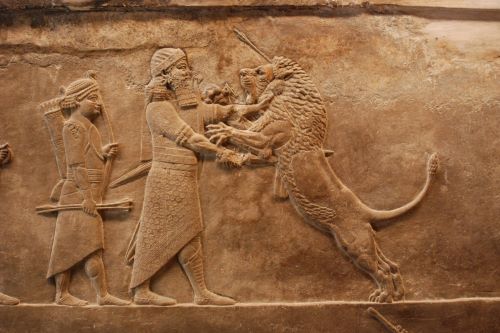
Artistic and architectural works developed further during the Assyrian and Neo-Assyrian periods, following the time of the Hittites and Kassites, especially in the form of reliefs, statuary, and monumental architecture such as palaces and temples. Among the most famous works of these periods are the reliefs from the palace of Ashurnasirpal II (r. 884-859 BCE) at Kalhu celebrating the completion of the city, those of Sargon II (r. 722-705 BCE) at Dur-Sharrukin, and the lion hunt from the palace of Ashurbanipal (r. 668-627 BCE) at Nineveh. The Assyrians also developed the practice of carving reliefs into cliffs and standing stones, later perfected in ancient Persian art and architecture.
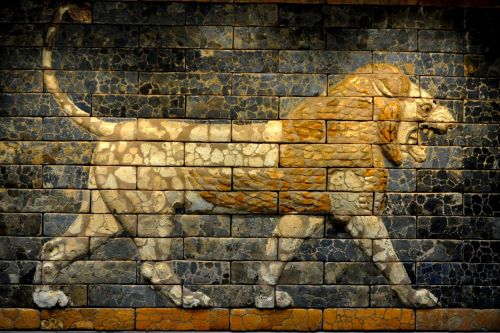
The Persian Achaemenid Empire (c. 550-330 BCE) took the region following the Neo-Babylonian Period which had continued the steady development of Mesopotamian art and architecture begun over 4,000 years earlier. The Babylonian king Nebuchadnezzar II (r. 605/604-562 BCE) commissioned one of the most famous architectural structures from Mesopotamia c. 575 BCE, the Ishtar Gate of Babylon, and the last Babylonian king, Nabonidus (r. 556-539 BCE), restored the Ziggurat of Ur and many other structures in the region that had fallen into ruin or disrepair.
After the Achaemenid Empire fell to Alexander the Great in 330 BCE, the Seleucid Empire (312-63 BCE) continued the legacy of art and architecture in the region, and works developed further during the Parthian Empire (247 BCE-224 CE) and the Sassanian Empire (224-651 CE). The city of Ctesiphon, the capital of the Parthian and Sassanian empires, still standing in ruin, epitomizes the development of architecture in the region through the Taq Kasra, the largest single-span vaulted arch of unreinforced brickwork in the world. Persian art and architecture retained the models of the past, improving upon them, and continuing the legacy of passing them on to later civilizations.
Bibliography
- Bertman, S. The Handbook to Life in Ancient Mesopotamia. Oxford University Press, 2005.
- Kramer, S. N. History Begins at Sumer. University of Pennsylvania Press, 1988.
- Kramer, S. N. The Sumerians: Their History, Culture, and Character. University of Chicago Press, 1971.
- Kriwaczek, P. Babylon: Mesopotamia and the Birth of Civilization. St. Martin’s Griffin, 2012.
- Leick, G. The A to Z of Mesopotamia. Scarecrow Press, 2010.
- Oppenheim, A. L. Ancient Mesopotamia: Portrait of a Dead Civilization. University of Chicago Press, 2000.
- Van De Mieroop, M. A History of the Ancient Near East, ca. 3000-323 BC. Wiley-Blackwell, 2015.
- Wallis Budge, E. A. Babylonian Life and History. Barnes & Noble, 2005.
Originally published by the World History Encyclopedia, 02.22.2023, under a Creative Commons: Attribution-NonCommercial-ShareAlike 3.0 Unported license.
About the Author