
Hamiltonians vs. Jeffersonians
After the new United States Congress completed its first task of creating a Bill of Rights, it turned its attention to the issue of financing the new government. President George Washington appointed Alexander Hamilton as the Treasury Secretary, and Hamilton took it upon himself to develop an economic structure for the United States that would give the public confidence in the government’s financial affairs.
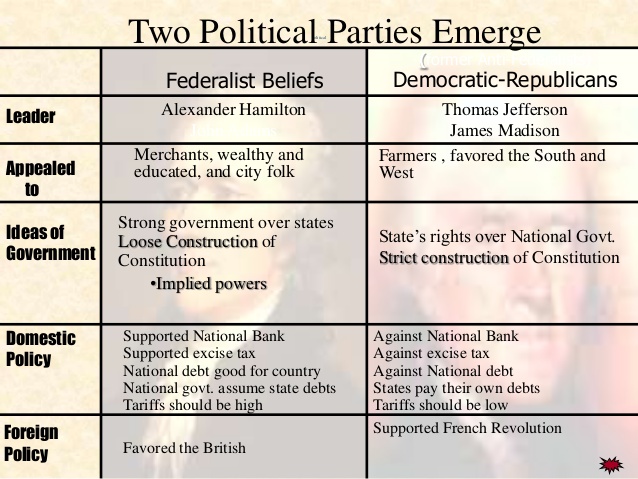
As he formulated his plan, Hamilton used a loose interpretation of the Constitution, believing that what the Constitution did not specifically forbid, it allowed. He also believed that a strong central government was critical to encourage commerce and industry and to prevent chaos within America’s borders. This perspective shaped his fiscal plan.

Hamilton’s proposal, titled “The First Report on the Public Credit,” declared that the federal government would assume the debts of the individual states. Each of the thirteen states had amassed significant debt as they fought for freedom from Britain. Hamilton believed that assuming these debts would not only give the public confidence in the federal government, but would also emotionally bind them to the government out of a sense of loyalty and gratitude. Adopting the states’ debts would cost the federal government around $21.5 million, an awesome sum at that time. Several southern states had already paid off their debts and would receive no direct benefit from the assumption of debts, so Hamilton’s plan offered to put a new national capital in the south. This capital would eventually become Washington, D.C.
The second element of Hamilton’s plan was to assume the Confederation’s debts at par, which meant that interest would be included when the debt was paid—a monstrous sum of more than $54 million. Hamilton wanted to assume the states’ and the Confederation’s debts because he felt a national debt would give the citizens unity and a sense of respect for the government.
A third key element in Hamilton’s financial strategy was to establish a national bank. Hamilton modeled his national bank after the Bank of England, which provided a strong federal institution that printed and circulated paper money, while giving the government a repository for excess funds. Hamilton believed that a national bank was necessary to implement the Constitution’s decree that the government collect taxes, pay debts, and regulate trade. Hamilton felt that this need fulfilled the Constitutional clause that stated what was “necessary and proper” could be accomplished by the government. This clause was also known as the “elastic clause.”
Although Hamilton was considered a financial wizard and many trusted him to finance the new government, he was not without opposition. His most outspoken critic was Thomas Jefferson, who was serving in President Washington’s Cabinet as Secretary of State. Jefferson strictly interpreted the Constitution and believed in a decentralized government that should exist primarily to protect man’s natural rights to life, liberty, and property.

In contrast to Hamilton’s proposal, Jefferson felt that the states should hold greater authority than the federal government, since the states were closer to the people and were less likely to abuse their authority. Furthermore, his strict interpretation of the Constitution—believing that what was not specifically written was forbidden—led him to believe that Hamilton’s proposal of a national bank exceeded federal authority.
Both Jefferson’s and Hamilton’s political views represented public opinion. What began as a personal dispute between the two men evolved into the formation of primitive political parties. Jeffersonians shared the belief in a strict interpretation of the Constitution, while Hamiltonians accepted a broad interpretation.
President George Washington, however, remained safely neutral in the dispute between his two staff members. He asked Hamilton and Jefferson to prepare arguments regarding Hamilton’s proposed U.S. bank based on their differing interpretations of the Constitution. After hearing both arguments, Congress and Washington favored Hamilton’s plan, and the Bank of the United States became a reality in 1791.
By this time, Hamilton had already developed several duties and excise taxes that the new national bank could collect. Congress had passed a Hamilton-recommended tariff of around eight percent on dutiable imports in 1789 and a domestic excise tax—a tax levied on the manufacture, sale, or consumption of goods—in 1791. An unforeseen result of this tax was the Whiskey Rebellion in 1794. Hamilton included whiskey, a commodity produced primarily by western farmers, in his tax. The plan levied a seven cent per gallon tax on whiskey, much to the dismay of distillers. For people in the backcountry, whiskey was not a luxury but a trade necessity and a form of currency; even preachers were paid with distilled whiskey.
Seeing their livelihood threatened by Hamilton’s excise tax, the whiskey producers rebelled. Peaceful protests eventually turned violent with the distillers tarring and feathering revenue collectors. When President Washington heard about the rebellion, Hamilton urged him to take action and he sent an army of over thirteen thousand men to end the uprising.
When the soldiers arrived in the backcountry of Western Pennsylvania, they were surprised to learn that the “rebellion” had been drastically blown out of proportion. The angry distillers were overwhelmed and quickly dispersed, and only three lives were lost in this battle. Public perception of this event was divided, and this division strengthened the emerging political parties. Hamiltonians—known also as Federalists—supported Hamilton’s financial plans and Washington’s actions to stop the Whiskey Rebellion, while Jeffersonians, who were becoming known as the Democratic-Republicans, argued that the government had used excessive and unnecessary force.
Federalists and Democratic-Republicans
With the two-party system of government in its founding stages in the United States, a continent away events were taking place that would further the evolution of the Federalist and the Democratic-Republican parties. The people of France were taking their cues from the American Revolution and rebelling against the authoritarian leadership of King Louis XVI. As war ensued between France and Great Britain in 1793, conflict arose in America as the Federalists and Democratic-Republicans disagreed on where to place their loyalties.
According to the Franco-American Alliance of 1778, the United States was bound to aid France whenever called upon. But at the time of the Alliance, no one could foresee that France would become embroiled in conflict against Britain and that the United States might be called upon to repel British forces from French lands. The emerging American political parties took opposite sides on the issue. The Democratic-Republicans wanted to demonstrate loyalty to the French, who had helped them claim their own liberty, although Jefferson only wanted to lend moral support. He did not believe that the French would call upon the United States to uphold their end of the treaty. Conversely, the Federalists, under Hamilton’s leadership, implored President Washington to declare the 1778 treaty suspended. Hamilton’s primary goal was to maintain a peaceful relationship with Britain to ensure continued trade to support the American economy.
George Washington’s response was an action of inaction. He issued the Neutrality Proclamation in 1793, which declared the United States neutral between Britain and France and strongly urged people to avoid any alliance with either camp. The Democratic-Republicans were outraged, not only by the declaration itself, but by Washington’s failure to consult Congress before issuing the proclamation. The Federalists, for the most part, were pleased.
Citizen Edmond Genêt, a French representative to the United States, set out to take advantage of the conflict. Upon meeting with Democratic-Republicans, he came to believe that the Neutrality Proclamation was more a governmental display of excess authority than a reflection of the public’s desire. He began to recruit unauthorized American armies to overtake Spanish Florida and Louisiana, along with parts of British Canada, in support of the Franco-American Alliance. Genêt even threatened to overthrow Washington himself. However, Washington prevailed by demanding and receiving Genêt’s withdrawal from the United States and replacement with a more rational French representative.
The Democratic-Republicans perpetually found themselves at odds with the Federalists as the British continued to battle with France. Britain ignored Washington’s Proclamation of Neutrality, assumed America was allied with France, and seized ships in the West Indies and captured many American sailors. Although both the Federalists and the Democratic-Republicans were outraged, they had very different opinions about how America should respond. Under Hamilton’s leadership, the Federalists were most concerned with the economy and wanted to avoid war at all costs. In contrast, the Democratic-Republicans following Jefferson’s leadership felt America was obligated to again fight Britain for its liberty.
Washington stepped in to contain the situation. He sent Federalist Chief Justice John Jay to London in 1794 to negotiate a treaty with Britain to maintain trade relations and avoid war. Yet again the Democratic-Republicans were unhappy with Washington’s actions, fearing that Jay, who was notoriously pro-British, would betray his own country.
Meanwhile Hamilton, fearful of war and ensuing economic disaster, sabotaged Jay’s negotiations by sharing U.S. negotiation tactics with the British. Not surprisingly, Jay’s negotiations were ineffective, garnering only minor victories for the United States. Jay’s Treaty gave the British 18 months to withdraw from the western forts, although they were given the right to continue fur trade with the Indians. The treaty also called for America to repay debts incurred to England during the Revolutionary War. Although there was public outcry over this treaty, the Senate passed the treaty in 1795.
The Democratic-Republicans raged, while the effects of Jay’s Treaty rippled across the United States and beyond. Spain, fearing that the treaty indicated burgeoning loyalties between the U.S. and England, moved to gain a foothold by establishing its own alliance with America. In Pinckney’s Treaty of 1795, the Spanish granted almost all the United States’ requests, including ownership of the previously disputed territory north of Florida. This treaty also gave American western farmers and traders the right of deposit at New Orleans.
George Washington’s Farewell Address

By 1796, President George Washington had served two consecutive four-year terms in office. The ongoing battle between Federalists and Democratic-Republicans contributed to his decision to retire following his second term.
Washington delivered his Farewell Address via newspapers. In this communication, he conveyed his concerns regarding alliances—both international and domestic. Washington felt that no alliance should be permanent, but rather limited to “extraordinary emergencies” and then only temporary.
He encouraged citizens to examine their loyalty to the United States, rather than to individual political parties, believing that the divisive nature of political parties would bring more harm than good to the union. He even warned against a general spirit of innovation which he felt could weaken the foundation set forth in the Constitution. Washington’s text was met in much the same way as many of his proclamations while in office: with partisan conflict. His supporters lauded his service and dedication to building a solid, strong government, while his detractors picked apart his shortcomings and inequities. However, both sides agreed that Washington had served the purpose of being a prominent figurehead for a union struggling to find its footing, and that his successor could be chosen with more focus on political prowess than prestige.
Originally published by AP Study Notes, republished with permission for educational, non-commercial purposes.
About the Author