The Great Depression stands as a turning point in American agricultural history not simply because it devastated farms, but because it redefined the purpose of intervention.

By Matthew A. McIntosh
Public Historian
Brewminate
Introduction: Crisis on the Land and the End of the Small-Farm Ideal
The Great Depression marked a decisive rupture in the history of American agriculture. While economic collapse touched nearly every sector, its impact on farming was both earlier and more severe. Long before bank failures and urban unemployment reached their peak, rural America was already in crisis. Falling prices, mounting debt, and shrinking margins exposed a farm economy that had been structurally fragile beneath its surface prosperity. The Depression did not create this weakness. It revealed and accelerated it.
The small family farm occupied a powerful place in American political and cultural imagination. It symbolized independence, moral virtue, and democratic stability, echoing Jeffersonian ideals that equated landownership with citizenship and self-rule. Yet by the 1920s, this ideal was increasingly detached from economic reality. Technological advances, expanded acreage, and global markets produced chronic overproduction, driving prices downward even in years of abundant harvest. Small farmers survived by borrowing, tying their futures to volatile markets they could not control.
When the Depression struck, these vulnerabilities converged into collapse. Commodity prices plummeted, credit evaporated, and foreclosure swept across rural communities. Environmental disaster compounded economic shock, turning drought and soil exhaustion into existential threats. The farms most exposed were those least able to absorb loss. Small operators with limited capital fell first, while larger and better-capitalized farms endured long enough to acquire land released through failure. Crisis became a sorting mechanism that rewarded scale and punished marginal survival.
What follows argues that the Great Depression did not simply devastate American agriculture. It reorganized it. Federal intervention would stabilize production but not preserve the small-farm class as a whole. Urban responses such as victory gardens and cooperative food programs offered resilience at the household level without reversing consolidation in the countryside. By tracing the transformation of farming through collapse, relief, and postwar restructuring, the discussion situates the Depression as a pivotal moment when rescue preserved output while allowing the small-farm ideal to recede into memory.
The Pre-Depression Farm Economy: Fragility beneath Abundance
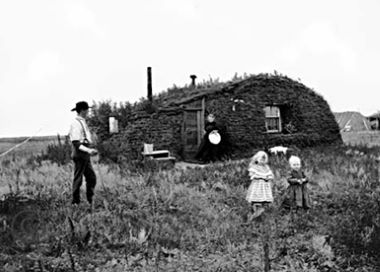
American agriculture entered the 1930s with the appearance of strength but the reality of strain. Wartime demand during the First World War had encouraged farmers to expand acreage, invest in machinery, and take on debt. When European production recovered in the 1920s, global markets softened and prices declined. Output remained high, but income did not follow. Abundance masked imbalance, creating a system that produced more food while steadily eroding the financial position of those who grew it.
Credit sustained this contradiction. Mortgages, equipment loans, and operating credit allowed farms to continue producing despite declining returns. For small operators, borrowing became a survival strategy rather than an investment in growth. Debt levels rose even as commodity prices stagnated, tightening margins year after year. Land itself served as collateral, transforming ownership into exposure. A single bad season could place a household at risk of foreclosure, not because production failed, but because prices did.
Market power deepened these vulnerabilities. Farmers sold into markets dominated by processors, railroads, and distributors who set terms beyond local control. Price-setting occurred downstream, while risk accumulated upstream. Individual producers lacked leverage to influence prices or storage decisions. Overproduction became a collective problem with individual consequences, and the burden of adjustment fell disproportionately on those least able to absorb loss. Scale offered insulation. Small size amplified exposure.
By the late 1920s, the farm economy rested on a narrow foundation. Productivity was high, but resilience was low. The system depended on continued credit access, stable prices, and favorable weather. Any disruption threatened collapse. When the Depression arrived, it did not strike a healthy sector. It shattered one already weakened by structural imbalance. What followed was not a sudden failure of farming, but the rapid unraveling of a system whose fragility had long been concealed by abundance.
Collapse: Price Crashes, Debt, and Environmental Disaster
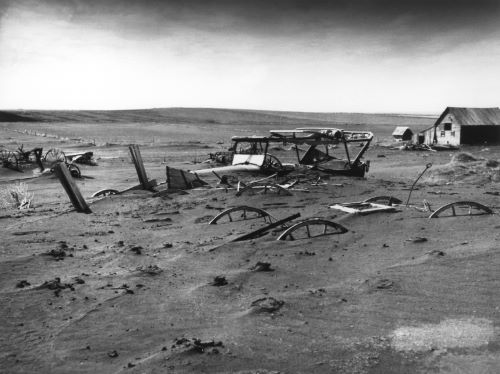
The onset of the Great Depression transformed long-standing strain into sudden collapse. Agricultural prices fell faster and farther than those in most other sectors. By the early 1930s, commodity prices had dropped to levels that made profitable production impossible regardless of efficiency. Farmers continued to produce because they had little alternative. Fixed costs remained, debts came due, and withholding output only deepened insolvency. Overproduction, once a chronic problem, became catastrophic when markets could no longer absorb it.
Debt converted falling prices into irreversible loss. Mortgages and operating loans were structured around expectations of stable or rising income that no longer existed. As revenues collapsed, farmers defaulted in waves. Foreclosure was not a moral failure or managerial error. It was a mechanical outcome of price decline meeting fixed repayment schedules. County courthouses filled with auctions as land passed from families to banks or speculators. Ownership, once the foundation of rural independence, became the lever through which dispossession occurred.
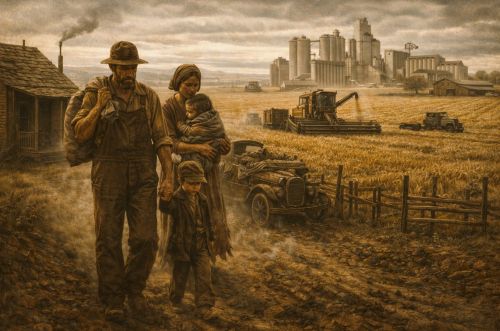
Environmental disaster magnified economic collapse. Drought and soil exhaustion devastated large regions of the Great Plains, turning years of intensive cultivation into ecological vulnerability. Wind erosion stripped topsoil from fields, rendering land temporarily or permanently unusable. Environmental shock did not act independently of economic forces. It interacted with debt, price collapse, and market pressure to accelerate failure. Farmers facing both crop loss and foreclosure had no margin left to absorb either.
Small farms were disproportionately exposed to this convergence. Limited capital reserves meant they could not endure multiple failed seasons or delayed recovery. Larger operations, though affected, possessed buffers that allowed them to survive long enough to acquire land released through foreclosure. Collapse functioned as a selective process. Failure redistributed land upward, concentrating ownership not through policy declaration but through market mechanics reinforced by crisis.
Migration followed collapse. Families abandoned farms in search of work, joining streams of displaced Americans moving toward cities or agricultural regions still offering seasonal labor. This movement did not represent opportunity but desperation. Displacement fractured communities, emptied rural towns, and intensified competition for scarce employment. The countryside lost people as well as land, accelerating the transformation of American agriculture from a social system into an industrial one.
The combined force of price collapse, debt enforcement, and environmental disaster ensured that recovery would not restore the previous order. Even as conditions stabilized later in the decade, the small-farm landscape had been irreversibly altered. Collapse did not merely interrupt farming. It reset its terms. Survival increasingly required scale, capital, and access to policy protection. Those without these advantages were removed from the land, not temporarily, but permanently.
Federal Intervention and Uneven Survival
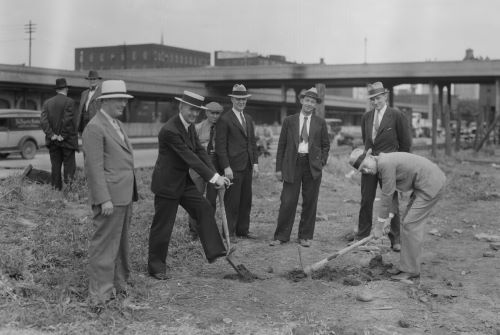
Federal intervention during the Depression reshaped American agriculture, but it did so unevenly. New Deal programs acknowledged that unregulated markets had failed rural producers, introducing price supports, production controls, and credit relief. These measures stabilized output and slowed the downward spiral of prices. Yet they were designed primarily to manage markets rather than preserve producers as a class. The distinction proved decisive. Intervention rescued agriculture without rescuing all farmers.
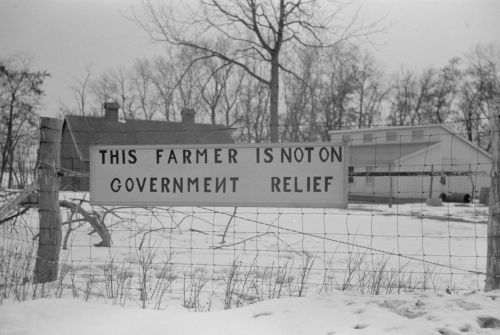
Relief flowed most reliably to those who already possessed land and scale. Programs that compensated farmers for reducing acreage or supported prices through payments favored larger operations with measurable output and administrative capacity. Smallholders, tenants, and sharecroppers often lacked clear title, political leverage, or access to program benefits. In many cases, payments to landowners encouraged consolidation, as owners reduced labor needs or displaced tenants to capture subsidies. Policy reinforced existing hierarchies even as it arrested collapse.
Credit programs followed a similar pattern. Refinancing and loan relief helped some farmers retain land, but access depended on collateral and perceived viability. Those deemed marginal were excluded or delayed until foreclosure became unavoidable. The state intervened selectively, preserving farms judged efficient while allowing others to fail. Survival became contingent not only on need but on alignment with policy definitions of productivity and modernization.
The result was stabilization without restoration. Federal programs prevented total agricultural collapse and ensured food supply, yet they also accelerated the transformation of farming toward larger, capitalized operations. Uneven survival was not an unintended consequence but a function of design. Aid preserved production, restructured ownership, and set the stage for postwar industrial agriculture. In rescuing agriculture, the state chose which forms of farming would endure.
Consolidation and Mechanization: The Postwar Transformation
The postwar period completed transformations set in motion during the Depression. Stabilization programs had arrested collapse, but they also clarified the terms of survival. Farms that endured the 1930s entered the postwar economy positioned to expand through mechanization, capitalization, and land acquisition. Those that did not were rarely restored. Recovery did not reverse consolidation. It normalized it, embedding scale as the defining condition of agricultural viability.
Mechanization accelerated this shift. Tractors, combines, and chemical inputs dramatically increased labor productivity, allowing fewer workers to cultivate more land. These technologies demanded capital investment and rewarded continuous operation at scale. For farms with access to credit and acreage, mechanization reduced costs and expanded output. For smaller operations, the required investment proved prohibitive. What had once been a competitive disadvantage became a barrier to entry, further narrowing the path to survival.
Policy reinforced these dynamics. Federal research, extension services, and price support structures emphasized efficiency, yield, and modernization. Programs were calibrated to output and compliance, favoring operations capable of meeting administrative and financial thresholds. The language of improvement framed consolidation as progress, aligning public policy with industrial models of production. Small farms were not explicitly targeted for elimination, but neither were they protected as a social good.
Labor relations shifted alongside technology. Family labor declined as mechanization reduced demand for hands and increased reliance on hired or seasonal workers. Rural populations contracted as opportunities disappeared, accelerating migration to cities and suburbs. Farming became less a way of life than a capital-intensive enterprise. Ownership consolidated, while communities thinned. The countryside produced more with fewer people, trading social density for efficiency.
By the mid-twentieth century, American agriculture had been fundamentally reorganized. The Depression had stripped away marginal producers; postwar policy and technology ensured they would not return. Consolidation was no longer a crisis response but a governing principle. Mechanization did not simply modernize farming. It finalized a transformation in which survival depended on capital, scale, and policy alignment, cementing the industrial model that would dominate American agriculture for decades.
Urban Responses: Victory Gardens and Cooperative Survival
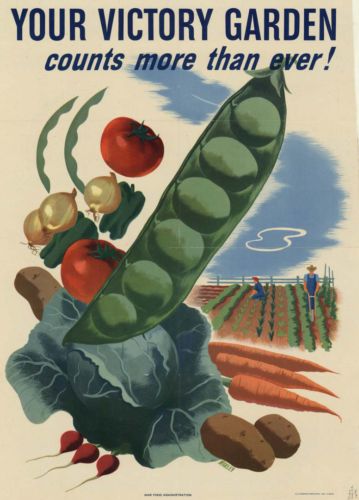
As rural collapse displaced producers and strained urban food systems, American cities witnessed a revival of household-scale food production. Victory gardens, promoted during the Depression and expanded during the Second World War, encouraged families to grow vegetables in backyards, vacant lots, and public spaces. These initiatives addressed immediate needs by supplementing diets and reducing pressure on commercial supply chains. They offered households a measure of control over food access at a moment when wages were unstable and prices uncertain.
Cooperative food programs complemented these efforts. Community canneries, shared preservation facilities, and neighborhood buying clubs allowed families to pool resources and reduce costs. Mutual aid organizations distributed food, coordinated labor, and provided informal safety nets where state relief fell short. These networks drew on older traditions of cooperation, adapting them to urban environments shaped by displacement and economic insecurity. Survival depended as much on social coordination as on individual effort.
Despite their effectiveness, urban food initiatives operated within strict limits. Victory gardens could not replace commercial agriculture, nor could cooperatives offset the scale of rural consolidation. They functioned as buffers rather than alternatives, mitigating hunger without restoring livelihoods. Participation required time, space, and physical capacity, which were unevenly distributed. As conditions improved, many programs were scaled back, their temporary success reinforcing the notion that such measures were emergency responses rather than enduring solutions.
Urban agriculture during the Depression mirrored patterns seen in earlier agrarian collapses. Grassroots resilience emerged where structural protection failed, sustaining households without reversing displacement. Victory gardens and cooperative survival strategies demonstrated adaptability and resourcefulness, but they also highlighted the boundary between coping and transformation. They preserved life at the margins while the agricultural system itself continued to consolidate, underscoring the distinction between food security and the survival of farming as a livelihood.
Aid, Power, and the Politics of Agricultural Rescue
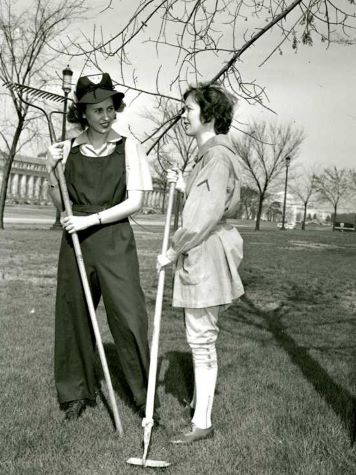
Relief during the Great Depression was never politically neutral. Decisions about who qualified for assistance, under what conditions, and for how long reflected competing visions of what American agriculture should become. Federal programs sought to stabilize prices and production, but the criteria used to distribute aid consistently favored landowners, larger operators, and those already integrated into administrative systems. Rescue was selective by design, shaped as much by power and influence as by need.
Ownership mattered more than vulnerability. Programs tied to acreage reduction, price supports, and compliance with production controls privileged farmers who held clear title and managed sizable operations. Tenants and sharecroppers, lacking ownership and political leverage, were often excluded or displaced when landowners reduced labor to capture subsidies. Aid flowed through property, not people, reinforcing hierarchies already sharpened by collapse. Relief preserved farms deemed viable while allowing others to disappear quietly.
Administrative capacity further filtered survival. Participation required navigating paperwork, meeting reporting standards, and complying with technical requirements that favored educated and capitalized producers. Smaller farmers, already stretched thin, struggled to access benefits even when eligible. Bureaucratic hurdles translated economic inequality into policy outcomes. What appeared as impartial administration functioned as a gatekeeping mechanism, sorting producers according to their ability to conform to institutional expectations.
Political alliances shaped these outcomes. Farm organizations, commodity groups, and regional blocs influenced program design, steering resources toward crops and regions with established representation. The politics of rescue mirrored the politics of consolidation. Aid stabilized markets and ensured supply, but it also entrenched interests positioned to shape policy. The result was a feedback loop in which survival reinforced influence, and influence shaped future rescue.
The legacy of Depression-era intervention reveals a central tension in agricultural policy. When rescue prioritizes production over producers, it preserves output while narrowing the class of those who can farm. The Great Depression demonstrates that intervention can arrest collapse without restoring balance. Aid mattered profoundly, but its distribution mattered more. By aligning rescue with power, the state transformed crisis response into a mechanism of long-term restructuring, ensuring that consolidation would persist long after the emergency had passed.
Structural Continuity: From the Depression to the Present
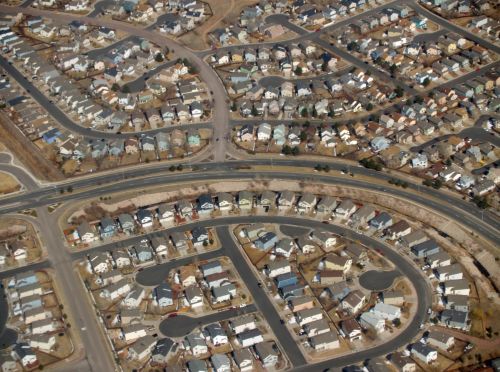
The agricultural order forged during the Great Depression did not dissolve with economic recovery. It hardened. Crisis clarified the terms under which farming would continue in the United States, and those terms favored capitalized survival over broad participation. Consolidation, debt dependence, and policy-mediated resilience became normalized features of the system. What had once been justified as emergency management evolved into a permanent framework governing who could remain on the land.
Postwar prosperity obscured this continuity rather than reversing it. Rising productivity, mechanization, and cheap food created a narrative of success that masked the steady disappearance of farms. The number of producers declined year after year even as output increased. Small and mid-sized farms exited quietly, absorbed by larger operations or priced out by capital requirements they could not meet. The structural lesson of the Depression endured: efficiency would be rewarded, endurance would not.
Late twentieth-century trade liberalization and early twenty-first-century trade shocks exposed how little had changed beneath the surface. Global market volatility, rising input costs, and retaliatory tariffs struck unevenly, replicating Depression-era dynamics. Large operations diversified risk across acreage, contracts, and political access. Smaller farms faced immediate loss. Emergency relief once again stabilized production without arresting consolidation. Aid preserved output, not producers, reinforcing patterns established decades earlier.
Urban responses followed familiar lines. Community gardens, local food networks, and cooperative purchasing expanded during periods of disruption, echoing the role of victory gardens in earlier crises. These initiatives improved food access and fostered local resilience, but they did not alter the structural forces driving agricultural displacement. As before, resilience at the margins substituted for reform at the center. Households adapted while consolidation continued.
The continuity from the Depression to the present lies in policy assumptions rather than identical programs. Agriculture is treated as an industry to be optimized rather than a social foundation to be sustained. Crisis intervention manages disruption without redistributing resilience. The Depression demonstrated how rapidly collapse could reorder farming. Its lasting legacy is the quiet permanence of that reordering, sustained by choices that continue to channel survival toward scale while leaving vulnerability widely distributed.
Conclusion: When Rescue Preserves Production but Not Producers
The Great Depression stands as a turning point in American agricultural history not simply because it devastated farms, but because it redefined the purpose of intervention. Federal rescue preserved production, stabilized markets, and ensured food supply. It did not, however, preserve the class of small producers who had long defined rural life. Survival was filtered through policy criteria that favored ownership, scale, and administrative compatibility, transforming crisis response into a mechanism of long-term restructuring.
This distinction between saving agriculture and saving farmers proved decisive. Relief programs slowed collapse while quietly narrowing the range of who could remain on the land. Farms that aligned with emerging industrial models endured and expanded. Those that did not were removed through foreclosure, displacement, or attrition. Urban resilience strategies such as victory gardens and cooperative food programs sustained households without restoring livelihoods. They softened the human cost of consolidation without interrupting its advance.
The consequences extended beyond economics. As small farms disappeared, rural communities thinned, labor relations shifted, and farming lost its character as a broadly accessible way of life. Ownership concentrated, dependence on capital deepened, and political influence followed consolidation. What emerged was an agricultural system capable of extraordinary productivity but increasingly detached from the social foundations that had once linked land, labor, and citizenship.
The Depression’s enduring lesson is structural rather than episodic. Intervention matters, but distribution matters more. When rescue preserves production without preserving producers, consolidation becomes permanent. History does not suggest that collapse is inevitable. It shows that policy determines who bears risk and who is shielded from it. The Great Depression revealed how quickly crisis can reorder agriculture. The persistence of that order reminds us that recovery, without equity, merely stabilizes a system that has already decided who will survive.
Bibliography
- Bentley, Amy. Eating for Victory: Food Rationing and the Politics of Domesticity. Urbana: University of Illinois Press, 1998.
- Cochrane, Willard W. The Development of American Agriculture: A Historical Analysis. Minneapolis: University of Minnesota Press, 1979.
- Danbom, David B. Born in the Country: A History of Rural America. Baltimore: Johns Hopkins University Press, 2006.
- Fite, Gilbert C. American Farmers: The New Minority. Bloomington: Indiana University Press, 1981.
- Hansen, Zeynep K., and Gary D. Libecap. “Small Farms, Externalities, and the Dust Bowl of the 1930s.” Journal of Political Economy 112, no. 3 (2004): 665–694.
- Hurt, R. Douglas. American Agriculture: A Brief History. West Lafayette, IN: Purdue University Press, 1994.
- Lawson, Laura J. City Bountiful: A Century of Community Gardening in America. Berkeley: University of California Press, 2005.
- MacDonald, James M., Penni Korb, and Robert A. Hoppe. Farm Size and the Organization of U.S. Crop Farming. Washington, DC: U.S. Department of Agriculture, Economic Research Service, 2013.
- Olson, Mancur. “Agriculture and the Depressed Areas.” Journal of Farm Economics 46:5 (1964): 984-988.
- Saloutos, Theodore. The American Farmer and the New Deal. Ames: Iowa State University Press, 1982.
- Worster, Donald. Dust Bowl: The Southern Plains in the 1930s. New York: Oxford University Press, 1979.
Originally published by Brewminate, 02.17.2026, under the terms of a Creative Commons Attribution-NonCommercial-NoDerivatives 4.0 International license.
About the Author