Ayn Rand’s philosophy is a central tenet of today’s Republican Party and the moral code they proudly cite and follow.
By Thom Hartmann
There’s a direct link between a sociopathic killer in 1927 and the GOP’s willingness to embrace a sociopathic president like Trump. That link runs through the work of Ayn Rand.
When Donald Trump was running for the GOP nomination, he told USA Today’s Kirsten Powers that Ayn Rand’s raped-girl-decides-she-likes-it novel, “The Fountainhead,” was his favorite book.
“It relates to business, beauty, life and inner emotions,” he told Powers. “That book relates to … everything.”
Trump probably knew that anything by Rand would be the right answer for Republicans; the party has embraced her for decades, to the point that Paul Ryan required interns to read her books as a condition of employment.
Powers added, “He [Trump] identified with Howard Roark, the novel’s idealistic protagonist who designs skyscrapers and rages against the establishment.” Roark raged so much in the novel that he blew up a public housing project with dynamite just to get his way.
Rand was quite clear about the characteristics she wrote into her heroes, and in particular Howard Roark. In her Journals, she writes of the theme of the book, “One puts oneself above all and crushes everything in one’s way to get the best for oneself. Fine!”
On Howard Roark, she writes that he “has learned long ago, with his first consciousness, two things which dominate his entire attitude toward life: his own superiority and the utter worthlessness of the world. He knows what he wants and what he thinks. He needs no other reasons, standards or considerations. His complete selfishness is as natural to him as breathing.”
Roark seems like the kind of man who would brag about grabbing women by the genitals because, “When you’re a star, they let you do it.” But this was long before Donald Trump was on the scene.
Instead, the man who so inspired Ayn Rand’s fictional heroes was a real sociopath named William Edward Hickman, who lived in Los Angeles.
Ten days before Christmas, in 1927, Hickman, a teenager with slicked dark hair and tiny, muted eyes, drove up to Mount Vernon Junior High School in Los Angeles, California, and kidnapped Marion Parker—the daughter of a wealthy banker in town.
Hickman held the girl ransom, demanding $1,500 from her father—back then about a year’s salary. Supremely confident that he would elude capture, Hickman signed his name on the ransom notes, “The Fox.”
After two days, Marion’s father agreed to hand over the ransom in exchange for the safety of his daughter. What Perry Parker didn’t know is that Hickman never intended to live up to his end of the bargain.
The Pittsburgh Press detailed what Hickman, in his own words, did next.
“It was while I was fixing the blindfold that the urge to murder came upon me,” he said. “I just couldn’t help myself. I got a towel and stepped up behind Marion. Then, before she could move, I put it around her neck and twisted it tightly.”
Hickman didn’t hold back on any of these details: he was proud of his cold-bloodedness.
“I held on and she made no outcry except to gurgle. I held on for about two minutes, I guess, and then I let go. When I cut loose the fastenings, she fell to the floor. I knew she was dead.”
But Hickman wasn’t finished. “After she was dead I carried her body into the bathroom and undressed her, all but the underwear, and cut a hole in her throat with a pocket knife to let the blood out.”
Hickman then dismembered the child piece-by-piece, putting her limbs in a cabinet in his apartment, and then wrapped up the carved-up torso, powdered the lifeless face of Marion Parker, set what was left of her stump torso with the head sitting atop it in the passenger seat of his car, and drove to meet her father to collect the ransom money.
He even sewed open her eyelids to make it look like she was alive.
On the way, Hickman dumped body parts out of his car window, before rendezvousing with Marion Parker’s father.
Armed with a shotgun so her father wouldn’t come close enough to Hickman’s car to see that Marion was dead, Hickman collected his $1,500, then kicked open the door and tossed the rest of Marion Parker onto the road. As he sped off, her father fell to his knees, screaming.
Days later, the police caught up with a defiant and unrepentant Hickman in Oregon. His lawyers pleaded insanity, but the jury gave him the gallows.
To nearly everyone, Hickman was a monster. The year of the murder, the Los Angeles Times called it “the most horrible crime of the 1920s.” Hickman was America’s most despicable villain at the time.
But to a young Russian idealist just arriving in America, Hickman was a hero.
And while Hickman the man has, today, been largely forgotten, Hickman the archetype has lived on and influenced our nation in a profound fashion, paving the way for Donald Trump, a man with no empathy or consideration of social norms, to one day occupy the White House.
The kind of man who would pose with a tiny baby, the youngest survivor of a slaughter that he, himself encouraged with his hateful rhetoric, and mug for the camera with a thumbs-up sign.
Two years before William Edward Hickman was sentenced to death, a 21-year-old Russian political science student named Alissa Zinovievna Rosenbaum arrived in New York Harbor on a French ocean liner. The year was 1926, and she was on the last leg of her dream trip to the Land of Opportunity, scurrying across the Soviet Union, Germany, and France before procuring a first-class cabin aboard the S.S. De Grasse, bound for the United States.
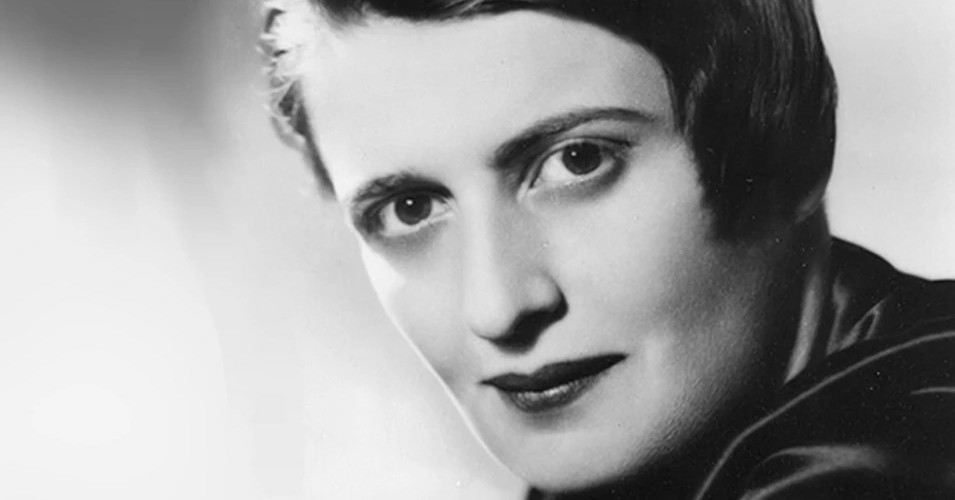
Alissa was a squat five-foot-two with a flapper hairdo and wide sunken dark eyes that gave her a haunting stare. And etched into those brooding eyes was burned the memory of a childhood backlit by the Russian Revolution.
She had just departed Leninist Russia where, almost a decade earlier, there was a harsh backlash against the Russian property owners—the people who were rich with Russian money like Donald Trump—by the Bolsheviks. Alissa’s own family was targeted, and at the age of 12 she witnessed Bolshevik soldiers burst into her father’s pharmacy business, loot the store, and plaster on the doors the red emblem of the state indicating that his private business now belonged to “the people.”
That incident left such a deep and burning wound in young Alissa’s mind, that she went to college to study political science and vowed one day she’d become a famous writer to warn the world of the dangers of Bolshevism.
Starting afresh in Hollywood, she anglicized her name to Ayn Rand, and moved from prop-girl to screenwriter/novelist, basing the heroes of several of her stories on a man she was reading about in the newspapers at the time. A man she wrote effusively about in her diaries. A man she hero-worshipped.
He was the most notorious man in American in 1928, having achieved a level of national fame she craved—William Edward Hickman.
What young Ayn Rand saw in Hickman that would encourage her to base a novel, then her philosophy, then her life’s work, on him was quite straightforward: unfeeling, unpitying selfishness.
He was the kind of man who would revel in the pain parents would feel when their children were ripped from their arms and held in freezing cages for over a year.
In Hickman, Ayn Rand wrote that she had finally found the new model of the Superman (her phrase, likely borrowed from Friedrich Nietzsche). Only a worldview held by a man like Hickman, she believed, could ever prevent an all-powerful state from traumatizing another generation of small businesspeople and their children as the Bolsheviks had her family.
Hickman’s words as recounted by Rand in her Journals, “I am like the state: what is good for me is right,” resonated deeply with her. It was the perfect articulation of her belief that if people pursued their own interests above all else—even above friends, family, or nation—the result would be utopian.
She wrote in her diary that those words of Hickman’s were, “the best and strongest expression of a real man’s psychology I ever heard.”
Hickman—the monster who boasted of how he had hacked up a 12-year-old girl—had Rand’s ear, as well as her heart. She saw a strongman archetype in him, the way that people wearing red MAGA hats see a strongman savior in Donald Trump.
As Hickman’s murder trial unfolded, Rand grew increasingly enraged at how the mediocre American masses had rushed to condemn her Superman, much like today people Trump calls mediocre condemn him and the killings that may have emerged from his rhetoric, from Charleston to Charlottesville to El Paso.
“The first thing that impresses me about the case,” Rand wrote in reference to the Hickman trial in early notes for a book she was working on titled The Little Street, “is the ferocious rage of the whole society against one man.”
Astounded that Americans didn’t recognize the heroism Hickman showed when he proudly rose above simply conforming to society’s rules, Rand wrote, “It is not the crime alone that has raised the fury of public hatred. It is the case of a daring challenge to society. … It is the amazing picture of a man with no regard whatever for all that society holds sacred, with a consciousness all his own.”
In other words, a man who lives exclusively for himself. A narcissistic psychopath. A man who could sell out his own country to foreign powers, tearing apart his nation’s people, just for his own enjoyment.
Rand explained that when the masses are confronted with such a bold actor, they neither understood nor empathized with him. Thus, “a brilliant, unusual, exceptional boy [was] turned [by the media] into a purposeless monster.”
The protagonist of the book that Rand was writing around that time was a boy named Danny Renahan. In her notes for the book, she wrote, “The model for the boy [Renahan] is Hickman.” He would be her ideal man, and the archetype for a philosophical movement that could transform a nation.
“He is born with the spirit of Argon and the nature of a medieval feudal lord,” Rand wrote in her notes describing Renahan. “Imperious. Impatient. Uncompromising. Untamable. Intolerant. Unadaptable. Passionate. Intensely proud. Superior to the mob… an extreme ‘extremist.’ … No respect for anything or anyone.”
The kind of man who would tell over 12,000 lies in two and a half years, who would daily lie to the press and his nation, just because he could—and would revel in it.
Rand wanted capitalism in its most raw form, uncheck by any government that could control the rules of the market or promote the benefits of society. Such good intentions had, after all, caused the hell she’d experienced in the Bolshevik Revolution, just like they’d caused Fred Trump to be arrested and fined for refusing to maintain apartments that black people had moved into.
Ayn Rand, like Hickman, found in the extremes her economic, political, and moral philosophy. Forget about democratic institutions, forget about regulating markets, and forget about pursuing any policies that benefit the majority at the expense of the very rich—the rule-makers and rule-enforcers could never, ever do anything well or good. Only billionaires should rule the world, as Trump has suggested.
Trump personifies this, putting an advocate of destroying public schools in charge of public schools, a coal lobbyist in charge of the EPA, an oil lobbyist in charge of our public lands, and a billionaire described by Forbes as a “grifter” in charge of the Commerce Department. His chief of staff said that putting children in cages (where seven so far have died) would actually be a public good. Don’t just ignore the rules; destroy them.
Welfare and other social safety net programs were, as Rand saw it, “the glorification of mediocrity” in society. Providing a social safety net for the poor, disabled, or unemployed, she believed, were part of a way of thinking that promoted, “satisfaction instead of joy, contentment instead of happiness… a glow-worm instead of a fire.”
She, like Trump, lived a largely joyless life. She mercilessly manipulated people, particularly her husband, and, like Trump, surrounded herself with cult-like followers who were only on the inside so long as they gave her total, unhesitating loyalty.
Like Trump and his billionaire backers, she believed that a government promoting working-class “looters” instead of solely looking out for capitalist “producers” was throwing its “best people” under the bus.
In Rand’s universe, the producers had no obligations to the looters. Providing welfare or sacrificing one nickel of your own money to help a “looter” on welfare, unemployment, or Social Security—particularly if it was “taken at the barrel of a gun” (taxes)—was morally reprehensible.
Like Trump saying, “My whole life I’ve been greedy,” for Rand looking out for numero uno was the singular name of the game—selfishness is next to godliness.
Later in Rand’s life, in 1959, as she gained more notoriety for the moral philosophy of selfishness that she named “Objectivism” and that is today at the core of libertarianism and the GOP, she sat down for an interview with CBS reporter Mike Wallace.
Suggesting that selfishness undermines most American values, Wallace bluntly challenged Rand.
“You are out to destroy almost every edifice in the contemporary American way of life,” Wallace said to Rand. “Our Judeo-Christian religion, our modified government-regulated capitalism, our rule by the majority will… you scorn churches, and the concept of God… are these accurate criticisms?”
As Wallace was reciting the public criticisms of Rand, the CBS television cameras zoomed in closely on her face, as her eyes darted back and forth between the ground and Wallace’s fingers. But the question, with its implied condemnation, didn’t faze her at all. Rand said with confidence in a matter-of-fact tone, “Yes.”
“We’re taught to feel concerned for our fellow man,” Wallace challenged, “to feel responsible for his welfare, to feel that we are, as religious people might put it, children under God and responsible one for the other—now why do you rebel?”
“That is what in fact makes man a sacrificial animal,” Rand answered. She added, “[man’s] highest moral purpose is the achievement of his own happiness.”
Rand’s philosophy, though growing in popularity on college campuses, never did—in her lifetime—achieve the sort of mass appeal she had hoped. It was confined to college coffee shops, intellectual conferences, and true-believer journals, but never hit the halls of Congress, the mainstream television airwaves, or water-cooler political debates. There were the handful of “true believers,” but that was it… until today.
Now, Ayn Rand’s philosophy is a central tenet of today’s Republican Party and the moral code proudly cited and followed by high-profile billionaires and the president of the United States.
Ironically, when she was finally beginning to be taken seriously, Ayn Rand became ill with lung cancer, and went on Social Security and Medicare to make it through her last days. She died a “looter” in 1982, unaware that her sociopathic worldview would one day validate an entire political party’s embrace of a sociopathic narcissist president.
Published by Common Dreams, 08.13.2019, under the terms of a Creative Commons Attribution-Share Alike 3.0 license.
About the Author