America’s Native horses never went extinct. They survived the Ice Age and lived among Native people.

By Dr. Shoshi Parks
Anthropologist
Introduction
The horses at the Sacred Way Sanctuary in Florence, Alabama, are among the last of their kind. Some have dark stripes like arrows tracing the spine or climbing up the forelegs. Some have curly, poodlelike coats or manes that cascade to the ground.
According to the history books, these horses don’t exist. In the official narrative, America’s original horses “went extinct” thousands of years ago, killed off by the frigid temperatures of the last Ice Age. Horses that live in the Americas today, claim historians, are descendants of those first brought by European explorers and settlers in the early 16th century.
But according to Indigenous oral histories and spiritual beliefs from Saskatchewan to Oklahoma, America’s Native horses never went extinct. They survived the Ice Age and lived among Native people before, and after, the arrival of European colonizers, and a mountain of historical and archaeological evidence proves it—from ancient clay and wood horse figurines from North America and horse petroglyphs in Peru to accounts recorded by early explorers.

Now, with only a few thousand Native horses believed to be left in the Americas, Native people are beginning to share the knowledge they have quietly protected for centuries. For many Indigenous people, these Native horses aren’t beasts of burden but relatives and sacred “medicine.” And in recent years, reserves such as the Sacred Way Sanctuary and South Dakota’s Black Hills Wild Horse Sanctuary have stepped up their work to rescue Indigenous horse lineages from extinction as part of the Native American Horse Trail. An alliance of Indigenous and non-Indigenous caretakers, the sanctuaries on the trail are dedicated not just to preserving Native horses but to promoting their history and protecting related sacred sites and ceremonies.
“There were certain relatives that Creator sent that specifically are designed to help us in our journey spiritually, to help strengthen us. One is the horse,” explains Dr. Yvette Running Horse Collin, co-founder of the Sacred Way Sanctuary. “They literally share our experience,” With only a relative few Native horses remaining, she says, “we have decided that we will now speak and we’re not going to stop.”
Native Horses and the Medicine They Provide
The Sacred Way Sanctuary is set off a semirural road in the bucolic hinterlands of northwestern Alabama. Bound by 2 miles of freshwater streams, it lies within the original borders of one of the first federal Indian Reservations in the United States, a place meant to contain and civilize members of the Cherokee Nation.
About 100 horses live on the land, each a descendent of Native North American horse lines named for the nations associated with them, including the Choctaw, Cherokee, Chickasaw, Lakota, Cheyenne, Apache, Ojibwe, and Pueblo. The horses at the Sacred Way Sanctuary and the others along the Native American Horse Trail are different from those of European lineages. They’re smaller, for starters, rarely more than 14 hands high (4.7 feet high at the withers). They stand differently, consume foods that European horses can’t digest, and their coats have distinct patterns and markings. There are speckled appaloosas and patchwork paints. There are horses with webbing on their faces.

Above all, the horses at these sanctuaries are sacred beings that can help to heal the wounds that cause the mind, body, and soul to shift out of alignment, says Running Horse Collin. The horses, or parts of the horse, are incorporated into ceremonies. An Oglala Lakota rite of passage ceremony, for example, involves piercing the ears of young boys and girls with earrings made of horsehair, says Loretta Afraid of Bear-Cook, an Oglala Lakota elder, faith keeper, cultural specialist, and a governing council member at the Sacred Way Sanctuary.
Another form of horse medicine was used by Oglala Lakota leaders in the 19th century, including famed chief Crazy Horse. “Once the horse dies, there’s a part on the leg that looks like a little circle, and that’s where the power comes from,” Afraid of Bear-Cook explains. “The chiefs of that time period, they [took] that horse medicine off the leg and they dried it and put it back behind the ear. Whenever they were going to ask for anything, whether it was spiritual or physical, they had the mindset that they would include the horse.”
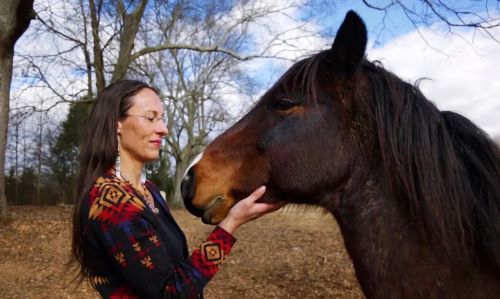
Just being around a horse is healing medicine, too. “From watching the horses, watching what they do, you learn responsibility. You can talk to that horse, which we still do today. If you look directly into its eyes, [it] will look to you, it’ll put its nose to you and it will open up,” Afraid of Bear-Cook says.
Indeed, in recent years Western science has begun to confirm what Indigenous communities have always known. Riding and caring for horses can activate the sympathetic nervous system in children and influence the rhythm of the human heart rate. Equine therapy is becoming increasingly popular for treating PTSD in military veterans and children experiencing anxiety and depression or recovering from trauma. “Horses are incredibly sacred, they’re more than sacred,” Running Horse Collin says. “Our people didn’t need those kind of studies, we just knew it worked.”
A Shared History
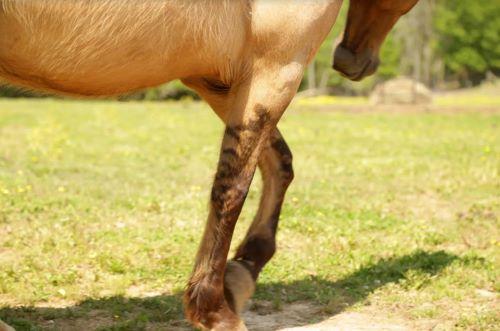
Horses and the Native people of North America are not just spiritually intertwined; their histories echo each other. After the conquistadors arrived, both were slaughtered, forced into subservience, and pushed onto inferior lands. Both have survived. “Side by side, they are with us, and they’ve experienced everything we’ve been through,” Running Horse Collin says.
The memory of those injustices still live on in the stories of Native people. Afraid of Bear-Cook was just a girl when the Bureau of Indian Affairs stormed the Pine Ridge Reservation with a fleet of empty trailers. They came for the horses and cattle of her people, the right to which the U.S. government claimed because the Lakota had “failed” to pay taxes on their livestock.
The bureau rounded them up one by one, loaded them on the trailers and drove away. Afterwards, remembers Afraid of Bear-Cook, the women cut their hair in mourning. The BIA hadn’t just taken their animals, they had “severed” the tribe’s relationship to their sacred relatives. They were never seen again.
Removing horses from their Indigenous caretakers (or slaughtering them outright) was a common tactic used by the U.S. government to force Native people to assimilate. “Going through our lives, we became aware that to further invalidate our existence in our communities, the bureau, the first thing that they did was come to [take] the cattle and horses,” says Afraid of Bear-Cook.

But denying Native claims to horses didn’t start with the U.S. government. Early explorers and settlers chronicled the presence of horses throughout North America. In 1521, herds were seen grazing the lands that would become Georgia and the Carolinas. Sixty years later, Sir Francis Drake found herds of horses living among Native people in coastal areas of California and Oregon. In 1598, Don Juan de Oñate described New Mexico as being “full of wild mares.”
Yet, the official story that was written into the history books, and which persists today, is that the New World had no horses before the arrival of the Spanish. According to the narrative, the first horses to arrive in the New World in 1519 were the progenitors of every horse found on the continent in later years. That it would have been biologically impossible for a small group of horses in Mexico to populate regions thousands of miles away in as little as two years is never discussed.
That’s by design, says Running Horse Collin who, after being asked by elders from different Native nations to set the record straight, conducted more than a decade of research and wrote her Ph.D. dissertation on the topic of Native horses in the Americas. In the Spain of the late 15th and 16th centuries, horses were associated with nobility, power, and cultural refinement. “If indeed there were horses here and the Native people had a relationship with them, with Europe’s standards at that time, we were civilized. And, in order for them to “conquer” and do what they wanted to do, we had to be uncivilized,” she says. Covering up the accounts of those who bore witness to horses in the New World and denying that horses existed in the New World at all, helped to sell the myth of settler colonialism on which the conquest of the Americas was built.
Crossbreeding with European horses and their slaughter in the name of “herd management” have reduced the Native horse population to just a few thousand. Still, Running Horse Collin believes it’s not too late to bring their story to light. In addition to her work with Sacred Way, this past fall she began talks with a team of French geneticists to analyze the DNA of the sanctuary’s native horses. She expects that their results will provide undeniable scientific proof not just that American horses persevered through the Ice Age, but that they, like Native people, have survived through the centuries.
Protecting Native horses and their spiritual relationship to Native people as well as educating the public about their existence drive not just the Sacred Way Sanctuary but other horse sanctuaries along the Native American Horse Trail. A handful of reserves participate in the partnership, established in 2014, each with its own area of focus. The Red Pony Stands Ojibwe Horse Sanctuary, for example, is dedicated to the preservation of the endangered Ojibwe pony, while the Black Hills Wild Horse Sanctuary is dedicated to caring for and preserving the wild “American mustang,” sacred sites, and the range.
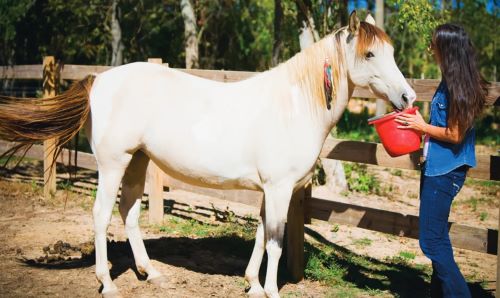
“There is no doubt in my mind that wild horses are native to North America,” says Rob Pliskin, a 30-year volunteer of the Black Hills Wild Horse Sanctuary and former board member of The Cloud Foundation, an organization dedicated to protecting wild horses and burros. “The sanctuary is for the benefit of the horses and their opportunity to live as they were intended to live. It also offers firsthand on-the-ground education about the nature of the wild horse and its presence in the ecology of the American West.”
Ultimately, raising awareness about Native horses does more than just assure their continued survival. It makes Native experiences, as a whole, more visible. “It’s many times hard to talk about [the Indigenous experience] directly because the world doesn’t want to hear it. But you can talk about the horses,” concludes Running Horse Collins. “We’re still alive. Are we battered? Sure. Are the horses battered? Sure. But is it over? No.”
Originally published by Yes! Magazine, 04.27.2020, under a Creative Commons Attribution-NonCommercial-NoDerivatives 4.0 International license.
About the Author