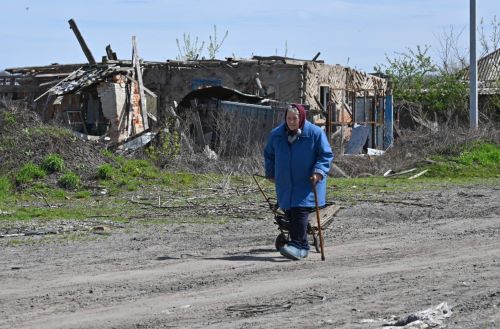
In armed conflicts, humanitarian crises, and climate-induced disasters, older people often suffer disproportionately.

By Daniel Balson
Human Rights Expert

By Jane Buchanan
Senior Advocacy Advisor
HelpAge USA
Introduction
We live in a rapidly aging world. Increased longevity as a result of significant health- and medical advancements and reduced child mortality is to be celebrated. At the same time, global aging will transform politics, economics, culture, and society for everyone. For older people in particular, geopolitical developments including armed conflict, the climate crisis, and artificial intelligence portend elevated risks. Yet the United States has done little to change the way it engages abroad in response to this major demographic shift.
The numbers are clear. People over 60 already outnumber children under 5, according to the World Health Organization. By 2050, the number of older people will more than double, to 2.1 billion, to become 22 percent of the world’s population. The vast majority will live in low- and middle-income countries.
In armed conflicts, humanitarian crises, and climate-induced disasters, older people often suffer disproportionately. According to the United Nations, 32 percent of civilians killed in the first year of the war in Ukraine were over 60, although they represented 25 percent of the population. This pattern is replicated across other conflicts.
Nigeria has been beset for many years by the Boko Haram insurgency in the north as well as climate-related conflicts between herders and farmers over pasture and farmland. Comprehensive data on the impacts of older people is difficult to source. However, when Amnesty International interviewed people responsible for receiving and burying bodies from two sites of government detention of alleged Boko Haram fighters in the city of Maiduguri, it found that older men accounted for 15 to 25 percent of the deaths in custody, though they comprise only 4 percent of the regional population.
In the Caucasus region, more than half of ethnic-Armenian civilians killed in the 2020 conflict between Armenia and Azerbaijan over Nagorno-Karabakh were people over 60, including because older people felt unable to flee since they served as primary caregivers for spouses, friends, neighbors, and others in their community.
As research has shown, older people face particular barriers to living dignified, healthy lives in displacement and as refugees. They are more likely to rely exclusively on small pensions to survive, restricting their access to decent homes, adequate food, and essential medicines in Ukraine and other countries. For older people who remain in their homes, unable or unwilling to flee, humanitarian assistance often fails to reach those in rural communities and near the front lines.
This explains why news and images coming out of Ukraine have featured older people so prominently: they are the face of civilian devastation.
Natural Disasters, the Climate Crisis, and Crime
The ruin and disruption brought on by natural disasters also pose major threats. As many as half a million people over 60 live in the area affected by the September 2023 earthquake in Morocco. Humanitarian assistance often does not reach older people, especially if they have disabilities or live away from centralized aid-distribution points. They typically have greater healthcare needs and rely more on regular access to medications, such as for chronic health conditions.
Similarly, as the climate crisis precipitates increasingly frequent extreme weather events, older people suffer disproportionately. A recent report by Human Rights Watch chronicled how unprecedented flooding in Bangladesh proved particularly devastating for older people and people with disabilities. In Spain’s 2022 heatwave, 98 percent of more than 4,500 heat-related deaths were people 65 and older, according to government data. Climate-related mortality among older people in the United States almost doubled between 2008and 2018. These deaths are among many risks older Americans face: they are at increased risk of poverty and nearly a quarter of a million people over age 55 were estimated to be homeless in 2019.
Older people also are taking action to demand accountability and to advance solutions. In Europe, thousands of older Swiss women have filed suit at the European Court of Human Rights, accusing their government of failing to adequately address climate change, and thus their elevated risk of dying in heatwaves like those seen across much of Europe this summer.
In addition to the effects of climate change, in many countries, older people are attracting the attention of criminals, armed gangs, and vigilantes. In the United States, state attorneys general increasingly recognize that criminals target older people, believing them to be invisible, convenient, and docile victims. In Nigeria, armed groups attacking homes and villages subject older people to violence, looting, and starvation.
While artificial intelligence may yet bring positive change to the way communities support older people, it has already empowered international criminal networks that seek to defraud them of their savings.
U.S. Leadership is Crucial
In recent years, foreign policy leaders in Washington have demonstrated a greater commitment to addressing the human rights risks faced by marginalized groups, with strategies, policies, and experts to ensure their inclusion. At the State Department, a special representative is responsible for racial equity and justice, and a special advisor is charged with protecting the rights of people with disabilities. It has an Office of Global Women’s Issues. One special envoy is dedicated to monitoring and combatting antisemitism, another with considering global youth issues, and a third with advancing the rights of LGBTQI+ people.
Yet, the United States has still not shown up to the same degree for older people despite evidence that it should urgently do so. Neither the State Department nor the U.S. Agency for International Development (USAID) have a strategy or policy on older people, and no senior official is charged with advocating for them. Although USAID emergency humanitarian funding guidelines require humanitarian organizations to include older people, there are no effective accountability mechanisms in place to guarantee that development dollars reach older people, humanitarian interventions adequately respond to their needs, and diplomatic efforts protect their rights. This status quo harms other equity and justice aims, as many older people, such as older women, face cumulative impacts from multiple forms discrimination and abuse over their lifetimes as they age.
There are a number of ways the U.S. government can, first, more sufficiently recognize the specific risks and experiences of older people within broader policies. For example, the State Department’s 2022 U.S. Strategy to Prevent and Respond to Gender-Based Violence Globally includes references to older people, particularly older women, as does USAID’s 2023 Gender Equality and Women’s Empowerment Policy.
These are important steps. Yet, meaningful protection of the rights of older people requires both this type of inclusion as an at-risk group across relevant policies, as well as dedicated policies, experts, and authority to ensure U.S. leadership and action on a strategic global issue.
The Biden administration should nominate and task a senior official within the State Department to defend the rights of older people and embed their interests throughout U.S. foreign policy. It should also urgently set out guidance to all executive agencies engaged abroad to ensure that U.S. diplomacy and foreign assistance promote and protect the human rights of older people, such as through a presidential memorandum, as the Obama administration did for LGBTQI+ persons. This would help lay the groundwork for the development of an age-inclusive development policy in USAID and the State Department and ensure the assignment of staff dedicated to older people’s rights. The senior official would be empowered to consult and include older people in diplomatic negotiations that impact them, evaluate whether foreign assistance programs are advancing their rights, and urge countries around the world to combat age discrimination.
Multilateral Action
The White House must also act multilaterally. International civil society organizations, U.N. agencies, and some governments are coalescing around the need for a global convention on the rights of older people, to rectify the gaps in international standards that fail to acknowledge and combat ageism and other specific harms to older people. The White House should show leadership in this effort, including through the U.N.’s working group on older people.
Two agreements concerning the rights of older people already exist at the regional level – the African Charter on Human and Peoples’ Rights on the Rights of Older Persons and the Inter-American Convention on Protecting the Human Rights of Older Persons. By demonstrating that countries are willing to collaborate to protect older people, these accords represent a valuable proof of concept but, for multiple reasons, they fall short of what is needed. As regional agreements, for example, they do not cover most of the world’s population. They lack the status and standing of a U.N. human rights treaty, making it harder to secure signatures, ratifications, and ascensions. Compliance and implementation are not subjected to monitoring by a U.N. treaty body. Moreover, they do not create universally accepted standards for advancing and protecting older people’s rights.
Finally, the U.S. Congress must play a role. Very few legislative resources are dedicated to ensuring the United States advances older people’s rights abroad. Hearings, appropriations, legislation, and floor statements are vital to changing policies and attitudes. Congress should regularly assess executive agencies’ allocation of resources and the effectiveness of efforts to promote older people’s equality and dignity. Members of Congress can also provide a critical venue for older people to speak about their experiences in crises and in conflicts abroad. They should also insist on specific policies for older people and dedicated envoys, advisors, and other experts.
For too long, policymakers have failed to address the needs and rights of older people with the determination reserved for other populations. If the Biden administration wishes to make good on its commitment to usher in a more inclusive foreign policy, it must realize that inclusion won’t be complete when older people are left behind.
Originally published by the Just Security, 11.07.2023, New York University School of Law, under the terms of a Creative Commons Attribution-No Derivs-NonCommercial license.
About the Author