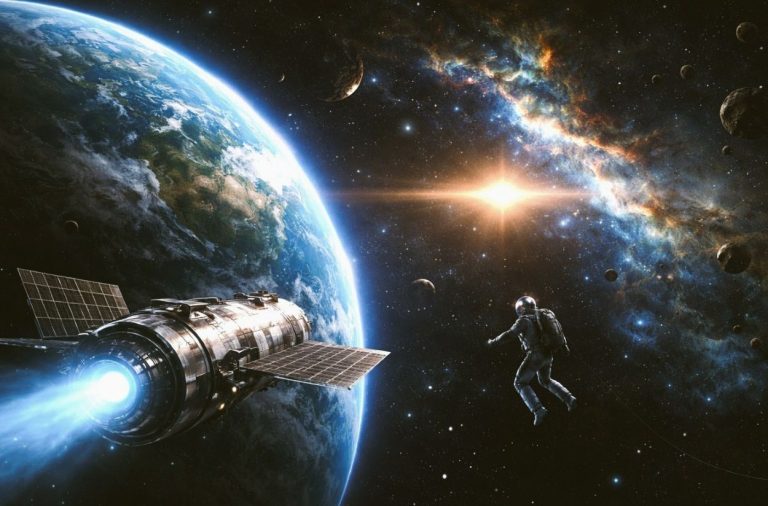
Humans have not set foot on the Moon for more than 50 years.

By Robin Pomeroy
Podcast Editor
World Economic Forum

By Natalie Marchant
Writer, Forum Agenda
World Economic Forum
Introduction
“You don’t need to be an astronaut to go into space anymore.”
So says Alexander MacDonald, NASA’s first ever chief economist, whose role has been pivotal as the US space agency increasingly works with commercial partners in its mission to explore the secrets of the universe for the benefit of all.
Long gone are the days of the two-nation Cold War space race between the US and the USSR. Nowadays, NASA is teaming up with other global players and the private sector on its Artemis lunar exploration programme – a set-up that seems worlds away from the Apollo programme that last put a man on the Moon in 1972.
International cooperation has always been an “essential element” in the progress of the entire space sector, with scientists working together for centuries, agrees Pascale Ehrenfreud, president of the Committee of Space Research (COSPAR).
And with the Moon missions of the 1960s and 70s still fueling the curiosity of millions across the world, what’s next in space? MacDonald and Ehrenfreund tell Radio Davos about plans to return to the Moon, why we’re looking for life on Mars and what that may look like.
Here are some of the highlights from the podcast:
Space Technology Supports Life on Earth
Space and space data offer a tremendous amount of economic and societal benefits to humankind, be it for monitoring climate change, boosting internet connectivity, or driving navigation systems.
There are “economic elements of all of those areas that impact national growth, that impact the global economy”, says MacDonald.
But much of the technology that fundamentally supports our quality of life wouldn’t have been developed if it hadn’t been for “an ambition to go and explore the stars”, he adds. The rapid evolution of semiconductors – the components that everyday devices like laptops and smartphones rely on, and which are powering the artificial intelligence revolution – was in many ways driven by the 1960s Moon missions, for example.
“So fundamentally, investments in things like going to the Moon are investments in advancing very complicated and sophisticated technology,” says MacDonald. “And as we know, the vast majority of growth in the 20th century came from advances in technology, from productivity improvements.”
What Our Return to the Moon May Look Like
Named after the Greek goddess who was the twin sister of Apollo, Artemis is NASA’s latest mission that aims to return humans to the Moon, create a lunar base and lay the groundwork for missions to Mars.
But while it has the same kind of objective of taking humans to the Moon as its predecessor, the Artemis programme it has the “broader objective of learning to stay and work there for extended periods of time”, explains MacDonald. Then there’s Gateway, NASA’s first commitment to a human habitable outpost that will permanently circle the Moon.
The way that its latest Moon mission is being conducted is also very different. One key difference this time round is that NASA has partnered internationally – with the first crewed mission, Artemis II, scheduled to take a Canadian astronaut, says MacDonald.
NASA and the US government have also committed to landing Japanese astronauts on the lunar surface in exchange for Japan’s contribution of a pressurised lunar rover that the crew can live and work in during the later stages of the programme, which will eventually see the launch of the first lunar space station.
Private Sector Role
NASA is also working extensively with the commercial sector for space exploration activities, with clear benefits to innovation as the recent capture of SpaceX’s Starship by a pair of giant ‘chopsticks’ highlights.
“Certainly, private companies are able to take risks that maybe a government agency can’t always directly take themselves. And so we’re seeing a massive increase in capabilities – reusable rocketry being the most obvious one,” MacDonald says.
“Seeing rockets launch into orbit and then return to pad… it’s something that we did not have 20 years ago. Today it happens 100 times a year.”
There are financial upsides too. Investments from venture capital and the private sector amount to around $10 billion invested in space annually – “a significant increase from where we were, say, 20 years ago”, says MacDonald – while NASA’s total expenditure on returning to the Moon is about $8 billion, “which is really not that much when you look at it in context of the global economy”.
MacDonald also stresses that no money is actually spent in space. “All of the money is spent terrestrially, resulting in jobs on Earth.”
Looking for Life on Mars
Is there life beyond Earth? “I think this is a question which is very fundamental and concerns us all,” says astrobiologist Ehrenfreund.
“Are we alone in the universe? And obviously, we want to understand how life originated on Earth. Is there life in our solar system? Is there life beyond our solar system?”
What we’re looking for is life as we know it and that means carbon-based life, she explains. And while there are already active orbiters, landers and rovers testing for basic components of life like amino acids and special hydrocarbons on Mars, no samples have yet been brought back to Earth – something which will be the focus of NASA and the European Space Agency’s (ESA) Mars Sample Return mission.
“If we bring back samples from Mars to Earth laboratories, I think we will have fantastic results and understand much more and eventually find organic molecules, a remnant of life, if life ever originated on Mars.”
International Cooperation on Space Is Key
Space exploration is happening at breakneck speed and continued collaboration between all the different stakeholders will be vital to keeping up the pace – with the International Space Station (ISS) is a great example as to why.
Since its launch in 1998, some 280 individuals representing 23 countries and five international partners have visited the ISS, with many more nations and stakeholders involved in carrying out thousands of experiments over the years. But the ISS is due to be retired in a few years’ time. NASA says on its website: “NASA has committed to fully use and safely operate the space station through 2030, as the agency also works to enable and seamlessly transition to commercially owned and operated platforms in low Earth orbit.”
“I think space has always been a little bit above political problems and has tried to cooperate, and I hope it is continuing like that,” says Ehrenfreud.
One question remains – will humankind soon set a foot on Mars? Nikolai Khlystov, Lead, Space Technology at the World Economic Forum, who co-hosted this episode of Radio Davos certainly thinks so.
“I think it is not going to be as soon as some of the official mission dates put it, for 2030; it will probably be late 2030s. But definitely in our lifetime.”
Originally published by the World Economic Forum, 12.03.2024, under the terms of a Creative Commons Attribution-NonCommercial-NoDerivatives 4.0 International license.
About the Author