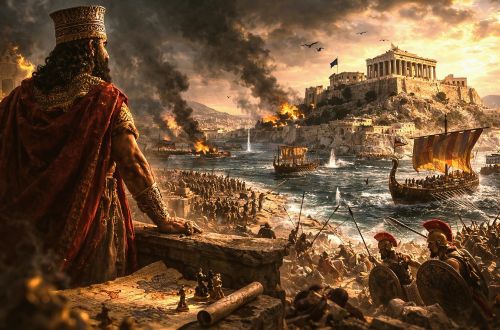
Xerxes’s massive invasion of Greece in 480 BCE promised swift imperial victory, yet geography, coalition resistance, and strategic miscalculation exposed the limits of overwhelming power.

By Matthew A. McIntosh
Public Historian
Brewminate
Introduction: Expectations of Easy Victory
In 480 BCE, King Xerxes I of Persia launched one of the most ambitious military expeditions of the ancient world, assembling a massive force to invade mainland Greece. The campaign followed earlier Persian efforts under Darius I to extend imperial authority across the Aegean. By the early fifth century BCE, the Achaemenid Empire governed an immense territory stretching from the Indus Valley to Egypt and Anatolia. Against this backdrop of imperial success, the invasion of Greece appeared less like a desperate gamble and more like the logical continuation of Persian expansion. The resources available to Xerxes, including vast manpower drawn from many subject peoples and an extensive logistical network, suggested that resistance from the relatively small Greek city-states could be swiftly overcome. Persian rulers had repeatedly demonstrated their ability to mobilize vast armies and fleets drawn from across the empire’s diverse populations, and the administrative structures established by earlier kings allowed such mobilization on a scale rarely seen in antiquity. To many observers within the imperial court, the campaign likely appeared not as a risky undertaking but as a calculated assertion of Persian supremacy over a peripheral region that had previously challenged Persian rule.
From the Persian perspective, the strategic balance seemed overwhelmingly favorable. The Greek world consisted of politically fragmented poleis frequently divided by rivalry, ideology, and competition for regional influence. Athens, Sparta, Corinth, and other city-states often viewed one another as adversaries rather than allies. Such fragmentation appeared to guarantee that coordinated resistance would be difficult to sustain. Moreover, several Greek communities in Asia Minor had already fallen under Persian control following earlier campaigns, reinforcing the impression that Greek opposition could be subdued through decisive military superiority and administrative integration. The invasion was not merely an act of conquest but an attempt to bring a turbulent frontier region into the broader imperial system.
Yet the assumption of rapid victory concealed deeper operational uncertainties. The Greek mainland presented environmental and political conditions very different from those faced by Persian armies in earlier conquests. Mountainous terrain limited the effectiveness of large armies, and the maritime geography of the Aegean gave naval power unusual strategic importance. Even more significantly, the threat of invasion stimulated cooperation among several Greek city-states that had previously remained divided. What Persian planners likely expected to be a swift demonstration of imperial strength began to encounter opposition that proved both determined and adaptive.
The Persian invasion of Greece illustrates a recurring phenomenon in the history of warfare: powerful states often assume that military superiority will translate into quick and decisive victory. This expectation of effortless triumph often shapes strategic planning, political rhetoric, and public confidence at the outset of war. Such assumptions can influence how wars are presented to both domestic audiences and subject populations, reinforcing narratives of inevitability and imperial strength. Yet the experience of Xerxes’s invasion reveals how such expectations can collapse when confronted with resilient opponents, unfavorable geography, and unexpected political unity among adversaries. Greek forces exploited terrain, naval maneuverability, and strategic coordination in ways that gradually eroded the advantages of the invading army. The campaign that began as a confident assertion of imperial dominance would instead become a costly struggle that reshaped relations between the Persian Empire and the Greek world. More broadly, the episode demonstrates that even the most formidable military power can misjudge the dynamics of conflict, particularly when initial confidence obscures the complexities of geography, coalition politics, and the determination of smaller states to resist external control.
The Persian Imperial System and Expectations of Dominance
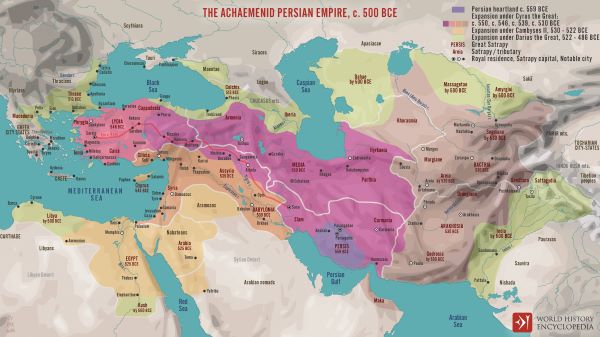
History Encyclopedia, Creative Commons
The Achaemenid Persian Empire represented one of the most extensive and administratively sophisticated political systems of the ancient world. Founded by Cyrus II in the mid-sixth century BCE and expanded under successive rulers, the empire incorporated a vast range of territories stretching from Central Asia and the Indus Valley westward through Mesopotamia and Anatolia to Egypt. This territorial reach created a political environment in which Persian kings governed dozens of ethnic groups, languages, and local traditions. Rather than attempting to impose uniform cultural practices across their domains, Persian rulers generally allowed subject populations to retain local customs while integrating them into a broader imperial framework. Such a system allowed the empire to expand rapidly without provoking constant rebellion, reinforcing the perception that Persian power could absorb diverse societies with relative stability.
Central to this system was the institution of the satrapy, a provincial administrative structure designed to manage the empire’s immense territories. Each satrapy was governed by a satrap who oversaw taxation, security, and communication with the royal court. These provincial authorities were supported by military garrisons, royal inspectors, and an elaborate bureaucratic apparatus that linked distant regions to the central authority of the king. The Persian state also invested heavily in infrastructure, including the famous Royal Road, which facilitated communication and troop movement across vast distances. This combination of administrative organization and logistical capability allowed the empire to mobilize resources on a scale unmatched by most contemporary states.
Military strength was an essential component of Persian imperial authority. The empire could call upon a wide array of forces drawn from its many subject peoples, including cavalry from the Iranian plateau, archers from Mesopotamia, infantry from Anatolia, and naval contingents from Phoenician and Egyptian ports. Such diversity gave Persian armies both numerical advantage and tactical flexibility. The royal court could assemble enormous military forces when necessary, projecting the image of overwhelming strength to both allies and adversaries. Persian armies were not simply large but also symbolically powerful, representing the authority of a king whose rule extended across continents. The inclusion of numerous ethnic contingents within imperial armies also reinforced the political message that the empire commanded loyalty from many regions and peoples. For imperial planners, the mobilization of such forces demonstrated the capacity of the state to coordinate military action on an extraordinary scale, creating the impression that few adversaries could resist such concentrated power.
Previous campaigns reinforced confidence in this imperial system. Persian rulers had successfully subdued powerful kingdoms including Lydia and Babylon, both of which possessed significant military and economic resources. These victories demonstrated the effectiveness of Persian strategy, which often combined military force with pragmatic governance after conquest. Subject territories were integrated into the empire through taxation and administrative oversight rather than through wholesale cultural suppression. As a result, Persian leaders could view their expanding realm as a stable political order capable of absorbing new territories without fundamental disruption.
By the time Xerxes I assumed the throne in 486 BCE, the empire had accumulated more than half a century of successful expansion and consolidation. The memory of earlier victories shaped expectations within the imperial court. Campaigns launched by Persian kings had typically resulted in the rapid defeat or submission of opposing states, reinforcing the belief that resistance could be overcome through superior organization and resources. Persian armies had repeatedly demonstrated their capacity to overwhelm regional powers that lacked comparable administrative coordination or manpower reserves. Such experiences encouraged the assumption that imperial campaigns would follow a predictable trajectory in which initial resistance collapsed once confronted by the logistical and military strength of the empire. The invasion of Greece appeared consistent with the empire’s established pattern of dealing with defiant regions along its frontiers.
Such confidence, however, carried the risk of strategic overestimation. The administrative and military structures that had enabled Persian success elsewhere did not necessarily guarantee identical results in every region. The empire’s experience with conquest may have encouraged assumptions that smaller states would ultimately submit once confronted by overwhelming force. This belief in the reliability of imperial power shaped the expectations surrounding Xerxes’s campaign, contributing to the broader conviction that the invasion of Greece would end quickly and decisively.
Greek Political Fragmentation and the Persian Strategic Miscalculation
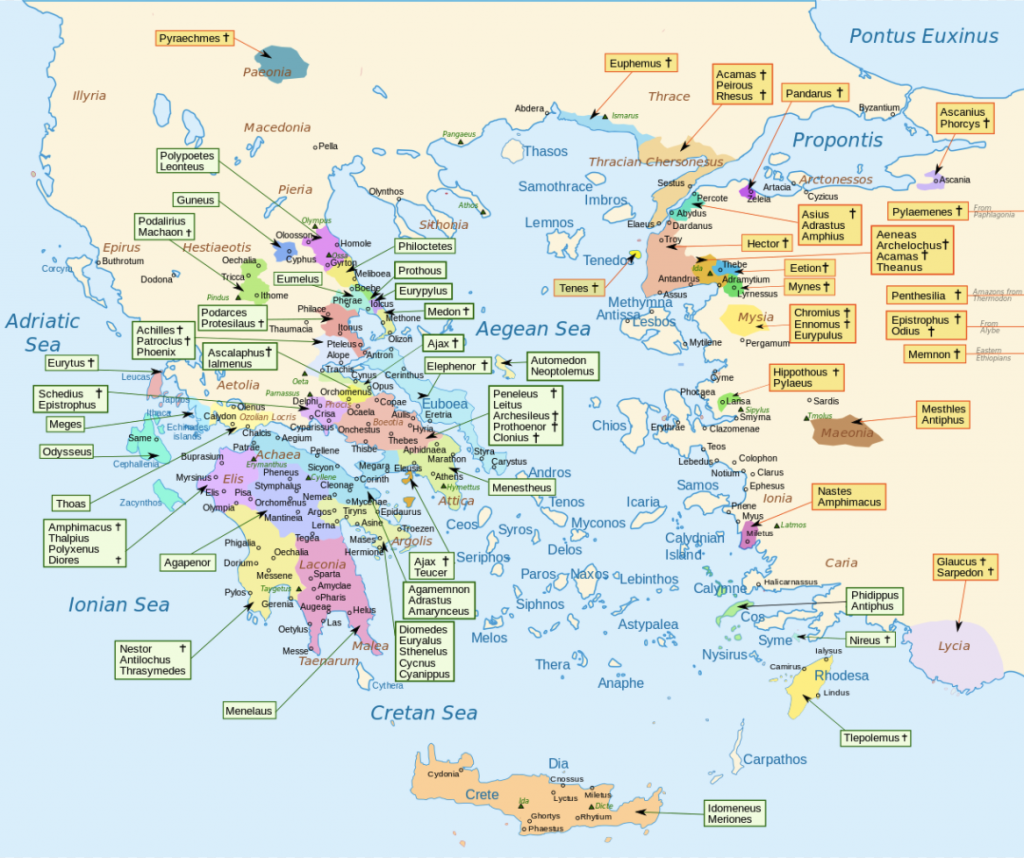
In contrast to the centralized structure of the Persian Empire, the Greek world of the early fifth century BCE consisted of numerous independent city-states, or poleis, each possessing its own political institutions, alliances, and rivalries. These communities were often fiercely protective of their autonomy and frequently engaged in competition or open conflict with one another. Athens, Sparta, Corinth, Thebes, and dozens of smaller cities operated within a political environment defined by shifting alliances and local ambitions rather than unified national identity. From the perspective of imperial observers, such fragmentation appeared to present a significant weakness. A region divided by internal rivalry seemed unlikely to mount sustained collective resistance against a powerful invading force.
Persian officials had reason to believe that Greek political divisions could be exploited. During earlier campaigns in the late sixth and early fifth centuries BCE, several Greek communities had already submitted to Persian authority or cooperated with imperial administration. In parts of Asia Minor, Greek cities had been incorporated into the imperial system as tributary territories following the suppression of the Ionian Revolt. These precedents suggested that some mainland Greek communities might likewise choose accommodation over resistance. Persian diplomatic strategy included efforts to encourage submission from individual city-states rather than confronting a unified coalition.
The expectation that Greek cities would act independently reflected a broader Persian approach to frontier management. Imperial administrators frequently relied on local elites to maintain order in newly incorporated regions, allowing communities to retain internal autonomy while acknowledging Persian sovereignty. Such arrangements had proven effective elsewhere in the empire, where local rulers often found cooperation with Persian authorities preferable to confrontation. Applying a similar strategy to the Greek mainland appeared reasonable given the political fragmentation that characterized the region. From an imperial perspective, the Greeks might be expected to pursue local advantage rather than collective defense. Moreover, the Persians had already observed patterns of rivalry and competition among Greek states, including conflicts over trade routes, territorial boundaries, and political influence. These divisions suggested that even if some cities resisted Persian authority, others might accept imperial protection or neutrality in order to weaken their regional rivals. The Persian leadership could reasonably anticipate that diplomacy, intimidation, and selective alliances would fragment Greek resistance before it could fully develop.
Yet the invasion generated political dynamics that Persian planners had not fully anticipated. The scale of Xerxes’s campaign, combined with the symbolic implications of foreign domination, encouraged several poleis to cooperate despite longstanding rivalries. Athens and Sparta, traditionally suspicious of one another, emerged as central participants in an alliance designed to coordinate resistance. Other cities contributed naval forces, troops, or logistical support, creating a coalition that was small compared with the Persian army but strategically coordinated in ways that complicated the invasion.
This emerging cooperation did not eliminate internal tensions within the Greek world. Many city-states remained neutral, and some chose to align themselves with Persian authority. Nevertheless, the coalition that formed around Athens and Sparta proved capable of coordinating military strategy and concentrating resources at critical points in the conflict. The alliance demonstrated that external pressure could sometimes overcome internal fragmentation, particularly when political independence itself appeared threatened. Persian expectations that local rivalries would prevent collective resistance proved only partially accurate. The willingness of several poleis to set aside immediate political disputes in order to confront a common threat revealed a level of strategic adaptability that imperial planners had underestimated. Although the Greek coalition remained fragile and occasionally divided, its existence altered the strategic landscape of the war in ways that complicated Persian assumptions about how quickly resistance would collapse.
The miscalculation was not simply a failure of intelligence but also a reflection of differing political structures. Persian imperial governance relied on hierarchical authority centered on the king, whereas the Greek world operated through decentralized communities that could form alliances when circumstances demanded cooperation. What initially appeared to Persian strategists as a structural weakness within Greek society instead became a source of adaptive resilience. The ability of independent city-states to coordinate defense without sacrificing their autonomy eventually complicated Persian efforts to impose imperial control over the region.
Geography, Naval Power, and the Battle of Salamis

The geography of the Greek mainland played a decisive role in shaping the course of Xerxes’s invasion. Unlike the expansive plains that Persian armies had traversed during earlier campaigns in Anatolia and Mesopotamia, much of Greece consisted of mountainous terrain broken by narrow passes and irregular coastlines. These physical conditions limited the operational advantages of large imperial armies. The narrow corridors through which invading forces were forced to travel created opportunities for smaller defensive forces to concentrate resistance at strategic points. For Persian planners accustomed to operating across broader landscapes, the geography of Greece introduced constraints that complicated the deployment of overwhelming numbers.
Naval power became central to the campaign. Control of the Aegean Sea determined the ability of either side to supply armies, coordinate movements, and maintain communication between scattered forces. The Persian Empire possessed a formidable fleet drawn largely from Phoenician, Egyptian, and Anatolian maritime traditions. These naval contingents had long served the empire and were capable of operating in large coordinated formations. Persian rulers had long relied on the maritime expertise of subject peoples, particularly the Phoenicians, whose shipbuilding and navigational skills were among the most advanced in the ancient Mediterranean. Such forces allowed the empire to project power across coastal regions and islands that might otherwise have been difficult to control. Yet the Persian fleet’s size also presented difficulties when maneuvering through the confined waters that characterized much of the Greek coastline. Large fleets required significant coordination, and the narrow channels and unpredictable coastal conditions of the Aegean could easily disrupt carefully organized formations.
Greek naval strategy exploited precisely these geographical constraints. Athens in particular had developed a strong maritime tradition in the early fifth century BCE, investing heavily in the construction of triremes and training experienced crews. Greek commanders recognized that direct confrontation with the Persian fleet in open water would likely favor the larger imperial force. Instead, they sought to draw Persian ships into restricted channels where numerical superiority could not easily be deployed. By narrowing the operational environment, Greek forces could offset Persian advantages in size and manpower.
The confrontation that followed in the straits near Salamis in 480 BCE became one of the decisive naval engagements of the ancient world. Greek commanders successfully lured the Persian fleet into the narrow waters between the island of Salamis and the mainland of Attica. Once inside this confined environment, Persian ships struggled to maintain coordinated formations. The congestion of vessels limited maneuverability and created confusion within the fleet. Greek triremes, operating in tighter formations and familiar with the local waters, were able to exploit this disorder. Commanders such as Themistocles understood that geography itself could function as a strategic weapon, turning the natural landscape into an ally against a numerically superior opponent. The narrow straits reduced the ability of Persian ships to deploy their full strength simultaneously, forcing them into fragmented engagements rather than coordinated assaults.
As the battle unfolded, the Persian fleet’s numerical advantage became increasingly difficult to use effectively. Ships collided, lines of command became disorganized, and the restricted space prevented many vessels from engaging the enemy at once. Greek crews used the agility of their triremes to ram opposing ships and disrupt Persian formations. What had initially appeared to be overwhelming naval superiority gradually transformed into a liability within the constrained geography of the straits.
The outcome of the Battle of Salamis fundamentally altered the strategic balance of the campaign. Persian naval losses undermined the logistical support necessary for maintaining the enormous invasion force operating in Greece. Without reliable control of the surrounding seas, sustaining the army became far more difficult. The defeat also carried psychological consequences, demonstrating that imperial forces could be decisively challenged under the right conditions. In this way, geography and naval strategy combined to transform what Persian leaders had expected to be a rapid conquest into a far more uncertain and finally unsuccessful campaign.
The Collapse of the Invasion and the Battle of Plataea

The defeat of the Persian fleet at Salamis in 480 BCE marked a turning point in the invasion of Greece, but it did not immediately end the campaign. Xerxes still commanded one of the largest armies assembled in the ancient world, and substantial Persian forces remained on Greek soil. Nevertheless, the strategic consequences of the naval defeat were profound. Persian control of the surrounding seas had been essential for maintaining supply lines and supporting the enormous logistical requirements of the invasion force. With the fleet weakened and Greek naval forces gaining greater freedom of movement, sustaining such a large army in hostile territory became increasingly difficult.
Recognizing these changing circumstances, Xerxes chose to withdraw a significant portion of the army back toward Asia. The decision was likely driven by a combination of logistical realities and strategic caution. Maintaining the full invasion force in Greece without reliable naval support posed substantial risks, particularly as winter approached and supply networks became more strained. The Persian army depended on long supply lines stretching through northern Greece and across the Hellespont, and disruptions to these routes threatened the ability to provision such a large force. Xerxes also had to consider the security of the empire itself, which required the presence of the king and portions of the royal army in other regions. As a result, he left a large contingent under the command of the experienced general Mardonius, who was tasked with continuing the campaign and attempting to secure a political settlement with the remaining Greek resistance while preserving Persian influence in the region.
Mardonius pursued a dual strategy of diplomacy and military pressure. He attempted to persuade several Greek city-states, particularly Athens, to accept Persian terms in exchange for favorable treatment within the imperial system. Such negotiations reflected the broader Persian practice of incorporating regional elites into imperial governance rather than relying exclusively on force. Yet these efforts ultimately failed. Athenian leaders rejected the offers of accommodation, and the coalition resisting Persian authority gradually regrouped for a renewed confrontation.
The decisive clash came in 479 BCE at the Battle of Plataea in central Greece. Greek forces drawn primarily from Sparta, Athens, and their allies confronted the Persian army commanded by Mardonius. Although the Persian forces remained formidable, the strategic context of the conflict had shifted since the initial invasion. Greek forces had gained valuable experience confronting Persian tactics, and coordination among the allied city-states had improved. During the battle, Greek hoplite infantry proved particularly effective in close combat against Persian units, and the death of Mardonius contributed to the collapse of Persian command and cohesion.
The defeat at Plataea effectively ended Persian efforts to conquer mainland Greece. Without the ability to maintain control over the region or to sustain prolonged operations, the remaining Persian forces withdrew. The battle demonstrated that the enormous resources of the Persian Empire could still be overcome when strategic advantages shifted toward its opponents. Greek hoplite formations, fighting on terrain that favored their methods of combat, proved capable of breaking Persian infantry once the battle moved into close engagement. The loss of Mardonius also disrupted Persian leadership at a critical moment, contributing to the disintegration of organized resistance on the battlefield. While the Persian Empire itself remained powerful and would continue to influence the eastern Mediterranean for generations, the failure of the invasion revealed the limits of imperial expansion when confronted by determined resistance and unfavorable strategic conditions. What had begun as a confident demonstration of imperial strength concluded as a campaign that exposed the vulnerability of even the most formidable ancient empires.
Imperial Narratives and the Reality of War
Military campaigns launched by powerful states are rarely presented to domestic audiences as uncertain or risky undertakings. Instead, rulers often frame wars as necessary, justified, and likely to succeed. Such narratives serve political purposes: they reinforce the authority of leadership, encourage unity among subjects, and project confidence to both allies and adversaries. In the case of the Persian invasion of Greece, imperial messaging likely emphasized the restoration of order and the punishment of rebellious regions rather than the possibility of prolonged conflict. Within imperial ideology, the king’s authority was closely associated with divine favor and political legitimacy, making the expectation of victory an important component of royal prestige.
The Persian Empire possessed a long tradition of royal inscriptions and official communications that portrayed the king as the guarantor of stability across a diverse realm. In these texts, disorder and rebellion were framed as disruptions that the king was obligated to correct through decisive action. Such language reflected not only political propaganda but also the administrative logic of empire. Campaigns against rebellious territories were expected to restore balance rather than produce extended wars of attrition. When viewed through this ideological lens, the invasion of Greece could be interpreted as a continuation of established imperial practice rather than a unique strategic challenge.
Yet the realities of warfare often diverge from the narratives constructed by political authority. Military operations unfold within environments shaped by geography, logistics, coalition dynamics, and the independent decisions of adversaries. Even powerful states cannot fully control these variables once a campaign begins. The Persian invasion demonstrated how quickly the assumptions underlying imperial confidence could be challenged. Greek resistance, naval setbacks, and logistical difficulties gradually undermined expectations of rapid conquest, revealing the gap between imperial rhetoric and battlefield outcomes. Decisions made by local commanders, unexpected alliances among opponents, and the unpredictable effects of terrain and supply all contributed to shaping events in ways that imperial planners had not anticipated. In such circumstances, the narrative of inevitable success becomes increasingly difficult to sustain, even as political leaders attempt to maintain confidence and authority.
The contrast between political narrative and military reality has appeared repeatedly throughout history. Governments frequently emphasize the inevitability of success at the outset of a conflict, while the unpredictable nature of war produces outcomes that defy those expectations. The experience of Xerxes’s campaign illustrates how even the most formidable imperial systems can struggle to reconcile official narratives with unfolding events on the ground. The invasion of Greece provides an early example of a broader historical pattern: the tension between the stories states tell about their wars and the complex realities those wars ultimately reveal.
Patterns of Overconfidence in Military History

The Persian invasion of Greece illustrates a broader historical phenomenon that extends far beyond the ancient Mediterranean. Throughout history, powerful states have often entered wars with strong expectations of rapid success. Leaders who command large armies, advanced technology, or extensive resources may assume that these advantages will quickly overwhelm smaller opponents. Such assumptions are frequently reinforced by prior victories, which can create a sense of institutional confidence within political and military leadership. Yet these expectations do not always account for the complex realities of warfare, where factors such as geography, logistics, political alliances, and the determination of defenders can significantly reshape outcomes.
Strategic overconfidence has appeared repeatedly in conflicts involving powerful states confronting smaller adversaries. Military planners sometimes assume that disparities in manpower, resources, or technology will determine the course of a campaign. However, the effectiveness of these advantages often depends on the conditions under which they are employed. Smaller states or coalitions may compensate for limited resources by exploiting terrain, developing adaptive strategies, or concentrating their forces at decisive points. As the Persian experience in Greece demonstrates, overwhelming numerical strength can lose much of its effectiveness when the operational environment constrains the ability to deploy it efficiently.
Another recurring element in such conflicts is the tendency for early assumptions about the duration of war to prove inaccurate. Political leaders frequently expect campaigns to conclude quickly once initial operations begin. Rapid victory is often presented as both likely and necessary, particularly when governments seek to maintain public support or justify the mobilization of resources. Yet once hostilities commence, wars may expand in scope and duration as opposing sides adapt their strategies and mobilize additional resources. What begins as a limited campaign can evolve into a prolonged struggle shaped by cumulative strategic decisions rather than initial expectations. Historical experience repeatedly shows that wars rarely follow the neat timelines envisioned during planning stages. As military operations unfold, unforeseen obstacles, shifting alliances, and unexpected resilience among adversaries often alter the strategic landscape in ways that make quick victories increasingly difficult to achieve.
Historical analysis reveals a persistent gap between prewar expectations and wartime realities. Military institutions develop plans based on available information and prevailing strategic assumptions, but these assumptions can be disrupted by unforeseen developments once conflict begins. Opponents who appear weak at the outset may demonstrate resilience or adaptability that planners had underestimated. Logistical challenges, supply constraints, and political pressures can complicate the ability of even powerful states to sustain military operations over extended periods.
The experience of Xerxes’s invasion serves as an early example of this broader pattern. The Persian Empire entered the campaign with vast resources and a record of successful expansion, yet the conflict unfolded in ways that undermined expectations of swift conquest. Greek resistance, geographic constraints, and the dynamics of coalition warfare transformed the invasion into a costly and ultimately unsuccessful effort. Rather than collapsing quickly under the pressure of imperial power, the Greek city-states demonstrated an ability to adapt strategically and coordinate their efforts in response to the invasion. This outcome illustrates how assumptions about overwhelming power can obscure the potential for smaller opponents to exploit environmental advantages and political cooperation. By examining such cases, historians can better understand how confidence in military superiority can shape strategic decisions while simultaneously obscuring the uncertainties that inevitably accompany war.
Conclusion: Power, Assumption, and the Limits of War
The Persian invasion of Greece under Xerxes I stands as one of the most striking examples of imperial confidence confronting unexpected resistance. At the outset of the campaign, the Persian Empire possessed enormous advantages in manpower, resources, and administrative coordination. The empire’s previous successes across the Near East and eastern Mediterranean had reinforced the belief that resistance from smaller political communities could be swiftly overcome. Yet the invasion demonstrated that military power alone does not guarantee decisive victory. Geography, coalition dynamics, and strategic adaptation by defenders can fundamentally alter the trajectory of a conflict.
The campaign revealed the limits of imperial assumptions about how wars unfold. Persian planners expected that the fragmentation of the Greek world would prevent effective resistance and that overwhelming force would compel submission. Instead, the invasion stimulated cooperation among several Greek city-states and encouraged defensive strategies that exploited local terrain and maritime conditions. The battles of Salamis and Plataea showed that even the largest armies and fleets can be constrained by geography and disrupted by opponents who adapt quickly to changing circumstances.
More broadly, the experience of Xerxes’s invasion illustrates a recurring pattern in the history of warfare. Powerful states frequently enter conflicts believing that superior resources will produce rapid and decisive outcomes. Such expectations can shape political rhetoric, military planning, and public perception at the beginning of a campaign. Yet wars rarely conform to these initial assumptions. Unexpected alliances, logistical pressures, and the determination of smaller adversaries often transform anticipated demonstrations of strength into prolonged and uncertain struggles.
The Persian invasion ultimately failed not because the empire lacked power, but because its leaders misjudged how that power would operate in a complex strategic environment. By examining this episode, historians gain insight into the broader dynamics that shape military conflict across time. The lesson is not merely that empires can be defeated, but that the confidence accompanying overwhelming power can obscure the uncertainties inherent in war itself. Understanding these patterns remains essential for interpreting how states evaluate military force, assess their adversaries, and confront the unpredictable realities of armed conflict.
Bibliography
- Briant, Pierre. From Cyrus to Alexander: A History of the Persian Empire. Winona Lake: Eisenbrauns, 1996.
- Brosius, Maria. The Persians: An Introduction. London: Routledge, 2006.
- Cairns, D. “Hybris, Dishonour, and Thinking Big.” The Journal of Hellenic Studies 116 (1996), 1-32.
- Cartledge, Paul. Thermopylae: The Battle That Changed the World. New York: Overlook Press, 2006.
- Freedman, Lawrence. Strategy: A History. Oxford: Oxford University Press, 2013.
- Green, Peter. The Greco-Persian Wars. Berkeley: University of California Press, 1996.
- Grethlein, Jonas. “How Not to Do History: Xerxes in Herodotus’ “Histories.” The American Journal of Philology 130:2 (2009), 195-218.
- Herodotus. Histories. Translated by Robin Waterfield. Oxford: Oxford University Press, 1998.
- Holland, Tom. Persian Fire: The First World Empire and the Battle for the West. New York: Doubleday, 2005.
- Keegan, John. A History of Warfare. New York: Vintage Books, 1993.
- Kuhrt, Amélie. The Persian Empire: A Corpus of Sources from the Achaemenid Period. London: Routledge, 2007.
- Murray, Williamson, and Allan R. Millett. A War to Be Won: Fighting the Second World War. Cambridge, MA: Harvard University Press, 2000.
- Robertson, N. “The Thessalian expedition of 480 B.C.” The Journal of Hellenic Studies 96 (1976), 100-120.
- Waters, Matt. Ancient Persia: A Concise History of the Achaemenid Empire, 550–330 BCE. Cambridge: Cambridge University Press, 2014.
Originally published by Brewminate, 03.12.2026, under the terms of a Creative Commons Attribution-NonCommercial-NoDerivatives 4.0 International license.
About the Author