
Treaty of Tordesillas
Columbus’s colonization of the Atlantic islands inaugurated an era of aggressive Spanish expansion across the Atlantic. Spanish colonization after Columbus accelerated the rivalry between Spain and Portugal to an unprecedented level. The two powers vied for domination through the acquisition of new lands.
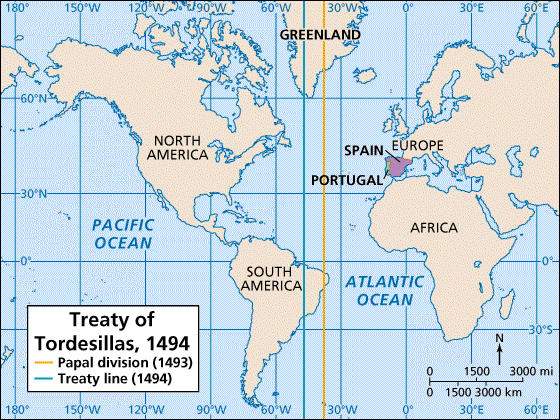
In the 1480s, Pope Sixtus IV had granted Portugal the right to all land south of the Cape Verde islands, leading the Portuguese king to claim that the lands discovered by Columbus belonged to Portugal, not Spain. But in 1493, Spanish-born Pope Alexander VI issued two papal decrees giving legitimacy to Spain’s Atlantic claims over the claims of Portugal. Hoping to salvage Portugal’s holdings, King João II negotiated a treaty with Spain. The Treaty of Tordesillas in 1494 drew a north-to-south line through South America. Spain gained territory west of the line, while Portugal retained the lands east of the line, including the east coast of Brazil.
Conquistadores and Spanish Colonization
Columbus’s discovery opened a floodgate of Spanish exploration. Inspired by tales of rivers of gold and timid, malleable native peoples, later Spanish explorers were relentless in their quest for land and gold. Spanish explorers with hopes of conquest in the New World were known as conquistadores. Hernán Cortés arrived on Hispaniola in 1504 and participated in the conquest of the Island. Cortés then led the exploration of the Yucatán Peninsula in hopes of attaining glory.
In 1519, Cortés entered Tenochtitlán, the capital of the Aztec/Mexica Empire. He and his men were astonished by the sophisticated gardens and temples in the city, but they were horrified by the practice of human sacrifice. Above all, the Aztec wealth in gold fascinated the Spanish explorers.
Hoping to gain power over the city, Cortés took Moctezuma, the Aztec ruler, hostage. The Spanish then murdered hundreds of high-ranking Mexica during a religious festival, but the people of Tenochtitlán quickly retaliated. Cortés and his people fled for their lives.

Following his defeat, Cortés slowly created alliances and recruited tens of thousands of native peoples who resented Aztec rule. Only by playing upon the disunity among the diverse groups in the Aztec Empire were the Spanish able to capture Tenochtitlán. In August 1521, Cortés claimed Tenochtitlán for Spain and renamed it Mexico City. The Spanish also brought smallpox, which took a heavy toll on the people in Tenochtitlán. Illness played a much greater role in the city’s downfall than violence.
Cortés was also aided by a Nahua woman called Malintzin—also known as La Malinche or Doña Marina, her Spanish name—whom the natives of Tabasco gave him as tribute. Malintzin translated for Cortés and, whether willingly or under duress, entered into a physical relationship with him. Their son, Martín, may have been the first mestizo—person of mixed indigenous American and European descent. Malintzin remains a controversial figure in the history of the Atlantic World; some people view her as a traitor because she helped Cortés conquer the Aztecs, while others see her as a victim of European expansion. Regardless, without Malintzin’s help, Cortés would not have been able to dismantle the Aztec Empire.

Another conquistador, Francisco Pizarro, made his way to the Spanish Caribbean in 1509, drawn by the promise of wealth and titles. He participated in successful expeditions in Panama before following rumors of Inca wealth to the south. Although his first efforts against the Inca Empire in the 1520s failed, Pizarro captured the Inca emperor Atahualpa in 1532 and executed him soon thereafter. In 1533, Pizarro founded Lima, Peru. Like Cortés, Pizarro had to combat not only the native peoples of the lands he was conquering but also competitors from his own country—a Spanish rival, Diego de Almagro, assassinated him in 1541.
Hernando de Soto had participated in Pizarro’s conquest of the Inca, and from 1539 to 1542, he led his own expeditions to what is today the southeastern United States. He and his followers explored modern-day Florida, Georgia, the Carolinas, Tennessee, Alabama, Mississippi, Arkansas, Oklahoma, Louisiana, and Texas. They brought European diseases and violence, claiming thousands of native lives. In 1542, de Soto himself died of sickness. The surviving Spaniards returned to Mexico City without finding the abundance of gold and silver they had anticipated.

Francisco Vásquez de Coronado went to Mexico, then called New Spain, in 1535. Between 1540 and 1542, Coronado led Spaniards and native allies on a large exploration of the southwestern United States. He found the Grand Canyon, Colorado River, and other natural wonders. During the winter of 1540–41, the explorers waged war against the Tiwa people in present-day New Mexico. Rather than leading to the discovery of gold and silver, however, the expedition simply left Coronado bankrupt.
The Spanish Golden Age
By 1600, Spain had reaped substantial monetary benefits from New World resources. Gold and silver began to connect European nations through trade, and the Spanish money supply ballooned, which signified the beginning of the economic system known as capitalism. The new riches ultimately created mass inflation and economic distress. However, Spain gained creative capital from their new global reach. These developments catapulted Spain into the Golden Age, or Siglo de Oro.
Riches poured in from the colonies, and new ideas poured in from other countries and new lands. The Habsburg dynasty—who ruled over the territories of Austria, the Netherlands, Naples, Sicily, and Spain—encouraged and financed a blossoming Spanish Renaissance culture, both in the colonies and in Spain.
One of this period’s most famous works is the novel The Ingenious Gentleman Don Quixote of La Mancha, by Miguel de Cervantes. This two-volume book—1605 and 1618—told a colorful tale of a hidalgo, or gentleman, who reads so many tales of chivalry and knighthood that he becomes unable to tell reality from fiction. With his faithful sidekick Sancho Panza, Don Quixote leaves reality behind and sets out to revive chivalry by doing battle with what he perceives as the enemies of Spain.

Spain also produced impressive art at this time. Las Meninas, The Maids of Honor, painted by Diego Velázquez in 1656, is one of the best-known paintings in history. Velázquez painted himself into this imposingly large royal portrait—he’s shown holding his brush and easel on the left—and boldly placed the viewer where the king and queen would stand in the scene.
Originally published by the Khan Academy under the terms of a Creative Commons Attribution-NonCommercial-ShareAlike 3.0 United States license.
About the Author