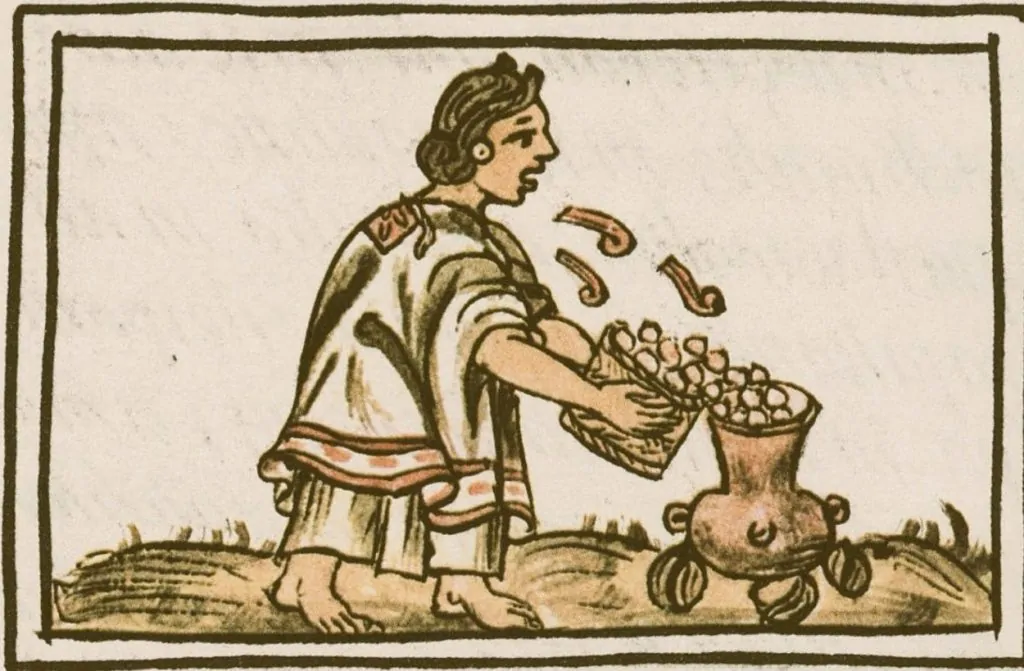
In Nahua moral life, warning another person was more than criticism. It was an act of care, discipline, and obligation in a world where one person’s fall could endanger many.

By Matthew A. McIntosh
Public Historian
Brewminate
Introduction: Warning as Care in a Dangerous World
To warn another person is never a neutral act. It assumes danger, claims authority, and risks offense. In the Nahua world of central Mexico, and especially in the society later known through the Mexica or Aztec empire, warning was embedded in a dense moral universe where persons were not imagined as isolated selves moving through private ethical space. A person’s conduct belonged to a network of household, neighborhood, school, lineage, temple, marketplace, battlefield, and city. Pride, drunkenness, uncontrolled speech, laziness, cowardice, sexual misconduct, and public arrogance were more than personal flaws. They were signs that a person had begun to lose balance in a world already understood as unstable. To warn such a person was not simply to criticize. It was to intervene before disorder spread outward.
The central Nahua metaphor for this danger was the “slippery earth,” a world in which human beings naturally stumbled and needed guidance, discipline, counsel, and restraint. This idea does not mean that Nahua ethics denied individuality, nor that every act of correction was affectionate. It means rather that moral life was relational and precarious. One learned how to walk, speak, eat, drink, labor, dress, obey, command, and fight in ways that preserved order. The body and the tongue were moral instruments. A person who spoke recklessly, boasted foolishly, or behaved without measure revealed more than bad manners; he or she revealed a dangerous loss of form. Admonition became a necessary art. The one who warned another person acted, at least ideally, as a stabilizing presence on treacherous ground.
I examine warning not as a casual social habit but as a structured practice of moral correction in the Nahua and broader Mesoamerican world. Its most formal expression appears in the huehuetlatolli, the “old words” or speeches of the elders, preserved in colonial-era collections and in Book 6 of Bernardino de Sahagún’s Florentine Codex. These speeches are not transcripts of everyday conversation in any simple sense. They are stylized, formal, and shaped by the conditions of sixteenth-century recording, translation, and Christian colonial interpretation. Yet for that very reason they are revealing. They show not only what Nahua speakers may have said in moments of instruction, but also what kinds of speech later Indigenous informants, scribes, and Franciscan compilers recognized as authoritative, proper, and morally serious. Their repeated concern with humility, restraint, obedience, sobriety, measured speech, and social place suggests a culture in which correction was not accidental but expected. The huehuetlatolli instructed listeners before marriage, before office, before adulthood, before public responsibility, and before the temptations of pride or disorder had fully taken hold. They addressed children, rulers, subjects, parents, newly married couples, nobles, successors, and students, but they also reveal a broader moral vocabulary that could travel beyond formal hierarchy into the ordinary work of admonishing another person. A warning was not merely information about danger. It was an act of verbal formation. It tried to shape the hearer’s posture toward the world before shame, punishment, or catastrophe made correction impossible. Warning was both ethical and rhetorical. It required the right words, the right posture, the right relationship, and the right sense of danger.
I will move from moral philosophy to social practice. It will consider how warning operated through formal speeches, household instruction, youth education, courtly etiquette, military discipline, diplomatic communication, and conquest-era memory. It will also resist the temptation to romanticize this system. Nahua admonition was often hierarchical, coercive, gendered, and severe. The same culture that valued counsel also punished failure harshly. Yet this tension is precisely what makes the subject historically revealing. In the Nahua world, warning could be care, surveillance, discipline, rescue, or threat, sometimes all at once. To understand warning as care in a dangerous world is not to soften Aztec severity, but to see how correction, affection, fear, and communal responsibility could occupy the same moral space.
The Person in Relation: Household and Community

To understand warning in the Nahua world, it is necessary first to understand the person who was being warned. The human being was not imagined as a detached moral unit whose choices belonged only to an interior conscience. A person existed in relation: to parents, elders, siblings, marriage partners, teachers, neighbors, rulers, gods, ancestors, and the corporate life of the community. This does not mean that Nahua society lacked individuality or personal responsibility. On the contrary, the sources are full of concern for personal conduct, reputation, discipline, and shame. But individuality was understood through placement. A person became legible through conduct within a household, a ward, a school, a marketplace, a ritual setting, and a political order. The self was not erased by the community; it was formed within it.
This relational idea of personhood made warning a socially meaningful act. If someone became arrogant, lazy, drunken, sexually reckless, boastful, cowardly, or careless with speech, the problem did not remain sealed inside that person’s private life. It touched the household that raised him, the teachers who instructed him, the companions who marched or labored beside him, the lineage whose name he carried, and the neighborhood or city that would bear the consequences of his disorder. In a society where honor, shame, labor, military discipline, ritual participation, and public reputation were shared burdens, misconduct could rarely be treated as a purely private failure. A young man’s drunkenness could dishonor those responsible for his formation. A noble’s arrogance could signal danger to dependents and allies. A careless speaker could damage relationships far beyond the original audience. Even ordinary laziness mattered because it suggested a refusal to carry one’s share of the work by which the household and community survived. A warning was not merely a statement that one person disapproved of another. It was an attempt to repair a break in relation before that break widened. The moral question was not only “What kind of person are you becoming?” but also “What are you doing to those who are bound to you?” Admonition placed the offender back inside the web of obligation he was beginning to forget.
This helps explain why Nahua moral instruction returned so often to bodily discipline. The body was not a neutral container for a hidden self. It was where moral order appeared. How one stood, walked, ate, drank, dressed, worked, fought, gestured, and lowered one’s gaze mattered because these actions disclosed one’s place in the world. Pride could be visible in posture. Disorder could be heard in laughter or speech. Laziness could be seen in the failure to rise, sweep, carry, plant, weave, train, serve, or labor when required. Drunkenness was not only a loss of self-control but a collapse of public form. The disciplined body showed that a person had accepted the burdens of adulthood, rank, gender, age, and obligation. The undisciplined body announced that the person was slipping away from measure.
Speech was equally embodied and equally dangerous. In the Nahua moral imagination, the mouth could steady or destroy. Words could console, advise, command, flatter, deceive, shame, accuse, or provoke. The huehuetlatolli repeatedly treat speech as a matter of restraint and placement: one should not speak wildly, boastfully, prematurely, or without regard for audience and rank. Reckless speech was not simply impolite. It could expose the speaker as immature, foolish, arrogant, or socially dangerous. A person who misused speech endangered more than his own reputation, because words moved through households and communities. Gossip, insult, falsehood, boastfulness, and uncontrolled anger could turn private disorder into public fracture. This is why warning someone about speech was itself a deeply serious form of speech. The correction had to model the restraint it demanded.
The household was the first major arena in which this relational self was formed. Parents and elders did not merely feed and protect children; they shaped them through counsel, discipline, work, example, and admonition. The speeches preserved in colonial Nahua sources often present parental instruction as a solemn preparation for danger. Children are told that life is difficult, that honor is fragile, that misconduct brings shame, and that one must learn humility before the world teaches it through suffering. These warnings were not abstract lessons offered from a distance. They belonged to the daily labor of making a child into a socially reliable person: someone who knew when to speak, when to be silent, how to serve, how to endure hardship, how to respect age and rank, how to avoid public disgrace, and how to recognize the consequences of appetite and pride. The household was both affectionate and disciplinary. It protected the young, but it also trained them to accept constraint. Parents warned because children were loved, but also because children carried the family’s reputation into public life. The son or daughter who behaved badly did not merely embarrass himself or herself; that child revealed something about the household’s success or failure in moral formation. These speeches are stylized and cannot be read as transparent recordings of every family conversation, but they reveal an ideal: the household was supposed to produce people who could carry themselves properly in the larger world. A parent who warned a child was not simply protecting family reputation, though reputation mattered. The parent was trying to give the child moral footing.
Beyond the household stood the broader corporate community. Nahua life was organized through webs of obligation that included neighborhood, school, temple, tribute, military service, ritual participation, and labor. A person did not become fully social by declaring an inner identity; he or she became social by performing duties well and visibly. This is why correction could come from many directions. Elders, teachers, rulers, priests, parents, spouses, and companions could all become voices of admonition under different circumstances. Their authority was not identical, and the consequences of their warnings could vary sharply, but they shared a common assumption: conduct required guidance because disorder was contagious. A badly formed person could become a danger to the group that had failed to form him.
This relational framework does not make Nahua warning gentle or egalitarian. It could be affectionate, but it could also be severe. It could save someone from shame, but it could also expose him to punishment. It could arise from genuine concern, but it could also reinforce hierarchy, gender discipline, class order, and imperial power. Still, the moral logic remains clear. In a world where personhood was embodied, spoken, taught, watched, and judged in relation to others, warning was one of the ways society tried to keep people from falling out of form. To warn another person was to say that his conduct had meaning beyond himself. It was to remind him that he belonged to others, and that belonging carried both protection and demand.
The Huehuetlatolli: The Old Words as a Grammar of Admonition

The most concentrated evidence for Nahua admonitory speech appears in the body of formal discourse known as the huehuetlatolli, often translated as the “old words” or “discourses of the elders.” These speeches were remembered, recorded, and reshaped in the sixteenth century, especially through Franciscan projects of collection and translation, but they preserve a form of moral language that cannot be reduced simply to European sermonizing. They are filled with counsel, warning, praise, rebuke, humility formulas, social instruction, and solemn reminders about the dangers of life. Parents speak to children; rulers are advised at moments of accession; elders instruct the young; nobles and commoners are taught how to carry themselves; newly married people are warned about the burdens ahead. The world they imagine is not one in which moral failure appears suddenly. It is one in which people must be prepared in advance because danger is ordinary.
The huehuetlatolli matter because they reveal warning as a disciplined genre of speech. A warning was not merely a burst of anger or a spontaneous correction. It had recognizable forms. It often began with humility, kinship language, and acknowledgment of the listener’s vulnerability. It reminded the hearer of the difficulty of life, the fragility of reputation, the inevitability of labor, and the shame that followed foolish conduct. The speaker did not simply say, “Do not do this.” He or she placed the listener inside a moral landscape: you have been born into hardship; you walk among dangers; others have labored for you; you carry obligations that preceded you; your conduct will either honor or disgrace those bonds. Admonition worked by recollection. It restored the hearer to an awareness of where he or she stood.
This formal structure gave admonition emotional force without making it purely sentimental. The speeches could be tender, but they were rarely indulgent. A parent’s counsel to a child, for example, might express affection while also insisting that the child must accept hunger, exhaustion, obedience, modesty, and restraint. A ruler’s accession speech might exalt office while warning that power is a burden surrounded by danger. Advice to the young often dwelled on drunkenness, sexual misconduct, laziness, arrogance, foolish talk, and the temptations of public display. These were not treated as minor flaws. They were openings through which a person could fall into disgrace. The warning had a double movement: it embraced the hearer as one worth saving, and it threatened the consequences of ignoring the words being given.
The huehuetlatolli also show how deeply Nahua admonition depended on metaphor. Moral instruction rarely appears as abstract rule alone. People are told how to walk, how to carry burdens, how to guard the mouth, how to keep one’s place, how to avoid becoming ridiculous before others, how to remain steady amid the instability of the earth. Metaphor made warning memorable because it translated moral danger into bodily and social images. To be arrogant was not only to hold a wrong opinion about oneself; it was to stand wrongly in the world. To speak recklessly was not only to utter improper words; it was to release disorder through the mouth. To ignore elders was not only to reject advice; it was to step away from the path laid down by those who had survived long enough to guide the young. The old words made ethics visible.
The huehuetlatolli must be used carefully. They are not a simple window into preconquest speech untouched by colonial mediation. Sahagún’s project depended on Nahua informants and scribes, but it also passed through Franciscan interests, alphabetic transcription, translation, classification, and the moral pressures of Christian evangelization. Andrés de Olmos’s collection likewise sits at the intersection of Indigenous memory and missionary scholarship. Some themes in the surviving texts resonated strongly with Christian moral instruction: humility, obedience, chastity, sobriety, reverence for elders, and the danger of pride. Yet that overlap does not make the material useless. It makes it complicated. The task is not to strip away every colonial layer in search of a pure preconquest original, but to read the speeches as records of a moral vocabulary that Indigenous speakers and colonial compilers both recognized as powerful. Their very preservation suggests that these forms of admonition remained meaningful across rupture.
When discussing warning, the importance of the huehuetlatolli is that they offer a grammar rather than a single anecdote. They show what warning was supposed to sound like when elevated into formal speech: grave, relational, metaphorical, bodily, public-minded, and concerned with preventing collapse before it became visible disgrace. They also help explain why a friend, peer, parent, teacher, or elder could imagine correction as care. In this tradition, to leave someone unwarned was not necessarily kindness. Silence could allow the other person to continue walking toward shame. The old words gave moral legitimacy to the uncomfortable act of speaking before the fall. They made admonition not an interruption of relationship, but one of the ways relationship fulfilled its obligations.
The Slippery Earth: Moral Life as Balance, Not Perfection

The image of the “slippery earth” is one of the most useful ways to understand Nahua moral life because it shifts the problem away from perfection and toward balance. Human beings were not imagined as creatures who could make themselves permanently secure through a single decision, pure belief, or flawless inner disposition. They lived in a world of motion, danger, appetite, uncertainty, and fragile social standing. To be human was to be exposed. One could fall through pride, drunkenness, sexual misconduct, foolish speech, cowardice, grief, anger, ambition, or simple forgetfulness of one’s obligations. Moral instruction did not assume that a person could escape danger altogether. It assumed that one had to learn how to stand, move, and speak without losing measure.
This is why warning occupies such an important place in Nahua ethical imagination. A warning is useful only in a world where danger is near enough to matter and where a person can still correct course before disaster arrives. If moral failure were merely an inner corruption, warning might be little more than accusation. If perfection were expected, warning might simply mark the guilty. But on the slippery earth, warning becomes a form of balance work. It catches the moment when someone is leaning too far toward disorder but has not yet fully fallen. The warning says: you are not beyond recovery, but you are no longer steady. It recognizes vulnerability without excusing it.
The metaphor also helps explain why Nahua moral teaching so often returns to moderation. The good person is not necessarily the one who conquers every impulse forever, but the one who learns how to restrain appetite, control speech, accept hardship, bear office, respect rank, and endure suffering without becoming deformed by it. Balance is not passivity. It requires effort, memory, discipline, and constant adjustment. The world itself does not hold still. Fortune changes, bodies weaken, hunger presses, anger rises, political demands shift, and public opinion can turn quickly. Under such conditions, the person who appears strong because he is loud, boastful, indulgent, or fearless may actually be the least stable. He has mistaken excess for power. The person of balance is not untouched by desire, anger, grief, ambition, or fear; he has learned to keep those forces from seizing the whole self and dragging others into the consequences. This is why Nahua counsel so often sounds practical rather than abstract. It teaches the young how to rise early, work hard, listen to elders, avoid intoxication, guard the tongue, accept correction, and endure the burdens of office or household responsibility. These are not small matters. They are the repeated gestures by which a person remains upright. Moral life is not a heroic achievement performed once, but a daily craft of proportion.
Nahua admonitory speech often warns against pride because pride is a failure of balance. The proud person has lost proportion. He no longer sees his dependence on parents, elders, gods, teachers, laborers, warriors, subjects, or the community that sustains him. He imagines himself as self-made, self-standing, and self-justifying. That is precisely the illusion the slippery earth undermines. No one stands alone. Even rulers must be counseled; even nobles must remember humility; even warriors must obey discipline; even elders must speak carefully. Warning a proud person means returning him to proportion. It reminds him that rank is not immunity from falling, and that public elevation can make the fall even more destructive. Pride was dangerous because it could masquerade as strength. The boastful warrior, the careless noble, the arrogant speaker, or the ruler intoxicated by office might seem powerful for a time, but each had begun to forget the relational structure that made power possible. A leader who rejected counsel endangered more than himself; he endangered those who depended on his judgment. A young man who imagined himself beyond correction had already severed himself from the very voices meant to preserve him. Admonition against pride was not merely a moral preference for humility. It was a political and social necessity. The higher a person stood, the more urgently he needed reminders that the earth beneath him remained slippery.
Drunkenness is another revealing example because it makes the loss of balance literal. Intoxication loosens the tongue, distorts posture, exposes appetite, weakens judgment, and turns the body into a public sign of disorder. In many societies drunkenness is condemned because it violates self-control, but in the Nahua context its danger was also relational and visible. The drunken person did not merely damage himself. He became shameful before others, vulnerable to ridicule, and dangerous to the order of household and community. Warnings against drink were warnings against becoming unformed in public. The person who could not govern his body revealed that he could not safely carry the obligations placed upon him.
The same logic applied to speech. The slippery earth was not crossed only by feet but by words. Speech could stabilize relationships, transmit counsel, honor rank, and restore social form; but it could also throw a person off balance. Boasting enlarged the self beyond its proper measure. Gossip carried disorder from one place to another. Insult invited conflict. Falsehood damaged trust. Foolish talk exposed immaturity. Warning someone to guard the mouth was not merely etiquette. It was moral protection. Words changed the world around the speaker, and once released they could not be gathered back. To speak without restraint was to step carelessly on dangerous ground.
This moral framework also complicates any simple opposition between compassion and discipline. The Nahua world imagined human beings as fragile, but it did not respond to fragility with permissiveness. Because people were vulnerable to falling, they needed formation. Because they could damage others when they fell, they needed correction. Counsel, shame, punishment, and affectionate warning all belonged to this larger effort to keep persons in balance. A modern reader may want to separate care from coercion, but the Nahua material often binds them together. A parent could warn out of love and fear. A teacher could discipline in order to form. A ruler could be admonished because office magnified danger. A peer could correct another not because friendship had failed, but because friendship could not remain silent before visible disorder.
The slippery earth does not describe a gloomy moral universe so much as a realistic one. It assumes that human beings are unstable, that social life is fragile, and that ethical conduct must be practiced continuously rather than possessed once and for all. In this world, warning another person was one of the ways balance was preserved. It did not promise perfection. It did not remove danger. It did not make society gentle. But it gave speech a crucial role in the work of survival. To warn was to reach toward someone already leaning toward a fall and to remind him where his feet were, who stood around him, and what would be broken if he slipped.
Speech as Power: The Ethics of the Mouth

If the body revealed moral order in Nahua life, the mouth revealed it even more dangerously. Speech did not merely describe the world; it acted within it. Words could honor, shame, instruct, deceive, console, command, accuse, flatter, reconcile, or destroy. A person’s mouth was not an incidental part of the self but one of the principal places where discipline appeared or collapsed. To speak well was to understand rank, occasion, restraint, obligation, and danger. To speak badly was to expose not only ignorance but imbalance. In this moral setting, warning someone about speech was never a small correction. It was a warning about the power by which social life itself was made and unmade.
The huehuetlatolli preserve this concern with speech as a repeated moral theme. The listener is urged to speak carefully, to avoid foolishness, to honor elders, to receive counsel, and to understand that words carry consequences beyond the moment of utterance. Speech was tied to dignity. It could show whether someone had been properly formed by household, school, and community. Measured speech suggested maturity, humility, and self-command; uncontrolled speech suggested childishness, arrogance, or disorder. This is why admonition so often appears as a speech about speech. The elder, parent, teacher, or ruler does not simply correct behavior from outside. The act of warning models the disciplined language it recommends. The speaker demonstrates, through formal counsel, how words should be carried. This self-modeling mattered because a warning delivered recklessly could reproduce the very disorder it condemned. To rebuke boastfulness with boastfulness, to condemn anger through uncontrolled anger, or to correct gossip by spreading humiliation would undermine the authority of the correction. The force of admonition depended partly on the speaker’s ability to inhabit the moral form being urged upon the listener. The old words treated speech as both content and performance: the warning said what should be done, but it also enacted a disciplined way of speaking in a dangerous world.
Gossip was dangerous because it moved disorder through the community. It took something private, uncertain, or malicious and gave it public circulation. In a society where reputation was embedded in household, lineage, rank, and office, such speech could do serious damage. Gossip did not need to be physically violent to be socially destructive. It could stain a household, provoke conflict, unsettle alliances, or make a person ridiculous before others. A warning against gossip was not only a plea for politeness. It was a warning against using the mouth as an instrument of social fragmentation. The person who spread reckless words behaved as though speech had no weight, when in fact it could carry shame from one body to another.
Boasting represented a different misuse of the mouth. Where gossip scattered disorder outward, boasting inflated the self beyond proper measure. The boastful person tried to enlarge his own image through speech, but in Nahua moral terms this enlargement could reveal a dangerous emptiness. The person who praised himself too loudly forgot dependence, ancestry, instruction, divine uncertainty, and the fragile conditions that made success possible. The boastful warrior, noble, youth, or officeholder announced that he no longer needed the counsel of others. He turned speech into a monument to himself. For that reason, warning against boasting was closely related to warning against pride. The mouth had become the place where imbalance declared itself. Boasting was dangerous because it could sound like confidence while functioning as separation. The speaker pulled himself away from the network of obligation that had made his achievement possible and presented success as if it belonged to him alone. In a warrior society, where courage, rank, and public honor mattered deeply, the temptation to advertise oneself must have been powerful. Yet Nahua moral speech repeatedly pressed against the illusion that glory erased dependency. A warrior’s success required training, discipline, companions, ritual order, weapons made by others, food produced by others, and the sanction of the polity he served. A noble’s authority rested on ancestry, office, ceremony, and public recognition. A ruler’s command depended on advisers, tribute networks, warriors, priests, laborers, and the fragile consent or fear of many communities. Boasting denied these relations by making the self too large. Warning the boaster was an attempt to reduce him back to human scale before his own words carried him into ridicule, isolation, or ruin.
Counsel, by contrast, was speech used to restore proportion. It did not merely transmit information. It placed the listener back inside a moral order. Good counsel reminded a child of parental labor, a ruler of public burden, a youth of danger, a spouse of obligation, a noble of humility, and a speaker of restraint. It translated relationship into words. The one giving counsel claimed a role, but also accepted a burden: to speak at the right time, with enough force to matter and enough discipline not to become abusive noise. This is why counsel could be severe without being merely hostile. Its purpose was not simply to wound the hearer, but to make the hearer capable of hearing danger before the world imposed harsher instruction.
The ethics of the mouth also helps explain why silence could be morally ambiguous. Silence might show humility, restraint, patience, or respect for rank. But silence could also become failure if someone who had the duty to warn refused to speak. A parent who saw a child drifting toward shame, a teacher who saw a student becoming lazy or arrogant, a companion who saw a peer losing discipline, or an adviser who saw a ruler rejecting measure could not always claim virtue by remaining quiet. In this world, the mouth had to be governed, but it could not be abandoned. The difficult art was knowing when speech preserved order and when it endangered it. Warning belonged precisely to that difficult middle ground: speech risky enough to offend, but necessary enough that silence might be worse.
This makes Nahua admonition revealing as a social practice. It treated the mouth as a site of power and danger, not merely expression. Gossip, boasting, insult, falsehood, flattery, and reckless talk were not minor failures of etiquette. They were ways of losing one’s footing on the slippery earth and pulling others toward disorder. Counsel and warning, at their best, were counter-speech: words used to restrain the destructive potential of words. A true warning did not simply tell someone to stop talking. It tried to teach the person how to inhabit speech properly: with measure, humility, timing, and awareness that every utterance entered a world already dense with obligation.
Schools of Discipline: The Social Training of Youth

The household began the work of moral formation, but Nahua society did not leave youth formation entirely to parents. Education was institutionalized, communal, and disciplinary. The two best-known schools, the telpochcalli and the calmecac, were not simply places where boys learned useful skills. They were institutions for making socially legible persons: warriors, priests, nobles, laborers, servants of the gods, servants of the city, and members of a community that expected obedience, endurance, and restraint. The telpochcalli, often associated with commoner youth and military training, prepared young men for labor, service, and war. The calmecac, associated particularly with noble youth and priestly or administrative formation, emphasized ritual discipline, self-denial, elite comportment, and the burdens of office. Both institutions extended the logic of admonition beyond the family. A youth did not merely belong to his parents. He belonged to a school, a cohort, a ward, a city, and a future role.
The distinction between the two schools should not be made too rigid, as if all social life can be divided neatly between “commoner military school” and “noble priestly school.” The sources themselves are shaped by colonial description, Indigenous recollection, and Spanish attempts to classify unfamiliar institutions. Still, the broad difference matters. The telpochcalli trained youth through collective life, physical endurance, labor, and preparation for war. It linked moral worth to service, toughness, obedience, and the capacity to endure hardship without complaint. The calmecac demanded a different but equally severe discipline: fasting, ritual knowledge, night vigils, careful speech, humility before sacred duties, and the cultivation of elite restraint. The difference was not between a harsh school and a gentle one. Both could be severe. The difference lay in the kind of person each institution was meant to produce.
In both settings, warning was built into the structure of education. Youth were not expected to discover adulthood privately. They were watched, corrected, instructed, punished, and reminded of the consequences of disorder. Laziness, drunkenness, sexual misconduct, disobedience, arrogance, and cowardice were not harmless youthful errors. They were signs that training had failed or that the youth had rejected the form being imposed upon him. In a society where adulthood required public reliability, misconduct in school could not be treated as private experimentation. It revealed whether a young person could be trusted with labor, arms, ritual obligation, household responsibility, or political office. The warning given to a student carried a larger message: your conduct is already becoming your future.
The communal character of these schools is crucial for understanding peer accountability. A youth in the telpochcalli or calmecac did not live as an isolated student moving through a private curriculum. He was embedded in a corporate group where reputation, labor, discipline, and punishment were shared experiences. Companions trained together, worked together, endured hardship together, and learned the expectations of male adulthood together. That setting made misconduct visible. The lazy youth, the braggart, the drunkard, the coward, the careless speaker, or the one who resisted discipline could not easily hide his failure from those around him. Even where the sources do not allow us to reconstruct a formal “peer-warning system” in modern terms, the social logic is clear: peers lived close enough to observe one another’s slipping. A warning from a companion would have made sense because the companion was not an outsider. He was part of the same disciplined world and would share, at least indirectly, the consequences of disorder within it.
The telpochcalli connected warning to military preparation. War required courage, obedience, endurance, and the suppression of selfish impulse. A young man who boasted too much, ignored orders, drank recklessly, or failed to endure fatigue was not merely unpleasant. He was dangerous. Military life depends on the reliability of companions, and Nahua warfare placed enormous value on discipline, capture, rank, and public honor. The school trained not only bodies but expectations. Youth learned that strength was not identical with noise, that courage was not identical with arrogance, and that honor required submission to collective discipline. A warrior who could not listen in youth might not obey in battle; a youth who made himself ridiculous through boasting might endanger the reputation he hoped to win; one who could not endure hunger, cold, labor, or command might collapse when hardship became real. The warning given in school anticipated the warning that might later be needed in the field. It taught that a companion’s failure was never simply his own, because panic, recklessness, cowardice, or disobedience could expose others to danger. Military training made peer correction practical as well as moral. The youth who warned another against arrogance or slackness was not only defending abstract virtue. He was helping preserve the discipline on which collective survival and honor depended. Admonition was practical. A warning against laziness or boasting was also a warning against future failure in war, where the cost of disorder could be shame, defeat, captivity, or death.
The calmecac intensified another aspect of warning: the discipline of those who would occupy elevated religious or political roles. Noble youths and those trained for priestly service had to learn that rank did not free them from constraint; it multiplied constraint. The higher the office, the more dangerous the fall. Ritual negligence, indulgence, sexual misconduct, drunkenness, pride, or careless speech could stain not only the individual but the office he represented. The calmecac made admonition part of elite formation. It taught that authority required austerity, that public dignity required self-command, and that sacred or political service demanded a body and mouth under control. Warning a noble youth was not an insult to his rank. It was a reminder that rank itself made correction necessary.
These schools show that Nahua admonition was not only a moral idea but a social system. The young were trained to expect correction before adulthood, and this expectation shaped how warning could later operate among companions, advisers, rulers, warriors, spouses, and elders. The school taught that the self was formed under observation. It also taught that correction could be a form of belonging. To be warned was to be treated as someone still capable of being shaped; to ignore warning was to move toward shame and exclusion. The harshness of this system should not be minimized. It could discipline through fear, pain, hierarchy, and public disgrace. Yet its logic was consistent with the wider Nahua understanding of the slippery earth. Youth had to be steadied before they were entrusted with the burdens of adult life, because an unsteady person did not fall alone.
Discipline: When Correction Became Punishment

The world of Nahua admonition cannot be understood if warning is separated too cleanly from punishment. Counsel was often presented as care, but it operated inside a society that accepted harsh discipline as one of the means by which people were formed. The same parent who warned a child with solemn affection could also invoke shame, hunger, pain, exhaustion, or public disgrace as the consequences of refusing instruction. The same school that trained youth through companionship and shared discipline could punish laziness, drunkenness, sexual misconduct, and disobedience severely. Warning had urgency because it stood before punishment. It was the voice that came before the lash, the public shame, the expulsion, the ritual consequence, or the legal sanction. To be warned was, in one sense, to be given a chance to return before force replaced speech.
This does not mean that Nahua correction was merely cruel. It means that love, fear, and discipline were not sharply separated in the way many modern readers might expect. Parents warned because they loved their children, but love did not imply indulgence. Teachers corrected because youth had to be made durable enough for adulthood, but durability was produced through obedience, hunger, labor, and endurance. Elders spoke harshly because shame could destroy a life, but they also believed that a person who ignored counsel might deserve the shame that followed. The emotional world of admonition was complex. A warning could be tender in intention and severe in language. It could aim to save while also threatening. It could tell a young person that he was precious enough to be corrected and vulnerable enough to be broken if he refused correction. That tension is essential, because Nahua moral formation assumed that affection without restraint could leave a person dangerously unfinished. A child protected from every consequence might grow into an adult unable to bear obligation, rank, hunger, fatigue, insult, or public scrutiny. Love had to anticipate the future world into which the child would be sent. It was not enough to cherish the young inside the household; they had to be hardened, instructed, and warned so that they could survive outside it. Fear was not merely an instrument of domination. It was also a way of making danger present before danger arrived.
The household offers the clearest example of this mixture. In Nahua moral speech, children were not treated as innocent beings whose impulses should simply unfold. They were beings in need of shaping. A child had to learn humility, labor, respect, modesty, and restraint because the world would not protect the foolish. The punishments described in early colonial sources can be disturbing: children might be subjected to hunger, cold, smoke, piercing, humiliation, or other painful forms of discipline. These practices should not be romanticized as merely symbolic. They were part of a hard moral pedagogy. Yet their logic rested on the belief that the undisciplined child was in danger. Pain inflicted early was imagined as less destructive than ruin later. The warning before punishment worked as a threshold: listen now, while correction can still be speech, before your body is made to learn what your ears refused. This household discipline also joined private affection to public consequence. A mother or father did not warn only because a child had annoyed them, nor only because obedience was convenient. They warned because the child’s future behavior would be read as evidence of the household’s success or failure. A son who became lazy, drunken, boastful, or disobedient carried that failure outward. A daughter who failed to embody expected modesty, labor, or restraint could expose the family to shame within a gendered moral order that placed heavy burdens on female conduct. The household became the first court of correction, not because it stood apart from society, but because it was society’s first instrument for forming the person before neighbors, schools, rulers, priests, and spouses would judge that formation more publicly.
The schools intensified this principle because they trained youth for public responsibility. In the telpochcalli, correction prepared young men for collective labor and war; in the calmecac, it prepared noble and priestly youth for ritual austerity, leadership, and the burden of rank. In both settings, punishment made visible the seriousness of formation. Laziness was not merely a personal inconvenience. Drunkenness was not merely a private vice. Sexual misconduct was not merely youthful excess. Each was treated as a sign that the student might become unreliable in the roles for which he was being formed. The more public the role, the less private the failure. The student who rejected warning threatened the reputation of the school, the authority of the teachers, the order of the cohort, and the future safety of the community. Punishment translated communal anxiety into bodily discipline.
Correction also became punishment when misconduct moved from the sphere of formation into the sphere of public disorder. A person who could still be warned was someone not yet fully lost to shame. But once disorder became visible enough, repeated enough, or dangerous enough, speech might no longer suffice. This is important for understanding the moral weight of warnings against drunkenness, arrogance, and reckless speech. These behaviors were feared not only because they violated ideals of self-control, but because they could expose the community to scandal, violence, insult, dishonor, or divine displeasure. A drunkard could become a public spectacle. A boastful noble could become politically dangerous. A reckless speaker could fracture relations. A disobedient youth could become a failed warrior, failed servant, failed priest, or failed citizen. Punishment marked the point at which society declared that imbalance could no longer be treated as private instability. It also transformed the meaning of the earlier warning. Once punishment arrived, the ignored counsel could be remembered as proof that the offender had been given a chance to return and had refused it. That memory mattered. It allowed the community to interpret punishment not as sudden violence, but as the final stage of a process that had begun with speech. The person had been advised, cautioned, instructed, corrected, perhaps even pleaded with; only afterward did harsher discipline become justified. Whether this justification always reflected reality is another question, but as a moral logic it gave warning enormous weight. The warning was the humane moment before the coercive one, and the refusal to heed it made punishment appear not only necessary but deserved.
The harshness of Nahua discipline complicates the claim that warning was care, but it does not erase it. Rather, it reveals the kind of care being imagined: not therapeutic affirmation, not private emotional support, and not unconditional protection from consequences. It was care within a world that believed people had to be formed before they destroyed themselves and others. Warning mattered because punishment was real. Fear gave counsel its edge, and affection gave discipline its moral justification. That combination could certainly be coercive, and it could reinforce hierarchy with great severity. But it also explains why silence could be treated as a failure of responsibility. To leave a child, student, companion, noble, or ruler unwarned was to let that person drift toward a point where correction would no longer come as words. In the Nahua world, the most merciful warning was sometimes the one that frightened a person before the world did worse.
Courtly Etiquette and Elite Warning: Admonition among the Elite
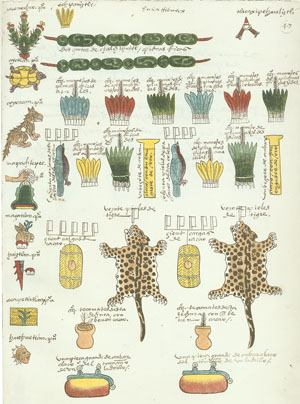
If household and school discipline trained the young to receive warning, courtly life required adults to transform warning into ceremony. Among rulers, nobles, priests, judges, military officers, and ambassadors, admonition could not be delivered as blunt insult without threatening the order it hoped to preserve. Rank mattered. Occasion mattered. Gesture, clothing, posture, metaphor, and silence mattered. The higher the person being warned, the more carefully the warning had to be framed, because elite correction involved a dangerous contradiction: the speaker had to acknowledge the dignity of the listener while also suggesting that the listener might be approaching error. Courtly warning was not less serious than household warning. It was often more delicate, because a badly delivered admonition could become political offense.
The accession of rulers offers one of the clearest settings for this elite admonitory culture. A newly installed ruler was praised, elevated, and ritually distinguished, but he was also warned. The speeches surrounding rule did not present kingship as unchecked personal glory. They emphasized burden, uncertainty, vigilance, humility, and the obligation to govern for the people and the gods. A ruler’s body and mouth now carried the weight of the polity. His errors would not remain private defects. Bad judgment could produce famine, defeat, rebellion, injustice, ritual failure, or divine anger. This is why elite admonition often appeared at the very moment of elevation. The ruler was warned precisely when he was honored, because honor without warning might tempt him into the illusion that rank had made him safe. Such warnings reveal a deep suspicion of power unrestrained by counsel. The ruler stood above others, but he did not stand alone. He depended on nobles, judges, priests, warriors, tribute officers, merchants, messengers, and local authorities whose cooperation made rule possible. Courtly speech reminded him of that dependence. It pressed against the fantasy that sovereignty meant self-sufficiency. Even the most powerful figure had to listen, deliberate, observe signs, receive reports, consult advisers, and speak with measured authority. A ruler who rejected counsel did not merely become personally arrogant; he endangered the entire political body. Warning a ruler was not an act against kingship. It was an act meant to preserve kingship from the ruler’s own excess.
Nobles were similarly trained to understand that status intensified scrutiny. Elite birth, insignia, clothing, titles, and access to court did not free a person from discipline. They made discipline more visible. A noble who spoke foolishly, drank publicly, abused inferiors, boasted of his lineage, or failed in ritual duty risked turning privilege into spectacle. The sources repeatedly suggest that noble conduct was supposed to be marked by restraint, gravity, and awareness of place. This does not mean nobles always behaved according to those ideals, any more than modern elites always perform the virtues they praise. But the ideal itself mattered. Courtly admonition warned the noble that prestige was fragile. Rank gave him a larger stage on which to fall.
Ambassadors and messengers occupied an important place in this ethics of speech. They carried words between rulers, cities, enemies, allies, tributaries, and potential victims of war. Their speech had to be exact, formal, and controlled, because they did not speak only as private individuals. They embodied the authority of the sender. A careless envoy could insult a ruler, misstate a demand, weaken a threat, or turn negotiation into violence. Diplomatic speech required a discipline of memory and manner. The ambassador had to know how to approach, how to wait, how to deliver, how to receive, and how to report. His mouth became an extension of political order, and the warning carried through him could be either a path away from violence or the formal announcement that violence was coming. In this role, the messenger stood at the crossing point between speech and action. He did not merely repeat words; he carried the weight of decisions already made elsewhere and delivered them into a setting where tone, sequence, and gesture could alter their effect. A warning sent through an envoy might contain courtesy, demand, prophecy, threat, invitation, or accusation, and the hearer had to interpret not only the words but the political world behind them. This made the ambassador’s disciplined mouth a kind of diplomatic instrument. He had to make another ruler hear danger without immediately destroying the possibility of response. His speech could open space for submission, alliance, negotiation, delay, or preparation, but it could also close that space if delivered badly. Diplomatic warning dramatized the Nahua conviction that words were not weak substitutes for action. They were part of action itself.
This is where courtly warning approaches the boundary between counsel and threat. Within the court, admonition might urge a ruler or noble toward humility, justice, restraint, or careful speech. Between polities, warning could become a diplomatic instrument of pressure. A demand for submission, a reminder of imperial power, a declaration of consequences, or an invitation to accept terms before war all belonged to a wider Mesoamerican political language in which speech preceded force. This did not make such warnings friendly in the ordinary sense. They could be coercive, imperial, and terrifying. Yet they still followed the same broad logic: words were given before disaster, and the listener was made responsible for what followed if the warning was ignored. The political warning effectively said that there was still time to choose the less destructive path.
The same ceremonial care that governed formal warning also reveals why elite speech could be morally ambiguous. A courtly admonition might genuinely attempt to restrain destructive power, but it might also flatter authority while pretending to correct it. A noble adviser might speak truth cautiously, but caution could become evasion. A ruler might receive counsel publicly while ignoring it privately. An ambassador might use polished language to conceal domination. The refinement of speech did not guarantee moral purity. Indeed, elite etiquette could make warning more difficult by surrounding power with honorific language and hierarchy. The higher the rank, the more necessary admonition became, but also the more dangerous it was to deliver openly. This ambiguity is essential because courtly speech operated in a world where survival often required indirection. Bluntness might be admired in retrospect, but in practice it could provoke anger, disgrace the speaker, or close the ruler’s ears altogether. A warning wrapped in humility, metaphor, or ceremonial deference might be the only warning that could be safely given. Yet the same forms that protected admonition could also weaken it. The adviser who spoke too softly might preserve himself while failing the polity. The courtier who turned correction into flattery might help power believe in its own innocence. The envoy who framed domination as benevolent warning might make coercion sound like order. Courtly warning sat uneasily between courage and accommodation. It required enough tact to be heard, but enough force not to become mere ornament.
For the history of warning, courtly etiquette adds an important layer to my argument. Nahua admonition was not only the stern speech of parents, teachers, or companions. It was also a political art practiced amid ceremony, rank, and danger. It taught that rulers needed warning because power made falling more consequential; nobles needed warning because privilege made disorder more visible; ambassadors needed discipline because words could stand between peace and war. In the courtly world, the ethics of the mouth became an ethics of government. To speak wrongly could wound the polity. To warn well could preserve it, at least for a time, from the arrogance, carelessness, and imbalance of those who stood highest.
Warning Before War: Diplomacy and the Road to Violence
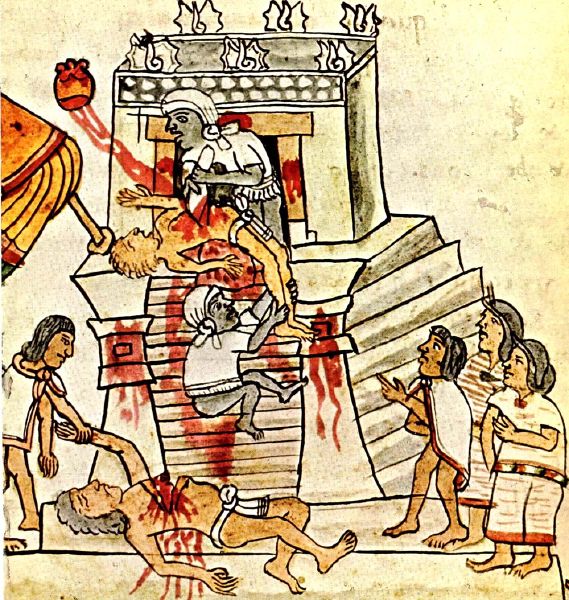
Warning in the Nahua world did not belong only to households, schools, and courts. It also operated on the road to war. Before violence arrived, words often moved first: messengers, ambassadors, merchants, scouts, tribute officials, and emissaries carried information between cities and rulers. These communications could be courteous, threatening, ceremonial, deceptive, or coercive, but they shared one important feature. They created a space in which the listener was told that danger was approaching and that choices remained, even if those choices were constrained by power. In this setting, warning became political. It did not necessarily express affection, friendship, or moral care in the intimate sense. It was speech used to shape the conduct of another community before armies, tribute demands, siege, or destruction made speech secondary.
The Mexica empire was not held together by battlefield violence alone. It relied on tribute, intimidation, alliance, negotiation, marriage ties, market connections, local rulers, and the strategic performance of imperial power. A city did not always have to be destroyed in order to be conquered. Often it had to be persuaded, frightened, isolated, or made to understand that resistance would be more costly than submission. This gave warning a practical imperial function. Envoys could announce demands, remind a ruler of Mexica strength, offer terms, or signal the consequences of refusal. Such speech stood between diplomacy and threat. It allowed the empire to extend power without immediate battle, while also making clear that refusal might bring battle closer.
Tribute sharpened this logic because it transformed warning into recurring obligation. Conquest was not simply a moment of military defeat; it became an ongoing relationship measured in goods, labor, service, obedience, and recognition of hierarchy. A tributary polity that failed to deliver what was expected did not merely miss a payment in the modern administrative sense. It challenged an imperial order that depended on visible compliance. A warning sent to such a community could carry multiple meanings: remember your place, restore the flow of goods, do not mistake delay for independence, do not force the empire to make an example of you. Tribute demands turned speech into a reminder of subordination, but also into a mechanism for preventing rebellion from becoming war. The tribute list itself was a form of memory, preserving in material terms the relationship between conqueror and conquered. Cotton mantles, cacao, feathers, military costumes, maize, beans, precious stones, crafted goods, labor obligations, and other payments did not simply enrich Tenochtitlan and its allies. They reiterated the fact of dependence. When tribute moved properly, hierarchy appeared stable; when it faltered, the interruption could be read as warning in the opposite direction, a sign that a subject community was testing the limits of imperial patience or capacity. In that situation, admonitory diplomacy could become the empire’s first response: a verbal effort to restore obedience before punitive expedition became necessary. Warning belonged to the administrative life of empire as much as to the battlefield. It was how power reminded others that conquest had not ended when the fighting stopped.
This political form of warning reveals both continuity and difference from the moral admonition discussed earlier. Like household or school warning, imperial warning assumed that disaster could be prevented if the listener returned to the proper order. But the order in question was no longer primarily moral formation; it was imperial hierarchy. The city being warned was treated almost like a person slipping out of place. It had become proud, forgetful, disobedient, or reckless, and it had to be reminded of the consequences of imbalance. Yet the analogy has limits. A parent warning a child and an empire warning a tributary city did not stand in the same ethical relation. Imperial warning could dress domination in the language of order. It could claim to prevent violence while resting on the threat of violence. It could make submission appear prudent and resistance appear foolish even when resistance had its own political logic.
The movement from warning to war also depended on performance. Threat had to be credible. If a ruler sent warnings but never acted, the warning lost force. If violence came without warning, the empire lost one of the rhetorical tools by which it justified domination. The most effective imperial speech balanced menace and procedure. It allowed the aggressor to say that terms had been offered, demands had been made, warnings had been delivered, and only then had force been used. This sequence mattered because it made violence appear ordered rather than impulsive. War could be framed not as uncontrolled aggression but as the final answer to refusal. The warning became part of the moral staging of conquest: the victim had been told, the danger had been named, and the consequences had been made intelligible before they arrived. This staging also mattered for audiences beyond the immediate target. Neighboring polities watched how warnings were delivered and how refusals were punished. The destruction or humiliation of one city could become instruction for another. Warning before war extended outward through reputation. It was not always necessary for every threatened community to receive the same message directly; news of imperial procedure could teach the lesson in advance. A city that had heard what happened elsewhere might understand a new embassy before the envoy finished speaking. The warning carried not only the words of the messenger but the memory of previous campaigns, defeated rulers, disrupted tribute flows, captured warriors, and communities that had misjudged the cost of resistance. Violence and speech reinforced one another. The warning made violence seem avoidable, while past violence made the warning believable.
Merchants and other travelers complicate the picture further. Long-distance exchange carried more than goods. It carried rumor, intelligence, news of political weakness, knowledge of roads, and awareness of distant peoples. In Mesoamerican political life, information itself was a form of power. Those who moved between regions could become informal carriers of warning, whether by reporting danger to their own rulers, alerting allies, or spreading fear of imperial strength. This does not mean every trader was a spy or every rumor was deliberate policy. It means that the world before war was dense with communication. A city might hear of another city’s defeat, of Mexica demands, of tribute burdens, of approaching soldiers, or of the fate of those who resisted. Such reports could function as warnings even when they were not delivered as formal diplomatic speeches. Fear traveled ahead of armies.
Warning before war shows the hardest edge of admonitory speech. It preserves the structure of “speak before disaster,” but it strips away much of the intimacy associated with friendship or household care. The warning sent by an empire might prevent bloodshed, but it might also make coercion more efficient. It might offer a city the chance to survive, but only by accepting subordination. It might restrain immediate violence, but also normalize the threat on which imperial power rested. Yet even here, the broader Nahua concern with speech remains visible. Words mattered because they shaped the path to action. They gave violence sequence, justification, and expectation. In the world of diplomacy, tribute, and war, warning was not the opposite of force. It was one of the ways force announced itself, organized itself, and sometimes avoided having to appear at all.
The Cakchiquels Annals and the Limits of Mesoamerican Solidarity
The conquest-era traditions preserved in the Annals of the Cakchiquels bring the problem of warning into a wider and more tragic frame. Here the issue is no longer simply a parent warning a child, a teacher correcting a youth, or an envoy threatening a tributary city before war. It is the question of whether Mesoamerican peoples could recognize, communicate, and respond collectively to an unprecedented danger. The Spanish invasion did not enter a politically empty world. It entered a dense landscape of rival kingdoms, alliances, memories of violence, tribute burdens, dynastic claims, and strategic calculations. In that world, warnings could travel, but they did not necessarily create solidarity. A community could hear of danger and still interpret it through local rivalries. It could understand that something terrible was happening and still decide that an enemy’s defeat created an opportunity.
The Annals of the Cakchiquels, sometimes known through the Memorial de Sololá, are valuable because they preserve a Cakchiquel view of the invasion of highland Guatemala rather than a simple Spanish victory narrative. The text records the arrival of Pedro de Alvarado, remembered under the Nahuatl-associated name Tonatiuh, and places Spanish violence within an Indigenous political world already divided by conflict. The Cakchiquel were not passive spectators of conquest, nor were they merely victims waiting for Europeans to arrive. They were political actors with their own enemies, alliances, fears, and calculations. Their relationship with the K’iche’ mattered enormously. The defeat of the K’iche’ by Alvarado could be interpreted not only as a warning of Spanish danger, but also as the destruction of a rival power. The same event could produce fear and advantage at once.
This is where the idea of a broad Mesoamerican “friendly warning” becomes difficult. It is tempting to imagine the Spanish invasion as a moment when Indigenous peoples recognized a common existential threat and warned one another accordingly. Some communication surely occurred. News of strange foreigners, new weapons, horses, disease, violence, and shifting alliances moved along roads, markets, diplomatic routes, and rumor networks. Merchants, messengers, refugees, warriors, translators, and allied Indigenous troops all became carriers of information, whether deliberately or unintentionally. Reports of Spanish conduct could precede Spanish arrival, and stories of defeat, massacre, alliance, or miraculous technology could circulate rapidly through a world already accustomed to long-distance exchange. But communication is not the same as unity. The peoples of Mesoamerica did not share a single political identity, and the Mexica, Cakchiquel, K’iche’, Tlaxcalans, Mixtecs, Maya polities, Totonacs, and many others had no automatic reason to treat one another as members of one threatened nation. They inhabited overlapping cultural worlds, but not one common state or one unified cause. Old grievances did not vanish simply because a new danger appeared. Indeed, the arrival of the Spaniards could make older conflicts more urgent rather than less. A polity that had suffered under a neighbor, rival, or imperial power might reasonably see the newcomer first as a weapon, ally, or temporary opportunity before recognizing him as a colonial danger in his own right. Warning had to pass through the filter of memory. Communities did not hear danger in the abstract; they heard it against the background of who was speaking, who had suffered, who might gain, and who had long been feared.
The Cakchiquel case shows this clearly. When Alvarado entered the Guatemalan highlands after the fall of Mexico-Tenochtitlan, he did so in a world where Indigenous allies, enemies, translators, and intelligence networks shaped the campaign. The Cakchiquel initially received the Spaniards and used the moment in relation to their own political struggle with the K’iche’. That decision was not irrational from within their world. They had seen a rival weakened and may have hoped to manage the newcomers within familiar patterns of alliance, tribute, and war. The tragedy was that the Spaniards did not remain within those patterns. Their demands for gold, labor, submission, and control quickly revealed that alliance with them could become subordination to them. What first appeared as a useful intervention in regional politics became another form of domination.
The Annals turn warning into a problem of interpretation. Danger may be visible, but its meaning is not always obvious. A warning about the Spaniards could be heard as news about a dangerous enemy, but also as news about an enemy who might be used against another enemy. Reports of Spanish victory might frighten one polity while encouraging another to seek advantage. Even Spanish brutality could be misread if Indigenous rulers believed it could be contained through diplomacy, gifts, alliance, or tribute. In older Mesoamerican political terms, a violent outsider might still be treated as a force to be negotiated with, redirected, incorporated, or temporarily appeased. The catastrophic misunderstanding lay in assuming that Spanish ambition would behave like another regional power, when it increasingly demanded a more radical submission. This made warning unstable because the same facts could support different strategies. Horses might signal terror, but also military utility. Spanish weapons might signal danger, but also the possibility of alliance. The fall of a rival might signal approaching catastrophe, but also immediate relief. Demands for gold might seem like tribute, even if they were the first sign of a more extractive colonial order. A warning only works when the hearer and speaker share enough assumptions about the danger being named. In the conquest world, those assumptions were breaking apart. The Spanish could be understood through existing categories (warrior, ally, tribute-taker, overlord, trading partner, sacredly charged stranger) but none of those categories fully contained what conquest would become. The Annals preserve that tragic interval when Indigenous actors knew enough to fear the newcomers, but not always enough to know that old strategies for managing danger might now deepen it.
This does not mean that Mesoamerican peoples failed because they were naïve or because they lacked solidarity in some morally simplistic way. Solidarity is easy to demand from the safety of hindsight. In the sixteenth century, communities made decisions under uncertainty, with partial information, recent memories of local violence, and immediate threats close at hand. The Cakchiquel did not know the full future of Spanish colonial rule when they first encountered Alvarado. They knew their own rivalries, their own survival needs, and the political habits of a world in which alliances with dangerous powers were often necessary. If warning failed, it failed not because people could not speak, but because speech entered a fractured political world. The warning had to compete with fear, ambition, revenge, hope, and the urgent desire to survive the next crisis.
The Cakchiquel experience complicates the broader argument about warning as care. In the intimate moral world of household, school, and friendship, warning could be imagined as an act of correction meant to keep a person from falling. In the conquest-era political world, warning was far less stable. It might come too late, be heard through rivalry, be dismissed as another community’s problem, or be absorbed into calculations of advantage. The limits of Mesoamerican solidarity were not limits of intelligence or courage. They were limits imposed by history itself: by political fragmentation, imperial memories, local enemies, and the impossibility of fully understanding a new colonial threat before it had already begun to transform the world. The Annals of the Cakchiquels show that warning depends not only on the speaker’s courage, but on the hearer’s world. When that world is divided, even true warnings may not be enough.
Friendship, Brotherhood, and Obligation: Was a Warning a Betrayal?

The question of whether warning another person counted as betrayal depends on what one thinks friendship is supposed to protect. In a modern setting, friendship is often imagined as loyalty to the individual: keeping confidences, avoiding judgment, respecting autonomy, and standing beside someone even when others criticize. That is not absent from older worlds, but it is not the whole story. In Nahua moral culture, loyalty could not be reduced to silence. A person belonged to others, and those others had claims on his conduct. If a friend, companion, classmate, fellow warrior, or kinsman saw someone drifting toward shame, disorder, or danger, silence might not look like loyalty at all. It might look like abandonment.
This does not mean that every warning was automatically noble. A rebuke could be cruel, self-serving, envious, politically motivated, or humiliating. A person could disguise rivalry as moral concern. A peer could report misconduct not to save a companion but to advance himself, protect his own reputation, or obey authority out of fear. The sources do not allow us to imagine a world of pure moral transparency, where every correction was accepted as loving and every accuser acted in good faith. But this very ambiguity makes warning historically interesting. It sat at the boundary between care and exposure. The one who warned had to risk being misunderstood, and the one who was warned had to decide whether the words were protective, hostile, or both. This was true because warning always rearranged a relationship. It placed one person, however briefly, in the position of moral speaker and the other in the position of one who needed correction. Even between companions, that imbalance could sting. The warned person might hear concern as arrogance, brotherhood as surveillance, or prudence as betrayal. The warning speaker, meanwhile, had to decide whether the danger was serious enough to justify the risk of resentment. Warning was not merely a statement about conduct. It was a test of trust. If trust held, the rebuke might be received as difficult care. If trust failed, the same words could become evidence of hostility.
Within the institutional life of youth, this ambiguity would have been quite sharp. A companion in the telpochcalli or calmecac was not simply a friend in the private emotional sense. He was a fellow participant in discipline. He trained, worked, endured hardship, obeyed superiors, and prepared for future service within the same moral world. If he saw another youth becoming lazy, boastful, drunken, sexually reckless, or resistant to instruction, he was witnessing more than private misbehavior. He was seeing a weakness that might later become public disgrace or collective danger. To warn such a companion could be understood as an act of brotherhood: a hard word spoken before teachers, elders, or punishment made correction harsher. Yet if the warning failed and the misconduct had to be reported, the line between brotherly care and betrayal became painfully thin.
The Nahua world helps us see that betrayal is not always defined by disclosure. In many moral contexts, betrayal means exposing what should have remained hidden. But in a communal system of formation, betrayal might also mean hiding what should have been corrected. If a youth’s drunkenness, a noble’s arrogance, a warrior’s cowardice, or a speaker’s reckless words endangered others, concealment could become complicity. The friend who protected the secret might preserve emotional closeness in the moment while allowing the person to fall more publicly later. The friend who warned, or even escalated the warning when it was ignored, might damage trust in the short term while trying to preserve the person’s life, honor, and place in the community. That moral structure does not make disclosure painless. It changes the question from “Did you expose me?” to “What were you trying to save me from?”
This logic also appears in the broader rhetoric of counsel. The huehuetlatolli present correction as something that belongs to relationship. Parents advise children because they are bound to them. Elders speak to youth because age carries responsibility. Rulers are warned because office makes their errors dangerous. In each case, the right to admonish comes from a recognized bond. Friendship and companionship can be placed within that pattern. The friend has no formal authority equal to a parent, teacher, ruler, or priest, but he may have a different kind of access: he sees habits before they become public, hears speech before elders hear it, observes arrogance before rulers punish it, and recognizes the early signs of imbalance because he shares ordinary life with the person at risk. Friendship gives warning its immediacy. It allows correction to arrive while the fall is still preventable. This immediacy matters because formal authorities often encounter disorder only after it has become visible enough to demand response. A parent may not hear every boast, a teacher may not see every evasion, a ruler may not notice every reckless habit among subordinates, and a priest may not know the small failures that precede larger ones. Companions occupy the space before exposure. They know the ordinary tone of a person’s speech, the difference between confidence and arrogance, the difference between fatigue and laziness, the difference between a momentary mistake and a dangerous pattern. Their warning can be earlier, more personal, and more precisely aimed. Friendship does not replace hierarchy, but it may reach places hierarchy cannot.
I do not intend to turn Nahua friendship into a sentimental ideal of mutual moral rescue. The social world in which warnings occurred was hierarchical, gendered, militarized, and watched. A young man might fear not only shame before his peers but punishment from superiors. A noble might receive counsel from those who depended on his favor and could not speak freely. A woman’s reputation could be burdened by expectations of modesty and sexual control that were enforced more harshly than equivalent male conduct. A commoner’s “correction” by someone above him might feel less like friendship than domination. The language of care could be used to enforce conformity. Warning may have saved some people from worse consequences, but it also helped reproduce the very order that defined which behaviors counted as dangerous.
The strongest interpretation is neither that warning was betrayal nor that it was always love. It was obligation under pressure. In the Nahua world, a friend or companion could not always prove loyalty by silence, because silence might leave another person alone on the slippery earth. But neither could he prove loyalty merely by speaking, because speech could wound, expose, flatter authority, or serve private ambition. The moral burden lay in the purpose, timing, form, and consequence of the warning. A true warning attempted to restore balance before punishment, shame, or disaster arrived. It treated the other person not as an isolated chooser but as someone whose life was bound to others. Warning was not the opposite of friendship. It was one of friendship’s most dangerous obligations.
Are We Turning Hierarchy and Coercion into “Friendship”?
The following video from “The Dual Lens” discusses Aztec philosophy:
There must be caution here in making Nahua admonition sound more mutual, intimate, or benevolent than the evidence allows. Much of the surviving material does not show equals gently warning one another as friends. It shows parents instructing children, elders correcting youth, teachers disciplining students, rulers receiving ceremonial counsel, nobles speaking within rank, priests imposing austerity, and imperial envoys warning other communities under threat of violence. These are not neutral relationships. They are structured by age, gender, class, office, ritual authority, and military power. To describe all of this under the language of friendship risks softening a world in which correction often came from above and could be backed by punishment. The danger is that “warning as care” may become an overly generous phrase for surveillance, coercion, and social control.
This objection is important because the sources themselves often preserve idealized speech rather than ordinary conflict. The huehuetlatolli show what admonition was supposed to sound like when formalized, elevated, and morally authorized. They do not necessarily show how every warning felt to the person receiving it. A child hearing a parent’s solemn counsel may have experienced care, but also fear. A youth corrected in the telpochcalli may have recognized the logic of discipline, but also humiliation. A noble advised at court may have understood admonition as necessary ceremony, but a commoner corrected by an elite might have experienced the same language as domination. The problem becomes sharper when one remembers that many of these texts were recorded after conquest, often through Franciscan projects of translation and moral classification. The surviving rhetoric of humility, obedience, sobriety, modesty, and restraint may preserve genuine Nahua values, but it also resonated with Christian colonial concerns. The evidence is powerful but not transparent.
The same caution applies to the language of brotherhood and peer obligation. It is reasonable to infer that companions in schools, war bands, households, and local communities observed and corrected one another, because Nahua social life was intensely collective and misconduct was publicly meaningful. But the evidence does not always let us reconstruct informal friendship in the modern sense. We should not imagine the telpochcalli as a peer-support environment, nor the calmecac as a community of mutual moral conversation detached from hierarchy. These were disciplinary institutions, organized around obedience, endurance, surveillance, rank, and preparation for public service. A youth who warned another may have acted out of concern, but he may also have acted out of fear of collective punishment, ambition, rivalry, resentment, or obedience to authority. The companion who corrected a peer might have been trying to prevent disgrace; he might also have been protecting himself from being implicated in another’s misconduct. “Brotherhood” could be both emotionally real and institutionally coercive. Shared hardship might produce loyalty, but shared discipline also meant that one person’s failure could endanger the group. The warning spoken by a peer cannot be reduced either to affectionate friendship or to cold surveillance. It occupied the uncomfortable space between them. Likewise, imperial warning before war should not be mistaken for moral friendship simply because it gave the target a chance to avoid destruction. An empire that warns a city to submit is not offering the same kind of care as a companion who warns a friend away from disgrace. The form may be similar, speech before punishment, but the ethical relationship is profoundly different.
Yet this refines my primary argument. The claim should not be that Nahua warning was always friendship, nor that correction was always loving, nor that coercion can be redeemed simply by calling it care. The stronger claim is that Nahua moral and political life treated speech before disaster as a necessary act within relationships of obligation. Sometimes those relationships were affectionate. Sometimes they were hierarchical. Sometimes they were coercive. Often they were more than one of these at once. A parent’s warning could be loving and frightening. A teacher’s correction could be formative and punitive. A courtier’s counsel could be prudent and evasive. An imperial envoy’s warning could prevent immediate bloodshed and enforce domination. The categories do not remain clean, because the society being examined did not separate moral formation, public discipline, and social order as neatly as modern liberal assumptions might prefer.
The final interpretation must be more complicated than “friends warned friends.” Nahua admonition belonged to a broader culture in which people were understood to live on unstable ground, bound to others through household, school, office, rank, ritual, tribute, war, and speech. Warning was one of the ways those bonds acted upon the person who seemed to be slipping. It could rescue, shame, discipline, threaten, expose, or preserve. It could be an act of loyalty, but also an instrument of hierarchy. That complexity is precisely what makes the subject historically valuable. Instead of turning coercion into friendship, I attempt to show how care itself could be imagined through discipline, how obligation could require uncomfortable speech, and how the same warning could be experienced as protection by one person and control by another. On the slippery earth, no one stood entirely alone, but not every hand extended to steady another was gentle.
Conclusion: The Friend Who Keeps You from Falling
The Nahua world imagined human beings as vulnerable creatures moving across unstable ground. Life did not become safe because one was young, noble, powerful, disciplined, educated, or well born. The child could stumble through foolishness; the youth through laziness or arrogance; the warrior through cowardice or boastfulness; the noble through indulgence; the ruler through pride; the city through refusal, rebellion, or misreading danger. This is why warning mattered. It belonged to a moral universe in which people were always in danger of losing proportion, and in which that loss rarely remained private. One person’s fall could shame a household, weaken a school, endanger companions, disorder a court, rupture diplomacy, or draw violence toward a community.
The warning voice appeared in many forms: the old words of the elders, the counsel of parents, the correction of teachers, the discipline of schools, the etiquette of court, the speech of ambassadors, the reports carried by merchants and travelers, and the difficult admonition of companions who saw danger before it became public. These forms were not identical. A parent’s warning was not the same as an imperial threat. A friend’s rebuke was not the same as a ruler’s ceremonial counsel. A schoolmate’s correction was not the same as a priest’s discipline. Yet all belonged to a broader culture that treated speech as consequential action. Words could wound, inflate, deceive, or destroy, but they could also steady. To warn was to use speech against disorder before punishment, shame, or disaster had the final word.
This does not make Nahua admonition simple or innocent. The same warning that rescued one person could humiliate another. The same rhetoric of care could reinforce hierarchy. The same insistence on discipline could form courage or justify coercion. The same speech before violence could prevent bloodshed or make domination more efficient. That ambiguity is not a weakness in the interpretation; it is the heart of it. Nahua society did not separate affection, fear, obligation, correction, and authority into neat modern categories. Care could be severe. Discipline could be intimate. Brotherhood could involve exposure. Counsel could be both moral and political. The friend who warned might be protecting someone from ruin, but he might also be acting within a world that gave him reasons to watch, report, and judge.
Still, the final image remains powerful: the friend, companion, elder, adviser, or messenger who sees someone slipping and speaks before the fall. On the slippery earth, silence was not always kindness. To leave another unwarned could mean allowing him to become ridiculous, dishonored, punished, conquered, or destroyed. Warning was dangerous because it risked anger and misunderstanding, but it was necessary because human beings did not stand alone. They were held in place by words, duties, memories, households, schools, offices, alliances, and communities. In that world, the truest warning was not merely a prohibition. It was a reminder of belonging. It said: your steps matter because others stand with you, and if you fall, you will not be the only one who feels the ground give way.
Bibliography
Affiliate disclosure: Amazon links on this site are paid links. As an Amazon Associate I earn from qualifying purchases.
- Abbott, Don P. “The Ancient Word: Rhetoric in Aztec Culture.” Rhetorica: A Journal of the History of Rhetoric 5:3 (1987), 251-264.
- Alvarado, Pedro de. “An Account of the Conquest of Guatemala in 1524.” In The Conquistadors: First-Person Accounts of the Conquest of Mexico, edited and translated by Patricia de Fuentes. Norman: University of Oklahoma Press, 1993.
- Asselbergs, Florine G. L. Conquered Conquistadors: The Lienzo de Quauhquechollan; A Nahua Vision of the Conquest of Guatemala. Boulder: University Press of Colorado, 2004.
- Berdan, Frances F. The Aztecs of Central Mexico: An Imperial Society. 2nd ed. Belmont, CA: Wadsworth, 2004.
- Berdan, Frances F., et.al. Aztec Imperial Strategies. Washington, DC: Dumbarton Oaks Research Library and Collection, 1996.
- Berdan, Frances F. and Patricia Rieff Anawalt. The Codex Mendoza. 4 vols. Berkeley: University of California Press, 1992.
- Bernardino de Sahagún. Florentine Codex: General History of the Things of New Spain. Translated by Arthur J. O. Anderson and Charles E. Dibble. Santa Fe: School of American Research, 1950. =
- Boone, Elizabeth Hill. Stories in Red and Black: Pictorial Histories of the Aztecs and Mixtecs. Austin: University of Texas Press, 2000.
- Burkhart, Louise M. The Slippery Earth: Nahua-Christian Moral Dialogue in Sixteenth-Century Mexico. Tucson: University of Arizona Press, 1989.
- Calnek, Edward E. “The Internal Structure of Tenochtitlan.” In The Valley of Mexico: Studies in Pre-Hispanic Ecology and Society, edited by Eric R. Wolf, 287–302. Albuquerque: University of New Mexico Press, 1976.
- Carrasco, David. City of Sacrifice: The Aztec Empire and the Role of Violence in Civilization. Boston: Beacon Press, 1999.
- Carmack, Robert M. Quichean Civilization: The Ethnohistoric, Ethnographic, and Archaeological Sources. Berkeley: University of California Press, 1973.
- Clendinnen, Inga. Aztecs: An Interpretation. Cambridge: Cambridge University Press, 1991.
- De Lucia, Kristin and Lisa Overholtzer. “Everyday Action and the Rise and Decline of Ancient Polities: Household Strategy and Political Change in Postclassic Xaltocan, Mexico.” Ancient Mesoamerica 25:2 (2014), 441-458.
- Durán, Diego. The History of the Indies of New Spain. Translated by Doris Heyden. Norman: University of Oklahoma Press, 1994.
- Hassig, Ross. Aztec Warfare: Imperial Expansion and Political Control. Norman: University of Oklahoma Press, 1988.
- —-. Trade, Tribute, and Transportation: The Sixteenth-Century Political Economy of the Valley of Mexico. Norman: University of Oklahoma Press, 1985.
- Hodge, Mary G. “Archaeological Views of Aztec Culture.” Journal of Archaeological Research 6:3 (1998), 195-238.
- Karttunen, Frances, and James Lockhart, eds. The Art of Nahuatl Speech: The Bancroft Dialogues. Los Angeles: UCLA Latin American Center Publications, 1987.
- Kellogg, Susan. Law and the Transformation of Aztec Culture, 1500–1700. Norman: University of Oklahoma Press, 1995.
- Kobayashi, José María. La educación como conquista: Empresa franciscana en México. Mexico City: El Colegio de México, 1974.
- León-Portilla, Miguel. Aztec Thought and Culture: A Study of the Ancient Nahuatl Mind. Translated by Jack Emory Davis. Norman: University of Oklahoma Press, 1963.
- Lockhart, James. The Nahuas after the Conquest: A Social and Cultural History of the Indians of Central Mexico, Sixteenth through Eighteenth Centuries. Stanford: Stanford University Press, 1992.
- López Austin, Alfredo. The Human Body and Ideology: Concepts of the Ancient Nahuas. Translated by Thelma Ortiz de Montellano and Bernard Ortiz de Montellano. 2 vols. Salt Lake City: University of Utah Press, 1988.
- Lovell, W. George. Conquest and Survival in Colonial Guatemala: A Historical Geography of the Cuchumatán Highlands, 1500–1821. 4th ed. Montreal: McGill-Queen’s University Press, 2015.
- Maffie, James. Aztec Philosophy: Understanding a World in Motion. Boulder: University Press of Colorado, 2013.
- Matthew, Laura E. Memories of Conquest: Becoming Mexicano in Colonial Guatemala. Chapel Hill: University of North Carolina Press, 2012.
- Offner, Jerome A. Law and Politics in Aztec Texcoco. Cambridge: Cambridge University Press, 1983.
- Olko, Justyna. Insignia of Rank in the Nahua World: From the Fifteenth to the Seventeenth Century. Boulder: University Press of Colorado, 2014.
- Olmos, Andrés de. Huehuetlatolli: Testimonios de la antigua palabra. Edited by Miguel León-Portilla and Librado Silva Galeana. Mexico City: Fondo de Cultura Económica, 1991.
- Pennock, Caroline Dodds. Bonds of Blood: Gender, Lifecycle, and Sacrifice in Aztec Culture. Basingstoke: Palgrave Macmillan, 2008.
- Read, Kay Almere. Time and Sacrifice in the Aztec Cosmos. Bloomington: Indiana University Press, 1998.
- Recinos, Adrián, and Delia Goetz, trans. The Annals of the Cakchiquels. Norman: University of Oklahoma Press, 1953.
- Restall, Matthew. Seven Myths of the Spanish Conquest. New York: Oxford University Press, 2003.
- Restall, Matthew, and Florine Asselbergs. Invading Guatemala: Spanish, Nahua, and Maya Accounts of the Conquest Wars. University Park: Pennsylvania State University Press, 2007.
- Sell, Barry D., Louise M. Burkhart, and Gregory Spira, eds. Nahua Theater: Death and Life in Colonial Nahua Mexico. Norman: University of Oklahoma Press, 2004.
- Smith, Michael E. The Aztecs. 3rd ed. Malden, MA: Wiley-Blackwell, 2011.
- Stuart, George E. “The Cultural Setting of the Aztecs.” Archaeology 35:1 (1982), 47-48, 51, 53.
- Van Akkeren, Ruud. Place of the Lord’s Daughter: Rab’inal, Its History, Its Dance-Drama. Leiden: Research School CNWS, 2000.
Originally published by Brewminate, 07.14.2026, under the terms of a Creative Commons Attribution-NonCommercial-NoDerivatives 4.0 International license.
About the Author