From Tocqueville to today, boundaries, private DMs, and call-ins, modern friendship transformed warning from moral correction into emotional, psychological, reputational, and political care.

By Matthew A. McIntosh
Public Historian
Brewminate
Introduction: From Saving the Soul to Protecting the Self
Modern friendship inherited an old moral problem: what does loyalty require when a friend is wrong, endangered, self-deceived, or on the edge of ruin? Classical and medieval writers rarely imagined friendship as mere companionship. For Aristotle, the highest form of friendship joined people in the pursuit of virtue; for Cicero, the true friend did not flatter but helped preserve moral judgment; for Christian writers such as Aelred of Rievaulx, friendship could become a spiritual discipline, a relationship in which correction and affection belonged together. In those older traditions, warning a friend was not a violation of friendship but one of its tests. The friend who remained silent before vice, folly, or danger was not being kind; he was failing in the work of friendship itself.
Yet the modern world changed the language, authority, and emotional stakes of such warnings. From the nineteenth century onward, the rise of individualism, secular psychology, therapeutic culture, mass literacy, urban mobility, and eventually digital communication altered what friends thought they were protecting. Earlier warnings might have aimed to save a soul, preserve honor, defend household order, prevent political disgrace, or protect a person from divine judgment. Modern warnings increasingly turned inward. A friend might now warn another about exhaustion, obsession, addiction, dependency, abusive patterns, emotional collapse, professional self-sabotage, or public reputational harm. The endangered object was no longer only the soul, the family name, the prince’s favor, or the community’s moral order. It was the self: fragile, expressive, autonomous, psychologically legible, and socially exposed.
This transformation did not mean that friendship became less serious. If anything, modern friendship acquired new burdens. The modern friend is often expected to validate feelings, respect autonomy, preserve confidentiality, avoid judgment, recognize trauma, and yet still intervene when care demands it. That tension gives modern friendship its distinctive moral difficulty. A friend who says nothing may be accused of enabling; a friend who speaks too sharply may be accused of control, betrayal, or emotional trespass. Modern friendship turns warning into boundary work. To warn a friend is no longer simply to say, “You are sinning,” or “You are dishonoring yourself.” It is to say, “You are hurting yourself,” “You are hurting others,” “I cannot keep participating in this,” or “You need help before this becomes worse.”
Modern friendship did not abandon the older duty of admonition; it psychologized, privatized, and eventually digitized it. The good friend remained the person willing to risk discomfort for the sake of truth, but the grounds of that truth shifted. In the nineteenth century, political and intellectual friendships such as that of Alexis de Tocqueville and Gustave de Beaumont reveal the emergence of friendship as emotional interpretation and psychological anchoring. In the twentieth century, addiction treatment and the formal intervention transformed warning into a structured therapeutic act. In the twenty-first century, private messages, public call-ins, and online reputation management have made friendship a site where care, accountability, and digital survival collide. Across these changes, the modern friend emerges not merely as companion or confidant, but as witness, mirror, and boundary: the person who may have to protect the self from itself.
The Nineteenth-Century Inward Turn

The nineteenth century did not invent intimate friendship, but it gave friendship a new moral and emotional setting. Older societies had certainly known passionate bonds, sworn companions, spiritual friends, political intimates, and literary correspondents, but modernity altered the social background against which friendship operated. Industrialization, urban growth, migration, expanding literacy, print culture, religious pluralism, and the weakening of inherited communal structures all placed greater emphasis on chosen relationships. Friendship became less tied to fixed status, neighborhood, guild, household, patronage, or confessional discipline, and more strongly associated with personal affinity. The friend increasingly appeared not simply as someone bound by obligation, but as someone selected, trusted, and admitted into the private chambers of the self.
This development was closely linked to the modern rise of individualism. Alexis de Tocqueville famously worried that democratic individualism might draw people away from older solidarities into a smaller circle of private concerns. He did not mean selfishness alone, but a social condition in which people increasingly imagined themselves as self-directing persons rather than as members of a fixed hierarchy. That shift mattered profoundly for friendship. If the modern self was understood as inward, autonomous, expressive, and vulnerable, then the friend became someone who could enter that inward space without destroying its autonomy. The friend was close enough to advise, but not formally entitled to command. This was one of the great changes in the moral structure of friendship. Earlier forms of admonition often rested on recognized hierarchies: the elder corrected the younger, the priest corrected the sinner, the lord corrected the dependent, the father corrected the household, the patron corrected the client. Modern friendship, by contrast, increasingly depended on consent. A friend could warn, but the warning had to be received as an act of care rather than an assertion of rank. The very freedom that made friendship feel authentic also made correction fragile, because the modern person could always reject the warning as intrusion, presumption, or emotional trespass. This made modern warning both more intimate and more precarious.
The nineteenth-century friend occupied a peculiar moral position. He or she could not easily claim the authority of priest, father, lord, magistrate, or patron. The warning had to come from affection, knowledge, and trust. A friend might say, “I know your character better than the crowd does,” or “I have watched what this ambition, grief, love, habit, or obsession is doing to you.” This was not the language of formal discipline, but of privileged perception. To warn a friend in the modern world was increasingly to claim access to the friend’s inner pattern: to see fatigue before collapse, vanity before humiliation, infatuation before ruin, melancholy before despair, or ambition before estrangement. The modern friend became a reader of the self. This reading could be tender, but it could also be unsettling, because it presumed that one person might understand another person’s motives more clearly than that person understood himself or herself. Modern friendship stood at the edge of psychology before psychology had fully become a professional language. Friends interpreted moods, nerves, habits, attachments, and obsessions; they noticed when a person was becoming unlike himself; they translated scattered behavior into a pattern. The friend’s warning gained its force not from office, doctrine, or law, but from accumulated intimacy. It was powerful precisely because it came from someone who had been watching with passing time.
Private correspondence gave this inward friendship one of its most important forms. Letters allowed friends to speak across distance in a mode that could be reflective, candid, and emotionally dense. The nineteenth-century letter often created an intimate space between absence and presence: the writer could confess, advise, apologize, rebuke, remember, and interpret. Such letters were not casual supplements to friendship; they helped make friendship itself. In them, friends could practice a kind of moral and emotional supervision that was gentler than public correction but more serious than ordinary sociability. A warning delivered by letter could be at once affectionate and severe, because the form allowed time, nuance, and self-examination.
Modern friendship was shaped by new ideals of sincerity and authenticity. Romantic and post-Romantic culture often prized the friend as the person before whom one could be most fully oneself. Ralph Waldo Emerson’s famous essay on friendship, for example, imagined friendship as a relationship of truth, spiritual equality, and elevated self-recognition rather than mere usefulness. Yet this very ideal created a paradox. If friendship required authenticity, then flattery was a failure of friendship. The true friend had to respect the self, but also refuse the false self: the performance, delusion, vanity, or destructive habit that masqueraded as freedom. Modern friendship made warning more emotionally dangerous because correction could feel like rejection of the person rather than criticism of the act.
Gender also shaped this inward turn. Nineteenth-century men and women were often encouraged to form friendships within different moral vocabularies. Male friendship could be linked to character, ambition, honor, politics, intellectual life, or professional advancement; female friendship was often associated with sympathy, moral refinement, domestic counsel, and emotional disclosure. These categories were neither absolute nor stable, but they influenced how warning was understood. A man might warn a friend against political recklessness, debt, dissipation, or loss of self-command. A woman might warn a friend against a dangerous attachment, imprudent marriage, emotional dependency, or social disgrace. In both cases, friendship functioned as an informal school of self-government. The friend did not merely console; the friend helped police the boundary between inward desire and outward consequence.
The nineteenth-century inward turn prepared the way for later modern forms of intervention, therapy, and boundary-setting. Once friendship was understood as a chosen relationship between interior selves, warning no longer depended primarily on external authority. It depended on the friend’s claim to know, care, and see clearly. This did not make admonition disappear; it made admonition more personal. The modern friend warned not from above, but from beside. That sideways authority, neither hierarchical nor indifferent, became one of the defining features of modern friendship. It is why the friend could become, in later centuries, not only companion and confidant, but emotional witness, psychological interpreter, and the person entrusted with saying what no one else could safely say.
Tocqueville and Beaumont: Political Friendship as Emotional Safeguard
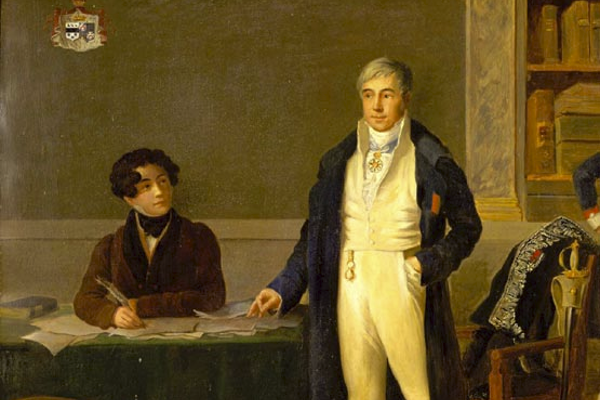
Alexis de Tocqueville and Gustave de Beaumont offer one of the clearest nineteenth-century examples of friendship becoming a form of emotional and political guardianship. Their bond began in the world of French law and administration, deepened during their 1831–1832 journey through the United States, and continued through decades of correspondence, political upheaval, professional frustration, and illness. They were not simply travel partners or intellectual collaborators. They were witnesses to one another’s formation. The American journey that helped produce Tocqueville’s Democracy in America and Beaumont’s Marie; or, Slavery in the United States was also a school of friendship, one in which observation of a new democratic society was inseparable from observation of each other. Tocqueville studied American individualism, restlessness, ambition, and anxiety, but he did so beside a friend who knew his own restlessness, ambition, and anxiety at close range.
That intimacy matters because Tocqueville himself was one of the great analysts of the modern inward turn. In Democracy in America, he described democratic individualism as a condition that could draw people away from inherited solidarities and into a narrower circle of private life. He feared not only tyranny by rulers, but also isolation, conformity, mediocrity, and the quiet weakening of civic courage. Yet these were not merely abstract political anxieties. They corresponded to the tensions of Tocqueville’s own life: his aristocratic inheritance, his liberal commitments, his difficult political career, his recurrent ill health, and his tendency toward intense intellectual and emotional pressure. Beaumont, as his friend, occupied a position no public critic could occupy. He could see not only Tocqueville’s ideas, but the strain of being Tocqueville.
This made their friendship a transitional form between older political counsel and modern psychological intimacy. Earlier political friendship often centered on prudence, loyalty, patronage, and public danger. A friend might warn another that a rash alliance, careless word, or poorly judged ambition could lead to disgrace, exile, imprisonment, or death. Tocqueville and Beaumont still inhabited that world in part. They lived through the July Monarchy, the Revolution of 1848, the Second Republic, and the rise of Louis-Napoleon. Politics was not theoretical for them; it was dangerous, exhausting, and morally compromising. Yet the warning between them increasingly belonged to a modern register. The danger was not only that Tocqueville might misjudge a party, a ministry, or a regime. It was that politics could consume his nerves, distort his judgment, damage his health, and isolate him from the very allies he needed.
Beaumont’s authority as friend came from long familiarity rather than hierarchy. He was not Tocqueville’s priest, father, patron, or superior. He could not command him. His influence depended on a kind of equality sharpened by intimacy. He knew Tocqueville as a traveler, colleague, writer, correspondent, invalid, aristocrat, liberal, and disappointed officeholder. That accumulated knowledge allowed him to function as a political conscience and emotional safeguard. The modern friend’s warning appears here in embryo: not a formal rebuke, not a public denunciation, not a theological admonition, but an intimate attempt to keep a person from being overtaken by his own temperament. Beaumont could warn Tocqueville because he understood the relation between Tocqueville’s mind and Tocqueville’s body, between political principle and psychological strain.
The friendship also reveals how modern warning could continue after death. Beaumont became one of the guardians of Tocqueville’s memory, editing and presenting his friend’s letters and remains for a wider public. This was not a neutral act. To edit a dead friend’s papers was to interpret the life, protect the reputation, and shape the moral meaning of the person left behind. Beaumont’s posthumous role extended the work of friendship from counsel into memorial stewardship. He did not merely preserve Tocqueville’s writings; he helped construct the image of Tocqueville as a serious, principled, fragile, morally exacting liberal thinker. The friend’s duty to warn in life became the friend’s duty to witness after death.
Tocqueville and Beaumont mark an important moment in the history of modern friendship. Their relationship still belonged to the older world of male political companionship, public honor, and civic responsibility, but it also anticipated a later world in which friends would be expected to read one another psychologically. Beaumont’s friendship mattered not because he “saved” Tocqueville in any simple dramatic sense, but because he stood close enough to recognize the human cost of Tocqueville’s political and intellectual vocation. The friend here is not merely a companion in action or an admirer of genius. He is the person who sees how ambition, illness, anxiety, principle, and public life converge inside a single vulnerable self. That is why Tocqueville and Beaumont belong at the threshold of modern boundary-setting: their friendship shows warning becoming less a matter of external discipline than of emotional preservation.
Victorian and Bourgeois Friendship

The nineteenth-century inward turn did not detach friendship from social discipline. On the contrary, the more friendship became associated with intimacy, sincerity, and chosen affection, the more it could become a powerful instrument for managing character. In Victorian and bourgeois culture, friendship often occupied the space between private feeling and public reputation. The friend was not a magistrate, priest, or parent, yet the friend could still judge, advise, caution, and correct. Because friendship was voluntary, its warnings could appear less coercive than formal authority, but that did not make them weak. A warning from a trusted friend could carry a peculiar force precisely because it came from within the circle of affection rather than from the outside world of law, church, or social rank.
Respectability gave this friendly counsel much of its urgency. In middle-class culture, character was not merely an inner quality; it was something displayed through habits, manners, self-command, domestic order, financial prudence, sexual propriety, and emotional restraint. A person’s public reputation depended on visible signs of private discipline. Drinking too much, spending recklessly, gambling, keeping disreputable company, pursuing an imprudent romance, writing indiscreet letters, or showing uncontrolled anger could become more than personal failings. Such actions threatened the social credibility on which marriage prospects, business trust, political standing, and family honor depended. The friend who warned against such behavior was not simply protecting another person’s feelings. He or she was guarding a fragile social identity.
This is why Victorian friendship so often functioned as an informal school of self-government. Bourgeois society placed heavy emphasis on the disciplined self: the man who mastered appetite and ambition, the woman who managed feeling and reputation, the household that displayed moral order, the professional who proved reliability through conduct. Advice between friends helped sustain that ideal. A friend could notice when another person’s behavior threatened to expose a weakness that polite society preferred to keep hidden. The warning might be phrased gently, as concern, but beneath it lay a sharper social logic: if you do not master yourself, others will judge you; if you do not govern your desires, your character will be read against you. Friendly counsel helped translate external social pressure into inward self-surveillance. It made the standards of respectability feel less like commands imposed by institutions and more like truths recognized by those who cared. The friend could say what society might later say more brutally, but say it early enough to allow correction. That gave friendly warning a preventive quality. It worked before scandal hardened, before debts became public, before a flirtation became ruinous, before anger became estrangement, before a lapse became an identity. The friend’s role was anticipatory: to detect the first signs of disorder and urge self-command before the world rendered its harsher verdict.
The management of character was important for men navigating ambition, work, and public life. Nineteenth-century ideals of manliness often joined independence with restraint. A man was expected to act with energy, but not recklessness; ambition, but not vanity; sociability, but not dissipation; courage, but not disorder. Male friends could warn one another against the forms of excess that threatened bourgeois masculinity: debt, drunkenness, sexual scandal, political imprudence, professional arrogance, or emotional collapse. Such warnings did not necessarily make friendship cold or instrumental. They could be deeply affectionate. But they reveal how friendship and discipline intertwined. A man’s friend could become the person who reminded him that freedom without self-command would destroy the very independence he prized.
Women’s friendships operated within a different but equally powerful moral economy. Nineteenth-century women, especially in middle-class contexts, were often judged through ideals of purity, sympathy, domestic virtue, emotional refinement, and relational duty. Female friendship could provide spaces of intense emotional disclosure, literary exchange, mutual support, and even forms of intimacy that exceeded later, narrower categories. Yet these friendships could also involve advice about reputation, courtship, marriage, family obligation, and the dangers of misplaced trust. A woman might warn another about an unsuitable suitor, an imprudent attachment, a compromising correspondence, or a form of dependency that threatened her security. Such counsel could be protective, but it also reflected the unequal risks women faced in a society that punished female impropriety more severely than male misconduct. This made female friendship significant as a space of both refuge and regulation. Within it, women could speak more frankly than polite mixed company allowed, but they also had to reckon with the fact that a woman’s social and economic future could be damaged by rumor, misreading, or association. Friendly advice about love, marriage, letters, travel, money, or conduct was rarely trivial. It was bound to the practical realities of limited property rights, constrained employment, sexual double standards, and the enormous cultural pressure placed on female reputation. The friend who warned another woman might be guarding her from exploitation or abandonment, but she might also be helping her survive a social order in which even innocence could be insufficient protection.
The friend’s warning in this bourgeois world stood at the intersection of care and conformity. To warn a friend against scandal, imprudence, or loss of self-command could be an act of genuine love. It could prevent harm, poverty, humiliation, abandonment, or social exclusion. Yet it could also reinforce restrictive norms. A friend who urged restraint might be protecting someone from cruelty but might also be helping society enforce that cruelty. This ambiguity is central to modern friendship. The friend became an agent of both liberation and discipline: the person who helped one become a coherent self, but also the person who reminded one what society would and would not forgive. Friendly advice could enlarge moral agency, but it could also narrow the acceptable forms of life. The same warning could sound compassionate in one context and coercive in another. A caution against reckless spending might preserve a household from ruin; a caution against unconventional love might preserve respectability at the cost of emotional truth. A warning about public anger might prevent professional destruction; it might also teach silence in the face of injustice. Victorian and bourgeois friendship cannot be treated simply as benevolent intimacy. It was one of the mechanisms through which modern people negotiated the price of belonging. Friends helped each other survive social judgment, but they also helped define what counted as survivable, respectable, or permissible in the first place.
Victorian and bourgeois friendship deepened the modern problem of boundaries. The warning friend did not speak with the formal authority of the church, state, or household, but with the intimate authority of shared confidence. That made the warning emotionally persuasive and socially useful. It also made it difficult to resist. A rebuke from a stranger could be dismissed as gossip; a warning from a friend demanded self-examination. By the late nineteenth century, friendship had become one of the places where modern people learned to read themselves as characters under observation: inwardly complex, outwardly judged, and always vulnerable to the consequences of conduct. The friend, standing close enough to see both private motive and public risk, became one of the chief guardians of that boundary.
The Psychological Century

The twentieth century transformed the friend’s warning by changing the language through which destructive behavior was understood. Older moral vocabularies did not disappear, and many people continued to interpret misconduct through sin, vice, weakness, irresponsibility, or bad character. Yet a new interpretive framework became increasingly available. A friend’s behavior might now be described as compulsive, neurotic, depressive, addictive, traumatized, narcissistic, avoidant, codependent, self-sabotaging, or symptomatic. The significance of this shift is difficult to overstate. To warn a friend was no longer only to criticize an act; it was to identify a pattern. The friend did not merely say, “You did wrong.” The friend increasingly said, “This keeps happening,” “You are repeating something,” “You are not seeing what this is doing to you,” or “This is bigger than this one incident.” That shift changed both the severity and the tenderness of admonition. A moral warning could condemn a choice and demand reform; a psychological warning could frame the same behavior as part of a longer history of fear, injury, compulsion, or maladaptation. The friend’s rebuke became more interpretive, more biographical, and often more difficult to resist. It claimed to see continuity where the person in trouble saw isolated moments. It connected the angry outburst to the old insecurity, the relapse to the familiar shame, the destructive romance to a repeated hunger for rescue, the withdrawal to a deeper pattern of fear. Modern friendship, under the pressure of psychological culture, became one of the places where people learned to understand conduct not as a series of disconnected moral failures, but as evidence of a self organized by history.
This psychological turn had deep roots in the late nineteenth and early twentieth centuries. Psychoanalysis, psychiatry, social work, and the emerging human sciences all encouraged modern people to look beneath conduct for hidden causes. Sigmund Freud’s influence was important, not because everyone accepted psychoanalysis in any strict doctrinal sense, but because Freudian and post-Freudian ideas helped popularize the assumption that ordinary behavior might conceal unconscious conflict, repression, displacement, unresolved childhood experience, or disguised desire. A lapse, fixation, outburst, attachment, or refusal could be read as a sign. This changed the cultural role of the friend. The friend became not simply a witness to behavior but an interpreter of meaning. To know someone well was to know not only what that person did, but what that person tended to do again and again.
This did not make friendship more detached or clinical. In many ways, it made friendship more intimate. A moral rebuke could stop at the surface of conduct: do not drink so much, do not humiliate your spouse, do not neglect your work, do not ruin your reputation. A psychological warning moved closer to the person’s private interior: why do you drink when you feel abandoned, why do you choose people who mistreat you, why do you turn every disagreement into betrayal, why do you disappear whenever others need you? The friend’s authority now depended on familiarity with emotional rhythm. A close friend could identify the cycle before outsiders could. He or she might notice the weeks of withdrawal before a breakdown, the forced cheer before a relapse, the defensive anger before an apology, the idealization before a destructive romance, or the frantic productivity before collapse. Modern friendship became a place where patterns were named before they became diagnoses.
The First and Second World Wars intensified this transformation by making psychological injury socially visible on a mass scale. “Shell shock,” combat neurosis, war trauma, and later post-traumatic stress forced modern societies to confront the fact that suffering could persist long after visible danger had passed. Trauma complicated older moral categories because it could make behavior appear irrational without being meaningless. A person might be irritable, detached, self-medicating, hypervigilant, emotionally numb, or unable to resume ordinary life, not because he lacked character, but because the past had not ended inside him. This recognition eventually moved far beyond veterans. The language of trauma came to shape understandings of abuse, disaster, racism, domestic violence, sexual violence, childhood neglect, and grief. Friends increasingly learned to ask not only “What is wrong with you?” but “What happened to you?” That question altered the moral atmosphere of warning. It did not remove responsibility, but it placed responsibility inside a history of injury.
The psychological century created the figure of the “therapeutic friend.” This was not necessarily a trained professional. More often, it was an ordinary person who had absorbed the language of therapy, self-help, recovery, and emotional literacy. The therapeutic friend listened, reflected, affirmed, asked about childhood, noticed triggers, encouraged counseling, warned against denial, and urged healthier boundaries. This figure became prominent in the second half of the twentieth century as therapy moved from a specialized clinical practice into a broader cultural ideal. The friend was now expected to provide emotional labor that earlier societies might have assigned to clergy, kin networks, or communal rituals. Friendship became a place where the self was narrated, repaired, and sometimes challenged. To be a good friend meant not only showing loyalty, but also helping another person understand himself or herself.
Yet the therapeutic friend also introduced new dangers. Psychological language could deepen compassion, but it could also become a new form of accusation. To call a friend “avoidant,” “narcissistic,” “codependent,” “trauma-bonded,” “borderline,” or “toxic” could clarify a destructive dynamic, but it could also reduce a complex person to a label. Diagnosis, especially when used informally, can become a weapon disguised as insight. The friend who once might have said “you are being selfish” might now say “you are acting out your narcissism,” which can be more difficult to answer because it claims to see beneath denial. The psychological warning carries a peculiar modern power. It does not merely judge behavior; it interprets the person’s interior life, sometimes without consent and sometimes without competence.
This ambiguity became clear in the changing language of addiction. Drinking, drug use, gambling, and other compulsive behaviors had long been condemned as vice or weakness. The twentieth century increasingly recast them as addiction, dependency, disease, or disorder. That shift made compassion more possible, but it also changed what friends were expected to do. If the problem was not merely bad conduct but a destructive condition marked by denial, relapse, and compulsion, then ordinary advice seemed insufficient. Friends and family were urged to stop enabling, recognize patterns, name consequences, and press for treatment. The friend’s warning became more urgent because the friend was understood to be confronting not just a choice, but a system of behavior that protected itself from recognition. This language could preserve love by separating the person from the disorder, allowing friends to say, “I am not abandoning you, but I will not cooperate with what is destroying you.” This sharpened the boundary between compassion and complicity. Paying debts, covering absences, making excuses, smoothing over violence, or pretending not to notice could now be interpreted as enabling rather than loyalty. This created a new moral demand within friendship: care had to become structured, conditional, and sometimes confrontational. It was no longer enough to feel sympathy for the suffering friend. One had to decide whether one’s sympathy was interrupting the destructive pattern or helping it continue. This would prepare the way for the formal intervention, where private concern became organized, scripted, and therapeutic.
By the end of the twentieth century, friendship had become one of the ordinary places where moral judgment, psychological explanation, and emotional care overlapped. Modern friends warned one another not only against disgrace or sin, but against burnout, breakdown, relapse, projection, dissociation, manipulation, self-harm, emotional dependency, and repeating inherited wounds. This did not mean that moral responsibility disappeared into diagnosis. Rather, modern warning became double-voiced. It said, “This may not be entirely your fault,” and also, “You are still responsible for what happens next.” That double message defines the psychological century’s contribution to friendship. The modern friend became the person who could hold compassion and confrontation together, seeing the wound without pretending the wound excuses every consequence.
The Formal Intervention

The modern history of friendship and warning reaches one of its clearest forms in the formal intervention. Addiction had long been understood through older languages of vice, weakness, sin, irresponsibility, or moral collapse. Drunkenness, compulsive gambling, narcotic use, and other destructive habits could certainly provoke concern among friends and family, but the warning often remained informal: a private rebuke, a tearful plea, a threat, a demand for reform, or an appeal to shame. In the twentieth century, addiction increasingly came to be understood as a condition marked by denial, compulsion, relapse, and progressive harm. This changed the friend’s role. If addiction was not merely a bad choice but a pattern that defended itself against recognition, then ordinary warning seemed inadequate. The friend had to do more than express disappointment. The friend had to pierce denial without simply becoming another voice in a familiar cycle of accusation and apology.
The formal intervention emerged from this problem. Associated particularly with the work of Vernon E. Johnson in the mid-twentieth century, the intervention translated the older act of loving admonition into a structured therapeutic encounter. Johnson, an Episcopal priest and recovering alcoholic, helped popularize the idea that people suffering from addiction did not always need to “hit bottom” in the most catastrophic sense before help became possible. Instead, those closest to the person could gather evidence, describe concrete harms, express love, present treatment as an immediate option, and refuse to continue enabling the destructive pattern. This was a major shift in the moral architecture of warning. The friend no longer approached the addicted person alone, hoping that affection or reason would be enough. The warning became collective, planned, and often guided by professional or semi-professional expertise.
This collective structure altered the emotional force of the warning. One friend might be dismissed as dramatic, judgmental, resentful, or misinformed. A group of friends and family members speaking in sequence was harder to evade. The intervention asked each participant to offer not abstract condemnation but specific testimony: what had been seen, what had been endured, what had changed, what harm had followed, and what would happen next if treatment were refused. The intervention resembled a court of intimacy, but one whose stated goal was rescue rather than punishment. Its authority came not from law but from relationship. Each person’s statement was supposed to say, “I am here because I love you, but love can no longer mean helping this continue.” The warning fused affection with boundary, compassion with consequence, and memory with demand. It also changed the temporality of friendship. Instead of waiting for the addicted person to ask for help, friends and relatives acted before the next disaster, relapse, arrest, firing, hospitalization, or estrangement. The intervention made warning anticipatory and evidentiary: it gathered the past in order to alter the future. Stories that had once been endured privately were brought together into a pattern the addicted person could no longer easily isolate or minimize. What had seemed to the individual like separate accidents, misunderstandings, apologies, or bad nights became, in the mouths of loved ones, a visible history of harm. This is why the intervention could be so emotionally overwhelming. It forced the person to encounter not only his or her own behavior, but the accumulated memories of everyone who had been living around that behavior. The friend’s warning was no longer a single voice of concern; it became a chorus of relational evidence.
The intervention also changed the meaning of loyalty. In older friendship traditions, loyalty could sometimes mean standing by a friend publicly, defending reputation, minimizing scandal, or absorbing private damage for the sake of the relationship. Addiction treatment challenged that logic by redefining silence and protection as enabling. Covering for missed work, paying debts, hiding bottles, explaining away violence, tolerating manipulation, or repeatedly forgiving without change could all be interpreted as ways of preserving the addiction rather than the person. This was emotionally difficult because it forced friends to distinguish between the friend and the destructive pattern. The intervention depended on that distinction. It told the addicted person, “We are not your enemies, but we are no longer willing to be useful to your illness.” In modern friendship, this became one of the sharpest forms of boundary-setting: refusing to confuse rescue with rescue’s imitation.
Yet the intervention was never free of ambiguity. Its theatrical structure could be powerful, but also coercive. A person could experience it as love, betrayal, ambush, humiliation, or social pressure disguised as care. The presence of multiple loved ones might break through denial, but it might also overwhelm, corner, or shame. Critics of confrontational models have emphasized approaches that rely more heavily on motivation, readiness for change, family systems, and collaborative treatment. Motivational interviewing, community reinforcement approaches, and other modern methods often seek to reduce resistance rather than defeat it. This does not make the intervention meaningless, but it complicates its moral status. The same act can be understood as merciful interruption or emotional coercion, depending on how it is planned, conducted, and received.
For the history of friendship, the importance of the formal intervention lies in how openly it reveals the modern logic of loving boundaries. The friend is no longer merely the confidant who listens, the companion who consoles, or the moralist who scolds. The friend becomes part of an organized effort to interrupt self-destruction. This role is painful because it risks the very bond it hopes to save. The addicted friend may feel exposed, judged, or abandoned; the intervening friend may feel cruel, frightened, or disloyal. But modern friendship often defines itself precisely at that point of risk. To love a friend is not always to preserve comfort. Sometimes it is to refuse the familiar script, to name the pattern everyone has learned to survive, and to say that the relationship itself must change if the person is to live.
Toxicity and Boundaries: The Friend Who Says “No”

The modern language of friendship eventually moved from interpretation to limit-setting. Once destructive behavior could be understood as pattern, trauma, addiction, compulsion, or emotional injury, friendship acquired a new burden: the friend was expected not only to understand, but also to decide how much participation was possible. This is where the language of boundaries became central. A boundary is not simply a rejection, although it can feel like one. It is a rule of relation, a declaration about access, responsibility, and consequence. In older moral worlds, a friend might warn, “You are endangering your soul,” “You are dishonoring yourself,” or “You are risking public disgrace.” In the contemporary world, the warning often takes another form: “I care about you, but I cannot keep doing this,” “I will not cover for you anymore,” “I will not be spoken to that way,” or “I cannot be the person who absorbs the damage every time this happens.”
This shift reveals a profound change in the moral structure of friendship. Earlier forms of admonition often assumed that the friend’s duty was to remain close enough to correct. Modern boundary language asks whether remaining close may itself become part of the harm. The friend who always listens, forgives, explains, rescues, and returns may come to see loyalty as a trap. What once appeared as patience can begin to look like enabling; what once appeared as compassion can become self-erasure. The modern friend faces a question older friendship traditions did not always foreground: when does love require endurance, and when does love require refusal? The answer is rarely simple, because friendship is built on generosity. But modern boundary culture insists that generosity without limits can become a form of disappearance. The friend who says “no” may not be abandoning friendship; he or she may be trying to preserve the conditions under which friendship can remain morally possible. This is significant because modern friendship has often been imagined as voluntary, intimate, and emotionally sustaining rather than governed by duty. If friendship is chosen, then staying is supposed to mean something. Leaving, limiting, or refusing can feel morally charged, as though the friend has failed the test of loyalty. Boundary language challenges that assumption by arguing that choice must remain active inside the relationship. A friendship that depends on one person’s endless availability, silence, or emotional labor is no longer simply intimate; it has become asymmetrical. The boundary restores the possibility of consent within affection. It says that friendship cannot be sustained by habit alone, and that a person may love another deeply while still refusing a role that has become degrading, exhausting, or unsafe.
The term “toxic” belongs to this same cultural world, though it must be used carefully. In popular language, a toxic friend is someone whose presence repeatedly produces harm: manipulation, humiliation, dependency, chronic crisis, contempt, jealousy, coercion, emotional volatility, or endless extraction without reciprocity. The usefulness of the term lies in its ability to name relational damage that may not rise to the level of legal abuse or clinical diagnosis but still corrodes the life of the person enduring it. It gives ordinary people a vocabulary for saying that affection does not cancel harm. Yet the term is also blunt. It can turn a pattern into an essence, as though a person were simply poisonous rather than wounded, immature, frightened, selfish, addicted, desperate, or trapped in learned behavior. The language of toxicity can protect, but it can also flatten. It may clarify the need for distance, but it can also make repair seem impossible before repair has even been attempted.
Modern friendship is shaped by a tension between compassion and self-protection. A friend in crisis may need patience, forgiveness, and sustained presence. People who are grieving, traumatized, depressed, addicted, or frightened may not behave well. If friendship withdrew at the first sign of difficulty, it would become little more than a consumer preference, a relationship maintained only while emotionally convenient. But the opposite danger is equally real. A person may invoke suffering to excuse cruelty, helplessness to demand endless labor, or intimacy to override another person’s limits. Modern friendship must distinguish between pain that asks for care and behavior that requires boundaries. A friend can recognize trauma without accepting mistreatment. A friend can understand a wound without agreeing to be wounded by it indefinitely.
The friend who says “no” also changes the meaning of honesty. In older traditions, honesty often meant telling a friend an unpleasant moral truth. In boundary culture, honesty includes naming the effect of the relationship itself. The warning is no longer only, “You are doing harm to yourself,” but “You are doing harm to me.” That is a difficult sentence because it shifts the friend from observer to participant. It admits that the relationship is not a neutral space in which one person helps another from a distance. Friendship entangles lives. The anxious friend may demand constant reassurance; the addicted friend may need rescue; the angry friend may require others to absorb outbursts; the self-absorbed friend may turn every conversation into a mirror. To set a boundary is to reveal that the warning friend has a self too, with limits, injuries, time, dignity, and needs. Modern friendship becomes reciprocal not only through affection, but through the recognition that neither person may consume the other. This is one reason boundary-setting often requires more courage than ordinary advice. It is easier to tell a friend that his behavior is bad for him than to admit that his behavior is damaging the relationship itself. The first kind of warning can preserve the speaker’s position as helper; the second exposes the speaker’s vulnerability. It says, “I am not outside this problem. I am being changed by it.” That admission can feel dangerous because it may provoke defensiveness, guilt, rage, or abandonment. Yet it is also morally clarifying. It prevents the warning friend from pretending to be infinitely strong, infinitely patient, or infinitely available. It rejects a sentimental model of friendship in which love means absorbing harm without naming it. The modern boundary insists that friendship must include the truth of both people’s experience, not merely the crisis of the one who demands care most loudly.
This is why boundary-setting can feel like betrayal even when it is an act of care. Many friendships are built on unspoken contracts: I will always answer, I will always forgive, I will always come over, I will always listen, I will always defend you, I will always understand. A boundary interrupts that script. It makes explicit what had been assumed and conditional what had seemed unconditional. The person receiving the boundary may hear it as rejection because it withdraws a familiar form of access. But the boundary may also be the first truthful statement in the relationship. It says that friendship cannot survive on sentiment alone. It requires forms, habits, restraints, and mutual recognition. The friend who says “no” is not necessarily closing the door; sometimes he or she is marking the only doorway through which the friendship can continue without becoming destructive.
The rise of boundaries and toxicity marks a late-modern development in the history of friendly warning. The friend is no longer only the one who warns another against sin, scandal, obsession, or addiction. The friend is also the one who warns from within the relationship: this pattern cannot continue here. That warning may lead to repair, distance, estrangement, therapy, apology, or a renegotiated bond. Its moral force lies in the recognition that care and access are not identical. Modern friendship still cherishes intimacy, but it increasingly understands intimacy as something that must be protected from domination, depletion, and contempt. The friend who says “no” is one of the defining figures of contemporary friendship because he or she embodies the central paradox of modern care: sometimes the most loving act is not to stay available at any cost, but to refuse the terms under which love has become a form of harm.
The Digital Backchannel: Private Warnings in an Age of Permanent Reputation

Digital communication transformed friendly warning by changing the speed, scale, and durability of social consequence. In earlier periods, a friend might warn another against a letter that could be circulated, a remark that might reach a patron, a scandal that might travel through drawing rooms, or a political misstep that could be remembered by enemies. The danger was real, but it was usually constrained by social distance, material circulation, and the pace of rumor. Social media collapsed those limits. A careless post, angry reply, crude joke, compromising image, or ill-considered political statement can now be copied, screenshot, archived, forwarded, searched, and revived long after the original context has vanished. In this world, reputation no longer belongs entirely to memory. It belongs to platforms.
The friend’s adapted to the logic of the feed. “Delete this” has become one of the characteristic admonitions of the digital age. It is brief, urgent, and often deeply protective. The friend who sends that message is not necessarily making a full moral argument. He or she may be warning that tone will be misread, context will collapse, irony will fail, strangers will arrive, employers will notice, old enemies will preserve the evidence, or the algorithm will carry the post to an audience for which it was never intended. This is a modern form of prudential friendship. The friend sees the public consequence before the poster does. What earlier friends might have done by taking someone aside at a dinner, intercepting a reckless letter, or advising silence before a patron, modern friends often do through the private message, the group chat, the text, or the late-night phone call.
The private warning matters because digital life has blurred the boundary between private expression and public record. A person may feel that a post is casual, momentary, or directed toward a familiar circle, but platforms are built to detach expression from its original audience. The imagined audience and the actual audience may be radically different. A joke intended for friends may be read by strangers as evidence of cruelty. A political statement meant as solidarity may be interpreted as ignorance. A venting post may become a professional liability. A photograph may reveal more than intended. The digital backchannel exists to repair, or at least reduce, this mismatch before it hardens into reputational fact. It is a protective whisper in a system designed for amplification.
This makes the backchannel a direct descendant of older traditions of friendly counsel, but with a distinct modern urgency. Francis Bacon could warn the Earl of Essex about the dangers of public perception in a courtly world where favor, rumor, and interpretation mattered. The digital friend performs a similar function in a world where the court is everywhere and nowhere. There is no single monarch to offend, no stable patron to placate, no contained circle of observers. Instead, there are employers, readers, followers, hostile strangers, ideological opponents, old classmates, family members, journalists, automated searches, and unknown future audiences. The modern warning is not simply, “This will look bad.” It is, “This may travel beyond your control, and once it does, you may not be able to explain yourself back into safety.” That loss of control is what gives the digital warning its particular force. Earlier reputational crises could be severe, but they were often mediated through known channels: the court, the church, the newspaper, the club, the workplace, the neighborhood. Digital reputation moves through unstable and partly invisible channels, where an audience may assemble suddenly and without proportion. A friend may warn not only about the content of the post but about the structure of the medium itself. The danger lies in the fact that platforms reward speed, outrage, compression, and decontextualization. The digital friend who says “do not post that” or “take that down” may be reading not merely the friend’s intention, but the likely mechanics of circulation. The backchannel warning is a form of media literacy transformed into care.
The digital backchannel also reveals how friendship now participates in reputation management. Reputation has always mattered, but online reputation is unusually unstable because it combines permanence with volatility. Posts can disappear from attention within minutes and then reappear years later. A person may be judged by a fragment, a screenshot, a phrase severed from context, or a pattern assembled by hostile readers. Friends become informal archivists and risk analysts. They remember what has happened before, recognize how certain words now circulate, understand which audiences may react, and know when a friend is speaking from anger rather than judgment. The backchannel warning is not merely censorship or timidity. It is an attempt to preserve agency in a communicative environment that often strips agency away after publication. It also reflects the collapse between personal identity and public brand. Even people who reject branding language often live under its pressure, because employers, clients, readers, students, relatives, and strangers may interpret online traces as evidence of character. A friend who intervenes privately may be protecting more than popularity; he or she may be protecting employment, credibility, safety, family relationships, or the possibility of being understood in good faith. Yet that protective labor can become exhausting. The digitally vigilant friend must know the friend’s temperament, the platform’s habits, the audience’s sensitivities, and the likely afterlife of a post. Friendship becomes a small emergency network, constantly negotiating the line between expression and exposure. What once might have been a private outburst now requires a reputational risk assessment.
Yet this form of warning carries its own ambiguities. A private message can protect a friend from humiliation, but it can also encourage excessive self-surveillance. The friend who constantly warns another about optics may help create a life governed by fear of misinterpretation. Digital prudence can become digital anxiety. Every joke, opinion, image, or affiliation can begin to feel like evidence in a future trial. The warning friend may become not the guardian of authenticity but the agent of caution, respectability, or brand management. This echoes the bourgeois friend’s older role in managing character, but with a sharper technological edge. The question is no longer only whether one’s conduct is honorable, but whether one’s conduct is screenshot-proof.
The backchannel also complicates the relationship between honesty and solidarity. A friend may privately warn someone because the post is genuinely cruel, false, bigoted, misleading, or harmful. In that case, the warning is ethical before it is reputational. But a friend may also warn because the post is unpopular, risky, unfashionable, or likely to provoke backlash. The distinction matters. Modern digital friendship must navigate the gap between “You should not say this because it is wrong” and “You should not say this because it will hurt you.” Often the two overlap, but not always. A friend who warns only against consequences may become a strategist of survival rather than a partner in moral growth. A friend who warns only in moral absolutes may ignore the disproportionate machinery of public punishment. The best digital backchannel holds both concerns together: truth and consequence, conscience and prudence, harm and context.
The private warning in the digital age shows modern friendship under pressure from permanent visibility. It is one of the most ordinary and revealing forms of contemporary boundary work. Friends warn friends before the crowd arrives, before a joke becomes a controversy, before a confession becomes searchable, before anger becomes evidence, before the person is reduced to the worst sentence he or she posted in the wrong mood. This warning is not always noble, and it is not always wise. It can protect vanity as easily as dignity, reputation as easily as character. But at its best, the digital backchannel preserves one of friendship’s oldest responsibilities in a new medium: the friend sees danger while there is still time to choose differently.
Calling Out and Calling In: The Politics of Accountable Friendship

The digital backchannel is private, protective, and often reputational. The call-out and the call-in move friendly warning into a more openly ethical and political register. In contemporary activist, educational, workplace, and online cultures, friends are not only expected to protect one another from public missteps; they may also be expected to confront harmful language, exclusionary habits, abusive conduct, racism, sexism, homophobia, transphobia, ableism, or other forms of social harm. This is a significant expansion of the friend’s warning. The modern friend no longer asks only, “Are you damaging yourself?” or “Are you damaging your reputation?” The friend may also ask, “Whom are you harming?” and “What responsibility do you have to change?”
The call-out is the more confrontational form. It names harm directly, often in public or semi-public space, and seeks to interrupt behavior by exposing it. A call-out may be necessary when harm is ongoing, when private warnings have failed, when the person causing harm holds power, or when silence would protect abuse. It can function as a refusal of complicity. The call-out belongs to a long history of moral denunciation, but digital media has changed its reach and speed. A rebuke that once might have remained inside a meeting, classroom, church, union, or friendship circle can now become visible to thousands of strangers. The call-out can protect the vulnerable by making hidden conduct visible, but it can also create a public drama in which correction becomes inseparable from humiliation. This is why the call-out is both ethically serious and socially volatile. It often arises from a legitimate need to name what has been ignored, minimized, or excused, especially when the ordinary channels of private correction have failed. But once the warning becomes public, it can be taken up by audiences with motives very different from those of the person who first spoke. What began as accountability may become spectacle; what began as protection may become punishment; what began as a demand for repair may become a contest over status, purity, or group belonging. The person called out may respond with defensiveness, apology, withdrawal, counterattack, or performative remorse, while the original harm may be clarified or obscured by the drama that follows. In friendship, this is quite fraught because the call-out tests the boundary between loyalty and truth. To call out a friend is to refuse the old expectation that friendship means protecting one’s own from exposure. It says that affection cannot require silence in the face of harm. Yet it also risks turning the friend into an example, a symbol, or a public object lesson, rather than a person still capable of being addressed.
The call-in emerged as a response to that danger. It does not reject accountability, but it tries to preserve relationship while pursuing it. To call someone in is to say, “You have caused harm, but I am not reducing you to that harm. I believe you can hear this, learn from it, and remain in community.” The call-in is relevant to friendship because it assumes some basis of trust. It may happen privately, in a small group, through a direct message, or in a carefully framed conversation. Its purpose is not to excuse the behavior, but to make growth possible without requiring public degradation as the price of correction. The call-in is one of the clearest contemporary forms of friendly admonition: a warning rooted in the belief that moral repair is still possible.
Yet the difference between calling out and calling in is not always clean. A call-in can become a call-out if it is performed before an audience, framed with contempt, or circulated beyond its intended circle. A call-out can become something like a call-in if it opens a path toward accountability rather than merely marking someone as disposable. The distinction depends not only on setting, but on intention, tone, power, history, and consequence. A powerful person who demands to be “called in” rather than criticized publicly may be trying to avoid accountability. A marginalized person who calls someone out may be doing the only thing available after private appeals have been ignored. Friendship does not erase these inequalities. A friend may owe another friend patience, but no one is owed endless patience at the expense of those being harmed.
This is where accountable friendship becomes politically difficult. Modern friendship often prizes acceptance: the friend is the person who understands, forgives, and sees the whole self. But political accountability insists that being understood is not the same as being excused. A friend may know why someone became defensive, why a joke was meant differently, why an old fear shaped a reaction, or why ignorance was genuine rather than malicious. That knowledge may soften the approach, but it cannot eliminate the harm. The accountable friend performs a double act. He or she interprets the friend charitably while still insisting that interpretation is not absolution. The warning says, “I know you are more than this, and that is why I am asking more of you.”
The politics of calling in also reveals a shift from private character to communal responsibility. Victorian friendship often managed respectability: whether a person would be seen as disciplined, honorable, prudent, or socially acceptable. Contemporary accountable friendship asks a different question: whether one’s conduct sustains or damages the community one claims to value. This does not mean reputation disappears. In digital culture, accountability and reputation are constantly entangled. But the moral center is different. The friend’s warning is not merely, “This will look bad.” It is, “This participates in harm,” “This repeats a pattern,” or “This contradicts the values you claim to hold.” The friend becomes not only a guardian of the individual self, but a witness for those affected by the self’s conduct. At its best, the call-in preserves one of friendship’s most demanding possibilities: the possibility of being corrected without being cast away. It refuses both sentimental loyalty and punitive purity. Sentimental loyalty says that friendship means defending one’s own people regardless of what they do. Punitive purity says that harm permanently defines the person who caused it. Accountable friendship tries to hold a narrower and more difficult path. It warns, confronts, and names harm, but it also leaves room for apology, repair, education, and changed behavior. In the long history of friendship, this is not a complete break from older admonition. It is a modern political version of an old ideal: the true friend is not the one who flatters, excuses, or protects every comfort, but the one who believes that correction can be an act of loyalty.
The Paradox of Modern Friendship: More Intimate and More Fragile

Modern friendship is burdened by a paradox. It has become more intimate, more emotionally articulate, and more morally ambitious, yet also more fragile. The modern friend is expected to know the hidden self, respect the autonomous self, protect the vulnerable self, challenge the harmful self, and sometimes withdraw from the destructive self. No older period lacked intensity, loyalty, or admonition, but the modern world has multiplied the kinds of care friendship is supposed to provide. A friend may be confidant, witness, critic, emergency contact, reputational adviser, lay therapist, accountability partner, and boundary-setter, sometimes all within the same relationship. The result is a bond that carries enormous emotional weight without the stabilizing structures that once surrounded many forms of obligation.
This fragility emerges partly from the voluntary character of modern friendship. Kinship, marriage, church membership, guild status, patronage, and neighborhood belonging historically carried formal or semi-formal expectations. Friendship, by contrast, increasingly presents itself as chosen, personal, and revocable. That freedom is part of its moral beauty. A friend remains because he or she wants to remain, not because law, blood, hierarchy, or institution commands it. But the same freedom makes warning precarious. A friend who speaks too bluntly may be dismissed as judgmental; a friend who sets a boundary may be accused of abandonment; a friend who confronts harm may be told that friendship requires unconditional support. Modern friendship has fewer settled rules for correction, which means that every serious warning must negotiate its own legitimacy.
The language of intimacy intensifies the problem. Modern friends often expect emotional transparency: to be seen, heard, accepted, and understood. That expectation can make friendship a powerful shelter from the impersonal pressures of work, politics, family, and public life. Yet the very expectation of acceptance can make correction feel like betrayal. If the friend is the person who knows the whole self, then criticism from that friend may strike more deeply than criticism from a stranger. A stranger can be wrong; a friend may be seeing too clearly. This is why modern warnings often produce disproportionate pain. They touch not only conduct but identity. To hear “you are hurting yourself,” “you are repeating this pattern,” or “I cannot keep being treated this way” is to encounter oneself in the mirror of another person’s love. It is also to face the possibility that intimacy has produced evidence: the friend has watched, remembered, compared, and connected moments the self may prefer to keep separate. The warning friend can say, “This is not just tonight,” or “This is not just one mistake,” because friendship has accumulated a private archive of behavior. That archive gives the warning its force, but also its sting. Modern friendship promises recognition, yet recognition is not always comforting. To be truly known is to risk being known against one’s own preferred story. The friend may see the excuse before it is spoken, the pattern beneath the apology, the fear behind the anger, or the self-deception inside the performance of confidence. Modern intimacy makes friendship both tender and dangerous. It allows one person to offer care at a depth few others can reach, but it also gives that person the power to wound by naming what the beloved self would rather conceal.
Modern friendship has become a place where people try to solve problems once handled by wider communities. Emotional suffering, addiction, loneliness, political alienation, spiritual uncertainty, reputational anxiety, and moral confusion often arrive first in the inbox, the text thread, the late-night call, or the private conversation. The modern friend is asked to respond before professionals, institutions, or communities appear, if they appear at all. This gives friendship an emergency quality. Friends are expected to notice danger early, but also not overstep; to encourage therapy but not therapize; to validate pain, but not excuse harm; to protect reputation, but not become merely strategic; to call in, but know when public accountability is necessary. No wonder modern friendship strains under its own ideals. It is asked to be both sanctuary and tribunal.
This also explains why boundary language has become so prominent. Boundaries are an attempt to give form to relationships that modern culture otherwise celebrates as spontaneous, authentic, and emotionally open. They are rules for intimacy after the decline of older rules. They say that chosen affection still needs limits, that empathy does not erase responsibility, and that closeness does not abolish the selfhood of either person. Yet boundaries also expose the instability they are meant to manage. The need to declare a boundary often means that the old assumptions of friendship have failed: reciprocity is no longer obvious, care is no longer mutual, speech is no longer safe, or loyalty has become confused with endurance. The boundary is both repair and warning. It tries to save the relationship by admitting that the relationship has become dangerous to one or both people.
The paradox of modern friendship, then, is that it asks friends to be more honest precisely when honesty may most threaten the bond. The modern friend must often choose between preserving comfort and preserving truth. Silence may keep the relationship intact while allowing harm to continue; confrontation may interrupt harm while risking estrangement. This is not a failure of modern friendship but one of its defining conditions. As friendship has moved from moral counsel to psychological interpretation, from respectability to authenticity, from private loyalty to public accountability, it has become both deeper and less secure. The modern friend is powerful because he or she stands close enough to warn from love. The modern friend is vulnerable because that warning may be the very act that breaks the friendship open.
Did Modern Friendship Really Change or Just the Vocabulary?
The following video from “The Art of Improvement” discusses Aristotle’s philosophy of friendship:
It must be considered that modern friendship may not have changed as dramatically as the language suggests. Friends have always warned friends. Classical moral philosophy, Roman letters, Christian spiritual counsel, early modern courtly advice, Victorian respectability, and contemporary therapeutic culture all preserve some version of the same idea: a true friend does not merely flatter, comfort, or agree. Aristotle’s account of virtuous friendship assumes that friends help one another become better; Cicero’s Laelius insists that friendship cannot survive without truthfulness; Aelred of Rievaulx made correction part of spiritual love; and early modern political friendships often treated warning as a necessary act of prudence. Seen from this angle, the modern intervention, the boundary-setting conversation, the private message saying “delete this,” and the activist call-in may be new forms of an old duty rather than fundamentally new moral acts.
This is important because the my emphasis on modernity could otherwise exaggerate rupture. It would be misleading to imagine a simple passage from religious admonition to secular psychology, or from hierarchical correction to egalitarian intimacy. Earlier friendships could be emotionally intense, psychologically perceptive, and deeply private. Medieval spiritual friendship was not merely institutional discipline; it could involve profound knowledge of another person’s temptations, weaknesses, hopes, and inner conflicts. Early modern correspondence could be intimate, candid, anxious, and psychologically subtle. Victorian friendship could combine affection, moral correction, and social management in ways that resemble modern boundary work. Likewise, modern friendship has not fully secularized. Religious counsel, honor, shame, family duty, and communal expectation still shape how friends warn one another. The vocabulary has changed unevenly, not universally.
The continuity becomes clear if one focuses on the structure rather than the terminology of warning. A friend sees danger before the endangered person fully sees it. The friend risks discomfort, anger, or estrangement by speaking. The warning attempts to interrupt a pattern before it becomes ruinous. The recipient may accept, reject, resent, reinterpret, or later remember the warning. This structure appears across many periods. The words may differ (sin, vice, folly, imprudence, hysteria, neurosis, addiction, toxicity, harm) but the relational drama remains recognizable. Friendship repeatedly places one person close enough to another to see what outsiders miss, and close enough to be punished for saying it. The history of friendly warning is less a story of replacement than of recurring moral pressure under changing cultural conditions.
Yet this modifies rather than defeats my main argument. The act of warning may be old, but the grounds on which a warning becomes legitimate have changed. In older traditions, the friend often drew authority from shared moral worlds: virtue, divine judgment, honor, household order, social rank, civic duty, or courtly prudence. In the modern world, those grounds increasingly compete with the authority of emotional intimacy, psychological interpretation, autonomy, trauma, consent, personal boundaries, therapeutic language, digital reputation, and political accountability. The modern friend does not simply say, “You are failing a known moral order.” The modern friend more often says, “This pattern is harming you,” “This relationship is harming me,” “This behavior is harming others,” or “This public act will outlive your intention.” That is not merely a change in vocabulary. It is a change in the moral grammar by which friendship explains its right to interfere.
The strongest conclusion is not that modern friendship invented warning, but that it relocated warning inside the modern self. Friendship’s old duty of admonition survives, but it now operates in a world that prizes autonomy while fearing isolation, values authenticity while managing reputation, honors care while insisting on boundaries, and seeks accountability while distrusting cruelty. Modern friendship is both continuous with older traditions and distinct from them. The friend still tells the truth before ruin hardens. But the truth now often concerns patterns, wounds, access, harm, digital permanence, and the limits of emotional labor. The vocabulary matters because it reveals what each age believes a person is, what a friend may know, and when love has the right to interrupt.
Conclusion: The Friend as Witness, Mirror, and Boundary
Modern friendship did not discard the ancient duty of admonition. It carried that duty into a world increasingly organized around the fragile, expressive, psychologically interpreted self. Earlier friends warned against sin, dishonor, imprudence, political danger, social disgrace, or the loss of virtue. Modern friends warn against obsession, addiction, burnout, toxic patterns, reputational collapse, harmful speech, emotional exploitation, and the erosion of the self under the pressure of intimacy. The form changed because the imagined danger changed. In the modern world, ruin is not always a fall from grace, a public scandal, or a punishment imposed from above. It may be a pattern repeated until it becomes a life, a wound mistaken for personality, a relationship that consumes one person’s dignity, or a careless digital act that outlives the mood that produced it.
The modern friend becomes a witness. He or she sees the pattern as it unfolds across time: the repeated apology, the familiar crisis, the return to the destructive romance, the relapse disguised as exception, the joke that will not survive its audience, the political anger turning into self-isolation, the pain that becomes permission to harm others. This witnessing gives friendship its peculiar authority. The friend is not omniscient, and the friend may be wrong, but the friend often sees continuity where the endangered person sees only episodes. That is why friendly warning can feel so intimate and so threatening. It is not merely a comment on behavior. It is a claim about the story of the self.
The modern friend is also a mirror, but not always a comforting one. Friendship promises recognition, and recognition can console; yet the truest mirror may also reveal what vanity, fear, shame, or exhaustion have hidden. The friend who warns says, “This is what I see when I look at you now,” and that vision may interrupt the self’s preferred account of itself. In the psychological century, this mirror became interpretive: it reflected patterns, wounds, compulsions, trauma, and dependency. In the digital century, it became anticipatory: it reflected not only who one is, but how one may be read, captured, circulated, and judged. In the age of accountable friendship, it became ethical: it reflected not only what one feels, but what one’s conduct does to others.
Finally, the modern friend is a boundary. This is perhaps the sharpest modern transformation of an older ideal. A friend does not merely warn from outside the danger; sometimes the friend is inside the danger and must name what the relationship itself has become. To say “no,” to refuse enabling, to call in rather than flatter, to warn privately before public harm, to withdraw when care has become self-erasure: these are modern versions of friendship’s oldest truth. Love that never risks truth becomes flattery. Truth that never risks love becomes cruelty. Modern friendship lives in the difficult space between them. The friend before the judge, the friend before the crowd, the friend before the algorithm, the friend before the addiction, and the friend before the wound all perform the same demanding task: to speak before ruin speaks more brutally.
Bibliography
Affiliate disclosure: Amazon links on this site are paid links. As an Amazon Associate I earn from qualifying purchases.
- Aelred of Rievaulx. Spiritual Friendship. Translated by Lawrence C. Braceland. Edited by Marsha L. Dutton. Collegeville, MN: Cistercian Publications, 2010.
- Ahmed, Sara. The Promise of Happiness. Durham, NC: Duke University Press, 2010.
- —-. Living a Feminist Life. Durham, NC: Duke University Press, 2017.
- Alcoholics Anonymous World Services. Alcoholics Anonymous: The Story of How Many Thousands of Men and Women Have Recovered from Alcoholism. 4th ed. New York: Alcoholics Anonymous World Services, 2001.
- Allan, Graham. Friendship: Developing a Sociological Perspective. Boulder, CO: Westview Press, 1989.
- American Psychiatric Association. Diagnostic and Statistical Manual of Mental Disorders. 5th ed. Washington, DC: American Psychiatric Publishing, 2013.
- Aristotle. Nicomachean Ethics. Translated by Terence Irwin. Indianapolis: Hackett, 1999.
- Bacon, Francis. The Letters and the Life of Francis Bacon Including All His Occasional Works. Edited by James Spedding. 7 vols. London: Longmans, Green, Reader, and Dyer, 1861–1874.
- Beattie, Melody. Codependent No More: How to Stop Controlling Others and Start Caring for Yourself. Center City, MN: Hazelden, 1987.
- Beaumont, Gustave de. Marie; or, Slavery in the United States. Translated by Barbara Chapman. Stanford, CA: Stanford University Press, 1958.
- Boyd, Danah. It’s Complicated: The Social Lives of Networked Teens. New Haven: Yale University Press, 2014.
- Brogan, Hugh. Alexis de Tocqueville: A Life. New Haven, CT: Yale University Press, 2006.
- Brown, Brené. Daring Greatly: How the Courage to Be Vulnerable Transforms the Way We Live, Love, Parent, and Lead. New York: Gotham Books, 2012.
- Caine, Barbara. Friendship: A History. London: Equinox, 2009.
- Cicero. Laelius De Amicita (On Friendship). Translated by P. G. Walsh. Warminster: Aris & Phillips, 1990.
- Cloud, Henry, and John Townsend. Boundaries: When to Say Yes, How to Say No to Take Control of Your Life. Grand Rapids, MI: Zondervan, 1992.
- Davidoff, Leonore, and Catherine Hall. Family Fortunes: Men and Women of the English Middle Class, 1780–1850. London: Hutchinson, 1987.
- Emerson, Ralph Waldo. “Friendship.” In Essays: First Series. Boston: James Munroe, 1841.
- Foucault, Michel. The History of Sexuality, Volume 2: The Use of Pleasure. Translated by Robert Hurley. New York: Vintage Books, 1985.
- Freud, Sigmund. Introductory Lectures on Psycho-Analysis. Translated by Joan Riviere. London: George Allen & Unwin Ltd, 1922.
- Halttunen, Karen. Confidence Men and Painted Women: A Study of Middle-Class Culture in America, 1830–1870. New Haven, CT: Yale University Press, 1982.
- Herman, Judith Lewis. Trauma and Recovery: The Aftermath of Violence—from Domestic Abuse to Political Terror. New York: Basic Books, 1992.
- Illouz, Eva. Cold Intimacies: The Making of Emotional Capitalism. Cambridge: Polity, 2007.
- —-. Saving the Modern Soul: Therapy, Emotions, and the Culture of Self-Help. Berkeley: University of California Press, 2008.
- Johnson, Vernon E. I’ll Quit Tomorrow. Revised ed. New York: Harper & Row, 1973.
- Lerner, Harriet. The Dance of Anger: A Woman’s Guide to Changing the Patterns of Intimate Relationships. New York: Harper & Row, 1985.
- Loneck, Barry, Garrett D. Garrett, and Paul J. Banks. “A Comparison of the Johnson Intervention with Four Other Methods of Referral to Outpatient Treatment.” American Journal of Drug and Alcohol Abuse 22:2 (1996), 233–246.
- —-. “The Johnson Intervention and Relapse during Outpatient Treatment.” American Journal of Drug and Alcohol Abuse 22:3 (1996), 363–375.
- Marwick, Alice E. Status Update: Celebrity, Publicity, and Branding in the Social Media Age. New Haven, CT: Yale University Press, 2013.
- Mayer-Schönberger, Viktor. Delete: The Virtue of Forgetting in the Digital Age. Princeton, NJ: Princeton University Press, 2009.
- Micale, Mark S. Hysterical Men: The Hidden History of Male Nervous Illness. Cambridge, MA: Harvard University Press, 2008.
- Mill, John Stuart. On Liberty. London: John W. Parker and Son, 1859.
- Miller, William R, ed. Treating Addiction: A Guide for Professionals. 2nd ed. New York: Guilford Press, 2019.
- Miller, William R., and Stephen Rollnick. Motivational Interviewing: Helping People Change. 3rd ed. New York: Guilford Press, 2013.
- Nelson, Claudia. Family Ties in Victorian England. Westport, CT: Praeger, 2007.
- Ng, Eve. Cancel Culture: A Critical Analysis. Cham, Switzerland: Palgrave Macmillan, 2022.
- Nguyen, C. Thi. “Echo Chambers and Epistemic Bubbles.” Episteme 17:2 (2020), 141–161.
- O’Connor, Pat. Friendship between Women: A Critical Review. New York: Guilford Press, 1992.
- Pahl, Ray. On Friendship. Cambridge: Polity, 2000.
- Pew Research Center. Reputation Management and Social Media. Washington, DC: Pew Research Center, 2010.
- Phillips, Whitney, and Ryan M. Milner. The Ambivalent Internet: Mischief, Oddity, and Antagonism Online. Cambridge: Polity, 2017.
- Rieff, Philip. The Triumph of the Therapeutic: Uses of Faith after Freud. Chicago: University of Chicago Press, 1966.
- Rose, Nikolas. Governing the Soul: The Shaping of the Private Self. 2nd ed. London: Free Association Books, 1999.
- Ross, Loretta J. Calling In: How to Start Making Change with Those You’d Rather Cancel. New York: Simon & Schuster, 2025.
- Rotundo, E. Anthony. American Manhood: Transformations in Masculinity from the Revolution to the Modern Era. New York: Basic Books, 1993.
- Shorter, Edward. A History of Psychiatry: From the Era of the Asylum to the Age of Prozac. New York: John Wiley & Sons, 1997.
- Shuttleworth, Sally. Charlotte Brontë and Victorian Psychology. Cambridge: Cambridge University Press, 1996.
- Silver, Allan. “Friendship in Commercial Society: Eighteenth-Century Social Theory and Modern Sociology.” American Journal of Sociology 95:6 (1990), 1474–1504.
- Solove, Daniel J. The Future of Reputation: Gossip, Rumor, and Privacy on the Internet. New Haven, CT: Yale University Press, 2007.
- Spencer, Liz, and Ray Pahl. Rethinking Friendship: Hidden Solidarities Today. Princeton, NJ: Princeton University Press, 2006.
- Substance Abuse and Mental Health Services Administration. Enhancing Motivation for Change in Substance Use Disorder Treatment. Treatment Improvement Protocol Series 35. Rockville, MD: SAMHSA, 2019.
- Táíwò, Olúfẹ́mi O. Elite Capture: How the Powerful Took Over Identity Politics—and Everything Else. Chicago: Haymarket Books, 2022.
- Taylor, Charles. Sources of the Self: The Making of the Modern Identity. Cambridge, MA: Harvard University Press, 1989.
- Tocqueville, Alexis de. Democracy in America. Translated by Henry Reeve. London: Saunders and Otley, 1835.
- —-. Memoir, Letters, and Remains of Alexis de Tocqueville. Edited by Gustave de Beaumont. Translated by the Translator of Napoleon’s Correspondence with King Joseph. 2 vols. London: Macmillan, 1861.
- —-. Recollections: The French Revolution of 1848 and Its Aftermath. Translated by Alexander Teixeira de Mattos. London: H. Henry & Co. Ltd, 1898.
- —-. Selected Letters on Politics and Society. Edited by Roger Boesche. Translated by James Toupin and Roger Boesche. Berkeley: University of California Press, 1985.
- Trottier, Daniel. Social Media as Surveillance: Rethinking Visibility in a Converging World. Farnham, UK: Ashgate, 2012.
- Vicinus, Martha. Intimate Friends: Women Who Loved Women, 1778–1928. Chicago: University of Chicago Press, 2004.
- Welch, Cheryl B. De Tocqueville. Oxford: Oxford University Press, 2001.
- Young, Allan. The Harmony of Illusions: Inventing Post-Traumatic Stress Disorder. Princeton, NJ: Princeton University Press, 1995.
- Zunz, Olivier, and Arthur Goldhammer, eds. and trans. Alexis de Tocqueville and Gustave de Beaumont in America: Their Friendship and Their Travels. Charlottesville: University of Virginia Press, 2010.
Originally published by Brewminate, 07.17.2026, under the terms of a Creative Commons Attribution-NonCommercial-NoDerivatives 4.0 International license.
About the Author