Why did humans first turn from nomadic wandering to villages and togetherness? The answer may lie in Turkey.

By Michael Balter
Journalist and Journalism Instructor
Basak, they need you in Building 42 again.”
Basak Boz looked up from the disarticulated human skeleton spread out on the laboratory bench in front of her.
The archaeologist standing in the lab doorway shuffled his dusty boots apologetically. “It looks like something really important this time,” he said.
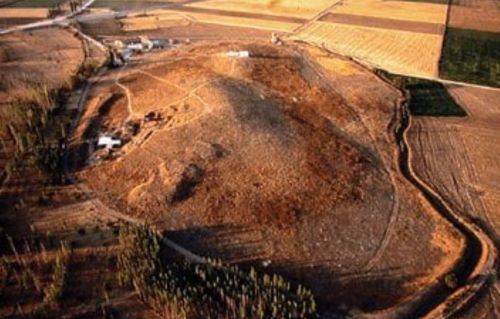
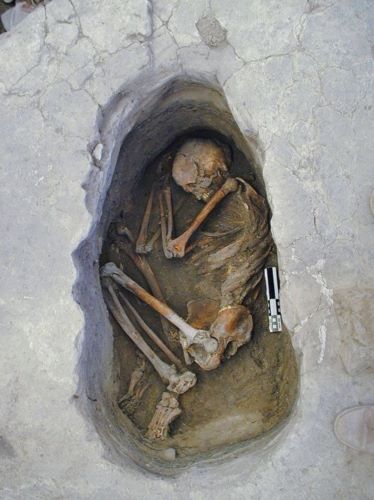
Building 42 is one of more than a dozen mud-brick dwellings under excavation at Catalhoyuk, a 9,500-year-old Neolithic, or New Stone Age, settlement that forms a great mound overlooking fields of wheat and melon in the Konya Plain of south-central Turkey. In the previous two months, archaeologists working on Building 42 had uncovered the remains of several individuals under its white plaster floors, including an adult, a child and two infants. But this find was different. It was the body of a woman who had been laid on her side, her legs drawn to her chest in a fetal position. Her arms, crossed over her chest, seemed to be cradling a large object.
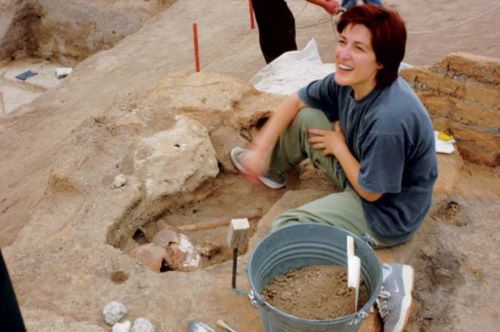
Boz, a physical anthropologist at HacettepeUniversity in Ankara, Turkey, walked up a hill to Building 42. She took out a set of implements, including an oven baster for blowing off dust and a small scalpel, and set to work. After about an hour, she noticed a powdery white substance around the object the skeleton cradled.

“Ian!” she said, beaming. “It’s a plastered skull!” Ian Hodder, the StanfordUniversity archaeologist who directs the Catalhoyuk excavations, was making his morning rounds of the 32-acre site. He crouched next to Boz to take a closer look. The skull’s face was covered with soft, white plaster, much of it painted ochre, a red pigment. The skull had been given a plaster nose, and its eye sockets had been filled with plaster. Boz could not be sure if the skull was male or female at first, but from the close knitting of the suture in the cranium (which closes as people age), she could tell that it belonged to an older person; later testing showed it was a woman’s.
Since researchers first began digging at Catalhoyuk (pronounced “Chah-tahl-hew-yook”) in the 1960s, they’ve found more than 400 skeletons under the houses, which are clustered in a honeycomb-like maze. Burying the dead under houses was common at early agricultural villages in the Near East—at Catalhoyuk, one dwelling alone had 64 skeletons. Plastered skulls were less common and have been found at only one other Neolithic site in Turkey, though some have been found in the Palestinian-controlled city of Jericho and at sites in Syria and Jordan. This was the first one ever found at Catalhoyuk—and the first buried with another human skeleton. The burial hinted at an emotional bond between two people. Was the plastered skull that of a parent of the woman buried there nine millennia ago?
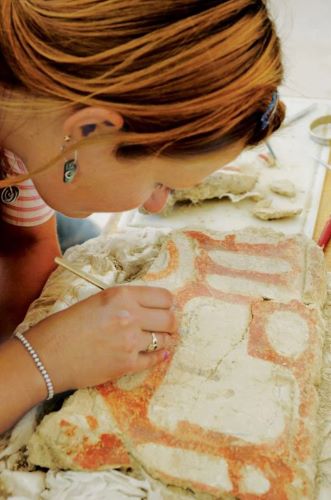
Hodder and his colleagues were also working to decipher paintings and sculptures found at Catalhoyuk. The surfaces of many houses are covered with murals of men hunting wild deer and cattle and of vultures swooping down on headless people. Some plaster walls bear bas-reliefs of leopards and apparently female figures that may represent goddesses. Hodder is convinced that this symbol-rich settlement, one of the largest and best-preserved Neolithic sites ever discovered, holds the key to prehistoric psyches and to one of the most fundamental questions about humanity: why people first settled in permanent communities.
In the millennia before Catalhoyuk’s flowering, most of the Near East was occupied by nomads who hunted gazelle, sheep, goats and cattle, and gathered wild grasses, cereals, nuts and fruits. Why, beginning about 14,000 years ago, did they take the first steps toward permanent communities, settling together in stone houses and eventually inventing farming? Afew millennia later, as many as 8,000 people gathered in Catalhoyuk, and they stayed put for more than a thousand years, building and rebuilding houses packed so closely together that residents had to enter through the roofs. “The formation of the first communities was a major turning point in humanity’s development, and the people of Catalhoyuk seem to have pushed the idea to an extreme,” says Hodder. “But we are still left with the question of why they would bother to come together in such numbers in the first place.”
For decades, it seemed that Catalhoyuk’s mysteries might never be explored. James Mellaart, a British archaeologist, discovered the site in 1958 and made it famous. But his research was cut short in 1965, after Turkish authorities withdrew his excavation permit after alleging he was involved in the Dorak Affair, a scandal in which important Bronze Age artifacts reportedly went missing. Mellaart was not formally charged, and a committee of distinguished archaeologists later exonerated him of any role in the affair. Still, he was never allowed back at the site, and it sat neglected for nearly 30 years.
Hodder, a tall, bespectacled, 56-year-old Englishman, first heard about Catalhoyuk in 1969 as a student of Mellaart’s at London’s Institute of Archaeology. In 1993, after some delicate negotiations with Turkish authorities, helped greatly by support from leading Turkish archaeologists, he was given permission to reopen the site. Nearly 120 archaeologists, anthropologists, paleoecologists, botanists, zoologists, geologists and chemists have gathered at the mound near Konya summer after summer, sieving through nearly every cubic inch of Catalhoyuk’s ancient soil for clues about how these Neolithic people lived and what they believed. The researchers even brought in a psychoanalyst to provide insights into the prehistoric mind. Catalhoyuk, says Colin Renfrew, emeritus professor of archaeology at CambridgeUniversity in Britain, is “one of the most ambitious excavation projects currently in progress.” Bruce Trigger of Montreal’s McGillUniversity, a noted historian of archaeology, says Hodder’s work at the site “is providing a new model of how archaeological research can and should be carried out.” Still, Hodder’s unorthodox approach—combining scientific rigor and imaginative speculation to get at the psychology of Catalhoyuk’s prehistoric inhabitants—has generated controversy.
Archaeologists have long debated what caused the Neolithic Revolution, when prehistoric human beings gave up the nomadic life, founded villages and began to farm the land. Academics once emphasized climatic and environmental changes that took place about 11,500 years ago, when the last ice age came to an end and agriculture became possible, maybe even necessary, for survival. Hodder, on the other hand, emphasizes the role played by changes in human psychology and cognition.
Mellaart, now retired and living in London, believed that religion was central to the lives of Catalhoyuk’s people. He concluded that they had worshiped a mother goddess, as represented by a plethora of female figurines, made of fired clay or stone, that both he and Hodder’s group have unearthed at the site over the years. Hodder questions whether the figurines represent religious deities, but he says they’re significant nonetheless. Before humans could domesticate the wild plants and animals around them, he says, they had to tame their own wild nature—a psychological process expressed in their art. In fact, Hodder believes that Catalhoyuk’s early settlers valued spirituality and artistic expression so highly that they located their village in the best place to pursue them.
Not all archaeologists agree with Hodder’s conclusions. But there’s no doubt the Neolithic Revolution changed humanity forever. The roots of civilization were planted along with the first crops of wheat and barley, and it’s not a stretch to say that the mightiest of today’s skyscrapers can trace their heritage to the Neolithic architects who built the first stone dwellings. Nearly everything that came afterward, including organized religion, writing, cities, social inequality, population explosions, traffic jams, mobile phones and the Internet, has roots in the moment people decided to live together in communities. And once they did so, the Catalhoyuk work shows, there was no turning back.
The phrase “Neolithic Revolution” was coined in the 1920s by the Australian archaeologist V. Gordon Childe, one of the 20th century’s leading prehistorians. For Childe, the key innovation in the revolution was agriculture, which made human beings the masters of their food supply. Childe himself had a fairly straightforward idea about why agriculture was invented, arguing that with the end of the last ice age about 11,500 years ago, the earth became both warmer and drier, forcing people and animals to gather near rivers, oases and other water sources. From such clusters came communities. But Childe’s theory fell out of favor after geologists and botanists discovered that the climate after the ice age was actually wetter, not drier.
Another explanation for the Neolithic Revolution, and one of the most influential, was the “marginality,” or “edge,” hypothesis, proposed in the 1960s by the pioneering archaeologist Lewis Binford, then at the University of New Mexico. Binford argued that early human beings would have lived where the hunting and gathering were best. As populations increased, so did competition for resources, among other stresses, leading some people to move to the margins, where they resorted to domesticating plants and animals. But this idea does not square with recent archaeological evidence that plant and animal domestication actually began in the optimal hunting and gathering zones of the Near East, rather than in the margins.
Such traditional explanations for the Neolithic Revolution fall short, according to Hodder, precisely because they focus too much on the beginnings of agriculture at the expense of the rise of permanent communities and sedentary life. Though prehistorians once assumed that farming and settling down went hand in hand, even that assumption is being challenged, if not overturned. It’s now clear that the first year-round, permanent human settlements predated agriculture by at least 3,000 years.
In the late 1980s, a drought caused a drastic drop in the Sea of Galilee in Israel, revealing the remains of a previously unknown archaeological site, later named Ohalo II. There, Israeli archaeologists found the burned remains of three huts made from brush plants, as well as a human burial and several hearths. Radiocarbon dating and other findings suggested that the site, a small, year-round camp for huntergatherers, was about 23,000 years old.
By about 14,000 years ago, the first settlements built with stone began to appear, in modern-day Israel and Jordan. The inhabitants, sedentary hunter-gatherers called Natufians, buried their dead in or under their houses, just as Neolithic peoples did after them. The first documented agriculture began some 11,500 years ago in what Harvard archaeologist Ofer Bar-Yosef calls the Levantine Corridor, between Jericho in the JordanValley and Mureybet in the EuphratesValley. In short, the evidence indicates that human communities came first, before agriculture. Could it be, as Hodder tends to believe, that the establishment of human communities was the real turning point, and agriculture just the icing on the cake?
Hodder has been influenced by the theories of the French prehistory expert Jacques Cauvin, one of the first to champion the notion that the Neolithic Revolution was sparked by changes in psychology. In the 1970s Cauvin and his co-workers were digging at Mureybet, in northern Syria, where they found evidence for an even earlier Natufian occupation underneath the Neolithic layers. The sediments corresponding to the transition from the Natufian to the Neolithic contained wild bull horns. And as the Neolithic progressed, a number of female figurines turned up. Cauvin concluded that such findings could mean only one thing: the Neolithic Revolution had been preceded by a “revolution of symbols,” which led to new beliefs about the world.
After surveying several Neolithic sites in Europe, Hodder concluded that a symbolic revolution had taken place in Europe as well. Because the European sites were full of representations of death and wild animals, he believes that prehistoric humans had attempted to overcome their fear of wild nature, and of their own mortality, by bringing the symbols of death and the wild into their dwellings, thus rendering the threats psychologically harmless. Only then could they start domesticating the world outside. It was Hodder’s search for the origins of that transformation that eventually took him to Catalhoyuk.
By the time Catalhoyuk was first settled—about 9,500 years ago, according to a recent round of radiocarbon dating at the site—the Neolithic epoch was well under way. The residents of this huge village cultivated wheat and barley, as well as lentils, peas, bitter vetch and other legumes. They herded sheep and goats. Paleoecologists working with Hodder say the village was located in the middle of marshlands that may have been flooded two or three months out of the year. But ongoing research suggests the village wasn’t anywhere near its crops.
So where did they grow food? Tentative evidence has come from Arlene Rosen, a geoarchaeologist at the Institute of Archaeology in London and an expert in the analysis of phytoliths, tiny fossils formed when silica from water in the the soil is deposited in plant cells. Researchers think phytoliths may help reveal some of the conditions in which plants were grown. Rosen determined that the wheat and barley found at marshy Catalhoyuk were likely grown on dry land. And yet, as other researchers had shown, the closest arable dry land was at least seven miles away.
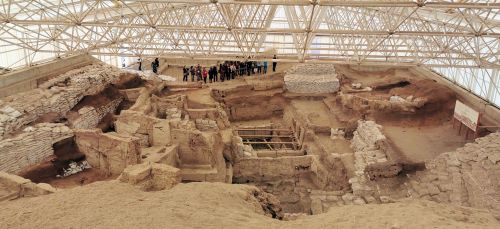
Why would a farming community of 8,000 people establish a settlement so far from its fields? For Hodder, there is only one explanation. The settlement site, once right in the middle of marshlands, is rich in the dense clays that villagers used to make plaster. They painted artworks on plaster, and they fashioned sculptures and figurines out of plaster. “They were plaster freaks,” Hodder says.
If the people of Catalhoyuk had located their village in the wooded foothills, they would have had easy access to their crops and to the oak and juniper trees they used in their mud-brick houses. But they would have had a difficult, perhaps impossible, time transporting the clay from the marshes over a distance of seven miles: the material must be kept wet, and the villagers’ small reed-and-grass baskets were hardly suitable for carrying the large quantities that they clearly used to plaster and replaster the walls and floors of their houses. It would have been easier for them to carry their crops to the village (where, as it happened, the foodstuffs were stored in plaster bins). In addition, the CarsambaRiver, which in prehistoric times flowed right past Catalhoyuk, would have enabled villagers to float juniper and oak logs from the nearby forests to their building sites.
Some experts disagree with Hodder’s interpretations, including Harvard’s Bar-Yosef, who believes sedentariness became more attractive for hunter-gatherers when environmental and demographic pressures pushed them to keep their resources together. BostonUniversity archaeologist Curtis Runnels, who has conducted extensive studies of prehistoric settlements in Greece, says that nearly all early Neolithic sites there were located near springs or rivers, but those settlers seldom decorated their walls with plaster. Runnels says there may well be other reasons that Catalhoyuk occupants settled in the marsh, even if it is not yet clear what they were. “Economic factors always seem a little inadequate to explain the details of Neolithic life, particularly at a site as interesting as Catalhoyuk,” Runnels says. “But my view is that Neolithic peoples first had to secure a dependable supply of food, then they could concentrate on ritual practices.”
But Hodder maintains that the people of Catalhoyuk gave a higher priority to culture and religion than to subsistence and, like people today, came together for shared community values like religion. Hodder sees support for that idea in other recent Neolithic digs in the Near East. At 11,000-year-old Gobekli Tepe in southeastern Turkey, a German team has uncovered stone pillars decorated with images of bears, lions and other wild animals. “These appear to be some sort of monuments, and they were built 2,000 years before Catalhoyuk,” Hodder says. “And yet there are no domestic houses in the early levels of settlement at Gobekli. The monuments appear to belong to some sort of ritual ceremonial center. It is as if communal ceremonies come first, and that pulls people together. Only later do you see permanent houses being built.”
At Catalhoyuk, the plaster-covered skull found last year testifies to the material’s significance for the people of this prehistoric village. Yet the find leaves Hodder and his coworkers with an enigmatic portrait of early human togetherness: a woman lying in her grave, embracing the painted skull of someone presumably very important to her for 9,000 years. Whatever brought our ancestors together, it was enough to keep them together—in death as well as in life.
Originally published by Smithsonian Magazine, May 2005, reprinted with permission for educational, non-commercial purposes.
About the Author