Jennifer Crumbley was found guilty for a school shooting committed by her son. His father faces trial next.
By Thaddeus Hoffmeister, J.D.
Professor of Law
University of Dayton
Introduction
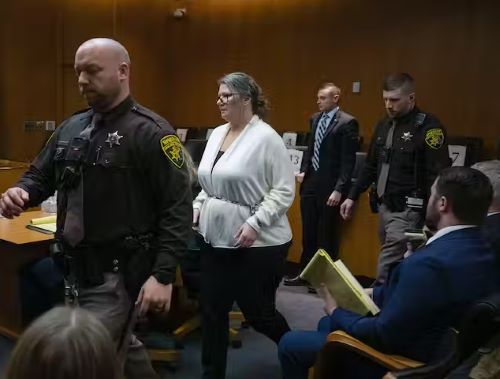
In a decision expected to have far-reaching implications for the criminal responsibility of parents of mass shooters, a Michigan jury on Feb. 6, 2024, convicted Jennifer Crumbley on charges of involuntary manslaughter for her role in her son’s deadly rampage nearly three years ago.
Both Crumbley parents have pleaded not guilty to four counts each of involuntary manslaughter. Jennifer Crumbley faces a maximum prison sentence of 60 years and maximum fines of US$30,000. Jennifer’s husband, James Crumbley, goes on trial for the same charges in March, and, if convicted, faces the same sentencing guidelines as his wife did.
In December 2023, their son, Ethan Crumbley, was sentenced to life in prison without parole for the Nov. 30, 2021, shooting in which he killed four people and wounded seven others.
During the sentencing hearing for Ethan, Oakland County Circuit Court Judge Kwamé Rowe said one of the victims was shot at point-blank range after being told by the defendant to get on his knees. Another victim was shot a second time after she was down, Rowe said, “to finish the job by shooting her again.”
Were the Parents Responsible?

Many were surprised when the Crumbleys, were charged for their alleged role in the tragedy.
Criminal law, unlike civil law, is less likely to hold defendants liable for the actions of a third party, even if that third party is the defendant’s child. This is because in criminal law defendants face incarceration and the associated stigma that comes with a conviction.
In the rare instances that parents of school shooters are prosecuted, they were normally charged with crimes such as child abuse, child neglect and the failure to properly secure a firearm. The charge lodged against the Crumbleys, involuntary manslaughter, also known as gross negligent homicide, was even more uncommon.
But it’s not without precedent.
In 2000, Jamelle James, a Michigan resident, pleaded no contest to involuntary manslaughter for leaving his handgun in a shoebox in his bedroom. At the time, James lived in an apartment prosecutors described as a “flophouse” that was shared with a number of people, including two young children.
A 6-year-old boy – James’ nephew – was temporarily living in the apartment and discovered the gun, brought it to school and fatally shot his first grade classmate Kayla Rolland. James spent more than two years in prison before he was released on probation.
Prosecutors claimed that James’ conduct was “grossly negligent” and “so reckless as to demonstrate a substantial lack of concern for whether an injury resulted.” Arguably, leaving an unsecured gun around very young children demonstrated James’ gross negligence.
Oakland County Prosecutor Karen McDonald has taken direct aim at Crumbley’s parents. Their behavior, McDonald explained, was “egregious.”
“I want to be really clear that these charges are meant to hold the individuals who contributed to this tragedy accountable and also send a message that gun owners have a responsibility,” McDonald said during a news conference on Dec. 4, 2021, less than a week after the shootings at Oxford. “When they fail to uphold that responsibility, there are serious and criminal consequences.”
‘Egregious’ Behavior
One of the key questions for jurors was whether the parents knew that a school shooting would occur or had reckless disregard of this fact. To prove the parents’ gross negligence, the prosecution relied on a series of alleged facts.
Among the most central facts was that the Crumbleys bought their son the handgun as a Christmas present and later took him to target practice.
Neither parent informed the school that they had bought the gun and that their son had access to it.
After being told that her son was searching for ammo on his phone at school, Jennifer Crumbley told her son via text message not to get caught: “LOL I’m not mad. You have to learn not to get caught.”
Neither of the parents opted to remove their son from school after being told that a teacher found a disturbing drawing of a bloody figure in his desk.
Finally, the gun was unsecured.
During closing arguments on Feb. 2, 2024, in Jennifer Crumbley’s trial, McDonald urged the jury to consider the “really egregious facts” before deciding to convict Crumbley.
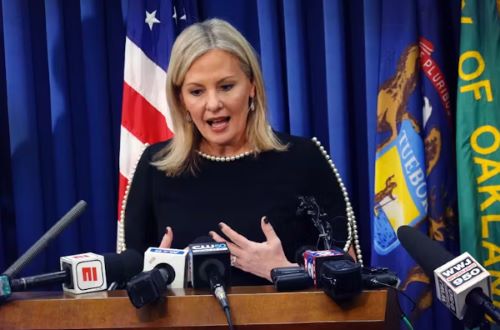
“It takes the unthinkable, and she has done the unthinkable, and because of that, four kids have died,” McDonald said.
Though the prosecution’s case appeared compelling, Shannon Smith, Crumbley’s defense attorney, had some very strong counterarguments.
For starters, the weapon was legal to own, and Michigan had no law at the time requiring the gun to be properly stored away from juveniles.
Smith argued that the blame lay not with Jennifer but elsewhere: on her husband for improperly securing the firearm and on the school for failing to notify her about her son’s behavioral issues. Jennifer, in her testimony, appeared to absolve herself of any missteps or negligent acts, stating, “I’ve asked myself if I would have done anything differently, and I wouldn’t have.”
Ultimately, Smith argued, the blame lay on Ethan, who planned and carried out the attack on his own.
As Smith asked in her closing defense argument, “Can every parent really be responsible for everything their children do, especially when it’s not foreseeable?”
Changing the Laws
In the James case, the 6-year-old who shot his classmate was never charged with a crime because most jurisdictions hold that children under the age of 7 are unable to formulate criminal intent.
The same cannot be said for Ethan Crumbley, who was 15 years old at the time of the shootings. He was charged with four counts of first-degree murder, one count of terrorism causing death, seven counts of assault with intent to murder and 12 counts of possession of a firearm in the commission of a felony.
Many people on both sides of the gun safety debate have applauded McDonald’s efforts to hold people responsible for allowing guns to fall into the hands of children.
According to a 2019 assessment by the U.S. Department of Homeland Security, 76% of the guns used in school shootings came from a parent or close relative, and approximately half the weapons were easily accessible.
Prosecuting the Crumbleys may reverse this trend, as may recently proposed state and federal legislation.
Two weeks after the Oxford shootings, for example, U.S. Rep. Elissa Slotkin, a Michigan Democrat, proposed a new federal law holding parents or other responsible adults liable for failing to secure their firearms.
That federal proposal became part of a state legislative package signed into law April 13, 2023, by Michigan Gov. Gretchen Whitmer.
The new laws took effect on Jan. 1, 2024. They established universal background checks for all firearm purchases and safe storage requirements designed to keep guns out of the hands of children.
Originally published by The Conversation, 02.06.2024, under the terms of a Creative Commons Attribution/No derivatives license.
About the Author