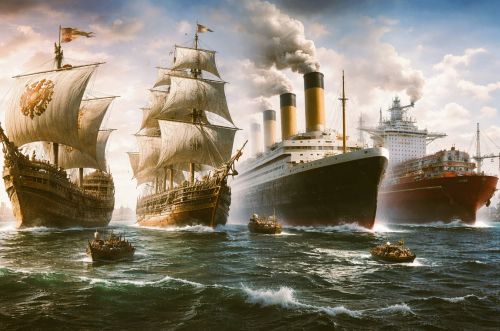
From medieval cogs to industrial supertankers, the largest ships reveal how technology, trade, and ambition reshaped maritime scale across centuries of global change.

By Matthew A. McIntosh
Public Historian
Brewminate
Introduction: The Meaning of Size at Sea
The concept of the “largest ship” is not a fixed or universal measure, but one that shifts across historical contexts, shaped by technological capability, economic demand, and cultural meaning. In each era, the scale of maritime construction reflects not only what was possible but what was necessary or desirable within a given society. From the merchant vessels of the medieval Baltic to the industrial leviathans of the twentieth century, size functioned as both a practical solution and a symbolic statement. To identify the largest ship of any period is to engage not merely in measurement, but in interpretation, situating physical dimensions within broader historical frameworks.
In the medieval world, ship size was closely tied to regional trade networks and the limitations imposed by available materials and navigational knowledge. Vessels such as the cog evolved to meet the needs of expanding commerce, particularly within the interconnected markets of Northern Europe. These ships were designed to maximize cargo capacity while maintaining structural integrity within the constraints of clinker-built construction, where overlapping planks provided flexibility but limited scalability. Their growth in size reflected increasing demand for bulk transport, yet remained constrained by the structural limits of wooden construction, the availability of suitable timber, and the relatively modest capacities of medieval shipyards. Navigation, reliant on coastal familiarity and rudimentary instruments, further discouraged excessive expansion in size, as larger vessels were more difficult to maneuver in confined or poorly charted waters. The largest examples, including the Svælget 2, represent the upper boundary of what pre-industrial economies could sustain, where expansion was incremental rather than transformative and closely tied to the gradual intensification of regional trade.
By the Victorian era, the meaning of size had shifted dramatically under the influence of industrialization. Advances in metallurgy, engineering, and propulsion enabled ships such as the SS Great Eastern to exceed previous limits by orders of magnitude. Here, scale was no longer solely a response to trade demands but an expression of technological ambition and industrial confidence. The ship embodied the optimism of an age that believed engineering could overcome distance, resource constraints, and even the unpredictability of the sea. Yet its mixed commercial success also revealed the risks inherent in pushing beyond established economic and operational norms.
In the modern industrial world, vessels like the Seawise Giant represent a further transformation in the meaning of maritime scale. No longer symbols of prestige or experimentation, such ships were products of highly specialized global systems, designed to maximize efficiency in the transport of critical resources such as oil. Their immense size reflects not only technological capability but the demands of an interconnected global economy in which scale directly translates into cost efficiency. The evolution of the largest ships across these periods reveals a broader historical trajectory, moving from localized trade and symbolic display toward industrial optimization, while consistently encountering the practical limits that constrain even the most ambitious designs.
The Medieval Context: Trade Networks and the Rise of the Cog

The medieval maritime world was shaped by regional trade networks that connected ports across the North Sea and Baltic, forming the economic backbone of Northern Europe. Unlike the expansive imperial systems of later periods, these networks were decentralized, relying on a web of merchant communities rather than centralized state control. Trade focused on bulk goods such as grain, timber, wool, and fish, all of which required reliable and capacious vessels for transport. These commodities were not luxury items but staples of everyday life, and their steady movement underpinned both urban growth and rural economies. As towns expanded and populations increased, the demand for consistent and large-scale transport intensified, placing new pressures on maritime infrastructure. The scale of shipbuilding was directly tied to the demands of commerce, with larger ships emerging as practical responses to increasing trade volume rather than as expressions of political ambition. The sea functioned less as a stage for spectacle and more as a working artery of economic life, where efficiency and reliability mattered more than grandeur.
Central to this development was the rise of the cog, a ship type that came to dominate Northern European waters from the twelfth century onward. The cog was particularly well suited to the conditions of the Baltic and North Sea, featuring a broad beam, high sides, and a single mast with a square sail. Its design emphasized stability and cargo capacity over speed, allowing it to carry substantial loads across relatively short but economically vital routes. The cog’s structural simplicity also made it adaptable, enabling shipbuilders to gradually increase its size in response to growing commercial needs without requiring radical changes in construction techniques.
The expansion of trade during the late medieval period, particularly under the influence of the Hanseatic League, drove further developments in ship size and capacity. As merchant networks became more integrated, the volume of goods transported across maritime routes increased significantly, creating incentives to build larger vessels that could reduce costs per unit of cargo. The Hanseatic League, though not a centralized state, functioned as a powerful economic coalition, facilitating trade across a wide geographic area and encouraging standardization in commercial practices. The cog evolved from a relatively modest vessel into a larger and more capable cargo ship, reflecting the growing complexity of medieval economic life.
Despite these developments, the scale of medieval ships remained constrained by technological and material limitations. Shipbuilders relied primarily on wood, with clinker construction techniques that, while durable and flexible, imposed limits on how large a hull could be built without compromising structural integrity. The physics of wooden shipbuilding required a careful balance between size and strength, as excessive length or beam could introduce stresses that traditional fastening methods could not adequately support. The availability of suitable timber was another critical factor, as large ships required long, high-quality planks that were not always readily accessible, particularly in regions where forests were already under pressure from construction and fuel demands. Additionally, shipyards lacked the mechanization and organizational capacity that would later characterize industrial production, meaning that construction remained labor-intensive and relatively slow, dependent on skilled craftsmen and seasonal conditions. These constraints ensured that growth in ship size was cautious and incremental, shaped as much by environmental realities as by economic ambition.
Navigation and maritime infrastructure further shaped the limits of ship size during this period. Medieval sailors relied heavily on coastal navigation, guided by experience, landmarks, and basic instruments rather than precise charts or advanced navigational tools. Ports and harbors were often shallow and poorly equipped to handle very large vessels, restricting the practical size of ships that could be built and operated effectively. These constraints ensured that even the largest medieval ships, while impressive within their context, remained modest in comparison to those of later periods.
Within these boundaries, the cog represents a significant achievement in medieval shipbuilding, embodying the balance between practicality and expansion that defined the era. Its evolution reflects the interplay between economic demand and technological capability, illustrating how incremental innovation could produce meaningful increases in scale without fundamentally altering existing methods. The emergence of larger cogs, culminating in vessels such as Svælget 2, marks the point at which medieval maritime systems reached their functional limits, setting the stage for the more dramatic transformations that would follow in the early modern and industrial periods.
Svælget 2: The Largest Known Medieval Cargo Ship

The discovery of Svælget 2 in the Øresund Strait has provided one of the most significant archaeological insights into the upper limits of medieval shipbuilding. Unearthed during modern survey work connected to the Lynetteholm project near Copenhagen, the wreck represents a rare and exceptionally well-preserved example of a large fifteenth-century cog. Dating to around 1410, the vessel offers a tangible reference point for understanding how far medieval shipwrights could push the scale of wooden cargo ships within the technological and economic constraints of the period. Unlike textual descriptions, which are often fragmentary or exaggerated, the physical remains of Svælget 2 allow for a more precise reconstruction of its dimensions, construction, and capabilities. The survival of key structural elements, including portions of the hull and internal framing, provides archaeologists with invaluable data on building techniques, timber selection, and the organization of labor in late medieval shipyards. The wreck functions not only as an isolated artifact but as a broader window into the material realities of maritime commerce in Northern Europe.
Measuring approximately 28 meters in length and 9 meters in beam, Svælget 2 stands out as the largest known cog of its kind, with an estimated cargo capacity of around 300 tons. This scale placed it well above the majority of contemporary merchant vessels, which were typically smaller and more limited in their carrying capacity. The ship’s size reflects not only an ambition to increase efficiency in the transport of bulk goods but also the maturation of regional trade systems that could support such vessels. Its broad hull and deep hold were optimized for carrying heavy cargoes such as grain, timber, and other essential commodities, reinforcing its role as a working vessel within the commercial networks of Northern Europe rather than a symbol of prestige or experimentation.
The construction of Svælget 2 further illustrates the sophistication of late medieval shipbuilding practices. Dendrochronological analysis has revealed that the ship was built using a combination of Pomeranian oak for its planking and timber sourced from the Low Countries for its internal framing, indicating the existence of complex and far-reaching supply chains. This blending of materials suggests not only access to diverse resources but also a level of coordination and planning that challenges earlier assumptions about the simplicity of medieval industry. The clinker-built hull, characteristic of cog construction, provided both strength and flexibility, while features such as a stern castle and evidence of an onboard galley point to an awareness of crew needs and operational requirements during extended voyages. These elements together reveal a vessel that was not merely large, but carefully designed to balance durability, capacity, and habitability, reflecting a nuanced understanding of maritime demands that extended beyond simple cargo transport.
Svælget 2 underscores the limitations inherent in medieval maritime technology. Despite its impressive size, the ship remained bound by the structural constraints of wooden construction and the logistical realities of its operating environment. Its dimensions, while large for the period, were still modest compared to later vessels, reflecting a ceiling imposed by available materials, construction techniques, and maritime infrastructure. Svælget 2 represents both an achievement and a boundary, marking the point at which medieval shipbuilding reached its practical limits before the transformative changes of the early modern and industrial eras.
Transition to the Early Modern World: Expansion and Empire

The transition from the medieval to the early modern maritime world marked a profound shift in both the scale and purpose of shipbuilding. While medieval vessels were largely shaped by regional trade networks, the fifteenth and sixteenth centuries saw the emergence of oceanic exploration and long-distance commerce that extended far beyond Europe’s immediate periphery. This transformation was driven by a combination of economic ambition, technological innovation, and geopolitical competition, as emerging states sought new routes to wealth and influence. The sea was no longer simply a medium of exchange between neighboring regions but a vast arena of expansion, connecting continents and facilitating the movement of goods, people, and ideas on an unprecedented scale.
Central to this transformation was the development of new ship types capable of undertaking extended voyages across open oceans. Vessels such as caravels, carracks, and later galleons represented significant departures from earlier designs, incorporating multiple masts, improved rigging systems, and stronger hulls suited to the demands of transoceanic travel. These ships were designed to balance cargo capacity with navigational flexibility, enabling them to carry valuable goods such as spices, silver, and textiles over long distances while maintaining sufficient maneuverability to handle varying wind conditions. The integration of lateen and square sails allowed for greater control in shifting winds, while reinforced hull structures provided the durability needed for prolonged exposure to open seas. Advances in navigation, including the increased use of the magnetic compass, astrolabe, and more reliable charts, complemented these structural improvements, creating a more cohesive system in which ship design and navigational practice evolved together. The evolution of these vessels reflects a growing understanding of maritime environments and the technical challenges associated with sustained oceanic navigation.
The expansion of European empires further accelerated the demand for larger and more capable ships. As colonial networks developed across the Atlantic, Indian Ocean, and beyond, the volume and value of maritime trade increased dramatically. Ships became essential instruments of empire, transporting not only goods but also soldiers, administrators, and settlers. The scale of these operations required vessels that could carry greater loads and withstand longer voyages, leading to incremental increases in size and complexity. These ships also served as platforms of power, often armed with cannon and designed to defend valuable cargoes against piracy and rival states, blurring the line between merchant vessel and warship. Shipbuilding became closely intertwined with imperial ambition, with maritime capacity serving as both a tool and a measure of geopolitical power, reinforcing the dominance of states that could sustain large and capable fleets.
Despite these advances, early modern shipbuilding remained constrained by the limitations of wooden construction. Even the largest carracks and galleons faced structural challenges as their size increased, including issues related to hull integrity, weight distribution, and maintenance. Shipbuilders relied on accumulated experience and empirical knowledge rather than formal engineering principles, which limited the extent to which designs could be scaled safely. While early modern ships were significantly larger than their medieval predecessors, their growth remained gradual and bounded by the inherent properties of their materials.
Economic considerations also played a crucial role in shaping ship size during this period. The high cost of construction and maintenance meant that larger ships represented substantial investments, requiring careful calculation of risk and return. Merchant enterprises and state-sponsored ventures alike had to balance the benefits of increased cargo capacity against the potential losses associated with shipwreck, piracy, or market fluctuations. Financing such vessels often involved complex arrangements, including joint-stock ventures and partnerships that distributed both risk and profit among multiple stakeholders. Insurance practices began to emerge in more formalized ways, reflecting the growing awareness of maritime risk in an increasingly interconnected commercial world. This tension between opportunity and risk influenced decisions about ship design and scale, ensuring that expansion was driven as much by economic logic as by technological possibility.
The early modern period represents a transitional phase in the history of maritime scale, bridging the gap between medieval commerce and industrial shipping. Ships grew larger and more capable, reflecting the expanding horizons of European trade and empire, yet they remained constrained by pre-industrial methods of construction and organization. This combination of growth and limitation set the stage for the transformative changes of the nineteenth century, when new materials and technologies would fundamentally alter the relationship between ambition and feasibility in shipbuilding.
The Industrial Breakthrough: Iron, Steam, and Scale
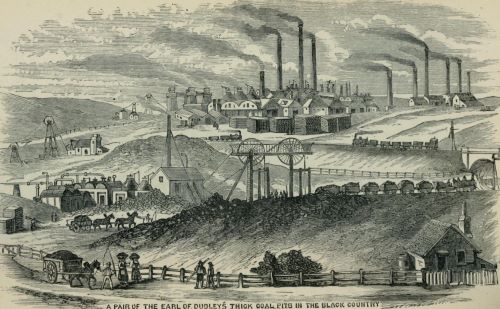
The nineteenth century marked a decisive turning point in the history of shipbuilding, as industrialization introduced new materials, energy sources, and production methods that fundamentally altered the scale and capabilities of maritime vessels. Where earlier ships had been constrained by the properties of wood and the unpredictability of wind, the adoption of iron and steam power opened new possibilities for expansion. Ship size was no longer limited by traditional construction techniques alone but increasingly determined by industrial capacity, engineering knowledge, and access to capital. The question of how large a ship could be built shifted from one of material feasibility to one of technological ambition and economic justification.
The transition from wooden to iron hulls represented one of the most significant innovations of the period. Iron provided greater structural strength and durability, allowing shipbuilders to construct larger vessels without the same risk of warping or structural failure that plagued wooden ships at increased scales. This material shift also enabled new hull designs, including longer and more streamlined forms that improved efficiency and stability. Iron construction required entirely new methods of production, including the use of riveted plates and specialized shipyard facilities capable of handling heavy industrial materials. The precision required in shaping, transporting, and assembling iron components marked a departure from the more flexible, craft-based practices of wooden shipbuilding. Shipyards became increasingly mechanized environments, where cranes, forges, and standardized parts played a central role in construction. This transformation reflected broader industrial trends, as the building of ships became integrated into systems of mass production and coordinated labor, linking maritime technology to the wider machinery of the Industrial Revolution.
Equally transformative was the introduction of steam propulsion, which reduced reliance on wind and allowed for more predictable and controlled navigation. Steam engines enabled ships to maintain consistent speeds regardless of weather conditions, significantly improving reliability for both commercial and passenger travel. This technological shift had profound implications for global trade, as it allowed for more regular schedules and reduced transit times across major routes. The combination of steam power and iron construction created a new class of vessels that could operate on a scale previously unimaginable, laying the groundwork for the massive ships of the later nineteenth and twentieth centuries.
The expansion of industrial infrastructure further supported the growth of ship size during this period. Advances in metallurgy, particularly the mass production of iron and later steel, ensured a steady supply of materials for shipbuilding. Improvements in transportation networks, including railways, facilitated the movement of raw materials and finished components to and from shipyards. These developments were accompanied by the emergence of professional engineering disciplines, which introduced more systematic approaches to design and construction. Engineers began to apply principles of physics and mathematics more rigorously, allowing for better predictions of structural behavior and performance at scale. Shipbuilding increasingly relied on technical expertise and standardized practices, reducing the uncertainties that had characterized earlier periods and enabling more ambitious projects to be undertaken with greater confidence.
Despite these advances, the push toward larger ships was not without its challenges. The integration of new materials and technologies introduced complexities that required careful management, including issues related to weight distribution, engine efficiency, and structural stress. Early iron ships faced skepticism and occasional failure, as both builders and operators adapted to unfamiliar systems. Moreover, the cost of constructing such vessels was substantial, limiting their production to well-funded enterprises and state-supported projects. These challenges highlight the experimental nature of early industrial shipbuilding, where innovation often proceeded through trial and error.
Within this transformative environment, the stage was set for vessels that would redefine the limits of maritime scale, most notably the SS Great Eastern. The industrial breakthroughs of the nineteenth century did not simply enable larger ships; they reshaped the entire framework within which shipbuilding operated, linking technological possibility with industrial organization and global economic demand. The result was a new era in which size became both a measure of progress and a reflection of the expanding reach of industrial society.
The SS Great Eastern: Victorian Ambition and Engineering Limits
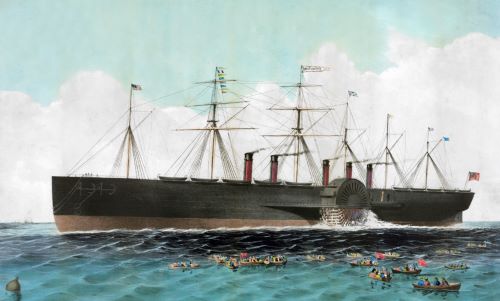
The SS Great Eastern, launched in 1858, stands as one of the most ambitious engineering projects of the Victorian era, embodying both the possibilities and the risks of industrial-scale innovation. Designed by the engineer Isambard Kingdom Brunel, the ship was conceived as a revolutionary vessel capable of transforming long-distance travel and global commerce. At 692 feet in length and of unprecedented volume, it dwarfed all existing ships, reflecting a bold confidence in the capacity of industrial technology to overcome traditional constraints. The SS Great Eastern was not merely an incremental improvement but a radical reimagining of what a ship could be, pushing the boundaries of size and design far beyond established norms.
One of the most distinctive features of the SS Great Eastern was its hybrid propulsion system, which combined sail, paddle wheels, and a screw propeller. This combination was intended to provide both reliability and flexibility, ensuring that the ship could operate efficiently under a variety of conditions. The use of multiple propulsion methods also reflected the transitional nature of the period, as steam technology had not yet fully supplanted traditional sailing techniques. Brunel’s design sought to integrate these systems into a single cohesive structure, demonstrating a willingness to experiment with new configurations in pursuit of improved performance. The ship’s iron hull further reinforced its innovative character, allowing for a scale that would have been impossible with wooden construction.
Despite its technical achievements, the SS Great Eastern faced significant challenges that limited its commercial success. The ship was designed to carry up to 4,000 passengers on long voyages, including routes between Britain and Australia, without the need for refueling. The infrastructure required to support such a vessel was largely absent, as few ports could accommodate its size and draft. Harbors were often too shallow, docks too small, and existing facilities unprepared for a ship of such unprecedented dimensions, forcing costly adaptations or limiting its operational routes. Operational costs were high, including fuel consumption, maintenance of its complex propulsion systems, and the staffing required to manage such a large vessel. The anticipated demand for large-scale passenger transport did not materialize at the level Brunel and his backers had envisioned, in part because smaller, more flexible ships proved more economically viable for established routes. These factors combined to undermine the economic viability of the project, highlighting the gap between technological capability and market realities and demonstrating that scale alone could not guarantee success within existing commercial frameworks.
Yet the story of the SS Great Eastern did not end with its initial failure as a passenger liner. The ship found a new and highly significant role in the laying of transatlantic telegraph cables, a task for which its size and stability proved ideally suited. In 1866, it successfully completed the installation of a durable cable linking Europe and North America, contributing to a major transformation in global communication. In this capacity, the vessel demonstrated that its value lay not only in its original purpose but in its adaptability, serving as a platform for one of the most important technological achievements of the nineteenth century.
The SS Great Eastern occupies a complex place in the history of shipbuilding, representing both the heights of Victorian ambition and the limitations of industrial innovation. Its design pushed the boundaries of what was technically possible, yet its initial commercial shortcomings reveal the challenges of aligning engineering vision with practical application. Its later success in cable-laying underscores the potential for technological repurposing, illustrating how even projects that fall short of their original goals can achieve lasting significance. The SS Great Eastern stands as both a cautionary tale and a testament to the transformative power of industrial engineering.
Industrial Maturity: Standardization and Global Shipping

By the late nineteenth and early twentieth centuries, shipbuilding entered a phase of industrial maturity characterized by increasing standardization, efficiency, and global integration. The experimental nature of earlier industrial advances gave way to more predictable and systematic approaches, as shipyards refined their methods and technologies. This period saw the consolidation of best practices in design, construction, and operation, allowing ships to be produced more reliably and at greater scale. As global trade expanded, the demand for consistent and cost-effective maritime transport grew, encouraging the development of vessels that prioritized efficiency over spectacle.
Standardization played a central role in this transformation, shaping both the design of ships and the organization of the shipping industry. Shipbuilders increasingly adopted uniform dimensions, construction techniques, and component specifications, enabling faster production and easier maintenance. The use of interchangeable parts and modular construction methods reduced costs and improved reliability, reflecting broader trends in industrial manufacturing. This shift also facilitated the training of labor and the coordination of large-scale shipyard operations, as standardized processes could be replicated across different sites and projects. Classification societies and regulatory bodies began to formalize standards related to safety, construction quality, and performance, further reinforcing consistency across the industry. These developments created a more predictable environment in which ships could be designed with known specifications and expected operational parameters, reducing uncertainty and enabling more efficient planning at both the industrial and commercial levels.
The growth of global shipping networks reinforced the importance of efficiency and predictability. Maritime transport became a critical component of the international economy, linking industrial centers with sources of raw materials and markets for finished goods. Steam-powered vessels, now more advanced and reliable, allowed for regular schedules and faster transit times, supporting the expansion of global trade. Shipping companies increasingly operated within complex logistical systems, where timing, coordination, and capacity were essential to maintaining profitability.
Infrastructure developments further influenced the evolution of ship size and design during this period. The construction of major canals, most notably the Suez Canal and later the Panama Canal, introduced new constraints that shaped the dimensions of ships. Vessels were often designed to fit within the size limits of these waterways, giving rise to standardized categories based on maximum allowable dimensions. These constraints highlight an important shift in the relationship between ships and their operating environments, as infrastructure began to play a more direct role in determining what sizes were practical and economically viable. Port facilities underwent significant expansion and modernization, with deeper harbors, larger docks, and improved cargo-handling systems designed to accommodate increasingly large vessels. This reciprocal relationship between ships and infrastructure created a feedback loop, in which the growth of one necessitated the development of the other, gradually raising the overall scale of maritime operations.
Economic considerations remained central to decisions about ship size, with a growing emphasis on economies of scale. Larger ships could carry more cargo per voyage, reducing transportation costs and increasing efficiency. This advantage was balanced by the need to ensure that ships could be fully utilized and accommodated by existing infrastructure. The largest ships of this period were typically designed not to maximize size at all costs but to achieve an optimal balance between capacity, cost, and operational flexibility.
This era of industrial maturity set the stage for the emergence of highly specialized vessels in the twentieth century, including tankers, bulk carriers, and container ships. These ships were designed with specific functions in mind, reflecting the increasing complexity and segmentation of global trade. The focus on efficiency and specialization would ultimately lead to the construction of ships such as the Seawise Giant, where size became a direct response to the demands of global energy markets. The mature industrial system transformed shipbuilding into a highly coordinated and economically driven enterprise, where scale was carefully calibrated to meet the needs of an interconnected world.
The Seawise Giant: The Ultimate Expression of Scale
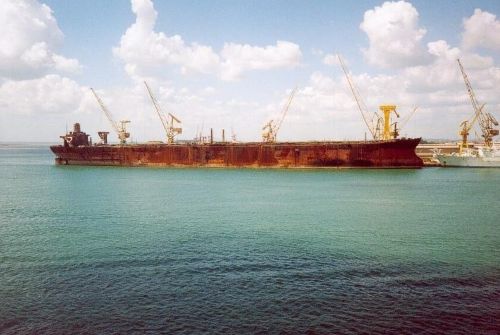
The Seawise Giant, constructed in 1979 by Sumitomo Heavy Industries in Japan, represents the most extreme realization of scale in the history of shipbuilding. At 458.45 meters in length and with a deadweight tonnage of over 564,000 tonnes, it remains the longest and heaviest self-propelled ship ever built. Unlike earlier large vessels, which often reflected a blend of ambition and experimentation, the Seawise Giant was the product of a mature industrial system that prioritized efficiency, specialization, and the demands of global energy markets. Its immense size was not an abstract demonstration of technological capability but a calculated response to the economic logic of transporting vast quantities of crude oil across long distances.
Designed as an Ultra Large Crude Carrier (ULCC), the Seawise Giant could transport approximately 4.1 million barrels of oil in a single voyage, dramatically reducing the cost per unit of cargo. This capacity made it an essential component of the global petroleum trade during a period when energy demand was rapidly increasing and economies were becoming more tightly interconnected. The ship’s design emphasized volume and stability, with a broad beam and deep draft that allowed it to carry unprecedented loads. Its vast storage capacity meant that fewer voyages were needed to transport the same quantity of oil, creating significant efficiencies in fuel consumption, labor, and time when compared to smaller tankers. These same features also introduced significant operational constraints, as the vessel was too large to pass through major canals such as Suez or Panama and required deep-water ports for loading and unloading. Its routes were highly specialized, often limited to particular terminals capable of accommodating its size, illustrating how maximum scale could enhance efficiency while simultaneously narrowing operational flexibility.
The operational history of the Seawise Giant further underscores both its significance and its limitations. During the Iran-Iraq War in 1988, the ship was severely damaged and sunk while anchored in the Persian Gulf, highlighting its vulnerability despite its massive scale. It was later salvaged, repaired, and returned to service under different names, including Happy Giant, Jahre Viking, and Knock Nevis. In its later years, the vessel was repurposed as a floating storage and offloading unit, reflecting a shift in its role within the global energy infrastructure. This adaptability illustrates how even the largest and most specialized ships can evolve in response to changing economic and geopolitical conditions.
The Seawise Giant demonstrates the practical limits of maritime scale in the modern world. Its enormous size, while economically advantageous under certain conditions, restricted its operational flexibility and made it dependent on specific routes and facilities. The ship’s deep draft prevented it from navigating many waterways, including the English Channel, and limited its ability to access ports without extensive infrastructure. These constraints reveal a central paradox of industrial shipbuilding: as vessels grow larger to maximize efficiency, they also become more constrained by the environments in which they operate. The Seawise Giant stands as both the culmination of centuries of increasing scale and a reminder that even the most advanced engineering must contend with the enduring realities of geography and infrastructure.
Scale and Constraint: When Bigger Stops Being Better
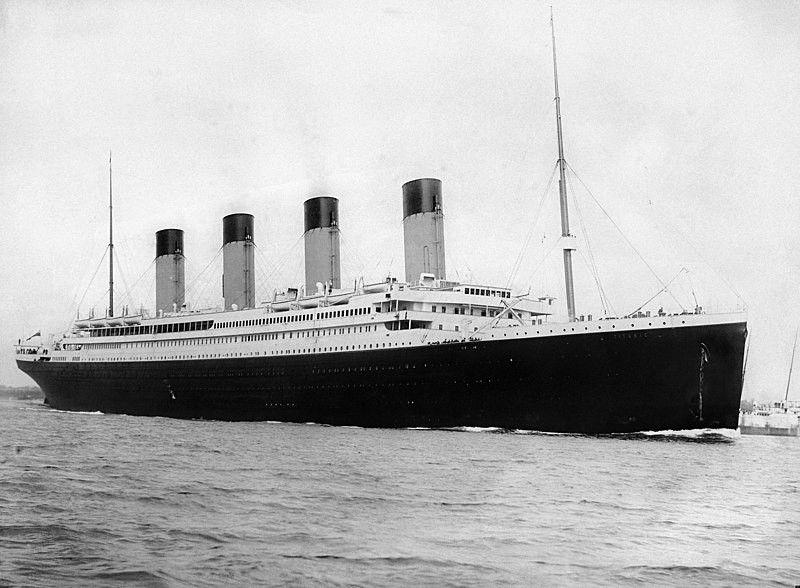
Across the history of shipbuilding, the pursuit of greater size has consistently been accompanied by a corresponding increase in constraint. While larger vessels offer clear advantages in cargo capacity and potential efficiency, they also introduce structural, operational, and environmental challenges that limit their practicality. This dynamic reveals an important principle in maritime history: size is not an unqualified good, but a variable that must be balanced against a range of competing factors. From the medieval cog to the industrial supertanker, each era demonstrates that beyond a certain point, increasing scale yields diminishing returns.
In the medieval period, these constraints were primarily material and technological. Wooden construction techniques, particularly clinker-built hulls, imposed natural limits on how large ships could be built without compromising their structural integrity. The overlapping planks that defined clinker construction provided flexibility in rough seas, but they also introduced stresses that became increasingly difficult to manage as hulls grew longer and wider. The availability of suitable timber further restricted expansion, as larger vessels required long, straight planks of high quality, often sourced from specific regions and transported over considerable distances. Forest depletion in some areas compounded this challenge, making high-quality ship timber an increasingly valuable and sometimes scarce resource. Navigation also played a critical role, with coastal sailing practices and limited navigational tools discouraging the use of excessively large ships that would be harder to maneuver and more vulnerable in confined or poorly charted waters. Port infrastructure imposed additional constraints, as many harbors were shallow or lacked the facilities to accommodate larger hulls. Even when larger vessels such as Svælget 2 were constructed, they operated within a narrow margin of practicality, reflecting the delicate balance between ambition and feasibility in a pre-industrial context.
The early modern period introduced new opportunities for expansion but did not eliminate these constraints. Larger ships were required to support growing empires and long-distance trade, yet they remained bound by the limitations of wooden hulls and sail propulsion. Structural stresses increased with size, and shipbuilders lacked the formal engineering knowledge needed to fully predict or mitigate these challenges. Economic risk also became more pronounced, as larger ships represented greater investments that could be lost to storms, warfare, or market fluctuations. Decisions about scale were shaped by a constant negotiation between potential gain and inherent risk.
With the advent of industrial shipbuilding, many of the earlier material constraints were overcome through the use of iron and steel, as well as steam propulsion. New forms of limitation emerged, particularly in relation to infrastructure and operational logistics. Ships such as the SS Great Eastern and later the Seawise Giant demonstrated that extreme size could outpace the capabilities of ports, canals, and support systems. The inability of such vessels to access certain routes or facilities reduced their flexibility, limiting the range of contexts in which they could be effectively employed. Industrialization shifted the locus of constraint from the ship itself to the broader systems within which it operated.
The history of large ships reveals that the question is not simply how big a vessel can be built, but how big it can be while remaining functional within its intended environment. Each period in maritime history reflects a different balance between scale and constraint, shaped by available technology, economic priorities, and infrastructural realities. The largest ships, from Svælget 2 to the Seawise Giant, stand as markers of these limits, illustrating both the achievements and the boundaries of human ingenuity.
Comparative Analysis: Changing Meanings of Maritime Scale
The meaning of maritime scale has undergone a profound transformation across historical periods, reflecting shifts in technology, economy, and cultural values. In earlier eras, particularly in the ancient and medieval worlds, the largest ships often carried symbolic weight that extended beyond their practical functions. Size could signal wealth, power, and the ability to mobilize resources, even when such vessels operated within relatively limited commercial systems. By contrast, in later periods, especially from the nineteenth century onward, ship size became increasingly tied to efficiency and industrial logic, reflecting a broader reorientation in the relationship between technology and society.
In the medieval context, large ships such as Svælget 2 were primarily instruments of commerce, designed to support the movement of essential goods within regional trade networks. Their size reflected practical considerations, including the need to transport bulk commodities efficiently across the Baltic and North Sea. While these vessels could also carry symbolic value, particularly in demonstrating the prosperity of merchant communities or port cities, their scale was fundamentally constrained by the demands of function and the limitations of available technology. Ship size was closely calibrated to the realities of coastal navigation, port accessibility, and available shipbuilding materials, ensuring that growth remained measured and sustainable. The emphasis remained on reliability and capacity rather than spectacle, with incremental growth serving the needs of expanding but still regionally bounded economies, where efficiency was defined in practical rather than abstract terms.
The early modern period introduced a more complex relationship between scale and meaning, as ships became central to the expansion of empires and the projection of power across vast distances. Vessels such as galleons and East Indiamen were not only carriers of goods but also instruments of state authority, often armed and capable of both trade and combat. Size began to take on a dual significance, combining practical utility with symbolic representation. Larger ships could carry more cargo and withstand longer voyages, but they also embodied the reach and ambition of the states that deployed them, reinforcing the connection between maritime capacity and geopolitical influence.
With the advent of industrialization, the symbolic dimension of ship size diminished relative to its economic and technological significance. Ships such as the SS Great Eastern still carried elements of spectacle and ambition, reflecting the optimism of the Victorian era, but their scale was increasingly justified in terms of efficiency and performance. The ability to transport larger numbers of passengers or greater quantities of goods more quickly and reliably became a central concern, aligning ship design with the broader priorities of industrial society. This shift also introduced a more quantitative understanding of efficiency, where metrics such as tonnage, speed, and cost per unit became central to evaluating a ship’s success. The SS Great Eastern, while initially conceived with elements of grandeur, demonstrated the challenges of reconciling visionary scale with practical economic application, marking a transitional moment in the evolution of maritime priorities.
In the modern industrial world, vessels like the Seawise Giant represent the culmination of this transformation, where scale is almost entirely defined by economic efficiency within global systems. The immense size of such ships is not intended to impress in a traditional sense but to optimize the transport of resources on a massive scale. Their design reflects a highly specialized and integrated global economy, in which the movement of goods is governed by cost, demand, and logistical coordination. These ships operate within tightly managed systems that include standardized ports, global supply chains, and advanced logistical planning, leaving little room for deviation from efficiency-driven design principles. The meaning of size is reduced to its functional implications, with little room for the symbolic or experimental motivations that characterized earlier periods, and success is measured primarily in terms of economic performance.
Despite these shifts, certain continuities remain in the history of maritime scale. Across all periods, the construction of exceptionally large ships has required significant investment, coordination, and technical expertise, marking them as products of societies capable of mobilizing substantial resources. Each era reveals the persistent tension between ambition and constraint, as the pursuit of greater size encounters the practical limits of materials, infrastructure, and environment. The changing meanings of maritime scale reflect not only technological progress but also enduring patterns in how societies balance aspiration with reality.
Conclusion: From Floating Symbols to Industrial Giants
The history of the largest ships across the medieval, early modern, and industrial periods reveals a clear transformation in both purpose and meaning. What began as vessels shaped primarily by regional trade and material limitation evolved into instruments of empire and components of a highly integrated global economy. Ships such as Svælget 2, the SS Great Eastern, and the Seawise Giant each represent the apex of their respective eras, not simply in size but in the ways they reflect the priorities and capabilities of the societies that produced them. In tracing this progression, it becomes evident that maritime scale is not a static measure of achievement but a dynamic expression of changing historical conditions.
In the medieval world, large ships were defined by practicality, serving the needs of commerce within geographically constrained networks. Their size was significant within context, yet firmly bounded by the limits of wooden construction, navigational knowledge, and port infrastructure. The early modern period expanded these boundaries as ships became central to imperial expansion, carrying goods, people, and power across vast distances. Here, scale began to embody both utility and symbolism, as larger vessels signaled not only economic capacity but also the reach and ambition of emerging global powers.
The industrial era marked a decisive shift in which the meaning of size became increasingly tied to efficiency, specialization, and economic optimization. The SS Great Eastern stands at this turning point, reflecting both the ambition and the uncertainty of a world adapting to new technologies. Its unprecedented scale demonstrated what industrial engineering could achieve, yet its operational struggles revealed how infrastructure, market demand, and economic logic could lag behind technological capability. By the time of the Seawise Giant, scale had become almost entirely functional, driven by the demands of global energy markets and supported by advanced industrial systems that could sustain such massive undertakings. In this later context, ships were no longer conceived as singular feats of innovation but as integral components of complex logistical networks, where efficiency, reliability, and cost-effectiveness dictated design. Yet even at this stage, the pursuit of greater size continued to encounter practical limitations, including restrictions imposed by canals, ports, and navigational routes, demonstrating that technological progress does not eliminate constraint but rather transforms its nature.
The evolution of the largest ships illustrates a broader historical pattern in which human ambition pushes against the boundaries of possibility, only to be reshaped by the realities of material, economic, and environmental conditions. These vessels stand as enduring markers of what could be achieved within their respective contexts, while also revealing the limits that define every era of innovation. From floating symbols of regional commerce to industrial giants of global trade, the largest ships tell a story not only of technological progress but of the changing relationship between human aspiration and the world in which it operates.
Bibliography
Affiliate disclosure: Amazon links on this site are paid links. As an Amazon Associate I earn from qualifying purchases.
- Adams, Jonathan. A Maritime Archaeology of Ships: Innovation and Social Change in Late Medieval and Early Modern Europe. Oxford: Oxbow Books, 2013.
- Anderson, J. L. “Piracy and World History: An Economic Perspective on Maritime Predation.” Journal of World History 6:2 (1995), 175-199.
- Armstrong, John, and David M. Williams. The Impact of Technological Change: The Early Steamship in Britain. London: Routledge, 2011.
- Boxer, C. R. The Portuguese Seaborne Empire, 1415–1825. New York: Knopf, 1969.
- Casson, Lionel. Ships and Seamanship in the Ancient World. Princeton: Princeton University Press, 1971.
- Couper, Alastair. The Geography of Sea Transport. London: Hutchinson, 1972.
- Crumlin-Pedersen, Ole. Archaeology and the Sea in Scandinavia and Britain: A Personal Account. Roskilde: Viking Ship Museum, 2010.
- Fernández-Armesto, Felipe. Pathfinders: A Global History of Exploration. Oxford: Oxford University Press, 2006.
- Friel, Ian. The Good Ship: Ships, Shipbuilding and Technology in England 1200–1520. London: British Museum Press, 1995.
- Gardiner, Robert, ed. The Age of the Galley: Mediterranean Oared Vessels since Pre-Classical Times. London: Conway Maritime Press, 1995.
- Harlaftis, Gelina. A History of Greek-Owned Shipping: The Making of an International Tramp Fleet, 1830 to the Present Day. London: Routledge, 1995.
- Hutchinson, Gillian. Medieval Ships and Shipping. London: Leicester University Press, 1994.
- Landes, David S. The Unbound Prometheus: Technological Change and Industrial Development in Western Europe from 1750 to the Present. Cambridge: Cambridge University Press, 1969.
- Levinson, Marc. The Box: How the Shipping Container Made the World Smaller and the World Economy Bigger. Princeton: Princeton University Press, 2006.
- Parry, J. H. The Age of Reconnaissance: Discovery, Exploration and Settlement, 1450–1650. Berkeley: University of California Press, 1981.
- Pomeranz, Kenneth. The Great Divergence: China, Europe, and the Making of the Modern World Economy. Princeton: Princeton University Press, 2000.
- Rodger, N. A. M. The Safeguard of the Sea: A Naval History of Britain, 660–1649. New York: W. W. Norton, 1997.
- Rolt, L. T. C. Isambard Kingdom Brunel. London: Penguin, 1957.
- Schubert, H. R. The History of the British Iron and Steel Industry from 450 B.C. to A.D. 1775. London: Routledge, 1957.
- Stopford, Martin. Maritime Economics. 3rd ed. London: Routledge, 1990.
- Unger, Richard W. Ships and Shipping in the North Sea and Atlantic, 1400–1800. Aldershot: Ashgate, 1997.
- Unger, Richard W. “Warships and Cargo Ships in Medieval Europe.” Technology and Culture 22:2 (1981), 233-252.
- Winchester, Simon. The Victorian Internet: The Remarkable Story of the Telegraph and the Nineteenth Century’s On-line Pioneers. New York: HarperCollins, 1998.
Originally published by Brewminate, 04.17.2026, under the terms of a Creative Commons Attribution-NonCommercial-NoDerivatives 4.0 International license.
About the Author