Examines Noah’s Ark claims through archaeology and theology, arguing that correlation is often mistaken for proof and highlighting the limits of historical interpretation.

By Matthew A. McIntosh
Public Historian
Brewminate
Introduction: Framing the Argument and the Video
A YouTube video by Daniel Maritz (DLM Christian Perspective) is presented as an exploration of ancient history and archaeology, yet it advances a far more specific claim: that global flood traditions, Mesopotamian texts, and recently interpreted artifacts collectively support the historical reality of Noah’s Ark. Maritz frames his argument through a combination of narrative storytelling, selective citation, and appeals to discovery, suggesting that fragments of ancient knowledge have now been properly assembled into a coherent confirmation of the biblical account. The presentation is polished and confident, drawing upon recognizable names in Assyriology and archaeology, but its central structure rests on a methodological fusion of theological conviction and historical interpretation that demands careful scrutiny. Rather than proceeding through cautious evaluation of evidence, Maritz constructs a narrative arc in which disparate materials are drawn together and interpreted through a unifying lens that presumes their ultimate compatibility. This approach creates an impression of cumulative proof, yet it depends upon interpretive decisions that are rarely acknowledged and seldom justified within the standards of professional historical inquiry.
At the heart of Maritz’s argument lies a recurring pattern: the treatment of similarity as evidence of identity. Flood narratives from disparate cultures are presented as echoes of a single global event, Mesopotamian epics are interpreted as partial or distorted memories of Genesis, and artifacts such as the Babylonian Map of the World are recast as geographical guides to a historical ark. This approach does not emerge from established historical or archaeological method, which typically distinguishes between mythic structure, literary transmission, and empirical evidence. Instead, Maritz’s framework collapses these distinctions, allowing symbolic, literary, and material sources to be read as mutually reinforcing proof of a predetermined conclusion.
Such a method raises fundamental historiographical concerns. Ancient flood narratives, including those found in the Epic of Gilgamesh and the Atrahasis Epic, are well documented within the cultural and literary traditions of Mesopotamia, where they function as theological reflections on divine power, human limitation, and cosmic order rather than as straightforward historical records. The Hebrew account in Genesis, composed within a later historical context, participates in this broader Near Eastern tradition while reshaping its themes in accordance with Israelite theology. Modern scholarship has consistently emphasized this relationship of adaptation and reinterpretation, situating Genesis within a continuum of narrative development rather than as an isolated or uniquely preserved historical account.
I will examine Maritz’s claims within that established scholarly framework, focusing on how evidence is selected, interpreted, and ultimately reshaped to support a particular religious narrative. The goal is not to dismiss theological belief, but to distinguish clearly between faith-based interpretation and historical analysis. By analyzing Maritz’s use of comparative mythology, philology, and archaeology, this study will demonstrate that the apparent coherence of his argument arises not from converging lines of independent evidence, but from a systematic reinterpretation of diverse sources under the guiding assumption of biblical literalism.
Global Flood Narratives and the Problem of Convergence
Following is the video by Daniel Maritz I am addressing here:
A central pillar of Maritz’s argument is the assertion that the widespread presence of flood narratives across global cultures constitutes compelling evidence for a single, historical deluge. He presents accounts from Mesopotamia, the Hebrew Bible, and other traditions as fragments of a shared memory, implying that their similarities are too numerous and too specific to be coincidental. This claim carries intuitive appeal, particularly when these narratives are presented side by side, stripped of their cultural contexts and framed as parallel testimonies. Yet this interpretive move depends upon a critical assumption that requires careful examination: that narrative resemblance necessarily indicates historical convergence rather than literary, cultural, or structural similarity.
Comparative mythology offers a more nuanced framework for understanding such parallels. Scholars have long noted that flood stories emerge in a wide range of societies, often reflecting environmental realities, cosmological structures, and recurring narrative patterns rather than a singular historical source. In riverine civilizations such as those of Mesopotamia, where seasonal flooding shaped both livelihood and worldview, stories of catastrophic inundation naturally became embedded within mythological systems. These narratives frequently explore themes of divine judgment, renewal, and the fragile boundary between order and chaos. In some cases, they also encode agricultural cycles, ritual practices, and broader cosmological ideas about destruction and rebirth. When examined within their original contexts, they reveal significant variation in purpose, structure, and meaning, even as they share certain motifs, underscoring the importance of interpreting them as products of specific cultural environments rather than fragments of a single remembered event.
The methodological issue arises when these motifs are isolated and reassembled into a uniform pattern. Maritz’s presentation privileges similarities while minimizing or excluding differences, creating an impression of coherence that does not withstand closer analysis. For instance, while both the Atrahasis Epic and the Genesis account involve divine decision-making and the survival of a chosen individual, the motivations attributed to the gods, the nature of the catastrophe, and the theological implications differ substantially. In Mesopotamian texts, the flood is often linked to divine irritation or overpopulation, whereas in Genesis it is framed as a moral judgment. These differences extend beyond narrative detail into the underlying worldview of each tradition, shaping how human-divine relationships are understood and how catastrophe itself is interpreted. Such distinctions are not peripheral details but central components of each narrative’s meaning, and their omission distorts the interpretive landscape by collapsing fundamentally different systems of thought into a single, artificially unified account.
Furthermore, the concept of diffusion, while relevant in certain cases, cannot be applied indiscriminately to all instances of narrative similarity. Cultural transmission does occur, particularly within interconnected regions such as the ancient Near East, where trade, migration, and conquest facilitated the exchange of ideas. This process operates alongside independent narrative development, in which societies generate analogous stories in response to shared human concerns and environmental experiences. The presence of flood myths in geographically distant cultures, many of which lack demonstrable lines of contact with Mesopotamia, complicates any attempt to trace all such narratives back to a single historical event.
Another dimension of the problem lies in the interpretive leap from narrative similarity to empirical confirmation. Even if one were to accept that certain flood traditions share a common origin within the ancient Near East, this would not in itself establish the historicity of a global flood. Literary traditions can preserve and transform earlier material without preserving historical fact in a literal sense. The transmission of mythic elements across texts often involves adaptation, reinterpretation, and theological reshaping, processes that reflect the concerns of later communities rather than the accurate recording of past events. These transformations can introduce new emphases, alter narrative structures, and embed distinct theological meanings that reflect changing cultural priorities over time. Maritz’s argument elides this distinction, treating narrative continuity as equivalent to historical validation and conflates literary inheritance with empirical evidence.
The broader scholarly consensus resists such conflation. Studies in comparative mythology and ancient Near Eastern literature emphasize the importance of contextual analysis, recognizing that similar narrative structures can arise from shared cognitive patterns as well as from cultural interaction. Rather than pointing to a single, global catastrophe, the distribution of flood myths highlights the ways in which human societies grapple with the forces of nature, the limits of human control, and the enduring question of survival in the face of overwhelming destruction. To interpret these narratives as fragments of a unified historical record is to impose a coherence that the evidence, when examined in its full complexity, does not support.
Mesopotamia, Genesis, and the Direction of Influence
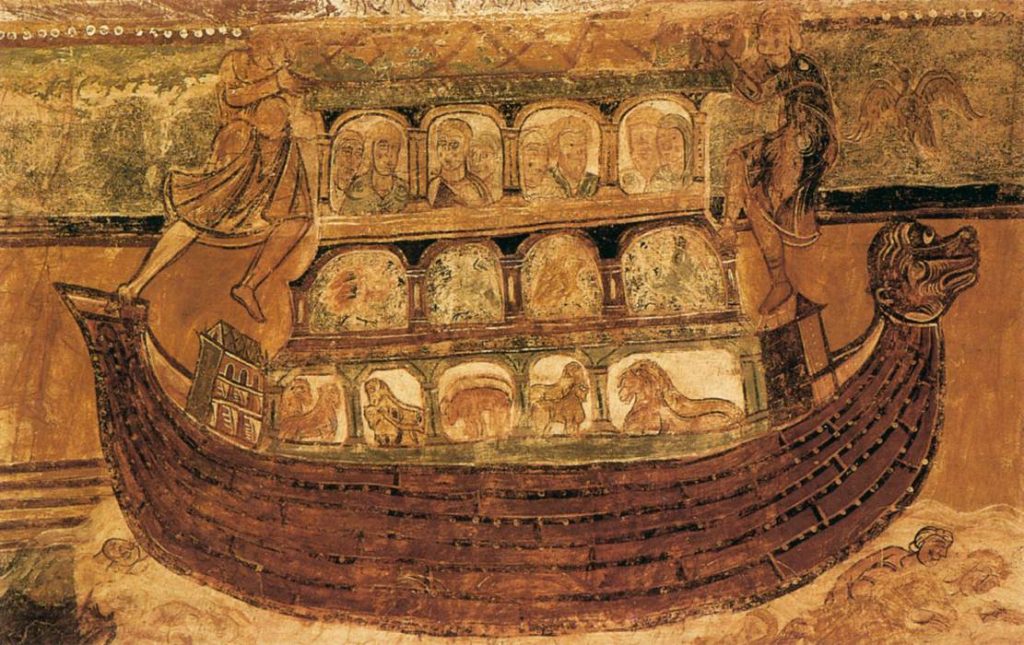
A central claim in Maritz’s presentation is that the biblical account of Noah represents the clearest and most accurate version of an original flood narrative, with Mesopotamian texts functioning as distorted or partial reflections of that primordial event. This interpretive framework reverses the direction of influence established by the overwhelming majority of modern scholarship. Rather than treating Genesis as the source from which earlier traditions diverge, historians and philologists situate the Hebrew flood narrative within a much older and well-documented Mesopotamian literary tradition. The implications of this reversal are significant, as it transforms a complex history of textual development into a simplified model of preservation and corruption.
The Mesopotamian flood traditions, preserved in texts such as the Atrahasis Epic and later incorporated into the Epic of Gilgamesh, predate the composition of Genesis by many centuries. These texts, written in Akkadian and preserved on cuneiform tablets, provide detailed accounts of a divinely sent flood, the selection of a survivor, and the construction of a vessel for preservation. Their chronology is supported by both linguistic analysis and archaeological context, placing them firmly within the second millennium BCE and earlier. Tablets containing portions of these narratives have been recovered from sites such as Ashurbanipal’s library at Nineveh, as well as earlier Old Babylonian contexts, allowing scholars to trace both the transmission and evolution of the tradition over time. By contrast, the Genesis narrative emerges from a later historical period, often associated with the first millennium BCE and shaped by the cultural and theological environment of ancient Israel. Its composition reflects not only earlier narrative influences but also editorial processes that integrated multiple sources into a unified theological text, further reinforcing its position within a later stage of literary development.
Maritz’s argument depends upon minimizing or reinterpreting this chronological framework. By presenting the Mesopotamian texts as derivative or corrupted, he avoids engaging with the well-established evidence for their priority. Yet such a position requires not only dismissing the dating of these texts but also overlooking the mechanisms of cultural transmission that characterize the ancient Near East. The region was marked by sustained interaction among societies, including trade networks, political domination, and periods of exile, all of which facilitated the movement of ideas and narratives. The Babylonian exile of the sixth century BCE provides a plausible historical context in which Israelite authors encountered and reworked Mesopotamian traditions, integrating them into their own theological framework.
A closer comparison of the narratives further reinforces this direction of influence. The structural parallels between the Mesopotamian accounts and Genesis are too specific to be explained by coincidence alone, yet the differences are equally revealing. In the Atrahasis Epic, the flood arises from divine frustration with human noise and overpopulation, reflecting a polytheistic worldview in which gods possess human-like limitations and conflicts. In Genesis, the flood is framed as a moral response to human wickedness, consistent with the monotheistic theology of ancient Israel. The transformation of the narrative from one theological system to another suggests adaptation rather than preservation, with elements of the older tradition reshaped to align with new religious and cultural priorities. This process of adaptation can also be seen in the restructuring of the narrative itself, including the emphasis on covenant, divine justice, and moral order, which are largely absent from the Mesopotamian versions. Such changes reflect deliberate theological reworking rather than the passive transmission of a fixed historical account.
Philological evidence also challenges Maritz’s claims. The names of the flood hero in Mesopotamian texts, such as Atrahasis or Utnapishtim, bear no direct linguistic relationship to Noah, and attempts to establish such a connection rely on superficial or speculative associations rather than rigorous analysis. Language change, borrowing, and translation in the ancient world followed identifiable patterns, and the absence of a credible linguistic link undermines the assertion that these figures represent the same historical individual preserved under different names. Instead, the variations in naming and characterization reflect distinct literary traditions that have been shaped independently, even as they share certain inherited motifs.
The broader scholarly consensus, grounded in decades of philological, archaeological, and literary analysis, recognizes Genesis as part of a continuum of Near Eastern narrative development. This does not diminish the significance of the biblical text but situates it within its proper historical context, as a reinterpretation of earlier traditions rather than their source. Maritz’s reversal of this relationship is not simply a matter of alternative interpretation, but a departure from established methodological standards. By privileging theological coherence over historical evidence, his argument reshapes the past to fit a predetermined narrative, obscuring the complex processes through which ancient texts were composed, transmitted, and transformed.
The Babylonian Map of the World: Context vs Interpretation
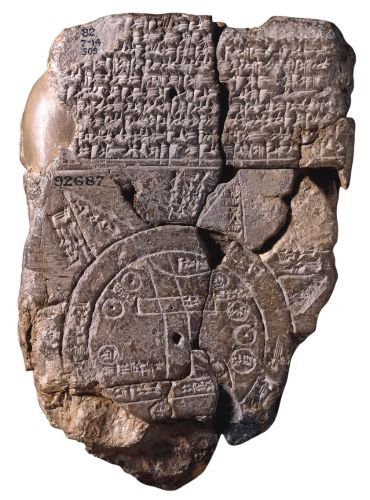
A significant component of Maritz’s argument centers on the Babylonian Map of the World, often referred to as the Imago Mundi, which he presents as a key piece of evidence linking Mesopotamian knowledge to the biblical account of Noah’s Ark. In his interpretation, the map is not merely a cosmological artifact but a literal guide that encodes geographical information about a post-flood landscape, including the location of the ark itself. This reading depends upon treating the map as a form of empirical cartography, comparable in intention to modern geographic representation. Such an approach diverges sharply from the consensus of Assyriological scholarship, which understands the artifact within a very different conceptual framework.
The Imago Mundi, dated to the first millennium BCE and preserved on a cuneiform tablet, represents a stylized and symbolic view of the world as conceived by ancient Mesopotamian scribes. It depicts a circular landmass surrounded by a cosmic river, often identified as the “Bitter River,” with Babylon positioned prominently near the center. Beyond this boundary lie triangular regions labeled as distant or mythical lands, each associated with brief textual descriptions. The map does not aim to provide accurate distances, directions, or topographical detail in the modern sense, but rather to express a cosmological ordering of space that reflects cultural and theological priorities. Its structure communicates meaning through symbolic arrangement rather than empirical measurement.
Maritz’s interpretation isolates specific elements of the map and recontextualizes them as literal geographical markers, particularly in relation to the supposed journey of a flood survivor to a distant mountain. This reading relies on extracting individual features from their symbolic context and assigning them fixed physical referents, effectively transforming a cosmological diagram into a navigational chart. Such a transformation overlooks the interpretive conventions of Mesopotamian cartography, in which spatial representation often served ideological and mythological functions rather than practical ones. The placement of Babylon at the center, for example, reflects its perceived importance within the known world, not a precise geographical calculation. Moreover, the triangular regions beyond the encircling river are not mapped territories in any conventional sense, but conceptual zones that mark the limits of the known and the beginning of the unknown. By treating these schematic features as literal directions or destinations, Maritz imposes a level of specificity that the artifact itself does not support, effectively reading into the map a clarity and intention that it was never designed to convey.
Scholarly analysis of the Imago Mundi, particularly the work associated with Irving Finkel and other Assyriologists, emphasizes the importance of reading the map alongside its accompanying text and within the broader corpus of Mesopotamian literature. The inscriptions on the tablet provide brief descriptions of regions beyond the known world, often invoking themes of danger, strangeness, or divine significance. These elements align with a broader tradition of describing the edges of the world as liminal spaces, where ordinary rules no longer apply. Maritz’s interpretation, by contrast, treats these descriptions as if they correspond directly to identifiable physical locations, thereby collapsing the distinction between symbolic geography and empirical mapping.
The problem is not merely one of misinterpretation, but of methodological inconsistency. To read the Imago Mundi as a literal map requires ignoring both its internal logic and the conventions of the culture that produced it. Ancient Near Eastern maps were not intended to function as tools for navigation in the modern sense; rather, they articulated a worldview in which geography, theology, and cosmology were intertwined. The circular form, the enclosing river, and the peripheral regions all contribute to a representation of order and boundary that cannot be reduced to physical terrain. These features encode relationships between center and periphery, civilization and chaos, the familiar and the unknown, rather than measurable spatial coordinates. By imposing modern expectations of cartographic precision onto this artifact, Maritz introduces an anachronism that distorts its original meaning and obscures the intellectual framework within which the map was created and understood.
The reinterpretation of the Babylonian Map of the World within Maritz’s argument exemplifies a broader pattern: the conversion of symbolic material into literal evidence through selective reading and contextual omission. What appears, at first glance, to be a striking convergence between artifact and narrative is revealed, upon closer examination, to be the result of interpretive reshaping. When the Imago Mundi is understood within its proper historical and cultural context, it no longer supports the claim that it encodes a journey to Noah’s Ark. Instead, it stands as a testament to the ways in which ancient societies conceptualized the structure of their world, offering insight into their intellectual and cosmological frameworks rather than into the verification of later religious narratives.
The “Missing Piece” and the Construction of Narrative

A recurring feature of Maritz’s presentation is the emphasis on discovery, particularly the notion that a crucial “missing piece” has recently emerged to clarify long-standing questions about the flood narrative. This framing lends an air of dramatic revelation to the material, suggesting that previously incomplete or misunderstood evidence has now been assembled into a coherent and decisive account. The language of recovery and completion carries rhetorical weight, implying that the past has yielded a hidden truth at precisely the moment it can be recognized and understood. Yet this narrative of discovery risks obscuring the more measured and methodical processes through which ancient texts are actually reconstructed and interpreted.
In the field of Assyriology, fragmentary texts are a normal and expected condition of the evidence. Cuneiform tablets are often broken, incomplete, or damaged, requiring scholars to reconstruct their contents through painstaking comparison with parallel texts, linguistic patterns, and established conventions of genre and style. This process is not one of sudden revelation but of incremental refinement, in which proposed readings are continually tested against the broader corpus of available material. When new fragments are identified or reassembled, they rarely provide entirely new narratives; more often, they clarify or expand upon themes that are already known. The idea of a single fragment functioning as a decisive key to an entire historical question reflects a misunderstanding of how textual reconstruction practically operates.
Maritz’s interpretation transforms this scholarly process into a narrative of confirmation. By presenting a reconstructed fragment as the “missing piece,” he suggests that it resolves uncertainties in favor of a particular conclusion, namely the historical accuracy of the biblical flood account. This move depends upon treating the fragment as if it speaks with a clarity and finality that the evidence itself does not support. In reality, reconstructed texts are accompanied by degrees of uncertainty, with gaps, alternative readings, and interpretive debates forming an integral part of the scholarly landscape. Scholars routinely publish transliterations with brackets indicating missing text, offer multiple possible restorations, and debate the implications of each reading in light of parallel sources. To elevate a fragment to the status of definitive proof requires setting aside these complexities and presenting a selective version of the evidence, one that suppresses ambiguity in favor of apparent certainty.
The construction of narrative plays a central role in this process. By arranging fragments, interpretations, and secondary commentary into a linear and seemingly cohesive story, Maritz creates the impression that the evidence naturally leads to his conclusion. This narrative coherence is not inherent in the material itself but is produced through choices about what to include, how to interpret it, and how to relate it to other sources. Elements that do not fit the desired pattern are minimized or omitted, while those that appear to align with it are emphasized and connected. The resulting account possesses a persuasive clarity that derives from its structure rather than from the independent convergence of evidence.
This pattern reflects a broader methodological issue in which the distinction between discovery and interpretation becomes blurred. In scholarly practice, the identification of a fragment and the interpretation of its meaning are separate stages, each subject to critical evaluation and revision. Maritz’s presentation collapses these stages, treating interpretation as an extension of discovery and thereby granting it an unwarranted degree of authority. The “missing piece” functions less as an objective addition to the body of evidence than as a rhetorical device, one that reinforces a predetermined narrative by framing interpretive choices as inevitable conclusions. It shifts attention away from the provisional and contested nature of historical knowledge, replacing it with a sense of resolution that reflects the priorities of the interpreter rather than the constraints of the evidence itself.
Philology, Parsiktu, and False Equivalence
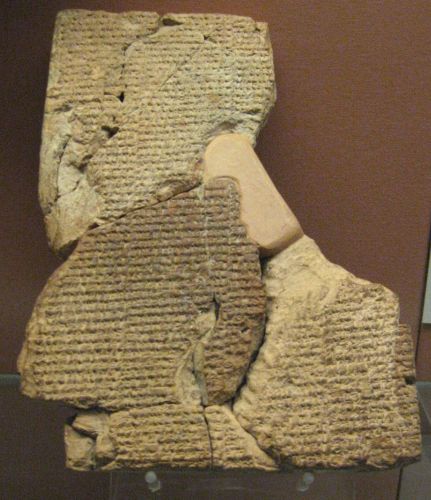
A further component of Maritz’s argument rests on philological claims, particularly his treatment of specific terms as evidence for a shared historical referent between Mesopotamian and biblical traditions. Central to this is the use of the Akkadian term parsiktu, which he presents as a technical or distinctive descriptor that aligns with the construction of Noah’s Ark. By highlighting this term and positioning it as uniquely significant, Maritz suggests that linguistic continuity supports the identification of Mesopotamian flood narratives with the Genesis account. This approach relies on the assumption that lexical similarity or rarity necessarily indicates a shared historical object or event.
Philology operates within a far more constrained and methodologically rigorous framework. The meaning of a word in an ancient language is determined through contextual usage across multiple texts, comparison with cognate languages, and analysis of grammatical and semantic patterns. A term such as parsiktu, even if relatively uncommon, cannot be isolated from its broader linguistic environment and assigned a fixed or specialized meaning without sufficient supporting evidence. Words often carry a range of meanings, and their significance may shift depending on context, genre, and period. Lexical interpretation also depends on patterns of attestation, where repeated usage across different texts allows scholars to identify stable meanings or semantic fields. In the absence of such patterns, proposed meanings remain provisional and subject to revision. To treat a single occurrence or limited set of occurrences as definitive requires a level of certainty that the evidence rarely permits and runs counter to established philological practice.
Maritz’s interpretation effectively transforms parsiktu from a contextual term into a diagnostic marker, one that supposedly identifies a specific type of vessel corresponding to the biblical ark. This move collapses the distinction between linguistic description and historical identification. In Mesopotamian texts, references to boats and construction techniques appear in a variety of contexts, including mythological narratives, administrative records, and technical descriptions. The presence of a particular term within a flood narrative does not, in itself, establish that the object described is identical to that of another tradition, especially when the surrounding narrative frameworks differ in significant ways.
The problem is compounded by the selective treatment of linguistic data. Maritz emphasizes points of apparent similarity while neglecting the broader pattern of divergence between the Mesopotamian and biblical accounts. The descriptions of the vessels themselves differ in shape, construction, and symbolic function. The boat described in the Atrahasis Epic, for example, is often interpreted as a large, cubical or circular structure, reflecting Mesopotamian conceptions of containment and stability. The ark in Genesis, by contrast, is described in elongated, rectangular terms, with specific proportions that align with a different set of narrative and symbolic priorities. These differences are not easily reconciled through appeals to shared terminology, and they highlight the extent to which each narrative reflects distinct cultural and theological concerns. By focusing narrowly on a single term, Maritz’s argument obscures these broader divergences and presents a simplified picture that does not reflect the complexity of the sources.
More broadly, the use of philology in Maritz’s argument illustrates a common logical fallacy: the assumption that similarity at the level of language implies identity at the level of referent. This form of false equivalence overlooks the complexity of linguistic transmission, in which words may be borrowed, adapted, or independently developed without preserving a stable connection to a single historical object. In ancient Near Eastern literature, recurring motifs and descriptive terms often reflect shared cultural and technological environments rather than direct historical continuity. The presence of overlapping vocabulary indicates interaction or parallel development, not the preservation of a singular event or artifact. Linguistic convergence can arise from shared material conditions, such as common building techniques or environmental constraints, rather than from the transmission of a specific historical memory. To treat such convergence as proof of identity is to misunderstand the nature of language itself and the processes through which meaning is constructed and transmitted.
When examined within the standards of professional philology, the argument built around parsiktu does not sustain the weight placed upon it. The term’s meaning remains dependent on context, and its occurrence within Mesopotamian flood narratives cannot be used to establish a direct equivalence with the biblical ark. Maritz’s treatment of the evidence simplifies the complexities of language into a straightforward chain of identification, transforming interpretive possibilities into asserted certainties. It replaces careful linguistic analysis with a form of selective reading that prioritizes confirmation over explanation.
Ark Identification and the Problem of Retroactive Mapping
A further extension of Maritz’s argument appears in his attempt to identify a specific physical location for the ark by correlating textual descriptions, ancient artifacts, and modern geography. This process involves mapping elements from Mesopotamian and biblical narratives onto contemporary landscapes, with particular emphasis on mountainous regions traditionally associated with the resting place of Noah’s Ark. The underlying assumption is that ancient texts contain sufficiently precise geographical information to allow for direct identification when properly interpreted. Such an approach depends upon treating these texts as descriptive records of physical space rather than as literary and theological compositions. It also assumes a continuity between ancient and modern geographical knowledge that cannot be taken for granted, given the symbolic and schematic nature of many ancient representations of space. By presenting these correlations as cumulative evidence, Maritz creates the impression that textual and physical data converge naturally, when in fact the relationship between them is mediated by a series of interpretive decisions.
The practice of retroactive mapping introduces a significant methodological problem. Ancient narratives often employ spatial language in ways that are symbolic, conventional, or oriented toward narrative function rather than empirical accuracy. Descriptions of journeys, distances, and destinations frequently reflect the internal logic of the story rather than a cartographic intention. When these descriptions are extracted from their narrative context and projected onto modern maps, they acquire a specificity that was never present in the original text. Maritz’s argument relies on this transformation, converting general or ambiguous references into precise coordinates through interpretive adjustment.
This process is further complicated by the selective use of evidence. To align textual descriptions with a particular location, elements that support the proposed identification are emphasized, while those that do not are minimized or reinterpreted. Variations in distance, direction, and environmental description are often resolved through flexible readings that accommodate the desired conclusion. Such interpretive elasticity allows a wide range of potential locations to be presented as plausible, yet it undermines the reliability of any specific identification. The resulting map is not derived from the text itself but constructed through a series of interpretive choices that shape the evidence to fit a predetermined outcome. This flexibility can extend to the reinterpretation of ambiguous terms, the adjustment of spatial relationships, and the selective prioritization of certain textual features over others. The process becomes less an act of discovery and more an exercise in confirmation, where the conclusion guides the interpretation rather than emerging from it.
The problem of retroactive mapping is not unique to this case but reflects a broader pattern in the interpretation of ancient narratives. Similar approaches have been used to identify locations associated with other mythological or religious traditions, often producing competing claims that cannot be reconciled through the available evidence. In each instance, the same methodological issue arises: the imposition of modern geographical expectations onto texts that were not composed with such expectations in mind. Without independent corroborating evidence, such as archaeological remains that can be securely dated and contextualized, these identifications remain speculative. Moreover, the recurrence of multiple, mutually incompatible claims highlights the degree to which such mappings depend upon interpretive preference rather than empirical constraint. The persistence of these claims reflects not their evidentiary strength, but the appeal of locating familiar narratives within recognizable landscapes.
When evaluated within the standards of historical and archaeological methodology, Maritz’s attempt to locate the ark illustrates the limits of using literary sources as geographical guides. Ancient texts can provide valuable insight into how past societies understood and imagined their world, but they do not function as maps in the modern sense. The identification of specific locations requires a convergence of multiple forms of evidence, including material remains, stratigraphic data, and verifiable chronological frameworks. In the absence of such evidence, the projection of narrative elements onto physical landscapes remains an exercise in interpretation rather than a demonstration of historical fact.
Ararat, Urartu, and the Expansion of Correlation

Maritz extends his argument by linking the biblical reference to the “mountains of Ararat” with the historical kingdom of Urartu, presenting this association as a bridge between scriptural narrative and archaeological reality. At first glance, this connection appears to have a degree of plausibility. The term “Ararat” in the Hebrew Bible is widely understood to reflect the name of the ancient region known in Assyrian sources as Urartu, located in the Armenian highlands. This correspondence is supported by linguistic and historical evidence, and it situates the biblical reference within a recognizable geographical context. The existence of such a connection does not, in itself, establish the historicity of the events described in the narrative.
The interpretive move that follows is more problematic. Maritz treats the identification of Ararat with Urartu as a form of confirmation, suggesting that the biblical account is grounded in verifiable geography and more likely to be historically accurate. This reasoning reflects a shift from contextualization to validation, in which the presence of a real place name is taken as evidence for the literal occurrence of the narrative. Yet ancient texts frequently anchor stories in known locations, not as a means of recording historical events, but as a way of situating them within a meaningful cultural landscape. The use of recognizable geography enhances the narrative’s plausibility and resonance without requiring that the events themselves be understood as historical in a modern sense. This practice is widespread in ancient literature, where mythological and theological narratives are embedded within real-world settings to lend them authority and immediacy. By overlooking this literary convention, Maritz interprets geographical reference as empirical confirmation, thereby conflating narrative strategy with historical reporting.
The expansion of correlation becomes evident when this initial linguistic and geographical link is extended beyond its evidentiary limits. Maritz incorporates additional claims, including references to specific mountain formations and modern sites that have been proposed as the resting place of the ark. Among these is the Durupinar formation, a geological feature in eastern Turkey that has been the subject of repeated claims of identification with Noah’s Ark. Such claims have been widely examined and rejected by geologists and archaeologists, who identify the formation as a natural structure shaped by erosion and tectonic processes. The persistence of these claims reflects the appeal of tangible confirmation, even in the absence of credible supporting evidence.
This pattern illustrates how correlation can be incrementally transformed into validation. A linguistically and historically grounded observation, such as the identification of Ararat with Urartu, becomes the foundation upon which increasingly speculative claims are constructed. Each additional layer of interpretation draws upon the apparent solidity of the initial connection, even as it moves further from the available evidence. The result is a chain of reasoning in which weak or unsupported claims derive credibility from their association with stronger, well-established ones. This process can create the impression of cumulative support, while in reality the evidentiary basis becomes progressively more tenuous.
When examined within a rigorous methodological framework, the distinction between contextual correlation and historical confirmation remains essential. The identification of Ararat with Urartu provides valuable insight into the geographical awareness of the biblical authors and the cultural environment in which the text was composed. It does not constitute evidence for the existence of the ark or the occurrence of a global flood. Maritz’s argument blurs this distinction, using a legitimate scholarly observation as a point of departure for claims that extend beyond what the evidence can sustain. It exemplifies a broader tendency to convert contextual information into confirmation of a predetermined narrative. This expansion of correlation into validation ultimately reflects not the strength of the underlying evidence, but the interpretive framework imposed upon it, in which each connection is treated as a step toward proof rather than as a limited and context-bound observation.
Archaeology, Apologetics, and Commercial Framing

Maritz’s presentation does not operate solely within the domain of historical interpretation; it also participates in a broader ecosystem in which archaeology, religious apologetics, and commercial enterprise intersect. This becomes particularly evident in the way material culture and reconstructed environments are presented as experiential confirmation of biblical narratives. References to exhibitions, models, and large-scale reconstructions are framed not merely as educational tools, but as demonstrations of plausibility, inviting audiences to visualize the ark and its context as if they were historically established realities. The persuasive force of such presentations lies in their ability to transform abstract claims into tangible experiences, thereby reinforcing the impression of authenticity.
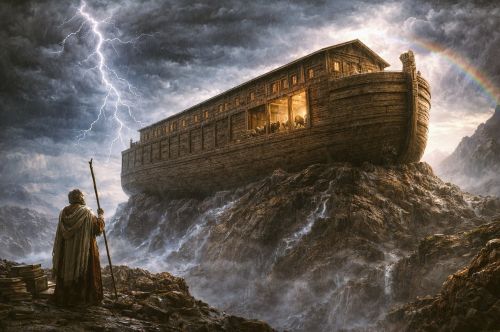
The use of reconstructed environments plays a central role in this process. Facilities such as the Ark Encounter in Kentucky present full-scale or near full-scale models of Noah’s Ark, designed to convey both the physical feasibility and the narrative coherence of the biblical account. These reconstructions are often accompanied by curated displays that integrate selective archaeological references, textual excerpts, and interpretive commentary, creating a unified narrative environment that feels comprehensive and internally consistent. Within these spaces, visitors are not simply observing artifacts or reading about historical interpretations; they are immersed in a constructed reality that blends sensory experience with narrative persuasion. The scale, detail, and physical presence of these reconstructions can give the impression of empirical confirmation, even though the underlying claims remain interpretive and contingent. The environment itself becomes a form of argument, one that operates visually and emotionally rather than analytically, encouraging acceptance through immersion rather than critical evaluation. While such installations can be engaging and informative in certain respects, they are fundamentally interpretive in nature, reflecting specific theological and ideological commitments rather than neutral presentations of evidence. The distinction between reconstruction and historical reality is not always clearly maintained, allowing visitors to conflate experiential immersion with empirical validation.
Maritz’s engagement with these forms of presentation reflects a broader apologetic strategy in which archaeology is mobilized to support preexisting beliefs. Rather than serving as an independent line of inquiry that tests hypotheses against material evidence, archaeology is presented as a confirmatory tool, selectively invoked to reinforce conclusions that have already been established on theological grounds. This approach contrasts with standard archaeological practice, which emphasizes the interpretation of material remains within their stratigraphic, chronological, and cultural contexts. In professional archaeology, conclusions emerge from the careful accumulation and analysis of evidence, often requiring revision or abandonment of prior assumptions when new data contradicts earlier interpretations. By contrast, apologetic frameworks tend to privilege coherence with established beliefs over methodological openness, leading to a selective engagement with evidence that supports the desired narrative while minimizing or excluding contradictory findings. The evidentiary value of artifacts is contingent upon their provenance and association, and conclusions are drawn through careful analysis rather than through alignment with external narratives. When archaeology is reframed as a tool of confirmation rather than investigation, its methodological foundations are effectively inverted, transforming a critical discipline into a reinforcing mechanism for predetermined conclusions.
The commercial dimension of this framework further complicates the relationship between evidence and interpretation. Large-scale attractions, publications, and media productions operate within a marketplace that rewards compelling and accessible narratives. The presentation of archaeology in these contexts is shaped not only by scholarly considerations but also by the demands of audience engagement and financial sustainability. Simplified or dramatized interpretations are more likely to attract attention and generate revenue, creating incentives that may conflict with the cautious and often provisional nature of academic scholarship. The boundary between education and promotion becomes increasingly difficult to delineate.
This convergence of archaeology, apologetics, and commerce does not necessarily invalidate all forms of public engagement with the past, but it does require careful evaluation of how evidence is presented and interpreted. When reconstructions and exhibits are framed as demonstrations of historical fact rather than as interpretive models, they risk misleading audiences about the nature of the underlying evidence. Maritz’s presentation participates in this dynamic by incorporating such materials into his argument as if they provide independent confirmation, rather than recognizing them as products of a particular interpretive framework.
A critical distinction must be maintained between archaeology as a scholarly discipline and archaeology as a component of narrative construction. In its academic form, archaeology operates through methodological rigor, evidentiary transparency, and ongoing debate. In its apologetic and commercial manifestations, it can become a vehicle for reinforcing belief through selective presentation and experiential persuasion. Maritz’s argument exemplifies this shift, demonstrating how the authority of archaeology can be invoked to lend credibility to claims that extend beyond what the evidence can substantiate. The result is a persuasive but methodologically compromised account, in which the appearance of evidence replaces its critical evaluation.
Myth, Symbol, and Theological Reinterpretation

The narrative of Noah’s Ark has long occupied a complex position at the intersection of myth, theology, and historical interpretation. While some traditions have approached it as a literal account of past events, many scholars understand it as a mythic narrative that conveys theological meaning through symbolic structure. The term “myth” does not imply falsehood, but rather a mode of storytelling that expresses foundational truths about human existence, divine judgment, and the relationship between order and chaos. The ark narrative, with its themes of destruction, preservation, and renewal, reflects a broader pattern found in ancient Near Eastern literature, where flood stories function as vehicles for exploring cosmic and moral order.
Within this interpretive framework, the details of the narrative take on symbolic significance. The flood itself represents a return to primordial chaos, echoing earlier cosmological traditions in which the world emerges from watery disorder. The ark becomes a microcosm of creation, preserving life through a period of unmaking and serving as the vessel through which order is restored. The selection of animals, the duration of the flood, and the eventual receding of the waters all contribute to a structured narrative that emphasizes divine control and purposeful renewal. These elements are not incidental details to be verified or falsified, but components of a carefully constructed theological message. The repetition of key actions, such as the measured sending of birds and the careful accounting of days, reinforces the sense of order emerging from chaos, suggesting that the narrative is as much about process and rhythm as it is about outcome. Even the architectural dimensions of the ark, often treated as technical specifications, can be understood symbolically as markers of completeness and divine instruction rather than as engineering data meant for empirical replication.
The relationship between the biblical flood narrative and earlier Mesopotamian traditions further supports this symbolic reading. Texts such as the Epic of Gilgamesh and the Atrahasis Epic contain flood accounts that share striking structural and thematic similarities with the Genesis narrative. These parallels include divine decision-making, the construction of a vessel, the preservation of life, and the sending of birds to test the receding waters. The presence of these shared motifs suggests that the biblical account participates in a broader cultural conversation, adapting and reinterpreting existing narrative forms to articulate distinct theological claims about the nature of the divine and the moral order of the world.
Theological reinterpretation of the flood narrative has continued across centuries, reflecting changing intellectual and cultural contexts. Early Jewish and Christian interpreters often read the story allegorically, emphasizing its moral and spiritual dimensions rather than its literal historicity. In medieval exegesis, the ark was frequently understood as a symbol of the Church, offering salvation amid a world marked by sin and disorder. Later theological traditions expanded these symbolic readings, exploring the narrative as a reflection on human responsibility, divine justice, and the possibility of renewal after catastrophe. These interpretations demonstrate the adaptability of the narrative, which can sustain multiple layers of meaning without requiring a strictly literal reading. This flexibility allowed the story to be recontextualized in response to new philosophical and scientific developments, including the rise of natural history and geological inquiry, which challenged literalist interpretations while leaving symbolic readings intact. Rather than diminishing the narrative’s significance, these reinterpretations underscore its resilience, showing how it can continue to function as a source of meaning even as its relationship to historical claims is reevaluated.
Modern scholarship has further developed these approaches by situating the flood narrative within its ancient Near Eastern context and examining its literary structure. Rather than seeking physical evidence for the events described, scholars analyze the text as a product of its time, shaped by cultural exchange, theological reflection, and narrative convention. This perspective does not diminish the significance of the story; instead, it allows for a deeper understanding of how it functions as a vehicle for meaning. By recognizing the symbolic and literary dimensions of the narrative, interpreters can engage with its themes in a way that is both historically informed and theologically nuanced.
Maritz’s approach stands in tension with these interpretive traditions, as it prioritizes literal verification over symbolic and theological analysis. By focusing on attempts to locate physical evidence for the ark, the argument shifts attention away from the narrative’s literary and cultural context. This emphasis risks reducing a complex and multifaceted text to a single dimension of interpretation, overlooking the richness of its symbolic content. A more comprehensive approach acknowledges that the power of the flood narrative lies not in its capacity to be proven as historical fact, but in its enduring ability to articulate fundamental questions about human existence, divine justice, and the possibility of renewal in the aftermath of destruction.
Conclusion: Evidence, Belief, and the Limits of Interpretation
The analysis of Maritz’s argument reveals a consistent pattern in which correlation is extended beyond its evidentiary limits and presented as confirmation of historical claims. Linguistic connections, geographical references, and archaeological parallels are treated not as contextually bounded observations, but as cumulative proof of the biblical narrative’s literal accuracy. This interpretive strategy relies on the gradual transformation of plausible associations into assertions of certainty, creating a framework in which the appearance of evidence substitutes for its critical evaluation. When examined within established historical and archaeological methodologies, these claims do not sustain the weight placed upon them, highlighting the importance of maintaining clear distinctions between correlation, plausibility, and verification.
The persistence and appeal of such arguments point to a deeper dynamic in the relationship between evidence and belief. Narratives like that of Noah’s Ark occupy a space that is not defined solely by historical inquiry, but also by theological meaning, cultural identity, and existential reflection. The desire to anchor these narratives in material evidence reflects an effort to reconcile faith with empirical standards of proof, seeking validation within the frameworks of modern scientific and historical discourse. This impulse is understandable, yet it can lead to methodological compromises when the standards of evidence are adjusted to accommodate predetermined conclusions rather than to test them.
A more productive approach recognizes the distinct roles that different forms of interpretation play. Historical and archaeological methods provide tools for evaluating claims about the past, grounded in evidence that can be critically examined and debated. Mythic and theological interpretations, by contrast, engage with questions of meaning, purpose, and moral order, operating within symbolic and narrative frameworks that are not reducible to empirical verification. Confusing these domains risks diminishing both, reducing theology to contested historical claims while stripping historical inquiry of its methodological rigor. The strength of each approach lies in its ability to address different kinds of questions, and clarity emerges when their boundaries are respected rather than collapsed.
The question is not whether the narrative of Noah’s Ark can be proven in a strictly historical sense, but how it continues to function as a source of meaning across time. Maritz’s argument illustrates the challenges that arise when the search for evidence is driven by the desire for confirmation, rather than by the principles of critical inquiry. By acknowledging the limits of what the available evidence can demonstrate, it becomes possible to engage the narrative more fully, appreciating its historical context, its literary structure, and its enduring theological significance without requiring it to conform to modern expectations of proof.
Bibliography
Affiliate disclosure: Amazon links on this site are paid links. As an Amazon Associate I earn from qualifying purchases.
- Baden, Joel S. The Composition of the Pentateuch: Renewing the Documentary Hypothesis. New Haven: Yale University Press, 2012.
- Black, Jeremy, Andrew George, and Nicholas Postgate. A Concise Dictionary of Akkadian. 2nd ed. Wiesbaden: Harrassowitz Verlag, 2000.
- Brettler, Marc Zvi. How to Read the Bible. Philadelphia: Jewish Publication Society, 2005.
- Cline, Eric H. Three Stones Make a Wall: The Story of Archaeology. Princeton: Princeton University Press, 2017.
- Collins, Lorence G., and David Fasold. “Bogus ‘Noah’s Ark’ from Turkey Exposed as a Common Geologic Structure.” Journal of Geoscience Education 44, no. 5 (1996): 439–444.
- Dalley, Stephanie. Myths from Mesopotamia: Creation, the Flood, Gilgamesh, and Others. Oxford: Oxford University Press, 1989.
- Dever, William G. What Did the Biblical Writers Know and When Did They Know It? Grand Rapids, MI: Eerdmans, 2001.
- Dundes, Alan, ed. The Flood Myth. Berkeley: University of California Press, 1988.
- Fagan, Brian M. Archaeology: A Brief Introduction. 12th ed. New York: Routledge, 2017.
- Finkel, Irving L. The Ark Before Noah: Decoding the Story of the Flood. London: Hodder & Stoughton, 2013.
- George, Andrew. The Babylonian Gilgamesh Epic: Introduction, Critical Edition and Cuneiform Texts. Oxford: Oxford University Press, 2003.
- —-, trans. The Epic of Gilgamesh: A New Translation. London: Penguin Classics, 1999.
- Griffin, Alan H. F. “Ovid’s Universal Flood.” Hermathena 152 (1992), 39-58.
- Horowitz, Wayne. Mesopotamian Cosmic Geography. Winona Lake, IN: Eisenbrauns, 1998.
- Huehnergard, John. A Grammar of Akkadian. 3rd ed. Winona Lake, IN: Eisenbrauns, 2011.
- Kitchen, K. A. On the Reliability of the Old Testament. Grand Rapids, MI: Eerdmans, 2003.
- Kraeling, Emil G. “The Earliest Hebrew Flood Story.” Journal of Biblical Literature 66:3 (1947), 279-293.
- Lambert, W. G. Babylonian Creation Myths. Winona Lake, IN: Eisenbrauns, 2013.
- Lambert, W. G., and A. R. Millard. Atra-Hasis: The Babylonian Story of the Flood. Oxford: Clarendon Press, 1969.
- Leeming, David Adams. Creation Myths of the World: An Encyclopedia. Santa Barbara, CA: ABC-CLIO, 2009.
- Levenson, Jon D. Creation and the Persistence of Evil: The Jewish Drama of Divine Omnipotence. Princeton: Princeton University Press, 1988.
- McDannell, Colleen. Material Christianity: Religion and Popular Culture in America. New Haven: Yale University Press, 1995.
- Millard, A. R. “The Babylonian Map of the World.” Iraq 50 (1988): 1–10.
- Robson, Eleanor. Ancient Knowledge Networks: A Social Geography of Cuneiform Scholarship in First-Millennium Assyria and Babylonia. London: UCL Press, 2019.
- Saggs, H. W. F. The Greatness That Was Babylon: A Survey of the Ancient Civilization of the Tigris-Euphrates Valley. London: Sidgwick & Jackson, 1962.
- Stark, Rodney. Discovering God: The Origins of the Great Religions and the Evolution of Belief. New York: HarperOne, 2007.
- Tigay, Jeffrey H. The Evolution of the Gilgamesh Epic. Philadelphia: University of Pennsylvania Press, 1982.
- Van De Mieroop, Marc. A History of the Ancient Near East, ca. 3000–323 BC. 3rd ed. Malden, MA: Wiley-Blackwell, 2003.
- Walton, John H. The Lost World of the Flood: Mythology, Theology, and the Deluge Debate. Downers Grove, IL: IVP Academic, 2018.
- Westermann, Claus. Genesis 1–11: A Commentary. Minneapolis: Augsburg Publishing House, 1984.
- Wright, David P. Inventing God’s Law: How the Covenant Code of the Bible Used and Revised the Laws of Hammurabi. Oxford: Oxford University Press, 2009.
Originally published by Brewminate, 04.17.2026, under the terms of a Creative Commons Attribution-NonCommercial-NoDerivatives 4.0 International license.
About the Author