The 1956 effort was no rousing success.

By Dr. W. Joseph Campbell
Professor Emeritus of Communication
American University
Introduction
In response to national pollsters’ failure in forecasting election outcomes in 1948 and 1952, The New York Times pursued in 1956 a weekslong, multistate exercise in on-the-ground reporting to assess public opinion about the presidential race.
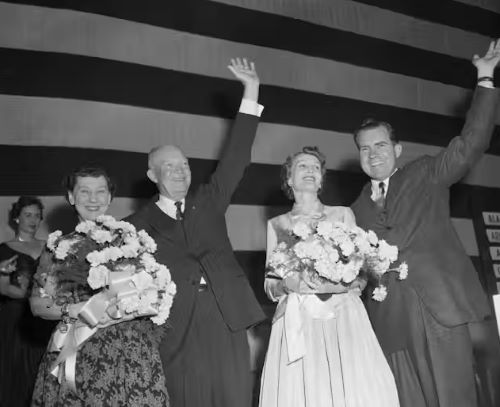
The Times’ experiment, which these days would be recognized as “shoe-leather reporting,” included two dozen journalists assigned to four teams that, in all, traveled to 27 battleground states over several weeks before the election – a rematch between President Dwight D. Eisenhower, a Republican, and his Democratic rival, Adlai E. Stevenson.
The reporting teams interviewed scores of Americans from all walks of life in an attempt to gauge voter preferences qualitatively – without relying on the data of preelection polls. One of the participating Times reporters declared afterward that the teams-based campaign coverage represented “a new departure in journalism.”
In unintended testimony to the challenges of measuring public opinion across a sprawling country, the Times’ coverage was no significant improvement over the polls. The Times’ reporting notably failed to anticipate the magnitude of Eisenhower’s reelection — a lopsided victory in which he carried 41 states.
In its final report before the election, the Times concluded that Eisenhower would win reelection but would fail to match the sweep of his landslide four years earlier. As it turned out, Eisenhower easily exceeded the dimensions of his victory in 1952, when his winning margin was 10.5 percentage points.
The Times’ coverage also failed to foresee Eisenhower’s state victories in 1956 in Virginia, Oklahoma and West Virginia, and markedly underestimated the president’s support in Connecticut, Illinois, Michigan, Minnesota, Pennsylvania and Texas, among other states.
The Times’ reporting experiment proved an imperfect substitute to election polling, as I discussed in a research paper presented recently to the American Journalism Historians Association. In the paper, I defined “shoe-leather reporting” as the gathering of newsworthy content through in-person interviews, document searches and on-the-scene observations. The idiom presumes that journalists will pursue fieldwork so energetically as to wear out their shoes.
“Shoe-leather reporting” has been long celebrated in American media; a widely published journalism educator has described the practice as “mythical” and “one of a very few gods an American journalist can officially pray to.”
Crises Skew Projections
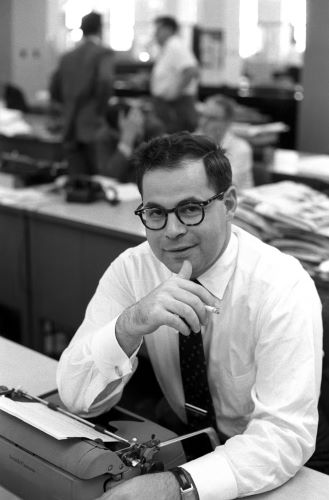
The Times’ experiment in 1956 represents an exceptional case study about both the appeal and limitations of detailed, interview-based reporting as a method for measuring public opinion in a presidential race, especially when dramatic international events occur shortly before the election.
Such was the case in 1956, when the Egyptian government seized the Suez Canal, prompting military intervention by Israeli, British and French armed forces — a response that Eisenhower deplored. About the same time, Soviet tanks were ordered into Hungary to crush an uprising against communist rule and install a regime compliant to Moscow.
The international crises may have boosted the margin of victory for Eisenhower, an Army general during World War II, in a rally-round-the-president effect.
It was, in any event, polling failure that inspired the Times’ campaign coverage experiment.
Eight years earlier, in 1948, the polls, the press and pundits anticipated that Republican Thomas E. Dewey would oust Democrat Harry S. Truman, who had become president on the death of Franklin D. Roosevelt in 1945.
But on the strength of a vigorous, cross-country campaign, Truman prevailed over Dewey and two minor-party candidates to win.
The leading national pollsters of the time — George Gallup, Archibald Crossley and Elmo Roper — all predicted Dewey’s easy victory. Roper announced in early September 1948 that Dewey was so far ahead that he would stop releasing survey results. Dewey, said Roper, would win “by a heavy margin.”
Truman, who predicted that pollsters would be “red-faced” on the day after the election, carried 28 states and 303 electoral votes. His margin of victory over Dewey, who won 16 states and 189 electoral votes, was 4.5 percentage points. J. Strom Thurmond of the segregationist Dixiecrat Party carried four Deep South states and 39 electoral votes.
Not Tied to ‘Arithmetic of Polls’
Not surprisingly, Gallup, Crossley and Roper turned exceedingly cautious in evaluating the 1952 presidential race, maintaining as the campaign closed that either candidate could win.
Eisenhower, they said, seemed to hold a narrow lead but that Stevenson was closing fast. Or as the Times said in reporting about a public gathering of the pollsters shortly before the election: “The poll takers gave a slight edge in the popular vote to … Eisenhower, the Republican candidate, but this was their dilemma: How fast is … Stevenson, the Democratic nominee, catching up?”
Equivocation did not serve the pollsters well. None of them anticipated Eisenhower’s sweeping victory — a 39-state landslide.
The Times did not editorially rebuke pollsters for their misfire in 1952, but the newspaper’s editors, wrote Pulitzer Prize-winning journalist Max Frankel in his memoir, had “lost confidence in polls.”
To cover the 1956 presidential election, the Times de-emphasized opinion polls in favor of its own intensive, on-the-ground reporting that focused on states where the presidential race was believed to be closely contested.
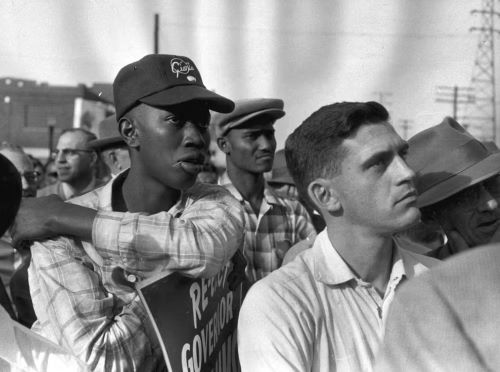
Frankel, who rose through the ranks to become the Times’ executive editor, recalled being taken off the rewrite desk in 1956 and sent knocking on doors “to gather voter sentiment. I drove through odd precincts of Milwaukee and Austin (Texas), Arlington (Virginia) and St. Joseph (Missouri), feeding notes” to a colleague on one of the reporting teams.
The teams typically spent three days in a state, conducting interviews “with political scientists and policemen, leading politicians and bartenders, laborers, housewives and farmers,” the newspaper said.
The Times described its grassroots reporting as “surveys,” although they were not quantitative samples.
“Team members found value in not being tied to the arithmetic of polls,” one of the participants, Donald D. Janson, wrote in a post-election assessment for the Nieman Reports, a journalism industry publication.
“The scope and depth of the venture was a new departure in journalism,” Janson declared.
The process was impressionistic, even idiosyncratic. “Each reporter,” Janson wrote, “was free to judge each response, from politician and voter alike, for reliability.”
The Times published 36 state-specific preelection reports, including nine based on reporters’ follow-up visits to states where outcomes were expected to be especially close.
In its wrap-up report two days before the election, the Times said it “seemed doubtful” that Eisenhower’s margin “would be as great as it was in 1952.” In fact, Eisenhower’s victory in 1956 far surpassed that of 1952; in the rematch, he crushed Stevenson by more than 9.5 million votes.
The Times conceded in an after-election article that its teams-based coverage “did not anticipate the magnitude of the President’s victory,” which it attributed to the Suez crisis and turmoil in Hungary. The crises, the Times said, “apparently gave the final impetus to the Eisenhower landslide.”
No Antidote for Bad Polls
The 1956 experiment in shoe-leather reporting was no rousing success. “There was some feeling,” Janson wrote afterward, “that the Times should stick to reporting trends and let the pollsters make the forecasts.”
Preelection polls by Gallup and Roper in 1956 accurately pointed to Eisenhower’s victory but overstated the president’s popular vote. Eisenhower won by 15 points; Gallup and Roper estimated his margin of victory would be 19 points. By 1956, Crossley had sold his business and retired from preelection polling.
Roper declared himself “personally pleased” by the outcome but reluctant to take “any bows for perfect accuracy.”
Given the unreliability of preelection polls in the late 1940s and early 1950s, the Times had ample reason to experiment in seeking a more precise understanding of popular opinion. But as results of the 1956 election demonstrated, shoe-leather reporting was no antidote for the wayward polls.
Originally published by The Conversation, 10.08.2024, under the terms of a Creative Commons Attribution/No derivatives license.
About the Author