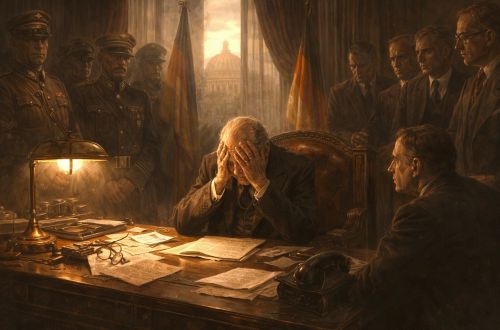
The historical lesson is not that institutions must be weakened to prevent abuse, but that they must remain tethered to accountable leadership.

By Matthew A. McIntosh
Public Historian
Brewminate
Introduction: When Institutions Outlive Leadership
Democratic systems are often assumed to fail when authority collapses outright. History suggests a more dangerous scenario. Institutions can remain intact, powerful, and legally operative long after effective leadership has faded. In such moments, the problem is not the absence of authority but its persistence without accountability. Offices continue to act, procedures continue to function, and decisions continue to be made, even as the individual meant to anchor responsibility no longer meaningfully governs. This disjunction between institutional power and personal capacity creates a condition in which governance survives while legitimacy quietly deteriorates.
Modern constitutional orders are especially susceptible to this danger because they are designed for continuity. Stability is prized, disruption feared, and removal mechanisms are often politically costly even when legally available. The result is a strong incentive to adapt around weakness rather than confront it directly. Advisors assume greater responsibility, informal networks gain influence, and decision-making migrates away from visible authority. Yet the symbolic center remains untouched. The leader stays in office, the constitution remains formally intact, and the system reassures itself that order has been preserved.
This condition produces a distinctive form of political decay. Power does not vanish, nor is it openly seized. Instead, it becomes diffuse and opaque. Those closest to the executive gain disproportionate influence, not through democratic mandate but through proximity and access. Decisions are framed for approval rather than deliberation, signatures replace judgment, and emergency procedures substitute for ordinary governance. What appears outwardly as continuity increasingly functions as substitution, with profound consequences for accountability and democratic restraint.
The final years of the Weimar Republic under President Paul von Hindenburg offer a stark illustration of this phenomenon. Hindenburg was not removed when his capacity declined. Instead, the presidency endured as an institutional shell, retaining immense constitutional power even as effective leadership receded. Advisors, political operatives, and ultimately extremists learned to maneuver within this hollowed structure, using its authority while bypassing its responsibility. By examining how Weimar Germany governed through decline rather than confronting it, what follows explores a recurring and perilous pattern: when institutions outlive leadership, they become vulnerable not to collapse, but to capture.
The Weimar Presidency: Power Without Daily Governance

The Weimar Constitution endowed the presidency with extraordinary authority, far exceeding that of most parliamentary heads of state in contemporary democracies. Designed in the shadow of imperial collapse, military defeat, and revolutionary upheaval, the office was intended to serve as a stabilizing force above party politics and legislative paralysis. The president could appoint and dismiss chancellors, dissolve the Reichstag, and, under Article 48, govern by emergency decree in times of crisis. This concentration of power was justified as a safeguard against disorder and fragmentation, reflecting deep elite mistrust of parliamentary durability. Yet it also created a dangerous asymmetry. The presidency possessed immense constitutional force without requiring sustained engagement in daily governance, making it uniquely vulnerable to the consequences of declining leadership capacity and detached oversight.
Article 48 was central to this imbalance. Intended as a temporary instrument to restore order during emergencies, it allowed the president to suspend civil liberties and rule by decree. In theory, parliamentary oversight remained intact. In practice, the threshold for emergency was vague, and enforcement depended on the president’s judgment and restraint. As economic instability and political fragmentation intensified during the late Weimar years, emergency governance increasingly replaced legislative deliberation. The constitutional framework permitted this shift without formal suspension of democracy, allowing extraordinary authority to become routine while preserving the appearance of legality.
This structure implicitly assumed an engaged and discerning executive capable of distinguishing necessity from convenience, crisis from governance by habit. It did not anticipate prolonged decline in leadership capacity, nor did it account for the growing reliance on intermediaries who operated without direct electoral accountability. The presidency could function with minimal visibility, issuing decrees, appointments, and authorizations without sustained public explanation. Cabinet government weakened as chancellors became dependent on presidential confidence rather than parliamentary majorities, further marginalizing representative institutions. As a result, the daily work of governance migrated away from deliberative bodies and toward executive-administrative channels, even as the president himself became less involved in substantive decision-making.
The result was an office that remained powerful while increasingly hollow at its center. The Weimar presidency did not fail because it lacked authority, but because its authority outlived the conditions that made its exercise responsible. Power accumulated in the institution even as leadership competence waned. This separation between constitutional strength and effective governance created a vacuum that others could fill. The presidency remained capable of decisive action, but it no longer guaranteed that such action would be accountable, deliberative, or democratically restrained.
Paul von Hindenburg: Symbol, Relic, and Fading Authority

Paul von Hindenburg entered the Weimar presidency not as a conventional political leader, but as a national symbol. His authority rested less on policy vision or administrative engagement than on memory, prestige, and myth. As a celebrated military figure from the First World War, Hindenburg embodied continuity with a vanished imperial past, offering reassurance to conservatives unsettled by democratic experimentation. His election signaled not a renewal of republican commitment, but a longing for stability rooted in familiarity and reverence. From the outset, the presidency under Hindenburg was shaped by symbolic legitimacy rather than active leadership.
This symbolic authority proved durable even as Hindenburg’s personal capacity waned. Advancing age, physical frailty, and diminishing engagement gradually limited his ability to function as an independent executive. Yet these changes did not prompt institutional reconsideration of his role or renewed scrutiny of the presidency’s demands. On the contrary, his symbolic value increased as his practical involvement declined. The presidency became a vessel for nostalgia and reassurance, insulating Hindenburg from political challenge while elevating the office as a stabilizing constant amid crisis. Decline was treated not as a public governance problem, but as a private condition to be managed discreetly by those around him, reinforcing a culture of silence rather than accountability.
Hindenburg’s reliance on advisors deepened this dynamic. As his capacity to evaluate policy and manage daily governance diminished, influence flowed to those closest to him. These figures shaped decisions, framed options, and controlled access, effectively mediating the exercise of presidential authority. Crucially, they did so without formal accountability. The presidency functioned less as a site of deliberation than as a conduit for decisions made elsewhere, endowed with legitimacy through Hindenburg’s signature rather than his judgment. Authority persisted, but its source became increasingly indirect.
Public perception played a critical role in sustaining this arrangement. Hindenburg’s image as a dignified elder statesman was carefully preserved through controlled appearances, ceremonial presence, and deferential press coverage. This public reverence shielded him from overt criticism and discouraged open discussion of incapacity or decline. Moments of public appearance were choreographed to reinforce continuity, while failures of leadership were attributed to circumstance, political obstruction, or national crisis rather than condition. The distinction between the man and the office blurred in a manner that discouraged accountability. To question Hindenburg’s capacity was to question the stability he symbolized, making silence the safer political choice for elites who feared destabilization more than dysfunction.
By the final years of the Weimar Republic, Hindenburg’s presidency had become emblematic of authority without agency. The office retained its constitutional power, but its exercise was increasingly detached from the individual who occupied it. What remained was a relic of leadership, sustained by reverence, habit, and institutional inertia rather than effective governance. This condition did not weaken the presidency in appearance. It strengthened it as an institutional shell, capable of conferring legitimacy while absorbing none of the responsibility for the decisions made in its name. The danger lay precisely in this imbalance. A powerful office, hollowed of leadership, invited capture by those positioned closest to its symbols rather than those accountable to the public.
Governing around the President: Advisors, Courtiers, and Proximity to Power
As Hindenburg’s capacity to govern diminished, authority did not recede with him. It relocated, subtly but decisively. The Weimar presidency increasingly functioned through a narrow circle of advisors who controlled access, framed decisions, and determined which matters reached the president’s attention at all. Governance shifted from deliberation to mediation. Those closest to Hindenburg did not merely advise in a conventional sense. They filtered reality, translating political complexity into simplified choices presented for approval rather than debate. Information moved upward selectively, shaped by assumptions about what the president could process or would tolerate. Power flowed not through constitutional channels, but through proximity to the aging executive himself, creating a shadow structure of influence that operated largely beyond public view.
This transformation resembled older patterns of court politics more than modern democratic governance. Advisors became courtiers, competing not for public legitimacy but for private access. Influence was measured by who could secure an audience, who could remain present, and who could speak last before a signature was affixed. Formal offices mattered less than informal trust and familiarity. The presidency thus became a site of interpersonal maneuvering rather than institutional coordination. Accountability weakened as authority concentrated in spaces shielded from public scrutiny and parliamentary oversight.
Decision-making under these conditions was shaped less by policy coherence than by presentation and timing. Advisors learned to anticipate the president’s preferences, sensitivities, and limitations, tailoring information accordingly to minimize hesitation or resistance. Complex issues were reduced to binary choices, often stripped of context or alternative options. Dissenting views were excluded, not necessarily because they lacked merit, but because they risked complicating approval. The goal was not to inform the president fully, but to secure consent efficiently. Governance became performative, oriented toward producing the appearance of executive action rather than ensuring its deliberative substance.
This proximity-based power carried profound consequences. Those who governed in the president’s name exercised immense authority without bearing visible responsibility for outcomes. Failures could be attributed to circumstance or necessity, while successes were credited to presidential leadership. The diffusion of accountability insulated decision-makers from consequence, encouraging risk-taking without restraint. The presidency served as a legitimizing veil, shielding those around it from scrutiny while amplifying their influence.
The personalization of access also accelerated political fragmentation. Competing factions sought to position themselves near the president, framing rivals as threats to stability or loyalty. Policy disputes were recast as questions of trust rather than substance. This dynamic deepened polarization within the executive sphere itself, even as it hollowed out parliamentary governance. Institutions designed to balance power were bypassed, not abolished, their marginalization justified by the urgency of crisis and the need for decisive action.
By the final phase of the Weimar Republic, governing around the president had become normalized rather than exceptional. The presidency remained the formal center of authority, but it no longer functioned as an independent executive will capable of judgment or restraint. It had become a procedural gateway through which others acted, conferring legitimacy without exercising responsibility. The danger of this arrangement lay not only in who exercised power, but in how quietly and indirectly it was exercised. Decisions that reshaped the republic were made through proximity rather than accountability, revealing how democratic systems can decay without overt rupture when leadership fades but institutions persist.
Emergency Powers as Routine Governance

The normalization of emergency authority was one of the most consequential transformations of the late Weimar period. What had been conceived as a temporary constitutional safeguard gradually became a standard instrument of governance. Article 48 of the Weimar Constitution empowered the president to suspend civil liberties and rule by decree in moments of crisis, a provision shaped by fears of insurrection and parliamentary paralysis. Yet as economic instability, political fragmentation, and executive weakness converged, the definition of emergency expanded until it encompassed ordinary governance itself.
Under conditions of declining presidential capacity, emergency powers proved especially attractive to those governing in Hindenburg’s name. Decrees offered speed, clarity, and insulation from parliamentary resistance at a moment when legislative consensus had become increasingly difficult to sustain. They allowed advisors and chancellors to bypass deliberative institutions while maintaining a veneer of constitutional legality and procedural continuity. Each invocation of emergency authority was justified as exceptional and temporary, framed as a reluctant response to necessity rather than a preferred mode of rule. Yet repetition altered perception. As decrees accumulated, emergency governance ceased to feel provisional and began to appear indispensable. The Reichstag was not formally abolished, but it was steadily marginalized, its legislative role reduced to acquiescence, retroactive approval, or irrelevance, eroding parliamentary habit without requiring its legal elimination.
This routinization depended heavily on institutional denial at multiple levels. As long as emergency rule could be framed as necessary, lawful, and reversible, the deeper problem of executive incapacity remained shielded from scrutiny. The machinery of the state continued to operate, reinforcing the illusion that governance remained coherent and legitimate despite its growing detachment from democratic deliberation. Administrative continuity masked democratic erosion, allowing elites to reassure themselves that stability had been preserved. Civil liberties were suspended not through a single dramatic rupture, but through repeated, normalized acts that attracted diminishing attention. Familiarity dulled resistance, and the exceptional lost its capacity to alarm, becoming instead an accepted feature of political life.
Emergency governance also altered political expectations and norms. Once decrees replaced legislation as the primary mode of action, accountability shifted upward and inward, away from public debate and representative institutions. Policy outcomes were attributed to necessity rather than choice, insulating decision-makers from sustained critique. Political responsibility became diffuse, obscured by layers of justification rooted in crisis rhetoric and procedural legality. Citizens were encouraged to accept restriction as protection and obedience as stability. In this environment, the distinction between constitutional authority and authoritarian practice grew increasingly thin, even as formal democratic structures remained in place.
By the final years of the Weimar Republic, emergency powers no longer signaled crisis. They signaled normalcy. Governance without parliament, civil liberties subject to suspension, and authority exercised by decree had become familiar features of political life rather than alarming exceptions. This transformation did not require a coup or the formal abandonment of constitutional order. It unfolded gradually through repetition, accommodation, and denial, until emergency governance appeared not as deviation but as necessity. Powers once justified as temporary safeguards of democracy became the routine mechanism through which democracy was quietly displaced, leaving institutions intact in form while hollowing them of democratic substance.
Institutional Denial and Elite Rationalization
The persistence of executive decline under Hindenburg did not result from ignorance or lack of information. It was sustained through a pattern of institutional denial reinforced by elite rationalization. Political actors across the spectrum recognized the president’s diminishing capacity yet treated acknowledgment as more dangerous than dysfunction. Denial functioned as a stabilizing narrative, allowing elites to reassure themselves and the public that the presidency remained intact and authoritative. By refusing to confront incapacity openly, institutions avoided questions that threatened not only constitutional order but the personal positions, alliances, and influence of those operating closest to power. What mattered was not whether the president could govern effectively, but whether the system could continue to project continuity without triggering political rupture. Denial thus became an organizing principle rather than a temporary accommodation.
Elite rationalization transformed avoidance into virtue. Decisions made through proximity rather than accountability were framed as pragmatic necessity rather than democratic failure. Advisors and political leaders justified their actions as temporary accommodations, emphasizing order, stability, and national survival. The language of emergency and responsibility displaced the language of capacity and legitimacy. By recasting institutional denial as statesmanship, elites shielded themselves from scrutiny while persuading themselves that they were preserving the republic rather than hollowing it out. This logic allowed extraordinary measures to appear reasonable, even inevitable.
Denial also narrowed the boundaries of acceptable discourse in increasingly consequential ways. To question Hindenburg’s capacity was to risk being labeled reckless, divisive, or disloyal at a moment of national crisis. Political fear disciplined speech as effectively as formal censorship, discouraging candid discussion even among those who privately recognized the problem. Concerns about governance were reframed as partisan attacks, moral failings, or threats to stability rather than institutional warnings. This suppression of honest assessment did not require explicit coordination or authoritarian decree. It emerged organically from shared incentives to maintain access, influence, and legitimacy within a fragile political environment. Silence became a form of loyalty, and loyalty became indistinguishable from denial, closing off pathways for corrective action even as dysfunction deepened.
The cumulative effect of this rationalization was institutional paralysis masked as decisiveness. By refusing to confront incapacity directly, elites undermined the very legitimacy they sought to preserve. Authority survived rhetorically while accountability dissolved in practice. Decisions appeared to emanate from the presidency while being shaped elsewhere, diffusing responsibility and obscuring agency. Institutional denial thus did not merely accompany democratic erosion. It actively produced it, transforming constitutional authority into a shell through which power moved without restraint or transparency.
Capture without Coup: How Extremism Exploited Executive Weakness

The collapse of the Weimar Republic did not occur through a sudden overthrow of constitutional order or a dramatic rupture in legal continuity. It unfolded through a slower and far more deceptive process of capture that left institutions formally intact while redirecting their power toward radically different ends. Extremist movements did not need to dismantle the presidency, suspend the constitution, or abolish elections in order to advance. They required access, proximity, and legitimacy. Executive weakness provided all three. As the presidency hollowed out, it became a vessel through which others could act, borrowing authority without assuming responsibility and exercising power without being visibly accountable for its consequences.
This form of capture depended on legality rather than rupture. Extremists learned to operate within existing rules, exploiting procedural openings created by emergency governance and proxy decision making. Presidential decrees, appointments, and dissolutions of parliament provided mechanisms for advancement that required no mass uprising or constitutional revision. Authority flowed through signatures and formal acts whose legitimacy derived from the office rather than the individual judgment behind them. In this environment, radical outcomes could be achieved through ordinary procedure, cloaked in the language of necessity and stability.
Proximity to executive authority proved more decisive than popular mandate. Extremist actors positioned themselves as solutions to paralysis rather than its cause, presenting themselves as reliable instruments through which the presidency could function. They framed their ambitions as service, their demands as cooperation, and their ascent as restoration rather than transformation. By aligning themselves with the appearance of continuity, they avoided triggering the defensive reflexes that might have accompanied overt rebellion. The presidency did not resist this process. Its weakness made resistance structurally unlikely.
The absence of a decisive executive will also altered elite calculations. Conservative and centrist actors who might have resisted extremism instead sought to contain it by channeling it through existing institutions. They assumed that access could be managed, influence moderated, and outcomes controlled. This assumption rested on the belief that institutions themselves would impose restraint. In reality, restraint depended on leadership that no longer existed. The result was not containment but acceleration, as extremists used institutional legitimacy to expand their reach while displacing those who believed they were managing the process.
Capture without coup represents the most dangerous phase of democratic erosion precisely because it preserves the surface of legality while emptying it of democratic substance. Institutions survive and procedures function. Authority appears continuous and reassuring. Yet power is exercised by those who were never meant to wield it, operating through shells of legitimacy emptied of accountability and deliberation. The Weimar experience demonstrates that democratic systems are not only vulnerable to violent overthrow or sudden collapse. They are equally vulnerable to exploitation when leadership fades and institutions persist. Extremism succeeds not by destroying the state, but by inheriting it intact and repurposing its authority from within.
Conclusion: The Danger of Institutions That No One Commands
This demonstrates that political systems rarely fail at the moment leadership weakens. They fail later, and for different reasons. When authority persists without effective command, institutions continue to act while accountability dissolves. The result is not immediate chaos, but a slow transformation of governance itself. Decisions are made, powers exercised, and legitimacy invoked, even as no one clearly bears responsibility for outcomes. This condition is more dangerous than open collapse because it preserves the appearance of order while hollowing out its substance.
Continuity can become a liability. Elites chose adaptation over confrontation, denial over resolution. Incapacity was managed rather than addressed, treated as an inconvenience rather than a constitutional crisis. The office remained powerful precisely because the officeholder could no longer command it fully. This allowed authority to migrate to those closest to power, not those most accountable to law or public judgment. The danger lay not in personal decline, but in institutional behavior shaped to accommodate it indefinitely.
These patterns are not confined to monarchy or fragile democracies. They reflect a structural vulnerability in systems designed to prioritize stability above all else. Continuity reassures, but it can also anesthetize. When institutions are allowed to operate without clear command, they become susceptible to capture by those who understand procedure better than principle. Emergency powers normalize. Proxy governance entrenches itself. Denial hardens into routine. By the time dysfunction becomes undeniable, legitimacy has already eroded beyond easy repair.
The historical lesson is not that institutions must be weakened to prevent abuse, but that they must remain tethered to accountable leadership. Removal mechanisms exist not to destabilize systems, but to preserve them. When incapacity is left unspoken, authority does not remain neutral. It moves. And when institutions continue to act without anyone clearly commanding them, they cease to protect democratic order and begin to endanger it. History offers no shortage of warnings. The most consequential failures occur not when power disappears, but when it persists without command.
Bibliography
- Dyzenhaus, David. Legality and Legitimacy: Carl Schmitt, Hans Kelsen and Hermann Heller in Weimar. Oxford: Oxford University Press, 1997.
- Evans, Richard J. The Coming of the Third Reich. New York: Penguin, 2003.
- Faust, A. B. “Paul von Hindenburg.” Current History 32:1 (1930): 41-46.
- Friedrich, Carl J. Constitutional Government and Democracy. Boston: Ginn and Company, 1950.
- Hirschman, Albert O. Exit, Voice, and Loyalty: Responses to Decline in Firms, Organizations, and States. Cambridge: Harvard University Press, 1970.
- Kershaw, Ian. Hitler: Hubris. New York: W. W. Norton, 1998.
- Mommsen, Hans. The Rise and Fall of Weimar Democracy. Chapel Hill: University of North Carolina Press, 1996.
- Needler, Martin. “The Theory of the Weimar Presidency.” The Review of Politics 21:4 (1959): 692-698.
- Skowronek, Stephen. Presidential Leadership in Political Time. Lawrence: University Press of Kansas, 2008.
- Stolleis, Michael. A History of Public Law in Germany, 1914–1945. Oxford: Oxford University Press, 2004.
- Turner, Henry Ashby Jr. German Big Business and the Rise of Hitler. Oxford: Oxford University Press, 1985.
- —-. Hitler’s Thirty Days to Power. Reading, MA: Addison-Wesley, 1996.
- Weber, Max. Economy and Society. Edited by Guenther Roth and Claus Wittich. Berkeley: University of California Press, 1978.
- Ziegler, Luke T. “A House Divided: How Hitler Exploited the Politics of Weimar Germany.” Tenor of Our Times 11:18 (2022).
Originally published by Brewminate, 01.29.2026, under the terms of a Creative Commons Attribution-NonCommercial-NoDerivatives 4.0 International license.
About the Author