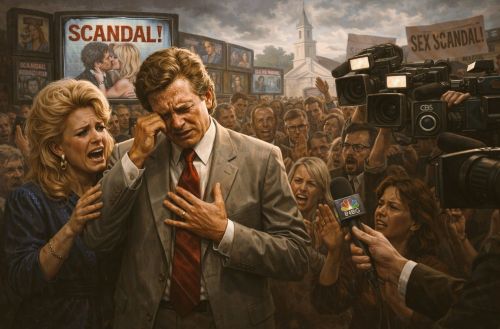
In 1980s America, televangelists fused moral authority, media spectacle, and partisan identity, revealing how scandal tests, but rarely dissolves, tribal loyalty.

By Matthew A. McIntosh
Public Historian
Brewminate
Introduction: Media, Morality, and the Rise of the Religious Right
The 1980s did not invent politically engaged evangelicalism, but they intensified and televised it. Conservative Protestant activism had been building since the mid-twentieth century, reacting to Supreme Court rulings on school prayer, abortion, and sexual regulation, as well as to broader cultural shifts associated with the sexual revolution. By the time Ronald Reagan won the presidency in 1980, a network of pastors, broadcasters, and organizers had already begun articulating a political theology centered on “family values,” moral restoration, and national renewal. The rise of televangelism must be situated within this wider realignment of conservative Christianity and partisan conservatism. Religious broadcasting did not simply mirror the movement; it amplified and reshaped it.
Television transformed religious authority by extending charismatic leadership beyond the local congregation. Evangelical broadcasters developed ministries that reached millions weekly, cultivating audiences who experienced spiritual guidance through screens rather than pews. Programs such as Jim Bakker’s PTL Club and Jimmy Swaggart’s revivalist broadcasts blurred the line between worship service, talk show, and fundraising platform. Viewers encountered preachers not only as theologians but as intimate personalities whose domestic settings, emotional appeals, and direct address fostered a sense of personal connection. The camera created proximity, rendering moral exhortation emotionally immediate and visually compelling. Religious programming adopted production techniques drawn from commercial entertainment, incorporating music, testimonials, staged interviews, and polished set design. These elements enhanced credibility while also reinforcing brand identity. Financial appeals were woven seamlessly into spiritual messaging, normalizing the exchange of donation for blessing or participation in a broader moral mission. Religious authority could scale rapidly, becoming national and even global in reach. Charisma was no longer confined to revival tents or church pulpits; it was broadcast into living rooms, integrating faith, media culture, and consumer participation.
The consolidation of the Religious Right during this period further fused moral rhetoric with partisan alignment. Organizations such as the Moral Majority framed political participation as a defense of Christian civilization against perceived secular decline. Abortion, feminism, and expanding LGBTQ visibility were presented as symptoms of cultural collapse. Televangelists frequently echoed and reinforced these themes, embedding political urgency within sermons about personal purity. Moral discourse functioned simultaneously as spiritual instruction and civic mobilization. To defend biblical standards was also to defend the nation.
This convergence of media, morality, and politics produced a distinctive form of public authority. Televangelists did not operate merely as religious leaders; they became symbolic representatives of a broader moral community defined by shared values and shared enemies. When scandal later emerged, it threatened more than individual reputations. It unsettled an identity structure in which moral credibility had been broadcast, monetized, and politicized. Understanding the scandals of Jim Bakker and Jimmy Swaggart requires attention not to personal failure alone but to the architecture of authority that television and partisan alignment had constructed.
The Construction of Televangelist Authority

Televangelist authority in the 1980s rested on a fusion of charisma, technology, and theology. Unlike parish clergy, whose legitimacy derived from denominational structures and local accountability, national broadcasters cultivated authority through mediated presence. The camera did not merely transmit sermons; it amplified personality. Facial expression, vocal cadence, tears, and spontaneous prayer were magnified and repeated weekly before vast audiences. Authority became performative and continuous rather than occasional and geographically bounded. Viewers developed parasocial relationships with ministers they would never meet, interpreting consistency of appearance and tone as evidence of sincerity.
Institutional scale reinforced this charismatic legitimacy. Ministries such as Jim Bakker’s PTL network built complex organizational structures that included production studios, satellite uplinks, mailing operations, educational initiatives, and Heritage USA, a sprawling Christian theme park that symbolized both religious aspiration and commercial ambition. The physical and financial magnitude of these enterprises signaled divine favor in the logic of prosperity-oriented theology, where material blessing was often framed as evidence of spiritual alignment. Growth itself functioned as proof. Expanding audiences, rising donations, and visible infrastructure were presented as confirmation that God endorsed the ministry’s mission. Televised tours of facilities, testimonials from beneficiaries, and reports of international outreach reinforced this narrative. Authority was measured not only in doctrinal terms but in measurable success, and measurable success was interpreted theologically. The spectacle of scale became part of the sermon, embedding legitimacy within the visible architecture of expansion.
Jimmy Swaggart’s authority operated through a somewhat different, though related, register. Rooted in Pentecostal revivalism, his broadcasts emphasized emotional intensity and personal holiness. Swaggart’s preaching style, marked by fervent denunciations of sin and visible weeping, cultivated an image of uncompromising moral seriousness. His musical performances reinforced spiritual authenticity, blending evangelism with gospel artistry. Viewers encountered not only a teacher but a prophetic voice. Authority here rested less on organizational grandeur than on moral urgency and perceived spiritual anointing. The camera translated revival tent intensity into domestic space.
Financial participation deepened loyalty and reinforced hierarchy. Donation appeals framed giving as covenantal partnership, linking personal blessing to ministry expansion. Regular contributors were integrated into identity networks through newsletters, prayer lines, conferences, and tiered donor programs that acknowledged faithful supporters. This reciprocal structure blurred the line between spiritual devotion and consumer behavior. Contributors received tangible symbols of belonging, from personalized correspondence to access to exclusive events. Giving was often framed as sacrificial obedience that would yield divine reward, reinforcing theological narratives of reciprocity. Donors were not merely supporters; they were stakeholders in a shared moral project whose continuation depended on their generosity. Financial investment created psychological investment, strengthening attachment to the leader whose ministry embodied communal values. As participation deepened, loyalty intertwined with identity.
The theological language surrounding these ministries further elevated their leaders. Both Bakker and Swaggart framed themselves as defenders of biblical truth in an era of cultural decline marked by secularism, permissiveness, and perceived hostility toward traditional Christianity. Moral authority was articulated in opposition to liberal trends within mainline denominations and broader societal shifts in sexual norms. By positioning themselves as guardians of orthodoxy, televangelists constructed a boundary between faithful insiders and corrupt outsiders. This rhetoric was not incidental but central. Conflict narratives intensified solidarity, casting criticism as persecution and opposition as validation of prophetic calling. Authority derived not only from charisma but from confrontation. The more embattled the movement appeared, the more urgent the leader’s voice became within it.
This construction of authority proved remarkably resilient prior to scandal. Media repetition, organizational scale, financial reciprocity, and theological boundary-making combined to produce leaders whose credibility extended beyond ordinary pastoral influence. Their legitimacy was embedded in networks of belief, investment, and shared identity. When controversy later emerged, it confronted not isolated figures but an elaborate system of mediated authority that had intertwined personal morality with communal belonging.
Moral Purity as Political Identity

By the 1980s, moral language had become inseparable from partisan identity within sectors of American evangelicalism. The defense of “family values” functioned not merely as theological affirmation but as political declaration embedded in campaign rhetoric, fundraising appeals, and voter mobilization drives. Sexual restraint, opposition to abortion, resistance to LGBTQ visibility, and advocacy of traditional gender roles were framed as nonnegotiable moral imperatives grounded in biblical authority. To uphold biblical morality was increasingly presented as synonymous with supporting conservative political candidates and policies. This alignment was reinforced through conferences, direct-mail campaigns, voter guides distributed in churches and coordinated messaging between religious broadcasters and political organizations. The alignment did not emerge spontaneously; it was cultivated deliberately through organizational networks, media platforms, and repeated broadcast messaging that linked spiritual fidelity with civic responsibility. Moral vocabulary and partisan language became mutually reinforcing, shaping a political culture in which theological conviction signaled electoral loyalty.
Televangelists played a crucial role in normalizing this fusion. Sermons that denounced cultural permissiveness frequently blended into commentary on Supreme Court decisions, federal education policy, and the moral direction of the nation. The personal was political in a literal sense. Congregants and viewers were told that private sexual behavior and public law reflected the same underlying spiritual struggle. Abortion, for example, was depicted not simply as policy dispute but as civilizational crisis. Sexual ethics were elevated to markers of national survival. Through repetition, moral purity became shorthand for political allegiance.
This rhetoric operated through boundary construction. Movements define themselves not only by shared commitments but by opposition to perceived threats. Secular humanism, feminism, gay rights activism, and liberal theology were cast as forces eroding divine order. The language of decline and restoration created a narrative arc in which believers occupied the role of guardians standing against corruption. Political participation acquired salvific overtones. Voting, donating, and mobilizing were framed as extensions of spiritual warfare. Moral identity became a badge signaling both religious orthodoxy and partisan alignment.
The Reagan era provided fertile ground for this convergence. Presidential rhetoric about America as a “city upon a hill” resonated with evangelical narratives of covenant and destiny, reinforcing the idea that national identity and spiritual faithfulness were intertwined. Public appearances by conservative Christian leaders alongside political figures symbolized a shared moral project. While the alliance between conservative Christians and the Republican Party was not uniform or uncontested, it solidified around shared priorities concerning abortion, school prayer, opposition to perceived cultural permissiveness, and resistance to expanding LGBTQ rights. Televangelists frequently amplified these themes, endorsing candidates implicitly or explicitly through coded language and voter guidance. Political leaders, in turn, appeared on religious broadcasts, reinforcing mutual legitimacy and signaling respect for evangelical constituencies. Moral discourse moved fluidly between pulpit and podium, creating a feedback loop in which religious rhetoric shaped policy advocacy and policy debates reinforced religious urgency.
Sexual purity assumed symbolic centrality. The integrity of the heterosexual nuclear family became emblematic of national stability. Deviations from this model were portrayed as symptoms of deeper rebellion against divine authority. The intensity of focus on sexual ethics reflected broader anxieties about rapid social change. By framing these issues in apocalyptic or civilizational terms, televangelists elevated them beyond pragmatic policy debate. Moral questions became identity markers, distinguishing the faithful from the unfaithful not only in church but in the voting booth.
The transformation of moral teaching into political identity had lasting consequences. When moral standards are fused with partisan loyalty, critique can appear as betrayal rather than disagreement. Leaders who embody the movement’s purity rhetoric become symbolic representatives of communal virtue, making their public image inseparable from the moral standing of their followers. Allegations of misconduct are filtered through group identity, often provoking defensive solidarity rather than immediate repudiation. Loyalty may override evidence, and repentance may be interpreted as persecution or spiritual attack rather than confirmation of wrongdoing. As a result, scandal threatens more than personal credibility; it destabilizes the identity architecture that binds theology to politics. The very intensity that energizes moral mobilization can complicate accountability when those who preached purity stand accused of violating it.
Jim Bakker: Sexual Scandal and Financial Collapse

Jim Bakker’s ministry embodied the height of 1980s televangelist expansion. Through the PTL Club and the development of Heritage USA in Fort Mill, South Carolina, Bakker constructed a religious empire that blended entertainment, hospitality, and evangelical messaging. Heritage USA was promoted as a Christian alternative to secular leisure culture, complete with hotels, water parks, and broadcast studios. The scale of the enterprise signaled divine blessing within the theological framework that linked material success to spiritual favor. Bakker’s televised persona emphasized warmth, optimism, and accessibility. He and his then-wife Tammy Faye Bakker cultivated a domestic intimacy that reinforced viewer trust. Authority rested not only on preaching but on presentation of a wholesome Christian lifestyle.
The scandal that erupted in 1987 centered on allegations involving Jessica Hahn, a church secretary who reported a sexual encounter with Bakker years earlier, followed by a financial settlement arranged by ministry associates. When details became public, the narrative shifted rapidly from moral exhortation to moral contradiction. Bakker had consistently preached sexual purity and denounced immorality within American culture, frequently warning viewers of the spiritual dangers of temptation and compromise. The revelation of private misconduct struck directly at the credibility of that message and destabilized the carefully cultivated image of marital and ministerial integrity. Media coverage expanded quickly, amplifying both the sexual dimension of the story and the broader financial operations of PTL. Investigative reports scrutinized fundraising appeals tied to lifetime lodging partnerships at Heritage USA, in which donors were promised annual stays that exceeded the ministry’s capacity to provide. Questions arose regarding accounting practices, executive compensation, and the use of donated funds. The scandal evolved from a narrative of personal failure into one of systemic mismanagement, intertwining sexual hypocrisy with financial impropriety in the public imagination.
Federal prosecution followed. In 1989 Bakker was convicted on multiple counts of mail fraud and conspiracy related to fundraising schemes that promised benefits the ministry could not fulfill. He was sentenced to prison, a dramatic fall from national prominence. The financial collapse of PTL accompanied the legal proceedings, with mounting debt and leadership turmoil destabilizing the organization. The spectacle of trial and imprisonment transformed Bakker from celebrated preacher to symbol of excess within religious broadcasting. Yet the judicial outcome did not eliminate his base of support. Many followers interpreted the prosecution through the lens of persecution, arguing that secular authorities targeted him because of his Christian witness.
The defense narratives that emerged reveal the structural dimension of the scandal. For devoted supporters, Bakker’s failure did not necessarily invalidate the broader moral framework he had articulated. Instead, it was reframed as evidence of human frailty, spiritual attack, or the corrupting pressures of fame and wealth. Public expressions of repentance, including written statements and later interviews, were interpreted by adherents as signs of genuine contrition rather than calculated rehabilitation. Some argued that the severity of his prison sentence demonstrated judicial overreach, reinforcing perceptions that religious conservatives faced disproportionate scrutiny. The language of redemption, deeply embedded in evangelical theology, provided a mechanism through which misconduct could be acknowledged yet spiritually transcended. Financial loss and organizational collapse were interpreted by certain audiences as tragic consequences of both personal sin and hostile media attention rather than as proof of systemic exploitation. Loyalty persisted because it was rooted in shared identity, doctrinal agreement, and emotional investment accumulated over years of broadcast intimacy.
Bakker’s trajectory illustrates the vulnerability and resilience of media-based moral authority. The same visibility that enabled rapid ascent intensified the scale of downfall. Televised charisma magnified scandal just as it had magnified influence. Yet the endurance of segments of his audience demonstrates how identity-based communities can absorb contradiction. The collapse of PTL exposed structural weaknesses in governance and accountability within televangelist ministries, but it also revealed the durability of loyalty when moral leadership is entwined with communal belonging.
Jimmy Swaggart: Confession, Repentance, and Repetition

Jimmy Swaggart’s scandal unfolded within a different institutional framework but exposed similar structural tensions. Unlike Jim Bakker, whose ministry was deeply entwined with expansive corporate infrastructure, Swaggart’s authority rested heavily on revivalist intensity, Pentecostal theology, and claims to personal holiness. His preaching style was confrontational and emotionally charged, marked by fiery denunciations of sin and emphatic calls to repentance. He frequently condemned sexual immorality with uncompromising language, positioning himself as a guardian of moral purity not only within Pentecostalism but within American Christianity more broadly. Swaggart’s broadcasts framed cultural decline as consequence of moral compromise, and he did not hesitate to criticize other ministers whom he believed insufficiently strict. This posture elevated his credibility among followers who valued doctrinal clarity and moral rigor. It also raised the stakes of his own conduct. When allegations of sexual misconduct emerged in 1988 involving encounters with a prostitute, the contradiction between rhetoric and behavior was stark. The scandal did not merely reveal personal failure; it disrupted an identity built upon visible severity toward the very sins now alleged.
The initial revelation triggered a dramatic public response. In February 1988, Swaggart delivered a televised confession before his congregation and national audience, weeping as he admitted wrongdoing and asking forgiveness. The spectacle of contrition became one of the most widely circulated religious broadcasts of the decade. Unlike Bakker’s legal defense and subsequent trial, Swaggart’s response centered on repentance as theological resolution. The language of sin, grace, and restoration framed the scandal within a narrative familiar to evangelical audiences. Confession functioned both as acknowledgment and as ritualized containment.
Institutional consequences followed, though they were uneven. The Assemblies of God denomination suspended Swaggart from ministry, requiring a period of rehabilitation before potential reinstatement. Swaggart rejected certain terms of discipline and ultimately continued his ministry independently. The conflict revealed tensions between denominational oversight and charismatic autonomy. His audience did not evaporate. Many viewers accepted the confession as sincere and interpreted the scandal as evidence of human weakness rather than doctrinal failure. Repentance served as bridge between misconduct and continued loyalty.
The pattern deepened when further allegations surfaced in 1991, again involving prostitution. The recurrence undermined claims that repentance had resolved the underlying issue and intensified scrutiny from both religious leaders and secular media. Public reaction was more muted than in 1988, perhaps reflecting fatigue or diminished surprise, yet the repetition reinforced skepticism among critics who viewed the earlier confession as insufficiently transformative. For supporters, however, responses varied along theological lines. Some disengaged, disillusioned by recurrence and concerned about integrity. Others remained, emphasizing forgiveness as central Christian virtue and interpreting repeated failure through the lens of spiritual struggle. The recurrence illuminated a key structural feature of identity-based moral communities: accountability and grace operate in tension. When repentance is doctrinally central, confession may preserve authority more effectively than denial, yet repeated confession strains credibility. Swaggart’s continued ministry demonstrated that loyalty could endure even when personal conduct contradicted public denunciations.
Swaggart’s case demonstrates the dual function of public repentance in media-driven religious movements. Confession can diffuse outrage by reframing scandal as spiritual struggle rather than structural corruption. Repeated misconduct exposes the limits of performative contrition. The tension between vulnerability and credibility becomes acute when moral authority rests on denunciations of precisely the behavior later confessed. In this interplay of sin, spectacle, and solidarity, Swaggart’s trajectory reveals how televised repentance may stabilize loyalty even as it destabilizes institutional trust.
Tribal Loyalty and Moral Community Insulation
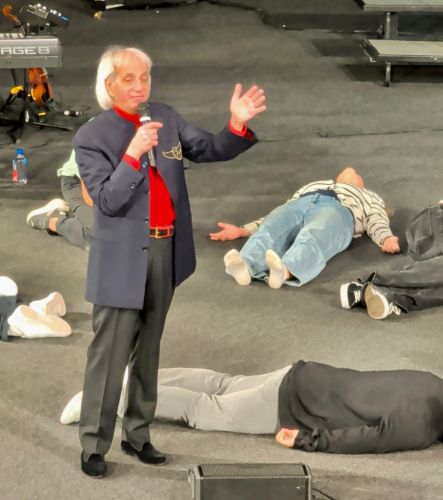
The endurance of support for Bakker and Swaggart cannot be explained solely by ignorance of evidence or naïve trust. Their ministries operated within moral communities structured around shared identity, shared narratives of cultural siege, and shared political commitments. When leaders are embedded within such networks, their credibility is intertwined with collective belonging. Allegations against them do not appear as isolated moral failures but as potential assaults on the community itself. Defense becomes less about the individual and more about protecting the integrity of the group’s moral story.
Political psychology offers insight into this dynamic. Identity-protective cognition suggests that individuals process information in ways that preserve group affiliation and self-concept. Within the Religious Right of the 1980s, televangelists symbolized resistance to secular liberalism and moral decline. Accepting allegations at face value could feel like conceding ground to ideological opponents or admitting that the movement’s moral clarity was compromised. As a result, scandal narratives were frequently reframed as persecution, spiritual attack, or media bias. Criticism from secular journalists or liberal commentators reinforced preexisting distrust, allowing supporters to discount evidence as hostile distortion rather than impartial reporting. Motivated reasoning operates most powerfully when identity stakes are high. The more central a leader becomes to communal self-understanding, the greater the psychological incentive to reinterpret damaging information in protective ways. Loyalty becomes intertwined with cognitive defense mechanisms that stabilize group cohesion in moments of threat.
The fusion of theology and politics intensified this insulation. When moral purity becomes a partisan marker, loyalty acquires spiritual weight. To abandon a leader publicly associated with biblical fidelity and conservative politics risks social and theological rupture. Communities that define themselves in opposition to external threats often cultivate internal solidarity as defense mechanism. Public repentance may restore credibility not only because of forgiveness doctrine but because communal unity is valued over fragmentation. In such settings, dissent can be interpreted as betrayal.
Media structure further reinforced insulation. Religious broadcasting networks, ministry newsletters, donor communications, and affiliated publications provided alternative interpretive frames distinct from mainstream news outlets. Viewers who consumed primarily sympathetic media encountered narratives emphasizing redemption, unfair targeting, prosecutorial excess, or moral hypocrisy among critics. These channels contextualized scandal within broader stories of cultural hostility toward Christianity. The existence of parallel information ecosystems allowed communities to sustain confidence even amid widespread criticism and legal scrutiny. Selective exposure to affirming narratives reduced cognitive dissonance and reinforced preexisting loyalties. Media segmentation contributed not only to the durability of moral authority but to the consolidation of identity boundaries between insiders and perceived adversaries.
Tribal loyalty does not eliminate accountability entirely, but it reshapes its contours. Leaders may suffer reputational damage, financial loss, or denominational discipline, yet segments of their following persist. The moral community absorbs contradiction by reinterpreting it through theological and political lenses. Scandal functions less as disqualifying rupture and more as stress test of allegiance. The insulation of leaders is not accidental; it is structural, rooted in identity formation that binds moral purity to collective survival.
Media, Spectacle, and the Commodification of Virtue
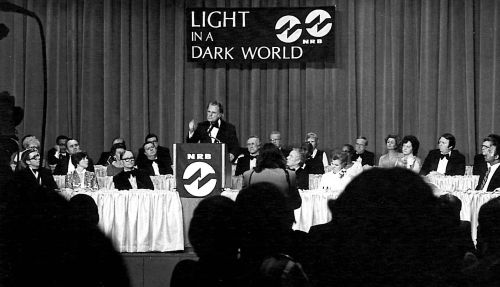
Televangelism in the 1980s did not merely transmit sermons; it packaged morality as consumable spectacle. Broadcast ministries adopted production values drawn from commercial television, blending religious exhortation with entertainment aesthetics. Studio lighting, musical interludes, testimonial segments, and emotionally charged appeals transformed spiritual instruction into an experience designed for mass appeal. Viewers were not passive recipients of doctrine but participants in a mediated drama of salvation and moral struggle. The spectacle itself became central to authority. Virtue was performed repeatedly before a national audience.
This performance had economic dimensions. Ministries depended on continuous fundraising, and moral urgency proved an effective mobilizing tool. Appeals for donations were framed as opportunities to defend biblical values, expand outreach, and resist cultural decline. Financial contribution became a tangible expression of moral alignment. Donors purchased not only religious programming but participation in a larger moral enterprise. Prosperity-inflected theology often reinforced this dynamic by linking generosity with divine favor. In such frameworks, economic exchange and spiritual identity intertwined.
The commodification of virtue extended beyond fundraising into brand construction. Televangelists developed recognizable visual identities, slogans, and thematic emphases that differentiated their ministries in a competitive religious marketplace. Bakker’s PTL projected warmth and optimism; Swaggart’s broadcasts emphasized intensity and uncompromising holiness. These branded identities allowed viewers to align themselves with particular moral styles. Loyalty to a ministry functioned similarly to loyalty to a product, reinforced through regular consumption and emotional investment. Virtue became associated with recognizable personalities and platforms.
Spectacle also shaped the reception of scandal. The same media apparatus that amplified moral authority amplified its collapse. Public confession, courtroom footage, and press conferences became televised events. Scandal unfolded as serialized drama, complete with emotional arcs and interpretive commentary. For audiences accustomed to experiencing faith through broadcast, even repentance became part of the spectacle. Media logic encouraged dramatic framing, emphasizing personal downfall and redemption narratives. Moral failure was narrated through familiar televisual conventions.
The commercialization of virtue created structural incentives that complicated accountability. Ministries required sustained audience engagement and financial support to maintain operations. Leaders faced pressure to sustain visibility and expansion. Success reinforced legitimacy, while decline threatened institutional survival. Transparency regarding financial strain or personal vulnerability could appear destabilizing. Spectacle rewarded confidence and certainty. The imperative to project unwavering moral authority could discourage candid acknowledgment of weakness until crisis forced exposure.
Televangelism reveals how modern media transforms moral leadership into branded performance. Virtue becomes both message and commodity, distributed through broadcast infrastructure and sustained through audience participation. The commodification of morality does not negate sincerity; many leaders and followers acted from genuine conviction. Yet the intertwining of spectacle, finance, and identity introduces vulnerabilities. When authority is mediated and monetized, scandal disrupts not only belief but the economic and performative structures that sustain it. The 1980s scandals illustrate how easily spectacle can pivot from celebration to collapse, while loyalty persists within communities shaped by media-bound moral identity.
Conclusion: Moral Identity and the Limits of Accountability
The televangelist scandals of the 1980s expose a structural paradox at the heart of media-driven moral movements. Jim Bakker and Jimmy Swaggart did not fall in isolation; they fell within systems that had fused religious conviction, political alignment, financial networks, and broadcast spectacle into a unified moral identity. Their authority rested not simply on doctrinal teaching but on performance, scale, and symbolic representation of a community under cultural pressure. When scandal broke, it disrupted that architecture. Yet the disruption did not dissolve the community that had helped construct it.
The durability of loyalty reveals the limits of exposure as corrective mechanism. Legal prosecution, denominational discipline, and media scrutiny imposed real consequences. Organizations collapsed, reputations fractured, and credibility diminished in broader public perception. Still, segments of each leader’s following persisted. Accountability operates differently within identity-based moral communities. When leaders become embodiments of collective virtue, their failure threatens shared belonging. Defensive reinterpretation, repentance narratives, and suspicion toward external critics can stabilize allegiance even under weight of evidence.
The fusion of moral purity and partisan identity intensifies this dynamic. In the 1980s, televangelists stood not only as religious figures but as cultural representatives of conservative Christianity in American politics. Scandal reverberated through theological and civic commitments simultaneously. To reject the leader could feel like rejecting the cause. When morality is tribalized, critique becomes entangled with perceived ideological opposition. Accountability is filtered through identity preservation.
The lessons extend beyond the personalities of Bakker and Swaggart. Media amplification, economic incentives, and political alignment continue to shape religious authority in contemporary contexts. The 1980s scandals demonstrate that moral absolutism does not guarantee institutional transparency. Instead, movements built upon strong moral identity may generate powerful mechanisms of insulation. Exposure can destabilize leaders, but loyalty may endure where identity remains intact. The limits of accountability lie not only in legal systems or denominational structures, but in the communal bonds that bind virtue to belonging.
Bibliography
Affiliate disclosure: Amazon links on this site are paid links. As an Amazon Associate I earn from qualifying purchases.
- Balmer, Randall. Thy Kingdom Come: How the Religious Right Distorts the Faith and Threatens America. New York: Basic Books, 2006.
- Biernatzki, William E. “Televangelism and the Religious Uses of Television.” Communication Research Trends 11:1-1 (1991)1-34.
- Bruce, Steve. Pray TV: Televangelism in America. London: Routledge, 1990.
- FitzGerald, Frances. The Evangelicals: The Struggle to Shape America. New York: Simon & Schuster, 2017.
- Frankl, Razelle. Televangelism: The Marketing of Popular Religion. Carbondale: Southern Illinois University Press, 1987.
- Hadden, Jeffrey K., and Charles E. Swann. Prime Time Preachers: The Rising Power of Televangelism. Reading, MA: Addison-Wesley, 1981.
- —-. “The Rise and Fall of American Televangelism.” The Annals of the American Academy of Political and Social Science 527:1 (1993), 113-130.
- —-. “Televangelism and the Mediated Charismatic Relationship.” The Social Science Journal 28:2 (1991), 143-162.
- Hoover, Stewart M. Religion in the Media Age. London: Routledge, 2006.
- James, Hunter. Smile Pretty and Say Jesus: The Last Great Days of PTL. Athens: University of Georgia Press, 2008.
- Kahan, Dan M. “Ideology, Motivated Reasoning, and Cognitive Reflection.” Judgment and Decision Making 8, no. 4 (2013): 407–424.
- Marsden, George M. Fundamentalism and American Culture. New York: Oxford University Press, 1980.
- Reagan, Ronald. “Address to the National Affairs Briefing,” Dallas, Texas, August 22, 1980.
- Schultze, Quentin J. Televangelism and American Culture: The Business of Popular Religion. Grand Rapids, MI: Baker Book House, 1991.
- Smith, Daniel Jordan. “The Pentecostal Prosperity Gospel in Nigeria: Paradoxes of Corruption and Inequality.” Journal of Modern African Studies 59:1 (2021), 103-122.
- Smith, Tom W. “The Impact of the Televangelist Scandals of 1987-88 on American Religious Beliefs and Behaviors.” GSS Social Change Report 34 (1991).
- United States v. Bakker, 925 F.2d 728 (4th Cir. 1991).
- Wilcox, Clyde, and Carin Robinson. Onward Christian Soldiers? The Religious Right in American Politics. Boulder, CO: Westview Press, 2010.
- Williams, Daniel K. God’s Own Party: The Making of the Christian Right. Oxford: Oxford University Press, 2010.
Originally published by Brewminate, 03.06.2026, under the terms of a Creative Commons Attribution-NonCommercial-NoDerivatives 4.0 International license.
About the Author