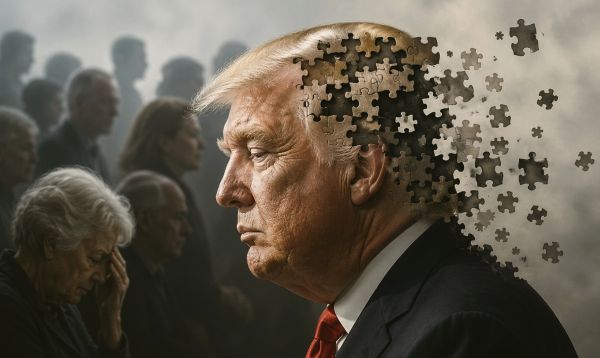
Blaming behavior we don’t like on a disease means less accountability, and is bad for those who live with dementia. It’s also often inaccurate.

By Dr. Joyce Siette
Associate Professor
Deputy Director, The MARCS Institute for Brain, Behaviour and Development
Western Sydney University

By Dr. Paul Strutt
Senior Lecturer in Psychology
Western Sydney University
Introduction
Over recent weeks, speculation has grown about US President Donald Trump’s erratic behaviour during the US-Israel war on Iran.
While questioning Trump’s mental fitness for office, various commentators have suggested he has malignant narcissism, Alzheimer’s disease or frontotemporal dementia, and is experiencing accelerating cognitive decline and a “profound psychological crisis”.
The claim of frontotemporal dementia in particular has stuck. This form of dementia can affect judgement, empathy, language skills and impulse control.
Trump’s critics say frontotemporal dementia explains his escalating threats, profanities and tendency to ramble.
But is frontotemporal dementia really the answer?
Diagnosing someone with this condition from afar is not only irresponsible – it’s impossible. It may also inadvertently give Trump an “out” for offensive but intentional behaviour, while increasing stigma for those who live with dementia.
What Is Frontotemporal Dementia?
Frontotemporal dementia describes a group of neurodegenerative disorders that mostly affect the frontal and temporal lobes of the brain. These are regions involved in behaviour, personality, language and decision-making.
Unlike dementia due to Alzheimer’s disease, frontotemporal dementia rarely begins with memory loss. Instead, early symptoms involve changes in social conduct, emotional regulation or language abilities.
There are several variants. The most common is behavioural-variant, which presents as a gradual decline in how a person behaves, interacts with others and expresses their personality.
Frontotemporal dementia is rare. Each year, around two or three out of 100,000 people are diagnosed with frontotemporal dementia worldwide. At any time, roughly nine out of 100,000 people live with the condition.
How Is It Diagnosed?
Diagnosis is complex and cannot rely on observation alone.
To make a diagnosis, a multidisciplinary team of clinicians will examine the person’s personal and medical history. This includes information from family members, neurological examinations and formal cognitive testing to consider possible diagnoses.
Brain imaging, such as MRI or PET scans, are used to identify changes in the structure and function of the brain. In some cases, genetic testing may be used when family history suggests inherited risk.
A “possible” diagnosis requires someone to demonstrate at least three of six core features. These are:
- disinhibition
- apathy
- loss of empathy
- compulsive behaviour
- hyperorality (excessive tendency to examine objects using the mouth)
- loss of executive functions, the set of cognitive abilities that underpin our ability to plan and make decisions.
Importantly, these features must also show clear progression over time.
But that is only the beginning. To reach a “probable” diagnosis, there must be imaging evidence as well as clear changes in a person’s ability to function independently in daily activities.
A “definite” diagnosis can only be confirmed through genetic testing or brain changes linked to disease. This can only happen after death because it requires physically examining the brain itself.
Even with these criteria, frontotemporal dementia remains one of the most challenging diseases to diagnose accurately. Its symptoms often overlap with psychiatric disorders such as bipolar disorder and schizophrenia, and its presentation varies widely between people.
Careful differential diagnosis, which rules out other conditions, is therefore required.
Why We Shouldn’t Diagnose from a Distance

Diagnosing frontotemporal dementia – or any form of dementia – is a complex process. Any “diagnosis” made without meeting the person, or looking at clinical evidence, is just speculation.
But there are other dangers in blaming controversial actions on dementia, such as Trump’s recent threat to wipe out “a whole civilisation” if Iran did not comply with US demands.
First, attributing behaviour we don’t like to dementia reduces accountability for intentional actions.
We know frontotemporal dementia affects brain regions that control impulse and social understanding. It does not explain political extremism, strategic decision-making or ideological conviction – especially where it has been longstanding.
Second, it further stigmatises those who live with the condition, reinforcing the idea that people with dementia are erratic, dangerous or morally compromised.
This stigma remains a major barrier to effective dementia care and prevention. Misconceptions can delay diagnosis, discourage families from seeking help, and make people with dementia feel more isolated.
In frontotemporal dementia, where changes in personality are already misunderstood, the risk of mischaracterisation is particularly acute.
The Ethics of Restraint
Humans are driven to make sense of troubling events. This negativity bias that has served us well in evolution. But it creates an asymmetry worth noting.
When leaders behave admirably, their actions are rarely attributed to neurological health. But when behaviour is troubling, the impulse to medicalise it can be strong. This selective framing turns diagnosis into a rhetorical tool rather than a clinical question.
The health of political leaders is a legitimate public concern. But there is a difference between evidence-based reporting (grounded in disclosed medical information) and speculative diagnosis based on observation from a distance.
Medical professionals have long recognised this boundary. Ethical guidelines warn against diagnosing individuals without examination, in part because doing so undermines trust in both medicine and the media.
Speculation about dementia may feel like a way of making sense of behaviour that is difficult, unsettling or even morally questionable. But it is a poor substitute for clinical rigour.
For those living with frontotemporal dementia, it risks turning a serious neurological disease into a casual metaphor that explains little and harms a lot.
Originally published by The Conversation, 04.22.2026, under the terms of a Creative Commons Attribution/No derivatives license.
About the Author