European leaders expected the Crimean War to remain a short, controlled conflict, but logistical failures, siege warfare, and political pressures transformed it into a prolonged struggle.

By Matthew A. McIntosh
Public Historian
Brewminate
Introduction: The Expectation of a Contained War
When the Crimean War began in 1853, many European leaders believed they were entering a conflict that would remain limited in scope and duration. The tensions that produced the war emerged from the long-standing geopolitical problem known as the “Eastern Question,” which concerned the gradual weakening of the Ottoman Empire and the implications of that decline for the balance of power in Europe. Russia sought to expand its influence in territories historically connected to Ottoman authority, while Britain and France feared that unchecked Russian expansion could disrupt the strategic equilibrium that had shaped European diplomacy since the Congress of Vienna. Despite these tensions, the initial stages of the crisis were widely viewed as a manageable confrontation that could be resolved through a combination of diplomatic pressure and limited military action.
The assumption that the war would remain contained reflected broader patterns in nineteenth-century European diplomacy. The great powers had developed a system of political interaction designed to prevent large-scale continental wars after the upheavals of the Napoleonic era. Military force was still considered a legitimate tool of policy, but it was often expected to serve as a controlled instrument of diplomacy rather than the opening stage of prolonged conflict. When Russian forces moved into Ottoman territories along the Danube, policymakers in several capitals believed that a demonstration of force by Britain and France would compel Russia to withdraw without requiring a sustained military campaign.
Yet these expectations underestimated the complexity of the strategic situation. The conflict involved multiple powers with different political objectives, and each government faced domestic pressures that made compromise increasingly difficult. Russia viewed its actions as a legitimate assertion of influence in regions where it claimed historical and religious interests, while Britain and France framed their intervention as a necessary defense of the European balance of power. As diplomatic negotiations faltered, military commitments gradually expanded beyond what many leaders had originally envisioned.
The Crimean War illustrates a recurring phenomenon in the history of international conflict: the tendency of political leaders to assume that war can be carefully limited and controlled. At the outset, policymakers frequently believe that military action will produce quick political results without generating broader escalation. The events that followed in Crimea, however, revealed how fragile such assumptions can be once hostilities begin. What many had anticipated as a short demonstration of power instead developed into a prolonged and costly struggle that exposed weaknesses in military organization, logistical planning, and political judgment across several of Europe’s most powerful states.
The Eastern Question and the Political Context of War

The political origins of the Crimean War cannot be understood without examining the broader geopolitical problem known as the Eastern Question. Throughout the nineteenth century, European powers struggled to determine how to manage the gradual decline of the Ottoman Empire, which had once dominated much of southeastern Europe and the eastern Mediterranean. As Ottoman authority weakened, neighboring powers saw opportunities to expand their influence into territories that had previously been governed from Constantinople. European diplomats feared that the collapse of Ottoman power might produce instability across the region, potentially triggering wider conflicts among rival states.
Russia played a central role in these tensions. Since the eighteenth century, Russian rulers had sought greater influence in the Black Sea region and the Balkans, areas populated by large numbers of Orthodox Christians who shared religious ties with the Russian Empire. Russian leaders frequently portrayed themselves as protectors of Orthodox communities living under Ottoman rule, a claim that carried both political and religious significance. The Russian Empire had long viewed access to warm-water ports and influence in the eastern Mediterranean as essential strategic objectives, particularly given the geographic limitations imposed by Russia’s northern climate and the seasonal freezing of many of its harbors. By the mid-nineteenth century, Russian policymakers believed that the declining Ottoman state could no longer effectively govern its diverse territories and that Russian influence in the region was both justified and inevitable. These ambitions were reinforced by earlier Russian victories against the Ottomans in the eighteenth and early nineteenth centuries, which had gradually expanded Russian authority along the northern shores of the Black Sea.
Other European powers viewed these ambitions with deep suspicion. Britain, in particular, regarded the Ottoman Empire as a crucial barrier preventing Russian expansion toward the Mediterranean and the strategic routes to India. British policymakers worried that Russian control of key territories near the Bosporus and Dardanelles could dramatically shift the balance of power in the eastern Mediterranean and threaten Britain’s imperial interests in Asia. French leaders also saw opportunities to assert their influence in the region while simultaneously reinforcing France’s position within European diplomacy following the rise of Napoleon III. The French government’s involvement in disputes over Christian holy sites in the Ottoman Empire reflected both religious concerns and broader geopolitical ambitions. These competing interests meant that developments within the Ottoman Empire were rarely treated as purely regional matters. Instead, the Eastern Question became a recurring source of diplomatic tension among the major powers of Europe.
The immediate crisis that triggered the Crimean War emerged from disputes over religious privileges in the Ottoman-controlled Holy Land. Competing claims by Catholic and Orthodox communities regarding access to Christian holy sites in Jerusalem and Bethlehem became entangled with the political ambitions of France and Russia. Napoleon III’s government supported Catholic claims, while Russia pressed the Ottoman authorities to recognize its role as protector of Orthodox Christians throughout the empire. What might have remained a localized religious dispute gradually evolved into a diplomatic confrontation involving multiple European powers.
When negotiations failed to produce a compromise, Russia increased the pressure on the Ottoman government by occupying the Danubian principalities of Moldavia and Wallachia in 1853. Russian leaders expected that this move would compel the Ottomans to accept their demands without provoking a wider war. Instead, the occupation heightened fears in London and Paris that Russia intended to expand its influence throughout southeastern Europe. Diplomatic efforts to defuse the crisis continued for several months, but mutual suspicion and miscalculation gradually narrowed the possibilities for a peaceful settlement.
By the time hostilities formally began, the Eastern Question had transformed from a long-standing diplomatic concern into an active military conflict. The war that followed was not the result of a single decision or incident but the culmination of decades of geopolitical rivalry, strategic anxiety, and competing interpretations of Ottoman decline. Understanding this political context helps explain why European leaders initially believed the conflict could be contained. Many policymakers assumed that the balance-of-power system developed after the Napoleonic Wars would prevent escalation beyond limited confrontation. Instead, the overlapping ambitions of the great powers, combined with diplomatic misjudgments and rising nationalist sentiment, created conditions in which compromise became increasingly difficult. Once military operations began, the political dynamics that had initially encouraged caution gradually gave way to the logic of war itself.
Strategic Assumptions among European Leaders

In the months leading to open hostilities, political and military leaders across Europe formed strategic assumptions that shaped how they approached the emerging conflict. Many policymakers believed that the crisis could be resolved through limited military pressure rather than through a prolonged campaign. Governments in London and Paris expected that a demonstration of naval and military strength would persuade Russia to withdraw from the Danubian principalities and accept diplomatic compromise. The idea that the war could be contained reflected the prevailing belief among European statesmen that major powers still possessed the ability to manage conflicts within the framework of balance-of-power diplomacy.
Russian leadership held its own set of assumptions about the likely course of events. Tsar Nicholas I believed that Russia’s position in southeastern Europe was both strategically justified and diplomatically defensible. Russian officials assumed that Britain and France would hesitate to commit themselves to a large-scale war on behalf of the Ottoman Empire, which many European observers considered politically fragile and militarily weak. Nicholas also believed that divisions among the Western powers might prevent them from forming a unified coalition against Russia. These expectations encouraged Russian policymakers to view the occupation of Moldavia and Wallachia as a calculated move that would strengthen their negotiating position without provoking a broader European war.
British and French leaders, however, were equally confident in their own strategic calculations. Many British officials believed that Russia would ultimately avoid direct confrontation with a coalition of Western powers. Britain possessed one of the world’s most powerful navies, and policymakers in London expected that naval pressure in the Black Sea could force Russia to reconsider its ambitions in the region. In France, Napoleon III also saw the conflict as an opportunity to restore French prestige in European affairs while demonstrating the strength of his regime. Yet neither government initially anticipated the scale of military commitment that would eventually be required.
Underlying these strategic calculations was a shared assumption that the war would remain geographically limited. European leaders expected that hostilities would focus primarily on areas surrounding the Black Sea and the Danubian frontier. Few policymakers initially imagined that the conflict would involve prolonged campaigns, large expeditionary forces, or extensive sieges. Military planning reflected expectations of a relatively short confrontation in which diplomatic negotiations would soon follow initial military operations. In many respects, these assumptions reflected the diplomatic culture of nineteenth-century Europe, where governments often viewed military force as a tool for influencing negotiations rather than as the beginning of a sustained struggle. Political leaders believed that limited engagements could be used to demonstrate resolve and compel concessions without triggering a broader transformation of the conflict. As a result, many governments underestimated the logistical and organizational challenges that would emerge once large armies were deployed far from their home territories.
These strategic misjudgments reveal how political expectations can shape the early stages of a conflict. Each of the major powers believed that controlled military pressure would produce favorable diplomatic outcomes without requiring a sustained war effort. Instead, the interaction of competing ambitions and miscalculations gradually expanded the scope of the conflict. Once the war moved beyond the initial diplomatic crisis, the strategic assumptions that had guided European leaders began to unravel, forcing governments to confront the realities of a much larger and more complex war than they had originally anticipated.
Logistics, Organization, and the Reality of War

As the Crimean War progressed, the expectations of a short and controlled conflict began to collide with the practical realities of conducting large-scale military operations. European armies of the mid-nineteenth century were not yet fully adapted to the demands of modern warfare, particularly when operating far from their home territories. The deployment of large expeditionary forces to the Crimean Peninsula required extensive planning, reliable supply networks, and efficient administrative coordination. Yet the armies involved in the campaign often struggled to maintain consistent logistical support once operations began.
The difficulties were particularly evident after Allied forces landed in Crimea in 1854 with the goal of neutralizing the Russian naval base at Sevastopol. Although the initial landings were conducted successfully, the Allied armies soon encountered severe supply shortages. Food, ammunition, medical equipment, and winter clothing were often delayed or poorly distributed. The logistical systems responsible for transporting supplies from ports to the front lines proved inadequate for sustaining a large army engaged in prolonged operations. These problems were not limited to a single army but affected several of the forces participating in the campaign.
Administrative inefficiencies compounded these challenges. Military organizations still relied heavily on bureaucratic structures that had evolved during earlier wars but had not been fully adapted to the scale and complexity of mid-nineteenth-century conflicts. Communication between commanders and supply officials was frequently slow or disorganized, and coordination among the allied armies was sometimes inconsistent. Responsibility for transportation, storage, and distribution of supplies was often divided among different departments that operated with limited coordination, which created delays even when essential resources were available. Commanders in the field frequently struggled to obtain accurate information about supply levels, while logistical officials faced difficulties responding quickly to changing operational conditions. As a result, soldiers often faced shortages and difficult living conditions even when supplies technically existed within the broader military system.
The harsh winter of 1854–1855 exposed these weaknesses with particular severity. Thousands of soldiers suffered from disease, exposure, and inadequate shelter as supply systems struggled to deliver essential provisions. In many cases, illness and logistical failure inflicted greater losses than direct combat. The difficulties faced by the Allied armies drew growing attention in Britain and France, especially as reports from journalists and observers began to reveal the scale of the suffering experienced by soldiers in the field.
The Russian army also faced significant logistical challenges, though its position differed from that of the Allied forces. Russian troops were operating closer to their own territory and benefited from shorter supply routes. However, Russia’s infrastructure and transportation networks were often insufficient to support sustained military operations on the scale required by the war. The difficulties of moving troops and supplies across long distances placed considerable strain on the Russian military system and limited its ability to respond quickly to changing conditions on the battlefield.
These logistical and organizational difficulties revealed a fundamental gap between elite expectations and the brutal conditions of industrial-era conflict. Governments that had initially assumed the conflict would remain limited now found themselves struggling to sustain large armies in a demanding operational environment. The Crimean War exposed weaknesses in military administration and planning that had previously remained hidden during peacetime. The challenges of supply, coordination, and organization demonstrated that even powerful states could encounter serious difficulties once a war extended beyond the short and controlled campaign that many policymakers had originally anticipated.
The Siege of Sevastopol and the Transformation of the War

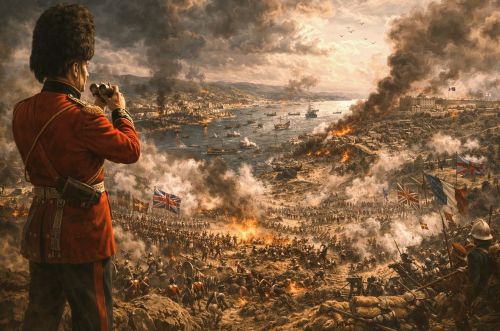
The central military episode of the Crimean War was the siege of Sevastopol, the principal Russian naval base on the Black Sea. Allied leaders initially believed that the capture of the city would deliver a decisive blow to Russian power in the region and quickly force the Russian government to negotiate. The decision to attack Sevastopol reflected the strategic assumption that a concentrated military effort against a critical target could end the war swiftly. Instead, the siege evolved into a prolonged and grueling campaign that transformed the character of the conflict.
After landing in Crimea in September 1854, British, French, and Ottoman forces advanced toward Sevastopol and defeated Russian troops at the Battle of the Alma. Although this early victory appeared to confirm Allied confidence, it did not lead to the rapid collapse of Russian defenses that many commanders had expected. Rather than launching an immediate assault on the city, Allied forces chose to establish positions to the south and begin a formal siege. This decision gave Russian commanders time to strengthen the city’s defenses and prepare for a drawn-out siege. The delay also allowed Russian engineers and officers to reorganize the defense of the city in a systematic way, creating layered fortifications designed to slow any Allied advance. What might have become a rapid offensive operation instead evolved into a siege campaign that required sustained military effort, complex coordination among allied forces, and the gradual erosion of Russian defensive positions.
Russian forces under the direction of military engineers and naval officers rapidly transformed Sevastopol into a heavily fortified defensive position. Warships in the harbor were deliberately scuttled to block Allied naval entry, while artillery from the fleet was removed and redeployed to reinforce land defenses. Soldiers and civilians worked together to construct extensive earthworks, trenches, and defensive batteries surrounding the city. These preparations significantly strengthened the Russian position and made the capture of Sevastopol far more difficult than Allied planners had anticipated.
As the siege progressed, the conflict increasingly resembled the kind of attritional warfare that would later characterize twentieth-century conflicts. Both sides engaged in sustained artillery bombardments, trench construction, and repeated assaults on fortified positions. Casualties mounted as soldiers fought in difficult conditions, and neither side achieved a rapid breakthrough. The battlefield environment around Sevastopol became dominated by engineering works, siege artillery, and carefully constructed defensive lines. Commanders were forced to rely on gradual advances and sustained pressure rather than the rapid maneuver warfare that many had expected earlier in the campaign. The slow pace of operations demonstrated how defensive fortifications and determined resistance could transform a campaign intended to produce quick results into a prolonged struggle.
The siege also exposed the human costs of the war on an unprecedented scale. Soldiers endured harsh weather, disease, and exhausting combat conditions while attempting to maintain their positions around the city. Medical services were often overwhelmed by the number of wounded and sick soldiers, and the difficulties of transporting the injured added further strain to already fragile logistical systems. Camps surrounding Sevastopol became environments where disease spread rapidly, and the physical exhaustion of soldiers was compounded by shortages of adequate shelter and supplies. Reports from the front, including those written by war correspondents and observers, brought the suffering experienced during the siege to the attention of European audiences. These accounts contributed to growing public awareness of the operational demands of modern war and intensified criticism of military administration and political leadership.
When Sevastopol finally fell in September 1855 after nearly a year of fighting, the outcome represented a hard-fought victory rather than the quick strategic triumph originally envisioned by Allied planners. The long siege had drained resources, inflicted heavy casualties, and demonstrated the difficulty of achieving decisive results even when attacking a major strategic objective. The campaign around Sevastopol marked a turning point in the Crimean War, transforming what many leaders had assumed would be a limited conflict into a prolonged and costly struggle.
Media, Public Opinion, and the First Modern War Narrative

One of the most significant developments during the Crimean War was the emergence of modern war reporting and its influence on public opinion. For the first time in a major European conflict, newspapers carried relatively frequent reports from correspondents stationed near the front lines. These accounts provided readers with vivid descriptions of battles, living conditions, and the experiences of soldiers. The increased flow of information between the battlefield and the public at home transformed the relationship between war and political accountability, as governments could no longer easily control the narrative surrounding military operations.
British journalist William Howard Russell of The Times became one of the most prominent figures associated with this new form of war reporting. His dispatches from Crimea described not only the progress of the campaign but also the suffering of soldiers and the failures of military administration. Russell’s reports criticized the inefficiency of supply systems, the poor conditions endured by troops, and the lack of coordination within the British command structure. Unlike earlier military reporting, which often relied heavily on official statements or delayed accounts, Russell’s dispatches attempted to convey the immediate realities faced by soldiers in the field. His writings exposed readers in Britain to the logistical breakdowns that had plagued the campaign, including the shortages of food, clothing, and medical care that became especially severe during the winter of 1854–1855. These accounts challenged the optimistic expectations that had accompanied the early stages of the war and forced political leaders to confront growing public dissatisfaction.
The Crimean War also coincided with the expanding influence of illustrated journalism and early war photography. Artists and illustrators working for newspapers and magazines produced images that allowed readers to visualize distant battlefields and military camps. Publications such as the Illustrated London News regularly printed scenes depicting soldiers, fortifications, and daily life in the camps around Sevastopol. Photographers such as Roger Fenton captured scenes from the war that circulated widely in Europe, offering audiences a new way to observe the physical environment of military conflict. Although many of these images avoided the most graphic depictions of combat, they nevertheless contributed to a broader awareness of the conditions under which soldiers were fighting. The visual dimension of war reporting created a powerful connection between distant battlefields and audiences at home, allowing the public to imagine the landscapes, camps, and fortifications that defined the conflict.
As information from the front reached European audiences, public opinion increasingly shaped political debate about the war. Reports describing inadequate medical care and poor logistical organization sparked criticism of government leadership and military administration. In Britain, public outrage over the suffering of soldiers contributed to demands for reform within the army and greater oversight of wartime decision-making. The visibility of these problems demonstrated how rapidly public perceptions of a conflict could shift once the realities of warfare became widely known.
The role of the media also influenced how governments attempted to frame the purpose and progress of the war. Political leaders sought to maintain support for the campaign by emphasizing strategic objectives and national prestige. Yet the constant flow of information from correspondents made it increasingly difficult to sustain narratives of simple or inevitable victory. Official statements often presented the war as a controlled effort to defend European stability and check Russian expansion, but reports from the battlefield frequently revealed confusion, hardship, and setbacks. This divergence between official messaging and journalistic reporting produced growing skepticism among readers and political observers. As newspapers continued to publish detailed accounts of military conditions, governments found it harder to shape public perception through carefully managed narratives.
The Crimean War represents an important moment in the history of modern warfare and communication. The emergence of war correspondents, illustrated journalism, and early photography created new channels through which the public could observe the conduct of military campaigns. These developments helped shape a new kind of war narrative in which public opinion played a more visible role in evaluating political decisions and military performance. The Crimean War foreshadowed later conflicts in which media coverage and public scrutiny would become integral elements of how wars were understood and contested.
Patterns of Misjudging Limited War

The Crimean War also reveals a broader historical tendency: governments often assume that military pressure can produce quick concessions without unleashing a longer and more destructive struggle. Governments often enter conflicts with the expectation that decisive pressure will produce political concessions from their adversaries without requiring a lengthy war. In practice, however, wars frequently evolve in ways that escape the assumptions of those who initiated them. Strategic calculations that appear sound during diplomatic crises may prove fragile once armies mobilize and military operations begin.
One reason these expectations persist is the influence of prior political and military experiences. States that have recently succeeded in using limited force to achieve diplomatic objectives may assume that similar strategies will work again. Leaders may also underestimate the capacity of opponents to resist or adapt, particularly when facing adversaries perceived as weaker or politically unstable. In the case of the Crimean War, European policymakers initially believed that Russia would retreat under diplomatic and military pressure, while Russian leaders assumed that Britain and France would avoid deep military involvement. These assumptions encouraged decisions that escalated the conflict even as each side expected the war to remain manageable.
Another factor contributing to the misjudgment of limited wars is the difficulty of predicting how multiple actors will respond once hostilities begin. Wars rarely involve a single set of political calculations. Instead, they unfold within a dynamic environment shaped by alliances, domestic political pressures, and the evolving strategies of competing states. Actions intended to signal strength or compel negotiation can instead provoke countermeasures that expand the scope of the conflict. Governments that initially seek limited objectives may gradually broaden their aims as the war develops, especially if early expectations prove incorrect. Domestic political pressures can also influence decision-making, as leaders fear that compromise or withdrawal might appear as weakness to both their own populations and foreign rivals. The political logic that once supported restraint may give way to the pressures of escalation, making it increasingly difficult to contain a war within the limits originally envisioned.
The experience of the Crimean War demonstrates how quickly a conflict assumed to be limited can expand into a prolonged and complex campaign. What began as a diplomatic confrontation over influence within the Ottoman Empire developed into a multi-year war involving large armies, extended sieges, and intense political debate across Europe. The misjudgments that accompanied the outbreak of the war highlight the persistent challenge faced by political leaders when they attempt to predict the course of military conflict. Even when governments seek to control the scale and duration of war, the interaction of strategic decisions and unforeseen circumstances can transform those expectations in ways that reshape the entire conflict.
Conclusion: The Limits of Political Control over War
The Crimean War began with the widespread assumption that European powers could manage a limited conflict without allowing it to expand into an extended war. Political leaders believed that military force could be used as a measured tool of statecraft, compelling concessions while preserving the wider European equilibrium. Yet the events of the war demonstrated how fragile such expectations can be once hostilities begin. The strategic assumptions that shaped the outbreak of the conflict quickly encountered the unpredictable realities of warfare, including logistical difficulties, determined resistance, and the expanding commitments of rival powers.
The experience of the war revealed how political calculations made during diplomatic crises often underestimate the complexity of military operations. Governments that initially expected a short confrontation found themselves drawn into a campaign that required sustained deployments, extended sieges, and significant human and financial costs. Once armies were mobilized and major powers became directly engaged, the conflict developed its own momentum. Statesmen who had once treated limited pressure as a tool of negotiation instead faced the challenge of managing a war that could no longer be easily contained. As military operations expanded and casualties mounted, governments had to balance strategic objectives with the political consequences of continued fighting. Decisions that initially seemed temporary or tactical gradually became part of a broader commitment to victory, making withdrawal or compromise increasingly difficult without risking political credibility or diplomatic influence.
The Crimean War also demonstrated the growing influence of public opinion and media coverage in shaping the conduct of war. Reports from correspondents, images from the battlefield, and political debate at home placed new scrutiny on military leadership and government decision-making. These developments complicated efforts by policymakers to control the narrative surrounding the conflict. As the realities of the campaign became visible to the public, governments faced increasing pressure to justify the costs and objectives of a war that had expanded beyond the expectations of its earliest planners.
The Crimean War provides an enduring lesson about the limits of political control over military conflict. Even when leaders attempt to design wars that remain limited in scope and duration, the interaction of strategic decisions, logistical realities, and public pressures can reshape the course of events in unexpected ways. The conflict shows how logistical strain, coalition politics, and public scrutiny can dismantle the original assumptions with which governments enter war. By examining the Crimean War within this broader historical pattern, historians gain insight into how assumptions about limited conflict can give way to the far more complicated realities of war.
Bibliography
Affiliate disclosure: Amazon links on this site are paid links. As an Amazon Associate I earn from qualifying purchases.
- Anderson, M. S. The Eastern Question, 1774–1923. London: Macmillan, 1966.
- Bates, Rachel. “Negotiating a ‘Tangled Web of Pride and Shame’: A Crimean Case-Study.” Museum & Society 13:4 (2015).
- Figes, Orlando. The Crimean War: A History. New York: Metropolitan Books, 2010.
- Freedman, Lawrence. Strategy: A History. Oxford: Oxford University Press, 2013.
- Goldfrank, David M. The Origins of the Crimean War. London: Longman, 1994.
- Hinton, Mike. “Reporting the Crimean War: Misinformation and Misinterpretation.” Interdisciplinary Studies in the Long Nineteenth Century 20:19 (2015).
- Keegan, John. A History of Warfare. New York: Vintage Books, 1993.
- Knightley, Phillip. The First Casualty: The War Correspondent as Hero and Myth-Maker from the Crimea to Iraq. Baltimore: Johns Hopkins University Press, 1975.
- Lambert, Andrew. The Crimean War: British Grand Strategy, 1853–56. Manchester: Manchester University Press, 1990.
- Lieven, Dominic. Empire: The Russian Empire and Its Rivals. New Haven: Yale University Press, 2001.
- Mawbie, Darcy. “Frances Duberly: A Failed Crimean Heroine?” Women’s History Review 34:7 (2025), 1156-1174.
- Royle, Trevor. Crimea: The Great Crimean War, 1854–1856. New York: Palgrave Macmillan, 1999.
- Strachan, Hew. European Armies and the Conduct of War. London: Routledge, 1983.
Originally published by Brewminate, 03.12.2026, under the terms of a Creative Commons Attribution-NonCommercial-NoDerivatives 4.0 International license.
About the Author