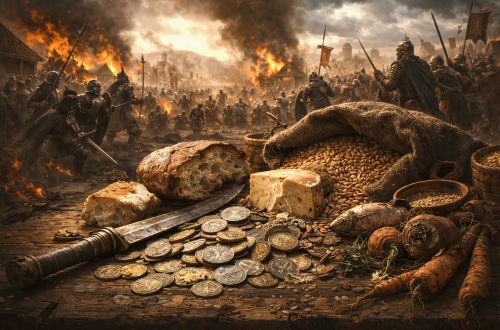
Medieval warfare strained fragile supply systems, driving price shocks in food, fuel, horses, and coinage as military demand disrupted production and destabilized markets.

By Matthew A. McIntosh
Public Historian
Brewminate
Introduction: War, Resources, and the Medieval Price System
In the medieval world, the economic consequences of warfare were felt most immediately in the availability and price of essential resources. Unlike modern economies, where energy shocks often revolve around oil or gas, medieval societies depended on agricultural production, animal power, timber, and metalworking to sustain both civilian life and military operations. When armies mobilized, they drew heavily upon these limited resources, consuming enormous quantities of food, fodder, wood, and iron. Such sudden surges in demand collided with fragile production systems that were highly sensitive to seasonal cycles, labor availability, and environmental conditions. Agricultural yields depended heavily on weather and harvest cycles, while timber and charcoal production required time-intensive management of forests and woodland resources. When military campaigns suddenly absorbed these materials, local economies often lacked the capacity to replace them quickly. As a result, warfare frequently produced rapid and severe price increases across basic commodities, destabilizing regional markets and imposing heavy burdens on civilian populations. Markets that normally operated within predictable seasonal rhythms could be thrown into chaos when armies requisitioned supplies or destroyed productive land.
The structure of medieval economies amplified the impact of these disruptions. Most people lived within local or regional economic systems in which supply chains were short and production was closely tied to nearby land and forests. Armies moving through a region could disrupt economic life almost immediately. Crops were seized or destroyed, livestock was requisitioned, and timber resources were rapidly consumed for fortifications, wagons, and siege equipment. In addition, military forces required vast quantities of fodder to sustain cavalry horses and draft animals, placing further pressure on agricultural output. When these resources were diverted toward military use, civilian markets experienced shortages that quickly translated into rising prices for grain, hay, oats, and other staples.
War also created financial pressures that extended beyond the battlefield itself. Medieval rulers lacked modern systems of public finance and relied on extraordinary taxation, forced loans, confiscation of treasure, or the seizure of bullion to fund major campaigns. These measures could disrupt local monetary circulation and contribute to broader economic instability. Large expeditions, such as the crusading campaigns of the twelfth and thirteenth centuries, required enormous quantities of silver and gold to pay soldiers, purchase supplies, and transport armies across great distances. The removal of precious metals from local economies could strain monetary systems that already relied on limited coin supplies, intensifying price volatility in regions affected by large-scale mobilization. In addition, wartime taxation and the forced extraction of resources could drain wealth from rural communities that were already operating at narrow margins of subsistence. When rulers concentrated bullion and revenue to finance distant campaigns, the resulting scarcity of coinage in local markets could disrupt everyday exchange and complicate trade, particularly in regions where coin circulation was already limited.
These dynamics reveal that war functioned as a powerful engine of economic disruption throughout the medieval period. Military campaigns simultaneously increased demand for resources while destroying or diverting the productive systems that generated them. Fuel sources such as timber and charcoal were consumed at extraordinary rates, agricultural production was damaged or redirected toward armies, and precious metals were drained from circulation to finance military activity. The result was a pattern of localized shortages and price shocks that could spread outward from zones of conflict into broader regional economies. Understanding the relationship between warfare and price volatility provides a crucial lens through which to examine the economic history of the medieval world.
War and the Consumption of Fuel: Timber, Charcoal, and Industrial Supply
In the medieval economy, fuel was not a peripheral resource but a central component of both everyday life and military production. Unlike the modern world, where energy is primarily derived from fossil fuels, medieval societies depended heavily on timber and charcoal to sustain domestic heating, craft production, and industrial activity. Woodlands supplied the raw materials for construction, while charcoal provided the high-temperature fuel required for metalworking. Warfare dramatically intensified demand for these resources. Armies required timber for siege engines, wagons, palisades, and field fortifications, while the production of swords, armor, arrowheads, and other weapons depended on charcoal-fired furnaces. As military mobilization expanded, these demands placed immediate pressure on local forests and fuel supplies. Medieval forests were not simply environmental features but economic reserves whose management shaped the stability of local markets. When military forces suddenly consumed these reserves, the effects were felt not only in military supply but also in the daily lives of civilians who depended on wood for heating, cooking, and craft production.
The construction of siege equipment illustrates the scale of wartime timber consumption. Medieval armies relied heavily on wooden machinery such as trebuchets, battering rams, siege towers, and protective mantlets. These devices required large quantities of carefully selected timber, often harvested from nearby forests during campaigns. When armies laid siege to fortified towns, the demand for wood increased further as soldiers constructed camps, defensive works, and logistical infrastructure. Timber was also required for bridges, ladders, and transport wagons that enabled armies to move across difficult terrain. The rapid extraction of these materials could strip surrounding landscapes of usable wood, particularly in regions already experiencing heavy military activity. In some cases, entire woodland areas were cleared within a short period to supply military construction projects, leaving nearby communities with diminished access to fuel and building materials long after the armies had departed.
Charcoal production formed another crucial link between fuel supply and military capacity. Blacksmiths and armorers depended on charcoal rather than raw wood because it burned at higher and more stable temperatures, making it suitable for forging iron and steel. Producing charcoal required significant quantities of timber, which were slowly burned in controlled conditions to create dense carbon fuel. During periods of intense warfare, the demand for weapons and armor expanded rapidly, increasing the need for charcoal and, by extension, the wood required to produce it. This relationship between military production and fuel supply meant that the pressure placed on forests extended far beyond the immediate needs of armies in the field.
The consequences of this increased consumption were often visible at the local level. Regions that experienced repeated campaigning could see their woodland resources depleted within a short period of time. When nearby forests were stripped of usable timber, communities faced shortages that affected both domestic life and craft industries. Fuel for heating and cooking became more expensive, while artisans who depended on charcoal struggled to obtain sufficient supplies. These shortages could translate directly into rising prices for goods that relied on wood or metal production, from tools and agricultural equipment to weapons and armor. In some areas, the scarcity of fuel forced communities to seek wood from more distant forests, increasing transport costs and further driving up prices. What began as a localized military demand had the potential to ripple outward through regional economies.
Extended conflicts such as the Hundred Years’ War magnified these pressures across wide regions of western Europe. Armies operating across northern France repeatedly consumed timber resources while simultaneously disrupting the normal management of forests and rural estates. As war spread through the countryside, the destruction of villages and agricultural infrastructure further reduced the capacity of local communities to maintain woodland resources. In areas where warfare became chronic, the cumulative effects of repeated military mobilization could produce long-term shortages that affected regional economies for decades.
These dynamics reveal that fuel scarcity was not merely an environmental issue but an economic consequence of sustained warfare. Timber and charcoal formed the energetic foundation of medieval industry, linking forests directly to the production of tools, weapons, and infrastructure. When military campaigns absorbed these resources at accelerated rates, the resulting shortages could drive up prices across multiple sectors of the economy. In this way, the demands of war reshaped the medieval energy landscape, transforming forests and fuel supplies into strategic resources whose scarcity could reverberate through local markets and contribute to broader patterns of wartime inflation.
Agriculture under Siege: Crop Destruction, Fodder Shortages, and Food Inflation

Warfare in the medieval world struck most directly at agriculture, the foundation upon which nearly every economic activity depended. Unlike modern industrial economies with diversified production systems, medieval societies relied overwhelmingly on grain cultivation, livestock raising, and seasonal harvest cycles. When military campaigns swept through rural regions, they disrupted these fragile systems with immediate consequences. Armies required enormous quantities of food for soldiers and animals alike, and they frequently obtained these supplies through requisition or outright seizure from local populations. Fields could be trampled by marching troops, livestock driven away, and stored grain confiscated to provision military forces. The result was often a sudden reduction in the food available to civilian communities.
The destruction of crops during wartime was not always accidental. Medieval commanders frequently employed deliberate strategies designed to deny resources to enemy forces. Scorched-earth tactics became particularly common in prolonged conflicts where armies sought to weaken opposing territories by destroying their agricultural base. During the Hundred Years’ War, English and French forces repeatedly burned villages, cut down orchards, and destroyed grain stores across large areas of the French countryside. These raids, known as chevauchées, aimed to undermine the enemy’s economic capacity while demonstrating the inability of local rulers to protect their subjects. Raiding armies often targeted mills, barns, and storehouses, knowing that the destruction of food reserves could cripple a region long after soldiers had departed. The loss of seed grain was particularly damaging, as it undermined the ability of farmers to plant the next season’s crops. In this way, wartime devastation could produce cascading agricultural failures that extended far beyond the immediate period of military activity.
Food shortages created by these campaigns quickly translated into rising prices in nearby markets. Medieval urban centers depended heavily on surrounding countryside for grain, meat, and dairy products. When warfare disrupted production or transport, merchants arriving at city markets carried smaller quantities of goods. Reduced supply combined with persistent demand inevitably drove prices upward. Bread, the staple of medieval diets, could become dramatically more expensive during periods of conflict. Poorer households, which already spent a large portion of their income on food, were particularly vulnerable to these price increases.
The demands of cavalry warfare further intensified these pressures. Horses required large quantities of fodder, especially oats and hay, which had to be gathered from the same agricultural landscape that fed the civilian population. During major campaigns, thousands of horses accompanied armies in the form of cavalry mounts, pack animals, and draft horses pulling supply wagons. Supplying these animals placed enormous strain on rural communities. Farmers were often compelled to surrender hay, oats, and pastureland to military forces, leaving insufficient feed for their own livestock. In regions repeatedly traversed by armies, entire harvests of fodder could be diverted toward sustaining cavalry forces. This not only drove up the price of hay and oats but also weakened the agricultural economy by reducing the availability of feed for plow animals and livestock herds. As fodder prices climbed, farmers faced increased costs simply to maintain their working animals, which further contributed to rising food prices in local markets.
The cumulative effect of these disruptions could produce conditions resembling famine even in regions not directly affected by battle. Once agricultural production declined and stored reserves were exhausted, communities struggled to recover quickly. Fields left untended during wartime required time and labor to restore, while livestock losses reduced the capacity of rural economies to regenerate agricultural output. Meanwhile, merchants traveling through conflict zones faced heightened risks of theft or destruction, further limiting the flow of food into urban markets. These combined pressures reinforced cycles of scarcity and price volatility.
Medieval warfare produced food inflation through multiple interconnected mechanisms. Crops were destroyed, grain stores seized, livestock removed, and fodder redirected toward military use. The disruption of rural labor and trade networks reduced the capacity of agricultural regions to recover quickly after campaigns ended. Prices for staple foods rose not simply because of increased demand but because the productive foundations of the food supply had been damaged or redirected. Warfare functioned as a direct assault on the agricultural systems that sustained medieval economies, transforming the countryside into both a battleground and a source of economic instability.
Horses as Strategic Assets: Warhorse Inflation and Military Logistics

Horses occupied a central position in the military economy of the medieval world. Cavalry warfare relied heavily on trained warhorses capable of carrying armored riders into battle, while armies also depended on large numbers of pack and draft animals to transport supplies, weapons, and equipment. Maintaining these animals required extensive resources, including grain, hay, pastureland, and specialized training. As a result, horses represented not only a tactical asset but also a significant financial investment. During periods of mobilization, the demand for suitable horses rose rapidly, placing pressure on breeding networks and driving up prices across regional markets.
The most prized mounts were destriers, powerful warhorses bred specifically for combat. These animals required years of careful breeding and training before they could serve effectively on the battlefield. Because of the long development time required to produce them, supply remained relatively limited even in stable periods. When war expanded the demand for cavalry, the scarcity of trained warhorses became particularly evident. Contemporary records indicate that the cost of a high-quality destrier could reach approximately £35 in late medieval England, a sum comparable to the annual income of some knights. Such prices reflected both the rarity of these animals and the importance attached to cavalry warfare in aristocratic military culture. Training these horses required not only physical conditioning but also the development of responsiveness to riders, discipline in chaotic combat environments, and the strength to carry heavily armored knights. The complexity of this preparation meant that warhorses could not simply be replaced quickly once lost, making them particularly vulnerable to price spikes during periods of heavy military mobilization.
Beyond the elite destrier, armies required large numbers of other horses for logistical purposes. Palfreys, rounceys, and packhorses carried supplies, transported officers, and pulled wagons loaded with food, equipment, and siege materials. These animals were less expensive than destriers but were still essential to military operations. When rulers prepared for major campaigns, they often purchased or requisitioned large numbers of horses from rural communities. This sudden surge in demand could dramatically raise prices in regional horse markets, especially in areas where breeding capacity was limited.
The volatility of horse prices was further intensified by the losses suffered during warfare. Horses were vulnerable to injury, exhaustion, and disease, and large numbers were killed or captured during battles and campaigns. Each loss required replacement, creating continuous demand for new animals. In prolonged conflicts such as the Hundred Years’ War, the repeated need to replenish cavalry mounts placed sustained pressure on horse breeding and trade networks. As supply struggled to keep pace with military demand, the price of suitable horses often increased sharply during periods of active campaigning. Breeders and traders sometimes responded to this demand by attempting to expand production, but the biological realities of horse breeding limited how quickly new animals could enter the market. As a result, wartime demand frequently outpaced supply, reinforcing cycles of scarcity and price volatility in horse markets across medieval Europe.
These dynamics reveal that horses functioned as a form of military capital within the medieval economy. The ability to field cavalry depended not only on the availability of trained riders but also on access to animals whose breeding and training required substantial time and resources. When warfare expanded the demand for these animals faster than breeders could supply them, markets responded with rapid price increases. Warhorse inflation illustrates how military mobilization could ripple outward through medieval economies, transforming animals essential to warfare into scarce and expensive commodities.
Financing Crusade and Campaign: Bullion Seizure and Monetary Pressure

The financial burden of medieval warfare extended far beyond the immediate costs of provisioning armies and maintaining cavalry forces. Large campaigns required enormous quantities of money to pay soldiers, purchase supplies, hire ships, and sustain operations across long distances. Unlike modern states, medieval kingdoms lacked permanent systems of public finance capable of supporting prolonged military expenditure. As a result, rulers preparing for major wars frequently turned to extraordinary measures to raise the funds required for military mobilization. These efforts placed significant pressure on the limited supplies of precious metals circulating within medieval economies, often producing monetary instability and localized inflation.
One of the most dramatic examples of these pressures emerged during the Crusades, when European rulers organized large expeditions to the eastern Mediterranean. Financing such campaigns required enormous sums of silver and gold, both to equip armies and to sustain them during extended operations abroad. Kings and nobles raised money through a variety of methods, including special taxes, the sale of lands or offices, and the seizure of valuable goods. These efforts often drained bullion from local economies as rulers concentrated wealth in preparation for overseas campaigns. The removal of precious metals from circulation could reduce the amount of coin available for everyday commerce, disrupting markets that already depended on relatively limited monetary supplies. In many regions, silver coinage formed the backbone of routine exchange in markets and towns, meaning that the large-scale redirection of bullion toward military treasuries could produce ripple effects throughout local economies. Merchants and artisans who depended on coin for trade sometimes found it more difficult to conduct transactions when precious metal reserves were drawn into royal war chests.
The preparations for the Third Crusade provide a particularly revealing example of these dynamics. King Richard I of England and King Philip II of France both imposed extraordinary financial measures to fund their participation in the campaign following the fall of Jerusalem in 1187. Richard’s government collected large sums through the Saladin Tithe, a tax levied on income and movable property across England. In addition, the king sold royal lands, offices, and privileges to raise further funds. Chroniclers remarked that Richard was willing to sell almost anything to finance the crusade, reflecting the immense financial demands created by the expedition.
The movement of these funds toward crusading armies had consequences both in Europe and in the eastern Mediterranean. As silver and gold were concentrated to support military logistics, local economies could experience temporary shortages of coinage. In regions where crusading armies assembled or passed through, the sudden influx of soldiers and merchants could drive up the prices of food, animals, metals, and other supplies. Markets in Mediterranean ports and Levantine cities often experienced particularly sharp price increases as armies prepared for long campaigns in unfamiliar territory. The logistical effort required to feed and equip thousands of soldiers placed enormous pressure on regional supply networks. Ports such as Genoa, Pisa, and Marseille became critical staging points for crusading expeditions, and the sudden demand for ships, provisions, and transport animals frequently strained local markets. As merchants responded to these opportunities by raising prices, the economic effects of crusading mobilization could spread through the interconnected trading networks of the Mediterranean.
These financial strains were not limited to crusading expeditions. Across medieval Europe, rulers preparing for major wars frequently resorted to extraordinary taxation, forced loans, and the seizure of wealth from religious institutions or wealthy subjects. While such measures could provide the resources necessary to mobilize armies, they also redistributed wealth in ways that could destabilize local markets. The concentration of bullion in royal treasuries sometimes reduced the amount of currency circulating in everyday transactions, complicating trade and contributing to price volatility.
The financing of medieval warfare produced monetary consequences that extended well beyond the battlefield. Military campaigns required rulers to gather and redirect large quantities of precious metal, altering the flow of currency through regional economies. When these financial pressures combined with the supply disruptions caused by warfare itself, the result could be significant inflation in the prices of essential goods. In this way, the fiscal demands of crusade and campaign illustrate another mechanism through which warfare reshaped medieval economic life, transforming the movement of bullion and coinage into a critical factor in wartime price instability. These pressures were particularly visible in regions where large armies assembled, where markets struggled to accommodate the sudden concentration of demand and money. The interaction between military finance and local economies demonstrates how the fiscal realities of war could reshape monetary circulation and amplify broader economic instability during periods of prolonged conflict.
Siege Economies: Inflation, Famine, and the Breakdown of Markets

Sieges represented some of the most extreme economic environments of the medieval world. When an army surrounded a fortified city or castle, the normal mechanisms of trade and supply collapsed almost immediately. Urban centers depended on a constant inflow of grain, livestock, and other provisions from surrounding rural regions. Once those supply routes were cut off, the city’s inhabitants were forced to rely entirely on whatever food reserves had been stored within the walls. As days or weeks passed, the scarcity of essential goods began to transform ordinary markets into desperate systems of rationing and speculation.
The immediate consequence of siege warfare was rapid price inflation within the enclosed city. Merchants who still possessed grain, meat, or other necessities found that demand rose sharply as supplies dwindled. As panic spread among the population, households attempted to purchase and store whatever food they could obtain, further accelerating the depletion of available stocks. Prices that might normally remain stable under ordinary conditions began to climb dramatically. Bread, flour, and other staple foods often became several times more expensive than their pre-siege values, placing them beyond the reach of poorer residents. Contemporary accounts from medieval sieges frequently describe the escalating cost of even the most basic provisions as fear and scarcity spread throughout the population. What had once been routine purchases in the marketplace became increasingly desperate transactions in which food was valued far beyond its normal market price.
Hoarding intensified these pressures. Wealthier inhabitants sometimes purchased and stored large quantities of food early in a siege, hoping to protect their families from later scarcity or to profit from rising prices. Such behavior could remove significant portions of the remaining food supply from public markets. As visible supplies shrank, fear and uncertainty spread through the population. In some cases, city authorities attempted to impose rationing systems or regulate prices in order to maintain social stability, but these measures were often difficult to enforce once scarcity became severe.
As sieges dragged on, the relationship between money and food could break down entirely. When grain reserves became critically low, even large sums of money could fail to secure adequate provisions. Chroniclers from several medieval sieges describe extraordinary price increases for basic foods, sometimes reaching levels that would have been unimaginable under normal conditions. Meat from horses, dogs, and other animals not typically consumed became part of the diet of desperate populations. In extreme cases, famine conditions emerged within the besieged city, with starvation and disease spreading rapidly among inhabitants weakened by hunger. The desperation of prolonged sieges could push populations to consume whatever remained available, and the scarcity of food often created severe social tensions within the city walls. In such circumstances, economic exchange increasingly gave way to survival strategies shaped by scarcity rather than by normal market behavior.
The collapse of markets during sieges reflected the broader fragility of medieval urban economies. Cities depended on continuous exchange with the surrounding countryside, and the interruption of that exchange exposed how limited urban reserves often were. While some large cities maintained granaries or communal food stores intended for emergencies, these supplies rarely lasted long during prolonged blockades. As a result, the siege environment often produced a complete breakdown of normal economic behavior, transforming markets into arenas of survival rather than commerce.
These conditions demonstrate how warfare could produce the most dramatic forms of inflation in medieval society. Unlike broader wartime price increases that unfolded gradually across regions, siege inflation emerged rapidly within confined spaces where supply had been entirely severed. The scarcity of food and fuel forced inhabitants into desperate competition for the remaining resources, driving prices upward until ordinary economic exchange became nearly meaningless. In this way, the siege economy illustrates the extreme consequences of wartime scarcity, revealing how the breakdown of supply networks could transform cities into zones of famine and economic collapse.
The Bullion Famine and the Monetary Effects of War
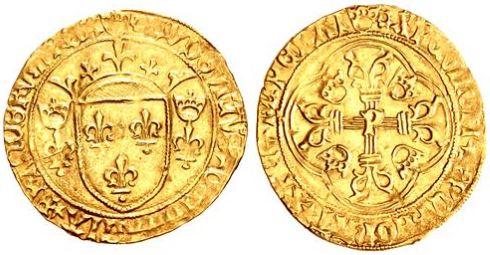
The late medieval economy faced a significant monetary disruption often described by historians as the “bullion famine,” a prolonged shortage of precious metals that constrained the availability of coin across Europe. Because medieval economies depended heavily on silver coinage for everyday transactions, fluctuations in the supply of bullion could have immediate and far-reaching economic consequences. The scarcity of precious metal limited the minting of new coins and reduced the circulation of currency necessary for trade. Warfare played a critical role in intensifying this shortage, as military conflicts disrupted mining operations, diverted resources toward armies, and destabilized the regions where much of Europe’s silver production occurred. In an economic system where coined silver functioned as the primary medium of exchange, even modest disruptions to bullion supply could reverberate through markets across wide geographic areas. The monetary pressures created by warfare affected not only governments attempting to finance campaigns but also merchants, craftsmen, and peasants whose daily economic transactions depended on access to reliable coinage.
Mining regions in Central Europe, particularly in areas of modern Germany, Bohemia, and Hungary, had long supplied much of the continent’s silver. During periods of stability these mines produced the bullion needed to sustain expanding commercial activity. War, however, often interrupted this production. Military campaigns, territorial disputes, and the general instability created by conflict could damage mining infrastructure, displace skilled laborers, and disrupt the transport networks used to move raw metal to minting centers. When these supply chains faltered, the production of coinage declined sharply, constricting the flow of currency throughout European markets.
The consequences of bullion scarcity were felt across multiple levels of the medieval economy. With fewer coins available for circulation, merchants and local authorities faced growing difficulties conducting routine transactions. In some regions, older coins were hoarded or withdrawn from circulation as people attempted to preserve their remaining stores of precious metal. This contraction of the money supply placed downward pressure on economic activity while simultaneously increasing the relative price of goods and services measured in scarce coinage. The resulting distortions could make markets increasingly unstable, particularly in areas already suffering from the economic strain of warfare.
Warfare also affected the monetary system through the fiscal demands it placed on rulers. Kings and princes required large quantities of coin to finance armies, pay mercenaries, and supply prolonged campaigns. When bullion supplies were insufficient to meet these needs, governments sometimes resorted to altering the composition of coinage through debasement, reducing the precious metal content in order to stretch limited resources further. Such policies allowed rulers to produce larger numbers of coins from the same quantity of metal, temporarily easing fiscal pressures created by war. Yet this strategy carried significant economic risks. As merchants and consumers recognized that newly minted coins contained less silver than earlier issues, confidence in the currency could erode. The resulting uncertainty often encouraged hoarding of older, higher-quality coins while the debased currency circulated more widely, a process that further complicated market exchange and contributed to price instability in the broader economy.
The bullion famine illustrates the complex relationship between warfare, resource scarcity, and monetary systems in the medieval world. Military conflict did not simply raise prices through the destruction of crops or the disruption of trade routes; it could also weaken the foundations of the currency itself. By interrupting mining production, concentrating precious metal in the hands of rulers and armies, and encouraging debasement policies, warfare contributed to a tightening of the money supply that reverberated throughout European markets. In this way, the monetary pressures created by conflict formed another mechanism through which war shaped inflation and economic instability during the medieval period.
Conclusion: War as a Catalyst of Medieval Price Shocks
Throughout the medieval period, warfare repeatedly acted as a powerful catalyst for economic disruption and price instability. Military conflict strained the fragile balance between production, supply, and consumption that sustained medieval economies. Armies consumed enormous quantities of food, fuel, animals, and metal, often faster than local economies could replace them. As a result, the demands of war frequently produced sudden shortages that drove prices upward, particularly in regions directly affected by campaigning armies or prolonged military mobilization.
The mechanisms through which war generated inflation were diverse but interconnected. The destruction of crops and the seizure of fodder destabilized agricultural production, while the consumption of timber and charcoal for siege engines and weapons placed heavy pressure on vital fuel resources. Large armies moving through rural landscapes frequently stripped forests and fields of the materials needed to sustain both warfare and everyday economic life. The mobilization of armies created volatile demand for specialized goods such as warhorses, armor, and metal equipment. Because these items required skilled labor and limited raw materials, their prices could rise sharply during periods of military mobilization. These pressures were compounded by disruptions to trade routes and local markets, which made it increasingly difficult for regions experiencing shortages to obtain supplies from elsewhere. When transportation networks were damaged or blocked by conflict, even regions with adequate production could find themselves isolated from broader markets, amplifying price instability.
Monetary factors intensified these material pressures. The fiscal demands of warfare pushed rulers to extract large quantities of bullion from their realms and to manipulate coinage in order to finance military campaigns. Royal treasuries often struggled to gather the silver necessary to pay soldiers, hire mercenaries, and maintain the logistical systems required for sustained warfare. In response, governments sometimes altered the metallic composition of coins or diverted precious metal from circulation into military expenditure. Conflicts disrupted mining regions that produced much of Europe’s silver, contributing to the bullion famine that constrained the supply of currency across the continent. When fewer coins were available for ordinary commercial exchange, economic transactions became more difficult and price relationships grew unstable. These monetary stresses interacted with the physical shortages created by warfare, producing complex patterns of inflation and market instability throughout the medieval economy.
These dynamics demonstrate that medieval price shocks were rarely the result of a single cause. Instead, they emerged from the interaction between military activity, resource consumption, and monetary pressures within a fragile economic system. Warfare exposed and intensified these vulnerabilities, transforming localized shortages into broader economic crises. The medieval experience reveals a recurring historical pattern: when military conflict disrupts production, trade, and currency simultaneously, the resulting pressures can produce rapid and destabilizing shifts in prices that reshape the economic landscape of entire regions.
Bibliography
Affiliate disclosure: Amazon links on this site are paid links. As an Amazon Associate I earn from qualifying purchases.
- Abulafia, David. The Great Sea: A Human History of the Mediterranean. Oxford: Oxford University Press, 2011.
- Acharya, Avidit and Alexander Lee. “Path Dependence in European Development: Medieval Politics, Conflict, and State Building.” Comparative Political Studies 52:13-14 (2019), 2171-2206.
- Ayton, Andrew, and J. L. Price, eds. The Medieval Military Revolution: State, Society and Military Change in Medieval and Early Modern Europe. London: I.B. Tauris, 1995.
- Bartlett, Robert. The Making of Europe: Conquest, Colonization and Cultural Change, 950-1350. Princeton: Princeton University Press, 1993.
- Contamine, Philippe. War in the Middle Ages. Oxford: Blackwell, 1980.
- Day, John. “The Great Bullion Famine of the Fifteenth Century.” Past & Present 79 (1978): 3–54.
- DeVries, Kelly. Medieval Military Technology. Toronto: University of Toronto Press, 1992.
- Dyer, Christopher. Making a Living in the Middle Ages: The People of Britain 850–1520. New Haven: Yale University Press, 2002.
- Hatcher, John, and Mark Bailey. Modelling the Middle Ages: The History and Theory of England’s Economic Development. Oxford: Oxford University Press, 2001.
- Hyland, Ann. The Medieval Warhorse: From Byzantium to the Crusades. Stroud: Sutton Publishing, 1994.
- Mayhew, Nicholas J. Sterling: The Rise and Fall of a Currency. London: Allen Lane, 1999.
- Munro, John H. “The Monetary Origins of the ‘Price Revolution’: South German Silver Mining, Merchant Banking, and Venetian Commerce, 1470–1540.” In Global Connections and Monetary History, 1470–1800, edited by Dennis Flynn, Arturo Giráldez, and Richard von Glahn. Aldershot: Ashgate, 2003.
- Prestwich, Michael. Armies and Warfare in the Middle Ages: The English Experience. New Haven: Yale University Press, 1996.
- —-. Plantagenet England 1225–1360. Oxford: Oxford University Press, 2005.
- Riley-Smith, Jonathan. The Crusades: A History. 3rd ed. London: Bloomsbury Academic, 2014.
- Spufford, Peter. Money and Its Use in Medieval Europe. Cambridge: Cambridge University Press, 1988.
- Thrupp, Sylvia L. “Economy and Society in Medieval England.” Journal of British Studies 2:1 (1962), 1-13.
- Tyerman, Christopher. God’s War: A New History of the Crusades. Cambridge, MA: Belknap Press of Harvard University Press, 2006.
- Verhulst, Adriaan. “Medieval Socio-Economic Historiography in Western Europe: Towards an Integrated Approach.” Journal of Medieval History 23:1 (1997), 89-101.
Originally published by Brewminate, 03.15.2026, under the terms of a Creative Commons Attribution-NonCommercial-NoDerivatives 4.0 International license.
About the Author