Immigration enforcement actions in healthcare settings are raising urgent concerns about patient safety, access to treatment, and the vulnerability of those seeking care.

By Eli Newman
Health Reporter
Bridge Michigan
Introduction
Dr. Lauren Snyder, a family physician in west Michigan, has had to adjust to encountering ICE as part of her medical practice.
She said she couldn’t go into detail to protect patients’ privacy and the confidentiality of her colleagues, but “they are here.”
Routine checkups at her office now include monitoring for a “basic fear of safety” — as some young patients relay stories about families held in US Immigration and Customs Enforcement facilities.
“That’s not one of our routine childhood screening questions: ‘Is your parent detained?’” Snyder, a member of the Committee to Protect Health Care, said during a press conference Tuesday.
The Michigan Immigrant Rights Center and the ACLU of Michigan called the media briefing to discuss guidance for health care facilities facing a rise in ICE encounters.
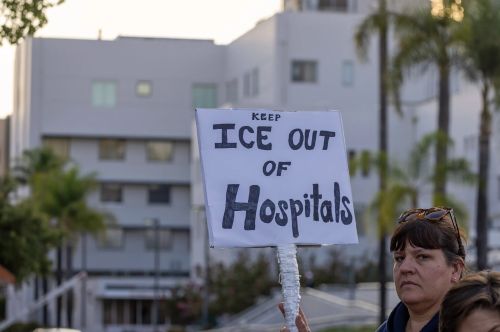
Doctors like Snyder, health care provider groups and civil rights advocates are noting an increase in immigration enforcement near and within Michigan’s health care facilities after the federal government withdrew guidelines that previously kept hospitals and clinics off-limits for law enforcement activity.
“We have seen an increase in reports, either from bystanders or health care providers, of enforcement activity at or near health care facilities and we’re also responding to incidents around the country that fear and are preparing for potentially happening in Michigan,” said ACLU staff attorney Ramis Wadood.
There’s also been increased reporting of individuals injured during ICE arrests taken to hospitals and emergency departments, according to Christine Sauvé, a communications manager with the Michigan Immigrant Rights Center.
“That’s on top of the medical care needs that folks are receiving while in detention,” she said. “There’s been some recent reporting showing the frequency of folks needing to go to emergency while they’re in detention.”
New Guidance
ICE did not respond immediately to a request for comment, but in a January 2025 statement, the US Department of Homeland Security, which oversees the agency, said it would review enforcement actions in “sensitive” areas on a case-by-case basis. DHS said “the Trump Administration will not tie the hands of our brave law enforcement” and trusts them to use “common sense.”
To address the changes in federal law enforcement, Michigan Immigrant Rights Center and the ACLU of Michigan this week sent guidance to more than 400 hospitals and providers in the state. The 12-page letter details the policy change and its impacts on care.
“This change in federal immigration enforcement policy does not alter patients’ legal rights or alter health-care providers’ legal obligations,” said Wadood. “Regardless of immigration status, patients remain entitled to necessary medical care under federal and state law, and health care facilities retain the legal authority to protect patient privacy and control access to nonpublic areas of their premises.”
Privacy Concerns
Federal policy changes could also compromise data privacy for those who use government benefits and social services, according to Michigan Poverty Law Program attorney Elinor Jordan.
“Since January, some Medicaid data of people who are known to not be lawfully present could potentially be turned over for immigration enforcement purposes,” Jordan said, adding that enrollees should weigh the benefits of using public programs against the risk of sharing information.
“Families and service providers should not take an all-or-nothing approach in response to data privacy threats.”
Changes outlined in the One Big Beautiful Bill Act to strip Medicaid eligibility from certain immigrant groups could impact 66,000 non-citizens in Michigan, she said, and leave about 90,000 refugees without health care.
The Michigan Health and Hospital Association said it does not collect data or provide guidance on operational policies of its members.
“Hospitals are, first and foremost, places of healing. Every day, healthcare teams across the state are focused on providing safe, high-quality care to every person that walks through their doors,” said MHA spokesperson Elise Gonzales in an email. “This commitment not only reflects their mission but also aligns with federal policies like the Emergency Medical Treatment and Labor Act that ensure patients receive care when and where they need it.”
Workers’ ‘Fear’ of ICE
Health care workers in the state are also strained by the Trump administration’s change in the “sensitive locations” policy. Many noncitizens work in clinics and hospitals, and those in the media briefing describe an atmosphere where employees worry about being targeted near or at work while managing the impacts of immigration enforcement on their personal lives.
Nationally, 29% of building cleaning and maintenance is done by foreign-born workers. Immigrants account for 9% of Michigan’s hospital workforce, according to the health policy research firm KFF.
A Lansing-area nurse’s relative was detained by ICE last year and unable to access medication, according to Yousef Rabhi, legislative director for the Michigan Nurses Association.
Alee Vang, a Hmong refugee, was deported to Laos in December, according to the family’s GoFundMe, while they await further government action to bring him back to the US.
“The fear is definitely there,” Rabhi said, adding that the law enforcement issue “transcends the citizenship status question” with the killing of Minneapolis ICU nurse Alex Pretti by federal immigration officers.
“There could be risks even conducting their day-to-day job and caring for their patients.”
Doctors say there’s a “chilling effect” that drives down health care utilization among documented and undocumented people because of increased immigration enforcement activity — 84% of health care workers surveyed by Physicians for Human Rights report significant or moderate decreases in patient visits since January 2025.
“Staff in a clinic where I work have expressed personal fears related to ICE raids despite their status as American citizens,” said Dr. Elliott Brannon, a family medicine resident in southeast Michigan. “Perhaps the most insidious impact of ICE, however, is for the patients that we don’t see.”
Originally published by Bridge Michigan, 03.24.2026, under the terms of a Creative Commons Attribution-NonCommercial-NoDerivatives 4.0 International license.
About the Author