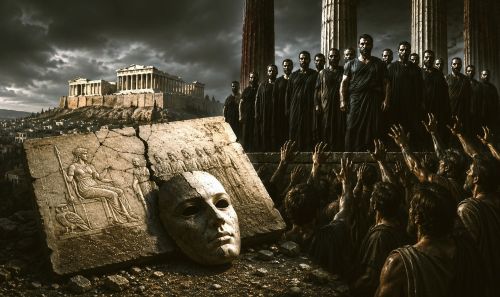
The Thirty Tyrants turned reform into repression, using law, citizenship, and civic order as masks for terror in defeated Athens.

By Matthew A. McIntosh
Public Historian
Brewminate
Introduction: When Reform Became a Mask for Tyranny
Athens did not fall into tyranny because its citizens suddenly forgot what freedom meant. It fell because defeat made deception plausible. In 404 BCE, after the catastrophe of the Peloponnesian War, the city stood exhausted, humiliated, and exposed to Spartan power. Its fleet was broken, its empire was gone, its Long Walls were marked for destruction, and its democratic confidence had been badly wounded. Into that crisis stepped the men later remembered as the Thirty Tyrants, not first as open destroyers of the polis, but as supposed restorers of order. Their mandate appeared constitutional. They were appointed to revise the laws and reshape the government after surrender. Yet that formal mission became the first and most important lie of their regime: reform was not the destination, but the disguise.
The Thirty understood that power seized in the language of naked ambition would invite immediate resistance. Power seized in the language of necessity could survive longer. They presented themselves as surgeons of a diseased city, men willing to cut away corruption, prosecute informers, discipline disorder, and rescue Athens from the failures that had led to defeat. This was a politically useful fiction because it contained enough truth to sound credible. Democratic Athens had been battered by war, faction, demagoguery, imperial collapse, and public mistrust. Many Athenians could believe, at least briefly, that severe reform might be needed. But the regime’s deception lay in the widening gap between its announced purpose and its actual practice. The Thirty delayed genuine constitutional settlement while placing offices, councils, armed force, and judicial procedure under oligarchic control. What had been introduced as reconstruction became occupation from within.
That transformation mattered because the Thirty did not simply abolish Athenian civic forms. They hollowed them out. Councils still met, accusations were still made, legal language still circulated, and punishments could still be dressed as judgments. But the meaning of law had changed. Law no longer protected the citizen body from arbitrary force; it became the instrument by which arbitrary force announced itself as public necessity. This was the foundation of the regime’s terror. The Thirty used the vocabulary of justice to kill enemies, the rhetoric of purification to seize wealth, the fiction of treason to eliminate rivals, and the language of citizenship to reduce most Athenians to silence. Their reign lasted only eight months, but its brevity should not obscure its intensity. It revealed how quickly a defeated democracy could be forced to watch its own institutions used against it.
Lies and deception were not incidental features of the Thirty Tyrants’ rule. They were foundational to it. The regime depended on a sequence of masks: constitutional reform concealed oligarchic seizure, moral cleansing concealed political purge, civic discipline concealed terror, selective citizenship concealed mass disenfranchisement, and legal procedure concealed murder. Led most ruthlessly by Critias, the Thirty made deception administrative, institutional, and performative. Their violence became terrifying not only because people died, but because death arrived under the signs of law, order, and public virtue. The central lie of the regime was that Athens could be saved by destroying the civic world that made Athens Athens. The democratic restoration of 403 BCE exposed that lie, but it also left Athenians with a painful problem that would haunt the restored polis: how to remember tyranny without letting memory become another weapon of civil war.
Defeat, Spartan Power, and the Birth of the Constitutional Lie
The rule of the Thirty began in the wreckage of Athenian defeat, and that defeat is essential to understanding the deception that followed. In 405 BCE, the Athenian fleet was destroyed at Aegospotami, a catastrophe that severed the city from the naval power on which its empire, grain supply, and democratic confidence had depended. By 404 BCE, Athens surrendered to Sparta under terms that stripped the city of its walls, ships, imperial possessions, and political security. The city that had once claimed leadership of the Greek world now faced occupation, hunger, factional accusation, and the humiliation of dependence on its bitterest rival. In that atmosphere, oligarchic reform could present itself not as treason, but as realism. Defeat made the old democratic order look vulnerable, and the Thirty exploited that vulnerability with cold precision.
Spartan power gave the oligarchic settlement its immediate force. The Thirty were not merely a spontaneous domestic committee of reformers, nor were they simply foreign puppets without Athenian roots. Their regime emerged from the convergence of internal oligarchic ambition and external Spartan pressure. Lysander’s influence mattered enormously. The Spartan commander had already supported oligarchic boards in other former Athenian dependencies, and Athens itself became part of that wider postwar reordering. The presence or threat of Spartan authority changed the meaning of Athenian politics. Opposition to the new settlement could be described not only as resistance to oligarchy, but as resistance to the peace itself, as though submission to the Thirty were the necessary price of survival.
This was the setting in which the constitutional lie was born. The Thirty were appointed to draft laws and establish a new constitution, a task that sounded temporary, procedural, and even restorative. Their official purpose suggested that Athens was passing through a dangerous but necessary transition from wartime disorder to lawful stability. Yet the very language of constitutional revision hid the imbalance of power from which the regime emerged. A constitution honestly framed would have defined offices, rights, procedures, and limits. It would have clarified who possessed authority, how decisions would be made, what protections citizens retained, and how public power could be checked. The Thirty instead used the interval before constitutional settlement to gather power into their own hands. They appointed magistrates, shaped the council, controlled prosecutions, and positioned themselves as the interpreters of legality before legality had been publicly restored. This delay was not an administrative inconvenience or a harmless pause in postwar reconstruction. It was the mechanism by which emergency became domination. By postponing the promised legal order, the Thirty created a space in which they could act first and justify afterward, presenting each seizure of power as provisional while making each provisional act harder to reverse. The constitution they were supposedly preparing became useful precisely because it remained absent. Its absence allowed them to invoke law as a future promise while exercising power as an immediate fact.
The deception worked because constitutional language carries an aura of restraint. A tyrant who announces himself as a tyrant invites moral clarity from his victims. A tyrant who calls himself a lawgiver forces citizens into hesitation. Was this emergency government? Was it reform? Was it punishment for imperial overreach? Was it the only way to avoid harsher Spartan treatment? These questions bought the Thirty time. They did not need every Athenian to believe in them enthusiastically. They needed enough Athenians to wait, to hope, to keep silent, or to imagine that the worst excesses would be temporary. Political deception often functions in precisely this suspended space between trust and fear, where citizens can still tell themselves that legality may soon return.
Theramenes’ early role shows how ambiguous the settlement initially appeared. He had participated in earlier oligarchic politics and cannot be treated as a straightforward democratic resister. Yet his later conflict with Critias also reveals that not all supporters of constitutional revision imagined the same future. For some, the defeat of democracy may have seemed to require a narrower, property-conscious civic order. For Critias and the harder oligarchs, the constitutional project became a screen for domination. The issue was not merely whether Athens would be democratic or oligarchic. It was whether law would bind the rulers at all. The Thirty answered that question by postponing law until it had become whatever they said it was.
The constitutional lie lay not only in broken promises, but in the conversion of constitutional process into political camouflage. The regime used Athens’ crisis to make illegality look transitional and coercion look corrective. It took the trauma of defeat and translated it into a claim of oligarchic necessity. This was the first stage of the Thirty’s deeper pattern: the systematic replacement of substance with appearance. They appeared to be lawgivers while acting as factional rulers. They appeared to restore order while preparing terror. They appeared to save Athens from the consequences of defeat while helping turn defeat into civil catastrophe. Before the executions multiplied and the confiscations widened, the regime’s foundational act was already in place: it taught Athens to hear the language of reform while being prepared for tyranny.
Purification as Propaganda: The Attack on Sycophants and “Bad Men”
The Thirty did not begin their rule by declaring war on the Athenian people. They began with a more careful and more dangerous performance: the punishment of men whom many Athenians already disliked. According to the surviving accounts, the regime first directed its violence against so-called sycophants, informers, and public predators who had made themselves hated in the democratic courts. This opening move was politically shrewd. It allowed the Thirty to present their authority as corrective rather than revolutionary, as though they were not overthrowing civic freedom but cleansing the city of those who had abused it. In a defeated Athens, where anger, exhaustion, and suspicion still hung in the air, such a claim could sound reasonable enough to delay alarm.
The charge against sycophants was not invented out of nothing. Athenian democracy had long been vulnerable to accusations that its legal culture encouraged malicious prosecution, opportunistic denunciation, and the manipulation of public anger. Comedy, political rhetoric, and elite criticism all preserved an image of the sycophant as a parasitic figure who exploited the courts for private gain, turning public justice into a private revenue stream and civic accountability into a weapon of intimidation. The democratic courts depended on citizen initiative, and that openness was one of the system’s strengths, but it also allowed hostile critics to portray popular justice as unstable, vindictive, or easily corrupted by professional accusers. The Thirty seized on this existing resentment and turned it into propaganda. By attacking men already branded as corrupt, they implied that their new government would restore moral order where democracy had permitted disorder. This was the first expansion of the constitutional lie into a moral lie: oligarchic rule would not merely repair institutions; it would purify the city. The charge was powerful precisely because it did not require the regime to invent public disgust from scratch. It only had to redirect that disgust toward the conclusion Critias and his allies wanted Athenians to reach: that extraordinary power in oligarchic hands was not tyranny, but cleansing.
That early campaign mattered because it made violence appear selective. Terror rarely announces its full appetite at the beginning. It tests the boundary of public tolerance by choosing victims whom few will defend. The Thirty understood that if the first deaths could be framed as deserved, then the principle of extraordinary punishment would become easier to normalize. Athenians who might have resisted an open massacre of political opponents could hesitate when the condemned were described as informers, corrupt litigants, or men harmful to the polis. The regime did not need every citizen to applaud. It needed enough citizens to think, at least for a moment, that perhaps these first victims had brought their fate on themselves.
The deception lay in the widening definition of danger. Once the Thirty had established their right to kill in the name of purification, the category of the “bad man” became elastic. The supposed purge of informers and criminals widened into an attack on democratic sympathizers, wealthy citizens, metics, critics, rivals, and anyone whose property or political existence made them useful targets. What had begun as public morality became political convenience. The accusation did not need to prove guilt; it needed only to place a man outside the circle of protection. The label “bad” was less a judgment than a weapon. It transformed persons into problems and made their removal appear not only lawful but beneficial. This elasticity was the regime’s most dangerous innovation, because it allowed political power to move without fixed boundaries. A sycophant could be killed as a public nuisance, a democrat as a threat to order, a wealthy metic as an enemy useful to plunder, and a moderate oligarch as a traitor to the cause. Each case could be described differently, but the underlying mechanism remained the same: the ruler named the danger, and the naming itself became sufficient. Once that logic entered public life, no citizen could know whether yesterday’s tolerated opinion might become tomorrow’s evidence of disloyalty.
This propaganda also inverted the memory of democracy. The Thirty encouraged Athenians to see the old democratic order through its worst abuses, as if the courts, assemblies, and popular institutions had been nothing more than engines of corruption. That distortion was essential to their legitimacy. If democracy could be reduced to sycophancy, disorder, and demagogic excess, then oligarchic violence could present itself as necessary discipline. Yet this was a profound act of civic falsification. Democratic Athens had certainly produced conflict, lawsuits, factional rivalries, and destructive political decisions. But it had also produced a broad culture of citizen participation, accountability, public speech, and legal identity. The Thirty compressed that complicated political inheritance into a caricature and then used the caricature as justification for repression.
The figure of Critias sharpened this logic. He did not merely inherit the language of oligarchic correction; he radicalized it. For Critias and those closest to him, purification meant more than punishing disliked men. It meant remaking the city by narrowing the political community, removing opposition, and teaching the population that safety depended on silence. The early executions served a pedagogical purpose. They instructed Athens in the new meanings of justice and danger. Justice meant whatever the regime identified as cleansing. Danger meant whatever stood in the way of oligarchic consolidation. The public language of moral reform became a screen behind which personal revenge, ideological hatred, and material greed could operate together. Critias’ severity also gave the regime a hard ideological edge that distinguished it from more cautious oligarchic revision. The goal was not simply to curb democratic excess or correct legal abuse. It was to break the habits that made democratic citizenship possible: public argument, mutual accountability, confidence in legal protections, and the expectation that political power could be challenged without immediate mortal danger. Under that pressure, purification became less a program than a performance of dominance. Each punishment told Athenians not only who had been condemned, but who now possessed the authority to define corruption, loyalty, and civic worth.
The attack on sycophants and “bad men” was not a minor prelude to the Thirty’s later terror. It was the first visible form of that terror, softened by moral language and aimed at victims chosen to make resistance difficult. The regime’s genius, if such a brutal thing deserves the word, was to understand that lies are strongest when they recruit existing frustrations. Many Athenians had reasons to resent informers and abusive litigants. The Thirty converted that resentment into permission. From there, permission became precedent, precedent became policy, and policy became murder. The city was told that corruption was being cut away. What was really being cut away was the habit of objecting when power named its enemies and called the naming justice.
The Machinery of Fear: Council, Magistrates, Whip-Bearers, and Spartan Force
The Thirty’s early propaganda would have meant little without machinery capable of turning accusation into command. Their regime did not rely on persuasion alone. It converted civic institutions into instruments of fear, placing councils, magistracies, attendants, armed supporters, and eventually Spartan force behind the language of order. This was one of the most disturbing features of their rule. Athens did not suddenly become a city without offices, procedures, or public bodies. Rather, the familiar architecture of government remained visible while its meaning changed. Institutions that had once mediated public life were made to serve a narrow oligarchic faction, and that continuity of appearance helped conceal the violence of the transformation.
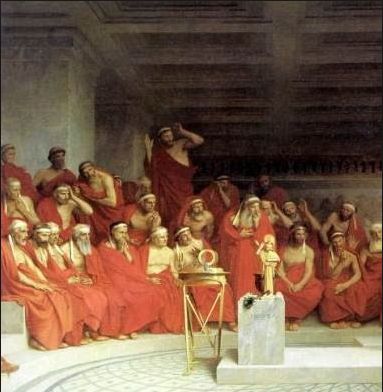
The Council was central to this process. Under democracy, the boule had been a key organ of civic administration, preparing business for the Assembly and participating in the daily functioning of the polis. Under the Thirty, council government became something darker: a controlled body through which oligarchic decisions could be given the look of civic process. The presence of a council allowed judgments, arrests, and decrees to appear as acts of government rather than private vengeance. Yet the council operated under intimidation, manipulation, and factional pressure. Its authority did not restrain the Thirty. It helped transmit their will. The deception lay in the preservation of institutional form after institutional independence had been broken. This was especially dangerous because Athenian political culture had trained citizens to recognize institutions as signs of legitimacy. A decree, a hearing, a council chamber, and an official summons all carried the memory of civic procedure even after the substance of civic accountability had been removed. The Thirty exploited that memory. They could make their actions look less like personal violence because violence passed through recognizable channels. The Council became a political stage on which coercion could dress itself as deliberation, even when the outcome had already been decided by fear.
The same logic applied to magistrates. The Thirty appointed officials who were supposed to embody lawful administration, but these offices functioned within a system already captured by oligarchic power. A magistracy can serve law only when its authority is bounded by rules, accountability, and recognized public standards. In the world created by the Thirty, offices became extensions of faction. Their occupants did not restore civic order; they helped translate the regime’s claims into administrative action. The machinery of government became a network through which names could be marked, property could be seized, arrests could be made, and enemies could be isolated. The danger was not merely that brutal men held office. It was that office itself gave brutality a civic costume.
The whip-bearers, or attendants associated with the regime’s coercive presence, made that costume harder and more visible. Their importance was partly practical and partly symbolic. They could intimidate, enforce, and accompany the regime’s commands, but they also announced that ordinary political life had been replaced by something more menacing. Their presence in civic spaces suggested that speech, movement, and assembly were now watched by force. The old democratic city had certainly known discipline, policing, and public enforcement, but the Thirty’s use of armed or semi-armed attendants created a different atmosphere. The citizen no longer encountered public authority as a shared civic framework. He encountered it as threat. That shift mattered because tyranny often announces itself through changed habits before it announces itself through formal declarations. A man entering a public space could see, in the bodies of these attendants, that the city’s center of gravity had moved away from persuasion and toward compulsion. Their whips were not only tools of punishment. They were visual arguments. They told Athenians that the regime possessed the power to interrupt, humiliate, seize, and silence. In a society where public standing and civic honor mattered deeply, such visible coercion attacked not only the body but the confidence required for citizenship.
This atmosphere of threat reshaped behavior before violence even occurred. Fear does not need constant killing to do its work. It teaches people to anticipate consequences. Under the Thirty, Athenians had to measure words, associations, wealth, family history, and political reputation against an unstable standard of danger. A man excluded from protection, suspected of democratic sympathy, or noticed for his property could not trust that ordinary legality would save him. The regime’s machinery made uncertainty itself coercive. Because no clear boundary separated safety from accusation, silence became prudent. Withdrawal became survival. The deception of institutional normalcy had an inner psychological effect: it allowed terror to spread through expectation as much as through action. This is why the administrative quality of the regime mattered so much. Random violence terrifies, but systematized uncertainty disciplines. It forces people to govern themselves in advance of punishment, to avoid gatherings, soften speech, abandon friends, flatter dangerous men, or pretend not to see what is happening. The Thirty did not have to place every Athenian under guard. They only had to create a political world in which each citizen understood that the next summons, denunciation, or confiscation might arrive under the seal of authority. Fear became portable, carried inside the citizen before any official touched him.
Spartan force deepened this system of intimidation. The Thirty were Athenian oligarchs, but they ruled in the shadow of Sparta, and that shadow was never merely abstract. Spartan backing made the regime’s threats more credible and made Athenian resistance more dangerous. The later presence of a Spartan garrison on the Acropolis, requested by the Thirty and supported by funds extracted from Athens, revealed the hollowness of their claim to be restoring the city’s own lawful order. A government confident in civic legitimacy does not need foreign arms lodged above the city it claims to save. The garrison exposed the regime’s dependence on external power, even as the Thirty continued to present themselves as guardians of Athenian stability.
That dependence created another layer of deception. The Thirty could depict opposition as dangerous not simply because it challenged oligarchy, but because it threatened the fragile peace with Sparta. In this rhetoric, submission to the regime became entangled with survival after defeat. Resistance could be made to appear reckless, unpatriotic, or likely to bring harsher punishment on the city. This was a powerful manipulation of postwar trauma. Athens had already suffered siege, surrender, and humiliation. The Thirty exploited that fear by presenting their own authority as the barrier between Athens and catastrophe. Yet they were themselves one of the chief catastrophes produced by defeat. Spartan support did not merely protect Athens from further harm; it protected the men who were harming Athens from within.
The machinery of fear, then, was not a separate development from the regime’s lies. It was how those lies acquired force. Constitutional reform, civic purification, lawful judgment, official administration, and postwar security all became more believable because they were backed by councils, magistrates, attendants, and Spartan arms. The Thirty understood that terror works best when it is not experienced as chaos, but as system. A knock at the door, a summons before a council, a name entered into suspicion, an order delivered by an official, a foreign garrison visible above the city: each could be made to feel like government. That was the regime’s achievement and its crime. It made fear administrative. It taught Athens that tyranny did not need to burn the institutions of the polis to the ground. It could sit inside them, speak through them, and make them pronounce terror in the name of order.
The Three Thousand: Citizenship as Theater and Disenfranchisement
The next stage in the Thirty’s deception was the creation of the list of the Three Thousand, a measure that turned citizenship itself into theater. The regime claimed to be defining the responsible civic body, identifying those men worthy of participation in the new order and separating them from the dangerous, disorderly, or unreliable mass. On the surface, this looked like constitutional clarification. It was disenfranchisement by selection. The Thirty did not merely rule over Athens; they narrowed Athens, reducing the political community to a controlled body whose membership depended on oligarchic approval. The list transformed civic status from a shared inheritance of the citizen body into a revocable privilege bestowed from above.
This deception mattered because the Three Thousand created an illusion of lawful inclusion while manufacturing mass exclusion. Those named on the list could imagine themselves protected, recognized, and perhaps even honored. Those left outside it discovered that they occupied a more dangerous category, neither fully foreign nor meaningfully secure. The regime did not need to announce that most Athenians had become politically disposable. It accomplished that result through classification. A man’s safety now depended not on citizenship as such, but on whether the oligarchs had placed his name inside the privileged circle. The Thirty converted a bureaucratic act into a civic wound. The list appeared orderly because it had numbers, names, and implied criteria. Its violence lay in the fact that those criteria were controlled by men who answered to no genuine public standard.
The Three Thousand also gave the regime a shield against the accusation of simple tyranny. By retaining a limited citizen body, the Thirty could pretend that Athens had not been reduced to the will of a few men. There were still citizens with recognized standing. There was still a group permitted to carry arms, participate in some restricted civic identity, and stand apart from the unprotected majority. Yet this was precisely the theatrical function of the list. It staged the appearance of a polity while denying the broader citizen body the substance of political life. The Thirty did not abolish citizenship altogether because total abolition would have exposed the regime too plainly. Instead, they made citizenship selective, conditional, and dependent on loyalty, thereby preserving the word while destroying much of what the word had meant in democratic Athens. The result was a political illusion powerful enough to confuse appearance with reality. A city could still seem to possess citizens, offices, and a governing class, while the larger civic body had been pushed into dependency and fear. The Three Thousand were not merely a privileged group. They were evidence staged for public consumption, a living argument that the regime was constitutional rather than tyrannical. Their existence allowed the Thirty to say that political life continued, even though the terms of that life had been rewritten by men who had no intention of submitting their authority to the people they claimed to organize.
The psychological effect was profound. Inclusion among the Three Thousand did not produce true freedom, because membership itself depended on the regime’s favor and could be shadowed by fear. Exclusion, meanwhile, marked a man as vulnerable before any charge had been made. The list worked in two directions at once. It rewarded enough people to create a constituency of caution, while terrifying those outside the boundary into silence. The included had reason not to endanger their status. The excluded had reason not to attract attention. This was civic division as political technology. The Thirty made Athenians look at one another through the invisible line of the list, wondering who was protected, who was exposed, who had influence, who had been abandoned, and who might survive by standing near power.
The disarming of those outside the approved body sharpened the deception into open domination. A restricted citizen list might be defended rhetorically as constitutional reform, but the removal of arms from the excluded revealed its coercive purpose. The regime was not merely deciding who should deliberate; it was deciding who could resist. By concentrating arms and civic standing among the Three Thousand, the Thirty created a political order in which citizenship, security, and force were fused. This was not a neutral sorting of qualified citizens from unqualified ones. It was the calculated weakening of the majority by men who knew that their rule could not endure if the broader citizen body remained politically and physically capable of opposition. The language of civic discipline concealed the practical work of making resistance less possible. Disarmament also made the list’s symbolic violence material. Exclusion no longer meant only humiliation or political silence. It meant vulnerability before armed men who had been marked as legitimate while others had been stripped of the means to defend themselves. The Thirty transformed civic hierarchy into a physical fact, making the political boundary between inclusion and exclusion visible in weapons, patrols, summonses, and fear. What looked like constitutional sorting was, at its core, preparation for one-sided force.
The Three Thousand embodied one of the regime’s central lies: that Athens could be made orderly by making most Athenians powerless. The list did not heal the defeated polis. It fractured it. It made citizenship conditional, converted public identity into an oligarchic favor, and taught the city that legality could arrive as exclusion wrapped in administrative form. Under democracy, citizenship had carried tensions, inequalities, and limits, but it also gave Athenian men a recognized place within the civic order. Under the Thirty, that recognition could be withdrawn by political design. The regime’s deception was to present this narrowing as restoration, as though a mutilated citizen body were a healthier one. The Three Thousand were not the rebirth of constitutional Athens. They were the stage scenery of oligarchy, arranged to make disenfranchisement look like order.
False Accusation and Confiscation: Wealth, Treason, and the Profits of Terror
Once the Thirty had narrowed citizenship, armed their supporters, and learned how to make violence appear administrative, accusation became one of their most profitable tools. The regime did not need a coherent legal standard for guilt. It needed charges flexible enough to attach themselves to whoever had become politically inconvenient or materially useful. Treason, conspiracy, democratic sympathy, corruption, and hostility to the new order could all be made to serve the same purpose: separating a person from protection so that his body, property, and reputation could be handled by the regime. In this atmosphere, accusation no longer followed crime. It created crime. To be named by the Thirty was to enter a political world in which innocence had already lost much of its force. That inversion was central to the regime’s deception, because it allowed power to masquerade as discovery. The Thirty could claim they had uncovered enemies when, in truth, they were manufacturing the conditions under which anyone could become one. A charge did not need to persuade a neutral court or survive public scrutiny. It needed only to perform the political work required of it: isolate the victim, frighten witnesses, silence friends, justify seizure, and warn others that safety depended on invisibility.
The economic dimension of this terror was not incidental. The Thirty ruled a defeated city whose resources had been shattered by war, surrender, and occupation. Their regime needed money, but its leading men also saw private enrichment and political reward in the seizure of property. Confiscation turned repression into a self-feeding system. Every execution or forced exile could remove an enemy while redistributing wealth to supporters, paying coercive forces, or satisfying the appetites of men who had tied their fortunes to oligarchic victory. The language of public security concealed a more sordid reality: terror could be made financially useful. When accusation carried the possibility of confiscation, political suspicion became a revenue stream.
Lysias’ account of his family’s suffering under the Thirty offers one of the clearest surviving windows into this predatory logic. As wealthy metics, Lysias and his brother Polemarchus occupied a particularly vulnerable position. They had money, social standing, and no full citizen protection. According to Lysias, the Thirty targeted metics not because they posed a proven danger to the regime, but because their property could be seized. Polemarchus was arrested and executed, while Lysias escaped and later used the restored democracy’s courts to narrate the crime. His speech against Eratosthenes is partisan and forensic, shaped by the needs of prosecution, but its value lies precisely in its exposure of how oligarchic violence could cloak theft in the language of political necessity. The regime did not merely silence opponents. It discovered that accusation could open houses, inventories, workshops, and estates.
The targeting of metics sharpened the moral bankruptcy of the regime’s claims. The Thirty had presented themselves as guardians of civic order, yet their actions against resident foreigners revealed how little their violence had to do with principled constitutional reform. Metics were essential to Athenian economic life, especially in trade, craft production, banking, and manufacturing, but they remained legally and politically dependent. That dependency made them easier to plunder. The regime could attack them without triggering the same immediate civic alarm that might follow a broad assault on included citizens. Here deception operated through legal vulnerability. The Thirty could represent their actions as measures against dangerous outsiders or disloyal elements while exploiting people whose wealth was more visible than their protections were secure. This was not merely opportunism at the margins of terror. It exposed how the regime understood the city itself. Athens was no longer a community of legal statuses, obligations, protections, and negotiated belonging. It was a field of extractable resources divided according to usefulness and danger. Metics could be praised in ordinary times for their economic value and then reclassified in crisis as disposable bodies attached to desirable property. The lie was double: the Thirty pretended to defend civic order while attacking the social and economic relationships that helped sustain the city, and they pretended to punish political danger while selecting victims whose chief offense was vulnerability combined with wealth.
False accusation also helped the Thirty solve a political problem created by their own extremism. A regime that rules through fear must continually produce enemies, because terror without enemies begins to look like naked criminality. Each accusation supplied a new explanation for the regime’s existence. If men were being arrested, it was because conspiracies existed. If property was being seized, it was because traitors had forfeited their claims. If prominent Athenians disappeared, it was because the city was being protected from hidden danger. The logic was circular but effective. The Thirty proved the existence of enemies by punishing them, and then used those punishments to prove that extraordinary rule remained necessary. Accusation became propaganda after the fact. The corpse, the exile, and the confiscated estate all became evidence in a story the regime had written before the charge was made.
This system was especially destructive because it corrupted the relationship between law and truth. In a healthy legal order, accusation initiates inquiry; under the Thirty, accusation often replaced inquiry. The forms of judgment might still appear, but they were increasingly detached from any serious expectation of proof, defense, or impartial procedure. The accused did not stand before a civic community committed to determining guilt. He stood before a regime that had already decided what his guilt could be made to accomplish. The distinction is crucial. The Thirty’s violence was not only illegal because it killed or exiled men unjustly. It was deceptive because it forced law to speak falsely. It made public judgment pronounce what power required, then called that pronouncement justice. That corruption wounded more than the individual victim. It attacked the civic trust that legal systems require in function at all. Once citizens understood that accusation could be shaped by greed, faction, or fear, the courtroom, council chamber, summons, and decree ceased to be signs of public order and became signs of danger. Truth became secondary to usefulness. Procedure became a costume. The regime’s lie was not only that particular men were guilty. It was that guilt itself still meant something stable in a world where power decided first and named the reason afterward.
The profits of terror measured more than greed. They revealed the fusion of political domination, moral fraud, and material extraction at the heart of the regime. The Thirty claimed to be rescuing Athens from corruption, yet they turned accusation into a market, citizenship into exposure, and punishment into plunder. Their victims were not only defeated by force; they were rewritten as dangers so that their destruction could appear necessary. This was one of the regime’s most poisonous lies. It taught Athenians that a man’s property could make him suspect, that wealth could be converted into guilt, and that treason could be discovered wherever the rulers found something worth taking. By the time the terror widened, the city had learned the lesson too well: under the Thirty, being accused did not mean one had committed a crime. It meant the regime had found a use for one’s ruin.
The Trial and Death of Theramenes: Moderation Rebranded as Treason
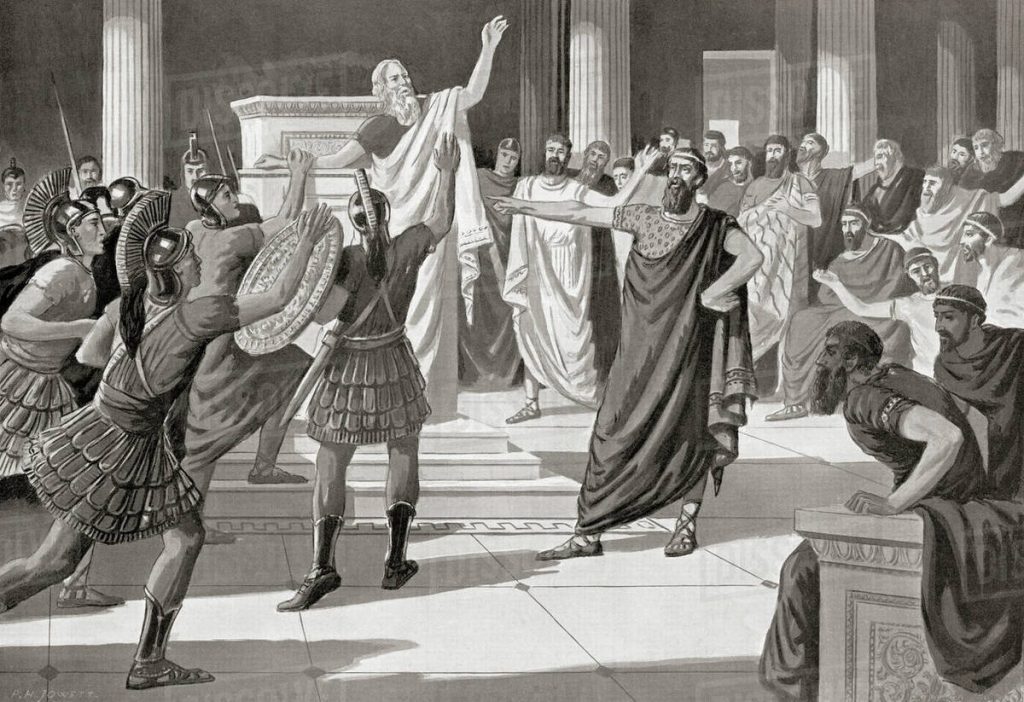
The conflict between Critias and Theramenes exposed the Thirty’s regime at the point where deception turned inward and began devouring its own architects. Theramenes had not been an innocent democrat standing outside oligarchic politics. He had moved through the unstable world of late fifth-century Athenian faction, had been associated with earlier oligarchic experiments, and had helped negotiate the surrender settlement that made the Thirty possible. Yet this complicated record is precisely what makes his destruction so revealing. Theramenes was not killed because he represented restored democracy in any simple sense. He was killed because he tried to distinguish oligarchic reform from unrestrained terror. Under Critias’ logic, that distinction itself became intolerable. The regime could endure ordinary enemies; it could not endure a member of its own circle who insisted that power needed limits, allies, procedure, and some claim to public legitimacy.
Xenophon’s account stages the confrontation as a battle over political meaning. Theramenes argued that the regime was making itself hated by killing men who had done no wrong and by narrowing its base so severely that it could not survive without force. Critias answered by redefining moderation as betrayal. This was the decisive deception. A man who objected to indiscriminate killing could be called an enemy of the government. A man who warned that the oligarchy was destroying its own credibility could be treated as a conspirator. A man who appealed to prudence could be marked as disloyal. Critias’ charge against Theramenes was not merely personal rivalry dressed as prosecution, though it was certainly that. It was a demonstration that the regime would no longer permit any language between obedience and treason. Once moderation could be renamed betrayal, all internal restraint disappeared.
The proceedings against Theramenes also revealed how completely legal form had been subordinated to political necessity. According to Xenophon, Theramenes sought refuge at the altar, appealing not simply for his own life but to the spectacle of injustice unfolding before the council. Critias then struck his name from the list of the Three Thousand, removing the protection that might have made summary execution more difficult. The act was chilling because it showed that even the regime’s own categories were disposable. Membership in the privileged body had been presented as civic security, but Critias could erase that security when it obstructed his will. The law did not govern the list; the ruler governed the law. This maneuver transformed the Three Thousand from a constitutional category into a theatrical prop, useful only so long as it served the ruling faction. If inclusion could be revoked at the moment of accusation, then inclusion had never been a genuine legal protection at all. It was permission temporarily granted by power and withdrawn whenever power wished to kill without restraint. Theramenes’ forced drinking of hemlock carried the outer appearance of official punishment while exposing the fraud beneath it. The cup, the council, the accusation, and the removal from the list all gave the scene a procedural surface, but that surface only made the deception more obscene. This was not justice after judgment. It was murder made procedural, a killing staged so that law could be forced to witness its own humiliation.
The death of Theramenes also served a broader political purpose. It warned the Three Thousand, the council, and the city that proximity to power did not guarantee safety. The regime had already taught the excluded to fear accusation, confiscation, and death. Now it taught the included to fear independence. Theramenes’ execution turned elite membership into a more anxious condition, because it showed that the boundary between insider and victim could be crossed by a single accusation from Critias. This was terror as internal discipline. The Thirty did not merely punish opposition outside the regime; they purified their own ranks by making hesitation dangerous. They created a political world in which agreement was never enough unless it remained absolute, vocal, and useful. Silence might preserve a man for a time, but criticism, even from within oligarchy, could be made fatal.
Theramenes’ death marked a deepening of the regime’s foundational lie. The Thirty had claimed to restore order after defeat, punish corrupt men, protect the city, and define a responsible civic body. Yet in the trial and execution of one of their own, those claims collapsed into open contradiction. A government that could erase protected status, manipulate procedure, and kill a prominent member for urging restraint was not defending law from disorder. It was disorder wearing the face of law. The episode also clarified the character of Critias’ leadership. He was not merely severe; he understood that domination required control over language itself. Prudence had to become cowardice, dissent had to become conspiracy, moderation had to become treason, and execution had to become justice. Theramenes’ final significance lies there. His death showed Athens that the Thirty’s deception had reached its most dangerous stage: the lie was no longer only told to the public. It had become the regime’s method of thinking.
Silencing Argument: Critias, Socrates, and the Political Fear of Speech

The Thirty feared weapons, wealth, exile, and organized democratic resistance, but they also feared speech. That fear was not incidental to their rule. A regime built on false names must always fear people who ask what names mean. The Thirty called domination reform, confiscation justice, exclusion citizenship, and murder lawful punishment. Argument threatened that entire political vocabulary because argument could expose the distance between words and acts. The suppression of speech under Critias was not merely an attack on philosophers or teachers. It was an attack on the civic habit of testing power by reason.
Xenophon’s Memorabilia preserves a revealing episode in which Critias and Charicles, both associated with the Thirty, restricted Socrates by forbidding the teaching of the “art of words” or argument. Xenophon presents the measure as personally aimed at Socrates, especially because Critias bore resentment toward him, but its political meaning reaches beyond private hostility. The ban identified speech, disputation, and instruction as dangers to oligarchic rule. Socrates’ way of questioning had always depended on exposing loose definitions, moral evasions, and claims to knowledge that could not withstand examination. Under ordinary civic conditions, that could be irritating, comic, or embarrassing. Under the Thirty, it became politically intolerable. The regime could not safely allow public reasoning to move freely when its own authority depended on making unreason sound lawful.
Critias’ fear of Socrates was sharpened by personal history. Ancient tradition associated Critias with Socrates’ circle, and later Athenians would remember that association uneasily. This does not mean Socrates caused Critias’ tyranny, nor does it justify the later democratic suspicion that helped frame Socrates as dangerous to the city. But the connection mattered because it placed Socrates near a painful question: how could men trained in argument, refinement, and intellectual ambition become enemies of civic restraint? Critias embodied one possible answer. He did not lack intelligence. He lacked moderation, sympathy, and respect for limits. His career demonstrated that cleverness without justice could become predatory. That made Socrates’ presence awkward for the regime and for its later memory. The philosopher’s questioning exposed ignorance, but one of his former associates had turned intelligence itself into an instrument of domination.
The confrontation between Socrates and the Thirty is especially revealing because Socrates did not respond like a conventional political agitator. He questioned the rule. Xenophon’s account has him ask what exactly was meant by the prohibited “art of words” and how he was supposed to obey a law whose terms were unclear. This was more than playful evasion. It was a philosophical exposure of tyrannical language. The Thirty wanted the force of law without the discipline of definition. Socrates pressed the point that a command must be intelligible if it is to be obeyed as law rather than endured as compulsion. The exchange showed why argument was dangerous to men like Critias and Charicles. It slowed power down. It demanded that command become accountable to meaning.
That demand struck at the center of oligarchic deception. The Thirty’s rule depended on elastic categories: “bad men,” “traitors,” “friends of the regime,” “enemies of order,” “the worthy,” and “the dangerous.” These terms gained power precisely because they could expand or contract according to need. Argument threatened to fix them, test them, and make them answerable to evidence. If a “bad man” had to be defined, the early purges became harder to defend. If “treason” required proof, confiscation became plunder. If “citizenship” meant more than inclusion on a controlled list, the Three Thousand became a fraud. If “law” required persuasion, procedure, and public intelligibility, then the Thirty’s decrees became what they really were: commands backed by fear. This was why speech posed such a structural danger to the regime. Argument did not merely disagree with particular policies; it challenged the regime’s power to make language float free from reality. The Thirty needed words to remain unstable enough to serve violence. Socratic questioning moved in the opposite direction, pressing words toward clarity, consistency, and ethical consequence. In that collision, the conflict between philosophy and tyranny became more than personal. It became a struggle over whether public language would belong to reasoned examination or to armed men who could rename their interests as justice.
The law against teaching argument belongs within the larger machinery of terror. It was not merely censorship in the narrow sense, nor was it only personal revenge against Socrates. It was part of the regime’s attempt to control the conditions under which Athenians could think politically. Speech creates associations. Questions create witnesses. Definitions create standards. Memory creates accountability. A government that survives by making citizens doubt their own judgment must weaken all four. The Thirty could kill men, seize property, and disarm opponents, but they also needed to make public reasoning feel unsafe. Once argument itself became suspect, silence could be made to look prudent, and prudence could be mistaken for consent.
Plato’s Apology adds another dimension to this picture when Socrates recalls the order to arrest Leon of Salamis. Although that episode belongs more directly to the regime’s attempt to implicate citizens in murder, it also shows how speech and conscience collided with command. Socrates later presented his refusal as evidence that he would not obey unjust authority, whether democratic or oligarchic. The Thirty, in his account, issued orders designed to make others share guilt. That strategy required silence. It required men to act without public reasoning, to obey without testing justice, and to let official language conceal the crime. Socrates’ refusal, like his questioning, interrupted the smooth passage from command to compliance. He did not overthrow the regime, but he demonstrated that the regime’s language could still be judged. The episode is especially important because it shows that the suppression of argument was not confined to classrooms, conversations, or philosophical circles. It extended into the moral space between order and action, where a citizen had to decide whether an official command deserved obedience. The Thirty wanted that space closed. They wanted command to move directly into compliance, without deliberation, without conscience, and without the dangerous pause in which a man might ask whether legality had become a mask for murder. Socrates’ refusal preserved that pause. It showed that even under terror, the individual act of judgment could expose the lie inside official language.
The fear of speech under the Thirty reveals the fragility beneath their brutality. They had arms, offices, lists, attendants, confiscations, and Spartan support, but they remained vulnerable to the simplest civic act: asking whether power was telling the truth. That is why Critias and Charicles tried to restrict argument. They understood that tyranny is not endangered only by armies. It is endangered by citizens who can still distinguish law from violence, justice from revenge, and order from submission. In Athens, where public speech had long been central to political identity, silencing argument was an attempt to silence the city’s democratic memory itself. The Thirty could command bodies for a time. What they feared was the mind that refused to let their lies become definitions.
Leon of Salamis and the Compulsion to Share Guilt
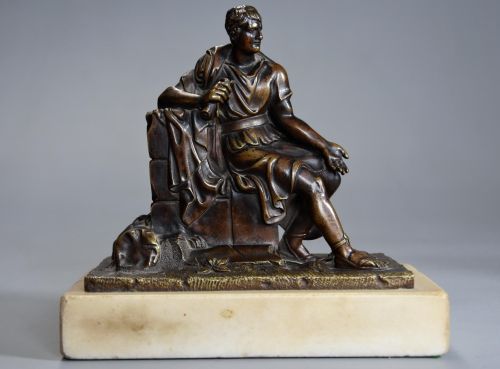
The order to arrest Leon of Salamis reveals another dimension of the Thirty’s deception: they did not merely want citizens to obey terror; they wanted them to participate in it. Plato’s Apology preserves Socrates’ recollection that the Thirty summoned him and four others to the Tholos and ordered them to bring Leon from Salamis so that he could be executed. The command was presented as official business. It came from men holding power in the city, issued through the machinery of government, and directed toward a named victim whose death had already been decided. Yet beneath that official surface lay a deeper political strategy. The Thirty were not asking citizens to assist law. They were trying to turn obedience into complicity.
This mattered because complicity is one of tyranny’s most effective forms of control. A regime that makes others share guilt creates a population less able to resist, accuse, or remember honestly. If enough men help carry out arrests, identify victims, escort prisoners, seize goods, or stand silently while crimes are committed, then the line between ruler and subject begins to blur. The Thirty understood that terror could be strengthened by distributing moral contamination. A citizen who participates in an unjust arrest may later fear the restoration of law, because law might expose not only the tyrants but also those who served them. The regime could make people dependent on its survival. Shared guilt became political glue, binding frightened men to the very power that had corrupted them. It also converted private fear into public discipline. Once participation had occurred, the participant could no longer think of himself simply as a victim of the regime’s pressure. He had reluctantly become part of its record. That knowledge could produce shame, silence, and renewed obedience. The Thirty did not need sincere ideological loyalty from everyone they used. Reluctant collaboration could serve them nearly as well, because fear of exposure after the fact could hold men in place as effectively as conviction.
The deception in the Leon episode lay in the false appearance of civic duty. Socrates and the others were not invited to deliberate about Leon’s guilt, nor were they asked to serve as witnesses in a lawful proceeding. They were ordered to fetch a man for execution. The command depended on the assumption that official authority could make the act respectable. To refuse would be dangerous because it exposed the order for what it was. To obey would help preserve the lie that the regime’s violence was lawful administration. Socrates’ refusal mattered not because it stopped the Thirty, for Leon was killed anyway, but because it broke the intended chain between command and moral surrender. He refused to let the title of government erase the character of the act.
Leon’s identity also sharpens the episode’s meaning. He was not presented in the surviving account as a battlefield enemy or armed rebel. He appears as a man selected for destruction by a regime already practiced in arrest, confiscation, and execution. The silence around the specific charge against him is itself revealing. The crime that matters in the story is not Leon’s. It is the regime’s. Plato uses the episode to show that an unjust command remains unjust even when issued by those who possess power, and that the citizen’s obligation to justice does not vanish under oligarchic rule. For the Thirty, that distinction was precisely what had to be destroyed. Their system required men to treat command as justification, obedience as safety, and silence as prudence. Leon becomes more than a victim remembered through Socrates’ testimony. He becomes the absent center of a political lesson about how tyranny hides murder inside administrative language. The regime did not need to explain him fully, because explanation was no longer the point. It needed only to move him from Salamis into its custody and then into death, while making other men carry part of that movement. The lack of a meaningful charge reveals how far the Thirty had traveled from law. They no longer had to persuade the city that a man deserved punishment. They only had to command enough people to behave as though he did.
The episode of Leon of Salamis belongs at the moral center of the Thirty’s reign. It shows tyranny not only killing, but recruiting others into the act of killing. It shows law reduced to a summons, citizenship reduced to obedience, and public office reduced to the power to implicate. Socrates’ refusal did not make him a democratic revolutionary, nor should the scene be romanticized as though one man’s conscience could redeem the city’s suffering. Its force is narrower and more devastating. The Thirty tried to make murder ordinary by making it official and shared. Socrates refused the share assigned to him. He exposed the regime’s lie that participation in injustice could be purified by the language of duty.
Exile, Resistance, and the Counter-Truth of Phyle

The Thirty’s power depended on isolating Athenians from one another, turning fear into silence and silence into the appearance of consent. Exile broke that illusion. Men driven from the city carried with them more than personal grievance; they carried an alternative memory of Athens. To the regime, they were enemies, fugitives, and destabilizing remnants of the defeated democracy. To themselves, they were the civic body in displacement, Athenians whose exclusion exposed the lie that the Thirty represented the polis. This mattered because tyranny does not only control territory. It tries to control the meaning of belonging. The exiles denied the regime that victory. By surviving outside the city, gathering strength, and speaking in the name of Athens against the men who occupied it, they created a counter-truth: the city was not identical with those who held its offices.
Phyle became the first crucial stage of that counter-truth. Thrasybulus and a small band of exiles seized the stronghold in Attica, transforming a marginal mountain position into a political challenge. The military act was modest at first, but its symbolic force was immense. The Thirty had presented opposition as scattered, criminal, and doomed. Phyle proved that opposition could become organized, visible, and durable. Its very survival disrupted the regime’s narrative of inevitability. If the Thirty truly embodied order, why did citizens gather against them? If the exiles were merely criminals, why did their number and confidence grow? If Athens had been saved by oligarchy, why did so many Athenians risk death to undo it? Phyle forced those questions into the open.
The regime’s response revealed its insecurity. The Thirty could not allow Phyle to remain merely a nuisance, because its existence threatened the political theater they had built. Their rule depended on the claim that safety, legitimacy, and civic order all flowed from obedience to the oligarchic settlement. Thrasybulus and his followers reversed that claim. They suggested, by their presence alone, that obedience had become collaboration and that resistance might be the truer form of civic loyalty. This was why the conflict over Phyle was not simply a military episode. It was a contest over the meaning of Athens after defeat. The Thirty had used Spartan backing, restricted citizenship, and controlled institutions to argue that they were the city’s necessary government. The exiles answered that Athens existed wherever Athenians refused to let tyranny define it.
As the resistance moved from Phyle toward Piraeus and Munychia, the counter-truth became harder to contain. Piraeus had long been associated with Athens’ naval, commercial, and democratic life, and its recovery by democratic exiles carried deep political resonance. The struggle was no longer confined to a remote stronghold. It moved into one of the city’s most charged spaces, where the memory of Athenian sea power and democratic participation still lingered. The Thirty had narrowed citizenship to the Three Thousand and turned political belonging into oligarchic permission. The men at Piraeus offered a different image: a community of return, bound not by a list imposed from above but by shared opposition to the regime’s violence. Their presence made visible what the Thirty had tried to hide, that the excluded were not a disposable remainder but a civic force capable of reassembling itself.
The battle at Munychia intensified this revelation. Critias, the regime’s hardest and most ideologically ruthless figure, was killed in the fighting, and his death broke more than a military line. It damaged the aura of inevitability that terror had created. Men who rule through fear often appear larger than they are until they are seen to bleed, fall, or fail. Critias’ death did not instantly restore democracy, nor did it end the political crisis by itself. But it shattered the fiction that the Thirty’s violence was destiny. The regime had taught Athenians to imagine its power as unavoidable because it controlled offices, arms, lists, and Spartan support. Munychia showed that the machinery could be resisted. The rulers who had renamed moderation as treason and murder as justice could themselves be judged by battle, defeat, and memory.
The resistance from Phyle to Piraeus exposed the central weakness of the Thirty’s deception. The regime could command the city for a time, but it could not fully possess the civic imagination of Athens. Exile became testimony. Return became argument. Armed resistance became a form of political truth-telling, not because violence itself purified politics, but because it disproved the lie that the Thirty were Athens. Thrasybulus and the exiles did not merely fight to regain homes, offices, and property. They fought to restore the distinction between the polis and the faction that had captured it. In that distinction lay the beginning of democratic recovery. The Thirty had tried to make silence look like consent, exclusion look like order, and fear look like peace. Phyle answered with the simple fact of organized refusal. Athens, it declared, still existed beyond the reach of the tyrants.
Restoration, Amnesty, and the Politics of Remembering Deception

The restoration of democracy in 403 BCE did not simply reverse the rule of the Thirty. It forced Athens to decide how a city wounded by tyranny, confiscation, exile, collaboration, and murder could become a political community again. The defeat of the oligarchic regime exposed its lies, but exposure alone could not rebuild civic life. Too many Athenians had suffered, too many had fled, too many had obeyed, and too many had benefited from fear. The restored democracy faced a problem as practical as it was moral: how to condemn the crimes of the Thirty without turning the entire city into a courtroom of accusation. The answer was the famous amnesty, a political settlement that sought to limit vengeance while preserving enough memory to mark tyranny as a crime against the polis. That balance was extraordinarily difficult because the tyranny had not been an external invasion alone, nor merely the work of a few isolated monsters. It had operated through Athenians, among Athenians, inside Athenian institutions, and in the language of Athenian law. Restoration required more than changing rulers. It required rebuilding trust in the possibility that civic speech, legal judgment, and public office could again mean something other than intimidation. The democracy had to return without pretending that nothing had happened, and it had to judge without allowing judgment itself to become another mask for factional revenge.
The amnesty was not forgetfulness in any simple sense. It did not ask Athenians to believe that the terror had been imaginary, nor did it erase the distinction between victim and perpetrator. Instead, it created a boundary around public retaliation, allowing prosecution against the principal oligarchic actors while restraining the wider spread of revenge. This mattered because the Thirty had ruled by corrupting accusation itself. They had used charges of treason, disloyalty, corruption, and conspiracy to isolate victims and justify violence. If the restored democracy had answered that system with unlimited counter-accusation, it risked reproducing the same civic poison under a different banner. The amnesty was not merely merciful. It was anti-tyrannical in structure. It refused to let accusation remain the primary language of politics.
Yet the amnesty also required an extraordinary discipline of memory. Athenians had to remember enough to understand what had happened, but not in a way that made coexistence impossible. This was especially difficult because the Thirty’s deception had penetrated ordinary civic relationships. Some men had informed. Some had served. Some had profited. Some had stayed silent because silence was the only form of survival available to them. The restored democracy could not pretend that all guilt was equal, but neither could it function if every past action became grounds for renewed civil war. The politics of remembering deception required a careful distinction between public accountability and endless recrimination. Athens had to name tyranny without allowing the memory of tyranny to tyrannize the future. That meant accepting a painful civic truth: not every wrong could be answered in court, not every wound could be publicly repaired, and not every compromised life could be sorted neatly into innocence or guilt. The regime of the Thirty had deliberately blurred those categories by forcing obedience, rewarding collaboration, and making fear a condition of survival. The restored democracy’s task was to recover moral distinction without indulging the fantasy of total purification. The amnesty was not a denial of memory but a disciplined form of it, one that tried to keep the city from becoming permanently organized around the very suspicions the Thirty had cultivated.
Lysias’ Against Eratosthenes reveals how tense that balance remained. In prosecuting Eratosthenes, Lysias did more than seek punishment for his brother Polemarchus’ death. He reconstructed the moral world of the Thirty, showing how arrests, confiscations, and executions had been concealed beneath official language. His speech demonstrates that the amnesty did not silence all memory. It allowed specific forms of accountability and public narration, especially against those most directly implicated in the regime’s crimes. The very need to argue the case shows that restoration was not a simple return to innocence. The democracy had to judge without becoming indiscriminate. It had to allow grief to speak without letting grief become the only law.
The restored democracy’s achievement was not that it forgot the Thirty, but that it refused to let their methods define the restored polis. The tyrants had made accusation elastic, citizenship conditional, law theatrical, and memory dangerous. The amnesty attempted to reverse that logic by narrowing prosecution, stabilizing civic identity, and reestablishing a shared political future. It could not erase trauma, nor could it undo the dead, the exiled, or the dispossessed. But it answered the regime’s foundational deception with a different kind of civic truth: Athens could not be rebuilt by turning every citizen into either prosecutor or suspect. After eight months in which lies had dressed themselves as law, the restored democracy had to make law credible again. That required punishment, restraint, and the painful decision to remember tyranny without becoming captive to it.
Conclusion: The Lie That Athens Needed Tyranny to Save It
The Thirty Tyrants’ rule began with the claim that Athens needed rescue. Defeat had made that claim persuasive, or at least difficult to dismiss. The city had lost the Peloponnesian War, its empire had collapsed, Spartan power shaped its future, and democracy could be blamed for catastrophe by those eager to replace it. The Thirty entered that wounded civic world speaking the language of reform, purification, discipline, and necessity. Yet every stage of their rule revealed the deception beneath the vocabulary. Constitutional revision became a means of delaying constitutional accountability. The punishment of “bad men” became a training ground for broader terror. The Three Thousand became a theatrical fragment of citizenship used to disguise mass exclusion. Law remained visible, but its meaning had been inverted. It no longer restrained power. It carried power’s lies into public form.
The regime’s violence was not separate from its deception. It depended on deception to function. Men were not simply killed; they were renamed as threats. Property was not simply stolen; it was confiscated under the pretense of punishment. Citizens were not simply silenced; they were taught that silence was prudence. Institutions were not simply destroyed; they were occupied, repurposed, and made to speak in the accents of tyranny. This is why the Thirty’s brief rule was so corrosive. It did not merely frighten Athens. It tried to corrupt the city’s ability to recognize itself. Words such as law, order, citizenship, justice, loyalty, and reform were made unstable, available for whatever meaning Critias and his allies needed them to bear. The regime’s deepest crime was not only that it shed blood, but that it tried to make bloodshed sound like civic restoration. That corruption of language allowed the Thirty to stretch terror across every part of civic life. A summons could become a death sentence, a list could become a weapon, a council chamber could become a theater of coercion, and a charge of disloyalty could become the first step toward execution or confiscation. The danger lay in the way violence was made legible as administration. Athenians were forced to watch familiar civic forms continue while their moral content was emptied out. The city still had officials, procedures, decrees, and public claims of necessity, but those forms no longer guaranteed even the pretense of justice. They had become channels through which injustice moved more efficiently. In that sense, the Thirty did not only commit crimes against individuals. They committed crimes against meaning itself, teaching Athens that the words of civic life could be made to serve the destruction of civic life.
Yet the collapse of the Thirty also showed that deception has limits. Phyle, Piraeus, Munychia, and the democratic restoration exposed the lie that the oligarchs were Athens itself. The exiles proved that the polis could survive outside the institutions temporarily captured by tyrants, because Athens was not merely a set of offices, walls, lists, or decrees. It was a political community capable of remembering, resisting, and returning. The death of Critias broke the aura of inevitability around oligarchic terror, while the amnesty of 403 BCE demonstrated a different kind of civic intelligence. The restored democracy did not answer every wrong with unlimited revenge. It sought to remember tyranny without becoming organized around the tyrants’ own habits of accusation and fear. That restraint was not weakness. It was part of the recovery of law from the falsehoods that had abused it.
The lie that Athens needed tyranny to save it was powerful because it used real crisis as its raw material. That is what made it dangerous. The Thirty did not invent defeat, exhaustion, mistrust, or anger. They exploited them. They taught a battered city to mistake domination for order and revenge for justice, at least long enough to kill, plunder, and silence. Their reign lasted only months, but it left behind a lasting warning about political language in moments of fear. Tyranny rarely presents itself first as tyranny. It arrives as emergency, cleansing, patriotism, reform, and necessity. In 404–403 BCE, Athens learned that the most dangerous political lie may not be the denial of crisis, but the claim that only cruelty can cure it.
Bibliography
- Aristotle. Athenaion Politeia [The Athenian Constitution]. Translated by H. Rackham. Cambridge, MA: Harvard University Press, 1935.
- Bakewell, Geoffrey. “Metics and Athenian Citizenship in the Aftermath of the Thirty.” Greek, Roman and Byzantine Studies 40:1 (1999), 5–22.
- Bearzot, Cinzia. Come si abbatte una democrazia: Tecniche di colpo di Stato nell’Atene antica. Rome: Laterza, 2013.
- Brickhouse, Thomas C., and Nicholas D. Smith. Socrates on Trial. Princeton: Princeton University Press, 1989.
- Buck, Robert J. Thrasybulus and the Athenian Democracy: The Life of an Athenian Statesman. Stuttgart: Franz Steiner Verlag, 1998.
- Carawan, Edwin. “The Athenian Amnesty and the ‘Scrutiny of the Laws.’” Journal of Hellenic Studies 122 (2002), 1–23.
- Cartledge, Paul. Agesilaos and the Crisis of Sparta. Baltimore: Johns Hopkins University Press, 1987.
- Cohen, David. Law, Violence, and Community in Classical Athens. Cambridge: Cambridge University Press, 1995.
- Cohen, Edward E. The Athenian Nation. Princeton, NJ: Princeton University Press, 2000.
- Harvey, F. D. “Sykophant and Sykophancy: Vexatious Redefinition?” In Nomos: Essays in Athenian Law, Politics and Society, edited by Paul Cartledge, Paul Millett, and Stephen Todd, 103–121. Cambridge: Cambridge University Press, 1990.
- Krentz, Peter. The Thirty at Athens. Ithaca: Cornell University Press, 1982.
- Lewis, David M. “The Thirty Years’ Peace.” In The Cambridge Ancient History, Volume 5: The Fifth Century B.C., edited by David M. Lewis, John Boardman, J. K. Davies, and M. Ostwald, 121–146. 2nd ed. Cambridge: Cambridge University Press, 1992.
- Loraux, Nicole. The Divided City: On Memory and Forgetting in Ancient Athens. New York: Zone Books, 2002.
- Lysias. Against Eratosthenes. In Lysias, translated by W. R. M. Lamb. Cambridge, MA: Harvard University Press, 1930.
- MacDowell, Douglas M. The Law in Classical Athens. Ithaca, NY: Cornell University Press, 1978.
- Manville, Philip Brook. The Origins of Citizenship in Ancient Athens. Princeton, NJ: Princeton University Press, 1990.
- Munn, Mark. The School of History: Athens in the Age of Socrates. Berkeley: University of California Press, 2000.
- Nails, Debra. The People of Plato: A Prosopography of Plato and Other Socratics. Indianapolis: Hackett, 2002.
- Ostwald, Martin. From Popular Sovereignty to the Sovereignty of Law: Law, Society, and Politics in Fifth-Century Athens. Berkeley: University of California Press, 1986.
- Pangle, Thomas L. The Socratic Way of Life: Xenophon’s Memorabilia. Chicago: University of Chicago Press, 2018.
- Plato. Apology. In Plato: Complete Works, edited by John M. Cooper. Indianapolis: Hackett Publishing, 1997.
- Reeve, C. D. C. Socrates in the Apology: An Essay on Plato’s Apology of Socrates. Indianapolis: Hackett, 1989.
- Rhodes, P. J. The Athenian Boule. Oxford: Clarendon Press, 1972.
- —-. A Commentary on the Aristotelian Athenaion Politeia. Oxford: Clarendon Press, 1981.
- Roberts, Jennifer Tolbert. Athens on Trial: The Antidemocratic Tradition in Western Thought. Princeton, NJ: Princeton University Press, 1994.
- Sanders, Kirk R. “Don’t Blame Socrates: Xenophon’s Critias and Alcibiades.” Classical Philology 107:1 (2012), 1–15.
- Shear, Julia L. Polis and Revolution: Responding to Oligarchy in Classical Athens. Cambridge: Cambridge University Press, 2011.
- Sinclair, R. K. Democracy and Participation in Athens. Cambridge: Cambridge University Press, 1988.
- Todd, S. C. Lysias. Austin: University of Texas Press, 2000.
- —-. The Shape of Athenian Law. Oxford: Clarendon Press, 1993.
- Tuplin, Christopher. “Xenophon and the Garrisons of the Achaemenid Empire.” Prometheus 25 (1999), 111–123.
- Whitehead, David. The Ideology of the Athenian Metic. Cambridge: Cambridge Philological Society, 1977.
- Wolpert, Andrew. Remembering Defeat: Civil War and Civic Memory in Ancient Athens. Baltimore: Johns Hopkins University Press, 2002.
- Xenophon. Hellenica. Translated by Carleton L. Brownson. Cambridge, MA: Harvard University Press, 1918.
- —-. Memorabilia and Apology. In Xenophon: Memorabilia and Oeconomicus, translated by E. C. Marchant. Cambridge, MA: Harvard University Press, Loeb Classical Library, 1923.
Originally published by Brewminate, 05.20.2026, under the terms of a Creative Commons Attribution-NonCommercial-NoDerivatives 4.0 International license.
About the Author