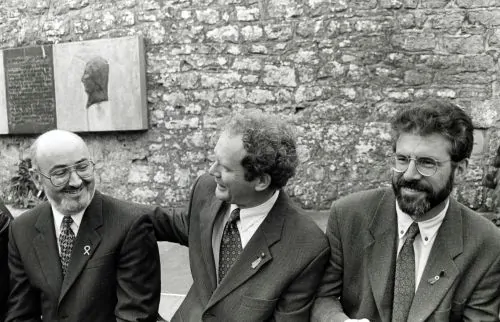
From 1988 to 1994, British broadcasters replaced Gerry Adams’s voice with actors, revealing how a restriction that preserved his words narrowed political access and press freedom.

By Matthew A. McIntosh
Public Historian
Brewminate
Introduction: The Man on the Screen Whose Voice Was Missing
In September 1993, BBC viewers watched Gerry Adams discuss the possibility of peace in Northern Ireland on On the Record. Adams’s face appeared on the screen, and his lips moved as he answered questions from presenter Sheena McDonald, but the voice carrying his words belonged to an actor. The substitution resulted from government restrictions that prohibited British broadcasters from transmitting direct statements by representatives of Sinn Féin and several republican and loyalist organizations. Although audiences could follow the substance of Adams’s answers, they could not hear his intonation, pauses, emphasis, or changes in pace. Tony Hall, then the BBC’s managing director of news and current affairs, later argued that Adams had sounded nervous and defensive under McDonald’s questioning, qualities that the imposed voice obscured. The interview preserved the appearance of an encounter while altering one of the principal means by which viewers judged the person being questioned. A government directive had entered the conversation between journalist and politician, shaping how the audience experienced both.
The arrangement originated on October 19, 1988, when Home Secretary Douglas Hurd issued directions to the BBC and the Independent Broadcasting Authority under powers contained in the BBC Licence and Agreement and the Broadcasting Act 1981. Hurd maintained that representatives and supporters of terrorism derived authority from appearing directly on radio and television. Newspapers remained free to print their statements, while broadcasters could summarize or reproduce the same words through another voice. Limited exceptions applied to parliamentary proceedings and qualifying statements made during election campaigns. These boundaries allowed the government to characterize the policy as a restriction on direct access rather than a prohibition on reporting.
That distinction became the organizing paradox of the ban. Dubbing offered broadcasters a practical means of retaining interviews that might otherwise have disappeared, and it enabled viewers to receive more information than a complete exclusion would have permitted. Yet spoken communication contains more than words considered apart from their delivery. Vocal hesitation may expose uncertainty, an abrupt change in tone can reveal anger, and the interaction between an interviewer’s question and a respondent’s immediate answer helps an audience assess credibility. Replacing a politician’s voice changed the evidence available to the public even when an actor repeated every sentence accurately. The production process also imposed additional work on newsrooms, which had to obtain clearance, record a substitute performance, and determine whether a speaker was covered by the directions in a particular context. Those burdens could influence whether an interview was pursued at all, especially when the subject involved municipal services or routine constituency affairs rather than a major security development. The policy’s effects consequently extended beyond the strange broadcasts that survive in television archives. They included reporting opportunities that became less attractive before a camera was dispatched or a program commissioned.
Any assessment of those consequences must remain grounded in the violence surrounding the policy. The Provisional IRA was conducting an armed campaign, loyalist organizations were also killing civilians, and Sinn Féin’s relationship with republican violence presented questions that broadcasters could not responsibly ignore. Hurd’s security argument was neither imaginary nor reducible to personal intolerance of an opposing view. The historical issue is whether the government’s response protected the public while preserving adequate political scrutiny, particularly when the restrictions reached elected representatives of a legal party. Britain’s broadcasting ban reveals that censorship need not erase every word to alter participation in public debate. By controlling the form in which designated speakers could be heard, it changed what audiences could judge and what newsrooms found practical to report.
An Electoral Mandate amid Armed Conflict
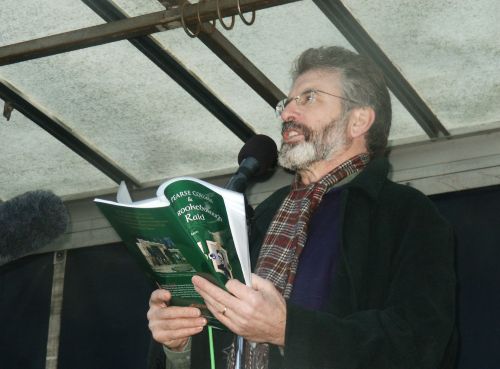
The electoral constituency that made Gerry Adams consequential to British politics emerged clearly during the 1981 prison crisis. Bobby Sands, a Provisional IRA prisoner participating in the hunger strike at the Maze, contested the April 9 by-election in Fermanagh and South Tyrone as an Anti-H-Block candidate. He received 30,492 votes, defeating Ulster Unionist Harry West by 1,446 in a constituency with an 86.9 percent turnout. Sands died twenty-six days later, but Owen Carron retained the seat for the protest movement in another by-election that August. Those returns did not reveal a single motive shared by every nationalist voter. Support for the prisoners’ demands could coexist with opposition to British policy without constituting approval of every IRA operation. Republican organizers nevertheless recognized that elections could convert the emotional power of the hunger strike into a sustained political presence.
The first regional test came in the October 1982 election for a new Northern Ireland Assembly. Sinn Féin secured 64,191 first-preference votes, representing 10.1 percent of the valid poll, and won five of the seventy-eight seats. The Social Democratic and Labour Party remained considerably larger, taking fourteen seats with 18.8 percent, while Adams topped the first-preference count in West Belfast. Sinn Féin expanded its total to 102,701 votes in the June 1983 Westminster election, and Adams captured Belfast West with a majority of 5,445. Even then, the SDLP received 137,012 votes across Northern Ireland and retained its position as the leading nationalist party. Republicanism had acquired a measurable constituency without gaining the authority to speak for nationalism as a whole.
Sinn Féin entered these contests without abandoning the armed strategy pursued by the Provisional IRA. Danny Morrison had summarized the intended combination at the party’s 1981 Ard Fheis through his enduring image of an Armalite rifle in one hand and a ballot paper in the other. The formulation described parallel activity rather than a completed transfer from insurgency to constitutional politics. After Adams became party president in 1983, electoral organization assumed greater importance, yet Sinn Féin continued to defend the legitimacy of republican armed struggle. Adams refused to take his Westminster seat because doing so required an oath of allegiance to the British monarch, consistent with the party’s abstentionist rejection of Parliament’s jurisdiction over Northern Ireland. Local institutions provided greater room for selective participation. Alex Maskey entered Belfast City Council in 1983, and other Sinn Féin councilors began handling neighborhood concerns while pursuing the party’s demand for British withdrawal. This mixture of abstention and participation allowed republicans to use elections as evidence of consent while denying that the institutions conducting them possessed ultimate sovereignty.
Municipal elections in May 1985 gave that strategy a more durable base. Sinn Féin won 75,686 first-preference votes, or 11.8 percent, and emerged with fifty-nine council seats across seventeen of Northern Ireland’s twenty-six districts. The SDLP still led the nationalist field with 17.8 percent, but republican representatives now possessed offices through which they addressed housing, public services, and constituency complaints. Ian McAllister’s later analysis indicates that Sinn Féin drew much of its new strength from previous nonvoters and younger entrants to the electorate instead of simply draining support from the SDLP. The result enlarged organized nationalism while sharpening the contest over who could credibly represent it.
Electoral consolidation occurred while lethal violence continued. The IRA’s bombing of the Grand Hotel in Brighton in October 1984 killed five people during the Conservative Party conference and narrowly missed Prime Minister Margaret Thatcher. Its Remembrance Sunday bombing at Enniskillen in November 1987 killed eleven people at the time and injured dozens more, producing widespread condemnation that included forceful criticism from many nationalists. Eight British soldiers died in the Ballygawley bus bombing the following August. Loyalist paramilitaries were simultaneously attacking Catholic civilians, while disputed actions by the security forces deepened distrust within nationalist communities. Ballots could confer public office, but they neither ended the conflict nor settled responsibility for violence committed in the name of competing political causes. By 1988, the British state confronted a legal party with elected representatives and a persistent body of voters whose leadership still endorsed the IRA’s asserted right to armed struggle. Sinn Féin’s mandate remained partial and morally contested, yet its electoral record prevented officials from plausibly treating the party as nothing more than a clandestine propaganda apparatus.
Before the Order: How Broadcasters Learned Caution
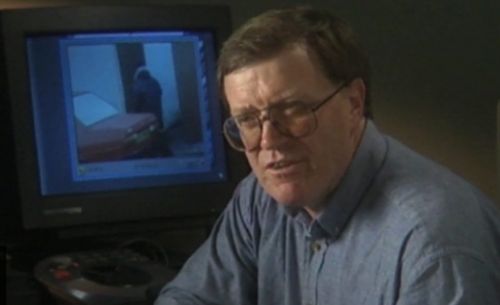
Long before Douglas Hurd spoke in October 1988, caution had acquired an administrative form inside British broadcasting. In 1971, when internment coincided with rising IRA violence and controversy over security-force conduct, the BBC and the Independent Television Authority introduced “reference up” procedures for material concerning Northern Ireland. A proposal or script that would ordinarily remain with its producers could be sent through extra layers of managerial or regulatory review. Such scrutiny addressed genuine hazards. Clandestine groups could arrange spectacles for the camera, while careless coverage might expose sources or worsen a volatile situation. It also transferred judgment from reporters closest to the evidence to executives responsible for preserving relations with government. Even a disputed phrase or proposed guest could prompt prolonged negotiations before transmission. The electoral advances described in the preceding section made Sinn Féin harder to dismiss as negligible, yet they encountered a broadcasting system already organized around suspicion of access itself.
The Carrickmore affair in 1979 displayed that system under strain. Acting on a tip, a Panorama crew filmed masked IRA members stopping vehicles at a roadblock in County Tyrone; none of the material was transmitted, but its existence generated accusations that the BBC had facilitated republican propaganda. Margaret Thatcher demanded that the corporation put its house in order, and an internal investigation found no collusion while faulting failures of referral; Panorama editor Roger Bolton was dismissed and then reinstated with a reprimand after colleagues protested. The subsequent requirement that every BBC program concerning Northern Ireland receive approval from the regional controller made the lesson durable. A report could be accurate and unseen and still reorder editorial authority.
A still larger confrontation arose over Real Lives: At the Edge of the Union, scheduled for August 7, 1985. Producer Paul Hamann constructed parallel portraits of Sinn Féin vice president Martin McGuinness and Democratic Unionist politician Gregory Campbell, allotting each comparable space to explain his commitments and appear in domestic surroundings. The format’s symmetry disturbed critics because it presented a man widely believed to be a senior IRA figure within conventions ordinarily granted to a public representative. After Thatcher opposed such an interview at a press conference, Home Secretary Leon Brittan wrote to the BBC governors that transmission would be contrary to the national interest. The governors postponed the film even though BBC managers had cleared it. On the scheduled evening, journalists at the BBC and commercial stations mounted a twenty-four-hour strike that removed most news programming; in Belfast, union members screened the documentary outside Broadcasting House. The protest succeeded in reopening the decision. At the Edge of the Union finally appeared on October 16 with minor contextual changes, attracting an audience of nearly five million. Formally, the governors had exercised their own authority, while the chronology made the government’s influence impossible for employees to ignore. Newsrooms absorbed a divided lesson from this qualified victory. Collective resistance could recover a program, while one contentious interview could still consume months of review and industrial conflict.
By early 1988, editorial independence had become inseparable from personal security. In January, the Northern Ireland Office asked broadcasters to carry an antiterrorism advertisement that concluded by directing viewers to the Royal Ulster Constabulary’s confidential telephone number. Ulster Television transmitted a revised version after the Independent Broadcasting Authority required changes because the original concentrated on republican violence while omitting loyalist attacks. The BBC refused the full commercial but, following negotiations, accepted a daily fifteen-second government announcement promoting the same number. Some BBC journalists warned that apparent alignment with the police would weaken the trust of potential sources and mark camera crews as state auxiliaries. According to journalists later interviewed by Ed Moloney, the announcement was withdrawn after three months when the Irish National Liberation Army threatened BBC employees. Those fears gained horrific context on March 19, when British Army corporals Derek Wood and David Howes, wearing civilian clothes, drove into an IRA funeral procession in Andersonstown shortly after Michael Stone’s loyalist attack on another republican funeral. Mistaken for loyalist assailants, the soldiers were dragged from their car and beaten before IRA members shot them dead. Television cameras recorded much of the attack. When the RUC requested untransmitted footage, broadcasters initially insisted upon court orders because routine disclosure could turn their recordings into police evidence and place field crews in danger. Thatcher told the Commons on March 22 that the media had a “bounden duty” to assist and declared that one stood either on the side of justice or on the side of terrorism. Police seized material from the BBC and ITN the following day under emergency and antiterrorism powers. Television personnel later testified behind screens, and two journalists left Belfast after receiving IRA threats. The evidence plainly had value in prosecuting murder, but the consequences confirmed that the broadcasters’ safety concerns were rooted in conditions on the ground rather than abstract professional privilege.
Broadcasters sometimes held their ground, and those episodes revealed the price of doing so. Thames Television’s This Week transmitted Death on the Rock on April 28, 1988, investigating the SAS killing in Gibraltar of Daniel McCann, Mairéad Farrell, and Seán Savage, three unarmed IRA members suspected of preparing a bombing. Foreign Secretary Geoffrey Howe twice asked the Independent Broadcasting Authority to postpone transmission, arguing that it might prejudice the approaching inquest or influence witnesses; the authority reviewed the film, obtained legal advice, required limited changes, and allowed it to air. An aggressive press campaign subsequently challenged the program’s evidence and impugned its witnesses, leading Thames to commission an independent inquiry by Lord Windlesham and Richard Rampton. Their report criticized two points of presentation but concluded that the journalists had acted in good faith and fairly represented most of the witness accounts. That finding sustained the investigation’s central legitimacy without erasing the ordeal its makers had endured, making resistance appear possible only at considerable professional cost.
September brought the clearest rehearsal for the coming order. Channel 4 planned an edition of its open-ended discussion program After Dark with Gerry Adams among the guests, but terrorism specialist Paul Wilkinson objected and the IBA indicated that it would prevent the appearance as offensive to public feeling. The channel canceled the entire discussion, explaining that it could not construct an adequate context at short notice. No Home Office direction yet governed the invitation; accumulated expectations had already decided its fate. A Daily Telegraph report on October 17 gave broadcasters their first public warning that ministers were considering formal restrictions, and Hurd announced them two days later. His directive consequently converted learned restraint into compulsory policy inside newsrooms accustomed to weighing political conflict against the danger that might follow a decision to proceed.
October 19, 1988: The Government Draws the Boundary
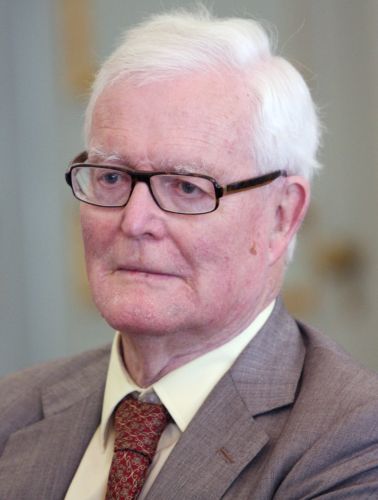
On October 19, 1988, announcement and action arrived together. Douglas Hurd informed the House of Commons that he had issued parallel directions to the British Broadcasting Corporation and the Independent Broadcasting Authority that day. The BBC direction rested on clause 13(4) of its Licence and Agreement, while the instruction to the IBA invoked section 29(3) of the Broadcasting Act 1981. These standing supervisory powers allowed the executive to proceed without introducing fresh legislation for prior parliamentary scrutiny. Broadcasters consequently became subject to the restrictions as soon as Hurd disclosed them, with copies deposited in the House of Commons Library and a fuller debate promised afterward. When MPs returned to the subject on November 2, they were being asked to approve politically a decision whose legal force was already being applied.
The directions classified spoken words through the organizational capacity in which a speaker delivered them. Broadcasters were required to exclude “any words spoken,” whether during an interview, a discussion, or another kind of program, by someone who represented or purported to represent a specified organization. The covered bodies included organizations already proscribed under emergency and antiterrorism legislation, along with Sinn Féin, Republican Sinn Féin, and the Ulster Defence Association. Naming the latter organizations separately brought lawful political and paramilitary associations within the same broadcasting rule as prohibited groups. A second provision extended the restriction to words by anyone who supported, solicited, or invited support for one of the designated bodies. Membership alone did not render a person inaudible on every subject, because the capacity in which that person appeared remained decisive. A Sinn Féin councillor might be barred while presenting the party group’s position on municipal business yet remain eligible to speak solely as a council representative or private individual. Conversely, an unaffiliated interviewee could fall within the restriction by explicitly appealing for support. Application depended upon judgments about representation and advocacy that the written direction could define only in general terms.
Election law and parliamentary privilege produced two conspicuous exceptions. Proceedings in Parliament could be transmitted directly, while candidates and those speaking for them could be heard during a pending parliamentary, European Parliament, or local election, provided their statements related to the candidacy and contest. Gerry Adams could consequently retain his broadcast voice during a campaign and lose it again once polling ended, even though his office, party, and opinions had not changed. By preserving direct speech where electoral fairness and privilege demanded it, the direction tacitly acknowledged that a reporter’s account was not always equivalent to hearing the political actor.
Hurd’s defense rested on an account of broadcasting’s peculiar force. Television and radio, he argued, gave advocates of paramilitary violence a direct route to a mass public, supplying “support and sustenance” that printed quotation could not provide in the same way. An appearance might confer what ministers regarded as unearned authority or respectability. Hurd also emphasized its possible power to intimidate viewers and offend bereaved families when transmitted after an atrocity. The concern had substance in a conflict where armed organizations cultivated publicity and used fear as part of political life. He invoked the Republic of Ireland’s Section 31 restrictions as evidence that a democratic government confronting terrorism could impose comparable controls. Journalists would remain free to summarize the prohibited statements, and newspapers could print them; Hurd characterized the measure as a denial of direct access rather than a restriction on reporting. That distinction supplied the policy with a coherent theory of media power, but it did not establish that the scarce interviews already reaching British audiences materially encouraged recruitment or sympathy.
The most damaging objection concerned evidence. Roy Hattersley reported that Independent Television had carried only four minutes of interviews with Sinn Féin supporters or associates during 1988, with all but one second appearing in coverage hostile or critical toward the organization. The government was suppressing an exceptionally rare practice that usually exposed its participants to adversarial questioning. Hattersley warned that removing such encounters could also hand republicanism an international claim to political martyrdom. Clare Short exposed the formal puzzle by asking why a speaker’s words could lawfully reach an audience through somebody else’s voice but not through his own. Michael Foot concentrated on constitutional method. A significant change in political communication had been made by ministerial direction, and the November 2 motion supplied parliamentary endorsement only after the event. Since difficult cases would still require interpretation, he feared that editors would consult the Home Office and gradually allow a government department to determine interview eligibility. Conservative dissenter Richard Shepherd added that Sinn Féin remained a lawful party whose candidates contested elections, making public judgment preferable to official exclusion. Supporters of Hurd reasonably replied that four minutes measured duration rather than impact and that a brief appearance could possess symbolic weight far beyond its running time. Nevertheless, ministers offered no persuasive demonstration that removing the original voice would weaken terrorism, while their claim to have relieved broadcasters of responsibility sat awkwardly beside the borderline decisions the directions left newsrooms to make.
Questions from the broadcasters soon revealed how much interpretation the apparently firm line required. In an October 24 letter, the Home Office explained that reported speech remained permissible, including a verbatim voice-over, and that actors could reconstruct prohibited statements; genuinely fictional use fell outside the direction’s intended reach. The guidance also confirmed that membership or elected office did not fix a speaker’s status for every appearance, requiring producers to determine the capacity in which each contribution was made. A separate judgment awaited them whenever the words might be understood as inviting organizational support. This clarification showed that the order was narrower than a complete blackout while making its operation more intricate than Hurd’s Commons statement suggested. The government had placed the decisive limit around audible self-presentation. The words could survive, but the legal political actor’s delivery became conditional upon an executive classification administered through newsroom choices.
Who Should Decide What the Public Can Hear?
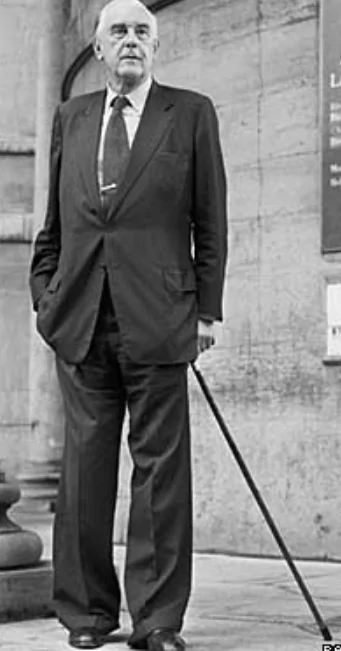
The Commons debate of November 2 shifted attention from the categories in Hurd’s notices to the authority behind them. Hurd maintained that it was “more sensible and honest” for the government to assume responsibility than to ask broadcasting organizations to reach difficult decisions independently. His formulation placed accountability upon ministers who could be questioned in Parliament and removed any pretense that the restrictions originated with editors. The motion before MPs concerned an order already in operation. Its passage signaled political approval without creating, revising, or renewing the directions themselves. The Conservative majority rejected Labour’s declaration that the measure was incompatible with a free society and endorsed Hurd’s action. Parliamentary involvement consequently ratified an exercise of executive discretion rather than subjecting a proposed law to amendment before it affected broadcasting.
That sequence reflected the constitutional design of British broadcasting. The BBC occupied a hybrid position. Publicly constituted and formally protected in its editorial work, it remained governed by a Licence and Agreement reserving a direct power to the home secretary. Commercial television operated through the statutory Independent Broadcasting Authority, whose governing legislation contained a parallel provision. Both settlements had developed from the belief that scarce frequencies and broadcasting’s mass reach justified controls beyond those applied to print. The relevant powers covered broad classes of material, leaving no requirement that Hurd identify a particular program or demonstrate injury caused by a specific interview. Parliament had accepted those provisions years earlier as parts of general regulatory schemes, without considering whether they should be used against representatives of Sinn Féin. Newspaper editors remained free to publish the same statements because no comparable licensing relationship connected them to the Home Office. Ministers could portray intervention as an established feature of public-service regulation. Its use nevertheless demonstrated how readily an exceptional reserve power could enter an editorial sphere whose independence rested largely upon institutional convention.
Corporate leaders objected without forcing a judicial contest. BBC chairman Marmaduke Hussey and director-general Michael Checkland warned that the directions created a damaging precedent and raised serious questions about the corporation’s independence. Lawyers for the BBC and commercial broadcasters examined the possibility of challenging the government but concluded that success was unlikely. Neither broadcasting institution sought judicial review. Management concentrated instead on obtaining clarification and maintaining lawful output, leaving individual journalists and their union to defend the wider principle of editorial freedom.
Broadcasting independence did not by itself settle the normative question. Editors were unelected gatekeepers whose selections determined political visibility, and the record of the preceding years showed that professional caution could also constrict coverage. The BBC and IBA already bore obligations concerning impartiality and material likely to offend public feeling. Hurd could accordingly claim that decisions touching national security belonged to ministers answerable to the Commons rather than corporate officers deliberating beyond public view. There was force in the proposition that exceptional restraint should be imposed openly by an identifiable officeholder. Yet the executive was scarcely a disinterested referee in Northern Ireland. The British government directed security policy and defended the conduct of institutions whose actions broadcasters were expected to investigate. Allowing that same government to classify eligible political speakers created a conflict that ministerial accountability alone could not resolve.
Those concerns supplied the basis of R v Secretary of State for the Home Department, ex parte Brind. David Brind, a BBC news producer, joined other broadcast journalists, most of them members of the National Union of Journalists, and an applicant claiming a viewer’s interest in receiving information. They argued that the directions removed an essential portion of editorial control and impaired broadcasters’ duty to maintain due impartiality. Their case also invoked Article 10 of the European Convention on Human Rights, which protected the freedom to impart and receive information. Ministerial action burdening political expression, they contended, should be tested against a pressing social need and assessed for proportionality. After defeats in the Divisional Court and Court of Appeal, the applicants carried the case to the House of Lords. There the dispute turned primarily upon the domestic status of the Convention and the intensity with which judges could examine executive discretion. Britain had ratified the Convention but had not yet incorporated it into national law. The law lords accepted that treaty obligations could assist in interpreting ambiguous legislation, although they found no relevant ambiguity in the powers governing the BBC and IBA. They also declined to recognize proportionality as a general ground of English administrative review. Applying the narrower standard associated with Wednesbury unreasonableness, the House concluded that Hurd had considered relevant concerns and had reached a decision available to a rational minister. Dismissal of the appeal in February 1991 established the directions’ legality without proving their effectiveness or endorsing them as the wisest response to political violence.
An important part of the judicial outcome arose from the restriction’s incompleteness. Lord Lowry characterized the interference as a “modest invasion of liberties,” while other judicial reasoning emphasized that journalists could continue conveying the information through indirect forms. Semantic continuity thereby reduced the apparent constitutional cost. The applicants answered that presentation affected understanding and that the immense consequences of defying a ministerial direction would encourage broadcasters to exclude doubtful material. Substitute voices served the courts as evidence of moderation even as journalists regarded compulsory substitution as an alteration of their reporting.
The answer that emerged was divided among institutions but unequal in rank. Ministers selected the affected organizations and supplied the governing definitions. Producers determined how those definitions applied to individual contributions, while judges supervised only the broad limits of legal power. Parliament could withdraw political support or enact a different rule, although its November vote neither designed the policy nor created independent scrutiny. Viewers appeared in official argument chiefly as people requiring protection from intimidation or offense, even though the journalists’ case presented them as citizens entitled to assess political leaders. A democracy confronting armed violence could restrain incitement or operational communications, and broadcasters possessed no exclusive warrant over national-security policy. Controls based upon a speaker’s identity demanded a stronger justification because the government imposing them participated in the conflict being reported. Brind preserved Hurd’s authority while exposing how profoundly public access depended upon institutions with different interests and unequal forms of accountability.
Finding the Permitted Voice
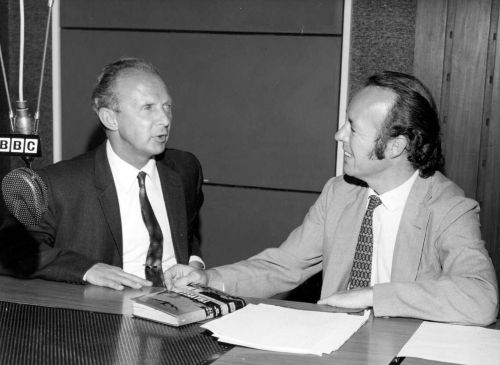
The practical search for an admissible form of speech began amid confusion. On the day Hurd announced the restrictions, BBC Controller of Editorial Policy John Wilson circulated provisional guidance warning that the government’s action would be “very broad.” His reading could have prevented newsreaders from quoting statements judged supportive of a designated organization, even when the prohibited individual never appeared. Channel 4’s initial legal advice went further by treating fictional dialogue and recordings made long before October 1988 as potentially covered. The first reported item altered under the order was a BBC Northern Ireland television interview with Ulster Defence Association leader Tommy Little concerning the organization’s former links with Libya. That case demonstrated the formal reach of the measure across the conflict while revealing how little broadcasters initially understood about acceptable substitution. Before dubbing became familiar, newsrooms had to discover through negotiation which elements of an interview could survive transmission.
A Home Office letter dated October 24 supplied the interpretation from which a workable production method developed. Written by official C. L. Scoble and approved by Hurd, it distinguished a direct statement from a journalist’s report of that statement. Broadcasters could show film or a still image of the restricted person while providing an account of the remarks, either paraphrased or reproduced word for word. The letter also permitted actors to perform verbatim language in reconstructions of actual events, while genuine works of fiction remained outside the notice. An interview could consequently be recorded in the usual manner and modified after its editorially relevant passages had been selected. The chosen extract was transcribed, assigned to a performer, and rerecorded while the performer watched the original footage. Technicians then removed the interviewee’s soundtrack and synchronized the replacement with the visible movement of the speaker’s mouth. Subtitles supplied another option for television, while a correspondent’s narration could accommodate a shorter report. Because the government expressly accepted these devices, actor dubbing was an authorized means of compliance rather than a loophole invented in defiance of the order. Its ingenuity belonged to the broadcasters, but its legality rested upon the Home Office’s own distinction between a person’s words and the sound of that person saying them.
The available techniques were not equivalent. A reporter’s paraphrase could deliver an item quickly, but compression transferred control of the phrasing to the journalist. Subtitles retained the language on television while requiring viewers to divide their attention between the written lines and the face above them; radio possessed no comparable device. Dubbing preserved the movement of question and answer, although another person now determined the audible character of the exchange. Peter Taylor’s 1990 report from the Maze Prison exposed a further peculiarity. Prisoners could speak directly about paramilitary activity in a personal capacity, yet one inmate had to be revoiced when he complained about the size of sausage rolls on behalf of IRA prisoners. The harmlessness of the complaint offered no exemption because representative capacity, rather than the threatening content of a sentence, activated the rule.
The actor’s labor made this regulatory distinction audible. Conor Grimes later recalled being summoned to the BBC’s Belfast newsroom, where Ireland correspondent Denis Murray placed him before a monitor and explained that he would speak for Adams. Grimes studied Adams’s lip movements, approximated his West Belfast accent, and adjusted the timing until the new recording matched the filmed image. The assignment demanded greater emotional discipline after UVF gunmen killed four men at Cappagh in 1991, one of whom had attended school with him. When personal feeling entered his reading, Murray intervened: “No emotion. It’s a newsroom. You’re not on a stage!” The instruction sought a delivery that would neither embellish Adams’s language nor invite the actor to interpret it dramatically. Yet suppressing visible emotion did not eliminate performance; it prescribed an institutional manner marked by measured pace and deliberate restraint. Grimes also kept himself available at short notice, since an unexpected statement could leave a bulletin dependent upon whether a suitable actor could reach the studio in time. As performers became adept at synchronization, the alteration could appear increasingly routine even though every finished sequence remained a carefully manufactured composite.
Constructing that composite affected which interviews seemed worth pursuing. Recording a covered speaker initiated a second production cycle after the ordinary work of reporting had already begun. Someone had to determine whether the person was speaking in a prohibited capacity and whether the surrounding subject changed that classification. Once an extract had been approved, it required transcription and a fresh recording; fitting the performance to the pictures consumed additional editing time. A scheduled documentary could absorb such demands more readily than a late-breaking bulletin. Live discussion presented a deeper obstacle because no surrogate could reproduce an answer at the moment it was given, while radio lost the compensating evidence of the interviewee’s visible presence. These differences made the burden uneven across programs and media. One BBC reporter interviewed by Ed Moloney observed that telephoning a source and incorporating the response into a correspondent’s report was easier than sending a camera crew to obtain material that could not be transmitted without reconstruction. The reporter feared that some colleagues would eventually avoid making the call. John Birt insisted that BBC journalists should continue interviewing relevant political figures regardless of the legal advice and technical work required, but the need for such an instruction acknowledged the pressure confronting producers. An omitted contribution left no trace on the broadcast, so the most consequential editorial decision could occur before an actor entered the studio.
The finished item preserved the restricted speaker’s wording while changing the encounter through which audiences received it. The interviewee remained responsible for the claims and chosen phrases. A performer supplied their audible delivery after editors had decided that the contribution justified the additional work. Ministers could maintain that political information remained available because the directions neither dictated the transcript nor compelled journalists to paraphrase it. That defense treated verbal content as detachable from the conditions of its presentation and understated the disadvantage created by delay, expense, and the loss of live exchange. Viewers might learn what Adams had said, yet their opportunity to assess his immediate response to questioning was narrowed by a recording assembled afterward. Finding the permitted voice relocated the order’s practical force into an ordinary newsroom judgment, whether a particular speaker’s contribution merited reconstruction at all.
When the Rules Followed the Speaker
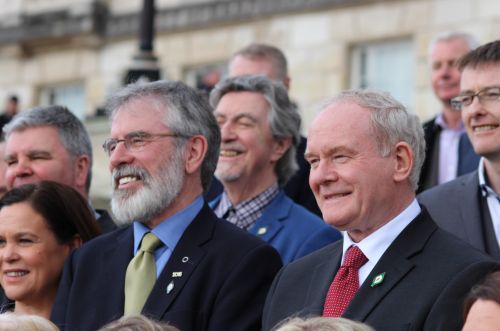
Identity alone did not formally determine whether someone could be heard. In its October 24 clarification, the Home Office rejected the proposition that membership or elected office made a person a permanent representative of a designated organization. A Sinn Féin member did not speak for Sinn Féin throughout every part of daily life. Coverage depended upon the words used and the circumstances in which they were uttered. Speech delivered in a personal role or solely on behalf of an elected council could pass outside the restriction, although language supporting a listed organization might still be caught by the notice’s separate provision. Affiliation initiated an inquiry without deciding its outcome. Each appearance required editors to assign a temporary public capacity before determining whether the original sound could remain.
Municipal politics made that distinction strikingly consequential. Sinn Féin councillors dealt with local administration and constituency concerns while also belonging to a party whose representatives were restricted. Comments offered on behalf of a council could be transmitted directly, whereas an answer articulating Sinn Féin policy normally required replacement. In February 1992, Gerard McGuigan, a Sinn Féin councillor in Belfast, was permitted to speak in his own voice when describing a loyalist attack on his home. His party affiliation had not diminished, nor had the political environment surrounding the assault become neutral. What changed was his position within the report. The broadcaster treated him as the target and witness of a particular incident. The exception allowed audiences to receive evidence from a person close to an event without granting him an unrestricted platform for organizational advocacy. Such distinctions had a defensible logic, but they also made audibility depend upon how a newsroom framed the purpose of an interview.
Electoral time produced an even sharper reversal. The notices operated with reduced force during formal campaign periods because broadcasters remained obliged to provide impartial election coverage. During the 1992 general election, audiences could hear Adams debate Social Democratic and Labour Party leader John Hume in their natural voices. Once voting ended, the ordinary restrictions returned, and Adams’s response to losing West Belfast to Joe Hendron could no longer be carried directly. Neither Adams’s political identity nor the subject of the coverage had altered during that brief interval; the expiration of the electoral exception changed the status of his speech.
The provision concerning supportive statements extended the problem beyond anyone holding a Sinn Féin membership card. On September 1, 1992, BBC2 transmitted an edition of Nation devoted to political violence in which former member of Parliament Bernadette McAliskey participated. She belonged to none of the organizations named in the notices. BBC lawyers nevertheless concluded that parts of her contribution supported or invited support for a prohibited group, and those passages appeared as subtitles after her voice was removed. Two anonymous audience participants received similar treatment. McAliskey maintained that she had explained the context in which republican violence arose without endorsing its use. Peter Bottomley, a former Northern Ireland minister who appeared in the program, subsequently told BBC Director-General Michael Checkland that the decision was mistaken and had falsely associated McAliskey with violent organizations. His intervention identified a consequence extending beyond temporary loss of sound. Selective silencing could publicly classify a contributor as a supporter of terrorism. The representative provision asked whether someone spoke for an institution, but the support provision required an assessment of what the contribution meant. In discussions of political violence, an explanation of motive could be interpreted as an excuse, while recognition of a grievance could be taken as approval of the organization claiming to act upon it. The BBC’s treatment of McAliskey showed how caution could bring independent critics within a policy presented primarily as a restraint upon paramilitary spokespeople.
National borders revealed another limit to the system. In January 1994, the Irish government allowed its Section 31 order to lapse, enabling RTÉ to broadcast Sinn Féin representatives directly. People in Northern Ireland who could receive Irish television and radio were consequently able to hear Adams even while the BBC and Ulster Television remained bound by the British notices. Later that month, the Clinton administration granted Adams a forty-eight-hour visa to visit New York despite forceful objections from London. He appeared throughout American television, including interviews on Larry King Live and The Phil Donahue Show, with no substitute standing between his speech and the American audience. British broadcasters reporting the same visit still had to replace his recorded voice. The controlling factor was the regulated act of transmission rather than the location of the microphone. Increasingly international television did not eliminate the government’s authority over domestic broadcasters, but it made the territorial limits of that authority conspicuous.
These variations demonstrate both the precision and the instability of the restrictions. The government could reasonably distinguish an eyewitness account needed for factual reporting from a statement intended to enhance the standing of an organization associated with continuing violence. The election modification likewise recognized that representative democracy imposed obligations difficult to reconcile with complete exclusion of a candidate. Applying those distinctions required broadcasters to make recurrent judgments about political identity and implied allegiance. Adams arrived at each prospective interview with a background that demanded scrutiny before anyone considered the immediate value of his answer. McAliskey’s experience established that formal affiliation was unnecessary once editors believed a contributor’s reasoning had crossed the line into support. The outcome was a revocable status under which a familiar public figure might be audible on one occasion and revoiced on the next. The rules followed the speaker because every new contribution was read through knowledge of who that person was, leaving the public to encounter decisions whose underlying classifications were rarely visible.
The Interview That Was Never Made

A canceled broadcast may leave a memo; an interview never proposed usually leaves nothing. This evidentiary imbalance makes the ban’s indirect consequences harder to establish than the substitutions visible on surviving recordings. During the ban’s first year, neither the BBC nor the ITV companies systematically monitored how the restrictions changed coverage, and a BBC spokesman in Belfast told Ed Moloney that such an exercise would cost too much. Named cancellations can be documented, while participant accounts reveal what journalists believed the rules permitted. Aggregate counts register a change in output but cannot recover each choice behind it. The early spate of publicly identified cases soon diminished. That decline could have been due to broadcasters mastering compliance, or caution may have moved upstream until difficult ideas ceased to enter production.
Enough fragments remain to show that nonproduction was more than a hypothetical concern. A contemporary Information on Ireland inventory placed a Channel 4 program about republican women among the early casualties. Intended interviews with people injured by plastic bullets and with relatives of the Guildford Four were affected as well, demonstrating that the loss extended beyond formal representatives of the named organizations. The breadth of these examples matters. An inquiry into policing or imprisonment could become harder to assemble even when its central subject was not a Sinn Féin press statement. Paul Hamann, then the BBC’s executive producer of documentaries, recalled that two prospective films offering unfamiliar approaches to Northern Ireland had fallen away after the order took effect. His testimony concerned projects already conceived, making it stronger evidence than a general complaint about a chilling atmosphere. Moloney also recorded an unnamed BBC executive’s account of proposals no longer advanced because producers expected rejection or feared being marked as politically suspect. In that setting, a minister did not need to order each cancellation. Anticipated resistance did part of the censoring before anyone authorized filming. Open-ended documentaries were particularly exposed because their value lay in following uncertain lines of inquiry, yet uncertainty made their eventual legal and editorial costs hard to calculate in advance.
Peter Taylor foresaw a change in the kind of coverage likely to reach the public. Broadcasters would still respond to atrocities, but programs probing the republican movement would become rarer. The IRA’s bombings and killings plainly remained news and demanded rigorous coverage; the distortion Taylor feared arose if violence supplied the principal occasion for returning to Northern Ireland at all. Event-driven reports showed consequences after they occurred, whereas extended interviews could examine the political reasoning and social support that sustained the movement between attacks. Losing those encounters also weakened adversarial journalism, since an absent Sinn Féin representative could neither promote the republican case nor be pressed to account for the IRA’s conduct.
Available numbers confirm a substantial reduction without supplying a complete causal history. The Glasgow University Media Group recorded 93 appearances by Sinn Féin representatives on network television news during the twelve months before the order and 34 during the next twelve months, a decline of more than 63 percent. Its pre-ban sample also found Sinn Féin participants in only 17 of 633 formal BBC interviews, so access had already been scarce. Danny Morrison offered an even sharper estimate from Sinn Féin’s own monitoring. Approximately 500 contacts from broadcast and print journalists in the three or four months beforehand, followed by about 100 in the four months afterward. That internal tally was neither independent nor audited, and its inclusion of press inquiries makes it an indicator of the party’s experience rather than an exact measure of broadcasting. Source behavior further complicates attribution. By 1994, Tony Hall argued that Sinn Féin and the IRA sometimes cited the restrictions when declining interviews, thereby insulating their representatives from questioning. A policy designed to obstruct republican advocacy could spare republican leaders the encounters in which journalists might expose evasions or demand answers about continuing violence. As a result, the archive favors broadcasts whose producers found a way through the rules. Revoiced clips prove that circumvention sometimes succeeded, but they reveal little about ideas rejected in discussion. Nor do they disclose inquiries abandoned after legal advice or invitations never issued. A completed Adams interview at least showed that his contribution had reached the program; viewers received no corresponding sign when an invitation was never extended. No historian can assign a dependable total to those absences, and participant testimony should not be inflated into proof that every reduction resulted from government pressure. Still, the documented cancellations and measured fall in appearances establish more than anecdote. Practitioners’ accounts explain how that decline could become self-reinforcing: fewer proposals eroded the expertise and relationships needed to make the next one. The interview that was never made mattered because it removed the exchange itself, including the journalist’s opportunity to test the claims that officials sought to keep from direct broadcast.
Challenging the Ban in Court
Six broadcast journalists (Donald Brind, Fred Emery, Alexander Graham, Victoria Leonard, Scarlett McGwire, and John Pilger) joined Thomas Nash, an employee of the National Union of Journalists and a television license holder, to challenge the directives. On January 24, 1989, they asked the Divisional Court for judicial review, seeking a declaration that the home secretary had exceeded his authority and an order quashing the notices. Their procedural choice mattered because judicial review tested the legality of executive action rather than inviting judges to substitute a preferred broadcasting policy. The Divisional Court dismissed the application on May 26; the Court of Appeal did the same on December 6. A further appeal brought the dispute before five law lords in November 1990. When the House of Lords gave judgment on February 7, 1991, every member agreed that the restrictions were lawful. The composition of the group framed the injury broadly. State intervention had burdened those who gathered and received political information as well as the people whose voices could not be transmitted. What had begun as a dispute over newsroom practice had become a constitutional case concerning the reach of ministerial discretion.
The applicants did not rest their case on a single conception of free speech. Section 29(3) of the Broadcasting Act 1981 authorized the home secretary to require the Independent Broadcasting Authority to refrain from transmitting “any matter or classes of matter,” while clause 13(4) of the BBC’s license and agreement supplied an equivalent power over the Corporation. Counsel argued that such open language should not be treated as permission for unlimited control over who could speak, particularly when the direction extended beyond statements about violence. Britain’s ratification of the European Convention on Human Rights offered a second route. Article 10 protected the freedom to impart and receive information, allowing interference only when it was prescribed by law and necessary in a democratic society for a recognized public purpose. The claimants maintained that necessity required a pressing social need and a means proportionate to the harm alleged. They also invoked the broadcasters’ duties of accuracy and due impartiality, arguing that the executive had displaced editorial judgment despite identifying no previous breach of those obligations. In ordinary administrative-law terms, they called the notices irrational under the demanding standard associated with Wednesbury. None of these submissions asserted that a television studio had to be opened unconditionally to every advocate of political violence. The more exact contention was that an exceptionally broad power should not sustain a prior restraint unless the government could justify this particular design. Embedded in the pleadings was a dispute over the applicable standard: must a court determine whether the interference was needed, or merely whether a minister could reasonably believe that it was?
None of the three domestic courts granted relief, and the appellate judgments closed the opening for Convention-based review. In 1991 the Convention was an international obligation that Parliament had not incorporated into domestic law, so Article 10 could not itself invalidate executive action. Lord Bridge accepted that courts might use a treaty to resolve genuine ambiguity in legislation, but he found no competing meanings in the capacious words of section 29(3). Turning the Convention into an implied limit on every statutory discretion, he concluded, would amount to “judicial usurpation of the legislative function.” The treaty could inform political criticism and a later application to Strasbourg; it could not provide the remedy that the challengers sought at home.
Common-law review nevertheless did not disappear once Article 10 was set aside. Lord Bridge began from the proposition that a restriction upon expression required justification by an important competing public interest, and Lord Ackner said that reasons affecting a fundamental right deserved close scrutiny. Their scrutiny remained “secondary.” The primary judgment belonged to the home secretary, while the bench asked whether a reasonable officeholder, acting upon the available material, could have reached it. The government supplied four connected rationales. An appearance after an atrocity might cause widespread offense, while access itself furnished undeserved publicity. Officials further claimed that broadcast presence increased the standing of violent organizations and could intimidate those being addressed. The law lords regarded the defeat of terrorism as an interest of the highest order and found ample material, including parliamentary speeches and a Home Office affidavit, to place Hurd’s decision within the range of lawful choices. They declined to recognize proportionality as an independent ground of English judicial review because weighing necessity for themselves would, in their view, convert supervision into an appeal on the merits. Lord Roskill allowed that the doctrine might enter domestic law in a future case, but he would not take that step here. The rejection of the due-impartiality argument completed the result. Broadcasters could still discharge their obligations by recasting material, so the minister had not made compliance impossible. This was more attentive than a declaration that expression counted for nothing, yet it placed a steep burden on anyone contesting a security measure that left some channel of communication technically available.
The judgments became most revealing when they assessed what the substitute channel preserved. McCowan LJ asked how ideas could be hindered when the BBC and ITN remained free to report a prohibited speaker verbatim or in paraphrase. He stressed that ITN’s relevant interviews during the preceding year occupied less than four and a half minutes on sixteen days, a small quantity that could be reformatted rather than lost. Yet he immediately recognized that an appearance might exert more influence than a presenter’s neutral recital; instead of treating that difference as an expressive loss, he treated it as confirmation of the government’s case. Lord Bridge likewise described the notices as confined to manner. An audience could see a face and receive the same sentences, provided an actor supplied the sound. The affidavits had proposed a different function for personal presence. Jonathan Dimbleby contended that an interviewer could confront evasions in public, whereas Lord Ackner replied that weak questioning might assist the cause it meant to expose. The judges understood that a mediated encounter did something beyond conveying propositions, but their analysis assigned the uncertain surplus of that encounter to the risk side of the balance.
Recourse to Strasbourg finally supplied the proportionality inquiry that domestic law had withheld, although it did not alter the outcome. On May 9, 1994, the European Commission of Human Rights ruled the journalists’ application in Brind and Others v. United Kingdom inadmissible by a majority. The Commission expressly found an interference with the first six applicants’ Article 10 rights and accepted that the notices had a real effect on their professional work. It nevertheless held that the direction, read with the Home Office’s clarifying letter of October 24, was sufficiently accessible and foreseeable. The restrictions pursued legitimate aims recognized by Article 10 and fell within Britain’s margin of appreciation. Images and verbal content remained available through substitutes, while the election exception further narrowed the order’s operation; compared with the more extensive Irish prohibition previously upheld in Purcell, the British arrangement appeared limited. The Commission even remarked that the logic of continuation was not readily apparent if the device made so little difference to the information available, but it treated that anomaly as evidence of a minor interference rather than weak evidence of necessity. A companion decision considered John Mitchell McLaughlin, a Sinn Féin member of Londonderry District Council, who argued that the rule obstructed his democratic responsibilities even though he had signed the statutory declaration against supporting violence. The Commission acknowledged the special importance of expression for an elected representative and conceded that journalists might be slower to interview someone covered by the notices. Still, it found no major impairment because McLaughlin’s statements could be relayed and his image remained broadcastable; his Article 10 complaint, like the journalists’, was deemed manifestly ill-founded. The European proceedings applied the test unavailable in the British courts and still accepted the official account of a narrowly drawn intervention. Neither decision demonstrated that excluding original voices reduced violence, the government admitted that the measure would not directly reduce terrorist acts, but together they made substitutability the legal reason why an acknowledged interference could survive.
The Same Speaker across Different Boundaries
Territory gave Adams’s speech no single broadcast form. Between 1988 and early 1994, an interview recorded in Belfast could reach London and Dublin in dissimilar forms even when the questions and answers were unchanged. British notices allowed a reconstruction in which another person read the answers, whereas Ireland’s Section 31 order barred RTÉ from carrying the interview itself. American networks broadcasting from the United States faced neither command. Each government could say it regulated domestic broadcasters rather than Adams wherever he traveled, but audiences did not remain within discrete national systems. That mismatch weakened the promise of denying him a platform, since the promise assumed a bounded media space that broadcasting technology no longer provided. Comparison governments’ different legal frameworks and security responsibilities is essential to a fair comparison. Those differences also show that public access depended on the institution transmitting the material and the route by which its signal arrived.
Ireland’s controls were older and more restrictive in what they prohibited. Section 31 of the Broadcasting Authority Act 1960 empowered a minister to direct RTÉ not to transmit specified matter, although the power remained unused until 1971. Minister for Posts and Telegraphs Gerard Collins then prohibited material calculated to promote organizations pursuing objectives through violence, a formula that left the broadcaster unsure how far legitimate reporting might extend. After the Provisional IRA killed Garda Michael Clerkin in October 1976, Conor Cruise O’Brien issued a new direction naming particular organizations and their representatives. The 1976 amendment limited each order to twelve months and allowed either house of the Oireachtas to annul it. Section 12 of the Radio and Television Act 1988 extended any Section 31 direction then binding RTÉ to licensed independent broadcasters. The 1993 order forbade an interview, or a report consisting of an interview, with a representative of the IRA, Sinn Féin, or another listed organization. Because the prohibited item was the encounter rather than merely the interviewee’s sound, an actor could not supply the solution adopted in Britain. Irish news programs could summarize a position from a statement or another source, but they could not reproduce the questioning that elicited it. RTÉ management further extended the rule to ordinary party members until Larry O’Toole, who had been interviewed in his capacity as a bakery strike spokesman, prevailed in the High Court in 1992 and before the Supreme Court in 1993. British and Irish controls addressed related violence through materially different restrictions. One left a conspicuous alteration in the completed report; the other more readily kept the recorded exchange off the air.
Signals reduced the practical force of the jurisdictional frontier. Reception of RTÉ in Northern Ireland and of British channels in the Republic was uneven, yet some households could watch reports made under another government’s rules. In one widely recalled anomaly, CNN carried a BBC interview to American viewers with the substitute voice already attached, so a British production decision traveled beyond the rule that had required it. After January 1994, a Northern Irish viewer with access to RTÉ could hear Adams directly while the BBC or ITV altered his audio. Legal authority adhered more reliably to broadcasters and distribution routes than to the experience of an audience.
On January 19, 1994, Ireland broke the regulatory parallel. The final instrument, S.I. No. 1 of 1993, expired because the minister issued no successor. Calling the event a repeal is imprecise. Section 31 remained in the statute book, while the annual prohibition made under it was allowed to lapse. The statutory choice fell to Michael D. Higgins, minister for arts, culture and the Gaeltacht, and had the support of Albert Reynolds’s coalition government. It followed the Downing Street Declaration of December 15, 1993, but preceded an IRA ceasefire by more than seven months. Armed violence remained an immediate concern, and opponents in the Dáil proposed renewable two-month orders until the IRA accepted a permanent cessation. The government’s defense placed greater confidence in public judgment and editorial scrutiny, with the ordinary law governing incitement still in force. The effect appeared almost at once. Dublin’s 98FM interviewed Adams as the restriction ended, and RTÉ carried his first post-ban television interview, without dubbing, on January 20. Longer encounters later that month, including Brian Farrell’s television interview, required Adams to address the Downing Street Declaration and the continuation of IRA operations. During the ensuing parliamentary debate, critics argued that repeated appearances conferred celebrity and political legitimacy. Supporters replied that sustained questioning exposed evasions, and one deputy cited a probing Donegal radio interview with Martin McGuinness and Pat Doherty that produced no visible surge in recruitment. Neither side’s impression amounted to a dependable measure of political effect. Ireland nevertheless furnished a revealing test. Ordinary editorial practice could let a controversial politician persuade viewers while also making his avoidance and inconsistency available for judgment.
Within days, Washington enlarged the contrast. President Bill Clinton authorized a forty-eight-hour visa after earlier refusals and strong British objections. American control operated at the point of entry. The visa restricted Adams to a twenty-five-mile radius around New York City and barred fundraising, but the government did not instruct broadcasters to alter his speech once he arrived. The administration described the decision as a calculated effort to encourage movement toward peace, permitting attendance at a National Committee on American Foreign Policy conference without granting unrestricted admission. Adams also appeared on Donahue and Charlie Rose and spoke on Larry King Live, all without imposed dubbing. The interviews differed in rigor, confirming that direct sound did not itself ensure an exacting encounter, but they let American viewers assess how he answered as well as what he said. British bulletins reporting the visit continued to replace his audio. Britain chose to preserve this difference. On February 4, Secretary of State for National Heritage Peter Brooke announced that the notices would remain in force, subject to review as circumstances changed. An American viewer and a British viewer could consequently watch the same political figure discuss the same conflict, although only the former heard him without an intermediary. British rules could shape reception at home, but they could not prevent Adams’s international emergence or stop that emergence from becoming domestic news.
The variation among jurisdictions must be weighed against Britain’s distinct security burden. The government faced a lethal campaign within its territory and had reason to consider how organizations associated with violence used mass broadcasting. Ireland’s decision supplied no proof that every direct interview would be harmless, while the American invitation arose in a political setting shaped by an influential Irish American constituency, parts of which had supported militant republicanism.
Adams was a practiced communicator who could evade unwelcome questions, and wider exposure could increase his standing in precisely the manner British ministers feared. The comparison nonetheless discloses the fundamental limit the notices could regulate the conditions under which British services presented him, but they could no longer exclude his unaltered delivery from the wider public sphere. By early 1994, some people in Northern Ireland could receive him through RTÉ while channels licensed in their own state continued to dub him. Accounts of the American appearances then entered British reporting even though their central participant was still heard through an actor. Citizens confronting Adams’s claims about peace and continuing violence consequently received different evidence with which to judge a single political actor. The rule had become a domestic intervention in an encounter that was already transnational. It distributed the evidence unevenly. What audiences could assess depended on geography and transmission.
Reporting Peace through a Borrowed Voice
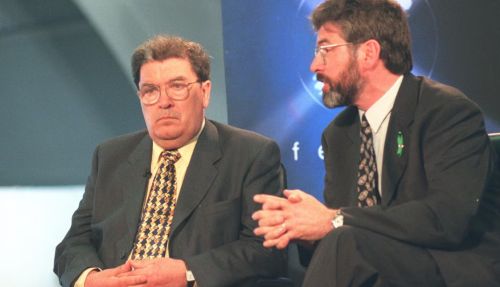
By the autumn of 1993, the broadcasting directions confronted a story they had not been designed to narrate. Their original political logic assumed that withholding a Sinn Féin representative’s original delivery would deny republicanism public standing and useful publicity. Yet the revived dialogue between John Hume and Gerry Adams made Adams relevant for a different reason. Reporters needed to discover whether a leader closely associated with militant republicanism could help move the IRA toward an end to its campaign. That inquiry neither absolved Sinn Féin of its defense of violence nor made every claim about an emerging settlement credible. It did turn exclusion into an obstacle to explaining one of the period’s most consequential developments. Producers consequently placed more of Adams on screen while assigning his delivery to actors, so his growing importance weakened the practical effort to keep him marginal without removing the formal penalty. News value and state policy now pulled in opposite directions. Adams supplied the recorded words, while a performer necessarily affected how their hesitation or confidence reached listeners. Editors then decided how much prominence this composite appearance deserved.
The Hume–Adams initiative made the resulting imbalance unusually plain. Their statement of April 24 acknowledged that their parties held different views while defining a peaceful and democratic accord as their primary objective. On September 25, the two leaders reported considerable progress toward a process involving all parties and sent an account of their discussions to the Irish government. Joint authorship did not yield equivalent conditions of appearance. Hume could explain the dialogue in his own speech and answer objections through an ordinary interview; Adams’s comments had to be read by presenters or delivered by actors whenever he spoke as a Sinn Féin representative. Surviving BBC Northern Ireland program logs repeatedly show reports combining interviews with Hume, statements from ministers, and unionist criticism with a restricted Adams contribution. Those records do not constitute a comprehensive content analysis, but they disclose how a shared undertaking acquired unequal forms of public authorship. Hume cannot be treated as a convenient mouthpiece for Adams. He led the SDLP and spoke from a substantially broader nationalist electoral mandate than Sinn Féin possessed. His constitutional reasoning was his own, and meeting Adams exposed him to sustained criticism from political opponents. Because Hume was an autonomous negotiator, his audible explanations could not reveal how Adams himself handled doubt, pressure, or disagreement. Audiences heard one participant defend the initiative without technical intervention, while the other arrived in a form that announced his exceptional status before he had completed an answer. An actor could preserve the propositions Adams advanced, but the surrounding contrast influenced which participant appeared to possess the language of accommodation.
No responsible bulletin could treat the word peace as evidence that peace had arrived. On October 23, 1993, an IRA bomb exploded prematurely in a Shankill Road fish shop, killing nine people as well as one of the men carrying it. Seven days later, loyalist gunmen acting under the Ulster Freedom Fighters name murdered eight civilians in the Rising Sun bar at Greysteel. These atrocities made rigorous questioning indispensable because conciliatory language continued beside deliberate killing. If Adams drew a distinction between the political initiative and continuing IRA attacks, the manner in which he defended that distinction was relevant evidence. A performer trying to sound neutral could make a strained answer seem composed, while a harsher rendering could impose aggression that the recorded speaker had not displayed. Direct delivery would have supplied audiences with more material for judgment while leaving journalists free to challenge every proposition.
The disclosure of a government channel to the republican leadership made the problem sharper. On November 29, Patrick Mayhew told the Commons that an indirect means of communication had existed for years. He attributed to the IRA leadership a message received near the end of February declaring that the conflict was over and requesting advice about bringing it to a close. The government sent a substantive reply on March 19, and Mayhew reported that substantive contact had resumed on November 2. Sinn Féin disputed the official presentation of the exchanges and subsequently published its own record, making authorship and wording part of the controversy. Mayhew insisted that the communications had never become negotiations and that formal dialogue remained conditional upon a permanent end to violence. That distinction had factual and diplomatic significance. A confidential channel could allow adversaries to test possibilities without making premature commitments, and its preservation was defensible if it offered a chance of preventing further deaths. Once the channel became public, it revealed a striking difference between governmental practice and broadcast presentation. Mayhew and John Major could explain their choice of terms in their own voices. Adams could be filmed rejecting or qualifying their account, but his political answers still reached British audiences through somebody else’s delivery. A minister could use emphasis to distinguish exchanging messages from bargaining, whereas a republican denial lost that direct expressive resource. Labour MP Bob Cryer connected the issues in the Commons when he challenged the secrecy surrounding the contacts and called for the removal of the arrangements under which actors reproduced Sinn Féin statements. Mayhew answered that broadcasting fell within the responsibility of the national heritage secretary and pointed to the stricter regime then operating in the Republic of Ireland. The government and the IRA plainly held different constitutional positions. Ministers bore responsibility for public safety, while the IRA remained responsible for a lethal campaign. Even so, the government privately treated republican communications as sufficiently important to preserve, interpret, and answer while public policy continued to diminish the evidence available when the same political movement responded on television. In a dispute centered upon sincerity and disputed wording, the sound of an answer formed part of the record the audience was being asked to evaluate.
After Major and Taoiseach Albert Reynolds issued the Downing Street Declaration on December 15, uncertainty became the substance of the news. The declaration affirmed that Britain had no selfish strategic or economic interest in Northern Ireland while maintaining that constitutional change required the consent of a majority there. It also offered supporters of republican violence a route into political dialogue after a permanent renunciation of force and a commitment to democratic methods.
Sinn Féin spent the following months seeking clarification and considering whether the document provided an adequate basis for progress. Acceptance depended partly upon contested meanings attached to terms such as permanent, consent, and peaceful. Broadcasters responded by granting Adams the longer exchanges that his role in the developing process appeared to require. Several minutes of concentrated screen time conveyed political stature even when an actor supplied the audible performance. The intervention also continued to label Adams as a speaker whose presence required official correction. An adversarial interview might force him to confront inconsistencies, yet a steady revoicing could reduce the perceptible effect of a difficult follow-up. Editors still chose between a prolonged exchange and a reporter’s paraphrase. Interviewers controlled the follow-up, and the final cut could preserve or remove an evasion. The government’s directions resolved none of those editorial questions. They produced a compromise that could enlarge Adams’s visual profile while reducing the interview’s value as evidence of how he responded under pressure.
On August 31, 1994, the IRA announced a “complete cessation of military operations” effective from midnight. The precise formulation immediately became an object of interpretation because it omitted the word permanent. British ministers demanded reassurance, whereas Reynolds and Hume regarded the announcement as the decisive opening they had sought. A surviving BBC Northern Ireland log records a twenty-four-minute bulletin devoted largely to the development. It presented the IRA statement and republican comment alongside reactions from officials and unionists. The political editor then examined whether complete implied permanence, demonstrating that semantic scrutiny had become central to the report. Major could be heard explaining his doubts, and Hume could defend his reading in his own delivery. Adams remained subject to substitution whenever he spoke in his representative capacity. The arrangement did not keep republican claims outside the bulletin; it made those claims arrive already marked by governmental disapproval. Nothing in this chronology establishes that the restrictions produced the ceasefire, and the continuation of negotiations under them does not establish that they were harmless. Their clearest effect at this stage was to alter the evidence through which audiences assessed the people claiming to guide the transition. The public now faced a declaration that political violence was ending while the state still regulated one of the ordinary means of deciding how much trust its principal republican advocate deserved.
Was This a Defensible Restriction during an Armed Conflict?
The following video from MetalAaron is an excerpt of an interview of Adams on Charlie Rose:
The strongest defense of the British policy begins with the character of the conflict in which it operated. Paramilitary organizations used violence to intimidate opponents and demonstrate their capacity to strike, while publicity extended the political effect of an operation far beyond its immediate victims. Sinn Féin was a lawful party with an electoral mandate, yet its leading representatives defended the legitimacy of republican armed struggle and rejected British authority in Northern Ireland. A televised appearance following an attack could connect a military event to the political explanation offered on its behalf. Radio and television also possessed an immediacy, reach, and institutional standing that newspapers did not reproduce in quite the same form. Ministers could reasonably distinguish between reporting a position and furnishing its advocate with the expressive advantages of a publicly regulated medium. Indeed, once delivery is recognized as part of political communication, the government can answer that delivery was precisely the additional resource it intended to withhold. Under this interpretation, the directions represented a refusal to amplify designated organizations through their chosen spokesmen rather than an attempt to make their ideas unknowable.
The actual design of the notices gives that argument more force than the shorthand description “broadcasting ban” suggests. Print journalism remained unaffected, and broadcasters could continue reporting the activities of the listed organizations. Television audiences might still see a restricted person, while an actor recited his recorded remarks or a journalist summarized them. The directions covered organizations associated with loyalist as well as republican violence, which gave the policy a degree of formal symmetry. Exemptions for parliamentary proceedings and election campaigns further suggested an effort to accommodate established democratic obligations. Hurd maintained that the intervention removed the “spurious authority and respectability” conferred by an appearance without preventing public discussion of the underlying subject. On that account, the substitute voice marked a boundary between access to information and access to the persuasive resources of personal performance. A right to communicate a political argument did not necessarily entail a right to communicate it in every available format. The House of Lords lent this reasoning legal authority when it concluded in Brind that the home secretary’s decision was not irrational, especially given the alternatives that remained available. The European Commission of Human Rights subsequently accepted that Article 10 was engaged but judged the interference limited enough to be justified in the interests of national security and public safety. Those rulings did not prove that the measure worked, although they do prevent its easy characterization as comprehensive suppression. Both tribunals regarded the preserved words, continuing pictures, and availability of mediated reporting as significant safeguards.
The position of victims supplies a further consideration. For someone bereaved by a bombing or shooting, the spectacle of a prominent figure defending the wider armed campaign on a public-service channel could appear to grant institutional standing to the organization connected with that violence. Editorial invitations and studio presentation inevitably bestow a measure of recognition, even when questioning is skeptical. A government responsible for public safety could claim a duty to prevent broadcasters from becoming instruments through which armed groups converted notoriety into political prestige. That contention has genuine moral force, but distress and revulsion cannot alone determine who may participate in journalism; reporting conflict frequently requires audiences to encounter arguments they find abhorrent. The more persuasive version of the case consequently depends on evidence that original delivery materially aided coercion, recruitment, or the continuation of violence.
Here the defense encounters an evidentiary problem that neither ministerial assertion nor judicial deference resolved. Ministers repeatedly invoked the publicity sought by terrorists, but they offered no public demonstration that hearing a representative’s natural voice increased recruitment or strengthened operational capacity. Hurd himself conceded that the directions were not an answer to terrorism. A decline in televised appearances would show that broadcasters had obeyed the notices, yet compliance could not establish a corresponding security gain. Because exact words and moving images remained permissible, the alleged residual danger lay largely in vocal presence. The government assigned considerable importance to that element without isolating its effect from prominence, framing, repetition, or the events that had made an interview newsworthy. The rule’s dependence on representative capacity created another difficulty. Ordinary political remarks could be restricted when delivered on behalf of a listed organization, while the same individual might be heard in a different role or during an election period. Supporters of the policy could answer that electoral law required a carefully bounded exception. Even so, permitting original speech when persuasion was consequential weakened the proposition that the speaker’s delivery was inherently dangerous. Broadcasters already possessed professional means of refusing incitement and challenging apologias for violence. They could shorten an interview, confront evasions, or place assertions beside contrary evidence. Paul Wilkinson, despite emphasizing the mutually beneficial relationship that can arise between terrorism and mass communication, favored voluntary editorial restraint over government compulsion in a democratic society. The domestic judgment in Brind adds little empirical support because the House of Lords asked whether the decision crossed the demanding threshold of legal irrationality; it did not independently establish necessity through a full proportionality inquiry. The European Commission examined proportionality more directly, but its conclusion relied heavily on the supposed adequacy of substitute forms. Newsroom caution, lost interviews, and the altered evidentiary value of dubbed speech show why that premise cannot simply be assumed. As the restriction continued for almost six years and political conditions shifted toward negotiation, the government never publicly supplied a comparably evolving justification for its continued breadth.
This modifies my interpretation by establishing that the security purpose was neither invented nor trivial. A democratic government confronting organized violence may prohibit direct incitement or operational assistance, and broadcasters may exercise exceptional restraint when an appearance has been arranged to serve an armed organization’s strategy. A brief intervention aimed at identifiable forms of harmful content, supported by evidence and subject to independent reassessment, could be defensible. The 1988 directions extended further by following representative status across subjects and remaining in force as the political setting changed. Officials decided whose natural delivery carried unacceptable legitimacy, while editors absorbed the practical burden of interpreting that judgment. Preserving the speaker’s propositions counts in the policy’s favor because it reduced the degree of exclusion, but it does not settle whether the remaining interference was necessary. Meaningful political access includes the opportunity to be questioned in one’s own manner and to let an audience assess hesitation, conviction, and evasion. The final interpretation should consequently recognize a legitimate governmental interest while demanding proof proportionate to the unusual power exercised. On that standard, the reality of armed conflict explains why the restriction could be proposed, yet it does not justify the expansive and prolonged mechanism Britain chose.
Conclusion: The Limits of a Borrowed Voice
The broadcasting directions attempted an unusual partition of political communication. They left Gerry Adams visibly present and permitted much of his language to reach the audience, yet assigned its sound to someone who held no responsibility for it. This arrangement allowed ministers to maintain that the public remained informed while designated organizations lost the authority associated with personal delivery. Political meaning does not reside solely in a transcript. Vocal inflection can reveal uncertainty, and an immediate answer may expose more than a prepared statement ever would. Separating the visible participant from his audible response disrupted the encounter through which viewers ordinarily judge a politician. The resulting broadcasts demonstrated that access to words could coexist with a consequential restriction on participation.
The practical record extends that conclusion beyond the oddity of actor dubbing. Long before October 1988, broadcasters had learned that coverage of Northern Ireland could provoke managerial intervention and ministerial anger. Hurd’s directions converted this uneasy relationship into an explicit rule backed by statutory authority. Because its operation depended on whom a person represented at a given moment, a producer could not decide what to transmit merely by assessing the content of an interview. Editorial planning now required judgments about organizational capacity, electoral timing, and whether a contribution amounted to support for a listed body. Actors enabled some important material to survive, but the workaround also made an exceptional interference appear administratively manageable. Other conversations were shortened, restructured, or never recorded because accommodation demanded additional labor and carried the risk of error. The courts treated the continued availability of pictures and substituted speech as evidence that the burden was limited. Their reasoning established the policy’s legality under the standards then applied without settling whether mediated delivery provided an adequate democratic substitute. Differences between British and Irish broadcasting rules further exposed the contingency of the supposed danger. The same remarks might be heard normally on one side of a jurisdictional boundary and redubbed on the other. That instability became harder to defend as John Hume and Adams pursued dialogue, secret contacts connected the British government with republican intermediaries, and reporters tried to interpret movement toward a settlement. When the IRA announced its cessation of military operations on August 31, 1994, exact wording, tone, and hesitation were matters of urgent public consequence. The British government withdrew the directions on September 16, bringing almost six years of altered broadcasting to an end. Their removal did not undo the choices made during that period, but it confirmed that the accepted terms of political visibility could change rapidly when official calculations changed.
The case must retain its historical specificity when applied to present disputes. Sinn Féin competed legally for votes while belonging to a republican movement in which the IRA was conducting a lethal campaign, and the restriction emerged amid bombings, shootings, and profound communal fear. Contemporary American candidates operating within constitutional politics do not become comparable to organizations associated with armed conflict merely because officials seek to limit their exposure. The useful comparison concerns the exercise of regulatory power over journalism. When threatened sanctions or licensing authority cause broadcasters to abandon interviews, redirect them to less regulated platforms, or narrow the range of permissible guests, censorship can shape public debate without requiring a general prohibition.
Britain confronted a real problem in deciding how democratic media should report movements connected to political violence. The existence of that problem explains the government’s concern, but the directions attached restraint to organizational identity more readily than to demonstrable harm in particular speech. Broadcasters consequently became both interpreters and enforcers of a boundary drawn by the executive. Their technical success in keeping Adams’s statements on the air should not obscure how often the policy changed the questions asked, the programs attempted, and the evidence available to viewers. A carefully limited measure against incitement could have addressed immediate danger without making a lawful party’s representative status the controlling test. The broader regime instead granted officials influence over the conditions under which political personality became audible. Its democratic cost lay partly in exclusion and partly in the uncertainty that encouraged editors to exclude more than the written instructions expressly demanded. An actor could reproduce every sentence assigned to him, but he could neither undergo the interview nor answer for its claims. Britain’s experiment showed how a government might leave political language intact while constraining the person through whom that language acquired public meaning.
Bibliography
- Armoudian, Maria. “The Frame Changers: Journalists, the Conflict, and Peace Process.” Irish Political Studies 33:3 (2018), 354–380.
- Barendt, Eric. Broadcasting Law: A Comparative Study. Oxford: Clarendon Press, 1993.
- Bean, Kevin. The New Politics of Sinn Féin. Liverpool: Liverpool University Press, 2007.
- Bennett, Geoffrey, and Russell L. Weaver. “The Northern Ireland Broadcasting Ban: Some Reflections on Judicial Review.” Vanderbilt Journal of Transnational Law 22:5 (1989), 1119–1160.
- Beresford, David. Ten Men Dead: The Story of the 1981 Irish Hunger Strike. London: Grafton, 1987.
- Birt, John. “Let Us Hear Their Apologies.” The Independent, October 19, 1992, 19.
- Bolton, Roger. Death on the Rock and Other Stories. London: W. H. Allen, 1990.
- British Broadcasting Corporation. “At the Edge of the Union.” Real Lives. Produced by Paul Hamann. Aired October 16, 1985, on BBC1.
- British Broadcasting Corporation. Licence and Agreement. April 2, 1981. Clause 13(4).
- Brown, Colin. “Sinn Fein Broadcast Ban to Be Maintained: Right Wing Urges Tougher Line on IRA.” Independent, February 5, 1994.
- Butler, David. The Trouble with Reporting Northern Ireland: The British State, the Broadcast Media and Nonfictional Representation of the Conflict. Aldershot: Avebury, 1995.
- Conflict Archive on the Internet. “Assembly Election (NI): Wednesday 20 October 1982.” Ulster University.
- —-. “Political Party Support in Northern Ireland, 1969 to 2015.” Ulster University.
- —-. “Westminster By-Election (NI): Thursday 9 April 1981.” Ulster University.
- —-. “Westminster General Election (NI): Thursday 9 June 1983.” Ulster University.
- Corcoran, Farrel. “Government, Public Broadcasting and the Urge to Censor.” In Political Censorship and the Democratic State: The Irish Broadcasting Ban, edited by Mary P. Corcoran and Mark O’Brien, 86–98. Dublin: Four Courts Press, 2005.
- Corcoran, Mary P., and Mark O’Brien, eds. Political Censorship and the Democratic State: The Irish Broadcasting Ban. Dublin: Four Courts Press, 2005.
- Council of Europe. Convention for the Protection of Human Rights and Fundamental Freedoms. Rome, November 4, 1950. Article 10.
- Craig, Paul. “The Nature of Reasonableness Review.” Current Legal Problems 66:1 (2013), 131–167.
- Curtis, Liz, and Mike Jempson. Interference on the Airwaves: Ireland, the Media and the Broadcasting Ban. London: Campaign for Press and Broadcasting Freedom, 1993.
- DeParle, Jason. “Belfast Confetti.” New Yorker, April 25, 1994.
- Deutsch, Richard. “The United Kingdom Ban on News of October 19, 1988.” Études irlandaises 15:1 (1990), 153–61.
- Edgerton, Gary R. “Quelling the ‘Oxygen of Publicity’: British Broadcasting and ‘The Troubles’ during the Thatcher Years.” Journal of Popular Culture 30:1 (1996), 115–132.
- English, Richard. Armed Struggle: The History of the IRA. Oxford: Oxford University Press, 2003.
- European Commission of Human Rights. Brind and Others v. United Kingdom. Application no. 18714/91. Decision of May 9, 1994. 18 European Human Rights Reports CD76.
- —-. McLaughlin v. United Kingdom. Application no. 18759/91. Decision of May 9, 1994. 18 European Human Rights Reports CD84.
- —-. Purcell and Others v. Ireland. Application no. 15404/89. Decision of April 16, 1991. Decisions and Reports 70: 262–86.
- Ewing, K. D., and C. A. Gearty. Freedom under Thatcher: Civil Liberties in Modern Britain. Oxford: Clarendon Press, 1990.
- Feeney, Brian. Sinn Féin: A Hundred Turbulent Years. Dublin: O’Brien Press, 2002.
- Gallet, Élodie. “‘This Is Not Censorship’: The BBC and the Broadcasting Ban (1988–1994).” Cahiers du MIMMOC, 27 (2022).
- Goldman, John J., and William Tuohy. “IRA Ally’s U.S. Success Riles London.” Los Angeles Times, February 3, 1994.
- Great Britain. Broadcasting Act 1981. Chapter 68. Section 29(3).
- —-. House of Lords. R v. Secretary of State for the Home Department, ex parte Brind and Others. [1991] 1 AC 696.
- —-. Parliament. House of Commons. “Broadcasting and Terrorism.” Hansard. October 19, 1988. Vol. 138, cols. 893–903.
- —-. Parliament. House of Commons. “Engagements.” Hansard, 6th ser., vol. 130, March 22, 1988, cols. 194–95.
- —-. Parliament. House of Commons. “Broadcasting and Terrorism.” Hansard. November 2, 1988. Vol. 139, cols. 1073–1118.
- Hall, Tony. “A Gag That Chokes Freedom.” The Independent, September 12, 1994.
- Horgan, John. Irish Media: A Critical History since 1922. London: Routledge, 2001.
- Hume, John, and Gerry Adams. “First Joint Statement.” April 24, 1993. CAIN Web Service, Ulster University.
- —-. “Second Joint Statement.” September 25, 1993. CAIN Web Service, Ulster University.
- Great Britain and Ireland. Joint Declaration on Peace: The Downing Street Declaration. December 15, 1993.
- Information on Ireland Briefing. “Some Incidents Following the Broadcasting Ban on Sinn Féin.” November 29, 1988.
- Ireland. Broadcasting Authority Act, 1960. No. 10 of 1960.
- —-. Broadcasting Authority (Amendment) Act, 1976. No. 37 of 1976.
- —-. Broadcasting Authority Act, 1960 (Section 31) Order, 1993. S.I. No. 1 of 1993.
- —-. Dáil Éireann. “Broadcasting Authority Legislation: Motion.” Dáil Éireann Debates, February 1–2, 1994.
- —-. Radio and Television Act, 1988. No. 20 of 1988.
- Irish Republican Army. “Statement Announcing a Complete Cessation of Military Operations.” August 31, 1994. CAIN Web Service, Ulster University.
- Jowell, Jeffrey, and Anthony Lester. “Beyond Wednesbury: Substantive Principles of Administrative Law.” Public Law (1987), 368–82.
- Lewis, Clive. “The European Convention, Proportionality and the Broadcasting Ban.” Cambridge Law Journal 50:2 (1991), 211–213.
- Lynch, Timothy J. “The Gerry Adams Visa in Anglo-American Relations.” Irish Studies in International Affairs 14 (2003), 33–44.
- Mallie, Eamonn, and David McKittrick. The Fight for Peace: The Secret Story behind the Irish Peace Process. London: Heinemann, 1996.
- MacInnes, Donald. “Being Gerry Adams: Belfast-Based Actor Conor Grimes Provided the Voice of the Sinn Féin Leader during the 1988–94 Broadcast Restrictions.” The Independent, May 15, 2014.
- McAllister, Ian. “‘The Armalite and the Ballot Box’: Sinn Féin’s Electoral Strategy in Northern Ireland.” Electoral Studies 23:1 (2004), 123–142.
- McKittrick, David, et.al. Lost Lives: The Stories of the Men, Women and Children Who Died as a Result of the Northern Ireland Troubles. Edinburgh: Mainstream, 2001.
- McLaughlin, Greg, and Stephen Baker. The Propaganda of Peace: The Role of Media and Culture in the Northern Ireland Peace Process. Bristol: Intellect, 2010.
- Miller, David. Don’t Mention the War: Northern Ireland, Propaganda and the Media. London: Pluto Press, 1994.
- Moloney, Ed. “Closing Down the Airwaves: The Story of the Broadcasting Ban.” In The Media and Northern Ireland: Covering the Troubles, edited by Bill Rolston. Basingstoke: Macmillan, 1991.
- Morrison, Danny. Address to the Sinn Féin Ard Fheis. Dublin, October 31, 1981.
- Murdoch, Alan. “Dublin Lifts Broadcast Ban on Sinn Féin: Whitehall Says Decision on British Law Will Have to Wait.” Independent, January 12, 1994.
- Ó Dochartaigh, Niall. Deniable Contact: Back-Channel Negotiation in Northern Ireland. Oxford: Oxford University Press, 2021.
- O’Toole v. Radio Telefís Éireann (No. 2). [1993] I.L.R.M. 458. Supreme Court of Ireland.
- Parry-Giles, Trevor. “Ideological Anxiety and the Censored Text: ‘Real Lives—At the Edge of the Union.’” Critical Studies in Mass Communication 11:1 (1994), 54–72.
- Purcell, Betty. “The Silence in Irish Broadcasting.” In The Media and Northern Ireland: Covering the Troubles, edited by Bill Rolston, 51–68. Basingstoke: Macmillan, 1991.
- Rodrigo-Jusué, Itoiz. “The Media, Terrorism, and Censorship in the UK: Conflicting Imagined Audiences in British Parliamentary Debates in 1988 and 2018.” British Politics 19 (2024), 64–83.
- Rolston, Bill, ed. The Media and Northern Ireland: Covering the Troubles. Basingstoke: Macmillan, 1991.
- RTÉ Archives. “Gerry Adams Calls for Clarification, 1994.” RTÉ News, January 20, 1994.
- Savage, Robert J. Northern Ireland, the BBC, and Censorship in Thatcher’s Britain. Oxford: Oxford University Press, 2022.
- Schlesinger, Philip. Putting “Reality” Together: BBC News. 2nd ed. London: Methuen, 1987.
- Schmid, Alex P., and Janny de Graaf. Violence as Communication: Insurgent Terrorism and the Western News Media. London: Sage, 1982.
- Seaton, Jean. “The BBC and the ‘Hidden Wiring’ of the British Constitution: The Imposition of the Broadcasting Ban in 1988.” Twentieth Century British History 24:3 (2013), 448–471.
- Sinn Féin. Setting the Record Straight: A Record of Communications between Sinn Féin and the British Government, October 1990–November 1993. Belfast: Sinn Féin, 1994.
- Spencer, Graham. “Keeping the Peace? Politics, Television News and the Northern Ireland Peace Process.” Irish Journal of Sociology 10:2 (2001), 57–76.
- Thames Television. “Death on the Rock.” This Week. Aired April 28, 1988, on ITV.
- Ulster University. “Peter Heathwood Collection of Television Programmes: 1993 and 1994 Yearly Listings.” CAIN Web Service.
- Ward, Stephen. “BBC ‘Blanks Out’ Voice of Former Ulster MP.” The Independent, September 2, 1992.
- —-. “BBC ‘Wrong’ to Silence Former Ulster MP.” The Independent, September 4, 1992.
- Weaver, Russell L., and Geoffrey Bennett. “The Northern Ireland Broadcasting Ban: Some Reflections on Judicial Review.” Vanderbilt Journal of Transnational Law 22:5 (1989): 1119–1160.
- Wilkinson, Paul. “The Media and Terrorism: A Reassessment.” Terrorism and Political Violence 9:2 (1997), 51–64.
- Windlesham, David, and Richard Rampton. The Windlesham/Rampton Report on “Death on the Rock.” London: Faber and Faber, 1989.
Originally published by Brewminate, 09.17.2026, under the terms of a Creative Commons Attribution-NonCommercial-NoDerivatives 4.0 International license.
About the Author