Weight of equipment in a pack affects a hiker at every single step. Losing one pound from the cooking set means lighter shoulders after lunchtime, lighter knees after the descent, and light feet for the last couple of miles. Less weight in the pots means faster boiling because there is less metal that needs heating prior to the water inside. Thus, there is savings in fuel, and thus, there is savings in weight.
Equipment that provides the benefit mentioned above deserves a place in a backpack. It means that ultralight camping cookware should work when every part of the equipment serves its function on a regular basis. Any piece of gear that stays untouched for three nights in a row should be at home. Sections below will explain the gear to take with you.
Cookware Comes First on the Packing List
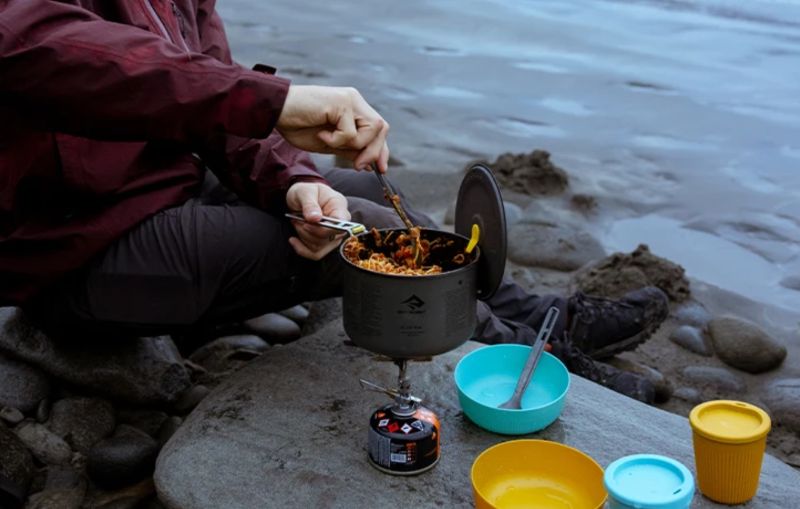
The pot is the start of everything. Titanium weighs three ounces, is not easily dented, but scorches the food with a hot flame. Aluminum is cheaper, distributes the heat evenly, and that is good when cooking something that is more viscous than water. 750 milliliter pots are enough for one hiker, 1.3 liters for two.
- A tight-fitting lid saves boiling time and extends the life of the canister for several extra days
- Foldable handles maintain the low profile when placed next to the sleeping bag
- Calibration lines inside the walls eliminate uncertainty during dinner
Three small features differentiate between a good pot and an annoying pot for a hiker. The stove and the fuel are usually packed together into a single unit, which is why a cook set is a compact package. A simple silnylon stuff sack prevents soot from getting into other items. The whole cook set stays in the top pocket, accessible anytime close to the water.
Stoves Suited for the Trip
Canister stoves connect to fuel by screwing on and start with a simple click. They weigh less than three ounces and boil half a liter of water in about three minutes. The feature becomes crucial on the cold morning when hands won’t cooperate. A windscreen helps the flame stay steady.
Alcohol burners weigh close to an ounce and are really cheap. Refill fuel can be found in most hardware stores in many of the trail towns. Boiling takes longer than six minutes, but is a good trade-off in warmer weather. Freezing temperatures are better for the more powerful burner in a canister stove.
Fuel Budgeting Keeps You Honest
Weight of fuel often surprises on a first longer trip. A hundred grams of fuel in the canister will last around twelve liters of boiling water in good conditions. Three days’ worth of dinners and early coffee should comfortably fit into this. A simple boil count decides the size before setting out to the trailhead.
Wind, elevation, and low temperature all increase burning rate. The shoulder requires a little margin for this reason. Hikers will test the fuel content of the canister by floating it in a stream. Partially used canisters find their place in overnight camping close to civilization.
Reducing Food Storage Volume for Packing Efficiency
Packages come with some hidden weight of cardboard, air, and excessive packaging material. Dinners stored in zip-top bags end up taking a small part of space compared to their original shelf size. A marker ensures you keep track of your meals through the entire week. This reduced pile ends up shedding a few ounces in total even before the walk.
- Reflective insulation forms a pot cozy to wrap the food at the end of a meal
- Odor bags ensure no odor emanates from your meals through the night
- Dinner in an individual bag makes it easy to get your dinner when it’s dark
10 minutes of placing meals in a cozy rehydrates the food without needing additional fuel. Odor bags are stored in a hard container or hung, depending on local rules. Garbage comes back in the same bags in which they came. All food items are stored in one place at camp.
Cooking Spot That Can Handle Any Weather
The surface on which the cooking takes place dictates how well the meal will be prepared. The pot is placed on the flat rock and kept away from the fire and dry grass. A small hollow created behind a big rock stops any wind more efficiently than a screen. One should sit upwind of the cooking fire so that steam is carried away from one’s face.
It is important to cook in the vestibule during rains when the entrance is opened for ventilation. Boiling extra water during cold days helps one warm in bed at night. Cooking in low beam from the headlamp provides sufficient light to see through the cooking pot. A light camp kitchen comes together one honest choice at a time. Pot, stove, fuel, filter, and a single long spoon make a full system that fits in a stuff sack the size of a grapefruit. Well-chosen ultralight camping cookware frees up room for food, water, and a warmer jacket. Meals arrive faster after a hard climb, which leaves energy for the miles ahead. A weekend close to home makes a fine test run before the kit heads out on a longer route.
About the Author