Hongi Hika’s firearms advantage gave Ngāpuhi extraordinary power, but it also compelled rival iwi to arm, fortify their pā, and reshape warfare across Aotearoa at devastating cost.

By Matthew A. McIntosh
Public Historian
Brewminate
Introduction: When Remaining Unarmed Became Dangerous
In July 1821, Hongi Hika returned to the Bay of Islands after a journey to England that had brought him home through Sydney. He carried a large consignment of muskets and ammunition, conventionally estimated at approximately 300 weapons even though the surviving evidence permits no reliable inventory. Hongi had pursued firearms and employed them in warfare long before this voyage, while Ngāpuhi taua had already demonstrated their growing reach during expeditions to the south. The new shipment was consequential because it concentrated enough firepower to deepen an existing disparity and sustain far larger bodies of armed warriors. Its arrival did not begin a single, coherent conflict that can neatly be isolated as the “Musket Wars.” It nevertheless marked the point at which a regional advantage became a military demonstration whose effects extended far beyond the communities Hongi intended to attack.
The violence that followed cannot be explained as though an imported object set an otherwise peaceful society in motion. Māori communities had long fought over killings, land, resources, political authority, and injuries to collective standing. Utu involved the restoration of balance and reciprocity rather than an automatic command to exact vengeance, while mana could be defended or enlarged through negotiation as well as armed action. Warfare existed alongside intermarriage, gift exchange, compensation, mediated settlement, strategic withdrawal, and the renewal of kinship obligations. Muskets supplied neither the motives for conflict nor the cultural framework through which particular disputes were understood. Yet avoiding technological determinism does not require treating the new weapons as incidental, because they changed what leaders could attempt, how distant enemies might be reached, and how severely defeat could affect an entire population. The important question is not whether Māori warfare existed before firearms, but how unequal access altered the choices available within an established political order. Nor was Ngāpuhi a centralized state acting under Hongi’s unrestricted command. It comprised numerous hapū whose rangatira competed, negotiated, and joined forces according to their own interests and relationships. Hongi possessed formidable mana and an unusual capacity to assemble combined expeditions, but those forces remained coalitions rather than a permanent army. The ensuing arms race consequently developed among overlapping networks of kin and allies, not between territorially fixed nations resembling nineteenth-century European powers.
The security dilemma offers one way to understand what happened after the northern weapons gap became unmistakable. A hapū might acquire firearms to protect its people, but neighboring groups could not be certain whether the growing arsenal was intended for deterrence, retaliation, or an approaching taua. Weapons stored against one enemy could later support an expedition against another, making defensive and offensive capability difficult to distinguish. Waiting for clearer evidence was dangerous because muskets proved most decisive when a well-armed force confronted people who possessed few of them or none at all. Once rivals began buying guns, restraint could leave a community exposed even when its leaders would have preferred negotiation. No superior authority could limit the trade, verify intentions, or guarantee that reciprocal disarmament would be honored. The security dilemma was developed to analyze modern international relations, and it becomes misleading if hapū are imagined as miniature states or Māori decisions are stripped of their meanings within tikanga. Used cautiously, the concept identifies a mechanism of escalating insecurity without claiming to explain every alliance, grievance, or campaign.
Firearms mattered most while their distribution remained sharply unequal, but possessing them required an economic system extending well beyond the battlefield. Muskets had to be purchased, supplied with powder and shot, maintained, transported, and placed in the hands of people capable of using them together. Potatoes, pigs, flax, iron tools, visiting ships, and access to colonial markets became parts of the military equation. Captives taken during successful expeditions could be compelled to produce additional commodities, connecting warfare to the acquisition of labor and renewed weapons purchases. Victory thereby increased the resources available for further operations, while reports of destruction encouraged threatened communities to accept enormous costs in order to arm themselves. That cycle did not preserve Ngāpuhi supremacy indefinitely. As firearms circulated, warriors gained experience and pā were altered to withstand gunfire, the exceptional advantage enjoyed by Hongi and his allies began to narrow.
The history that follows begins at Moremonui, where a small number of muskets failed to save Ngāpuhi from a skillfully executed ambush, and then turns to the commercial relationships that made a much larger arsenal possible. It follows Hongi’s campaigns through Mauinaina, Te Tōtara, Mātakitaki, Mokoia, and Te Ika-a-Ranganui before tracing the countermovements they encouraged across Aotearoa. At every stage, Māori actors interpreted the new danger through local histories rather than responding mechanically to the presence of a weapon. The resulting wars were neither the inevitable product of firearms nor merely traditional conflicts conducted with different equipment. They became an arms race because communities increasingly concluded that, whatever their intentions, remaining unarmed had become the more perilous choice.
War before the Musket: The Politics of Hapū
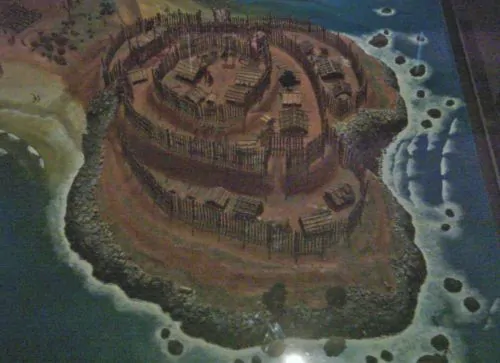
Before European firearms altered the military environment, collective power in Aotearoa rested primarily with hapū, communities joined by descent, residence, marriage, and shared interests in particular lands and resources. Hapū could cultivate together, defend settlements, organize expeditions, and negotiate with neighboring groups, but their membership and alliances were not rigidly bounded. Broader iwi identities connected related descent communities through common ancestors, although they did not ordinarily function as centralized governments possessing permanent executives or standing forces. Whakapapa allowed individuals to claim relationships through several lines, making political affiliation dependent partly upon circumstance and the issue under dispute. A person might emphasize one connection when seeking access to land and another when requesting military assistance. Consequently, the conventional language of “intertribal war” can conceal a more intricate landscape in which closely related groups quarreled, distant relations became allies, and coalitions changed without erasing enduring genealogical connections.
Authority within this world was inherited, demonstrated, and continually tested. A rangatira drew influence from ancestry but also from generosity, judgment, courage, productive leadership, and the ability to protect the people whose support made collective action possible. Mana belonged to communities as well as individuals, linking present conduct with the standing inherited from ancestors. Leadership depended less upon issuing commands than upon persuading relatives and allies that a proposed response was necessary, honorable, and likely to succeed.
Utu provided a broad principle for managing obligations created by exchanges between people and communities. It applied to hospitality, assistance, gifts, insults, injuries, and deaths, encompassing beneficial reciprocity as well as punishment. An act that disturbed an existing relationship called for an appropriate return, but neither the form nor the timing of that response was predetermined. Compensation, the transfer of valued property, a politically useful marriage, public acknowledgment, or ritual action might restore an acceptable balance without a pitched encounter. Muru allowed an injured party to seize goods from those considered responsible, sometimes through a formally assembled taua muru whose actions transformed wrongdoing into a recognized public reckoning. Serious bloodshed could create obligations that survived the original participants and were remembered by their descendants, especially when no settlement had been accepted. Even then, inherited responsibility did not operate as an automatic mechanism compelling each generation to fight; leaders still had to decide which claims to pursue, whom to enlist, and what result would constitute sufficient redress.
Disputes did not always produce a clean division between peace and war. Access to gardens, fisheries, forests, or travel routes could become entangled with an affront to a rangatira, a breached tapu, an accusation of makutu, an unauthorized killing, or a contested marriage. What transformed such incidents into wider confrontations was often the accumulation of grievances and the success of interested leaders in recruiting supporters. Kin connections could restrain escalation because potential opponents had relatives on both sides, yet the same relationships might also draw additional hapū into an expanding quarrel. Negotiations continued while forces assembled, and accommodation could remain possible after raiding had begun.
A taua could not travel upon grievance alone. Its organizers sent messages, consulted allied rangatira, gathered warriors, sought ritual preparation, and accumulated provisions sufficient for the intended journey. Before the widespread cultivation of potatoes, campaigning depended heavily upon stored kūmara, dried fish, fern root, and whatever food could safely be obtained along the route. Expeditions consequently tended to favor periods when supplies were available and the agricultural calendar could tolerate the absence of large numbers of adults, although political necessity sometimes overrode seasonal convenience. A substantial force consumed provisions rapidly, while defenders could frustrate it by removing food, abandoning vulnerable settlements, or withdrawing behind fortifications. Canoe routes, overland tracks, weather, and the willingness of communities to supply allies further shaped where an army could go and how long it could remain there. Prolonged absence also carried opportunity costs because the same people expected to fight were needed to clear ground, cultivate crops, fish, build, and maintain local security. Exceptional long-distance expeditions occurred, but mobilization on that scale demanded preparation and could not be sustained indefinitely.
Fighting combined surprise, maneuver, intimidation, and close physical combat with long weapons, spears, and short striking clubs fashioned from wood, stone, or bone. Ambushes and attacks at dawn might decide an encounter before formal deployment, while feigned retreats or challenges could draw an opponent onto unfavorable ground. Pā used terraces, ditches, banks, palisades, storage areas, and carefully chosen terrain to delay assault and protect inhabitants, leaving attackers to attempt blockade, deception, starvation, or a costly breach. These constraints should not be mistaken for gentleness. The capture of a defended settlement could result in extensive killing, captivity, dispersal, and the destruction of a community’s material base.
Victory seldom resembled the permanent annexation of one sovereign territory by another. Conquerors might take captives and taonga, occupy valuable ground, impose a new political relationship, or leave after obtaining the satisfaction they sought. Survivors could find refuge among relatives, establish themselves elsewhere, rebuild under allied protection, or return when the balance of local support changed. Rights to whenua derived from overlapping histories of ancestry, occupation, conquest, marriage, and gifting, so defeat could transform claims without necessarily extinguishing every earlier connection. Peace might be marked by unions between prominent families, exchanges of valued possessions, the release or incorporation of captives, and agreements whose durability depended upon continuing observance. The pre-musket order was capable of severe and recurring violence, but it also contained ways to limit confrontation and reconstruct relations after it. Firearms entered this adaptable system and did not abolish its political principles; they enlarged the consequences of temporary superiority and made recovery from a badly unequal encounter far more difficult.
Moremonui: The Battle That Disproved Easy Determinism
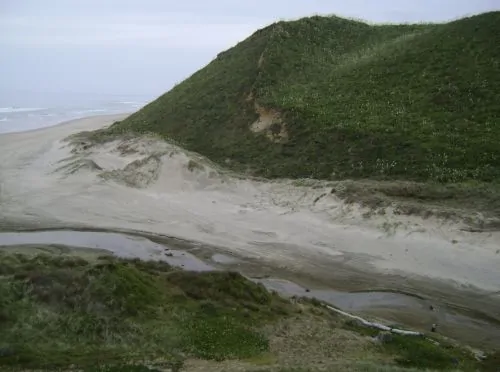
Moremonui reaches historians through a layered archive rather than a contemporary battlefield report. Usually dated to 1807 or 1808, it is often identified as the earliest recorded engagement between Māori forces in which muskets were present, although the claim depends upon evidence written down years afterward. Surviving narratives combine whakapapa, named landscapes, collective recollection, and later historical reconstruction. Consequently, dates, casualty estimates, and parts of the tactical sequence differ among accounts. A consistent core nevertheless remains visible. A northern expedition carrying a small number of firearms suffered a crushing defeat at the hands of opponents who used intelligence, concealment, terrain, and close assault more effectively.
The fighting grew from a succession of deaths and retaliatory expeditions connecting communities in the Bay of Islands with those around Kaipara. Pōkaia led the Ngāpuhi force southward, accompanied by Hongi Hika and warriors belonging to several northern groups. Arrayed against them was a coalition associated with Te Roroa, Te Uri-o-Hau, Ngāti Rongo, and the wider political world later summarized under the name Ngāti Whātua. Those broad labels are useful geographical shorthand, but they can make the confrontation appear more unified than it was. Leadership rested with particular rangatira, while obligations arose through immediate relationships that could cross the apparent boundary between the armies. Murupaenga and Tāoho were prominent among the defenders, whose connections to people within the northern force affected both the conduct of the battle and the limits eventually placed upon pursuit. Later accounts also emphasize that the Kaipara coalition obtained advance knowledge of Ngāpuhi movements and anticipated where the expedition would halt. Moremonui Gully, near the long western beach south of Maunganui Bluff, offered cover from which an attack could be launched against warriors encumbered by their camp routine.
According to the later narratives, the assault came around dawn while members of the Ngāpuhi expedition were preparing food and had not assembled for combat. Warriors concealed around the gully closed the distance before the northern force could organize a sustained response. Some muskets may have been discharged, but their limited number prevented those shots from stopping the attack. Once hand-to-hand fighting began, traditional weapons remained immediately reusable while every discharged firearm required a complicated reload. The withdrawal onto the open beach then became a rout, leaving scattered groups unable to recover a coherent formation.
Ngāpuhi’s defeat cannot be converted into a claim that early muskets possessed no military value. A muzzle-loading firearm could kill at a distance and produce effects beyond the reach of a taiaha, patu, or spear, but its usefulness depended upon powder, shot, dry equipment, time, and protection during reloading. One gun offered a dangerous first discharge; it did not provide continuous fire against opponents already closing from several directions. Tradition credits Murupaenga with recognizing this interval and pressing the attack before the musketeers could prepare another shot. No disciplined firing line, reserve group, or sufficiently numerous body of armed warriors existed to preserve the distance on which the firearm’s advantage depended. Possession had not yet matured into an integrated method of fighting. Easy technological determinism assumes that a more powerful implement should impose its logic upon any encounter, whereas Moremonui demonstrates that surprise and tactical adaptation could temporarily invert the apparent hierarchy of weapons. The opposite conclusion would be equally misleading, since the neutralization of a few isolated muskets did not predict what would happen when firearms became numerous enough to provide covering fire, repeated volleys, and greater freedom of movement. Later Ngāpuhi victories would arise from that altered combination rather than from the musket considered as a self-acting object.
The losses gave Moremonui an importance that exceeded its immediate strategic result. Precise totals cannot be recovered confidently, although every tradition describes severe Ngāpuhi casualties and identifies Pōkaia and two of Hongi’s brothers among the dead. Accounts place Hongi and Te Koikoi in concealment in a swamp before their escape, turning the survival of a future conqueror into one of the battle’s most consequential accidents. Another remembered episode credits Tāoho with marking a line in the sand beyond which the victors were not to pursue their fleeing relatives, showing that kinship could still restrain violence at the moment of success. The names Te Haerenga-o-te-One and Te Kai-a-te-Karoro preserved contrasting elements of the event, one recalling the boundary drawn upon the beach and the other the gulls said to have gathered over the unburied dead.
For Hongi, bereavement made Moremonui a continuing political claim rather than a closed defeat. The deaths of close relations supplied a powerful obligation of utu, but they should not be treated as the single cause of every expedition he later undertook. It would be too neat to interpret his acquisition of firearms, culminating in the large consignment brought through Sydney in 1821, as the execution of a plan formed entirely on that beach. Trade opportunities, contests within the north, overseas travel, personal ambition, and the accumulating evidence of what large firearm concentrations could accomplish all contributed to his strategy. Moremonui may nonetheless have furnished a harsh practical lesson that scattered guns could be overcome, while a numerous and coordinated body of musketeers offered a different kind of power. When Hongi’s forces defeated a Ngāti Whātua coalition at Te Ika-a-Ranganui in 1825, the result was not a mechanical reversal of the earlier battle, since the participants, tactics, preparations, and political circumstances had all changed. The two encounters reveal why neither technological dismissal nor technological inevitability is adequate. Firearms could fail when tactically isolated, yet their expanding availability steadily changed what leaders could attempt and what their rivals had to prepare against.
The Bay of Islands Advantage
The northern lead in firearms began at anchorages rather than on a battlefield. Pēwhairangi, the Bay of Islands, offered sheltered waters where crews could obtain supplies before continuing into the Pacific or returning across the Tasman Sea. By the opening years of the nineteenth century, whaling and trading vessels were calling there with increasing regularity. Sailors required fresh provisions, drinking water, firewood, replacement spars, and assistance with repairs, all of which nearby Māori communities could provide. Their ships carried iron tools, cloth, tobacco, and other commodities alongside muskets, powder, and shot. Comparable exchanges occurred elsewhere, but few districts initially received the same concentration of maritime traffic. Repeated contact allowed northern communities to acquire European goods more steadily, learn what captains valued, and develop relationships extending as far as Sydney.
Commerce along these shores depended upon political brokerage. European captains could not treat the bay as an ownerless depot, since access to timber, water, provisions, and labor required cooperation from people who held authority in particular places. Rangatira such as Ruatara, Hongi Hika, Korokoro, and Pōmare cultivated visiting sailors, traveled aboard European vessels, and competed to become preferred intermediaries. A leader who could protect a crew, settle a dispute, or assemble a cargo gained both material goods and enhanced standing among neighboring communities. Foreign visitors likewise benefited from attaching themselves to a recognized patron who could reduce the hazards of an unfamiliar harbor. These arrangements were neither stable nor equally advantageous to every northern hapū. Proximity to a landing place mattered, but personal reputation and the capacity to mobilize producers could be just as important. What outsiders perceived as a single Ngāpuhi trading zone was a collection of overlapping relationships through which some leaders obtained firearms earlier than others.
The Church Missionary Society added permanence to a commercial world previously organized around visiting ships. Marsden’s party founded its first station at Rangihoua in 1814 under Ruatara’s protection, while the Kerikeri settlement established in 1819 stood within Hongi’s sphere of influence. Samuel Marsden prohibited the missionaries from selling muskets and powder, repeating his orders when several settlers engaged in private dealings despite the ban. The missions consequently should not be portrayed as straightforward arms depots. Their vessels, workshops, agricultural experiments, and connections with Port Jackson nevertheless widened the channels through which northern Māori encountered imported technology. Before Christianity had attracted many converts, the stations were already economically and diplomatically consequential.
Food made those relationships profitable. Potatoes had reached Aotearoa before the missionaries, but Māori growers rapidly expanded their cultivation as demand from ship crews increased. The crop could flourish in environments less favorable to kūmara and could be produced under different seasonal and ritual arrangements, allowing communities to enlarge the area devoted to exchange. Pigs supplied another valuable form of portable wealth, while timber and dressed flax linked local production to commercial interests across the Tasman. One reported rate in 1814 placed the cost of a musket at approximately 150 baskets of potatoes and eight pigs. Such figures were observations from fluctuating encounters rather than prices set by a uniform market, yet they convey the formidable quantity of work embodied in a single firearm. Iron spades, hoes, and axes could help clear ground and increase output, but implements alone produced no surplus. Planting, tending, harvesting, preparing cargoes, and moving provisions to the shore drew heavily upon ordinary cultivators and, after the campaigns beginning in 1818, growing numbers of captives compelled to work. Missionary accounts even described provisions being traded while local people experienced hunger, although their moral judgments require the same scrutiny as their numerical claims. “Food for guns” denoted more than barter at the water’s edge, since it converted cultivation, animal husbandry, and human exertion into the means of organized violence.
A musket also generated continuing demands after it had been purchased. Its owner required powder, lead or prepared shot, replacement flints, and someone capable of repairing locks or damaged stocks. Inferior trade guns could misfire, burst, or deteriorate quickly in damp conditions, making access to maintenance almost as valuable as initial ownership. Because vessels returned frequently to the Bay of Islands, northern musketeers had better opportunities to replenish supplies and replace unusable weapons. The consequential distinction was not simply between people who possessed guns and those who did not, but between sporadic acquisition and dependable resupply.
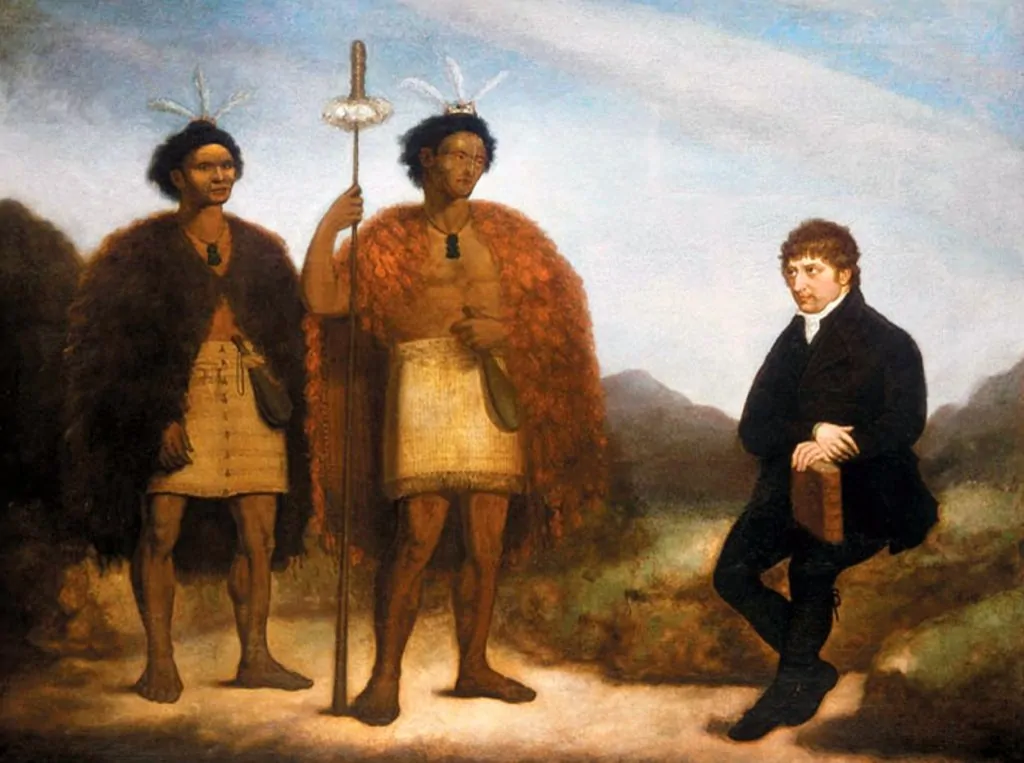
Hongi Hika turned this commercial environment into an unusually extensive personal network. During his visit to Sydney in 1814, he strengthened his association with Marsden and supported the proposed mission’s establishment in the Bay of Islands. Protecting missionaries did not require accepting their priorities, and Hongi continued to seek weapons from merchants even when mission personnel refused to supply them. He understood that the presence of resident Europeans could enhance the bay’s reputation as a secure destination, thereby attracting ships whose captains operated under fewer religious restraints. His journey to England with Thomas Kendall and the young rangatira Waikato in 1820 extended those connections far beyond the Tasman world. Hongi and Waikato assisted Samuel Lee at Cambridge with work on the Māori language, entered elite social circles, and were presented to George IV, but Hongi evaluated these encounters partly according to what they could yield at home. On the return journey, gifts and other assets were converted in Sydney into a major consignment of firearms and ammunition. The precise total remains uncertain, although the evidence supports hundreds rather than the isolated weapons previously obtained through ordinary exchange. Hongi’s cargo in 1821 was the concentrated product of relationships and productive capacity developed over the preceding decade.
By 1821, northern military strength rested upon a chain of exchanges stretching from inland cultivations to ships arriving from New South Wales. The harbors drew vessels, while rangatira made those visits commercially workable and directed imported goods toward locally defined purposes. Mission settlements increased the regularity of contact even as their leaders tried to restrict the trade in arms. Campaigns beginning in 1818 then supplied some victorious hapū with captives whose coerced labor could enlarge the production of potatoes and flax, helping purchase further weapons for later expeditions. This cycle never absorbed the entire northern economy, nor was every crop grown for war, but it directed enough resources toward armament to deepen the disparity between the Bay of Islands and less-connected regions. Communities elsewhere could purchase a few muskets when a vessel happened to call, yet matching Ngāpuhi required reliable traders, substantial food reserves, ammunition supplies, and time to acquire practical experience. The Bay of Islands advantage lay in sustaining armed power before most rivals could reproduce the commercial foundations beneath it.
The Arsenal of 1821
The 1820 voyage carried several projects within it. Thomas Kendall presented travel to England as an opportunity to improve his study of te reo Māori, obtain ecclesiastical recognition, and strengthen support for the Church Missionary Society settlement in Pēwhairangi. Hongi Hika and the younger rangatira Waikato boarded the whaler New Zealander with purposes that overlapped with Kendall’s without being subordinate to them. They could seek knowledge, prestige, influential relationships, and valuable goods through the same undertaking, while recent warfare had given firearms particular urgency for Hongi. Samuel Marsden had attempted to dissuade Kendall, and the society had not commissioned the journey as a formal embassy. The three travelers consequently shared a route while pursuing agendas shaped by markedly different political worlds.
British hospitality came intertwined with serious errors of interpretation. Missionary patrons, aristocratic hosts, and curious spectators regarded the visitors’ moko, bearing, and social status with fascination, but frequently translated Māori rank into European categories. Hongi was sometimes styled the “king of New Zealand,” a description that flattened relationships among rangatira and largely autonomous hapū into a monarchy recognizable to British audiences. That mistake magnified his apparent command over Ngāpuhi and encouraged later writers to portray his return as the arming of a sovereign’s national army. It also concealed Waikato’s standing by reducing him to Hongi’s companion rather than acknowledging him as a participant with authority and interests of his own. Neither curiosity nor misrecognition deprived the visitors of agency. Hongi accepted audiences and ceremonial honors that could increase his mana at home, cultivated useful acquaintances, and examined the material capacities of a society whose ships already connected Pēwhairangi with distant markets. The surviving evidence does not disclose everything he concluded about British power, and later anecdotes too readily assign him a single consuming thought. Even so, his conduct suggests purposeful observation rather than passive exposure to an unfamiliar empire.
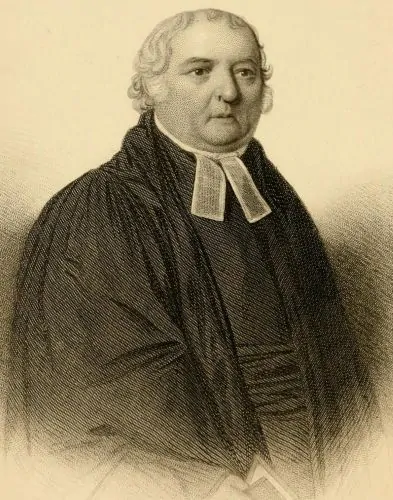
Cambridge yielded the journey’s most durable nonmilitary result. Working with the linguist Samuel Lee and with Kendall, Hongi and Waikato supplied pronunciation, vocabulary, and grammatical judgments essential to A Grammar and Vocabulary of the Language of New Zealand, published in 1820. Their knowledge corrected and enlarged material that Kendall could not have produced independently, making Māori expertise foundational to an ostensibly missionary publication. The resulting text remained provisional and filtered te reo through English grammatical assumptions, while its reliance on northern speakers gave particular usages an enduring place in written Māori. This collaboration complicates the later image of Hongi as a visitor concerned with weapons alone, for he also acted as an intellectual authority in an exchange that would influence literacy, translation, and cross-cultural communication.
Royal attention became the most embellished episode of the visit. Hongi and Waikato were presented to George IV late in 1820, and accounts commonly associate the audience with gifts that included firearms and a coat of mail or suit of armor for Hongi, although surviving lists and later recollections do not agree in every detail. Such objects possessed several kinds of value simultaneously. British benefactors could regard them as marks of honor and civilized diplomacy, whereas their recipients could assess their usefulness, exchangeability, and capacity to enhance mana. Retellings gradually turned the encounter into a tidier story in which Hongi deceived a king, sold every royal present, and converted the proceeds directly into muskets. Other narratives placed him in British arsenals and attributed dramatic statements to him about the superiority of guns over all that England displayed. These details entered the record unevenly and often long after the journey, so they cannot all be treated as eyewitness testimony. The securely established audience and presentation of valuable goods should be distinguished from the moralized legend subsequently built around them. Even the armor acquired significance beyond its physical protection, since later reports of Hongi wearing it in combat helped create a reputation for exceptional power and apparent invulnerability.
The decisive accumulation occurred after the party left Britain. Hongi, Waikato, and Kendall traveled to New South Wales aboard the convict transport Speke, reached Port Jackson in May 1821, and sailed for Pēwhairangi on the Westmoreland several weeks later. Sydney provided access to merchants, shipmasters, and military goods circulating through a colonial port where restraints on selling weapons to Māori were inconsistent and readily evaded. By the time the Westmoreland arrived in July, the returning party possessed several hundred muskets together with powder, ball, and other arms, making the cargo substantially a product of colonial procurement rather than royal generosity.
Counting that cargo is harder than describing its consequences. Many narratives specify approximately three hundred muskets, while others give five hundred and add swords, daggers, or further military stores. Both figures have been repeated with greater certainty than the documentary record warrants. No dependable surviving manifest fixes the number, condition, ownership, or origins of every weapon unloaded in Pēwhairangi. “Several hundred muskets” is the most defensible formulation, especially when accompanied by acknowledgment that ammunition mattered as much as the guns themselves. The familiar claim that Hongi exchanged all his royal gifts for the shipment probably compresses multiple purchases, gifts, debts, and private arrangements into one memorable bargain. Some portable property acquired in Britain may have helped finance the purchases, but Sydney contacts and preexisting commercial relationships were at least as important. Charles de Thierry’s involvement has produced another deceptively precise explanation. Later accounts connect his proposed Hokianga land acquisition with the financing of five hundred muskets, yet the associated deed was completed in 1822 and recorded thirty-six axes as its stated consideration. That chronology does not remove de Thierry from the wider history of speculation surrounding the journey, but it prevents a single land-for-guns transaction from securely explaining the entire 1821 consignment. The “arsenal” is best understood as an extraordinary concentration of firearms and consumable stores, not as a verified inventory of five hundred identical weapons obtained through one exchange.
Once landed, the weapons had to become political resources before they could generate military force. No rangatira could personally employ a stock of that size, and Hongi possessed no centralized apparatus capable of issuing muskets by administrative command. Distribution among relatives, allied leaders, and selected warriors could strengthen obligations while also requiring negotiation over participation, objectives, and the division of future gains. The shipment expanded Hongi’s ability to equip large Ngāpuhi coalitions without converting those coalitions into a permanent army or dissolving hapū autonomy. Its most consequential feature was the abruptness with which it altered the regional balance. Incremental purchases had previously added guns in small numbers, whereas the 1821 cargo compressed years of acquisition into a single return voyage. England supplied recognition, information, and negotiable property; Sydney supplied scale; Māori relationships determined how the imported material would be mobilized. The advantage would not last indefinitely, but neighboring communities confronting its immediate concentration had compelling reasons to seek firearms before Hongi’s alliances could bring them within range.
Mauinaina and Te Tōtara: The Weapons Gap Made Visible
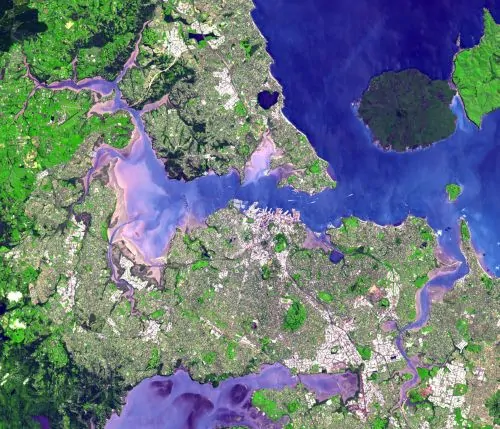
Within weeks of his July return, Hongi helped assemble a taua capable of carrying the northern advantage into Tāmaki and Hauraki. Later chronologies place its departure in early September 1821 and commonly estimate its strength at approximately two thousand warriors, perhaps half of them carrying muskets. Those round numbers cannot be verified precisely, yet the surviving traditions consistently describe an exceptionally large and heavily armed force. Its warriors followed several rangatira rather than belonging to a standing Ngāpuhi army, making participation dependent upon kinship, common grievances, anticipated rewards, and confidence in the expedition’s leadership. Moving such a body required waka, provisions, powder, shot, and coordinated decisions about where its separate contingents would gather. The logistical achievement mattered almost as much as the imported weapons because an unfed taua or an exhausted paddling fleet could not exploit superiority in arms. By deploying so many muskets within one theater, the northern commanders could reveal a disparity that smaller raids had previously shown only in fragments.
The first major objective occupied one of the most strategically valuable parts of Tāmaki Makaurau. Fertile soils, extensive fisheries, and portages connecting the Waitematā and Manukau harbors made the district both a productive homeland and a junction in interregional travel. Near the Tāmaki River, in the vicinity of present-day Panmure, the neighboring positions of Mokoia and Mauinaina sheltered communities associated principally with Ngāti Pāoa. Te Hinaki organized their defense while word of the approaching fleet allowed residents and allies to gather behind the fortifications. These pā protected cultivations, families, food stores, and the political standing that came from maintaining occupation, so withdrawal would have carried costs beyond immediate survival. Their earthworks and palisades remained formidable against assault, and the defenders were neither inexperienced nor wholly without firearms. The imbalance lay in the quantity of guns available, the ammunition that sustained them, and the number of northern warriors who could keep some weapons ready while others reloaded. Ngāti Pāoa confronted a military problem for which courage and conventional preparation offered no easy remedy.
The catastrophe is more securely established than its statistics or exact battlefield sequence. Missionary records documented the expedition and the alarm surrounding it, whereas many tactical details reached print through oral testimony collected decades afterward. Colonial compilers sometimes combined separate recollections, assigned precise dates to approximate chronologies, and converted estimates into firm totals. Frequently repeated claims that one thousand, two thousand, or even more people died should consequently be read as evidence of remembered enormity rather than reliable enumeration. A cautious reconstruction can identify the principal actors, the disparity in firearms, the fall of the pā, and the extensive loss of life without pretending that every dramatic incident has equal documentary support.
At Mokoia and Mauinaina, the abundance of muskets changed how attackers and defenders could use the ground. Warriors appearing above palisades or moving through exposed sections of the defenses faced a volume of fire that a small number of guns could not answer consistently. An individual trade musket remained inaccurate, liable to misfire, and slow to reload, but a large body of shooters could make repeated exposure dangerous even when many shots missed. Depth of numbers also allowed armed men to be protected by comrades carrying traditional weapons during the vulnerable interval between discharges. Later narratives describe Ngāpuhi firing from elevated positions and directing sustained shot toward the interior, although the construction and placement of those platforms remain uncertain. Noise, smoke, wounds inflicted at a distance, and the inability to suppress northern marksmen placed cumulative pressure on the defenders. Nevertheless, the fortifications did not collapse at the sound of the first volley. Entry still required men to advance into danger, and the final fighting involved close combat, confusion, and pursuit as defensive cohesion failed. Te Hinaki was killed during the struggle, after which organized resistance gave way to a broader calamity for those enclosed within the positions. Firearms had supplied the decisive asymmetry, but numerical depth, persistence, leadership, and assault completed the victory. Capture extended the violence beyond the moment when resistance ended. Te Hinaki and many other rangatira and warriors were killed, along with women, children, and people who had entered the pā for protection. Accounts of postbattle executions, ritual consumption, and captives taken north convey the severity of the defeat even though their numerical claims remain irreconcilable. Prisoners offered labor, reproductive incorporation, ransom possibilities, and evidence of victory, while the dead carried meanings connected to utu and the restoration of injured mana. Survivors dispersed toward other parts of Hauraki and Waikato, and large areas of Tāmaki became considerably less secure for settled occupation. Such displacement did not extinguish mana whenua or transform the district into land without owners. Later colonial narratives that treated wartime flight as permanent abandonment converted a temporary consequence of invasion into a misleading history of vacancy.
Te Tōtara presented a different military problem. By December, Hongi’s forces had moved against this major Ngāti Maru pā on the lower Waihou, near present-day Thames. Its steep approaches and substantial defenses limited the targets available to attackers while forcing anyone attempting entry into confined and dangerous ground. Ngāti Maru had also received warning from the destruction farther north and could anticipate the methods their opponents might employ. Traditional accounts maintain that Te Tōtara resisted direct attack for two days and a night, a duration that demonstrated the continuing value of terrain, palisades, numbers, and discipline. Northern gunfire imposed danger upon the defenders but failed to produce an immediate breach. The pause exposed an important limitation in Hongi’s advantage because even abundant firearms could not guarantee the rapid reduction of a well-sited pā whose occupants remained organized.
Negotiation then changed the conditions of the contest. According to the principal traditions, Hongi sent a delegation into Te Tōtara to arrange peace after the unsuccessful assaults. Gifts were exchanged, assurances were accepted, and the northern force embarked in its canoes as though abandoning the siege. Once darkness concealed its movements, the taua landed near Tararu, returned to the pā, and attacked inhabitants whose vigilance had relaxed. Some versions specify that sixty rangatira participated in the embassy, while others remember Pōmare withdrawing rather than share responsibility for violating the settlement. Such details cannot be reconciled completely, but the persistent core of the account is that a recognized peace preceded the surprise. The resulting condemnation cannot be dismissed as a European moral judgment added afterward, since Hauraki memory treated the agreement and exchanged gifts as creating obligations that had been deliberately broken. Surprise opened what musket fire had failed to force, after which firearms intensified the confusion and restricted escape. Numerous defenders and visiting allies were killed or captured, although figures reaching into the thousands remain no more trustworthy here than at Mauinaina. Later accounts also connected the death of Hongi’s son-in-law Tete during the fighting with grievances directed toward Waikato, illustrating how one successful expedition could generate the justification for another.
Placed beside one another, the two victories resist a single explanation. Mauinaina showed what concentrated musketry could do against defenders possessing far fewer guns, especially when the attackers also enjoyed superior numbers and ample supplies. Te Tōtara demonstrated that a strong position could withstand the same invaders until deception and a nighttime return altered the tactical situation. The contrast denies the musket a uniform script, yet both episodes publicized the severe risk faced by communities unable to answer sustained firearm use. News traveled through survivors, captives, relatives, traders, and returning warriors, carrying knowledge of the northern victories far beyond the conquered pā. Other iwi could respond by dispersing vulnerable settlements, improving defenses, cultivating alliances, mounting anticipatory expeditions, or accelerating their own acquisition of weapons. The campaigns of 1821 turned an uneven distribution of muskets into common strategic knowledge. Once that knowledge spread, obtaining firearms became a defensive calculation even when possession also made larger offensives possible.
From Mātakitaki to Mokoia: The Expanding Radius of War
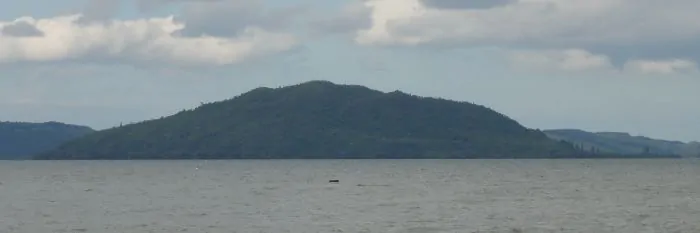
Near present-day Pirongia, Mātakitaki occupied ground at the junction of the Waipā River and Mangapiko Stream. Campaign narratives describe a defensive complex of three connected pā protected by waterways, steep banks, ditches, and palisades. Its physical strength explains why Waikato and allied communities treated it as a place of assembly when the invasion approached in May 1822. Under influential rangatira including Te Wherowhero and Te Kanawa, warriors converged alongside older people, women, children, and displaced families. Later accounts place anywhere from several thousand to roughly ten thousand people within the complex, while estimates of Hongi’s force commonly run from two to three thousand. Such totals reflect oral transmission, retrospective magnification, and inconsistent definitions of who counted as a combatant, so they cannot bear exact statistical weight. They nevertheless preserve an important asymmetry. Mātakitaki contained a dense civilian population, whereas the attackers brought an unusually high concentration of firearms. The very success of the pā as a refuge increased the number of bodies that would have to pass through restricted spaces if its defenses failed. Security and congestion had become inseparable before the main attack.
When the assault began, that congestion became a lethal condition. Accounts differ over the preliminary exchanges and the duration of Waikato resistance; some traditions also remember local counterattacks that inflicted Ngāpuhi losses. On the central sequence, the narratives broadly agree. Concentrated musket fire produced fear among defenders who had never encountered guns on such a scale. Noise, smoke, unfamiliar wounds, and uncertainty about the source of each discharge disrupted communication as well as morale. A mass movement toward the available escape routes followed. Later reconstructions disagree over whether a bridge or crossing collapsed, an exit became blocked, or both events occurred in succession, but they converge on lethal compression at a narrow passage. People fell, others were driven over them, and many were trampled or suffocated; bullets alone did not account for the death toll. Traditions surrounding Te Wherowhero’s close-quarters stand preserve the fact that resistance continued in pockets after general panic had begun. Such episodes distinguish the collapse of a crowded refuge from the instantaneous paralysis of every defender. Ngāpuhi entered a position whose inhabitants no longer functioned as a coordinated body, killing some, capturing others, and pursuing groups that scattered southward. The guns multiplied harm twice, first through the wounds they caused and then through the collective flight their concentrated use induced. Casualty claims vary too widely to sustain a confident total, and even the most frequently repeated figures measure remembered calamity more reliably than they enumerate the dead. What survives scrutiny is the mechanism of collapse and the enormous demographic shock, not an exact body count.
Victory yielded devastation, not a northern province. Te Wherowhero survived and, according to Waikato traditions, helped recover captured women from an isolated Ngāpuhi party. Communities withdrew toward the upper Waipā and Mōkau country for several years, while the northern expedition went home without installing permanent rule. Peace in 1823 permitted a gradual return and was reinforced by the marriage of Matire Toha of Ngāpuhi to Kati, a close relative of Te Wherowhero. Meanwhile, Waikato leaders pursued firearms with new urgency; Mātakitaki had produced dislocation and strategic learning, not political extinction.
The following year carried northern firepower into the Rotorua lake district, although the campaign’s stated cause arose from a particular chain of deaths rather than an open-ended project of conquest. In 1822, Te Pae-o-te-rangi and members of his Ngāpuhi party were killed by Tūhourangi at Motutawa in Lake Rotokākahi, while some who fled were killed by Ngāti Whakaue at Ōhinemutu. News of those events prompted argument in the north over timing, responsibility, and the proper response. Te Wera Hauraki reportedly resisted demands for immediate departure and urged waiting until dried kūmara and fish could sustain the journey. His counsel exposes a practical limit obscured by later tales of irresistible advance. Anger could summon a taua, but food determined when it could move. When the force assembled in early 1823, Hongi, Pōmare, Te Wera, and other rangatira gathered warriors whose participation depended on persuasion, kinship, and adequate supplies. The movement toward Mokoia joined a specific demand for redress to deliberate preparation and another formidable problem of transport.
From the Bay of Plenty, the taua proceeded inland through the Pongakawa valley and brought waka toward Rotorua through a succession of rivers, lakes, and overland carries. Canoes were hauled into Lake Rotoehu, dragged across the forested passage to Lake Rotoiti, and taken onward toward Lake Rotorua. This work demanded time and exposed the expedition to harassment, including resistance associated with Ngāti Pikiao, so the interior was no frictionless corridor. Te Arawa had gathered on Mokoia Island and concentrated the available local waka, treating the surrounding lake as a broad defensive barrier. Against an enemy confined to the shore, that decision made strong sense. Transporting attack craft inland changed the tactical problem by allowing armed parties to cross water that had been expected to preserve separation. Traditions differ over the order of the landings and remember at least some initial resistance, cautioning against any picture of an island surrendered at the mere sight of guns. Te Arawa were not literally weaponless, but their limited firearms could not match the northern supply. Once Ngāpuhi established themselves ashore, maintaining a coherent defense became exceptionally difficult. The often repeated count of approximately 170 Te Arawa dead is no firmer than many other numerical claims from these campaigns, although substantial killing and captivity remain beyond dispute. Mokoia fell because an apparently secure refuge had been reached, not because islands or pā had suddenly lost all defensive value.
At the moment when defeat seemed to leave the victors with unbounded discretion, Te Ao-kapurangi forced a different outcome. A woman of mana from Ngāti Rangiwewehi and Tapuika, as well as the wife of Te Wera, she had already sought protection for relatives whom the expedition’s grievance did not encompass. Hongi agreed to spare those who passed between her thighs; she answered that deliberately narrow condition by standing astride the ridgepole of Tamatekapua so that people entering the crowded house passed beneath her. Ngāpuhi honored the refuge, and Te Wera, Te Ao-kapurangi, and Te Arawa leaders helped secure peace the next day, curbing wider pursuit and permanent seizure. Preserved in Te Arawa memory and in the saying about Te Ao-kapurangi’s crowded house, her intervention reveals authority operating through whakapapa, argument, and an obligation publicly conceded amid conquest.
Mātakitaki and Mokoia exposed two different limits of inherited sanctuary. At the former, concentration behind extensive works became dangerous when panic drove a large population toward constricted exits. At the latter, separation by water failed after attackers transported the means of crossing it. Neither result created a territorial empire. Northern forces could penetrate, punish, seize captives, and withdraw far more easily than they could administer distant communities. The radius of destructive action widened faster than the reach of lasting political control. For Waikato and Te Arawa, the lesson was grim without being hopeless, since refuge, alliance, provisioning, and access to firearms could all be reconsidered. Their subsequent acquisition of muskets and adaptation of defensive practice shortened the interval during which a northern expedition could expect such a pronounced imbalance. These campaigns carried the weapons gap deep inland, yet in doing so they accelerated the responses that would turn a regional advantage into a many-sided arms race.
The Logic of Reciprocal Arming
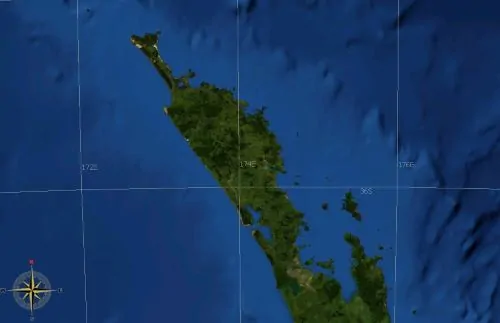
Reciprocal arming did not resemble a contest between two centralized states. It emerged from overlapping judgments made by rangatira, hapū, iwi coalitions, kin networks, and trading communities whose interests might coincide during one campaign and diverge during the next. The language of the security dilemma is useful only if detached from assumptions about fixed borders, permanent alliances, and unitary governments. In this setting, the decisive calculation concerned relative exposure within a mobile and politically plural world. Once a potential rival could assemble a gun-bearing taua, reliance on taiaha, patu, and older defensive arrangements carried a risk that prudence alone could no longer dismiss.
The central difficulty was that firearms revealed capacity more clearly than purpose. A musket acquired to guard a kāinga, protect a trading place, or affirm the mana of its owner could later be lent to kin, carried on a distant expedition, passed through marriage, or taken in battle. Neither friendship nor recent peace established how that weapon would be used as leadership, grievances, and alliances changed. Outsiders also struggled to estimate how many serviceable guns an opponent possessed, how much powder remained, or whether its shooters had learned to coordinate their fire. Reports from travelers and returning taua circulated alongside rumor, each capable of magnifying alarm before verification was possible. Waiting for unmistakable proof of hostile intention could mean waiting until an armed force was already approaching. Purchasing guns appeared defensive to the buyer while enlarging the range of attacks that others had to anticipate. Their countermove could then be interpreted as aggression by the first purchaser, even when it sprang from the same fear of exposure. No shared misunderstanding was required, since changing capability could make several incompatible precautions reasonable at once.
Uneven timing sharpened the pressure. Communities close to harbors frequented by European ships could purchase weapons before inland groups, yet exchange through relatives, intermediaries, and returning travelers gradually carried firearms beyond the first ports. Every delay widened the interval in which an early adopter might exploit superiority. Earlier grievances still identified plausible enemies, and tikanga continued to shape the claims under which taua departed, but the prospect of a rival’s approaching rearmament could alter when leaders chose to act. An expedition might seek redress while also weakening a future opponent, securing access to trade, or capturing resources that would finance further purchases. The innovation consequently compressed the time available for caution without dictating a single target or political outcome.
Possession itself was never a binary condition. An unloaded musket offered little protection, a damaged lock could turn valuable property into dead weight, and poor powder might fail at the moment of combat. A useful arsenal depended on recurring supplies of gunpowder, lead, flints, spare parts, and technical knowledge. Maintaining those flows required durable relationships with ships, resident traders, neighboring brokers, or kin who controlled accessible landing places. Geography shaped the price of military preparedness long after the first purchase. In the Bay of Islands, provisions and maritime services had helped establish Ngāpuhi access; in other districts, dressed flax, timber, labor, or rights of residence entered local bargains. The phrase “flax for guns” captures one highly consequential exchange but obscures the variety of commodities and arrangements through which Māori dealt with Europeans. Prisoners were compelled in some regions to process fiber or produce food, allowing victory to enlarge the labor force supporting additional acquisition. That coercive feedback was formidable where it operated, although it was neither uniform throughout Aotearoa nor sufficient to explain every expedition. Missionary opposition could impede particular sales without closing a competitive market in which captains and merchants profited by supplying customers whom others refused. Households also bore the opportunity costs, since time devoted to market production, guarding, and military training could not be spent elsewhere. Arming was consequently an economic reorganization as well as a battlefield response, binding local security to volatile circuits of credit, shipping, and colonial demand.
Waikato supplies the clearest reversal of relative exposure. After the peace of 1823 and the gradual return from refuge, Waikato communities pursued firearms through developing west-coast connections, including the trader John Rodolphus Kent at Kāwhia. When Ngāpuhi forces again entered Waikato in 1832, Te Wherowhero could reportedly gather about three thousand warriors, most of them carrying muskets, and the incursion was repelled. This recovery did not undo the deaths, displacement, and humiliation associated with Mātakitaki. It demonstrates instead how defeat accelerated acquisition until an advantage once concentrated in the north could no longer guarantee success against a former target.
Farther south, the experience of Ngāti Toa shows how reciprocal pressure migrated with people and commerce. Te Rauparaha obtained an early musket through Ngāti Maru, joined the northern expedition of 1819, and received further firearms from Ngāpuhi on its return. Knowledge that ships could be reached near Cook Strait added a commercial consideration to the subsequent movement from Kāwhia, though warfare with Waikato, the search for security, and established kin connections also shaped the migrations. After Ngāti Toa established itself at Kāpiti, visiting vessels and the growth of whaling opened a dependable market for supplies and weapons. Control over this exchange strengthened Te Rauparaha’s position among allies, while captives were forced to prepare flax that could be traded for powder and guns. Armed expeditions then carried violence across Cook Strait and down the eastern coast of Te Waipounamu, where groups with few firearms initially faced severe disadvantages. The sequence did not end in permanent Ngāti Toa ascendancy. By about 1833, Ngāi Tahu had secured guns through whalers in Otago and could mount resistance that made further southern fighting indecisive. Here, the strategic advantage moved from acquisition to offensive reach and then to counter-acquisition, while the political landscape remained divided among allies whose cooperation never amounted to unquestioned obedience to a single commander.
Parity remained incomplete even where muskets became common. Weapon quality differed, ammunition arrived irregularly, and proficiency depended upon practice that consumed the very powder needed for war. Intelligence, leadership, terrain, and the redesign of pā could offset numerical disparities, so counting guns never supplied a reliable measure of power. Political action mattered just as much, for negotiated peace, strategic marriage, or a revised alliance could interrupt a local cycle of preparation and reprisal. Communities often armed while pursuing accommodation, keeping open more than one path through an uncertain environment.
The process had no stable finish line. As weapons spread, Ngāpuhi lost much of the extraordinary differential that had enabled the campaigns of the early 1820s, yet Aotearoa did not return to the military conditions that preceded large-scale firearm imports. More communities now possessed the means to deter assault, punish intrusion, and project force beyond their immediate rohe. Widespread armament could produce a guarded balance in one region while intensifying competition in another. Nor did possession make continual war inevitable, since rangatira still judged costs, obligations, opportunities, and prospects for peace. The political order contained effective practices of negotiation and reconciliation, but no encompassing authority could bind every potential belligerent to disarm simultaneously or guarantee that restraint would be reciprocated. By the early 1830s, a musket had shifted from an exceptional source of northern leverage toward a practical requirement for communities expecting serious conflict. Reciprocal arming eroded the leverage Hongi Hika had once derived from scarcity while distributing the burdens of preparedness and the capacity for destruction across a far wider field.
When the Arms Race Moved beyond Ngāpuhi

During the later 1820s, military initiative ceased to radiate chiefly from the Bay of Islands. Hongi Hika’s death in 1828 marked this transition without producing it, for Hauraki, Waikato, Tauranga, Taranaki, and Cook Strait communities were already obtaining guns through their own connections. The resulting conflicts shared the pressures created by weapon scarcity and memories of earlier violence, yet they did not form a coordinated national war. Each region incorporated firearms into a distinct political landscape. What had begun as a pronounced northern advantage was becoming a widely distributed capacity shaped by local leadership, migration, and access to commerce.
Ngāpuhi power did not disappear when Hongi died, but its exercise became more fragmented. His prestige, kin connections, and record of success had helped him assemble composite taua on a scale that no successor consistently matched. Individual hapū retained substantial arsenals and continued to pursue their own disputes, sometimes under leaders whose ambitions had never depended upon Hongi’s direction. The Bay of Islands conflict remembered as the Girls’ War in 1830 demonstrated how readily armed strength could be turned inward through an inter-hapū quarrel. Raiding beyond the north continued, although counter-acquisition made distant expeditions increasingly hazardous. In 1831 Te Haramiti led a Ngāpuhi force toward Tauranga, where local defenders supported by Te Waharoa and Ngāti Hauā defeated it at Motiti. Te Haramiti was killed, and much of his party was destroyed. The loss left northern military prestige intact in some settings while proving that Ngāpuhi identity no longer predicted superiority wherever a taua landed. Recovery in Waikato soon created a new zone of insecurity to the west. During 1831–32, large Waikato forces entered northern Taranaki under leaders who carried their own histories of grievance, territorial ambition, and obligation. Pukerangiora fell after a siege in which the concentration of people inside the pā made dwindling food supplies increasingly desperate. Hunger eventually forced attempts to escape, during which many occupants were killed or captured. The invaders next pressed toward Ōtaka at Ngāmotu, expecting another decisive success. There, Te Āti Awa defenders possessed firearms and received assistance from resident traders, including Dicky Barrett and Jacky Love, whose small cannon supplemented the defense. After weeks of fighting, the Waikato force withdrew without taking the position. For Taranaki communities, the contrast between Pukerangiora and Ngāmotu showed that regional rearmament could generate fresh offensives while also giving selected settlements the means to survive them.
Military pressure in Taranaki did more than change battlefield results; it redirected populations. Te Āti Awa, Ngāti Tama, and Ngāti Mutunga already had relationships with Ngāti Toa and had participated in earlier movements toward Cook Strait. Further heke followed the Waikato invasion, including the migration commonly associated with Tama Te Uaua and leaders such as Te Puni and Te Wharepōuri. Those moving south included people escaping immediate danger, rangatira seeking defensible territory, and armed parties capable of advancing claims of their own. They carried muskets, military experience, whakapapa connections, and memories of recent losses into districts already altered by Ngāti Toa expansion. Their arrival complicated relations among Ngāti Toa, Ngāti Raukawa, resident communities, and earlier Taranaki migrants. Competition soon developed among people who had previously cooperated against other enemies. At Haowhenua, usually dated to 1834, Te Āti Awa groups fought Ngāti Raukawa while different sections of Ngāti Toa favored opposing sides. Te Rauparaha supported his Ngāti Raukawa relatives, whereas other Ngāti Toa leaders assisted or sympathized with Te Āti Awa. The inconclusive result left neither side able to impose an uncontested settlement. Firearms increased what each coalition could risk, but they could not freeze alliances or transform related peoples into a permanent bloc.
Around Matamata and the Bay of Plenty, another set of conflicts emerged from the displacements caused by the earlier northern campaigns. Ngāti Maru survivors had received refuge after the fall of Te Tōtara, but their growing presence created disputes with Ngāti Hauā over land, food, and political authority. Te Waharoa combined deception, alliance building, and armed force to expel Ngāti Maru, with the battle of Taumatawīwī in 1830 confirming their return toward Hauraki. A peacemaking gathering in 1835 reduced that conflict, only for the killing of Te Hunga to open war with Te Arawa the following year. Attacks at Maketū, Te Tūmū, and Ōhinemutu drew Ngāti Hauā, Ngāti Korokī, Ngāti Maniapoto, Tauranga communities, and Te Arawa into successive mobilizations. These struggles followed local injuries and territorial relationships even though the military environment in which they unfolded had been created partly by earlier Ngāpuhi victories.
Te Wera Hauraki’s career reveals a different route by which northern firepower entered regional politics. Having participated in expeditions along the Bay of Plenty and East Coast, the Ngāpuhi rangatira eventually made peace with Ngāti Kahungunu and settled for many years at Māhia. His armed following became a source of protection for communities threatened by forces advancing from the interior, particularly during the concentration of refugees around the peninsula. That relationship depended on more than the temporary shelter offered by superior weapons. Te Wera cultivated reciprocal obligations with local leaders, defended those who placed themselves under his protection, and joined political arrangements whose purposes were determined at Māhia rather than in the Bay of Islands. He later fought alongside Ngāti Porou against Te Whānau-ā-Apanui at Toka-a-kuku, placing a former northern raider within another alliance of East Coast peoples. Māhia did not become a Ngāpuhi possession, nor did Te Wera’s authority erase that of Ngāti Kahungunu rangatira. His experience instead shows how an armed contingent could be incorporated into a host community and redirected toward objectives far removed from its original campaigns.
Some of the longest consequences of this redistribution appeared in Te Waipounamu. Forces operating from Kāpiti and Te Tau Ihu included several migrant groups whose cooperation could not be reduced to Ngāti Toa command. Their campaigns transformed the northern South Island, displaced established communities, and opened new disputes over settlements, access routes, and pounamu. Ngāi Tahu losses at Kaikōura, Kaiapoi, and Ōnawe were severe, but survivors in the south acquired weapons and rebuilt their ability to retaliate. Counterexpeditions beginning in 1833 carried the fighting back toward Cook Strait and nearly captured Te Rauparaha at Kapara-te-hau. In 1836–37, Te Pūoho of Ngāti Tama attempted to escape that increasingly contested frontier by leading an armed party down the western coast and across Tioripatea into the interior. The route brought his taua through the lakes of Central Otago and eventually into Murihiku, far from the principal bases of either Ngāti Toa or Ngāi Tahu. Tūhawaiki and other southern leaders organized a response from Ruapuke and overtook the invaders at Tūtūrau. Te Pūoho was killed, and almost his entire party was destroyed or captured. Surprise and distance had carried the expedition deep into the south, but neither could overcome defenders who now possessed firearms, intelligence, and the ability to mobilize quickly.
These theaters resist a narrative in which weapons simply spread outward from a permanent northern center. No single chronology governed Hauraki resettlement, Waikato expansion, Taranaki migration, East Coast alliance making, and southern resistance. In every district, imported arms entered disputes whose participants understood them through particular genealogies, insults, deaths, territorial claims, and expectations of reciprocity. The collective label “Musket Wars” remains useful for identifying a period of connected upheaval, although it can conceal the political independence of the conflicts it gathers together. Hongi Hika accelerated the initial imbalance and demonstrated what a heavily armed coalition could accomplish. His campaigns also helped force movements and purchases that continued after his own capacity to influence events had ended. Later leaders adopted firearms without inheriting his objectives, and many fought enemies whom Hongi had never confronted. The arms race had moved beyond Ngāpuhi when northern precedent remained important but northern direction was no longer necessary.
Learning to Fight with and against Muskets
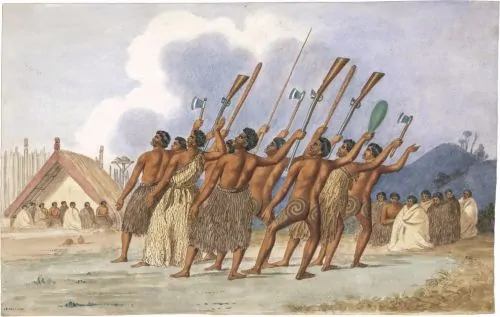
A musket became decisive only when its owner could make it function under pressure. Firearms entering Aotearoa were anything but standardized, for serviceable military pieces circulated beside worn shipboard arms and cheaply made trade guns whose locks, barrels, and stocks varied greatly in condition. Black powder spoiled when damp, flints shattered or loosened, fouling impeded repeated loading, and a defective spring could reduce a prized acquisition to an awkward club. Even a sound smoothbore was slow to reload and unreliable at distances from which an advancing enemy might close rapidly. Possession began a course of tactical education rather than completing it.
Competence accumulated through repetition, instruction, and the correction of failures in battle. A warrior had to charge the barrel, seat the ball, prime the pan, judge the condition of the flint, and complete the sequence while noise and danger disrupted deliberate movement. Practice also taught the distances at which a shot might repay its cost, methods for keeping powder containers dry, and ways to clear residue before a weapon became unusable. Sailors, traders, Pākehā-Māori, armed allies, and experienced enemies all offered possible models, although Māori adaptation was neither uniform nor a simple imitation of European drill. The surviving evidence gives little reason to imagine taua transformed into standardized line infantry. It does indicate growing control over the moment and sequence of fire. Parties could stagger their discharges so that some weapons remained loaded, while shooters behind cover reloaded under the protection of companions. Leaders who restrained wasteful shooting preserved ammunition for close range, when smoke, noise, injury, or the fall of a prominent warrior might disturb an opposing formation. Repeated campaigning consequently produced differences in proficiency that inventories of weapons cannot reveal.
Even a well-handled firearm did not displace the older arsenal. A musket could open an encounter from concealment, check a pursuit, or disorganize warriors gathering for an assault, after which the struggle often narrowed to bodies at close quarters. Some fighters fired and advanced with taiaha, patu, mere, or toki, while others retained loaded guns as their companions closed with the enemy. Ambushes, sudden rushes, withdrawals, and attacks on a disordered flank remained useful, although the timing of each maneuver now had to account for loading and discharge. Moremonui had already shown that musketeers poorly integrated with the rest of a force could be overrun after their initial advantage ebbed. Later proficiency arose from combining the disruptive effect of gunfire with established forms of collective action.
The battlefield use of muskets rested on work performed far from the firing line. Every shot consumed imported powder, lead, and flint that could not be replenished from the surrounding landscape in equivalent form. Powder had to be wrapped against rain and river crossings, balls carried or cast, spare flints protected, and ramrods kept intact. Locks and barrels required cleaning, while serious breakage might demand tools and knowledge found at a mission station or trading anchorage. Daily inspection mattered because corrosion and accumulated residue converted stored value into misfires at the moment of need. Transport imposed another limit. Waka could bear substantial loads along coasts and navigable waterways, but portages and inland tracks placed arms and provisions on human backs. The cultivators and food gatherers who supplied a taua were consequently participants in its fighting capacity, as were those who maintained kāinga and cultivations during the warriors’ absence. Potatoes and prepared stores supported longer operations, yet no expedition escaped seasonal demands or the danger of exhausting supplies far from home. A leader confronting dwindling ammunition might decline a distant exchange and preserve loaded pieces for an attempted breach. Capturing an enemy store could become a tactical objective in its own right. Prolonged firing might spend the reserve required to cover a withdrawal or defend a camp after dark. Readiness in the field made a modest collection of serviceable weapons more formidable than a larger stock of neglected guns.
Fortification presented a different problem. Many older pā occupied steep or elevated sites and combined earthworks with palisades, storage areas, and fighting stages intended to break assaults with hand weapons. Such defenses did not abruptly become useless, since difficult terrain and successive barriers could still separate and expose attackers. Defenders who rose above a stockade, crowded onto a platform, or followed a predictable crest line nevertheless offered targets to musketeers using cover or neighboring high ground. What mattered increasingly was how effectively a layout allowed the garrison to observe, fire, and reload without remaining visible.
Builders answered by reshaping earth and timber around the needs of protected shooters. No single design appeared everywhere, and much of the surviving evidence resists precise dating, but a recognizable family of adaptations emerged as firearms became common. Existing ditches, banks, and stockades were rearranged rather than discarded wholesale. In some pā, an outer screen or secondary palisade absorbed shots and concealed the main defensive line; elsewhere, strengthened barriers delayed entry while defenders fired through low openings or beneath raised rails. Hollows and trenches protected a shooter during the vulnerable act of reloading. Bends and offsets in a perimeter could bring fire across an approach that looked safe from the front. Internal routes allowed defenders to shift between positions without continually displaying themselves on the skyline. Multiple defensive lines also made a penetration less conclusive, because an attacker passing the first barrier could enter ground covered from another. The expression “gunfighter pā” is useful only when it denotes this varied and developing response rather than a fixed invention adopted across the country in one moment. Deep shelters and elaborate works designed to endure artillery bombardment at Ōhaeawai and Ruapekapeka in 1845–46 represented a later culmination, not an unchanged blueprint for the campaigns of the 1820s. The earlier principle was simpler and already consequential, since a defender could discharge, disappear into protection, reload, and return fire from a prepared position.
No council directed this experimentation across Aotearoa. Tactical knowledge moved with survivors, migrants, visiting kin, incorporated captives, and Pākehā-Māori who had handled firearms elsewhere. An unsuccessful assault could reveal the danger of simultaneous discharge, while a breached pā exposed a blind angle or weak section of palisade to anyone who escaped. Successful practices were remembered and imitated, but they were adjusted to local terrain, available resources, the size of the garrison, and the purpose of each site. Similar solutions may sometimes have arisen independently because widely separated communities faced comparable weapons and loading intervals. Learning was dispersed through Māori networks of observation and relationship, with battle accelerating an exchange that commerce alone could not provide.
These adaptations changed the meaning of firearm parity. A defender with fewer muskets could produce more useful fire when cover preserved shooters and prepared positions concentrated their aim. An attacker could no longer assume that an opening discharge followed by a rush would settle the contest. Reconnaissance and blockade became more important, as did surprise or attempts to draw the garrison outside. Pā remained vulnerable to shortages of food and water, internal division, breached alliances, or an unguarded avenue of escape, so defensive innovation did not abolish strategy or diplomacy. It did compel an assailant to remain longer, carry more provisions, and risk counterattack elsewhere. Once guns circulated broadly, judgment of range, fire discipline, logistical endurance, and intelligent use of terrain distinguished forces that appeared equally armed. The initial weapons gap had widened into a contest over practiced knowledge and protective design. Its course depended on Māori choices about organization, landscape, and acceptable risk rather than an automatic script embedded in the musket.
The Human Geography of the Arms Race
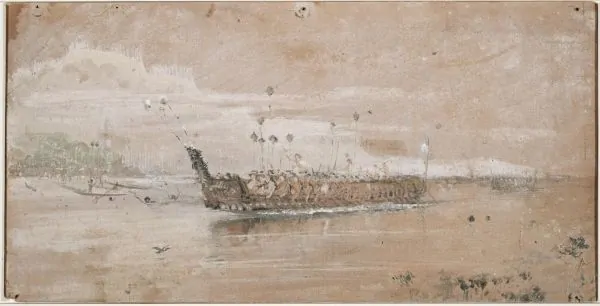
Military diffusion altered more than the distribution of firepower. As campaigns crossed Aotearoa, they changed where communities could safely reside, maintain cultivations, gather food, and travel between related settlements. Human geography in this setting encompassed the contraction of some kāinga, the creation of refuges elsewhere, the separation of kin, and the concentration of survivors around defensible sites. No comprehensive census recorded these changes, while missionary journals and later tribal histories described some districts far more fully than others. Any reconstruction must combine approximate demographic evidence with accounts of captivity, migration, abandoned resources, and eventual return.
The often-repeated estimate of roughly 20,000 deaths conveys the magnitude of the Musket Wars without providing a precise total. It rests on incomplete campaign traditions, European observations, remembered genealogies, and later calculations rather than contemporary registration. Some people died from gunfire, but many others were killed during close combat, pursuit, executions after the fall of a pā, or attacks on settlements unable to offer organized resistance. Untreated wounds added to the toll. Flight could expose displaced communities to hunger and severe weather, while crowding around refuges increased vulnerability to illnesses already circulating through Māori society. These indirect deaths are difficult to distinguish from the broader demographic effects of introduced disease. Losses were also distributed unevenly, leaving some hapū gravely diminished while neighboring groups escaped, absorbed refugees, or benefited from timely alliances. The death of experienced cultivators and elders weakened capacities that could not be replaced merely by obtaining additional weapons. An aggregate figure consequently obscures the intense local damage that made particular districts appear suddenly emptied of their former population.
Survival did not guarantee continued residence or personal autonomy. Māori captivity preceded the introduction of firearms, but the reach and frequency of nineteenth-century expeditions enlarged the distances over which captives were carried. Taurekareka taken from defeated communities could be marched to unfamiliar districts and compelled to work in cultivations, process flax, or support households whose military success depended upon their labor. Women and children were exposed when a pā fell or a fleeing population fragmented. Captive status was not identical in every community, and individuals might eventually marry into their captors’ kin group, gain a measure of standing, escape, or return home after release. Such possibilities should not soften the coercion involved or the rupture of whakapapa relationships caused by forced removal. Captivity converted military defeat into a redistribution of population, transferring productive labor and future descendants from one community to another.
Flight, organized withdrawal, and strategic relocation transformed settlement patterns on a still larger scale. Some communities left exposed river valleys or coastal kāinga for forested interiors, islands, and strengthened pā where an approaching taua could be detected or resisted. Others joined relatives in distant districts, temporarily divided their population among several refuges, or moved under the protection of a stronger ally. The southward movements associated with Ngāti Toa and several Taranaki iwi unfolded through successive stages rather than as a single departure from ancestral land. Pauses, returns, negotiations, and renewed campaigns shaped their course. Rangatira could present relocation as a means of securing opportunity and political independence, even as many followers experienced bereavement, separation, and the loss of familiar resources. New arrivals sometimes established mutually useful alliances with resident communities, but they could also intensify competition or displace those already living there. The arrival of one threatened population could place additional pressure on another far beyond the district in which the original danger arose. Economic routines changed with the movement of people, since old cultivations, fishing grounds, and gathering places could no longer be used regularly while new food supplies had to be created. Settlements described by European visitors as deserted might represent temporary refuge, recent devastation, or a seasonal absence rather than permanent extinction. Relatives who remained behind and parties who returned to harvest resources could preserve connections across considerable distances. Migration rearranged occupation without turning ancestral country into unclaimed space.
Wartime absence did not automatically extinguish territorial rights under tikanga. Claims might derive from descent and occupation while also being strengthened through marriage, gifting, recognized use, or conquest followed by settlement. Raupatu could alter authority, but a battlefield victory by itself did not produce the simple and exclusive transfer imagined by later colonial property law. Displaced groups maintained ahi kā through resident relatives, periodic return, continued harvesting, or remembered obligations to particular places. By 1840, some districts consequently contained overlapping interests belonging to conquerors, earlier inhabitants, recent migrants, and people preparing to return from refuge. Crown purchasers, private settlers, and eventually the Native Land Court often compressed this history into fixed categories of ownership that could not represent its complexity. Decisions made during the Musket Wars remained consequential long after large-scale campaigning subsided, particularly where wartime movement was later mistaken for abandonment.
Geographic disruption also endured through social memory. Whakapapa identified those who had been killed, carried away, incorporated elsewhere, or reunited with their relatives, while waiata and accounts attached particular losses to named landscapes. Descendants of captives could preserve knowledge of an earlier home even after acquiring relationships and responsibilities in the community of their birth. Recollections of refuge and return informed later negotiations over marriage, access to resources, political allegiance, and land. They could sustain obligations of utu, although remembrance did not mechanically require renewed violence and could instead support compensation or reconciliation. European observers usually recorded chiefs, spectacular battles, and visibly abandoned settlements more readily than the experiences of cultivators, captive children, or dispersed households. Oral histories collected later introduced their own problems of compression and retrospective ordering, but they preserved dimensions of upheaval absent from contemporary written accounts. A place that appeared vacant to an outsider could remain occupied in whakapapa, responsibility, and intention.
Seen from the level of households and settlements, the security dilemma acquired costs that battlefield narratives only partly reveal. Communities armed themselves to prevent death or subordination, yet the resulting campaigns destroyed food production, scattered relatives, and transferred insecurity into adjoining regions. Migration might save one population while increasing pressure on another, just as a successful defense could redirect an attacking taua toward a less protected target. These consequences were not irreversible, for Māori communities rebuilt cultivations, negotiated peace, incorporated newcomers, and reoccupied ancestral places when conditions permitted. Recovery demonstrates agency without diminishing the scale of the disruption that preceded it. The arms race must be measured not only by muskets acquired or expeditions launched, but also by changes in who lived where, under whose protection, and with what unresolved claims to return.
How the Northern Advantage Ended
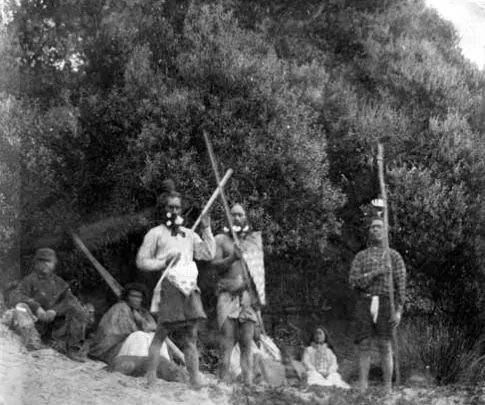
The northern lead did not disappear in a single defeat or on a fixed date. Its erosion began when firearms ceased to be concentrated among the Bay of Islands communities that had first secured them in substantial quantities. Traders established relationships elsewhere, captured weapons changed hands, and threatened iwi accepted severe commercial sacrifices to obtain their own supplies. Every spectacular Ngāpuhi victory also demonstrated the danger of remaining dependent on older weapons alone. Distribution remained uneven, and northern hapū continued to possess considerable arsenals, maritime experience, and access to imported goods. By the later 1820s, their opponents were increasingly capable of answering gunfire with gunfire, narrowing the exceptional disparity that had enabled the earliest campaigns.
Exact numerical equality was not required to deprive an attacker of easy superiority. A taua that once could approach with little fear of an effective reply now faced defenders able to fire from prepared positions, disrupt an assault, and punish pursuit. Modified pā compounded that change by denying invaders the rapid decision upon which a long expedition often depended. Attackers might undertake a prolonged siege, search for a less protected target, or withdraw before their provisions and ammunition became dangerously depleted. Superior musket numbers still mattered, as did weapon condition, experience, and access to powder. What declined was the additional advantage produced by each gun once the opposing side possessed enough firearms to impose serious losses. An arsenal that had transformed the balance in 1821 could not guarantee comparable results against prepared opponents several years later. The resulting parity was functional rather than numerical, measured by the ability to deny victory rather than by identical totals.
Distance placed a separate ceiling on northern power. Ngāpuhi taua could travel hundreds of miles and devastate communities far from the Bay of Islands, but destruction did not readily become permanent government. Long routes consumed supplies, strained canoes and carrying parties, and required coalition members to remain away from their own cultivations and political responsibilities. Allied rangatira joined expeditions for particular purposes and retained the authority to depart once those purposes had been fulfilled. Holding conquered territory would have demanded resident garrisons, continuing reinforcement, and acceptance by communities whose surviving members still possessed kin connections and opportunities for return. Northern power was consequently formidable as an expeditionary force but poorly suited to creating an enduring empire across Aotearoa.
Hongi Hika’s wounding during fighting at Whangaroa in 1827 gave this gradual change a dramatic personal focus. A musket ball passed through his chest, leaving an injury from which he never fully recovered before his death in 1828. The manner of his decline carried an obvious irony, yet it should not be treated as a technological judgment in which the weapon he promoted simply turned against him and ended his system. His absence mattered because the authority behind the great expeditions had always been personal and negotiated. Hongi drew upon whakapapa, marriage connections, gifts, accumulated mana, and a reputation for success to assemble forces whose members did not constitute a permanent army. He also combined early commercial access with an unusual willingness to undertake distant and hazardous campaigns. Ngāpuhi remained a constellation of powerful hapū rather than a centralized polity possessing an office to which supreme military command automatically passed. After Hongi’s death, other northern rangatira retained muskets, trading relationships, and substantial influence, but none inherited his particular combination of opportunity and coalition-building power. Leaders increasingly pursued their own disputes and commercial interests, making sustained external action on the earlier scale more difficult. His death accelerated a dispersal of initiative already inherent in northern political organization rather than causing an abrupt collapse.
During the 1830s, military equilibrium intersected with growing pressure to restore communities damaged by repeated campaigning. Rebuilding cultivations, recovering captives, resettling ancestral places, and repairing relationships could promise more durable gains than another distant expedition. Peace agreements and political marriages offered ways to interrupt cycles of retaliation without requiring either side to forget earlier losses. Missionaries also acquired greater influence as intermediaries, while Māori converts introduced Christian arguments into debates over vengeance, captives, and reconciliation. Mission accounts sometimes exaggerated their own role, since accommodation frequently rested upon calculations that had little to do with conversion. Mediation became more effective when armed opponents recognized that neither could expect a quick victory at tolerable cost. Fighting persisted in several regions into the 1840s, but parity, exhaustion, diplomacy, and changing priorities steadily reduced the frequency of the immense northern expeditions associated with Hongi’s ascendancy.
Ending the northern advantage did not undo the arms race. Muskets had become embedded in Māori politics, and Ngāpuhi remained capable of defending the north and influencing events beyond it. What vanished was the brief conjunction of concentrated weapons, vulnerable opponents, and leadership able to mobilize that imbalance across great distances. Armed plurality replaced a predominantly one-sided gap, making calculation and alliance increasingly important to survival. Hongi’s campaigns hastened that transition because their success advertised the need for the very countermeasures that eventually contained northern power. A lead founded on transferable technology carried the conditions of its own decline, as threatened communities acquired weapons, altered their defenses, and denied any one coalition a lasting monopoly on force.
Were These Really “Musket Wars” or a Security Dilemma?
The following video from hamuera tewake discussees the Musket Wars:
The strongest objection here is that both of its organizing terms may impose excessive unity on a diverse period. “Musket Wars” retrospectively gathers conflicts fought across several decades by communities pursuing different grievances in widely separated regions. Naming the era after a weapon can quietly promote that weapon from an important instrument to the presumed cause of hostilities. It also encourages campaigns to be arranged around technological acquisition even when participants understood them through whakapapa, disputed authority, resource access, or obligations arising from earlier violence. Some expeditions involved extensive gunfire, whereas others still turned upon siege, hunger, deception, and close combat. There was no single Musket War directed toward a common objective, and many of its constituent struggles cannot be explained by muskets alone.
Angela Ballara’s emphasis on taua and tikanga gives this challenge substantial weight. Māori warfare remained embedded in particular relationships through which mana could be defended, utu pursued, kin assisted, and injuries carried between generations. A campaign launched after an enemy obtained firearms might still have originated in a remembered killing, an insult to a rangatira, or a contested claim to land. Leaders could employ a new military advantage to pursue ambitions that were neither novel nor primarily defensive. Diplomacy, intermarriage, compensation, and negotiated restraint also remained available, demonstrating that armed competition never constituted the whole of Māori politics. An interpretation beginning with an arms race can flatten historically specific motives into a generalized reaction to danger.
Security-dilemma language creates a second difficulty because the concept emerged from theories of relations among states. Hapū and iwi were not bounded sovereign units with permanent executives, standing armies, or interests reducible to territorial survival. Authority was distributed among rangatira whose influence depended upon kinship, achievement, consent, and the circumstances of a particular undertaking. Whakapapa crossed political divisions, while individuals and communities could possess obligations on more than one side of a dispute. The conventional security dilemma also emphasizes uncertainty about intentions, yet some intentions during these campaigns were openly punitive, acquisitive, or expansionist. Hongi Hika and other leaders did not merely fear attack; they sometimes recognized opportunities to settle utu, increase mana, take captives, or establish influence. Nor does the purchase of a musket disclose why its buyer wanted it. A subsequent expedition might represent preemption, revenge, calculated aggression, or several purposes operating together. Missionary records and later oral accounts rarely permit those motives to be separated with confidence. Observing that one acquisition followed another consequently demonstrates reciprocal arming more readily than it proves that fear was the decisive cause of every decision.
This criticism does not remove the material compulsion created by an extreme weapons disparity. Communities that witnessed the destruction of poorly armed neighbors had sound reasons to conclude that their own survival required firearms, stronger defenses, or alliances with groups possessing them. That conclusion remained rational even when leaders also anticipated offensive uses for the weapons they acquired. No analogy with centralized states is necessary to recognize that one community’s increased striking power made others less secure. The evidence supports a recurring security mechanism without requiring every participant to have been defensive, reluctant, or uncertain about an opponent’s intentions.
The most defensible interpretation treats “Musket Wars” as chronological shorthand rather than a sufficient explanation. Tikanga, mana, utu, kinship, and local political histories account for why particular enemies fought at particular moments. The security dilemma instead helps explain why firearms spread so rapidly once conspicuous victories exposed the cost of lacking them. It also clarifies why leaders pursuing unrelated objectives repeatedly contributed to the same cumulative escalation. Defensive preparation, revenge, prestige, and opportunism could coexist within a single decision to acquire weapons or launch a taua. Restricting the argument in this way makes it more precise rather than less consequential. Muskets did not supply the original grievances, but they transformed the risks attached to those grievances and reduced the freedom to remain outside the competition. The period was a collection of culturally and politically distinct conflicts intensified by a reciprocal arming process that no single participant could direct.
Conclusion: The Price of Not Falling Behind
Hongi Hika occupies the center of this history without standing outside it as its solitary author. He perceived the military possibilities created by firearms and combined them with commercial access, agricultural production, diplomatic relationships, and exceptional authority among allied warriors. His travels to England and Sydney strengthened an arsenal whose significance became apparent through the campaigns that followed. Those victories converted a northern advantage into evidence visible throughout Aotearoa. Yet even Hongi relied upon autonomous hapū, negotiated coalitions, established obligations, and communities capable of provisioning prolonged expeditions. Describing him as a catalyst recognizes his choices while avoiding the fiction that one leader created either Māori conflict or the social order within which taua operated.
For communities beyond the Bay of Islands, the intentions of a newly armed neighbor mattered less than the capabilities its weapons made possible. A promise of peace could be withdrawn, an alliance could fracture, and a grievance previously contained by distance could become the basis for an expedition. Remaining poorly armed exposed a population to risks that goodwill alone could not remove. Musket acquisition could serve protection and aggression simultaneously, since the means of deterring an attack also enabled preemption or revenge. Each effort to reduce vulnerability consequently enlarged the danger perceived elsewhere. Communities committed labor and trade goods to securing guns, shifted people toward safer settlements, and altered defensive works to survive attacks that might never occur. Those preparations were rational for each participant even though their cumulative effect extended warfare into new regions and increased its destructive reach. The security-dilemma interpretation remains useful precisely at this level, where it identifies compulsion without assigning an identical motive to every rangatira or taua. The price of avoiding subordination was participation in a competition whose final costs no community could calculate in advance.
None of this turns the musket into an autonomous historical force. Weapons malfunctioned, ammunition ran short, fortified defenders endured, and apparently superior taua could still be defeated. Outcomes depended upon experience, supply, terrain, leadership, and the cohesion of those who fought together. Mana, utu, and kinship continued to shape the purposes of campaigns, while negotiation could postpone violence or bring it to an end. Firearms changed the available choices and their consequences, but Māori actors decided how those choices would be used.
By the time northern exclusivity had vanished, armed parity and improved defenses had made the one-sided victories of the early 1820s increasingly difficult to reproduce. That adjustment did not restore those who had been killed, release every captive, reverse each migration, or resolve the territorial claims left by wartime displacement. Nor did parity create peace by itself, although it made distant conquest more hazardous and gave diplomacy greater room to operate. Māori communities nevertheless rebuilt cultivations, returned to ancestral places, incorporated displaced people, and negotiated new relationships from the conditions the wars had created. The result was neither a simple tale of technological progress nor one of an Indigenous society helpless before a foreign weapon. It was a history of Māori initiative exercised within an international trade environment that rewarded rapid adaptation and punished delay. The weapons disparity eventually narrowed, but closing it required communities to absorb the weapon, reorganize around its dangers, and bear losses that extended far beyond the battlefield. The deepest price of not falling behind was that survival increasingly demanded participation in the same competition that had made survival uncertain.
Bibliography
Affiliate disclosure: Amazon links on this site are paid links. As an Amazon Associate I earn from qualifying purchases.
- Anderson, Atholl. Te Puoho’s Last Raid. Dunedin: Otago Heritage Books, 1986.
- —-. The Welcome of Strangers: An Ethnohistory of Southern Maori A.D. 1650–1850. Dunedin: University of Otago Press, 1998.
- Anderson, Atholl, Judith Binney, and Aroha Harris. Tangata Whenua: An Illustrated History. Wellington: Bridget Williams Books, 2014.
- Ballantyne, Tony. Webs of Empire: Locating New Zealand’s Colonial Past. Wellington: Bridget Williams Books, 2012.
- Ballara, Angela. Iwi: The Dynamics of Māori Tribal Organisation from c. 1769 to c. 1945. Wellington: Victoria University Press, 1998.
- —-. Taua: “Musket Wars,” “Land Wars” or Tikanga? Warfare in Māori Society in the Early Nineteenth Century. Auckland: Penguin, 2003.
- —-. “Te Ao-kapurangi.” In The Dictionary of New Zealand Biography, Volume One, 1769–1869, edited by W. H. Oliver. Wellington: Allen & Unwin and Department of Internal Affairs, 1998.
- Banks, Joseph. The Endeavour Journal of Joseph Banks, 1768–1771. Edited by J. C. Beaglehole. 2 vols. Sydney: Angus and Robertson, 1963.
- Belich, James. Making Peoples: A History of the New Zealanders from Polynesian Settlement to the End of the Nineteenth Century. Auckland: Penguin Press, 1996.
- —-. “The New Zealand Wars and the Myth of Conquest.” In Remembrance of Pacific Pasts: An Invitation to Remake History, edited by Robert Borofsky. Honolulu: University of Hawaii Press, 2000, 255-268.
- Bentley, Trevor. Pākehā Māori: The Extraordinary Story of the Europeans Who Lived as Māori in Early New Zealand. Auckland: Penguin, 1999.
- Best, Elsdon. The Pa Maori: An Account of the Fortified Villages of the Maori in Pre-European and Modern Times, Illustrating Methods of Defence by Means of Ramparts, Fosses, Scarps and Stockades. Dominion Museum Bulletin 6. Wellington: Government Printer, 1927.
- Binney, Judith. Encircled Lands: Te Urewera, 1820–1921. Wellington: Bridget Williams Books, 2009.
- —-. The Legacy of Guilt: A Life of Thomas Kendall. Auckland: Oxford University Press, 1968.
- Butler, John Gare. Earliest New Zealand: The Journals and Correspondence of the Rev. John Butler. Compiled by R. J. Barton. Masterton, New Zealand: Palamontain and Petherick, 1927.
- Cloher, Dorothy Urlich. Hongi Hika: Warrior Chief. Auckland: Viking, 2003.
- Cook, James. The Journals of Captain James Cook on His Voyages of Discovery. Vol. 1, The Voyage of the Endeavour, 1768–1771. Edited by J. C. Beaglehole. Cambridge: Cambridge University Press for the Hakluyt Society, 1968.
- Crosby, R. D. The Musket Wars: A History of Inter-Iwi Conflict, 1806–45. Auckland: Reed, 1999.
- Cruise, Richard A. Journal of a Ten Months’ Residence in New Zealand. London: Longman, Hurst, Rees, Orme, and Brown, 1823.
- D’Arcy, Paul. “Maori and Muskets from a Pan-Polynesian Perspective.” New Zealand Journal of History 34:1 (2000), 117–132.
- Dieffenbach, Ernst. Travels in New Zealand: With Contributions to the Geography, Geology, Botany, and Natural History of That Country. 2 vols. London: John Murray, 1843.
- Earle, Augustus. A Narrative of a Nine Months’ Residence in New Zealand in 1827: Together with a Journal of a Residence in Tristan d’Acunha, an Island Situated between South America and the Cape of Good Hope. London: Longman, Rees, Orme, Brown, Green, and Longman, 1832.
- Elder, John Rawson, ed. Marsden’s Lieutenants. Dunedin: Coulls Somerville Wilkie and A. H. Reed for the Otago University Council, 1934.
- Fitzgerald, Caroline. Te Wiremu: Henry Williams—Early Years in the North. Wellington: Huia Publishers, 2011.
- Fox, Aileen. Prehistoric Maori Fortifications in the North Island of New Zealand. Auckland: Longman Paul, 1976.
- Hepburn-Roper, Sebastian. “Musket War and Musket Trade: The New South Wales to New Zealand Firearms Trade, 1829–1840.” Asia-Pacific Economic History Review 63:1 (2023), 73–93.
- Herz, John H. “Idealist Internationalism and the Security Dilemma.” World Politics 2:2 (1950), 157–180.
- Jervis, Robert. “Cooperation under the Security Dilemma.” World Politics 30:2 (1978), 167–214.
- Jones, Pei Te Hurinui, and Bruce Biggs. Ngā Iwi o Tainui: The Traditional History of the Tainui People. Auckland: Auckland University Press, 1995.
- Kendall, Thomas. A Grammar and Vocabulary of the Language of New Zealand. Revised by Samuel Lee. London: Church Missionary Society, 1820.
- Kerehona, Brent. “Hongi Hika: A Portrait.” Journal of Museum Ethnography 32 (2019), 209-224.
- Knight, Ian. Māori Fortifications. Oxford: Osprey Publishing, 2009.
- Marsden, Samuel. The Letters and Journals of Samuel Marsden, 1765–1838. Edited by John Rawson Elder. Dunedin: Coulls Somerville Wilkie and A. H. Reed for the Otago University Council, 1932.
- Middleton, Angela. “Potatoes and Muskets: Māori Gardening at Kerikeri.” In Te Kerikeri 1770–1850: The Meeting Pool, edited by Judith Binney, 33–39. Wellington: Bridget Williams Books, 2007.
- The Missionary Register for MDCCCXXI. London: L. B. Seeley and Son, 1821.
- Monin, Paul. This Is My Place: Hauraki Contested, 1769–1875. Wellington: Bridget Williams Books, 2001.
- Nicholas, John Liddiard. Narrative of a Voyage to New Zealand, Performed in the Years 1814 and 1815, in Company with the Rev. Samuel Marsden. 2 vols. London: James Black and Son, 1817.
- O’Malley, Vincent. The Great War for New Zealand: Waikato 1800–2000. Wellington: Bridget Williams Books, 2016.
- —-. The Meeting Place: Māori and Pākehā Encounters, 1642–1840. Auckland: Auckland University Press, 2012.
- Oliver, Steven. “Te Rauparaha.” In The Dictionary of New Zealand Biography. Vol. 1, 1769–1869, edited by W. H. Oliver. Wellington: Allen & Unwin New Zealand and Department of Internal Affairs, 1990.
- —-. “Te Wherowhero, Pōtatau.” In The Dictionary of New Zealand Biography, Volume One, 1769–1869, edited by W. H. Oliver. Wellington: Allen & Unwin and Department of Internal Affairs, 1990.
- Petrie, Hazel. Chiefs of Industry: Māori Tribal Enterprise in Early Colonial New Zealand. Auckland: Auckland University Press, 2007.
- —-. Outcasts of the Gods? The Struggle over Slavery in Māori New Zealand. Auckland: Auckland University Press, 2015.
- Polack, Joel Samuel. New Zealand: Being a Narrative of Travels and Adventures during a Residence in That Country between the Years 1831 and 1837. 2 vols. London: Richard Bentley, 1838.
- Pool, Ian. Te Iwi Maori: A New Zealand Population Past, Present and Projected. Auckland: Auckland University Press, 1991.
- Raeside, J. D. Sovereign Chief: A Biography of Baron de Thierry. Christchurch: Caxton Press, 1977.
- Salmond, Anne. Between Worlds: Early Exchanges Between Māori and Europeans, 1773–1815. Auckland: Viking, 1997.
- Savage, John. Some Account of New Zealand, Particularly the Bay of Islands, and Surrounding Country. London: J. Murray, 1807.
- Shortland, Edward. The Southern Districts of New Zealand: A Journal, with Passing Notices of the Customs of the Aborigines. London: Longman, Brown, Green, and Longmans, 1851.
- Smith, S. Percy. Maori Wars of the Nineteenth Century: The Struggle of the Northern against the Southern Maori Tribes Prior to the Colonisation of New Zealand in 1840. Christchurch: Whitcombe and Tombs, 1910.
- —-. “Wars of the Northern against the Southern Tribes of New Zealand in the Nineteenth Century.” The Journal of the Polynesian Society 8:3,31 (1899), 141-164.
- Stafford, D. M. Te Arawa: A History of the Arawa People. Wellington: A. H. and A. W. Reed, 1967.
- Stokes, Evelyn. “Te Waharoa.” In The Dictionary of New Zealand Biography. Vol. 1, 1769–1869, edited by W. H. Oliver. Wellington: Allen & Unwin New Zealand and Department of Internal Affairs, 1990.
- Stone, R. C. J. From Tāmaki-makau-rau to Auckland. Auckland: Auckland University Press, 2001.
- Tāmihana Te Rauparaha. He Pukapuka Tātaku i ngā Mahi a Te Rauparaha Nui: A Record of the Life of the Great Te Rauparaha. Translated and edited by Ross Calman. Auckland: Auckland University Press, 2020.
- Tarakawa, Takaanui Hōhaia. “Nga Mahi a Te Wera, me Nga-Puhi Hoki, ki Te Tai-Rawhiti / The Doings of Te Wera-Hauraki and Nga-Puhi on the East Coast, N.Z.” Translated by S. Percy Smith. Journal of the Polynesian Society 8, no. 3 (September 1899)–9, no. 2 (June 1900).
- Thompson, Christina A. “A Dangerous People Whose Only Occupation Is War: Maori and Pakeha in 19th-Century New Zealand.” The Journal of Pacific History 32:1 (1997), 109-119.
- Vayda, Andrew P. Māori Warfare. Wellington: Polynesian Society, 1960.
- —-. “Maoris and Muskets in New Zealand: Disruption of a War System.” Political Science Quarterly 85:4 (1970), 560–584.
- Waitangi Tribunal. The Hauraki Report. 3 vols. Wellington: Legislation Direct, 2006.
- —-. He Whakaputanga me te Tiriti: The Declaration and the Treaty. The Report on Stage 1 of the Te Paparahi o Te Raki Inquiry. Wellington: Legislation Direct, 2014.
- —-. The Taranaki Report: Kaupapa Tuatahi. Wellington: GP Publications, 1996.
- —-. The Te Roroa Report 1992. Wellington: Brooker and Friend, 1992.
- —-. Te Whanganui a Tara me Ona Takiwa: Report on the Wellington District. Wellington: Legislation Direct, 2003.
- Wakefield, Edward Jerningham. Adventure in New Zealand, from 1839 to 1844. 2 vols. London: John Murray, 1845.
- Williams, Henry. The Early Journals of Henry Williams, Senior Missionary in New Zealand of the Church Missionary Society, 1826–40. Edited by Lawrence M. Rogers. Christchurch: Pegasus Press, 1961.
- Wright, Matthew. Guns & Utu: A Short History of the Musket Wars. Auckland: Penguin, 2011.
- Yate, William. An Account of New Zealand: And of the Formation and Progress of the Church Missionary Society’s Mission in the Northern Island. 2nd ed. London: R. B. Seeley and W. Burnside, 1835.
Originally published by Brewminate, 09.23.2026, under the terms of a Creative Commons Attribution-NonCommercial-NoDerivatives 4.0 International license.
About the Author