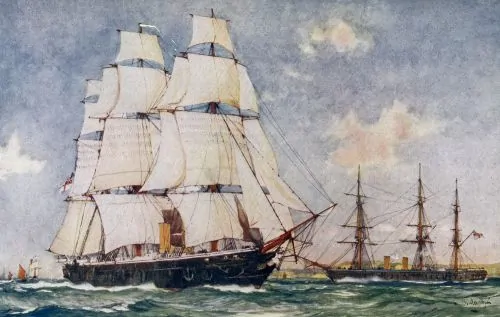
France’s La Gloire and Britain’s HMS Warrior transformed naval power, forcing rival states into an escalating contest over armor, artillery, propulsion, industrial capacity, and cost.

By Matthew A. McIntosh
Public Historian
Brewminate
Introduction: When the World’s Strongest Fleet Lost Its Future
On 24 November 1859, the French armored frigate La Gloire entered the water at Toulon and unsettled the assumptions on which British naval supremacy rested. Britain still possessed the world’s largest and most experienced navy, supported by an extensive network of dockyards, overseas bases, trained personnel, and merchant shipping. No launching ceremony could erase that material superiority. Yet La Gloire suggested that the Royal Navy’s imposing inventory of wooden warships might no longer guarantee command of the sea against an armored opponent. Britain had not suddenly lost its fleet; it confronted the more disturbing possibility that the fleet in which it had invested so heavily belonged to a receding era.
Nothing incorporated into the French vessel had appeared without precedent. Naval engineers had experimented for decades with steam engines, screw propulsion, iron construction, and increasingly destructive artillery, while the armored floating batteries employed during the Crimean War had demonstrated the protective value of iron plate under combat conditions. Henri Dupuy de Lôme’s achievement was to combine these developments in the first seagoing armored warship intended to operate as a major fleet unit. Beneath La Gloire’s iron plating remained a wooden hull, and her machinery coexisted with a full sailing rig; she was a transitional design rather than a perfected machine. Even so, the synthesis crossed an important threshold. An armored, steam-driven frigate could choose its movement more freely than a vessel dependent on wind and could threaten wooden opponents with shell fire while resisting much of their return fire. For France, which could not readily equal Britain ship for ship, altering the standard by which effective naval power was measured offered a means of reducing the value of Britain’s numerical lead.
Britain did not wait for La Gloire’s launch before reacting. The Admiralty authorized HMS Warrior on 11 May 1859, after French intentions had become known but several months before the French ship entered the water. The familiar account in which France acted and Britain replied captures the public sequence more neatly than the underlying procurement process. When HMS Warrior was launched on 29 December 1860, her iron hull, greater dimensions, high speed, and protected central battery embodied an effort to surpass the French design rather than reproduce it. The contest was already unfolding through intelligence, design decisions, dockyard planning, and industrial contracts before either ironclad joined an operational fleet.
Obsolescence in this setting requires careful definition. Wooden warships did not become physically useless in 1859; they continued to perform patrol, transport, training, blockade, colonial, and secondary combat duties, while converted wooden vessels remained part of major navies for years. Nor had the superiority of armor been settled under every tactical condition, since early ironclads possessed vulnerable steering gear, unprotected extremities, imperfect machinery, and uncertain endurance. What changed abruptly was the strategic credibility of the wooden ship as the principal instrument of battle-fleet power. Admirals and ministers now had to consider whether an expensive ship of the line could damage an armored adversary before explosive shells devastated its exposed hull and crew. Britain’s accumulated investment in timber, guns, dockyard labor, and trained seamen retained considerable utility, but it no longer supplied an unquestioned measure of first-line strength. Once armor became the expected protection of a capital ship, heavier weapons were required to defeat it; stronger artillery encouraged thicker plate, while added weight demanded larger hulls and more powerful engines. Each apparent solution generated another technical and financial problem. Naval competition expanded beyond ships themselves to encompass metallurgy, engineering, state finance, private manufacturing, dockyard administration, and the political willingness to replace vessels long before they had worn out. Because Britain and France sometimes cooperated diplomatically even as they prepared against one another, this escalation did not require either government to intend an imminent war. Defensive precautions on one side could appear as evidence of offensive preparation on the other.
The importance of La Gloire and HMS Warrior lay less in their individual fighting records than in the crisis of valuation they created. The French ironclad made a new conception of the ocean-going capital ship materially credible; the British response confirmed that no leading navy could safely ignore it. HMS Warrior restored confidence by exceeding the immediate French challenge, but her success also accelerated the process that would make her own design dated within a remarkably short period. The resulting arms race was not an automatic consequence of invention; it arose from strategic anxiety, institutional judgment, industrial capacity, and uncertainty about how untested vessels would perform in war. Neither ironclad needed to fight its rival to exercise influence. They revealed that naval supremacy would henceforth depend not merely on the number of ships a state possessed, but on its capacity to replace yesterday’s strength before a competitor did.
Before the Shock: The Convergence of Existing Technology
The armored frigates of 1859 and 1860 arose from a prolonged transformation rather than an isolated invention. In the decades after the Napoleonic Wars, the wooden ship of the line reached an imposing degree of refinement, combining heavy broadside batteries with durable construction and an elaborate body of seamanship. Its effectiveness nevertheless depended upon familiar conditions. Wind supplied movement, timber absorbed punishment, and solid cannonballs inflicted damage through penetration and splintering. Innovations in gunnery began to upset those expectations before naval engineers possessed an adequate means of protecting ships from the weapons they were creating. Steam machinery simultaneously offered independence from weather, although its early forms imposed severe penalties in weight, range, and gun placement. Only when advances in propulsion and metalworking caught up with the destructive capacity of naval artillery did a fundamentally different fighting vessel become practicable.
Artillery posed the most immediate challenge to the survivability of the wooden warship. Solid round shot could pierce planking, dismount guns, cut rigging, and send lethal splinters through crowded decks, but victory generally depended upon an accumulation of hits delivered at short range. Explosive projectiles had long been fired from mortars aboard specialized bomb vessels, though their high trajectories and hazardous handling made them unsuitable for ordinary broadside engagements. During the 1820s, the French artillery officer Henri-Joseph Paixhans advocated a heavy naval gun capable of firing hollow shells along a flatter path, allowing a projectile to enter a wooden hull before its fuze detonated the charge. Trials against the retired ship of the line Pacificateur in 1824 demonstrated effects far more destructive than those produced by a comparable penetration from solid shot. Adoption remained gradual because reliable fuzes, stronger cannon, safe ammunition procedures, and trained crews were required before shell guns could become routine fleet weapons. By the 1840s, the major maritime powers had incorporated them into naval service, making fire and internal explosions increasingly prominent dangers. Russia’s destruction of an Ottoman squadron at Sinope in November 1853 gave shell fire a powerful reputation, although the result also reflected Russian numerical superiority, heavier armament, favorable positioning, and deficiencies in the Ottoman defense. Sinope was not a controlled demonstration that every wooden fleet had become helpless, but it gave European observers a vivid example of how quickly shells could consume ships constructed from seasoned timber, cordage, canvas, and tar.
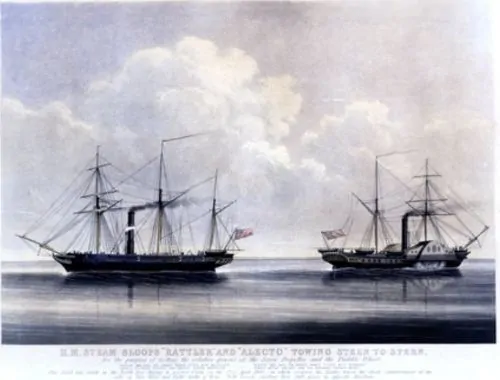
Motive power followed a separate course. Paddle-wheel steamers proved useful for towing, dispatch work, coastal operations, and movement through confined waters, yet their exposed machinery occupied valuable space along the sides where a warship normally carried guns. The submerged screw propeller interfered far less with the broadside and could be disengaged when a vessel proceeded under sail. The celebrated 1845 contest in which HMS Rattler pulled the paddle-driven HMS Alecto astern was not an exact comparison, since the ships’ engines did not produce equal power, but it publicized a propulsion system already gaining institutional support. France’s Napoléon, launched in 1850, and Britain’s HMS Agamemnon, launched two years later, showed that large screw-propelled battleships could retain sailing rigs and conventional batteries while gaining reliable tactical mobility under steam.
Iron introduced a different set of uncertainties because an iron hull and iron armor were not equivalent technologies. Commercial shipbuilders valued iron for structural strength, internal capacity, and the ability to produce hull forms less dependent upon scarce supplies of suitable timber. European navies experimented with iron-hulled vessels during the 1830s and 1840s, but firing tests encouraged doubts about their fitness for battle. Thin structural plates could be pierced or torn by solid shot, producing ragged openings and metal fragments that were difficult to contain, while dockyard personnel possessed far greater experience repairing wooden frames and planking. Iron hulls also complicated compass use, and they could not be covered conventionally with copper sheathing without promoting galvanic corrosion, leaving marine growth to impair performance on prolonged deployments.
Thick wrought-iron armor offered another possibility because it was intended to resist a projectile rather than serve merely as the ship’s outer structure. Experiments indicated that substantial plate backed by heavy timber could spread an impact and prevent penetration, but such protection added an enormous burden to a vessel already carrying guns, machinery, boilers, coal, stores, and rigging. Armor consequently became more than an attachment that constructors could fasten to an existing design. Its adoption required sufficient buoyancy, stronger internal support, dependable propulsion, and careful distribution of weight if a ship was to remain stable and maneuverable at sea.
Combat furnished the most persuasive test of these developments during the Crimean War. The Anglo-French attack on Sevastopol’s defenses in October 1854 exposed the hazards faced by wooden ships engaging well-sited coastal artillery, even when steam assistance allowed them to take up positions without relying entirely upon the wind. France and Britain had already begun developing armored floating batteries intended to withstand the concentrated fire of Russian fortifications. On 17 October 1855, the French batteries Dévastation, Lave, and Tonnante approached the defenses at Kinburn and endured scores of hits while suffering comparatively limited casualties. Their wrought-iron plates allowed them to remain near the target and continue firing after punishment that might have forced an unprotected vessel to withdraw. The episode did not prove that these craft could function as ocean-going capital ships. They were slow, shallow-drafted, uncomfortable in rough water, and dependent upon towing for long passages. Kinburn was also an unequal action in which the Russian position faced overwhelming allied resources. Even with those qualifications, the battle supplied operational evidence that sufficiently thick plate over timber backing could protect a working gun battery under sustained fire.
By the closing years of the 1850s, naval constructors no longer lacked any indispensable component of an armored seagoing warship. They could draw upon decades of experience with shell guns, increasingly efficient marine engines, proven screw battleships, improved plate production, and the wartime performance of floating batteries. The unresolved task was to combine those elements without producing a vessel too sluggish for fleet service, too unstable to carry a useful armament, or too dependent upon coal for extended operations. France was well positioned to attempt that integration because its centralized naval construction corps concentrated considerable authority in technically trained designers, while Napoleon III had shown a personal interest in armored batteries and other military innovations. Henri Dupuy de Lôme also brought experience from the design of Napoléon, linking the French steam battle fleet directly to the next stage of experimentation. Britain possessed deeper industrial resources and extensive knowledge of iron shipbuilding, but its worldwide commitments gave the Admiralty sound reasons to scrutinize endurance, repair requirements, and seaworthiness before abandoning established practices. Technology had made an armored frigate possible; policy, strategic calculation, and rival judgments determined which power would place one in the water first.
France’s Search for a Qualitative Advantage
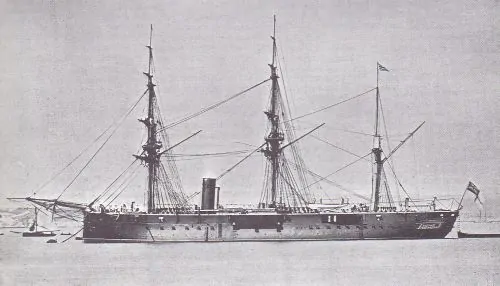
France entered the 1850s with an imposing navy but an unfavorable strategic equation. Across the Channel, Britain possessed greater shipbuilding capacity, a larger merchant marine, more extensive financial resources, and a worldwide network of dockyards and coaling stations. Direct numerical rivalry demanded expenditures that Paris could scarcely sustain while maintaining continental armies and pursuing imperial commitments. A more promising course lay in gaining temporary superiority through design; if a new type of vessel could defeat existing warships, the significance of Britain’s numerical lead would diminish until the Royal Navy rebuilt around the same principle. This preference never hardened into a formally articulated doctrine shared by every minister and admiral. It was instead a recurrent response to structural disadvantage, offering France greater diplomatic and military leverage than a simple multiplication of conventional hulls could provide.
French institutions supplied unusually favorable conditions for such experiments. The centralized Corps du génie maritime joined advanced mathematical training, state arsenals, and administrative authority in a professional community capable of carrying designs from calculation to construction. Henri Dupuy de Lôme exemplified that system. After studying British iron shipbuilding during visits in 1842 and 1843, he reported his findings in the 1844 Mémoire sur la construction des bâtiments en fer. His investigation treated foreign industrial practice as knowledge that France could absorb, refine, and apply to warship design. The resulting habit of selective borrowing mattered as much as any single invention, because it allowed French constructors to combine techniques developed on both sides of the Channel. Dupuy de Lôme’s Napoléon, launched in 1850, translated that method into the first purpose-built screw-propelled ship of the line, coupling the firepower of a large broadside vessel with reliable auxiliary steam propulsion. British conversions and new construction soon erased much of its novelty, yet their speed confirmed that France had briefly compelled the larger navy to follow a design initiative originating abroad. The episode furnished the durable lesson that a technical lead might be short, but even a short lead could redirect an opponent’s expenditure and unsettle its plans.
Imperial politics enlarged the value attached to naval innovation. Napoleon III regarded modern warships as instruments of national prestige, overseas intervention, diplomatic display, and dynastic legitimacy, purposes that complemented their strictly operational functions. Anglo-French cooperation during the Crimean War did not suspend professional comparison between the allied fleets, and subsequent disagreements over Italy revived older British suspicions. Queen Victoria and Prince Albert’s visit to Cherbourg in August 1858 placed the harbor’s new basins, fortifications, and assembled fleet before British observers at a moment of growing unease. The spectacle did not prove that France intended an invasion; it demonstrated how readily dockyards and warships could acquire threatening meanings even when displayed amid ceremonies of friendship.
La Gloire emerged when administrative capacity, imperial ambition, and recent combat experience were converted into a procurement decision. Her design received approval in 1857, and her keel was laid at Toulon on March 4, 1858, well before the public drama created by her launch the following November. Dupuy de Lôme adapted the form of a steam ship of the line while reducing the upper works to a single enclosed gun deck, thereby releasing the displacement needed for continuous side protection. Although officially classed as an armored frigate because she carried only one covered battery, her intended place was among the principal fighting ships rather than in the traditional scouting duties associated with frigates. Approximately 120 millimeters of wrought-iron plate, secured over thick timber, covered her sides from below the waterline to the upper deck and guarded the machinery as well as the battery. Her original armament of thirty-six 164.7-millimeter rifled muzzle-loading guns concentrated destructive force within that protected broadside, while her screw engine was designed to give a speed of about thirteen knots. Against an unarmored wooden opponent, she promised an asymmetrical engagement. Her own vital spaces possessed substantial resistance to the shells that endangered her adversary, while her rifled projectiles could still inflict ruinous structural and incendiary damage. Her guns were themselves soon judged inadequate against newer armor, an early indication that the advantage created by protection would stimulate demands for more powerful ordnance. The wooden hull was a calculated means of accelerating construction in familiar arsenals and providing massive backing for the plates; it represented an expedient stage in development rather than a French rejection of iron structure.
Nor was La Gloire conceived as a solitary demonstrator. The sister ships Invincible and Normandie extended the design into a class, allowing the navy to contemplate the employment of armored vessels as a formation rather than as an isolated curiosity. France simultaneously proceeded with Couronne, laid down in 1859 with an iron hull, thereby testing another solution to the structural problem. The larger Magenta and Solférino subsequently restored two enclosed gun decks while preserving armor and steam propulsion, revealing an effort to retain the concentrated broadside of the traditional capital ship within the new protective system. These successive designs amounted to an expanding fleet program, even though their differences betrayed uncertainty about the ideal combination of hull, battery, rig, and machinery. Its horizon remained a balanced battle fleet capable of major-power operations; the commerce-raiding ideas later associated with the Jeune École belonged to a different strategic setting.
French initiative nevertheless carried severe constraints. Naval appropriations competed with the army and with Napoleon III’s ambitious foreign policy, while armor plate, engines, guns, and dockyard alterations imposed costs extending far beyond the price of the hull itself. Wooden construction hastened the first deployments but also brought maintenance problems and limited service lives, whereas iron construction demanded industrial resources that could not be enlarged instantaneously. Large armored ships took years to build in exposed state yards, giving foreign observers ample opportunity to report their dimensions and probable capabilities. But surviving evidence does not reveal a single, consistent plan by which the emperor, ministers, constructors, and admirals intended to overturn British maritime supremacy; their purposes included deterrence, prestige, battle-fleet strength, colonial service, and technological experiment in varying proportions. Durable superiority eluded France, but agenda-setting did not. By making ocean-going armor the organizing problem of capital-ship design, the French forced Britain to commit money, labor, and political attention to a fleet whose leading units would now have to be conceived anew. France’s qualitative advantage was measured less by the number of years it lasted than by its ability to determine what its stronger rival had to build next.
La Gloire: An Armored Ship for the Open Sea
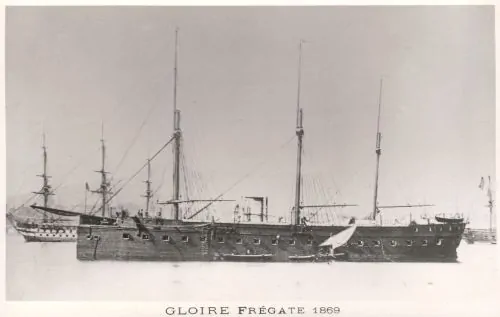
The phrase “for the open sea” identifies the most demanding aspect of La Gloire’s design. Crimean floating batteries could accept poor speed, restricted endurance, cramped accommodations, and assistance from towing vessels because they existed to attack fixed positions near friendly bases. A fleet warship had to survive prolonged motion in heavy weather, carry provisions and coal, accommodate hundreds of men, maneuver independently, and preserve enough stability to use its guns. Each additional requirement competed for the same displacement already claimed by armor, artillery, engines, boilers, and rigging. Dupuy de Lôme faced a problem considerably larger than placing iron plates on a wooden hull. His vessel had to transfer armored protection from specialized siege operations into the routine movements of a battle fleet.
Scale made that ambition visible. Displacing approximately 5,630 metric tons, La Gloire measured about 78 meters in length, carried a beam of 17 meters, and drew nearly 8.5 meters of water. Her underwater form drew upon French experience with recent screw ships of the line, giving the new vessel proportions already associated with sustained naval service. Above the waterline, one enclosed battery replaced the multiple gun decks that had defined the largest wooden capital ships. Eliminating those upper tiers reduced topweight and reserved carrying capacity for machinery and protection, although it also lowered the number of guns that could be brought into action. Iron plating extended from below the waterline to the upper deck, producing a protected vertical surface far more comprehensive than the narrow belts fitted to many later warships. A complement of roughly 570 officers and sailors occupied the remaining internal space alongside the boilers, magazines, coal bunkers, stores, and guns. The resulting silhouette was low, heavy, and purposeful, yet the deep draft and crowded interior disclosed how tightly the competing demands had been reconciled.
Protection depended upon a composite structure rather than the iron plates alone. Wrought iron received and deformed under the initial impact, while the substantial timber behind it supported the plate and absorbed part of the remaining force. Joints, fastening bolts, gun openings, and repeated hits could still compromise the system, making claims of invulnerability misleading even before heavier artillery appeared. Experiments with comparable targets nevertheless indicated that approximately 120 millimeters of armor over thick wood could resist many service projectiles under conditions that would have been disastrous for an unprotected hull. Tactical superiority required neither perfect immunity nor indefinite resistance; it required the armored ship to retain its battery and propulsion while its wooden opponent suffered disabling damage.
Mobility completed the transformation from protected battery to cruising warship. Eight boilers supplied a horizontal two-cylinder engine that delivered approximately 2,500 indicated horsepower to a single screw. Trial runs produced speeds of about thirteen knots, although practical performance under ordinary service conditions was lower than the most favorable recorded figures. Even so, La Gloire possessed enough power to move without a tow, take a station in a squadron, and maneuver against the steam ships then forming the core of European battle fleets. Her coal capacity of roughly 675 metric tons offered an estimated radius of about 2,000 nautical miles at an economical eight knots, useful for Mediterranean operations but insufficient for unrestricted global cruising under steam. The original light barquentine rig carried approximately 1,100 square meters of sail; experience led to the adoption of a much larger full rig approaching 2,500 square meters. Sail remained an operational necessity because it conserved fuel, extended time between ports, and supplied an alternative when engines or boilers failed. That combination also imposed penalties, since masts, yards, rigging, and their crews consumed weight and space while the broad hull, armor, and dragging propeller prevented the ship from matching the sailing qualities of an unpowered frigate.
Her battery preserved familiar broadside tactics within the altered architecture. Thirty-four of the thirty-six 164.7-millimeter rifled muzzle-loading guns fired through ports along the covered deck, while two additional pieces served as chase guns above. Their elongated projectiles offered accuracy and destructive power against timber, but they soon proved poorly suited to defeating protection comparable to La Gloire’s own. The ship consequently held her greatest immediate advantage against the existing wooden fleet rather than against future ironclad rivals. Her main gun ports stood only about 1.9 meters above the water, and rough seas could make the battery wet or prevent ports on the engaged side from being opened safely. Ocean-going capability did not guarantee unrestricted combat effectiveness in every sea state; the captain still had to reconcile heading, roll, speed, and gun clearance before delivering a broadside.
Operational evidence appeared soon after La Gloire entered service in August 1860. The following month she escorted the imperial yacht Aigle, carrying Napoleon III to Algiers, and remained with it during severe weather on the return passage when other escorts fell away. Comparative trials against the wooden steam ship of the line Algésiras began later that year, allowing French officers to evaluate speed, handling, and fleet utility under controlled conditions. Such exercises established that the armored frigate could undertake ordinary squadron duties rather than merely endure a brief coastal sortie. Her subsequent Mediterranean service produced no battle test, leaving conclusions about her fighting power dependent upon gunnery experiments, trials, and informed extrapolation.
The conventional designation “first seagoing ironclad” describes La Gloire’s relationship to the floating batteries more accurately than it implies unlimited cruising independence. She could cross exposed waters under her own power, carry a full naval crew and supplies, remain with a fleet, and perform missions far from the protected anchorage for which earlier armored craft had been designed. Low gun ports, modest steaming range, imperfect sailing qualities, restricted ventilation, and the maintenance demands of a plated wooden hull marked the boundaries of her achievement. She was a successful transitional vessel whose limitations were inseparable from the speed with which so many new requirements had been combined. The consequential change lay in the assignment of armor to a mobile capital ship capable of seeking an enemy rather than waiting beside a fortress. Wooden squadrons could now encounter protected opponents along blockade lines, in contested straits, or during a fleet concentration, circumstances under which coastal batteries had never threatened them. Britain could build a larger iron hull, install more powerful machinery, and refine the distribution of protection, but it could no longer dismiss the category that the French vessel had carried into service.
Britain Reacts before the Launch
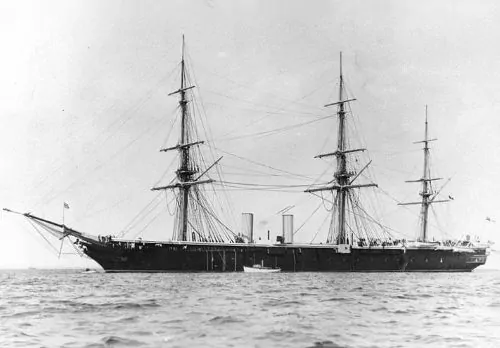
The familiar sequence in which France launched La Gloire and Britain then produced HMS Warrior obscures the most revealing feature of the British response. The Admiralty awarded the contract for Warrior to the Thames Iron Works on 11 May 1859, whereas La Gloire did not leave the slip at Toulon until 24 November. Officials were acting on reports, observed progress in French yards, and estimates of what the completed vessel might accomplish. A capital ship under construction was difficult to conceal, since armor contracts, engines, labor concentrations, and activity on a large slip disclosed more than diplomatic reticence could hide. London needed neither a sea trial nor a gunnery demonstration to recognize the possible consequences. The first British decision belonged to the realm of informed anticipation, where a credible foreign project could redirect procurement months before its claims were proven.
British hesitation over how to respond was grounded in real technical and administrative problems. Earlier trials had shown that poorly arranged iron plates could crack or throw lethal fragments inward, while naval officers also worried about compass deviation, hull fouling, corrosion, and repairs at distant stations. Royal dockyards possessed deep experience in timber construction but had no comparable record of building a first-class iron warship. The service had also spent heavily on screw-propelled wooden battleships whose usefulness could not responsibly be written off merely because a rival experiment appeared promising. Abandoning that investment prematurely carried strategic and fiscal risks; waiting until every question was resolved might concede France several valuable years. Britain’s commercial economy supplied much of the missing capacity, for private yards had accumulated extensive knowledge through iron merchant steamers, marine machinery, plate rolling, and large-scale fabrication. The difficulty lay in bringing those industrial resources into a naval system whose design offices, maintenance network, officer culture, and stores remained organized principally around wood. Hesitation and capability consequently existed together. The Board could doubt whether iron should become the universal hull material while still judging that an exceptionally powerful armored frigate constituted prudent insurance.
By 22 November 1858, the Admiralty had converted information about the French program into a formal design requirement. Under Sir John Pakington, the Board called for an armor-plated frigate initially conceived with a wooden hull and dimensions roughly comparable to the vessel taking shape at Toulon. Surveyor of the Navy Sir Baldwin Wake Walker, despite his reservations about iron hulls, and Henry Corry at the Admiralty helped bring the issue before the Board. That first specification accepted the military case for side protection before officials had settled the structural material beneath it. Its provisional character is important. Policy advanced through successive judgments rather than emerging from a single instant of technical revelation.
During the winter of 1858–59, the proposed ship developed beyond the scale of a direct French counterpart. The Admiralty demanded approximately fifteen knots under steam, a full sailing rig, and sufficient endurance for service throughout Britain’s worldwide system of bases and stations. Chief Constructor Isaac Watts and Chief Engineer Thomas Lloyd translated those ambitions into a design that exploited the strength and comparatively favorable weight of an iron hull. Watts drew upon lessons embodied in recent large frigates such as Mersey, while Lloyd had to accommodate machinery powerful enough to drive a vessel burdened with armor, guns, coal, rigging, and a large crew. Iron construction made greater length possible without imposing the structural weakness already apparent in the largest wooden frigates. It also permitted displacement and internal volume to increase while preserving fine enough lines for high speed. The design retained arrangements familiar to naval officers, including a broadside battery, screw propulsion, and complete sailing equipment, but placed them within a much larger industrial structure carrying concentrated protection. Because the royal yards lacked experience with iron warships of comparable scale, the Admiralty turned to private enterprise and selected the Thames Iron Works at Blackwall. This division of labor joined centralized naval requirements to commercial metallurgy, specialist engine production, and the capital equipment of a modern shipyard. Familiar subsystems reduced some of the risk, allowing the complete vessel to be far more ambitious than any previous British warship. The resulting project aimed to create a substantial margin over the French design rather than reproduce it feature for feature.
The contract placed on 11 May belonged to Pakington’s Conservative Board, yet its survival after the ministry fell in June shows that the response had moved beyond one politician’s alarm. The Duke of Somerset inherited the Admiralty under Lord Palmerston and allowed the work to continue as iron production accelerated during the summer. A second vessel, HMS Black Prince, was ordered from Robert Napier and Sons at Govan on 6 October and laid down six days later, so both British ships were committed before La Gloire reached the water. Parliamentary opinion remained far less settled than naval procurement. In the Commons debate on national defenses on 29 July, Edward Horsman and Sir Charles Napier treated French preparations as evidence of danger, while Richard Cobden challenged the prevailing panic with comparative fleet statistics and warned that reciprocal armament could manufacture the hostility it purported to deter. Their disagreement concerned threat, expenditure, and causation, but neither side could make existing ship totals answer the emerging question of whether protection had changed the combat value of those totals.
This chronology recasts the ironclad shock as a change in expectations before it became a spectacle at launch. British leaders did not need to accept every claim made for armor, or immediately discard the wooden battle fleet, to conclude that delay was the more dangerous wager. They committed funds to an untested type because La Gloire made a larger French armored squadron plausible and because lengthy construction schedules punished governments that waited for certainty. Industrial depth gave Britain an unusually powerful form of insurance; it could commission a larger iron-hulled counterdesign while continuing older programs and revising details as evidence accumulated. Such flexibility should not be mistaken for serenity. The speed of the order, its passage across a change of government, and the addition of Black Prince reveal how seriously officials treated the possibility that accumulated numerical strength might cease to translate into effective fighting power. When the French ship finally entered the water, the British counterstroke was already taking physical form, although its superiority remained a design promise rather than an operational fact. Britain had started spending against a forecast, and that preemptive commitment marks the point at which technological uncertainty became an arms race.
HMS Warrior: Overmatch as Strategic Reassurance
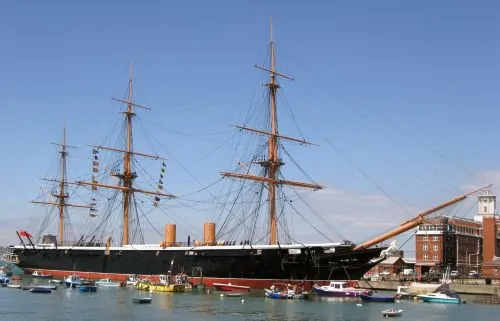
Once the Admiralty had elected to answer the French initiative, equality offered too little security. HMS Warrior was conceived as a conspicuous surplus of fighting power. It was larger than La Gloire, faster under steam, more powerfully armed, and supported by an iron structure capable of carrying extensive protection. Each advantage compensated for uncertainty elsewhere, reducing the danger that an unexpected weakness in one system would compromise the whole vessel. Because no ironclad had yet proved itself in a fleet engagement, British confidence had to rest on measured performance, constructional strength, and the visible scale of the finished ship. The result provided strategic reassurance before it supplied combat experience. Britain could again claim that the most formidable individual warship belonged to the Royal Navy, even though the longer contest remained unsettled.
Scale supplied the first element of this response. Measuring approximately 420 feet overall, with a beam of 58 feet 4 inches and a displacement exceeding 9,100 long tons, Warrior dwarfed contemporary wooden warships as well as her French counterpart. Her draft of nearly 27 feet and complement of about 700 officers and men revealed that unprecedented fighting capacity came with substantial demands for harbors, stores, and personnel. An iron hull made such dimensions practicable without the structural deformation that threatened exceptionally long wooden vessels. Ninety-two watertight compartments divided the interior, while a double bottom beneath the boilers and engines furnished additional security against grounding and underwater damage. Subdivision could restrict flooding after a localized breach, although it could not protect every part of the hull from heavy gunfire. Length also imposed penalties. Warrior answered the helm slowly, required ample sea room, and could not enter every dock used by older ships. Her dimensions were both a fighting resource and an early warning that future capital ships would reshape the supporting infrastructure of naval power.
Protection was concentrated around the machinery and principal battery rather than distributed uniformly from stem to stern. A belt of 4.5-inch wrought-iron plate, backed by a deep layer of teak, covered approximately 213 feet of the central hull; it rose well above the waterline and extended several feet beneath it. Armored transverse bulkheads closed the ends of this citadel, creating a protected compartment within the longer iron structure. Tongue-and-groove joints between plates and comparatively narrow gun ports reduced the vulnerable openings through which projectiles or fragments might enter. Firing conducted in 1861 against representative targets at Shoeburyness indicated that this combination of plate, timber backing, and structural support could withstand standard naval ordnance under the tested conditions. Such experiments furnished persuasive evidence rather than universal proof, since results varied with range, angle, projectile, charge, and the quality of individual plates. The bow and stern remained unarmored, and damage near the rudder or steering arrangements could still leave the ship unable to maneuver. Hits below the protected region presented another danger that peacetime trials could estimate but never fully resolve. Even with these reservations, the citadel made it difficult for an opponent to disable guns, engines, and boilers quickly, the capabilities on which Warrior depended to continue fighting.
Mobility converted defensive strength into tactical discretion. Ten boilers supplied John Penn and Sons’ two-cylinder trunk engine, which developed 5,267 indicated horsepower and drove the single screw at more than fourteen knots during measured trials. Approximately 800 long tons of coal gave a range of about 2,100 nautical miles at eleven knots, while 48,400 square feet of sail could propel the ship at roughly thirteen knots without steam. Her funnels could be lowered and the propeller raised to reduce drag during extended sailing, although lifting the immense screw required labor from hundreds of men. Speed allowed Warrior to pursue a wooden opponent, hold a favorable distance, or decline an encounter with a force whose strength remained uncertain, making propulsion central to her prospective method of combat.
The battery exposed how much technological ambiguity persisted inside this imposing vessel. As completed, Warrior carried twenty-six 68-pounder smoothbore guns, ten 110-pounder Armstrong rifled breech-loaders, and four smaller 40-pounder Armstrong weapons. The 68-pounder was an established piece capable of firing explosive shell against wooden hulls and heavy solid shot against plate at short range. Armstrong’s rifled gun promised greater accuracy, an elongated projectile, and the convenience of loading from within the ship, qualities that appeared particularly suitable for an armored battery. Comparative trials in 1861 showed that the 110-pounder could perform less effectively against iron plate than the older smoothbore, while its breech mechanism generated additional service concerns. Retaining both types amounted to a hedge against imperfect knowledge rather than an incoherent armament policy. The broadside arrangement likewise preserved familiar gunnery practice while armor, steam, and iron construction altered the conditions under which the guns would be used. Rearmament with heavier rifled muzzle-loaders later in the decade confirmed that the original battery could not remain authoritative for long. British assurance consequently depended as much on the ability to replace weapons and modify the ship as on the guns installed at her completion.
Public meaning accumulated around Warrior as her construction gave way to trials and active service. Launched on 29 December 1860, commissioned in August 1861, and completed that October, she moved from anticipated answer to observable national achievement in less than three years. Her reported cost of £377,292 approached twice that of a large wooden warship, placing a substantial premium on technological leadership. The press nevertheless presented the expense as evidence that Britain had regained the initiative; The Times judged even her interim armament sufficient to make her the “most formidable ship afloat.” Illustrated depictions emphasized the extraordinary length of the black hull, the disciplined geometry of the battery, and the union of masts, funnels, and armor that distinguished her from either a traditional sailing ship or a coastal battery. Although these representations could not establish battlefield effectiveness, they gave politicians, naval officers, foreign observers, and the British public a common image of recovered ascendancy.
Even so, Warrior did not settle the Anglo-French competition through her individual superiority. France continued to possess a growing group of armored vessels, and numerical comparisons remained unsettling to contemporaries who understood that one exceptional frigate could not patrol several seas simultaneously. Unprotected extremities, vulnerable steering arrangements, a broad turning circle, and reliance on enormous quantities of coal limited what her striking specifications meant in practice. Her cost also complicated repetition, since maintaining a fleet of similar ships required continuing expenditure on private industry, dockyard enlargement, trained engineers, ammunition, and overseas fuel supplies. Advances in artillery threatened to erode her protective advantage, while thicker armor would burden the propulsion systems of subsequent designs. What Warrior established was the British capacity to assemble an iron hull, armor, heavy ordnance, sail power, and high-performance machinery on a scale beyond the French prototype. That achievement restored confidence by demonstrating adaptability, yet it also raised expectations that every future challenge would receive an equally decisive answer. Overmatch furnished only provisional reassurance. The very features that made Warrior impressive also encouraged rivals to build against her and ensured that Britain would soon have to surpass its own creation.
Two Ships, Two Models of Naval Power
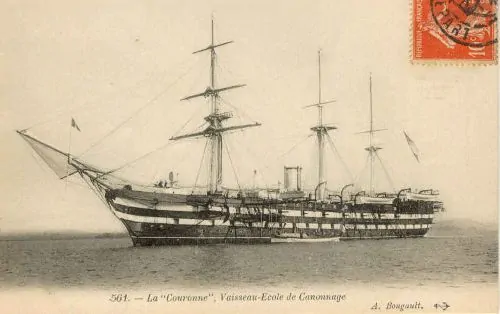
Placed side by side, La Gloire and HMS Warrior represented more than alternative solutions to the same engineering problem. The French vessel embodied a strategy of gaining leverage by introducing an armored seagoing type quickly enough to disturb a stronger rival’s force structure. Britain’s answer sought a wider margin in speed, protection, endurance, and firepower, making superior performance itself a source of restored confidence. These approaches reflected differences in dockyard practice, manufacturing capacity, strategic commitments, fiscal calculation, and willingness to accept technical risk. The ships demonstrated how competing states could derive markedly different concepts of maritime strength from the same combination of steam propulsion, shell-firing artillery, and iron plate.
France’s model emphasized timely incorporation rather than maximum displacement or mechanical novelty in every component. Naval constructors joined armor and screw propulsion to a hull that could be built with familiar materials, established labor practices, and existing dockyard facilities. Choosing timber was a calculated means of shortening the passage from design to completion, although it exposed La Gloire to deterioration and restricted the dimensions that could be sustained over a long service life. French planners accepted those disadvantages because the immediate objective was to place a credible armored warship at sea before Britain had reoriented its capital-ship program. Protection was concentrated on the qualities needed to survive contemporary gunfire, while auxiliary sail power preserved an accepted means of cruising beyond the reliable reach of coal supplies. Construction of Invincible and Normandie transformed the initial design into a class rather than leaving it as an isolated experiment. Other projects, including the iron-hulled Couronne, showed that France did not regard the wooden structure as a permanent doctrinal commitment. French influence arose from establishing a reproducible category of warship whose appearance compelled every major navy to reconsider its plans.
Britain attached naval assurance to a more expansive performance margin. An iron hull, powerful machinery, extensive rig, and exceptional size reflected the Royal Navy’s expectation that a capital ship might serve in the Channel, accompany a fleet, cross an ocean, or appear at a distant station. Commercial ironworking and marine engineering allowed the Admiralty to demand a vessel beyond what its timber-oriented royal dockyards could readily produce. Warrior consequently represented a partnership between state specifications and private industrial capacity, with the latter becoming integral to national defense. Her imposing dimensions answered a political problem as well as an operational one, since the public visibility of French progress had weakened confidence in mere totals of wooden ships. This approach also established an expensive precedent by associating security with the construction of units that exceeded, rather than simply equaled, the latest foreign design.
The divergence should not obscure the extensive inheritance shared by both vessels. Each retained masts, yards, sails, a broadside battery, crowded living spaces, and many of the routines of the wooden steam navy. Their commanders still depended on disciplined gun crews, reliable signaling, effective damage control, and officers capable of handling large sailing rigs alongside complicated engines. Armor altered the likelihood that a ship could remain in action under fire, but it did not eliminate the importance of seamanship, visibility, sea state, formation, or ammunition supply. Neither navy possessed a settled doctrine for fighting armored squadrons because no engagement had yet disclosed how such ships would behave amid smoke, collision risks, mechanical failures, and concentrated shellfire. The durability of French timber remained uncertain, whereas British iron created difficulties involving fouling, corrosion, compass deviation, and access to suitable repair facilities. A nominal advantage in speed might disappear through poor coal, damaged machinery, an unfavorable wind, or months spent away from dockyard maintenance. Gunnery results could vary with projectile quality, impact angle, range estimation, and the physical consistency of individual armor plates. Victory could not be calculated simply by comparing published measurements. The modernity of both ships was layered onto inherited methods whose continued effectiveness had yet to be tested against an armored opponent.
At the fleet level, the two models soon began to converge. France converted its initial lead into several armored hulls, while Britain discovered that Warrior and Black Prince alone could not satisfy the demands of home defense, overseas deployment, and numerical competition. The smaller Defence and Resistance reduced some of the financial and operational burdens imposed by the first British pair, demonstrating that even the wealthier navy could not reproduce its largest design without modification. Meanwhile, France’s adoption of an iron hull for Couronne acknowledged the structural opportunities already displayed more dramatically in Warrior. Cross-adaptation gradually displaced the original distinction between a French emphasis on rapid introduction and a British preference for overwhelming individual capability.
Seen strategically, the comparison produces no unqualified victor. France demonstrated that a materially weaker navy could unsettle the leading maritime power by changing the qualities that determined whether a fleet appeared credible. Britain showed that manufacturing depth, financial resources, and private engineering could raise the performance ceiling once the challenge had been recognized. La Gloire achieved the greater disruptive effect because her existence made armored construction unavoidable, whereas Warrior possessed the greater concentration of fighting capabilities when she entered service. Wooden screw ships continued to perform blockades, transport troops, patrol distant waters, and reinforce stations, but their declining status affected future investment more severely than immediate employment. Once both governments treated armor as indispensable to first-class combat, another unprotected capital ship risked entering service beneath the standard against which naval strength was now judged. France had redirected expenditure; Britain had greatly increased the price of remaining at the forefront. The two models consequently merged into a competitive system in which security depended on repeated technical renewal rather than possession of a permanently superior design.
What “Obsolete” Actually Meant
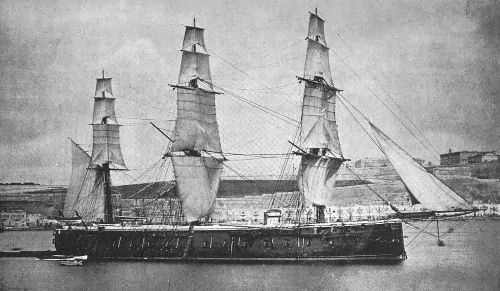
To call the wooden battle fleet obsolete in 1860 is accurate only if the term is separated from disappearance, worthlessness, or immediate incapacity. In naval usage, obsolescence described a loss of confidence in a vessel’s ability to perform the most demanding mission expected of its class. A screw-powered wooden ship of the line could still maneuver with a squadron, carry numerous guns, transport troops, enforce a blockade, and project authority in waters where no hostile ironclad was present. What changed was the assumption that such a vessel could meet an enemy’s most advanced capital ship on acceptable terms. The word denoted a demotion within the hierarchy of combat rather than the physical extinction of an entire fleet.
At the center of that demotion was an unfavorable exchange of risks. Explosive shells could ignite timber, scatter splinters through gun crews, and cause destructive damage within the confined spaces of a wooden battery. Against armor, the same weapons might burst ineffectively, shatter on impact, or leave dents that did little to impair the protected guns and machinery. This imbalance did not make La Gloire or HMS Warrior invulnerable. Wooden ships could strike unprotected extremities, damage masts and funnels, attack steering gear, or close to ranges at which heavy solid shot had a better chance of breaking plate and backing. Early armor varied in quality, bolts and joints created weaknesses, and underwater hits remained dangerous to every design. An armored vessel deprived of propulsion might also become vulnerable to concentrated attack, collision, grounding, or capture. Nevertheless, the commander of a wooden ship faced a disturbing possibility. His opponent could inflict decisive injury with familiar ammunition while his own broadside might fail against the areas that mattered most. A first-class battle unit was expected to threaten its counterpart as well as endure return fire, and the wooden hull no longer met that expectation reliably. Obsolescence was relational, emerging from the prospective encounter between unequal forms of protection rather than from any isolated defect in timber construction.
Away from a fleet engagement, wooden warships retained a broad field of useful employment. They escorted commerce, carried soldiers, bombarded unfortified positions, suppressed piracy, patrolled imperial routes, and displayed national power in regions lacking modern naval opponents. On distant stations, crews could often obtain timber and undertake familiar repairs more readily than they could replace rolled plate or service sophisticated engines. Many existing vessels also possessed sound hulls, ample internal volume, and years of potential service if assigned to less exacting duties. Britain converted or reconstructed wooden ships already under construction (including Royal Oak, Prince Consort, Caledonia, and Ocean) as armored frigates, preserving part of the labor and material invested in them. These projects could not reproduce every advantage of a purpose-built iron hull, but they expanded the armored fleet more quickly than an exclusive reliance on entirely new designs would have allowed. Demotion, conversion, and reassignment extended the value of older resources while acknowledging that their original place in the battle line had become doubtful.
For Britain, the most consequential form of obsolescence appeared in planning and expenditure. British superiority had rested partly on possessing more wooden capital ships than any plausible coalition could readily assemble, yet the arrival of armor reduced the relevance of that numerical inheritance in a contest with France. The Admiralty now had to maintain useful portions of the established fleet while financing ironclads, enlarging docks, purchasing armor plate, improving steam machinery, and developing guns capable of defeating the protection carried by foreign vessels. Timber yards, ropewalks, sail lofts, and generations of shipwright experience did not cease to matter, but their relative position weakened as rolling mills, engineering works, and specialized foundries assumed greater importance. Parliamentary controversy followed because nobody could determine with confidence how many armored ships were sufficient, how rapidly wooden vessels should be retired, or which current experiments would justify their cost. France had imposed a disproportionate burden by compelling the larger navy to reconsider assets accumulated over decades. A state can dominate an established standard and still face the highest bill when that standard changes. Britain’s wooden strength magnified the disruption because so much prestige, infrastructure, and strategic calculation had been attached to the superseded type.
Human and institutional adjustments proceeded more slowly than decisions about new construction. Sail handling remained essential, traditional gunnery continued aboard armored broadside ships, and wooden-hull specialists still maintained most vessels in commission. Engineers acquired greater authority, while ironworkers, armor fitters, machinists, and stokers became increasingly important to combat readiness. Officers had to reconsider formation keeping, engagement distance, ammunition selection, collision hazards, and the consequences of machinery failure under fire without the guidance of battle-tested doctrine. The disruption spread unevenly through the naval establishment, altering some occupations and assumptions while leaving others intact.
Time, accordingly, moved at several different rates within the same transformation. Procurement obsolescence came first because ordering another unarmored capital ship became increasingly difficult to defend once potential adversaries were building protected vessels. Tactical obsolescence remained partly hypothetical until combat experience could test predictions made at proving grounds and drafting tables. Administrative retirement proceeded far more gradually, as governments continued using wooden warships whose maintenance costs were justified by secondary duties. Some once-prestigious ships survived for years as guard ships, receiving vessels, training establishments, or harbor hulks after they had lost any credible place in a modern battle squadron. By the early 1860s, “obsolete” most precisely meant unsuitable as the principal instrument for fighting an equally advanced maritime rival. La Gloire and HMS Warrior did not erase the military utility of the ships around them; they transferred the burden of justification onto every government considering further investment in an unprotected hull. Once that reversal occurred, continued service could prolong the lives of wooden warships without restoring their former standing.
From a French Challenge to a Competitive Cycle
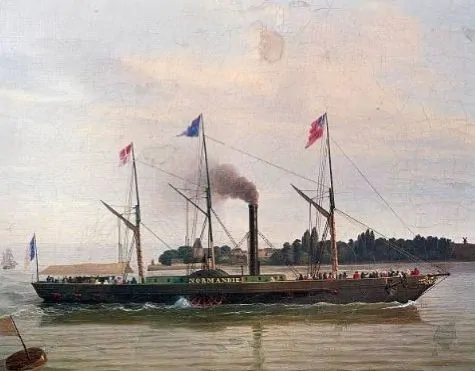
The rivalry changed character once both governments possessed armored programs rather than individual experimental ships. France’s initial move had been intended to disrupt a strategic balance founded on British wooden superiority, but construction of HMS Warrior showed that the advantage gained by surprise could be answered through greater scale and industrial concentration. French planners then had to assess the British response just as the Admiralty continued studying French building plans. Because a capital ship required years to design, construct, arm, and test, every decision concerned the opponent expected at completion rather than the vessels already at sea. Comparison between La Gloire and Warrior consequently expanded into a continuing process of prediction, counterdesign, and accelerated expenditure.
France initially tried to preserve its advantage by multiplying armored types. The completion of Invincible and Normandie gave La Gloire sister ships, while Magenta and Solférino carried two armored gun decks in an effort to combine protection with the weight of fire associated with traditional ships of the line. Couronne introduced an iron hull, demonstrating that French constructors recognized the structural limitations of timber even while continuing to exploit established wooden-building capacity. The subsequent Provence class extended armored construction across a larger group of vessels rather than concentrating resources in a few exceptional units. French yards employed both hull materials because a uniform transition to iron would have slowed production and placed excessive demands on particular facilities. This mixed program allowed the navy to build several protected warships simultaneously, although differences in speed, durability, armament, and handling complicated their use as a coherent squadron. Contemporary comparisons often credited France with an early numerical lead, but totals varied according to whether ships under construction, fitting out, or actually ready for service were included. The political value of the program lay partly in that uncertainty, since Britain could not safely assume that unfinished French vessels posed no near-term danger. Numerical pressure supplemented the original technical surprise.
Across the Channel, the Admiralty assembled an armored force through purpose-built ships, reconstructed wooden hulls, and designs of several sizes. Defence and Resistance sacrificed some of Warrior’s imposing scale in favor of lower cost and shallower draft, whereas Hector and Valiant represented another attempt to balance protection, speed, and affordability. The iron-hulled Achilles and the immense ships of the Minotaur class carried British construction toward heavier armament and broader protected areas. Conversions such as Royal Oak and the Prince Consort class brought armor into service without waiting for every hull to be started anew. These vessels did not possess identical tactical qualities, but uniformity mattered less than producing enough credible units to meet a rapidly changing estimate of French strength. Multiple designs also allowed the Admiralty to distribute work among royal dockyards and commercial builders while avoiding complete dependence on any single technical solution. The British objective had moved beyond answering one celebrated French ship; it now required an armored battle fleet capable of supporting the navy’s extensive geographical commitments.
Material competition prevented this expansion from producing a stable standard. Increasing plate thickness improved resistance to existing guns, but artillery experiments soon produced projectiles and charges intended to overcome the added protection. Difficulties with early Armstrong breech-loaders encouraged British development of rifled muzzle-loading weapons whose greater weight imposed new stresses on decks, mountings, and hull structure. Heavier guns demanded more powerful machinery if speed was to be preserved, while larger engines consumed additional coal and occupied space otherwise available for weapons or supplies. Armor concentrated amidships left the extremities exposed, yet extending protection increased displacement and could reduce stability or freeboard. Naval architects responded by reconsidering the inherited broadside arrangement, placing fewer large guns within central batteries or mounting them in rotating turrets. The turret conversion of Royal Sovereign and the central-battery design of Bellerophon indicated how quickly the layout associated with the first seagoing ironclads came under challenge. Existing vessels could receive new guns, altered rigs, and mechanical improvements, but the dimensions and load-bearing capacity of their hulls imposed firm limits on reconstruction. A ship might enter service with sound machinery and intact armor while already embodying an arrangement that designers had begun to abandon. Qualitative change proceeded alongside numerical expansion, making a simple count of armored hulls progressively less informative.
Public scrutiny translated these uncertainties into persistent political pressure. Newspapers and parliamentary speakers compared national totals, although they frequently combined coastal batteries with oceangoing ships or treated incomplete vessels as if they were immediately available for battle. Admiralty officials faced criticism whenever French construction appeared to advance, yet disclosure of additional British orders could encourage Paris to authorize further expenditure. Estimates consequently rested on incomplete intelligence and assumptions about how quickly foreign yards could finish, arm, and crew their ships. Naval budgets advanced unevenly through periods of urgency, retrenchment, delay, and renewed alarm rather than rising in a smooth progression.
By the middle of the 1860s, Britain had recovered a clear advantage in the number and aggregate power of seagoing ironclads. Access to large private yards, extensive iron production, established marine-engine firms, and public credit enabled the Admiralty to sustain construction at a pace France found increasingly difficult to match. Napoleon III’s government also had to reconcile naval ambitions with military expenditure and costly commitments beyond metropolitan waters. French failure to retain the lead did not end the process that La Gloire had initiated, because armored construction was spreading among other maritime states. Italy ordered major warships from foreign builders, Austria developed a fleet for competition in the Adriatic, and Russia pursued armor as a means of rebuilding naval strength after the Crimean settlement.
The clash between Monitor and Virginia at Hampton Roads in March 1862 did not begin the European transition, which was already well underway, but it supplied a dramatic combat demonstration of armored survival and wooden vulnerability. Coastal defense vessels, turret ships, rams, and seagoing broadside ironclads subsequently offered governments several paths into the new naval order. London and Paris remained the principal points of comparison, but their rivalry had generated standards that other powers could adopt and modify.
This sequence cannot be reduced to an automatic reaction in which every French ship mechanically produced a British counterpart. Budgets, strategic geography, dockyard capacity, institutional preferences, and domestic politics shaped the timing and form of each decision. France sought leverage through early adoption and rapid multiplication, while Britain eventually redirected the contest toward industrially demanding vessels that were difficult for a rival to equal in sustained numbers. By the late 1860s, neither La Gloire nor Warrior defined the highest available standard, even though both remained capable warships. Their diminished first-line standing resulted from the success of imitation, experimentation, and counterdesign throughout the fleets they had helped inspire. Each improvement relieved one anxiety while revealing another weakness in protection, armament, propulsion, or tactical arrangement. The original Anglo-French confrontation had thereby become a competitive cycle in which naval security depended increasingly on the ability to finance the next generation before the current one had fully justified its cost.
The Rising Price of Relevance
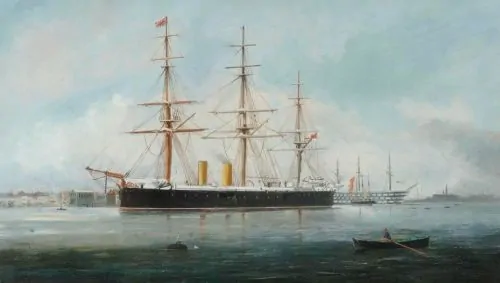
After the first armored frigates entered service, competitive standing could no longer be secured by adding iron plate to an otherwise settled design. Naval architects confronted an interconnected problem in which protection, armament, propulsion, endurance, stability, and hull strength all competed for limited displacement. Additional armor increased weight, heavier guns demanded stronger mountings, and greater mass required more powerful machinery merely to preserve existing speed. Because each improvement altered the conditions governing the others, a successful design represented a temporary balance rather than a completed solution. The rising price of relevance included repeated experimentation, specialized industrial production, and the risk that a costly ship would be overtaken before its intended service life had elapsed.
Armor presented an immediate metallurgical as well as architectural challenge. The 4.5-inch wrought-iron protection carried by Warrior had tested well against contemporary service guns, but thicker plates became desirable as rifled artillery and improved projectiles entered naval arsenals. Producing large pieces of consistently sound iron strained rolling techniques, and defects concealed within a plate could cause cracking or separation under impact. Laminating several thinner plates offered one means of increasing resistance, although tests showed that multiple layers did not always equal the performance of a single well-manufactured slab of comparable total thickness. Timber backing, bolts, frames, and plate joints remained essential because armor had to absorb and distribute force without being driven into the hull. Bellerophon carried protection reaching approximately six inches, while Hercules extended portions of her belt to nine inches before the decade ended. These gains could be achieved only by restricting armor to selected areas or accepting a substantial increase in displacement. France followed a comparable path in vessels such as the Océan class, where heavier protection was concentrated around a central battery. Armor had become a complex structural system whose effectiveness depended on placement and support as much as nominal thickness.
Artillery development placed continuous pressure on those protective arrangements. The 110-pounder Armstrong breech-loader had promised range and accuracy, yet disappointing penetration and recurring mechanical concerns weakened confidence in the weapon soon after its introduction. Britain shifted toward rifled muzzle-loaders, progressing through seven-, eight-, nine-, and ten-inch guns whose projectiles carried far greater striking energy than the ordnance installed aboard the earliest ironclads. Chilled-iron Palliser shot further improved performance against wrought plate by resisting deformation at impact. Naval batteries consequently moved away from scores of medium weapons toward smaller numbers of extremely heavy rifles. That change enlarged gun ports, increased recoil loads, slowed handling, and required stronger decks as well as more elaborate carriages. Loading a massive muzzle-loader inside a protected battery also demanded carefully arranged machinery and ample working space around each weapon. A vessel could carry fewer guns than an older wooden ship while delivering substantially more destructive force from each discharge. Every advance in penetration reduced confidence in armor that had recently appeared adequate and encouraged demands for another increase in protection.
Propulsion had to compensate for the accumulating weight. Early ironclads relied on large simple-expansion engines whose appetite for coal limited endurance and consumed valuable internal volume through boilers, bunkers, condensers, and machinery spaces. Rising indicated horsepower generally kept speeds within the low-to-middle teens rather than producing spectacular acceleration, because larger hulls and thicker armor absorbed much of the added output. Sail remained an important means of conserving fuel during extended deployments, despite the manpower required to operate the rig and the interference of masts and stays with guns and firing arcs. Machinery also introduced dependencies on trained engineers, manufactured spare parts, dockyard workshops, and overseas coal supplies that could not be improvised as readily as many repairs to a wooden hull. The expense of steam power extended well beyond the engine purchase, reaching into recruitment, logistics, maintenance, and the geographical organization of the fleet.
Interaction among these demands encouraged fundamental changes in warship architecture. Enlarging a hull created additional carrying capacity, but the resulting structure brought its own weight and required still more power to move at an acceptable speed. Central-battery ships concentrated their heaviest guns and armor within a shorter defended space, permitting thicker protection without plating the entire broadside to the same standard. Edward James Reed’s Bellerophon demonstrated how improved subdivision and a compact battery could produce a more efficient fighting unit than a straightforward enlargement of Warrior. Rotating turrets offered wider firing arcs and reduced the number of guns needed to command either side of a vessel. Their immense weight, loading arrangements, turning mechanisms, and requirement for an unobstructed field of fire created fresh structural and stability problems. A full sailing rig became increasingly difficult to reconcile with turrets, low freeboard, and heavy upper works. The loss of Captain in 1870 exposed the danger of combining these features without sufficient stability, turning a debate over configuration into a fatal demonstration of design risk. Devastation, laid down without sailing masts and dependent on steam propulsion, represented a very different answer to the same accumulation of compromises. Naval architecture had become a succession of costly experiments in which failure could arise from the interaction of individually defensible choices.
Financial evidence from the period requires careful interpretation because construction costs did not rise in a straight line. Warrior cost approximately £377,000, while the much larger Minotaur approached £480,000, yet smaller successors could be cheaper and official accounts did not always include armament, stores, or subsequent alterations on the same basis. Initial price also concealed the expenditure required to rearm a vessel, replace machinery, strengthen decks, or modify rigging after service exposed deficiencies. Beyond the ships stood an expanding network of dry docks, armor mills, gun foundries, coaling stations, lifting equipment, and engineering schools. The financial burden accumulated across the naval establishment even when the recorded cost of a particular hull appeared moderate.
France and Britain experienced this burden differently. French reliance on wooden hulls allowed established dockyards to participate in armored construction, but it did not eliminate concerns about structural longevity or the expense of maintaining timber beneath heavy plate. Britain possessed broader access to private iron shipbuilders and marine-engine firms, although its worldwide deployments multiplied requirements for fuel, repair facilities, replacement crews, and suitable docks. Operating costs continued after commissioning, and every major refit removed a valuable vessel from readiness while consuming skilled labor needed for newer construction. Ships that remained sound in an accounting sense could depreciate rapidly as fighting assets when foreign guns or armor advanced beyond their capabilities. Older ironclads were retained for secondary duties, coast defense, training, or reserve service, preserving utility without treating them as equivalents of the latest vessels. Governments consequently had to support several technological generations at once while deciding which classes deserved modernization. Fleet adequacy increasingly depended on the condition, location, and compatibility of ships rather than their aggregate number.
No physical law compelled governments to pursue every marginal improvement regardless of cost. A navy could have accepted slower ships, thinner armor, lighter weapons, or a force intended primarily for local defense, but such restraint became difficult when a rival might exploit the sacrificed capability. British and French officials evaluated new designs against the strongest plausible opponent rather than against an abstract measure of sufficiency. Their decisions brought unproven guns, experimental layouts, and expensive machinery into service because postponement seemed capable of producing a more dangerous inferiority. Industrial prestige and political credibility reinforced the military case for remaining near the leading edge. Relevance acquired a recurring price. Maintaining a first-class navy required the capacity to revise the definition of a first-class warship before the existing fleet had repaid its investment.
From Channel Rivalry to an International Standard
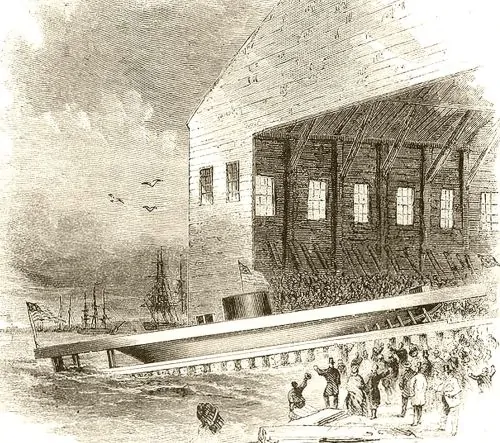
By the middle of the 1860s, the ironclad had ceased to be an Anglo-French exception and had become a requirement for admission to the first rank of naval powers. Foreign officers inspected ships, observed firing trials, collected dockyard intelligence, and reported parliamentary debates to their governments. Technical journals circulated diagrams and performance claims, while private firms offered foreign customers combinations of hulls, engines, armor, guns, and specialist labor. The emerging international standard did not prescribe a single warship configuration; it established an expectation that a serious battle fleet must possess steam-powered armored vessels capable of confronting those operated by its rivals.
The Mediterranean furnished the first major test of how widely that expectation had spread. The newly unified Kingdom of Italy treated a modern fleet as evidence of great-power status and ordered armored ships from yards in France, Britain, and the United States while attempting to develop domestic construction. Austria responded under Archduke Ferdinand Maximilian, assembling its own ironclad force despite more limited financial and industrial resources. Both navies entered the contest with vessels of varied origin whose machinery, guns, dimensions, and handling characteristics differed considerably. Their confrontation at Lissa on July 20, 1866, showed that acquiring modern hulls did not automatically create an effective battle fleet. Italy possessed an apparent advantage in armored ships, yet divided command, inadequate preparation, and poor signaling prevented Admiral Carlo Pellion di Persano from using that superiority coherently. Rear Admiral Wilhelm von Tegetthoff closed rapidly, compressed the engagement into a confused melee, and relied on discipline as well as aggressive maneuvering to offset Italian firepower. The Austrian flagship Erzherzog Ferdinand Max rammed and sank Re d’Italia, giving the ancient tactic of collision an influence over subsequent design debates far beyond its actual record of success. Austria’s wooden ship of the line Kaiser also survived close action against Italian ironclads, although she sustained severe damage, illustrating that older construction retained tactical value under favorable circumstances. European observers often extracted an exaggerated lesson about the ram from Lissa; the more persuasive conclusion was that training, leadership, and fleet organization remained capable of outweighing superiority measured by ship type alone.
Russia adopted armor according to geographical and political requirements created by defeat in the Crimean War. The Treaty of Paris restricted Russian naval power in the Black Sea, directing immediate attention toward the defense of the Baltic approaches and St. Petersburg. Unable at first to manufacture every component domestically, the government ordered Pervenets from a British yard and used the project to acquire experience in iron construction and armor production. Follow-on vessels built in Russia incorporated foreign machinery, technical advice, and imported industrial methods while expanding local capability. Shallow-draft turret ships derived from the American monitor concept offered another solution for operating among shoals, islands, and fortified coastal waters. Russian policy thereby treated the international model as a collection of adaptable technologies, selecting features suited to Baltic defense instead of reproducing an oceangoing French or British armored frigate.
The American Civil War generated a distinct family of armored warships shaped by blockade, river operations, and attacks on defended harbors. The encounter between Virginia and Monitor in 1862 received extraordinary attention because it offered combat evidence that armor could withstand punishment capable of wrecking wooden vessels. Monitor’s low silhouette, shallow draft, and rotating turret were particularly suitable for protected coastal waters, though limited freeboard and restricted accommodations reduced her fitness for sustained ocean service. On western rivers, armored gunboats combined modest draft with heavy forward fire, permitting Union forces to cooperate with armies and penetrate Confederate waterways. The broadside ironclad New Ironsides provided a different model, delivering prolonged fire against coastal fortifications while absorbing numerous hits.
European navies examined all these experiences without assuming that ships designed for American rivers or harbors could meet their own cruising requirements. Cowper Phipps Coles had already promoted turret armament in Britain before Hampton Roads, but the battle strengthened his claim that a few guns with wide arcs could rival a much larger broadside battery. American experience consequently accelerated an existing European debate while demonstrating that several specialized forms of ironclad could coexist.
Commercial shipbuilding carried the new measure of naval status far beyond the states capable of designing every component themselves. Spain acquired the French-built Numancia, which fought during the Chincha Islands War and subsequently completed the first circumnavigation by an ironclad, demonstrating that an armored vessel could operate far from European support. The Ottoman government placed substantial orders with British and French builders, using imported ships to pursue strategic influence without first constructing a complete domestic armor industry. The vessel eventually commissioned by Japan as Kōtetsu had been built in France for the Confederacy, transferred through American custody after the Civil War, and then sold to the Japanese government, a career that revealed the international mobility of advanced warship technology. Purchasing a hull could provide an immediate symbol of modern strength, but sustained operation still required ammunition, trained engineers, replacement machinery, secure coal supplies, and dockyards capable of handling heavy iron structures.
No uniform design emerged from this diffusion. Oceanic navies favored ships with endurance and high freeboard, Baltic planners emphasized shallow-water defense, Mediterranean powers experimented with rams, and the United States constructed monitors and river gunboats for continental warfare. What united them was the conviction that unprotected wooden ships could no longer constitute the strongest portion of a fleet intended to fight an advanced opponent. Britain and France retained important advantages because their industries could produce armor, ordnance, engines, and large hulls in combination, whereas many customers remained dependent on imported equipment or foreign technicians. Smaller states could purchase temporary equality in a particular class of vessel more readily than they could create the industrial and administrative system needed to renew that equality. Combat at Lissa and during the American Civil War further showed that possession of ironclads did not erase disparities in doctrine, command, logistics, or crew proficiency. Even so, every new purchaser enlarged the number of theaters in which an armored adversary might appear. A transformation initiated in the Channel had become an international hierarchy in which first-class naval standing was increasingly measured by the capacity to acquire, operate, and eventually replace armored steam warships.
Was There Really an “Ironclad Shock”?
The following video from “The Ministry for History” discusses the Gloire and Warrior in the French Invasion scare:
The strongest objection to my thesis concerns the word “shock” itself. The term ordinarily suggests an abrupt and unexpected event that overturns established assumptions before institutions have time to prepare. Naval development between the 1840s and early 1860s instead reveals prolonged experimentation, extensive professional debate, and substantial continuity in ship design. If La Gloire and HMS Warrior emerged from processes already understood by French and British officials, treating their appearance as a sudden rupture may impose drama on a transition that contemporaries had anticipated. A revisionist interpretation would describe the first seagoing ironclads as conspicuous milestones within an evolutionary transformation rather than revolutionary causes in their own right.
Chronology supplies the clearest evidence for this challenge. British officials knew that France was constructing an armored frigate while La Gloire remained on the stocks, and intelligence about her expected protection and performance circulated well before her launch. The Admiralty had considered armored seagoing vessels by late 1858 and placed the contract for Warrior in May 1859, six months before the completed French ship entered the water. Britain consequently did not discover the implications of armor through a dramatic encounter with an operational foreign vessel. Shell-firing artillery had been debated for decades, screw propulsion was already transforming the battle fleet, and commercial yards possessed considerable experience with iron hulls and powerful marine engines. French and British floating batteries had carried armor into combat during the Crimean War, establishing that wrought plate could protect crews and machinery from conventional fire. None of these developments made La Gloire inevitable in every technical detail, but they provided the knowledge from which a seagoing armored warship could be conceived. Senior naval administrators were responding to an observable construction program, not confronting an inexplicable machine without precedent. The early date of the British decision weakens any account in which the launch itself suddenly awakened the Admiralty to a new age.
Material continuity broadens the objection. Both pioneering vessels preserved broadside batteries, extensive sailing rigs, large crews, and operating practices inherited from wooden steam warships. Existing ships continued to conduct blockades, transport soldiers, patrol overseas stations, and support imperial operations long after armored construction began. Several wooden hulls were reconstructed as ironclads, demonstrating that navies could redirect prior investments instead of discarding them completely. Gunnery routines and sail handling remained indispensable, while engineers gradually joined rather than immediately displaced established groups within naval service. The transition proceeded through modification, reassignment, and selective replacement across many years, a pattern difficult to reconcile with the ordinary meaning of instantaneous technological overthrow.
Causation presents an even harder problem for the idea of a discrete shock. Anglo-French naval rivalry long preceded La Gloire, and both governments had repeatedly adjusted construction in response to steam propulsion, French screw ships, British industrial expansion, and the strategic experience of the Crimean War. Metallurgy, mechanical engineering, explosive ordnance, and increasingly capable private shipyards were already changing what naval administrations could demand. From this perspective, La Gloire was a product of larger developments and a visible focal point for pressures that would have continued without her. A reasonable counterfactual holds that some form of seagoing ironclad would soon have appeared even if France had canceled that particular vessel, although its timing and configuration would remain uncertain. The language of an arms race can also exaggerate coherence by implying uninterrupted expansion toward an agreed objective. French and British programs experienced budgetary restraint, construction delays, political changes, failed experiments, and disagreement over which capabilities deserved priority. Russia, Italy, the United States, and other powers adopted armor for purposes that did not simply reproduce the strategic competition in the Channel. Contemporary journalism and parliamentary opposition further magnified selected foreign projects because alarming comparisons helped secure attention or appropriations. Under the strongest revisionist reading, the celebrated pair symbolized an industrial transformation whose actual causes were dispersed across institutions, technologies, and international politics.
The term “ironclad shock” remains defensible only when given a narrower meaning. It describes a disruption in strategic expectations and procurement decisions, rather than technical surprise or the immediate disappearance of wooden naval power. France’s program converted several known developments into a credible seagoing opponent whose construction demanded an answer before its combat qualities could be verified. The early ordering of Warrior reinforces this interpretation because it shows anticipation producing major expenditure in response to a forecast capability. Wooden ships retained extensive practical value, yet planners could no longer presume that numerical superiority in unprotected hulls guaranteed command against a peer fleet. My central argument must be modified. La Gloire did not single-handedly create armored warfare, and Warrior did not complete a revolution that began on one launch date. Their importance lay in concentrating gradual developments into concrete strategic commitments from which retreat became increasingly difficult. The shock occurred most powerfully in the altered calculation of what governments would need next, even while much of what they already possessed remained in service.
Conclusion: Supremacy on Borrowed Time
The importance of La Gloire rested in the response she compelled before firing a shot in war. Her armored battery made it impossible to judge naval strength solely by counting the wooden ships accumulated during earlier decades. HMS Warrior answered with a vessel whose size and performance displayed Britain’s capacity to exceed the immediate French challenge. That achievement restored confidence without recovering the more durable security that numerical superiority had once appeared to provide. The two ships marked the point at which maritime leadership became inseparable from the ability to anticipate and finance the next transformation.
For Britain, this change exposed a paradox within established military power. Its wooden fleet still contained useful ships, trained crews, valuable machinery, and enormous prior investment, yet maintaining those resources now competed with the construction of an armored force. Every vessel retained for blockade, transport, or overseas service consumed personnel and dockyard capacity that could not simultaneously support a new ironclad. France had gained leverage by changing the category of ship that mattered most instead of trying to equal British totals within the existing one. Britain responded through its greater command of iron production, marine engineering, private shipbuilding, and public credit. French timing and British manufacturing strength produced different forms of advantage, neither of which promised permanence. Once rival governments began thickening armor, enlarging guns, and altering propulsion, superiority depended on experimentation and revision as much as possession. The strongest fleet had acquired the greatest capacity for renewal, but it also carried the heaviest obligation to keep renewing.
This transformation remained more gradual than the language of shock might imply. Steam propulsion, shell guns, iron construction, and armored batteries all predated La Gloire, while Britain committed itself to Warrior before the French vessel was launched. Wooden ships continued serving throughout the transition, and inherited methods survived aboard their armored successors. Such continuity prevents either ship from being treated as an isolated technological miracle. The sharper break occurred in policy. Officials could no longer assume that existing strength would remain adequate until ships wore out naturally. As armored vessels appeared in the Mediterranean, Baltic, Americas, and imperial fleets, the requirement spread across several strategic environments without producing a uniform design. Battles and accidents further showed that machinery and protection could not compensate automatically for poor command, inadequate stability, deficient maintenance, or unprepared crews.
Supremacy was now held on borrowed time because every successful warship supplied rivals with a target for their next design. France demonstrated how a weaker fleet could unsettle a dominant one by changing the basis of comparison, while Britain showed that industrial resources could answer the challenge without ending the underlying insecurity. The ships made obsolete by this process often remained useful; what disappeared was confidence that their usefulness could define future naval power. The lasting consequence of the ironclad shock was a new condition of maritime leadership in which no fleet could remain first merely by preserving what had made it first.
Bibliography
- Battesti, Michèle. La Marine de Napoléon III: Une politique navale. 2 vols. Paris: Service historique de la Marine, 1997.
- Baxter, James Phinney III. The Introduction of the Ironclad Warship. New Haven: Archon Books, 1968.
- Beckett, Ian F. W. “Victorians at War — War, Technology, and Change.” Journal of the Society for Army Historical Research 81:328 (2003), 330-338.
- Beeler, John F. British Naval Policy in the Gladstone-Disraeli Era, 1866–1880. Stanford, CA: Stanford University Press, 1997.
- Brassey, Thomas. The British Navy: Its Strength, Resources, and Administration. 5 vols. London: Longmans, Green, 1882–83.
- Brown, David K. Before the Ironclad: Development of Ship Design, Propulsion and Armament in the Royal Navy, 1815–1860. London: Conway Maritime Press, 1990.
- “Building the Great Steam-Frigate ‘Warrior,’ at the Thames Iron Works, Blackwall.” Illustrated London News, December 29, 1860.
- Canney, Donald L. The Old Steam Navy. Vol. 2, The Ironclads, 1842–1885. Annapolis, MD: Naval Institute Press, 1993.
- Canuel, Hugues. “From a Prestige Fleet to the Jeune École: French Naval Policy and Strategy under the Second Empire and the Early Third Republic (1852–1914).” Naval War College Review 71:1 (Winter 2018), 93–118.
- Chesneau, Roger, and Eugene M. Kolesnik, eds. Conway’s All the World’s Fighting Ships, 1860–1905. London: Conway Maritime Press, 1979.
- Douglas, Howard. A Treatise on Naval Gunnery. 4th ed. London: John Murray, 1855.
- Dupuy de Lôme, Henri. Mémoire sur la construction des bâtiments en fer, adressé à M. le ministre de la Marine et des colonies. Paris: Arthus Bertrand, 1844.
- France. Ministère de la Marine et des Colonies. Annuaire de la marine et des colonies. Paris: Imprimerie impériale, 1861–1865.
- Friedman, Norman. British Battleships of the Victorian Era. Barnsley: Seaforth Publishing, 2018.
- Fuller, Howard J. “‘Seagoing Purposes Indispensable to the Defence of This Country’: Policy Pitfalls of Great Britain’s Early Ironclads.” The Northern Mariner/Le marin du nord 13:1 (January 2003), 19–36.
- Gardiner, Robert, ed. Steam, Steel & Shellfire: The Steam Warship, 1815–1905. London: Conway Maritime Press, 1992.
- Garrison, Ervan G. “Three Ironclad Warships—The Archaeology of Industrial Process and Historical Myth.” Historical Archaeology 29:4 (1995), 26-38.
- Gille, Eric. Cent ans de cuirassés français. Nantes: Marines Éditions, 1999.
- Great Britain. Admiralty. The Navy List. London: John Murray, 1861–1866.
- Great Britain. Parliament. House of Commons. “Iron-Plated Ships—Observations.” Parliamentary Debates. 3rd ser., vol. 166, cols. 263–289. March 31, 1862.
- —-. “The National Defences.” Hansard, 3rd ser., vol. 155, July 29, 1859, cols. 676–728.
- —-. “Navy Estimates.” Hansard’s Parliamentary Debates, March 11, 1861.
- Griffiths, Denis. Steam at Sea: Two Centuries of Steam-Powered Ships. London: Conway Maritime Press, 1997.
- Halsted, E. P. “Iron-Cased Ships.” Letter to the editor. The Times (London), September 22, 1860.
- Hamilton, C. I. Anglo-French Naval Rivalry, 1840–1870. Oxford: Clarendon Press, 1993.
- “Her Majesty’s Iron-Clad Steam-Frigate Warrior, 40 Guns.” Illustrated London News, August 10, 1861.
- Holley, Alexander Lyman. A Treatise on Ordnance and Armor. New York: D. Van Nostrand, 1865.
- “The Iron-Coated French Frigate La Gloire.” The Illustrated London News, March 9, 1861.
- “Iron Plated Ships.” Scientific American 3:26 (December 22, 1860, 404.
- King, J. W. The War-Ships and Navies of the World. Boston: A. Williams and Company, 1880.
- Lambert, Andrew. Battleships in Transition: The Creation of the Steam Battlefleet, 1815–1860. London: Conway Maritime Press, 1984.
- —-. The Last Sailing Battlefleet: Maintaining Naval Mastery, 1815–1850. London: Conway Maritime Press, 1991.
- —-. Warrior: Restoring the World’s First Ironclad. London: Conway Maritime Press, 1987.
- Lyon, David, and Rif Winfield. The Sail & Steam Navy List: All the Ships of the Royal Navy, 1815–1889. London: Chatham Publishing, 2004.
- McLaughlin, Stephen. Russian and Soviet Battleships. Annapolis, MD: Naval Institute Press, 2003.
- McNeill, William H. The Pursuit of Power: Technology, Armed Force, and Society since A.D. 1000. Chicago: University of Chicago Press, 1982.
- Paixhans, Henri-Joseph. Nouvelle force maritime, et application de cette force à quelques parties du service de l’armée de terre. Paris: Bachelier, 1822.
- Parkes, Oscar. British Battleships: “Warrior,” 1860 to “Vanguard,” 1950: A History of Design, Construction and Armament. Rev. ed. Annapolis, MD: Naval Institute Press, 1990.
- Rasor, Eugene L. “British Naval History: A Survey of Recent Developments.” International Social Science Review 76:1/2 (2001), 44-65.
- Reed, Edward J. Our Iron-Clad Ships: Their Qualities, Performances, and Cost. London: John Murray, 1869.
- Roberts, Stephen S. French Warships in the Age of Steam, 1859–1914: Design, Construction, Careers and Fates. Barnsley: Seaforth Publishing, 2021.
- Russell, John Scott. The Fleet of the Future: Iron or Wood? Containing a Reply to Some Conclusions of General Sir Howard Douglas in Favour of Wooden Walls. London: Longman, Green, Longman, and Roberts, 1861.
- Russell, William Howard. The British Expedition to the Crimea. Rev. ed. 2 vols. London: G. Routledge & Co., 1877.
- Sandler, Stanley. “The Emergence of the Modern Capital Ship.” Technology and Culture 11:4 (1970), 576-595.
- Sondhaus, Lawrence. The Habsburg Empire and the Sea: Austrian Naval Policy, 1797–1866. West Lafayette, IN: Purdue University Press, 1989.
- —-. Naval Warfare, 1815–1914. London: Routledge, 1996.
- United States. Navy Department. Annual Report of the Secretary of the Navy. Washington, DC: Government Printing Office, 1862.
- “The Warrior.” The Times (London), May 9, 1861.
- “The Warrior.” The Times (London), August 7, 1861.
- Very, Edward W. Navies of the World: Giving Concise Descriptions of the Plans, Armament and Armor of the Naval Vessels of Twenty of the Principal Nations. New York: John Wiley & Sons, 1880.
- Wells, John. The Immortal Warrior: Britain’s First and Last Battleship. Emsworth, UK: Kenneth Mason, 1987.
Originally published by Brewminate, 09.24.2026, under the terms of a Creative Commons Attribution-NonCommercial-NoDerivatives 4.0 International license.
About the Author