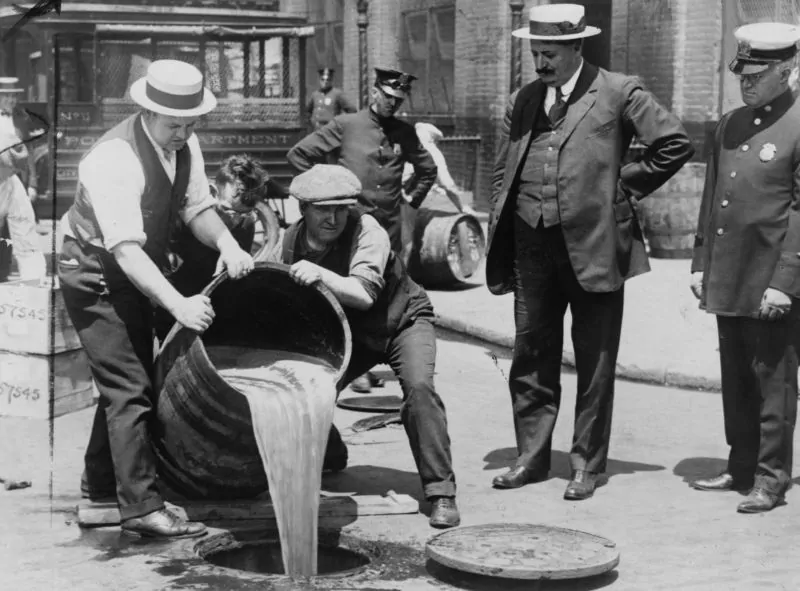
Alcohol addiction remains a significant challenge today, affecting individuals, families and communities across the US, UK and beyond.
Despite greater awareness of the health risks associated with excessive drinking and increased access to alcohol rehab and support, many people continue to struggle with dependence. Looking back at one of history’s most ambitious attempts to tackle alcohol consumption, Prohibition in the United States, can provide valuable insight into why addiction is such a complex issue.
Introduced in the early 20th century, Prohibition attempted to dramatically reduce alcohol consumption by making the manufacture, sale and transportation of alcoholic drinks illegal. While the policy had some impact on drinking levels, it ultimately failed to eliminate demand for alcohol. More than a century later, its history offers important lessons about addiction, public health and the limitations of simply restricting access to a substance.
The Rise of the Temperance Movement
The roots of Prohibition can be traced back to the 19th century, when temperance organisations began campaigning against alcohol. Groups such as the American Temperance Society, founded in 1826, argued that drinking contributed to poverty, family breakdown and wider social problems. The movement gathered political momentum over subsequent decades, eventually helping create support for nationwide legislation.
The campaign culminated in the ratification of the 18th Amendment in January 1919. It prohibited the manufacture, sale and transportation of intoxicating liquor across the United States. The Volstead Act, passed later that year, established the framework for enforcing Prohibition.
Did Prohibition Stop People Drinking?
Initially, Prohibition appeared to have some success. Historical evidence indicates that alcohol consumption fell during the early years, alongside reductions in some alcohol-related harms. However, demand for alcohol did not disappear.
Instead, an underground market developed. Bootleggers produced and transported alcohol illegally, while speakeasies provided places for people to drink. Illegal alcohol production also became increasingly connected with organised crime.
The experience demonstrated a fundamental problem with treating alcohol consumption solely as a legal issue: banning a substance does not necessarily remove the desire to use it.
What Does Prohibition Tell Us About Addiction?
Perhaps the most important lesson is that addiction cannot be explained simply by availability. People may continue seeking a substance despite legal, financial, social or health consequences.
This does not mean that alcohol policies are ineffective. Modern approaches show that regulation can reduce harmful drinking and associated health problems. However, effective approaches tend to recognise that reducing alcohol-related harm requires more than simply restricting access.
Addiction can involve biological, psychological and social factors. For someone experiencing alcohol dependence, removing easy access to alcohol without addressing the underlying reasons for drinking may not resolve the problem. Stress, trauma, mental health difficulties, social circumstances and established patterns of behaviour can all contribute to problematic drinking.
From Morality to Treatment
Another significant change since the Prohibition era has been the way alcohol problems are understood. Historically, excessive drinking was often viewed through a moral lens, with people who struggled with alcohol sometimes characterised as lacking willpower.
Modern approaches increasingly recognise alcohol use disorder as a medical and treatable condition. This shift is important because stigma can prevent people from seeking help. Viewing addiction as a health issue makes it easier to focus on treatment, recovery and long-term support rather than punishment alone.
Why Prohibition Ultimately Failed
By the early 1930s, support for Prohibition had weakened significantly. Enforcement was expensive, illegal alcohol markets had flourished and organised crime had benefited from the trade. The 21st Amendment was ratified on 5 December 1933, repealing the 18th Amendment and bringing national Prohibition to an end.
The story of Prohibition does not suggest that society should simply accept harmful drinking. Instead, it demonstrates that addiction is complex. Regulation can play an important role in reducing harm, but lasting change also requires education, early intervention, accessible treatment and support for people struggling with dependence. More than 90 years after Prohibition ended, its central lesson remains relevant: addressing addiction is rarely as simple as removing the substance. Understanding why people use it in the first place is often the more important step.
About the Author