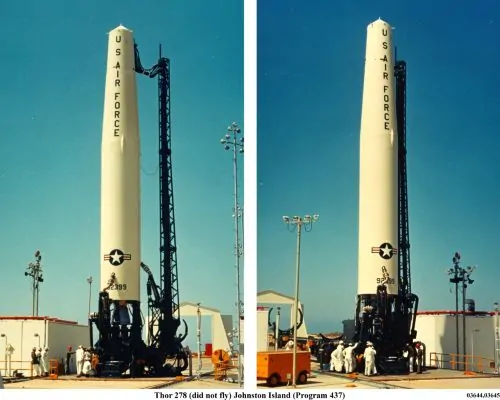
Long before the United States acknowledged weapons in orbit, Program 437 kept nuclear-armed Thor missiles on alert at Johnston Atoll, prepared to destroy hostile satellites from the ground.

By Matthew A. McIntosh
Public Historian
Brewminate
Introduction: What Was Actually New in 2026
On September 14, 2026, Secretary of the Air Force Troy Meink publicly declared that the United States possessed “on-orbit space control weapons” capable of defending the joint force against hostile action. His carefully chosen formulation was historic because it acknowledged that American weapons were already operating beyond Earth rather than merely being planned for future deployment. Neither the Air Force nor the Space Force identified the systems, explained how they worked, or disclosed whether they could produce kinetic destruction. Initial coverage nevertheless treated the statement as confirmation that the United States had crossed into a new era of armed competition in space. That characterization was correct in one important respect: Washington had admitted that operational weapons were resident in orbit. It did not mean that the United States had only just acquired the ability or willingness to attack spacecraft.
More than six decades earlier, American military units had maintained missiles capable of carrying nuclear warheads into space to destroy hostile satellites. Program 437 was not an orbital weapon but a direct-ascent system launched from Johnston Atoll, and it belonged to a different technological and legal category from the capabilities disclosed in 2026. Nor was it the country’s earliest operational antisatellite system, since the Army’s shorter-range Nike-Zeus-based Program 505 preceded it. Its historical significance lies instead in the nuclear-armed Thor missiles that the Air Force placed on continuous alert in June 1964, supported by trained crews and an established command structure prepared for an actual mission.
The system’s architecture joined equipment designed for other purposes into a new counterspace capability. American tracking networks would identify a target and calculate the narrow interval in which its orbital path could be crossed. A Thor intermediate-range ballistic missile would then rise from Johnston Island carrying a nuclear interception vehicle rather than a conventional projectile requiring a direct collision. Detonation close to the selected spacecraft was expected to compensate for imperfect guidance by exposing it to intense radiation and electromagnetic effects across a broad area. High-altitude nuclear experiments had already demonstrated that such effects could damage satellites far from the burst and persist within Earth’s magnetic field. Those discoveries made nuclear interception technically attractive while revealing that its consequences could not be confined to an enemy vehicle. Friendly and neutral spacecraft might also be disabled, including satellites that entered the affected region well after the explosion. Program 437 never conducted a nuclear interception, but its operational plan relied upon the very indiscrimination that earlier testing had exposed.
Its terrestrial location did not make Program 437 peripheral to the militarization of space. By assigning personnel, missiles, nuclear devices, communications infrastructure, and targeting procedures to an antisatellite mission, the United States transformed a speculative concept into an organized military capability. Officials described the system as defensive because it was intended to negate threatening spacecraft, particularly hypothetical Soviet orbital bombardment platforms. Yet a protective label could not control the physical reach of the weapon or prevent Moscow from interpreting its launch as the opening stage of a wider nuclear attack. Program 437 consequently embodied an enduring problem in counterspace policy. Preparations undertaken to reduce one state’s vulnerability can produce greater insecurity throughout the orbital environment.
What changed in 2026 was the acknowledged location and persistence of American space-control weapons, not the appearance of the counterspace mission itself. A ground-launched Thor remained on Earth until ordered toward a target, whereas a resident system could already be positioned near other spacecraft and potentially maneuver without the unmistakable warning provided by a missile launch. Such proximity introduces different problems of observation, attribution, and escalation, although the absence of disclosed technical details makes closer comparison premature. Program 437 nonetheless establishes that the United States had crossed an earlier operational boundary by 1964, when nuclear weapons stood ready to attack objects moving above the atmosphere.
The program converted the uncontrolled effects of high-altitude nuclear explosions into a hurriedly assembled military instrument whose nominal power concealed serious limitations. It was too destructive to be discriminating, yet too restricted in coverage and responsiveness to provide a dependable defense. Program 437 was not the direct technological ancestor of every later space weapon, but it reveals that the strategic contest over who may threaten satellites, and who may claim to protect them through force, began long before weapons themselves took up permanent positions overhead.
Sputnik and the Fear of Attack from Space
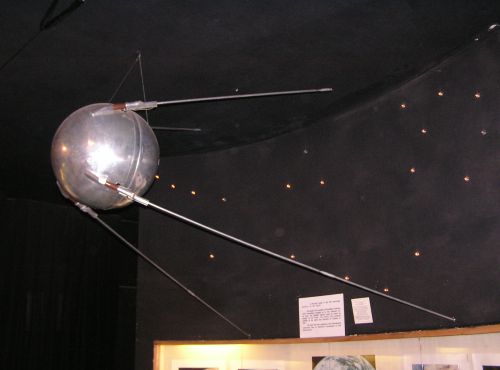
Sputnik I was not a weapon, and its radio transmitter could do little more than announce the satellite’s passage. Yet its launch on October 4, 1957, made an older American nightmare newly plausible; if Soviet engineers could place a sphere above the United States, perhaps they could also send a nuclear payload across intercontinental distances or eventually position one beyond terrestrial warning lines. The technical distinction between a satellite and a missile blurred in public discussion because both depended upon powerful rockets, reliable guidance, and mastery of long-range flight. Consequently, the R-7 launcher carried greater strategic meaning than the polished 184-pound sphere at its tip. Its success did not prove that Moscow possessed a dependable fleet of deployable intercontinental missiles, but it demonstrated that Soviet claims could no longer be dismissed as propaganda alone. Geography seemed to contract almost overnight. Oceans that had once insulated the continental United States appeared less reassuring when a Soviet object crossed the sky several times each day. Apprehension centered not on what Sputnik could accomplish, but on what its orbit appeared to certify.
President Dwight D. Eisenhower resisted that conflation, remarking at his October 9 press conference that the satellite itself had not increased his apprehension “one iota.” His composure reflected access to classified assessments that had anticipated a Soviet satellite and distinguished launch capacity from an effective intercontinental arsenal. Indeed, NSC 5520 had recognized two years earlier that a scientific spacecraft possessed limited offensive utility even while a successful launch would advertise progress in missile technology. Such qualifications fared poorly against sensational headlines, congressional criticism, and the humiliating spectacle of Soviet success preceding the highly publicized American effort.
The most immediate military use of satellites was observation rather than bombardment. Washington had already begun seeking systems that could photograph denied territory without exposing pilots to capture or aircraft to interception. Sputnik inadvertently assisted that objective. By launching the first artificial moon, celebrating its passage over foreign territory, and provoking no assertion that national sovereignty extended indefinitely upward, the Soviet Union strengthened an emerging practice of unrestricted orbital overflight. This event did not settle international law, but it reduced the political obstacle confronting subsequent American reconnaissance spacecraft. CORONA would eventually transform knowledge of Soviet forces, although before its first successful photographic recovery in 1960, analysts still had to assemble conclusions from aerial imagery, telemetry, intercepted communications, defectors, and inference. A vehicle overhead could be menacing and stabilizing at once. It might conceal a destructive payload, or it might reveal that the opponent possessed fewer weapons than anticipated. As a result, the phrase “attack from space” came to encompass bombardment by orbital vehicles, assaults against satellites, and ballistic strikes that merely traversed the upper atmosphere. These were separate military problems, although strategic debate frequently compressed them into a single prospect of surprise.
American planning supplied many of the images through which Soviet intentions were interpreted. In the years after 1957, Air Force studies considered nuclear-armed bombardment satellites, the Dyna-Soar piloted glider, Project SAINT’s satellite inspector, and other machines capable of reconnaissance, interception, or attack. When analysts asked what Moscow might construct, they naturally drew upon this domestic catalogue of possibilities. That tendency did not make the resulting warnings imaginary, since the Soviet Union had displayed formidable booster technology while withholding reliable information about its programs. Nevertheless, technical feasibility could acquire the authority of evidence as conjectures passed through intelligence briefings, service requirements, and procurement arguments, producing an adversary partly observed and partly modeled upon American ambitions.
Nuclear delivery from orbit represented the gravest version of this uncertainty. A warhead might theoretically circle Earth before descending, while a fractional-orbit weapon would enter a near-orbital trajectory and deorbit before completing a revolution. An approach from the south or another unexpected direction could circumvent early-warning radars oriented primarily toward polar missile routes and reduce the time available for national leaders to respond. During the period in which an American antisatellite capability first took shape, intelligence had not established that the Soviet Union possessed such a weapon. Estimates issued in 1957 carefully separated demonstrated rocket power from unresolved questions of accuracy, reliability, warhead integration, production, and deployment. A 1962 estimate concluded that Moscow could orbit one or perhaps a few nuclear-armed satellites if it chose, while treating more advanced bombardment systems as prospective rather than existing forces. Air Force planners had institutional reasons to emphasize the most dangerous plausible case, whereas other analysts stressed that an orbital bomb offered uncertain advantages over an ICBM and could not remain hidden once tracked. Soviet secrecy and Nikita Khrushchev’s boasts nevertheless preserved the more alarming interpretation. By the time Moscow began testing an actual fractional-orbit system in the mid-1960s, the United States had already spent years preparing for hostile spacecraft whose offensive purpose had never been confirmed.
This sequence was more complicated than a straightforward response to a detected Soviet weapon. It amounted to insurance against technological surprise, devised where authentic advances in rocketry met limited knowledge of Soviet intentions and a bureaucratic tendency to convert possibility into a military requirement. American officials consequently pursued ways to inspect, intercept, or destroy objects in orbit before they could identify a deployed enemy strike satellite. The route that ultimately led to Program 437 depended upon another discovery. High-altitude American nuclear experiments showed that an explosion far above Earth could affect spacecraft well beyond its nominal point of detonation.
Argus and Starfish Prime: The Discovery of a Satellite-Killing Environment

The decisive experimental turn came before the United States possessed an operational antisatellite weapon. In 1957, Livermore physicist Nicholas C. Christofilos proposed that electrons released by a nuclear burst above the atmosphere might become trapped by Earth’s magnetic field, forming an artificial radiation belt. Explorer 1 and Explorer 3 soon revealed the natural belts associated with James Van Allen, lending physical reality to a region that had scarcely figured in military planning. Christofilos’s conjecture was not originally a blueprint for destroying spacecraft; one anticipated application was a temporary defensive screen capable of impairing the electronics or fuzing of hostile reentry vehicles. Yet the proposal carried a wider implication. A bomb could alter the conditions through which numerous distant machines traveled instead of destroying one object at the point of explosion. The Defense Department accordingly began treating the magnetosphere itself as an experimental apparatus, with consequences that exceeded the initial anti-missile premise.
Operation Argus was assembled in less than six months, partly because an approaching nuclear-testing moratorium made delay unacceptable to its sponsors. From the USS Norton Sound in the South Atlantic, Task Force 88 launched three modified X-17A rockets carrying W25 nuclear devices of approximately 1.7 kilotons. The warheads detonated on August 27, August 30, and September 6, 1958, at approximate altitudes of 200, 240, and 540 kilometers. Explorer 4, launched specifically to investigate radiation phenomena, joined sounding rockets and observation stations distributed across several continents and oceans. Their instruments confirmed that energetic particles could be injected into the geomagnetic field and retained there. Electrons spiraled along magnetic field lines, reflected between northern and southern mirror points, and drifted around much of the planet. The resulting belts remained detectable for weeks, proving that a brief explosion could produce an extended geophysical disturbance. Argus did not establish an effective shield against ballistic missiles, because the induced radiation was neither intense nor durable enough for that purpose. It nevertheless demonstrated something strategically more consequential. Human action could manufacture a hazardous orbital environment without placing a weapon beside each prospective target.
The military importance of these findings lay in the physics of the aftermath. At orbital altitudes, insufficient air existed to sustain the familiar blast wave associated with a surface or low-altitude detonation, but prompt x-rays, gamma rays, and neutrons could still injure nearby spacecraft, while gamma-ray interactions with the atmosphere could generate an electromagnetic pulse across a vast area. A second mechanism developed more slowly as energetic electrons became trapped, spiraled between magnetic mirror points, and repeatedly intersected satellite orbits. Each passage subjected solar cells, semiconductors, and other components to additional ionizing radiation, allowing damage to accumulate even when no single encounter proved immediately fatal. Distance from the burst ceased to provide a simple measure of safety, because the geomagnetic field could carry and preserve destructive effects far beyond the original detonation site.
Evidence nonetheless remained fragmentary. The Teak and Orange shots conducted near Johnston Atoll in 1958 had produced artificial auroras, communication disruptions, and other unexpected electrical phenomena, but sparse instrumentation and incomplete models made their broader implications difficult to determine. A testing moratorium then interrupted American experimentation until the Soviet Union resumed nuclear tests in 1961. The Kennedy administration’s Operation Dominic, including its high-altitude Fishbowl series, was intended in part to obtain the measurements that the earlier explosions had failed to supply.
Starfish Prime magnified the problem beyond anything Argus had displayed. An initial attempt in June 1962 ended when its Thor launch vehicle malfunctioned and was destroyed, scattering radioactive warhead debris around Johnston and nearby Sand Island. The successful shot followed on July 9 UTC, late on July 8 in Hawaii, when a Thor carried a W49 thermonuclear warhead to an altitude of roughly 400 kilometers before it exploded about 1,450 kilometers southwest of the islands. Its estimated yield of 1.4 megatons exceeded that of each Argus device by more than eight hundred times. The flash and artificial auroras were visible across a broad expanse of the Pacific, turning the upper atmosphere into a luminous record of the event. In Hawaii, contemporary reports attributed burglar-alarm activations, failures in sections of the street-lighting system, and disruption of a microwave telephone link to the electromagnetic pulse, although the cause of every reported malfunction cannot be established with equal confidence. Instruments in space recorded electron intensities several orders of magnitude above normal levels as the explosion populated an artificial belt. The most damaging portion of that radiation field persisted for months, with remnants measurable considerably longer, transforming a momentary detonation into a sustained environmental hazard.
Orbiting spacecraft became unplanned dosimeters and, in several cases, casualties. TRAAC and Transit 4B failed earlier than expected during the following weeks and months, while Ariel 1 and Injun I experienced substantial degradation; Soviet Kosmos 5 also operated within the disturbed region. Telstar 1, launched the day after Starfish Prime, initially survived and supplied valuable measurements of the new belt before cumulative radiation damage impaired its command electronics. Later Soviet high-altitude explosions added further energetic particles, making Telstar’s final failure in February 1963 the product of a combined exposure rather than an event attributable with certainty to one American test. Similar evidentiary limits surround some of the other spacecraft, whose designs, shielding, orbital paths, and preexisting condition varied considerably. Even with those qualifications, the concentration of anomalies and premature losses demonstrated that powerful nuclear bursts could reduce satellite lifetimes on an operationally significant scale. Concern about inflicting still greater damage contributed to the cancellation of Urraca, a proposed megaton-class Fishbowl explosion at an altitude exceeding 1,000 kilometers. The artificial belt distinguished neither nationality nor mission. Military vehicles, scientific instruments, commercial relays, and friendly systems encountered the same charged particles.
For weapon designers, the conclusion was simultaneously enabling and alarming. A nuclear interceptor could compensate for limited tracking and guidance accuracy by producing effects across a region far larger than the target satellite itself. That reach threatened other spacecraft, terrestrial electronics, radio communications, and potentially human crews, making discrimination a physical impossibility rather than merely a difficult operational choice. The Partial Test Ban Treaty, signed in August 1963 and effective that October, prohibited its parties from conducting nuclear explosions in outer space, but it did not require them to dismantle existing launch vehicles, warheads, or contingency organizations. Program 437 consequently entered service in 1964 not because American officials were unaware of nuclear interception’s collateral dangers, but because they elected to preserve a capability whose expansive effects constituted both its principal military advantage and its most serious liability.
Program 505 and the Competition for the ASAT Mission
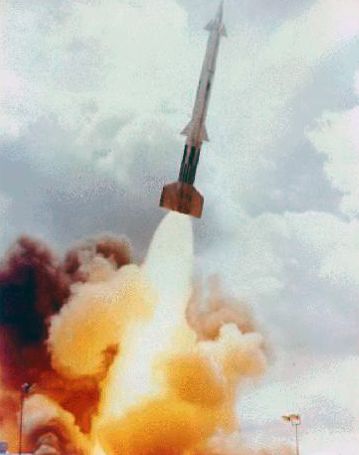
The first American force to place a dedicated satellite interceptor on operational alert belonged to the Army, despite the Air Force’s nominal leadership in military space. Its opportunity came from Nike Zeus, an antiballistic missile system combining a high-acceleration interceptor with powerful tracking radars, ground-based computers, and a nuclear warhead. In April 1962, Secretary of Defense Robert McNamara asked the Army to determine whether the equipment at Kwajalein Atoll could be adapted for use against satellites. The resulting effort was initially designated Project Mudflap and later became Program 505. A March 1961 Defense Department directive had assigned responsibility for most new military space-system development to the Air Force, but a missile fired from Earth at an object in orbit did not fit neatly within that division of authority. Because Zeus itself never entered orbit, the Army could characterize the project as an extension of missile defense, while the Air Force regarded the target and strategic purpose as part of its expanding space responsibilities.
Speed favored the Army’s proposal. Kwajalein already possessed launch facilities, specialized radars, command computers, trained personnel, and an established test organization constructed for realistic interceptions of ballistic-missile targets. Rather than design an entirely new weapon, engineers converted the DM-15B version of Nike Zeus into the DM-15S antisatellite interceptor. A revised hydraulic system gave the upper stage greater maneuvering capability, while improved booster propellant increased its attainable altitude. Its onboard batteries could supply power for approximately five minutes instead of the two minutes available in the earlier configuration, an important change for a longer ascent. Interception still depended on commands transmitted from the ground rather than an autonomous homing vehicle searching for its target. The planned W50 warhead, with a yield of approximately 400 kilotons, meant that the missile needed to approach within the expected nuclear lethal radius rather than collide directly with a spacecraft. Reusing Zeus allowed the Army to offer a deployable system within months, although nearly every resulting economy tied Program 505 to the location and performance limits of machinery created for another mission.
Hardware trials began at White Sands Missile Range before the complete system moved to the central Pacific. On December 17, 1962, a modified booster carrying a standard Zeus upper section reached approximately 100 nautical miles in altitude. A complete DM-15S climbed to about 151 nautical miles on February 15, 1963. After testing shifted to Kwajalein, an attempt on March 21 failed when the missile-tracking radar could not acquire the interceptor. A second trial on April 19 ended unsuccessfully after the missile’s tracking beacon stopped functioning shortly before the planned encounter. Success came on May 24, when a Zeus demonstrated an intercept solution against an orbiting Agena D stage equipped with miss-distance instrumentation. Neither a nuclear explosion nor the physical destruction of the Agena occurred; the recorded separation showed that a nuclear-armed interceptor would have passed close enough to disable the target. On August 1, 1963, the Army declared Program 505 operational, establishing a genuine alert capability rather than another experimental study.
Readiness did not amount to comprehensive coverage. The modified Zeus could reach only about 150 nautical miles, or 278 kilometers, and a prospective target’s ground track had to bring it sufficiently close to Kwajalein for engagement. A single DM-15S was normally kept prepared for immediate use, while its crew depended on advance orbital information and a brief opportunity to acquire the approaching spacecraft. Even against a reachable target, the W50 would have reproduced the central problem revealed by the high-altitude tests. The radius that made a near miss effective also prevented the explosion from discriminating among nearby satellites.
Program 505 entered service while the Air Force was developing a substantially different answer to the same requirement. McNamara had authorized the project that became Program 437 on November 20, 1962, so the two efforts overlapped rather than following one another in orderly succession. This was not a formal competition in which Zeus and Thor were launched against identical targets, but their simultaneous development created a practical contest over which service and system would retain the mission. The Air Force’s Thor offered far greater lifting power, an interception altitude approaching 700 nautical miles, and the capacity to carry a larger thermonuclear device, although it lacked the closely controlled radar guidance that distinguished Zeus. The Army could point to earlier readiness, existing personnel, and a successful instrumented interception. Air Force leaders answered that their service operated the principal surveillance networks, managed most military satellite programs, and already held the department’s general mandate for space development. McNamara initially preserved Program 505 as an interim capability rather than waiting for the more ambitious alternative. Once Program 437 became operational in June 1964, the Zeus installation was released from continuous alert after less than a year in that status. Residual Program 505 activity continued, including additional Nike Zeus launches through 1966, but the Defense Department had selected the system with the broader engagement envelope and the service with the stronger institutional claim.
Program 505 changes the chronology without displacing Program 437 from the center of the larger story. The United States possessed its first operational ASAT system on August 1, 1963, approximately ten months before the Thor installation assumed the principal alert. That milestone requires qualification because Zeus never destroyed an orbiting spacecraft; its military credibility rested on an instrumented near-intercept combined with the calculated reach of a nuclear warhead. Its restricted altitude, dependence on favorable orbital geometry, and brief front-line tenure explain why Program 437 became the more consequential deployment. The episode also shows that early American counterspace capability developed through the adaptation of missile hardware and a contest among established services before the government had produced a stable doctrine for warfare involving satellites. Program 437 marked the outcome of that competition, not its beginning.
Building Program 437 at Johnston Atoll
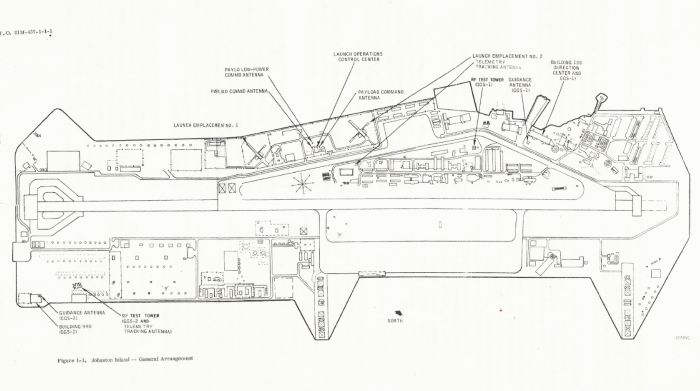
Converting the November 1962 authorization into a usable weapon meant compressing system design, site preparation, force organization, and testing into roughly seventeen months. General Bernard Schriever had proposed the basic arrangement on September 12, 1962, joining an earlier direct-ascent study to the Thor experience accumulated during Operation Fishbowl. After Robert McNamara approved further development, Air Force Systems Command placed Colonel Quentin A. Riepe in charge of a five-person project office in Los Angeles and concealed the undertaking behind the neutral designation Program 437. Space Systems Division received its formal go-ahead in January 1963. On March 28, Secretary of the Air Force Eugene Zuckert elevated the project to one of the service’s highest development priorities and demanded an emergency satellite-negation capability. The timetable did not allow the normal succession of prototype, extended evaluation, and production; developers had to create the equipment and its operational institution almost simultaneously.
Johnston Island, the principal landmass in an atoll roughly 700 nautical miles southwest of Honolulu, was a prepared range rather than an untouched construction site. Fishbowl had left two launch emplacements, a blockhouse, and Thor support services; isolation aided security and range safety. Yet the inheritance bore damage. Bluegill Prime’s failure on July 25, 1962, had destroyed a missile at Launch Emplacement 1 and spread plutonium contamination, forcing cleanup and repair. The mid-Pacific site could engage some orbital tracks before they crossed the continental United States, but satellites passing outside its reachable geometry remained immune.
At the center of the new installation stood a missile already receding from its original strategic role. The 65-foot Thor had been built as an intermediate-range ballistic missile, and newer intercontinental weapons were making both spare boosters and experienced personnel available. The Air Force drew vehicles from its existing stock and recovered ground equipment from deactivated Thor sites in Britain, then modified the combination for a steep crossing shot into low Earth orbit. A liquid-oxygen and kerosene propulsion system offered substantial lifting power but imposed exacting fueling, maintenance, and launch procedures. Sandia National Laboratories supplied an intercept vehicle containing detonation equipment, telemetry, and a W49 thermonuclear warhead with a yield of approximately 1.44 megatons. Under favorable geometry, the completed weapon could reach targets near 700 nautical miles in altitude, placing a considerable portion of low Earth orbit within range. It did not need to strike a satellite physically. A nominal lethal radius of about five miles allowed explosive output to compensate for residual errors in timing and guidance.
A composite manpower plan turned this assortment into a military force. Air Defense Command organized the 10th Aerospace Defense Squadron at Vandenberg Air Force Base on November 15, 1963, with the California base handling training, logistics, and reserve matériel while a detachment occupied Johnston. Members of the 6595th Test Squadron assisted with the transition; Strategic Air Command supplied Thor expertise, and ADC recruited additional operators from Bomarc missile crews. The initial staffing model called for 178 people and three launch teams rotating through ninety-day tours, supported by a smaller permanent island contingent that kept the pads serviceable between rotations. By assigning uniformed airmen to the firing chain, the service made Program 437 an Air Force combat responsibility rather than a contractor demonstration.
Targeting began far beyond Johnston. The Space Detection and Tracking System, operating within the North American Air Defense Command warning structure, combined radar and optical observations to maintain orbital data on potential targets. Air Defense Command personnel would select an interception point, while Ford Aerospace software converted the predicted encounter into flight and launch-time instructions transmitted securely to the atoll. Generating that solution could take six to twelve hours, so the requested “instant” response remained an aspiration. Once the data arrived, technicians configured and fueled the Thor as both missiles proceeded through parallel countdowns, one serving as the shot vehicle and the other as immediate insurance against a malfunction. The actual release opportunity might last only five seconds because a satellite crossed the chosen line of flight at orbital velocity. Air Force Systems Command promised placement within approximately three nautical miles of the intended crossing, and engineers believed the guidance equipment could perform markedly better. Even so, the warhead’s estimated five-mile destructive radius, not a terminal homing sensor, closed the remaining margin. Program 437 consequently relied on the continuous cooperation of distant surveillance stations, continental command centers, secure communications, and an island launch crew; the missile alone was not the complete weapon system.
Using inherited equipment did not make the project inexpensive. The January 1963 plan limited first-phase research, development, facilities, and testing to $17 million, with annual operating costs estimated at between $3 million and $5 million. By August, the projected initial bill had risen to $39.2 million as additional boosters and integration work entered the package. Engineers still had to alter the pads and blockhouse, improve local radar and computers, revise airborne guidance, and connect Johnston reliably to the surveillance network while preserving the May 1964 target date.
The proving campaign carried the code name Squanto Terror and comprised four unarmed flights between mid-February and late May 1964. On the opening trial, Douglas Aircraft personnel aimed a simulated payload toward a spent Transit 2A launch body; a daylight schedule allowed a Baker-Nunn camera to record whether the interceptor entered the prescribed lethal zone. Mechanical trouble in the primary Thor during the second exercise led controllers to employ the backup missile, which completed the mission successfully. A uniformed 10th Aerospace Defense Squadron crew conducted the third flight in April and satisfied its assigned objectives. The final launch on May 28 failed after exhaust burned through a vernier-engine actuator cable, causing the booster to malfunction shortly after liftoff. Reviewers separated that hardware defect from the crew’s performance and procedures. None of the trials destroyed a spacecraft or detonated a nuclear device; consistent with the Partial Test Ban Treaty, success was determined by whether the simulated payload passed within the calculated radius of destruction. Lieutenant General Herbert B. Thatcher accepted the accumulated evidence and declared initial operating capability on May 29. Transfer of a second nuclear-armed Thor to Johnston on June 10 completed the planned two-missile, twenty-four-hour alert.
The resulting force was austere. Two armed boosters stood on exposed Johnston launch pads, while two additional vehicles remained at Vandenberg as stored replacements; funding for only eight Program 437 Thors also constrained subsequent training. Air Defense Command wanted each of its three crews to conduct an annual combat-training launch, but every such exercise consumed scarce hardware. Salt air, tropical storms, and a long supply line transformed the location’s protective isolation into a persistent maintenance burden. Nevertheless, the permanent watch, prepared warheads, trained personnel, and established engagement procedure made the installation more than an experimental range. An approved interception would send the weapon upward from Johnston; nothing armed remained aloft awaiting a target. In material terms, the United States had established an antisatellite launch complex, not stationed a weapon in orbit.
Squanto Terror and the Meaning of Operational Readiness
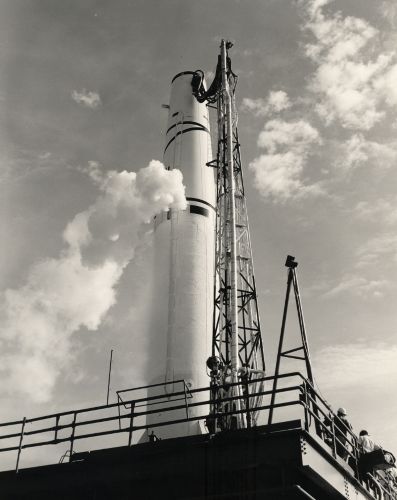
Squanto Terror addressed a problem that completed facilities could not resolve. What basis was sufficient for calling a nuclear antisatellite force ready for use? An end-to-end trial would have required detonating a live warhead near an orbital target. Once the Partial Test Ban Treaty entered into force in October 1963, such an explosion was legally unavailable, quite apart from the danger to unrelated spacecraft and the artificial radiation already examined above. Air Force evaluators consequently divided the mission into portions that could be observed without producing the intended destruction. Tracking forecasts established the encounter geometry, while range instrumentation reconstructed the Thor’s flight and a dummy payload represented the W49. Entry into a calculated effects volume, not physical contact or an actual kill, became the decisive measure. This method was rational for a weapon whose nuclear radius compensated for miss distance, but it made the verdict dependent on models of warhead effects as well as measured flight data. From the outset, readiness denoted an official inference drawn from connected demonstrations, not an empirical reproduction of the wartime event.
On February 14, 1964, Douglas Aircraft personnel conducted the opening flight against a spent rocket body from the Transit 2A launch. Scheduling the shot in daylight allowed Johnston’s Baker-Nunn camera to photograph the closest approach, providing a record independent of the missile’s telemetry. The inert payload traversed the region in which a nuclear burst was expected to disable the object, and the exercise was scored as successful. Yet the accomplishment was deliberately narrow. A contractor team had placed a ballistic vehicle near a well-characterized piece of American hardware. It verified the underlying geometry without establishing that an Air Defense Command unit could execute an authenticated wartime order against a Soviet spacecraft.
Early March supplied a sterner trial. Mechanical trouble kept the designated Thor from flying, and the contractor crew recommended shifting the exercise to the reserve vehicle. That booster completed the planned trajectory and received credit for a satisfactory intercept. At first glance, the episode merely added another malfunction to a development effort already dependent on aging hardware. For an alert force, successful substitution tested the logic behind preparing more than one missile, because orbital alignment would not wait for extensive repairs. The launch team also showed that it could identify a defective vehicle and preserve the exercise by transferring the mission. The result did not establish high reliability; it demonstrated limited resilience when a serious fault appeared before commitment.
The third launch, conducted in late April, carried the institutional burden that the first two had left unresolved. Uniformed members of the 10th Aerospace Defense Squadron, the “blue-suit” crew in contemporary terminology, performed the mission and met its assigned objectives. Their success indicated that the necessary procedures had been transferred from development engineers to the unit responsible for maintaining alert, even though contractors and range specialists remained indispensable. More consequential than another accuracy score, the flight established that Program 437 no longer depended on a civilian crew to conduct its launch sequence.
Then came the May 28 flight, witnessed by Lt. Gen. Herbert B. Thatcher, commander of Air Defense Command. Shortly after liftoff, exhaust burned through a vernier-engine actuator cable, and the Thor malfunctioned before completing its intended course. The postflight review attributed the loss to booster hardware, not to squadron action or defective procedures. Thatcher accepted that distinction and declared Program 437 at initial operational capability on May 29. Judged as a stand-alone examination, certifying the force one day after a failed launch appears remarkably lenient. The decision becomes more intelligible when Squanto Terror is considered cumulatively. Previous shots had established trajectory performance and the usefulness of a reserve missile, while the uniformed crew had already demonstrated the required sequence. The final accident exposed a material risk without invalidating the targeting calculations or showing that operators had erred. Thatcher’s ruling reveals the acceptance standard of an emergency program under schedule pressure. A diagnosable vehicle failure could coexist with readiness if commanders believed the remaining force offered a usable option.
The acronym IOC concealed a deliberately limited threshold. Its application on May 29 preceded the June 10 transfer of the second Thor, after which Johnston could maintain its intended two-vehicle alert posture around the clock. A January Defense Department report prepared for the White House had called the June objective a “short reaction” capability while noting that SPADATS then required approximately thirty-six hours of observation to predict an intercept accurately. Subsequent improvements shortened that interval, but they did not transform Program 437 into a shoot-on-warning weapon. Much of the response cycle occurred before a launch crew received a usable solution, and the opportunity to fire still depended on whether the spacecraft’s path entered Johnston’s reach. In this vocabulary, operational meant that an assigned unit could attempt a defined mission under bounded conditions; it did not promise a demonstrated kill, and neither coverage nor response was unlimited.
Maintaining that status posed a different test. Air Defense Command intended to conduct three combat-training launches each year so that every rotating crew would periodically perform an actual countdown and flight. The first took place on November 16, 1964, converting certification into a recurrent obligation instead of a one-time ceremony. On April 5, 1965, a second training mission sent a dummy warhead within 0.89 nautical mile of the inactive Transit 2A satellite, producing a more exact measure than the earlier language of entering an effects envelope. Each firing consumed one of a small inventory, forcing managers to expend on practice the same boosters they hoped to preserve for combat. Although the Defense Department authorized sixteen additional vehicles in September 1965, another combat-training launch did not occur until March 31, 1967. Ground rehearsals and technical inspections could preserve procedural familiarity, but they could not fully substitute for missile flight. Program 437 exposed readiness as a depreciating condition governed by training opportunities and hardware consumption, not a permanent quality conferred by the IOC date.
Contemporary officials themselves preserved this ambiguity. In 1965 Maj. Gen. John D. Lavelle told House appropriators that Program 437 was not yet fully operational and had initially been designed to prove a concept. That testimony did not rescind Thatcher’s declaration; it applied a more demanding standard of maturity than the minimum required to place a force on alert. Program 437 was plainly more than a proposal, for trained personnel held nuclear-armed missiles within a functioning command and targeting structure. No flight completed the destructive sequence, and none tested performance amid enemy deception or interference. The most defensible description is an operational but incompletely validated emergency weapon, proof that the United States possessed a deployed counterspace force in 1964, yet not proof that it had placed an armament in orbit.
The Indiscriminate Weapon and the Narrow Defense
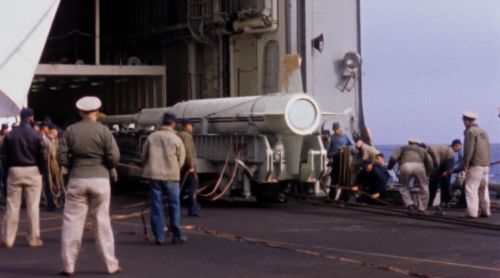
Program 437 joined two radically different scales of action. At the point of launch, it was selective. National authorities could designate a tracked spacecraft, calculate one encounter, and send a Thor toward a prescribed position. Yet the W49 warhead could not confine its violence to that chosen object. The same nuclear yield that compensated for imperfect interception accuracy also spread several forms of injury beyond the aim point, through processes whose outer limits neither the launch crew nor the command structure could precisely determine. Engagement capacity was small while potential consequences were comparatively broad. This asymmetry explains both halves of the program’s character. The destructive instrument was indiscriminate even though the protection it supplied was severely bounded.
At interception altitude, a thermonuclear burst would not resemble an explosion over a city. Because a vacuum could not carry a sustained blast wave in the familiar atmospheric sense, destruction depended chiefly on radiation, rapid energy deposition, and electrical disturbances produced by the detonation. Program 437 paired a 1.44-megaton W49 warhead with a nominal lethal radius of approximately five miles, thereby making proximity rather than collision the essential requirement. That figure expressed a planning estimate for disabling an assumed spacecraft under particular conditions; it was not a physical wall beyond which all effects ceased. Close to the burst, absorbed X-ray energy could heat and ablate exposed surfaces so quickly that the resulting stress damaged structures or internal equipment. Gamma rays and neutrons could penetrate farther into components, impairing electronics even when the vehicle remained outwardly intact. Depending on the geometry, prompt electromagnetic effects might induce disruptive currents or produce transient failures in vulnerable circuits. Actual results consequently varied with distance, orientation, shielding, component design, and the prior condition of the satellite.
No single circle on the plotting board could represent all of those hazards. The calculated kill zone helped launch officers determine where the warhead had to function, whereas ionospheric disturbance, line-of-sight electromagnetic exposure, and magnetically trapped particles followed different geometries. Johnston’s isolation reduced immediate danger to populated territory, but it could not make the upper atmosphere and magnetosphere behave like a contained testing chamber. Estimates of collateral harm remained uncertain because exposure changed with burst altitude, geomagnetic position, spacecraft trajectory, and the susceptibility of every vehicle passing through the affected region.
The Argus and Starfish experiments had already demonstrated that a high-altitude detonation could alter the near-Earth environment long after its flash disappeared. Program 437 changed the meaning of that discovery by making a comparable event available as a standing military option. If ordered to destroy one hostile vehicle, the United States might generate artificial radiation capable of degrading other spacecraft during later passages. Trapped electrons followed magnetic fields rather than the intention recorded in a target folder. Damage could accumulate gradually in solar cells and internal electronics, allowing failure to occur far from Johnston and well after commanders considered the interception complete. A friendly reconnaissance satellite did not need to be beside the intended victim at the instant of detonation to become part of the cost. Allied or neutral spacecraft, and vehicles launched while the disturbed environment persisted, would acquire no immunity from their political status. The orbital population of 1964 was sparse by later standards, which reduced the likely number of casualties but did not abolish the danger. As American dependence on space-based intelligence, meteorology, communications, and navigation increased, the national assets exposed to an American nuclear antisatellite operation would increase with it.
Whatever discrimination Program 437 possessed lay chiefly in the decision made before launch. Tracking networks and intelligence analysts could classify an orbit, associate it with a Soviet mission, and recommend an aim point, while senior officials retained the authority to withhold fire if identification or political circumstances remained doubtful. The Thor itself carried no terminal sensor capable of inspecting a payload or distinguishing an orbital bomber from a camera-bearing satellite during approach. Once the warhead functioned, radiation could recognize neither ownership nor purpose. Lyndon Johnson’s September 1964 announcement described the capability as protection against “bomb-carrying satellites,” a politically intelligible category that made the system sound more exact than it was. The phrase identified the threat used to justify Program 437; it did not describe a characteristic by which the weapon could separate dangerous spacecraft from unrelated ones.
The delivery system suffered the converse imbalance; it was more selective than comprehensive. A lone site at Johnston could reach only compatible trajectories, after surveillance stations had detected the object and specialists had spent hours preparing an interception. The five-second firing window and two ready missiles provided little depth against a salvo, convincing decoys, or successive threats, while gaps in observation might postpone warning until the adversary’s mission was nearly complete. A reconnaissance spacecraft could already have transmitted its imagery, and a deorbiting weapon might release its payload before Program 437 finished its engagement sequence. The most favorable target was consequently a predictable vehicle that remained in low orbit and repeatedly passed within Johnston’s reach, not every hostile object placed above Earth.
This restriction was most serious against the orbital-bombardment concepts invoked to defend the program politically. A fractional-orbit weapon was intended to descend before completing one revolution, denying defenders both time and a recurring opportunity for attack. If its trajectory evaded early detection or failed to cross Johnston’s accessible geometry, a technically sound Thor offered no protection. A multiple-orbit bombardment system, by contrast, would present repeated tracking opportunities and fit more readily within Program 437’s deliberate planning cycle. The relationship inverted the public rationale. The threat that appeared most urgent might be the hardest to engage, whereas the more vulnerable target was one that remained aloft long enough to be observed and attacked. Even a successful interception introduced a separate strategic danger. The launch of a nuclear-capable missile from an American base, followed by a megaton-class burst above the Pacific, might be interpreted in Moscow as part of a wider nuclear operation before its limited purpose became apparent. An action described as defensive could eliminate its assigned satellite, injure unrelated space systems, and intensify the confrontation it was intended to contain.
Calling Program 437 indiscriminate does not mean that one detonation was certain to eliminate every spacecraft in low Earth orbit; survival depended on geometry, construction, and time spent within any artificial radiation belt. The term instead describes a weapon whose consequences could not be restricted to the selected target with the confidence expected of a genuinely discriminating defense. Because access to hostile vehicles was episodic while the environmental and political costs of firing were extensive, the system may have possessed greater value as a latent retaliatory threat than as a dependable shield, although the deterrent influence of a weapon never used in war cannot be measured securely. Its historical significance lies in that imbalance. The United States fielded an operational antisatellite capability decades before 2026, but the 1964 system remained a nuclear interceptor launched from Earth rather than a weapon deployed in orbit.
Program 437 Unmasked
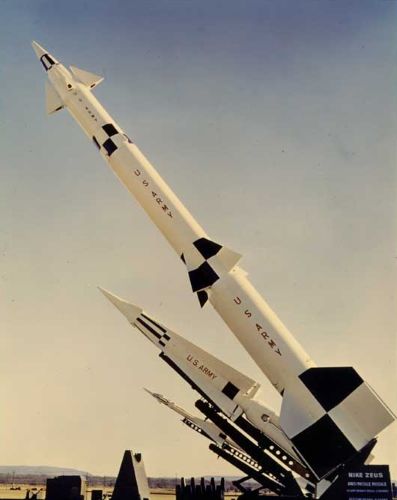
By September 1964, the existence of an American antisatellite effort was no longer wholly secret. Missile trials, defense appropriations, and aerospace contracting had supplied enough clues for attentive journalists and industry specialists to recognize that interception work was underway. President John F. Kennedy had acknowledged in October 1963 that the United States was developing Nike-Zeus and Thor systems for use against spacecraft. That admission answered congressional anxieties about Soviet orbital bombardment without presenting either project as a completed defensive force. It disclosed a technological objective rather than the disposition of combat equipment. Program names, nuclear armament, basing arrangements, and the status of the units involved remained concealed. Lyndon Johnson’s subsequent announcement crossed an important threshold by converting scattered knowledge of development into an authoritative claim of present military capability.
The fuller revelation came on September 17, 1964, during Johnson’s appearance on the steps of the California State Capitol in Sacramento. He recalled the alarm caused by Sputnik, emphasized American support for a United Nations resolution against weapons of mass destruction in orbit, and repeated that the United States did not intend to station warheads there. Significantly, Johnson also conceded that his administration had no reason to believe another country was then planning to place nuclear weapons in orbit. He nevertheless announced that two systems had been developed and tested for destroying armed satellites, declaring them “in place,” “operationally ready,” and “on alert.” Although he did not identify Program 505 or Program 437 by name, the paired description presented them as complementary answers to the same danger. By surrounding the disclosure with assurances of restraint, Johnson portrayed antisatellite preparation as a means of discouraging the militarization of space rather than contributing to it.
Robert McNamara’s public explanation the following day added technical credibility while preserving the program’s most sensitive features. The defense secretary stated that test vehicles had executed simulated interceptions or passed within the calculated destruction distance of orbital targets, and he described the weapons as ground-based systems using information from existing tracking networks. He declined to identify their locations, available numbers, or warhead types. Americans consequently learned that their government could attack a spacecraft from below, but not that nuclear detonation supplied the destructive mechanism.
Political circumstances made this selective disclosure useful. Fewer than seven weeks remained before the presidential election, and Republican nominee Barry Goldwater had repeatedly challenged the administration’s firmness on national defense. Johnson insisted that he was speaking as president rather than as a partisan candidate, yet his setting and language gave the announcement unmistakable electoral value. The speech warned foreign governments not to mistake American campaign debate for strategic distraction, turning the two antisatellite systems into evidence that national preparedness continued despite domestic contention. It also reassured allies that Washington possessed an answer to a seemingly novel Soviet avenue of attack. For voters, Johnson could display technological strength while maintaining his preferred image as a cautious custodian of peace. The underlying hardware was real, so the declaration cannot be dismissed as an invented campaign spectacle. Even so, grouping the Army’s Nike-Zeus installation with the Air Force’s Thor force erased the competition, unequal reach, and separate development histories that had shaped them. The public heard the language of redundancy and comprehensive protection; defense officials knew that the two programs offered different and highly conditional opportunities for interception.
What remained classified was central to understanding what Johnson had unveiled. Neither he nor McNamara disclosed that Program 437 depended on a thermonuclear warhead, a fact that would have connected the announcement to the disturbing legacy of Starfish Prime and complicated the administration’s simultaneous emphasis on peaceful space policy. Johnston Atoll’s role was also omitted, preventing outsiders from evaluating how geography restricted the satellites that could be reached. Silence about the small inventory and incomplete test record kept official confidence from being measured against the actual depth of the force. The administration announced the promised result, the destruction of an armed satellite, while withholding the characteristics that determined whether such an engagement was possible and what else it might damage. Public debate could address the desirability of defending against orbital bombs, but not the risks attached to the method selected. Program 437 was revealed only to the degree required for deterrence and political reassurance.
Official acknowledgment nevertheless changed the weapon’s function. Its classified mission had been to provide national authorities with an emergency means of attacking a threatening spacecraft; after Sacramento, its known existence also compelled Soviet planners to consider an American response even if they understood its weaknesses. That strategic signal did not produce corresponding public comprehension, because disclosure exposed the capability while preserving the assumptions beneath it. The episode separates technological creation from political visibility. The United States openly claimed an alert antisatellite force in 1964, but its Thor remained an Earth-launched interceptor rather than a weapon stationed in orbit, and Johnson’s carefully shaped announcement made the shield appear more complete than the underlying system allowed.
The Camera Beside the Warhead: Program 437AP
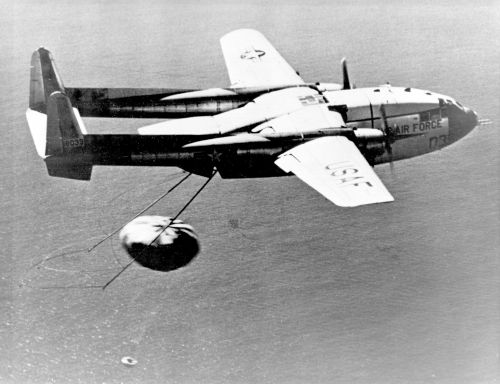
Program 437AP began with a problem that the nuclear interceptor itself could not solve: identification. Tracking information could establish a spacecraft’s orbit, but orbital behavior alone did not reliably reveal its mission or determine whether it was armed. On May 23, 1963, Air Force Systems Command directed the Space Systems Division to investigate whether a Thor could make a close photographic pass by another satellite. Initially designated Program 437X and later renamed 437AP for Alternate Payload, the project sought technical intelligence that might help senior authorities decide whether an unfamiliar vehicle warranted attack. Its camera was not intended to accompany the nuclear package during the same flight; it replaced the warhead. Because exposed film had to be returned to Earth and examined, inspection could not culminate in an immediate detonation, and any subsequent destructive mission would require another decision and another launch.
The proposed inspector borrowed heavily from the classified American reconnaissance program. Under Secretary of the Air Force Brockway McMillan, who simultaneously directed the National Reconnaissance Office, requested a development plan in December 1963, linking Program 437AP to the organization responsible for CORONA. General Electric adapted proven imaging and recovery technologies rather than constructing an entirely new system. The resulting payload incorporated panoramic and index cameras behind a protective door that opened during the brief encounter with the target. Designers expected the instrument to expose only a small series of daylight photographs as the two vehicles crossed paths at orbital velocity. After the pass, the film was to be wound into an H-30A recovery capsule, separated from the expendable camera section, and returned through the atmosphere beneath a parachute. A specially equipped C-130 operating from Hickam Air Force Base would seize the descending capsule in midair, following the method already developed for CORONA recoveries. The arrangement transformed an intermediate-range missile into a suborbital reconnaissance vehicle without placing the inspector into a lasting orbit. It also meant that commanders would receive no live image from the encounter; the intelligence value of the mission depended on successful reentry, recovery, processing, and interpretation.
Absorbing the photographic mission into the 10th Aerospace Defense Squadron imposed difficult choices. Program 437AP required the same Thor boosters, launch emplacements, tracking data, and specialist crews reserved for the nuclear assignment, although its test launches could double as valuable crew-training exercises. At one stage, Air Defense Command considered keeping one camera-equipped missile beside one nuclear-armed Thor, an arrangement that would have eliminated the two-shot antisatellite posture. Later planning retained both missiles in their destructive configuration until an inspection order required technicians to substitute the photographic packages at the T-minus-eight-hour decision point. Neither scheme provided two independent capabilities at once, and converting payloads would consume time during the very crisis in which rapid clarification might matter most. A launch also left Johnston requiring an estimated fifteen days of refurbishment before another photographic or nuclear mission, making the camera a competitor for scarce operational resources as well as an addition to them.
Four launches between December 1965 and July 1966 produced a record that was impressive in navigation but uneven as intelligence collection. On December 7, 1965, local time, the first inspector rose from Johnston toward an expended Agena rocket body. It reached the encounter 8.18 minutes after liftoff, and its measured separation differed from the prescribed 3.2-nautical-mile standoff by only 0.56 nautical miles. A momentary electrical short then prevented the film capsule from separating, causing the unrecovered payload to descend with the rest of the vehicle. The second launch, on January 18, 1966, approached another Agena and returned its film successfully, although the quality of the imagery has not been publicly established. A March 12 mission reportedly met all of its research and development objectives, again without leaving a published photographic record by which outsiders could judge the result. NASA subsequently offered an unexpected civilian application after its Orbiting Astronomical Observatory I lost power following its April 1966 launch. The July 2 inspection attempt veered away from the observatory after another electrical short, leaving the camera to record empty space rather than the disabled satellite. These missions demonstrated that a Thor could bring an imaging package close to an orbital object and sometimes return film, but they did not establish a consistently dependable intelligence service.
Inspection was less destructive than nuclear interception, yet it demanded considerably greater precision. The warhead could exploit a calculated effects radius, whereas a camera had to acquire an illuminated target during a fleeting encounter while controlling relative motion closely enough to avoid a blurred or empty frame. Useful passes required direct sunlight and a crossing angle no greater than approximately forty-five degrees; the most favorable altitude was near 400 nautical miles even though the Thor could theoretically reach about 725. Tracking became unreliable for objects in rapidly changing low orbits, while satellites above the booster’s ceiling remained inaccessible. Even a sharp exterior photograph could suggest a spacecraft’s purpose without conclusively revealing its internal payload or the intentions of the government operating it. The unpublished image quality from the successful tests makes it impossible to know how much uncertainty Program 437AP would actually have removed. Rather than solving the identification problem, the inspector exchanged the nuclear system’s question of destructive reach for a more demanding question about the reliability and meaning of visual evidence.
The decisive challenge emerged when the Air Force proposed an April 1966 mission against an actual Soviet satellite. The Joint Chiefs of Staff and the United States Intelligence Board rejected the flight as unnecessarily provocative, and Secretary of the Air Force Harold Brown’s request for ten additional missions did not overcome fears that Moscow would interpret a Thor rising from Johnston as a nuclear antisatellite attack. Intelligence officials suggested moving the photographic program to a separate base, but duplicating the island’s specialized facilities proved too expensive, and the Air Staff canceled Program 437AP on November 30, 1966. The experiment consequently exposed a dilemma hidden by the apparent interchangeability of its payloads. Replacing the warhead could change American intent, but it could not change what a Thor launched from a known antisatellite installation looked like to the state whose spacecraft it approached.
A Nuclear ASAT between Two Treaties
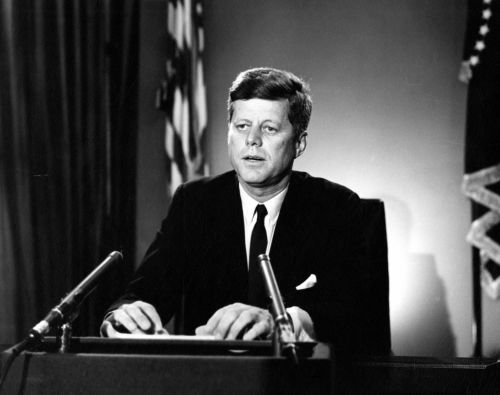
Program 437 entered operational service during a rapid recasting of the rules governing nuclear explosions and military activity beyond the atmosphere. Approved in November 1962, the system originated before the Limited Test Ban Treaty was signed, reached alert status after that agreement entered into force, and remained available when the Outer Space Treaty followed in 1967. Its chronology resists any simple verdict that Washington either designed the weapon to evade settled law or maintained it in open violation of an existing prohibition. The governing framework developed around a military capability whose architecture had already been chosen. Each treaty addressed a different part of that architecture; one restricted nuclear explosions in space, while the other prohibited the orbital emplacement of nuclear weapons and other weapons of mass destruction. Those provisions narrowed what the United States could do with Program 437 without expressly requiring that its Thor missiles, warheads, and support organization be dismantled.
The first agreement regulated an act rather than an inventory. Signed on August 5, 1963, and effective from October 10, the Treaty Banning Nuclear Weapon Tests in the Atmosphere, in Outer Space and Under Water obligated its parties to prevent not only nuclear weapon tests but also “any other nuclear explosion” in the environments it covered. That wording foreclosed another full-yield experiment like Starfish Prime and made a deliberate Program 437 detonation in outer space incompatible with ordinary treaty observance while the agreement remained binding. It did not prohibit possessing nuclear warheads, maintaining launch vehicles, calculating intercepts, or holding a ground-based force at readiness. The result was an unusual division between preparation and execution. Nearly every preliminary action could continue, although the final act that gave the system its destructive effect had been renounced. Earlier nuclear-effects data and nonnuclear missile flights consequently acquired legal as well as technical importance, for they allowed the Air Force to sustain confidence without repeating the prohibited explosion. The treaty contained a withdrawal provision for circumstances jeopardizing a party’s supreme interests, but withdrawal required notice and explanation; it was not a standing license to fire during a sudden confrontation. Program 437’s operational designation signified a preserved wartime option, not an unrestricted peacetime authority to conduct the mission for which the force had been organized.
A second diplomatic current concerned the location of weapons rather than their detonation. United Nations General Assembly Resolution 1884, adopted on October 17, 1963, called upon states to refrain from placing objects carrying nuclear or other weapons of mass destruction into orbit, installing such arms on celestial bodies, or stationing them elsewhere in outer space. Eleven months later, Lyndon Johnson could affirm that the United States had no intention of putting nuclear warheads into orbit while announcing that American antisatellite systems were operationally ready. The two declarations were compatible within the emerging vocabulary of space law because a Thor dispatched on a brief intercept trajectory was not an object kept in orbit.
The Outer Space Treaty converted that political undertaking into a binding rule, although its reach remained carefully delimited. Opened for signature on January 27, 1967, and entering into force on October 10, Article IV prohibited parties from placing in orbit around Earth any object carrying nuclear weapons or other weapons of mass destruction, installing such arms on celestial bodies, or stationing them in outer space by any other means. Program 437 did none of those things while sitting on alert at Johnston Atoll. In a mission, its booster would ascend from Earth, carry its payload through the target region, and follow a suborbital course rather than insert the warhead into a sustained circuit around the planet. Early interpretations of the treaty generally treated ballistic vehicles that merely traversed outer space as different from objects placed there, a reading consistent with the language negotiated by the superpowers. Nor did Article IV impose complete demilitarization upon the region surrounding Earth. Its comprehensive requirement that activities be conducted exclusively for peaceful purposes applied to the Moon and other celestial bodies, whereas military communications, reconnaissance, navigation, and early-warning satellites remained accepted features of Earth orbit. The treaty consequently prohibited an orbiting nuclear bombardment platform without outlawing every terrestrial weapon capable of reaching a spacecraft. Because the direct-ascent design preceded the negotiations, it would be anachronistic to describe Program 437 as a contrivance created to exploit this boundary; nevertheless, that boundary permitted the system to survive the agreement.
Remaining outside Article IV’s clearest ban did not make a nuclear interception legally uncomplicated. Article III required activities in exploring and using outer space to conform to international law, including the United Nations Charter, while Article IX imposed duties of due regard and consultation when a planned activity might cause potentially harmful interference with the peaceful activities of other parties. A high-altitude nuclear burst capable of damaging unrelated satellites, disrupting terrestrial systems, and producing persistent artificial radiation would have implicated those obligations directly. Article IX supplied neither a precise damage threshold nor a categorical prohibition on antisatellite weapons, so its application would have depended on circumstances, consultation, and contested judgments about military necessity. In wartime, the legality of a launch would also have turned on the law governing force and armed conflict, rather than on the Outer Space Treaty alone. Program 437 may have survived as a deployable force, but survival within the treaties’ formal categories did not confer advance approval upon its use.
The resulting position was neither straightforward legality nor simple defiance. The Limited Test Ban Treaty restricted detonating a nuclear device in space, whereas the Outer Space Treaty restricted placing or stationing such a device there; neither agreement ordered the elimination of an Earth-based interceptor retained for a military emergency. Program 437 consequently occupied an area left incompletely governed by accords that controlled particular activities and locations rather than antisatellite warfare as a distinct class of conduct. That history sharpens the meaning of the acknowledged deployment of weapons in orbit in 2026. Earlier American counterspace arms were real, operational, and potentially catastrophic, but they belonged to a different basing category from weapons maintained beyond the atmosphere.
From Twenty-Four-Hour Alert to Paper Capability
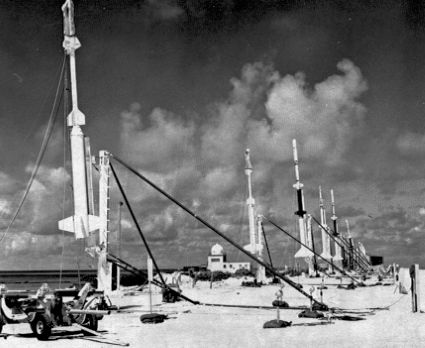
Treaty law was not the immediate cause of Program 437’s decline. Retrenchment emerged instead from aging hardware, competing missions, diminishing personnel, and a reduced willingness to sustain an expensive force with limited strategic utility. At its high point after June 10, 1964, two nuclear-armed Thors stood on Johnston Island’s launch pads under a twenty-four-hour readiness requirement, supported by spare vehicles and trained crews at Vandenberg Air Force Base. By the close of the decade, nearly every material element behind that posture had weakened. The change came through successive administrative decisions rather than a single order of cancellation. When the designation finally disappeared in 1975, “capability” meant something radically different from the force originally placed on alert.
Combat training launches offered the earliest measure of contraction because they consumed irreplaceable missiles while testing whether crews could still perform the mission. Air Defense Command had initially expected three such launches each year, allowing its rotating teams to practice the procedures required to place a Thor at the correct point in a satellite’s path. The available inventory never supported that tempo for long. Although the Defense Department authorized additional boosters in 1965, Thors were also wanted for scientific, meteorological, and experimental launch work. By the later 1960s, the 10th Aerospace Defense Group possessed only six vehicles for both its antisatellite responsibility and the Burner II program. Four were required to preserve the combat arrangement, two at Johnston and two spares at Vandenberg, while the remaining pair had been allocated to other launches. Every vehicle was committed, leaving further training dependent upon sacrificing a reserve missile or obtaining boosters that the Air Force was increasingly reluctant to purchase. A final combat training launch could still be conducted in March 1970, but one additional flight did not restore the earlier rhythm of rehearsal. Program 437 began losing practiced proficiency before it formally lost its mission.
Johnston Island’s environment imposed another form of attrition. Thors waited on uncovered pads amid heat, humidity, salt-laden air, and Pacific storms, conditions that steadily attacked missile surfaces and ground equipment. On March 22, 1969, a failed turbopump rendered one of the alert vehicles inoperable. A replacement arrived from Vandenberg about two weeks later and allowed the unit to recover its declared readiness, yet the interruption demonstrated how readily a single mechanical failure and a long supply route could reduce the two-missile force by half.
The institutional response favored retrenchment over modernization. Air Defense Command had proposed transferring operations to the more secure facilities at Vandenberg and had also sought a nonnuclear, co-orbital successor capable of inspection, interception, and postattack assessment. The Air Staff rejected that requirement, leaving the command responsible for an aging direct-ascent system without approving the replacement it preferred. As the Vietnam War absorbed money and personnel, continued investment in a small specialized unit on a remote atoll became harder to defend. In September 1969, the Air Staff decided that Program 437 would terminate by June 30, 1973, while an associated manpower reduction eliminated 124 guidance and security positions. The loss of security personnel prompted orders to remove the nuclear warheads from the missiles and keep them in protected shelters. Crews could reinstall the weapons if a launch appeared imminent, but the alert force no longer consisted continuously of two armed vehicles awaiting orders on their pads. Johnston retained the necessary components, though it now required preliminary work before it could recreate the posture announced in 1964.
The Office of the Secretary of Defense considered the projected 1973 termination unnecessarily slow. On May 4, 1970, Deputy Secretary of Defense David Packard directed the Air Force to accelerate the phase-down by the end of the fiscal year. Ten days later, Secretary of the Air Force Robert Seamans informed Secretary of Defense Melvin Laird that Air Defense Command would deactivate the Johnston launch operation on October 2. Nearly all assigned personnel then departed, leaving a caretaker staff and extending the estimated preparation time for an antisatellite mission to thirty days. A launch would require crews and equipment to return, after which the missile and its payload would have to be restored to operational condition. That arrangement preserved a contingency plan, but it no longer provided a prompt response to a spacecraft whose orbit might present only brief opportunities for interception.
Nature delivered the most conspicuous blow after operational retrenchment had already occurred. On August 19, 1972, Hurricane Celeste passed within twenty-one miles of Johnston Island, badly damaging the launch installations and disabling the guidance computer. Portions of the equipment were subsequently repaired, but restoration did not bring back permanent crews, armed missiles, or the former reaction standard. The Air Staff favored retiring the nuclear warheads, whereas Aerospace Defense Command resisted on the ground that Program 437 could be reconstructed at Vandenberg if circumstances demanded it. The weapons were retained at Nellis Air Force Base as part of what the command regarded as a marginal antisatellite option. That option was not wholly fictitious. Technical records survived, suitable facilities could theoretically be assembled, and the Thor remained a known launch vehicle. Execution would have required retrieving aging equipment, rebuilding an operational team, integrating a missile and warhead, recreating a guidance chain, and preparing an appropriate launch site. Program 437 had become a mobilization proposal supported by stored matériel rather than a deployed force prepared to receive a firing order.
During 1974, the Air Force ended the remaining Johnston antisatellite assignment, and the Department of Defense terminated Program 437 on April 1, 1975. Its eleven-year administrative life should not be treated as eleven years of equivalent readiness. The two nuclear-armed Thors maintained on twenty-four-hour alert in 1964 represented an operational weapon system; the scattered warheads, residual plans, and damaged or inactive infrastructure of the early 1970s represented a latent capacity that would first have required reconstitution. Recognizing that difference neither minimizes the original deployment nor extends it beyond the period when the United States could actually conduct the mission on short notice.
What Changed in 2026 and What Did Not

On September 14, 2026, Secretary of the Air Force Troy Meink supplied the statement that prompted this historical comparison. Speaking at the Air & Space Forces Association’s Air, Space & Cyber Conference, he declared that the United States possessed “on-orbit space control weapons” capable of defending the joint force against hostile action. Meink subsequently emphasized that the wording had been carefully chosen, while declining to identify the systems, their number, their orbital locations, or the date on which they had been launched. He would not say whether they employed kinetic force, electronic interference, directed energy, cyber effects, or some combination of methods. The available evidence establishes the date of direct public acknowledgment, not the moment when the hardware first reached orbit. Claims that September 2026 witnessed either the first launch of such a system or the beginning of American military activity in space go beyond what the announcement demonstrated.
Military spacecraft had supported American national security for more than six decades before Meink spoke. Reconnaissance, missile-warning, communications, navigation, and weather satellites became integral to military operations without ordinarily being classified as weapons merely because armed forces relied upon them. Their functions assisted terrestrial combat but did not necessarily involve imposing harmful effects upon an adversary’s spacecraft or space services. Neither the creation of the Space Force in 2019 nor the 2026 disclosure transformed a previously civilian environment into a military one; the more consequential development was the government’s explicit identification of orbiting equipment as weaponry.
September 2026 likewise did not inaugurate an American ability to attack satellites. Program 437 had placed nuclear-armed Thor interceptors on alert in 1964, even though those missiles remained on Earth until ordered to fly. An air-launched ASM-135 destroyed the Solwind P78-1 satellite in September 1985, demonstrating a nonnuclear direct-ascent method from an F-15. The ground-based Counter Communications System entered service in the next decade with the ability to disrupt hostile satellite links without creating a physical explosion in orbit. During Operation Burnt Frost in February 2008, a ship-launched SM-3 intercepted the failed USA-193 spacecraft, although the government presented the mission as the removal of a hazardous satellite rather than the test of a standing antisatellite force. These systems differed substantially in purpose, destructiveness, and readiness, but all could deny an adversary some benefit derived from space. Defined by the object or service subjected to attack, American counterspace capability plainly preceded the 2026 announcement.
The consequential difference concerns the location of the acknowledged instrument. Program 437’s warhead would have spent only part of its ballistic flight above the atmosphere before completing its mission and falling away; it was never intended to enter a sustained orbit. Meink’s language instead described weapons already operating on orbital paths. Such emplacement could offer persistence, different engagement geometries, and less dependence upon launching an interceptor after a crisis began, although the absence of technical information prevents firm conclusions about actual response times or target access. “Space control” is itself a broad functional category rather than the name of a particular weapon design. A Space Force explanation issued after the speech noted that the term could encompass kinetic or nonkinetic means and could support offensive as well as defensive operations. Nothing released in September established that the systems carried explosives, could physically destroy satellites, or had ever been used against a target. There is no evidence that they possessed nuclear payloads, and their description supplies no basis for portraying them as weapons intended to strike Earth. What can be stated securely is narrower. The United States admitted that equipment it classified as weaponry was stationed in orbit and available for space-control missions.
Official language crossed a doctrinal threshold as well. The Space Force’s 2025 planning framework had already treated space superiority as a condition that might require orbital warfare, electromagnetic action, cyber operations, and attacks upon hostile space capabilities. Meink’s announcement moved that vocabulary from a statement of how the service expected to fight toward an assertion that at least some relevant weapons had been fielded. Lyndon Johnson’s 1964 disclosure had acknowledged operational antisatellite systems while leaving the nuclear character and Johnston Island deployment of Program 437 unspoken; Meink identified the orbital location while withholding almost everything about mechanism and purpose beyond defense of the joint force. Secrecy persisted, but its boundary shifted. Even if the systems had circled Earth covertly for some time, naming them could influence deterrence, adversary planning, procurement decisions, and diplomatic arguments in ways that a classified capability could not. Meink’s words alone do not establish a violation of the Outer Space Treaty. Article IV would prohibit nuclear weapons or other weapons of mass destruction in orbit, but it does not categorically exclude conventional, electronic, cyber, or other nonnuclear weapons from that location; the treaty’s wider duties concerning international law, due regard, and harmful interference would still apply to their employment. Two opposite interpretations must be rejected. 2026 was not the birth of American counterspace warfare, yet it was more than a relabeling of familiar ground-based systems. Program 437 demonstrates the age of the mission, whereas the new disclosure confirms a change in where an acknowledged operational weapon is kept. The threshold crossed in 2026 concerned orbital presence and public ownership of that fact, not the invention of the satellite as a military target.
Does Program 437 Belong in the Same History as On-Orbit Weapons?
The following video from HISTORY covers the Manhattan Project:
The strongest objection to placing Program 437 beside the weapons acknowledged in 2026 is that a common target does not establish a continuous weapons lineage. “Counterspace” is an analytical category broad enough to encompass nuclear explosions, direct-impact interceptors, electronic jamming, cyber operations, directed energy, and spacecraft designed for close approach. Grouping those instruments together may clarify their strategic purpose while concealing decisive differences in technology, basing, command, and anticipated effect. Program 437 emerged from early Cold War fears about nuclear attack, rudimentary orbital surveillance, and a satellite population overwhelmingly controlled by governments. Weapons stationed in orbit during the twenty-first century inhabit a far more congested environment upon which armed forces, businesses, scientific institutions, and civilian infrastructure depend. Treating the former as an embryonic version of the latter could substitute a convenient origin story for demonstrated historical continuity.
Materially, the distance between the two cases is considerable. Program 437 kept its launcher and nuclear payload on Earth until an attack order sent the Thor through a brief ballistic ascent; the weapon was never intended to remain aloft as part of an orbital arsenal. Its destructive mechanism depended on a nuclear detonation whose radiation could disable spacecraft without requiring a precise collision. Readiness consequently rested upon finite missile stocks, launch crews, warhead custody, tracking information, and access to a geographically constrained Pacific site. An orbit-resident weapon begins from a different position because it already occupies the medium in which its mission would be performed. Depending upon its design, such a system might maneuver, observe, interfere reversibly, or exert force without reproducing the wide physical consequences associated with a high-altitude nuclear burst, although the 2026 announcement did not establish that any of these possibilities applied. The institutional setting has changed just as profoundly. Program 437 belonged to an Air Force organization concerned with continental aerospace defense, whereas contemporary space-control policy is administered by a military service created specifically for operations in the space domain. Nor did the Thor force transmit an uninterrupted body of hardware, personnel, or operational practice to that service. No public evidence traces a direct acquisition or engineering succession from the Johnston Atoll system to the capabilities identified in 2026, making any claim of technical ancestry untenable.
Evidence is also distributed unevenly across the comparison. Declassified files permit historians to reconstruct Program 437’s warhead, booster, alert arrangements, operational restrictions, and eventual decline, while the 2026 disclosure supplied little more than a carefully bounded capability statement. It remains publicly uncertain what the newer weapons do, how many exist, whom they are intended to affect, or whether their effects are destructive and permanent. Comparison can establish a difference in basing and acknowledgment, but it cannot yet demonstrate equivalence in mechanism, target set, or envisioned employment.
Still, historical relationships need not depend upon shared machinery. Program 437 and the orbiting capabilities of 2026 can be situated within the same strategic history if the subject is defined as governmental preparation to deny adversaries the benefits of spacecraft. At that level, both episodes concern the conversion of a technically possible interference mission into a capability represented as available for military use. They also raise recurring questions about how much secrecy serves deterrence, when public disclosure lends credibility, and whether a weapon described as protective can be separated from its offensive utility. The resemblance does not erase the movement from a sparsely populated orbital environment to one supporting indispensable military and civilian services; instead, that transformation changes the stakes of a persistent policy problem. Likewise, the language of defense carries different operational implications when attached to a nuclear interceptor awaiting launch and when applied to an undisclosed object already above the atmosphere. What persists is not a particular method of attack but the state’s decision to organize, maintain, and legitimize a means of contesting another power’s access to space. This narrower functional connection is historically meaningful without turning every antisatellite technology into a member of one undifferentiated family.
This objection changes the level at which continuity should be claimed. Program 437 was not the prototype from which an orbital weapon naturally evolved, and its termination did not merely interrupt an otherwise coherent march toward the 2026 posture. The later acknowledgment remains a separate development in location, potential persistence, institutional ownership, and perhaps physical effect. Yet excluding the Thor system altogether would imply that American weaponization of conflict against spacecraft began only when the weapon itself was publicly said to reside in orbit. The more defensible interpretation is that Program 437 belongs in the same strategic history but not in the same technical lineage; it was a precedent for accepting the antisatellite mission, not a prototype for the machines disclosed six decades later.
Conclusion: The Weapon on the Beach and the Weapons Overhead
On Johnston Atoll, Program 437 made an abstract Cold War fear physical. A Thor missile, nuclear warhead, trained crews, tracking network, and command procedure assembled for use against objects in orbit. Its significance did not depend upon a launch in combat. By 1964, the United States had moved beyond experimentation to a force it described as operational, although Squanto Terror never validated the entire sequence through the nuclear destruction of a satellite. That incomplete testing matters because readiness denoted an authorized military purpose and functioning organization rather than empirical certainty that every component would perform under wartime conditions. Experience since Sputnik, the radiation effects revealed by Argus and Starfish Prime, and competition with Program 505 all contributed to the system, but none made its deployment unavoidable. Program 437 resulted from a deliberate decision to preserve an antisatellite option whose strategic value could exceed its practical usability.
That imbalance became more pronounced when the proposed defense was measured against the environment in which it would operate. A nuclear burst compensated for the difficulty of striking a fast-moving spacecraft precisely, yet the same expansive effects that simplified interception endangered friendly satellites, communications, and other systems beyond the selected target. The Limited Test Ban Treaty subsequently prohibited nuclear explosions in outer space without requiring the United States to dismantle an Earth-based missile force, leaving Program 437 deployable in form but severely constrained in lawful employment. The Outer Space Treaty drew another consequential distinction by forbidding the placement of nuclear weapons and other weapons of mass destruction in orbit while leaving ground-launched antisatellite systems and conventionally armed orbital devices outside that specific prohibition. Public announcements likewise revealed the existence of an American interception capability while withholding its nuclear mechanism, location, and operational limitations. Program 437AP illustrated another path because its recoverable camera replaced the warhead rather than accompanying it, converting the Thor into a means of examining spacecraft instead of destroying them. Inspection never displaced the destructive mission, but its development exposed uncertainty over what the United States most needed from a counterspace system. Declining missile reserves, reduced training, removal of the warheads, and longer preparation requirements gradually hollowed out the original alert posture before Hurricane Celeste damaged Johnston’s facilities in 1972. When the program ended in 1975, what remained was increasingly an administrative possibility rather than a dependable combat force waiting at the launchpad.
The 2026 acknowledgment illuminates this earlier history by contrast, although it cannot supply details that officials continue to conceal. The phrase “on-orbit space control weapons” establishes their location and claimed military status while leaving their number, design, effects, targets, testing history, and deployment date undisclosed. Public evidence does not equate those systems with the thermonuclear Thor or demonstrate a direct line of technological descent from Johnston Atoll. What distinguishes the announcement is the admission that American weapons already reside in orbit, whereas the intention to contest an adversary’s use of satellites had entered operational planning more than six decades earlier.
The record consequently supports a layered conclusion rather than a single date for the beginning of American counterspace armament. Starting the story in 2026 erases ground-based weapons that were organized, armed, and placed on alert; describing the orbital systems as mere continuations of Program 437 would diminish the political and strategic importance of stationing weapons in space itself. The earlier program also warns that an officially declared capability may possess deterrent value even when its testing, availability, and permissible use remain uncertain. The contemporary admission places a similarly guarded claim within an orbital ecosystem vastly more crowded and indispensable than the one threatened by Thor. Substantial discontinuities in hardware, institutions, and prospective effects separate the two episodes, but both reflect a willingness to make an adversary’s spacecraft subject to organized military force. The weapon once waiting on Johnston’s shore and the classified weapons now overhead belong to different technological eras, yet they reveal how long the United States has been prepared to turn access to orbit into an object of armed power.
Bibliography
- Albon, Courtney. “Meink Reveals Space Force Has ‘On-Orbit Space Control Weapons.’” Air & Space Forces Magazine, September 14, 2026.
- Baucom, Donald R. The Origins of SDI, 1944–1983. Lawrence: University Press of Kansas, 1992.
- Bell Laboratories. ABM Research and Development at Bell Laboratories: Project History. Prepared on behalf of Western Electric for the U.S. Army Ballistic Missile Defense Systems Command under Contract DAHC60-71-C-0005. Whippany, NJ: Bell Laboratories, October 1975.
- Bowen, Bleddyn E. War in Space: Strategy, Spacepower, Geopolitics. Edinburgh: Edinburgh University Press, 2020.
- Brown, W. L., and J. D. Gabbe. “The Electron Distribution in the Earth’s Radiation Belts during July 1962 as Measured by Telstar.” Journal of Geophysical Research 68:3 (1963), 607–618.
- Bulkeley, Rip. The Sputniks Crisis and Early United States Space Policy: A Critique of the Historiography of Space. Bloomington: Indiana University Press, 1991.
- Catalini, Mike, and Konstantin Toropin. “US Acknowledges for the First Time That It Has Deployed Weapons in Space.” Associated Press, September 15, 2026.
- Central Intelligence Agency. “Soviet Capabilities and Probable Programs in the Guided Missile Field.” National Intelligence Estimate 11-5-57. March 12, 1957.
- —-. “Soviet Capabilities for Long Range Attack.” National Intelligence Estimate 11-8-62. July 6, 1962.
- —-. “The Soviet ICBM Program.” National Intelligence Estimate 11-10-57. December 17, 1957.
- Cheng, Bin. Studies in International Space Law. Oxford: Clarendon Press, 1997.
- Christofilos, Nicholas C. “The Argus Experiment.” Journal of Geophysical Research 64:8 (1959), 869–875.
- Chun, Clayton K. S. Shooting Down a “Star”: Program 437, the US Nuclear ASAT System and Present-Day Copycat Killers. Maxwell Air Force Base, AL: Air University Press, 2000.
- Conrad, Edward E., et.al. Collateral Damage to Satellites from an EMP Attack. DTRA-IR-10-22. Fort Belvoir, VA: Defense Threat Reduction Agency, 2010.
- Day, Dwayne A., John M. Logsdon, and Brian Latell, eds. Eye in the Sky: The Story of the CORONA Spy Satellites. Washington, DC: Smithsonian Institution Press, 1998.
- Dembling, Paul G., and Daniel M. Arons. “The Evolution of the Outer Space Treaty.” Journal of Air Law and Commerce 33:3 (1967), 419–456.
- Divine, Robert A. The Sputnik Challenge: Eisenhower’s Response to the Soviet Satellite. New York: Oxford University Press, 1993.
- Eisenhower, Dwight D. “The President’s News Conference.” October 9, 1957. In Public Papers of the Presidents of the United States: Dwight D. Eisenhower, 1957. Washington, DC: Government Printing Office, 1958.
- Gombosi, Tamas I., et.al. “Anthropogenic Space Weather.” Space Science Reviews 212:3-4 (2017), 985–1039.
- Hess, Wilmot N. The Effects of High Altitude Explosions. NASA Technical Note D-2402. Washington, DC: National Aeronautics and Space Administration, 1964.
- Higuchi, Toshihiro. Political Fallout: Nuclear Weapons Testing and the Making of a Global Environmental Crisis. Stanford, CA: Stanford University Press, 2020.
- Howard, W. J. “Status Report on Anti-Satellite Capabilities.” Memorandum to Charles E. Johnson, January 18, 1964. In Foreign Relations of the United States, 1964–1968, vol. 10, National Security Policy, edited by David S. Patterson, document 5. Washington, DC: U.S. Government Printing Office, 2001.
- Johnson, Lyndon B. “Remarks in Sacramento on the Steps of the State Capitol.” September 17, 1964. In Public Papers of the Presidents of the United States: Lyndon B. Johnson, 1963–64. Book 2. Washington, DC: Government Printing Office, 1965.
- Jones, C. B., et.al. Operation ARGUS, 1958. DNA 6039F. Washington, DC: Defense Nuclear Agency, 1982.
- Lachs, Manfred. The Law of Outer Space: An Experience in Contemporary Law-Making. Leiden: A. W. Sijthoff, 1972.
- Lonnquest, John C., and David F. Winkler. To Defend and Deter: The Legacy of the United States Cold War Missile Program. Rock Island, IL: Defense Publishing Service, 1996.
- Lorenz, Ralph D., and David M. Harland. Space Systems Failures: Disasters and Rescues of Satellites, Rockets and Space Probes. Chichester, UK: Praxis Publishing, 2005.
- McDougall, Walter A. The Heavens and the Earth: A Political History of the Space Age. New York: Basic Books, 1985.
- Meink, Troy E. “Keynote Address to the Air & Space Forces Association Air, Space & Cyber Conference.” National Harbor, MD, September 14, 2026.
- Molczan, Ted. “Program 437AP: A Sub-orbital Corona-Derived Satellite Inspector.” Visual Satellite Observer’s Home Page, January 6, 2016.
- Moltz, James Clay. The Politics of Space Security: Strategic Restraint and the Pursuit of National Interests. 3rd ed. Stanford, CA: Stanford University Press, 2019.
- Mundey, Lisa M. “The Civilianization of a Nuclear Weapon Effects Test: Operation ARGUS.” Historical Studies in the Natural Sciences 42:4 (2012), 283–321.
- Narin, Francis, comp. A “Quick Look” at the Technical Results of Starfish Prime. Los Alamos, NM: Los Alamos Scientific Laboratory, August 1962. Declassified.
- National Aeronautics and Space Administration. Astronautics and Aeronautics, 1966: Chronology on Science, Technology, and Policy. NASA SP-4007. Washington, DC: National Aeronautics and Space Administration, 1967.
- National Security Council. “Draft Statement of Policy on U.S. Scientific Satellite Program.” NSC 5520. May 20, 1955. In Foreign Relations of the United States, 1955–1957, Volume XI, United Nations and General International Matters.
- North American Aerospace Defense Command. A Brief History of NORAD. Colorado Springs, CO: Office of History, North American Aerospace Defense Command, 2012.
- Peebles, Curtis. High Frontier: The U.S. Air Force and the Military Space Program. Washington, DC: Air Force History and Museums Program, 1997.
- Rademacher, Steven E. Plutonium Exposures to Personnel Assigned to Johnston Atoll. Albuquerque, NM: Air Force Safety Center, 2016.
- Ruffner, Kevin C., ed. CORONA: America’s First Satellite Program. Washington, DC: Center for the Study of Intelligence, Central Intelligence Agency, 1995.
- Samson, Victoria, and Kathleen Brett, eds. Global Counterspace Capabilities: An Open Source Assessment. Secure World Foundation, 2026.
- Secretary of the Air Force Public Affairs. “SecAF Announces On-Orbit Space Control Weapons.” U.S. Space Force, September 15, 2026.
- Siddiqi, Asif A. Challenge to Apollo: The Soviet Union and the Space Race, 1945–1974. NASA SP-2000-4408. Washington, DC: NASA History Division, 2000.
- Spires, David N. Beyond Horizons: A Half Century of Air Force Space Leadership. Washington, DC: Air Force History and Museums Program, 1998.
- Stares, Paul B. The Militarization of Space: U.S. Policy, 1945–1984. Ithaca, NY: Cornell University Press, 1985.
- Stassis, Cristina. “US Air Force Secretary Reveals Deployment of On-Orbit Space Control Weapons.” Military Times, September 14, 2026.
- Swope, Clayton, Kari A. Bingen, Makena Young, and Kendra LaFave. Space Threat Assessment 2025. Washington, DC: Center for Strategic and International Studies, 2025.
- United Nations. Resolution 1884 (XVIII), “Question of General and Complete Disarmament.” October 17, 1963.
- —-. “Treaty Banning Nuclear Weapon Tests in the Atmosphere, in Outer Space and Under Water.” Signed August 5, 1963; entered into force October 10, 1963. United Nations Treaty Series 480: 43.
- —-. “Treaty on Principles Governing the Activities of States in the Exploration and Use of Outer Space, Including the Moon and Other Celestial Bodies.” Opened for signature January 27, 1967; entered into force October 10, 1967. United Nations Treaty Series 610: 205.
- United States Air Force. 10th Aerospace Defense Group. “Unit Histories.” 1968–1970. Air Force Historical Research Agency, Maxwell Air Force Base, AL.
- —-. Headquarters, Air Defense Command. Program 437 operational records and phaseout correspondence, 1969–1975. Air Force Historical Research Agency, Maxwell Air Force Base, AL.
- —-. Program 437 (S) (Phase II): Proposed System Package Plan. 2nd rev. Los Angeles: Headquarters, Space Systems Division, August 21, 1963. Declassified.
- —-. Space Systems Division. Program 437: Partial System Package. Los Angeles: Headquarters, Space Systems Division, January 16, 1963. Declassified.
- United States Congress. House. Committee on Science and Astronautics. Defense Space Interests. 87th Cong., 1st sess. Washington, DC: Government Printing Office, 1961.
- —-. Committee on Appropriations. Department of Defense Appropriations for 1966: Hearings before a Subcommittee of the Committee on Appropriations. 89th Cong., 1st sess., pt. 2. Washington, DC: Government Printing Office, 1965.
- United States Department of Defense. “Development of Space Systems.” Department of Defense Directive 5160.32. March 6, 1961.
- —-. “DoD Succeeds in Intercepting Non-Functioning Satellite.” News release, February 20, 2008.
- United States Space Force. “SecAF Announces On-Orbit Space Control Weapons.” September 14, 2026.
- —-. Space Warfighting: A Framework for Planners. Washington, DC: Department of the Air Force, 2025.
- Van Allen, James A., Carl E. McIlwain, and George H. Ludwig. “Satellite Observations of Electrons Artificially Injected into the Geomagnetic Field.” Proceedings of the National Academy of Sciences 45:8 (1959), 1152–1171.
- Walker, James A., Lewis Bernstein, and Sharon Lang. Seize the High Ground: The Army in Space and Missile Defense. Washington, DC: Center of Military History, U.S. Army, 2003.
- Weeden, Brian. “Through a Glass, Darkly: Chinese, American, and Russian Anti-Satellite Testing in Space.” Secure World Foundation, 2014.
Originally published by Brewminate, 09.25.2026, under the terms of a Creative Commons Attribution-NonCommercial-NoDerivatives 4.0 International license.
About the Author