Indira Gandhi’s 1977 election defeat exposed the gap between public silence and consent, as Emergency coercion met organized opposition and voters’ changing judgments of government.

By Matthew A. McIntosh
Public Historian
Brewminate
Introduction: The Government That Asked for Approval and Lost
In March 1977, Indira Gandhi lost the parliamentary constituency of Rae Bareli, and the Congress government she led suffered its first national electoral defeat since independence. The result displaced a prime minister whose administration had spent the preceding twenty-one months restricting the political activity through which opposition ordinarily became visible. Gandhi had presented the election as an opportunity for the government to seek popular authorization for its record and purposes. Instead, the vote demonstrated that the authority to govern could be withdrawn even from a leadership that had sharply curtailed the means of challenging it.
The Emergency proclaimed in June 1975 had been justified as a defense of the country against disorder and as a means of restoring the conditions necessary for development. Its public language emphasized discipline, while official programs promised improvements in the lives of disadvantaged citizens. Yet the government’s claim to act for the population existed alongside measures that limited people’s ability to contest what officials did in their name. Preventive detention removed political opponents from public life, and censorship restricted the reporting of grievances that might have challenged official accounts of national recovery. Coercive sterilization campaigns made the exercise of administrative power an immediate intrusion into bodily autonomy, while demolition and resettlement programs exposed poorer urban residents to displacement under the language of improvement. These experiences did not produce a single response across India, nor did every citizen encounter Emergency government principally through repression. They raised a fundamental question about political representation: what could a government legitimately infer about public approval when it had increased the risks of expressing disapproval?
An answer requires more than reading the election as an uncomplicated national uprising conducted through ballot papers. Congress retained substantial electoral support, and the severity of its losses varied dramatically across regions. Opposition cooperation also changed the practical meaning of a vote against the incumbent, giving dissatisfied electors a stronger prospect of replacing the government rather than merely registering protest. The distinction matters because personal resentment of an official, opposition to a specific campaign, and commitment to constitutional liberty could lead voters toward the same candidate without making their motives interchangeable. The parliamentary outcome established who would govern; it did not supply a complete explanation of why each elector had voted.
The relationship between suppressed dissent and electoral defeat must be reconstructed through evidence produced for different purposes. Election returns establish the distribution of support, while campaign materials reveal competing efforts to define what the contest meant. Testimony gathered afterward by the Shah Commission helps document abuses of authority, but its findings cannot simply be projected backward as knowledge shared by voters before the election. Scholarship further unsettles an account confined to Gandhi’s personal ambition or to the exceptional misconduct of her associates. Gyan Prakash locates the Emergency within the tensions between state authority and the promise of democratic transformation, while Christophe Jaffrelot and Pratinav Anil emphasize the institutions and social constituencies that facilitated authoritarian government, together with its uneven reach. These approaches direct attention toward the political relationships through which coercion was implemented and sometimes accommodated. The argument developed here is that the 1977 defeat became possible when experiences of arbitrary government could be connected to an organized electoral alternative, allowing grievances constrained in public life to acquire decisive parliamentary force. Its significance lies neither in proving that apparent submission had always concealed unanimous resistance nor in assigning one democratic intention to millions of voters, but in exposing how little enforced quiet could establish about a government’s continuing right to rule.
From Electoral Ascendancy to the Crisis of 1975
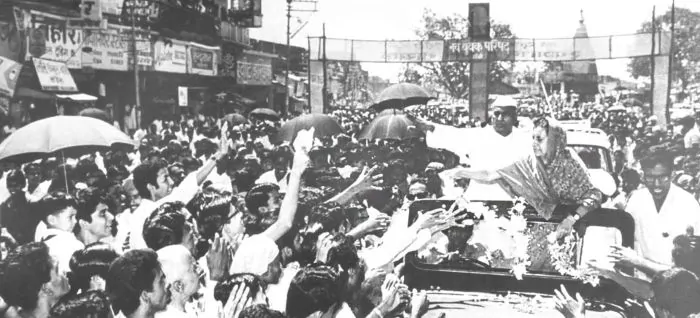
Gandhi entered the 1970s having transformed a struggle within Congress into an appeal for authority beyond its established leadership. The party’s division in 1969 had weakened the position of the organizational veterans who opposed her, but it also required her to demonstrate that she could command an electorate independently of them. In the parliamentary election of March 1971, the promise expressed through Garibi Hatao, or “Remove Poverty,” presented her leadership as the means of overcoming entrenched privilege. Congress’s commanding victory gave that appeal institutional substance, providing a parliamentary majority with which to pursue its program. India’s military success against Pakistan and the emergence of Bangladesh in December strengthened her standing afterward, adding international prestige to an already formidable domestic position. The distinction in sequence matters. Electoral success preceded the war, while the war helped consolidate the ascendancy that followed it. Within Congress, this concentration of prestige altered the relationships through which decisions were negotiated. The party had previously accommodated powerful regional leaders whose influence rested on their own organizations and local alliances, even when those arrangements limited the coherence of national policy. Gandhi’s victory increased the dependence of officeholders on their association with her and made loyalty to the central leadership a more important qualification for advancement. Congress successes in the state elections of 1972 reinforced the impression that her appeal could sustain governments well beyond New Delhi. Yet weakening established intermediaries did not eliminate the interests they had managed or create an equally effective system for resolving disputes. As Francine Frankel’s analysis of political economy helps establish, the expansion of central political authority coexisted with persistent obstacles to implementing redistributive change. Gandhi could claim unusual freedom from her former rivals while remaining dependent on administrative institutions and local social relationships that limited what her promises could accomplish.
Economic deterioration made those limitations increasingly difficult to explain to people whose expectations had risen with the government’s electoral language. Poor harvests placed pressure on food supplies, while the costs associated with war and the refugee emergency had already strained public resources. The international oil shock of 1973 intensified a crisis that had domestic origins as well, worsening the balance of payments and contributing to rapidly rising prices. Households experienced the resulting difficulties through the cost of necessities, making arguments about external circumstances an inadequate answer to immediate hardship. Organized workers also pressed demands that challenged the distribution of the burdens of adjustment. The nationwide railway strike of May 1974, associated with George Fernandes’s leadership, brought disputes over wages and working conditions into conflict with the central government’s insistence on maintaining an essential transport system. Its defeat through extensive arrests and punitive action against employees demonstrated the authorities’ willingness to use coercion against a major labor mobilization before the internal Emergency began. Economic grievances did not dictate the political decisions that followed, but they weakened the credibility of a leadership that had made improvement in ordinary lives central to its justification.
Gujarat supplied a damaging example of how local grievances could develop into a challenge to a Congress administration. Protests beginning among students over rising charges expanded into the Nav Nirman agitation against corruption and Chief Minister Chimanbhai Patel’s government. His resignation in February 1974 was followed by the dissolution of the state assembly, although fresh elections did not take place until June 1975. During the interval, the demand to return to the polls became a dispute over how long central rule could legitimately postpone a new representative government. Congress’s subsequent loss of office showed that opposition cooperation could produce a practical alternative within electoral politics, giving the Gujarat experience significance beyond the state itself.
In Bihar, student mobilization developed from grievances concerning education and employment, together with accusations of corruption in public life. Jayaprakash Narayan entered a movement that local activists had already begun, bringing the standing of a veteran of the independence struggle who had moved through socialist politics toward Gandhian approaches to social reconstruction. His leadership widened the movement’s ambitions, connecting demands against the state government with a program of “Total Revolution.” The phrase envisaged changes extending beyond the replacement of individual ministers, although its breadth left unresolved questions about the institutions through which those changes would occur. Narayan’s relationship with Gandhi had its own history of exchanges and disagreements, making it misleading to present their confrontation as the inevitable meeting of lifelong enemies. As Rakesh Ankit’s work demonstrates, their eventual rivalry emerged from a changing political relationship. By 1974, Narayan’s standing also helped bring established opposition parties into closer association with a movement that claimed to transcend conventional party competition.
That association created tensions within the opposition’s democratic claims. Demands that legislators resign and that elected assemblies be dissolved asserted a right of popular intervention between elections, but they left uncertain how the demonstrators’ authority should be measured against that of existing representatives. Narayan’s emphasis on nonviolence did not resolve every problem created by disruptive mobilization, while cooperation with the Jana Sangh and the Rashtriya Swayamsevak Sangh introduced organizations whose objectives differed from those of socialist and Gandhian participants. Bipan Chandra’s critical interpretation gives substantial weight to these difficulties, questioning whether the movement’s methods could undermine representative government in the course of claiming to renew it. Such objections deserve consideration because allegations of corruption did not automatically establish that one movement spoke for an entire population. They also require limits. The government’s possession of a parliamentary majority did not settle whether its conduct was defensible or release it from the obligation to tolerate lawful protest. The dispute involved competing accounts of democratic accountability, and neither side could resolve it simply by invoking the people as an undifferentiated source of endorsement.
The confrontation acquired a sharper legal dimension on 12 June 1975, when Justice Jagmohanlal Sinha of the Allahabad High Court invalidated Gandhi’s election from Rae Bareli. The petition had been brought by Raj Narain, her defeated opponent in 1971, and concerned the conduct of that constituency campaign. Among the findings upheld were the improper use of assistance from government personnel, including Yashpal Kapur while he remained a government employee. Several other allegations failed, making it essential to distinguish the court’s specific findings from wider accusations directed against Gandhi. The judgment nonetheless carried severe implications for her parliamentary membership and exposed her to disqualification. It also gave demands for her resignation a judicial foundation distinct from the opposition’s claims about economic failure or the moral authority of protest.
Justice V. R. Krishna Iyer’s conditional stay of 24 June preserved Gandhi’s ability to remain prime minister while her appeal proceeded, although it restricted her participation as a member of the Lok Sabha, including her right to vote. The legal position left room for continued government alongside further adjudication, without resolving the political demands that she step aside. At the opposition rally in Delhi on 25 June, Narayan urged the police and armed forces to refuse illegal or immoral orders, an appeal that government supporters represented as a threat to the obedience necessary for constitutional administration. Its qualifying language matters, as does the explosive setting in which it was delivered. Later that night, President Fakhruddin Ali Ahmed signed the proclamation of an internal Emergency on Gandhi’s advice. In her broadcast the following morning, she portrayed the preceding agitation as an attempt to prevent elected institutions from functioning and defended intervention as necessary to protect national stability. The economic crisis and the opposition’s disputed methods help explain the circumstances surrounding that decision, but neither made it unavoidable. A leadership that had recently won exceptional electoral authority now answered challenges to its position by placing political competition under emergency restrictions.
Closing the Channels of Opposition
During the night of 25–26 June 1975, arrests deprived the opposition of much of its established leadership before it could organize a coordinated response to the proclamation. Jayaprakash Narayan and Morarji Desai were among those taken into custody, while the operation extended beyond prominent national figures to activists whose importance lay in maintaining organizations locally. Imprisoning such people interrupted relationships through which meetings were arranged and supporters mobilized. A party might continue to exist formally while losing much of its practical capacity to conduct politics outside government. The speed of the initial operation also altered calculations among those who remained free, since established public standing offered little assurance against detention.
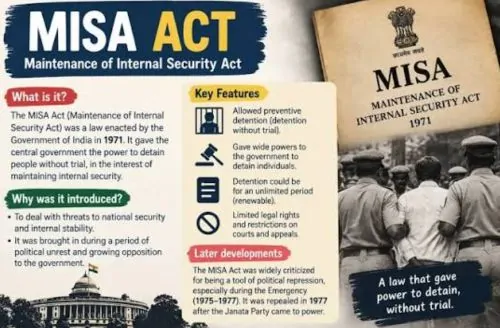
Preventive detention supplied an administrative means of extending this disruption without requiring the prosecution of each opponent for a proven criminal offense. The Maintenance of Internal Security Act, enacted in 1971, already permitted confinement on executive assessments of anticipated threats, and Emergency amendments weakened safeguards surrounding its use. Special procedures under Section 16A allowed detention grounds and supporting information to be withheld, making it harder for prisoners to understand and contest the case against them. Subsequent testimony before the Shah Commission exposed how little independent examination could precede the issuing of apparently individualized orders. Delhi district magistrate Sushil Kumar described signing sixty-seven detention orders during the opening night on the basis of a list of names, without substantive supporting material having been placed before him. Such evidence requires attention to the particular officials and circumstances involved, but it demonstrates a mechanism through which political instructions could acquire the outward form of legally considered decisions. Executive reconsideration remained possible, yet its existence offered a different kind of protection from scrutiny by an institution independent of those responsible for confinement.
Judicial proceedings initially provided opportunities to question whether these powers had been exercised lawfully, but that possibility became the subject of a decisive constitutional struggle. A presidential order of 27 June suspended the right to approach courts for enforcement of the protections contained in Articles 14, 21, and 22, including equality before the law and safeguards concerning personal liberty. Several High Courts accepted that detention could still be examined for defects such as bad faith or failure to comply with the governing statute. On 28 April 1976, the Supreme Court rejected that position by a four-to-one majority in Additional District Magistrate, Jabalpur v. Shivkant Shukla. Its ruling barred the habeas corpus challenges at issue, denying detainees that remedy against executive confinement even when they alleged illegality. Justice H. R. Khanna dissented, maintaining that the requirement of lawful authority for deprivation of liberty existed independently of Article 21. The disagreement concerned whether emergency constitutional arrangements had displaced a basic restraint on official power. For prisoners and their families, the majority’s answer sharply reduced the prospect of obtaining release through judicial examination of the detention’s underlying justification.
Newspapers encountered a separate system for controlling what could become publicly known. In Delhi, interruption of electricity to newspaper offices helped obstruct publication at the Emergency’s outset, while censorship orders subsequently required material within their scope to be submitted for approval before printing. These arrangements reached beyond the suppression of overt calls for resistance. Reports about arrests or official misconduct could be restricted, limiting the evidence available to readers assessing the administration’s performance. Editorial judgment also operated under the possibility that publication would attract further official action, encouraging caution beyond the demands of an individual censor. Government-controlled broadcasting gave the authorities another powerful means of presenting their interpretation of events, and the creation of Samachar through the merger of four news agencies in 1976 further concentrated the supply of news. Journalists and proprietors responded differently, with some resisting interference and others accommodating or endorsing the new conditions. Those differences complicate the history of the press without diminishing the significance of a system that gave officials extensive influence over the information through which their own conduct could be evaluated.
Workplace politics underwent a related contraction. Restrictions on industrial action, together with the vulnerability of organizers to detention, weakened employees’ ability to press collective demands against employers or the state. The absence of strikes could be presented as improved industrial discipline even where workers had lost effective bargaining opportunities. Trade unions were divided in their responses, and organizations associated with Congress or the Communist Party of India could support Emergency policies rather than oppose them. Jaffrelot and Anil’s attention to such institutional participation is important because it shows how restrictions could be sustained through cooperation within organized society as well as through police intervention.
Exceptions reveal why the Emergency’s institutional history cannot be reduced to the disappearance of every legal restraint. In Binod Rao v. Minocher Rustom Masani, decided in February 1976, the Bombay High Court upheld much of the relief obtained against censorship of material intended for Freedom First, although it permitted the prohibition of two disputed items. The litigation demonstrated that officials could still be required to justify whether certain restrictions fell within the authority granted to them. It also exposed the time and resources needed to secure permission to publish material already delayed by administrative intervention. Such judgments preserved meaningful limits in specific circumstances, while leaving the broader machinery of censorship in operation.
A citizen seeking help against an official decision faced difficulties extending beyond the merits of the original complaint. An opposition representative who might have raised the matter could be imprisoned, and a newspaper capable of investigating it might be unable to print the findings. Where detention was involved, the most important judicial route for testing the executive’s justification had been obstructed. Other avenues, including petitions to officials or approaches to influential Congress politicians, remained available, but they increasingly depended on securing assistance within the governing hierarchy. These conditions made it harder to establish publicly whether an injury was isolated or formed part of a wider administrative practice. They also increased the distance between experiencing an abuse and organizing an effective demand for its correction. The authorities acquired greater freedom to implement policy while the people affected had fewer dependable means of requiring an explanation, creating the setting in which programs presented as national improvement could proceed with diminished public scrutiny.
Governing for the Public Good
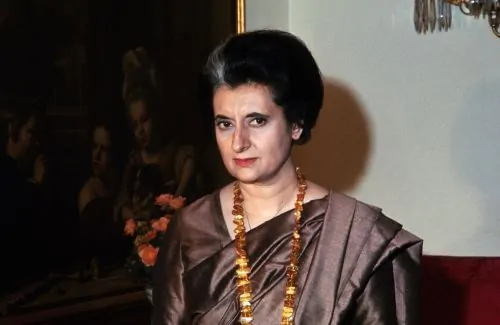
On 1 July 1975, Gandhi announced the Twenty-Point Programme, giving the Emergency an economic agenda through which its extraordinary powers could be presented as instruments of social reform. Her broadcast acknowledged that some proposals were new while others required more determined implementation, locating the initiative within an existing developmental project. The program promised action against rural exploitation alongside measures intended to relieve the pressures of inflation. Its breadth allowed the administration to address different constituencies through a common language of accelerated improvement. Political restrictions could then be defended as creating the conditions in which neglected commitments would finally become effective. This justification invited citizens to assess the new arrangements through their promised benefits, while leaving the leadership considerable discretion to determine what counted as progress.
Rural measures occupied an important place in this appeal because they addressed inequalities that electoral democracy had repeatedly promised to diminish. Enforcing agricultural land ceilings and distributing surplus land challenged the concentration of resources on which dependence in the countryside rested. Proposals concerning house sites and protection against eviction offered landless households the prospect of greater residential security, while action on indebtedness addressed obligations that could bind people to creditors across generations. The abolition of bonded labor likewise carried substantial emancipatory meaning, subsequently acquiring a legislative basis that went beyond exhortation. These objectives deserve assessment as responses to enduring social conditions, with attention to what implementation actually changed. A declaration against bondage required officials to identify affected workers and secure their release, then confront the economic dependence that could make renewed exploitation possible. Land redistribution similarly depended on whether beneficiaries obtained possession and could retain it against stronger local interests. Frankel’s account of India’s political economy is valuable here because it explains the resistance redistributive policies encountered within social relationships that could also influence the institutions administering reform.
Improvements in economic conditions gave the authorities evidence with which to defend their approach, although the causes of those improvements require separate examination. Inflation moderated, and agricultural recovery helped ease supply pressures after the difficulties of the preceding years. Earlier stabilization measures also contributed to the changing situation, making the timing of recovery insufficient to establish that Emergency restrictions had produced it. A household benefiting from more affordable necessities could welcome that development without possessing the information needed to distinguish the effects of better harvests from those of administrative intervention.
The appeal of disciplined administration also reflected interests that extended beyond the intended beneficiaries of redistribution. For some business leaders, fewer industrial stoppages and a more predictable operating environment offered advantages, even while the program retained language associated with socialist reform. Sections of the urban middle class could welcome expectations of greater punctuality or action against disorder, interpreting these as overdue improvements in everyday administration. The Communist Party of India approached the government’s economic promises through its own understanding of progressive change and the political forces threatening it. These responses arose from different commitments, and their coexistence did not establish agreement about the purposes to which stronger executive authority should be directed. Jaffrelot and Anil’s analysis draws attention to the resulting combination of redistributive rhetoric with arrangements that could favor established economic power. Support for the Emergency could rest on sincere expectations of improvement while reflecting considerable differences over whose difficulties deserved priority.
Sanjay Gandhi’s Five-Point Programme developed within this setting but occupied a different institutional position from the prime minister’s economic initiative. Associated with literacy, family planning, tree planting, the abolition of dowry, and the removal of caste distinctions, it placed significant emphasis on changing social behavior. It should be distinguished from the Twenty-Point Programme announced in July, both in its origins and in the authority through which it acquired influence. Sanjay held no ministerial office, yet his relationship to the prime minister and his connections within the Youth Congress gave his preferences growing importance to officials and politicians. The objectives attached to his campaign could command support individually while leaving unanswered questions about who had authorized him to direct their pursuit. As his prominence increased, responsiveness to a powerful political figure became entangled with the performance of public responsibilities, weakening the clarity of the relationship between an official’s statutory duties and the expectations surrounding advancement. Developmental publicity helped give these different initiatives a larger political meaning. In July 1975, an editorial in the Planning Commission’s journal Yojana, entitled “The Elephant Can Run,” depicted the economic program as an opportunity to overcome national sluggishness and recover confidence through purposeful action. Its dismissal of “barren polemics” expressed an impatience with political discussion judged by its immediate practical yield. That argument had force in a society where formal commitments to equality had left widespread deprivation unresolved, but it also narrowed the terms on which administrative accomplishment might be evaluated. A recorded distribution of land required examination of the security it provided, just as a promise of improved wages required evidence that workers received them. Recipients needed opportunities to describe failures that an official return might conceal or classify as completed work. The Emergency’s reform agenda raised a problem extending beyond whether its objectives were desirable. Assessing its contribution to public welfare required attention to how benefits were delivered and to the ability of affected people to challenge the decisions made during delivery.
Sterilization and the Administrative Production of Compliance
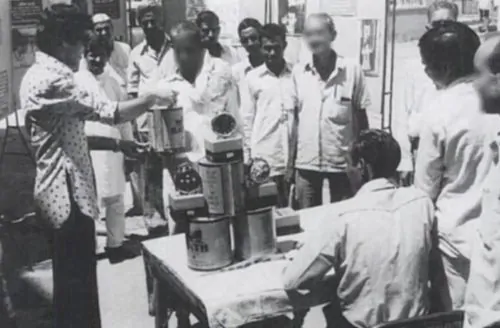
India’s national family-planning program dated from 1952, and the Emergency inherited an established apparatus for influencing reproductive behavior. Sterilization campaigns and financial incentives had developed well before Gandhi’s government acquired its exceptional powers. Population growth was frequently represented as an obstacle to economic improvement, making the limitation of births appear necessary to the success of development itself. Matthew Connelly’s research places these policies within a longer history of population control in which international expertise interacted with Indian political priorities. The Emergency intensified practices whose administrative foundations were already available, while weakening constraints on how they could be pursued. Understanding that continuity helps explain why a campaign associated so strongly with Sanjay Gandhi could expand rapidly through ordinary departments of government.
During 1976, sterilization became an increasingly prominent measure of administrative performance. The Shah Commission’s national figures record approximately 2.6 million procedures in the financial year 1975–76 and more than 8.1 million in 1976–77, a dramatic acceleration that included operations on both men and women. Targets established centrally were sometimes increased by state governments, creating further demands on the district authorities responsible for implementation. Sanjay’s promotion of family planning gave the campaign additional political urgency, but its execution involved ministers and established administrative hierarchies whose responsibilities cannot be dissolved into his personal influence. Pressure moved through successive levels of government, encouraging officials to demonstrate achievement through results that could be counted and compared. Sterilization offered an immediately reportable intervention, whereas other forms of contraception required continuing provision and use. The preference for a readily recorded procedure affected the relationship between the program’s demographic ambitions and the choices available to individuals.
Recruitment duties extended beyond medical personnel into occupations whose ordinary responsibilities had little connection with reproductive health. In Aurangabad, the Shah Commission documented a district health officer’s telegram of 11 March 1976 making payment of teachers’ February salaries conditional on their meeting a two-person recruitment target and undergoing sterilization themselves if eligible. An employee facing such a requirement was placed under pressure both as a potential patient and as an intermediary expected to secure other patients. Linking remuneration to recruitment transferred part of the burden of obtaining compliance to people whose own livelihoods could be endangered by failure.
For those approached through this expanding system, coercion could take several forms, with different implications for how an apparent agreement should be understood. Police custody and forcible transportation to a medical facility represented direct compulsion, while threatened losses of income or access to benefits could make refusal prohibitively costly without an officer physically restraining the patient. Financial compensation presents a more complicated question because it could help a willing participant cover lost earnings, yet its attractiveness also depended on the recipient’s circumstances. Poverty alone does not establish that a person lacked the capacity to choose sterilization, and treating every payment as proof of coercion would erase decisions that individuals made for their own reasons. The relevant inquiry concerns the alternatives available, the information supplied, and the pressures attached to refusal. A signature on a form cannot resolve those questions independently of the encounter that produced it. Where officials controlled resources on which households depended, the same administrative relationship could combine the offer of assistance with an implicit or explicit threat.
Uttawar, a predominantly Meo Muslim village in Haryana’s then Gurgaon district, provides a documented example of how resistance could provoke collective punishment. The Shah Commission connected the police operation there in November 1976 with the authorities’ determination to overcome opposition to sterilization, recording the interruption of electricity supplies during the confrontation. Following the raid of 6 November, villagers were taken to health centers, where testimony from medical officers corroborated accounts of forcible procedures. The evidence also described pressure on doctors to operate, showing how coercion could pass through the clinical setting rather than ending at its entrance. This case requires attention to the vulnerability of a specific Muslim community, whose resistance became the subject of an organized administrative response. Its significance lies in the documented conjunction of policing with medical intervention; the national campaign still requires investigation across populations subjected to different local practices. Aggregate statistics conceal much of this variation because an operation total records a completed procedure rather than the circumstances under which it occurred. The increase during 1976–77 cannot be converted directly into a count of people forcibly sterilized, just as official descriptions of recruitment cannot establish that those recorded as accepting the procedure did so freely. Complaints collected after the Emergency provide indispensable evidence, but they were gathered through an inquiry into wrongdoing rather than a representative survey of every patient’s experience. A defensible reconstruction depends on comparing testimony with contemporary instructions and medical records, while preserving distinctions between documented force and other forms of constrained agreement.
The political importance of these practices extends beyond the identification of individual officials who exceeded their authority. Rebecca Jane Williams’s interpretation locates family planning within the Emergency’s campaign against poverty, showing why the developmental rationale must remain part of the explanation of coercion. Describing abuses solely as departures from an otherwise benign policy can obscure the incentives created when rapid reductions in fertility became an official demonstration of national progress. Central encouragement and local enforcement were connected, even where the severity of compulsion differed or senior authorities later sought to restrain certain practices. People encountering a recruiter or police officer could have reasons to associate their treatment with a larger governmental undertaking. The extent to which they attributed responsibility to Congress must be established through political evidence rather than assumed from the fact of an operation. What the administrative record establishes more securely is that a campaign presented as improving collective welfare could make the exercise of reproductive choice contingent on a person’s capacity to withstand official pressure.
Resettlement and the Loss of Protection
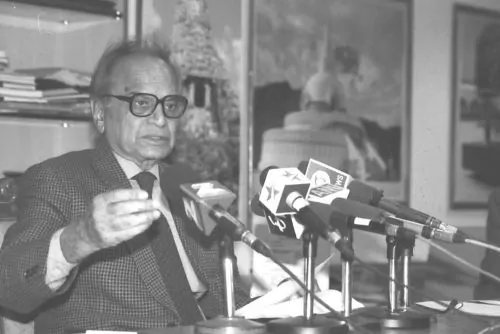
Delhi’s clearance campaigns drew upon a planning history that preceded the Emergency. The capital’s expansion after independence, shaped by Partition and continuing migration, had produced persistent disputes over housing and the use of urban land. The Delhi Development Authority and the Master Plan of 1962 supplied an institutional framework for reorganizing that growth, including the removal or relocation of settlements classified as incompatible with planned development. Such classifications carried substantial implications for people whose homes also provided access to employment or space for small-scale production. A settlement viewed administratively as an obstruction could function for its inhabitants as an indispensable economic location. Earlier policies had already exposed poorer residents to displacement, but the Emergency increased the speed of clearance while reducing opportunities to negotiate its terms.
Responsibility for the intensified operations was distributed across institutions whose activities did not always follow a coherent sequence of authorization. Jagmohan, vice-chairman of the Delhi Development Authority, occupied an important position in the redevelopment effort, while municipal agencies and the police supplied additional capacities for demolition and enforcement. Sanjay Gandhi’s informal influence affected this environment, although attributing every action to his personal instructions would exceed what the documentary record establishes. The Shah Commission itself encountered uncertainty about the original decision directing the overall acceleration. Its investigation identified repeated departures from prescribed procedures, including inadequate notice and the occupation of property before the necessary acquisition process had been completed. The existence of a planning framework cannot establish the legality of each operation conducted in its name. Nor did the provision of an alternative site resolve questions about how residents had been removed or what they had lost. Ownership documentation could prove insufficient to secure even the protections residents believed officials had acknowledged. Ibrahim, a homeowner in the Turkman Gate area, told the Shah Commission that he had presented property papers and received an assurance that his house would be spared. According to his testimony, the building was subsequently demolished without notice, and at the police station he was compelled to sign a statement describing the demolition as voluntary. This account requires attribution to the witness, but it formed part of a broader investigation that documented the destruction of private properties alongside the clearance of settlements treated as unauthorized. The distinction complicates any description of the campaign as simply removing squatters from public land. It also exposes the importance of the records produced afterward, since a declaration of voluntary action could conceal the circumstances in which an owner had lost both a building and the means of contesting its destruction.
The confrontation at Turkman Gate developed through an expanding operation rather than a single, uniformly resisted act of clearance. The initial removal of the dilapidated Dujana House transit camp on 13–14 April 1976 was reported to have proceeded without opposition. Demolition then extended into surrounding areas, placing additional residents and properties at risk beyond that initial undertaking. Resistance culminated in a violent confrontation and police firing on 19 April, bringing deaths and injuries into a campaign already marked by profound uncertainty about what would be destroyed. Accounts of the immediate provocation differed, and the Shah Commission distinguished those disputed events from the wider decisions that had produced the confrontation. Clearance subsequently continued under curfew, making the restoration of order compatible with further destruction in the affected neighborhood. The episode demands scrutiny of both the redevelopment authorities and the conduct of the security forces. Its significance cannot be captured through a simple opposition between orderly improvement and irrational resistance, because the scope of the operation had changed while residents’ opportunities to influence it had contracted.
Relocation imposed losses that the allocation of replacement land could not adequately measure. The Commission found that sites distant from employment created additional travel costs and difficulties for workers whose earnings depended on regular access to established parts of the city. Small open plots frequently replaced dwellings, leaving households responsible for rebuilding accommodation while basic amenities remained inadequate. For people engaged in informal occupations, the interruption of familiar commercial relationships could compound the immediate expense of removal. Emma Tarlo’s research makes these circumstances central to understanding resettlement as a prolonged reorganization of everyday life. The administrative act of assigning a plot marked only one stage in a process whose economic burdens continued after demolition squads had departed. Housing provision also became connected to the population campaign through the documents required to obtain replacement accommodation. The Delhi Administration acknowledged that sterilization certificates were demanded before certain resettlement allotments were finalized and plots or flats handed over. This connection gave the certificate a function extending beyond the recording of a medical procedure, making it relevant to a household’s efforts to recover a place to live. Tarlo’s work traces the transactions and negotiations that developed around such requirements, showing how residents attempted to navigate a system that linked bodily intervention with spatial eligibility. Their responses complicate an account in which displaced people appear only as passive recipients of orders. They also reveal how ingenuity exercised under severe constraint could help sustain an administrative arrangement whose conditions residents had little power to determine.
Personal access to influential politicians offered another possible route to protection, but its reliability diminished sharply. Congress politician Subhadra Joshi described unsuccessful efforts to obtain advance consultation about demolitions, followed by approaches to senior figures that failed to halt the program. Her account shows that information about the damage could travel upward without producing an effective restraint on the agencies carrying it out. For residents accustomed to seeking assistance through political intermediaries, this failure weakened a practical connection between their support for public figures and the expectation that those figures would defend them.
Delhi presents a concentrated example of dispossession extending beyond the loss of a physical structure. A household might retain evidence of ownership yet fail to prevent demolition, or receive a resettlement allocation while losing affordable access to work. The operation changed the relationship between residence and the forms of assistance through which people had managed their insecurity. These developments affected groups with different legal positions, and neither the experience of Turkman Gate nor that of any resettlement colony can stand for every person displaced in the capital. Delhi itself also requires a bounded place within the national history, since its concentration of redevelopment agencies and proximity to the political leadership produced distinctive circumstances. Within those limits, the case reveals why promises of rehabilitation must be examined alongside the protections that removal had destroyed. The resulting grievances concerned the government’s capacity to safeguard ordinary lives when its own projects placed them in jeopardy, providing a basis for political estrangement that an allotted plot alone could not repair.
Opposition Beneath the Surface
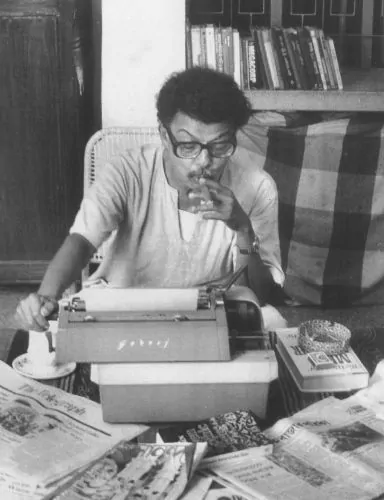
Gour Kishore Ghosh’s letter to his thirteen-year-old son located the decision to protest within the responsibilities of a household. The journalist weighed his obligation to provide security for dependants against the deprivation of his freedom to write, making dissent a choice with foreseeable costs for others. Its circulation through underground literature extended a personal address into a public defense of democratic expression. The document exposes one motive for resistance while helping explain why someone with similar objections might hesitate to act.
Clandestine communication depended on people willing to reproduce material and place it in other hands, turning readers into participants in its distribution. Handwritten copies and cyclostyled bulletins could connect otherwise separated groups, although producing them required access to equipment and trustworthy contacts. In an underground circular dated 15 August 1975, George Fernandes urged recipients to copy and translate the publications they received, supplementing their distribution with spoken communication. His confidence in the multiplying effects of conversation expressed an organizing ambition whose actual reach cannot be calculated from the appeal itself. Foreign radio supplied another resource, carrying information across restrictions imposed on domestic reporting. Pragya Dhital’s examination of prison writings shows how news of Sheikh Mujibur Rahman’s assassination in Bangladesh reached detained Indian politicians through broadcasts that frustrated attempts to control its initial dissemination. Their interpretation of that news demonstrates the survival of critical political reflection inside confinement, without establishing that everything written there immediately reached an external audience. Communication also crossed national boundaries through opposition activists and Indians living abroad. Edward Anderson and Patrick Clibbens document overseas demonstrations and efforts to influence foreign opinion, together with the movement of pamphlets back into India. Such connections gave some opponents resources beyond the government’s immediate jurisdiction, while diplomatic monitoring and pro-Emergency campaigning abroad challenged their activities. The resulting exchange preserved alternative accounts of events, but access remained uneven, and information transmitted outside censorship still required scrutiny for exaggeration or speculation.
In Punjab, the Akali Dal sustained a public campaign of civil disobedience through its established political and religious institutions. The Save Democracy Morcha began in July 1975 and continued until the election announcement in January 1977. Successive groups of volunteers courted arrest, maintaining an observable challenge as participants were removed. Paul Wallace’s account demonstrates how organizational continuity could support prolonged protest under conditions that made isolated acts of defiance difficult to sustain.
Cooperation among opponents existed alongside sharp differences over objectives and acceptable methods. Socialist activists and Hindu nationalists could participate in overlapping networks without acquiring a common conception of India’s political future. Fernandes’s circular itself complained that party loyalties obstructed coordination and called for more decisive leadership, revealing frustrations that later accounts of a united democratic struggle can obscure. The conduct of the Rashtriya Swayamsevak Sangh presents another difficulty for any uniformly heroic reconstruction. Its members contributed to underground activity, yet its detained leader, Balasaheb Deoras, also addressed conciliatory letters to Gandhi in August and November 1975. Correspondence reproduced in A. G. Noorani’s near-contemporary account praised aspects of her public statements and sought relief from the ban on the organization, linking its restoration to possible cooperation. These overtures require interpretation as attempts to negotiate an organization’s position; they cannot establish the intentions or conduct of every member. Jaffrelot and Anil accordingly place documented resistance beside substantial evidence of accommodation. Maintaining an organization, securing prisoners’ release, and opposing the political order were purposes that could overlap without being identical. Shared imprisonment and practical collaboration helped create relationships among previously antagonistic groups, but agreement about immediate survival left important disagreements unresolved.
Outside these identifiable organizations, dissatisfaction could persist without becoming participation in a movement. Accounts of ordinary life require attention to decisions made to protect employment or obtain relief from an official, since such actions might coexist with objections that remained privately expressed. Tarlo’s research on Delhi’s resettled communities illustrates the complicated relationship between suffering administrative injury, negotiating available opportunities, and assigning political responsibility. A person who sought to evade a requirement did not necessarily identify with an opposition party, while someone who avoided public protest might still object strongly to what had occurred. Histories built chiefly from surviving pamphlets and activists’ recollections provide much stronger evidence for organized dissent than for the distribution of opinion across the population. The networks that endured preserved contacts and some capacity for collective action, leaving open the further task of connecting their activities with grievances whose holders had neither joined them nor accepted their leadership.
What Could the Government Know?
Access to confidential information gave the central leadership advantages unavailable to most people attempting to assess the Emergency from outside government. Departments received complaints and reports that could disclose difficulties absent from published accounts, while Congress possessed its own connections with constituencies. The historical problem concerns how such material was evaluated and whether its implications altered decisions. Knowledge that an official had used coercion, an assessment of the resulting dissatisfaction, and a prediction about voting behavior required different judgments, none of which followed automatically from possession of the same information.
A correspondence trail concerning salary payments in Aligarh demonstrates why complete ignorance provides an inadequate explanation. In October 1976, the Department of Revenue and Banking alerted the Health Ministry to a district magistrate’s instructions requiring certification that eligible employees had undergone sterilization before salaries could be drawn. Examination at a lower level within the ministry produced an objection that the order conflicted with government policy. The matter advanced through the hierarchy without securing intervention. On 11 November, Sarla Grewal recommended that the ministry take no action, invoking the state government’s competence, and Health Secretary Gian Prakash subsequently recorded that he had mentioned the issue to the minister and considered further action unnecessary. These surviving notations establish awareness within the central ministry of a specific coercive practice; they do not establish that Gandhi personally examined the file. They also reveal a process more complicated than the transmission of uniformly reassuring reports. An objection could enter the administrative record, receive consideration, and then be contained through a decision about jurisdiction. The machinery could acknowledge an injury without treating it as grounds for changing the campaign that had produced it. For assessing political knowledge, the important distinction is between information reaching an office and that office recognizing a need to act on its significance.
Optimistic electoral assessments also existed outside Gandhi’s administration. A United States interagency intelligence memorandum of May 1976 anticipated an overwhelming Congress victory if elections were held, despite recognizing the restrictions imposed on opposition activity. This forecast preceded the autumn intensification of sterilization and supplies no evidence of what Gandhi herself received. Its value lies in showing that confidence could arise among external observers who combined economic improvement with an assessment of opposition weakness.
Evidence concerning Gandhi’s own expectations requires closer discrimination between contemporary assessments and explanations assembled after the result. Srinath Raghavan has identified reports prepared for her in June and October 1976 that combined favorable evaluations of the Emergency with warnings about its diminishing political benefits. In discussing this research, he notes that the October assessment drew attention to declining Congress support among poorer and minority voters in Uttar Pradesh because of the sterilization campaign. Such findings complicate an interpretation in which adverse information was entirely excluded from the prime minister’s attention. They also permit a different reading of electoral timing, since awareness of deterioration could make an earlier contest appear preferable to a longer postponement. That remains an interpretation of the available evidence, rather than a complete reconstruction of her private reasoning. P. N. Dhar’s later recollections place weight on her desire to recover the direct relationship with public audiences associated with the 1971 campaign, introducing considerations that cannot be reduced to a numerical forecast. Myron Weiner, writing soon after the 1977 election, observed that victory had been widely expected by outside commentators and apparently by Gandhi, preserving an important qualification about her personal belief. Retrospective testimony can illuminate the atmosphere surrounding a decision, but proximity to the prime minister does not make every remembered conversation a definitive account of her motives.
The resulting picture is one of selective interpretation within a changing political situation. Reports of achievement could encourage confidence, while evidence of resentment might be classified as geographically limited or attributable to correctable misconduct. A divided opposition also presented a different electoral prospect from one capable of coordinating candidates, making any forecast dependent on assumptions about what would happen once campaigning became possible. Criticism of the government could acquire wider circulation during that interval, allowing voters to relate their experiences to arguments they had previously encountered only incompletely. An assessment made under restricted competition faced uncertainty about the conditions that a competitive election would itself create. The leadership could possess substantial knowledge of difficulties and still misjudge how grievances would combine when citizens were offered an effective means of removing it.
Calling an Election within the Emergency
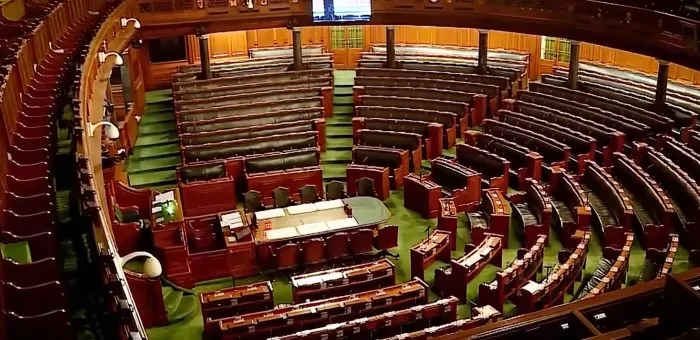
On the evening of 18 January 1977, Gandhi announced that a general election would be held in March, and the Fifth Lok Sabha was dissolved that day. Its term had already been extended under the Emergency, leaving the administration considerable time before another parliamentary contest became necessary. The announcement changed the immediate political timetable through a decision by the incumbent leadership. In her broadcast, Gandhi presented the preceding months as a period in which firm action had rescued the country from instability and enabled economic recovery. She acknowledged the principle that government derived its authority from the people and should periodically seek their sanction, while continuing to defend the restrictions through which her administration had governed. Electoral renewal appeared within this account as the next stage of national recovery, accompanied by warnings against disruptive activity. The promise to permit recognized parties to present their views existed alongside a claim that the government retained responsibility for defining acceptable conduct. Opponents were being offered an opportunity to challenge the administration within arrangements whose broader justification the prime minister continued to uphold.
Morarji Desai and L. K. Advani had been released before the evening broadcast. Their return to public activity gave immediate substance to the announcement, although other detainees remained confined. Opposition leaders accordingly demanded further releases and the removal of restrictions on meetings and reporting. Their response made the conditions of participation an urgent issue, since restoring prominent figures to public life would have limited practical value if the people needed to organize their campaigns remained unavailable.
On 20 January, the Union government announced further relaxation of Emergency rules, lifting curbs on political activity and press censorship for election purposes. State authorities were instructed to expedite the release of political detainees and permit public meetings, reopening activities through which parties could approach voters collectively. These measures represented a substantial change in political practice, but the Emergency itself remained in force. Polling took place on 16, 18, 19, and 20 March, before the proclamation was revoked on 21 March. The distinction is essential to understanding the uncertainty surrounding the campaign, because liberties being exercised through relaxation had not yet acquired the security of a completed constitutional restoration. Candidates and journalists had to assess what the new permissions allowed while remembering how recently the same authorities had restricted their work.
The treatment of newspapers illustrates the mixture of expanded opportunity and retained pressure. Censorship laws were held in abeyance, enabling reporting and criticism that had previously been obstructed, yet the Shah Commission subsequently documented efforts to influence editorial conduct through informal warnings. Its inquiry recorded threats concerning what might happen after the election and continued official monitoring of the press with possible future action in view. Such practices could encourage caution even when routine prior scrutiny had been suspended. They also show why formal permission to publish requires examination alongside the expectations confronting those responsible for publication. But the campaign cannot be understood simply as a continuation of the earlier restrictions under another name. Public meetings allowed opponents to address audiences, and freer reporting gave their claims a circulation that clandestine networks alone had struggled to achieve. Congress retained the advantages of incumbency, including its established relationship with government-controlled broadcasting, but it now faced organized criticism in settings where voters could compare competing accounts. The opening created room for action whose effects could not be determined solely by the leadership that had authorized it, making the conduct of the campaign consequential even before a ballot was cast.
For the opposition, participation meant deciding whether the available opening could support a genuine attempt to replace the government. Demands for freer conditions continued alongside preparations to contest, allowing politicians to challenge the arrangements without abandoning the opportunity they provided. The practical question became how to assemble campaigns capable of reaching constituencies within a short period after prolonged organizational disruption. Success required agreements among groups whose survival during the Emergency had preserved contacts and commitments, but had left unresolved who would stand where and how their competing claims would be reconciled.
Making Rejection Electorally Effective

India’s electoral system gave opposition coordination an importance that dissatisfaction alone could not supply. In each parliamentary constituency, the candidate receiving the largest number of votes won the seat, without needing an absolute majority. Several parties competing against Congress could divide support sufficiently to preserve its advantage, even where many electors preferred a change. To challenge the incumbent effectively, opposition leaders needed agreements about nominations that would reduce competition among themselves and give local supporters a candidate around whom they could organize.
The Janata formation announced in January 1977 brought together Congress (Organisation), the Bharatiya Lok Dal, the Bharatiya Jana Sangh, and the Socialist Party. Its public launch on 23 January presented a recognizable national combination, but the cooperation underlying it had a longer and less straightforward history. Rakesh Ankit’s reconstruction of negotiations beginning before the Emergency demonstrates the importance of disagreements over leadership and the terms on which organizations would surrender independence. Detention and restricted activity had increased the urgency of collaboration without settling those disputes. Jayaprakash Narayan exercised considerable influence through his insistence that opponents unite, linking his participation in the election campaign to their willingness to do so. His intervention supplied pressure that individual party leaders would have found difficult to exert across organizational boundaries. Yet unity also required decisions by politicians whose authority depended on followers and constituencies that Narayan could not simply direct. The short interval before polling encouraged agreements that earlier negotiations had failed to complete, because prolonged bargaining now threatened to squander the opportunity to contest. Electoral consolidation advanced ahead of the formal organizational merger, which followed the election in May.
This distinction appeared on the ballot through the arrangements for party recognition and symbols. The Election Commission explained that Janata could not yet receive recognition as a national party because the constituent organizations had not completed a legal merger. Its leaders accepted the position and used the Bharatiya Lok Dal’s symbol of a ploughman within a wheel across most of the country. In Tamil Nadu and Pondicherry, candidates instead contested under the Congress (Organisation) symbol, reflecting that organization’s more established presence there. Sponsorship declarations followed these arrangements, making the administrative categories in election returns different from the political identities through which the alliance addressed the electorate. A common electoral undertaking could operate through existing legal designations while its participants continued to negotiate a more complete union.
Jagjivan Ram’s departure from the government on 2 February widened the challenge to Congress in another direction. As minister of agriculture and irrigation and a veteran of successive Congress administrations, he possessed experience and public standing acquired within the governing establishment. His resignation from both the Cabinet and the party, accompanied by the announcement of the Congress for Democracy, made the fracture visible at a level that the release of established opposition leaders alone could not achieve. Hemvati Nandan Bahuguna and Nandini Satpathy brought further political connections into the new organization, whose national committee took shape on 5 February. Ram’s criticism of the destruction of internal party democracy challenged Gandhi’s conduct through standards associated with Congress’s own institutional history. The name Congress for Democracy likewise claimed continuity with a political inheritance, potentially offering dissatisfied Congress supporters a route away from the incumbent without requiring them to abandon every earlier allegiance. His standing as a prominent Dalit leader added significance, although neither that identity nor his influence establishes that Dalit voters acted as a uniform constituency at his direction. The defection also demands attention to his previous participation in Emergency government, since he had remained in office through the measures he now opposed. Its immediate effect was to strengthen an electoral challenge through a rupture within the administration itself. Congress for Democracy retained its separate organization during the campaign while cooperating with Janata, postponing formal absorption until after polling.
Agreements beyond these organizations extended the opposition’s constituency arrangements further. Electoral understandings included cooperation with the Akali Dal and the Communist Party of India (Marxist), whose political purposes remained distinct from those of Janata’s constituents. Their participation enlarged the range of local organizations that could work against Congress without requiring every ally to enter the same party. Cooperation rested on several kinds of agreement, with common sponsorship in some contests and negotiated support for separate organizations in others.
The practical value of these arrangements depended on what happened after leaders agreed to them. A nomination allocated to one component required supporters of other components to accept a candidate whose previous affiliations might have made cooperation difficult. Existing local knowledge could help campaigns identify sympathetic households, while workers returning to public activity faced the task of rebuilding contact after prolonged disruption. Symbols made candidates easier to identify, but recognition on a ballot still required campaigning to establish why that candidate deserved support. Malte Pehl’s subsequent analysis gives substantial weight to the reduction of competition among anti-Congress parties, emphasizing a mechanism through which votes acquired parliamentary effect. That interpretation brings negotiations over candidacies into the explanation of Congress’s vulnerability, alongside the grievances investigated in the preceding sections. The opposition had begun to convert organizational survival into the capacity to contest for office, giving criticism of the Emergency a practical objective that individual protests had been unable to secure.
Translating Coercion into Campaign Arguments
Congress’s election appeal sought to retain the language of democratic government while defending the administration’s capacity to deliver improvement. Its manifesto reaffirmed commitments to democracy and secularism, combining these with continued action against poverty and social inequality. The party also explicitly rejected compulsion in family planning, making its campaign position different from an unqualified endorsement of everything done during the Emergency. Gandhi’s public explanations attributed abuses to overzealous local officials while preserving the distinction between those practices and national policy. This defense allowed acknowledgment of hardship to coexist with a request for renewed confidence in the leadership. The argumentative effect was to present correction as possible within continued Congress government, rather than to concede that the conduct of the administration required its removal. Opponents challenged that separation, arguing that incidents described as local departures had become possible through the concentration of authority and the weakening of restraints on its exercise.
At Delhi’s opposition rally on 30 January, Morarji Desai presented the contest as a choice between democracy and dictatorship. Atal Bihari Vajpayee’s attack on compulsion in family planning gave that broad distinction a concrete administrative reference. The speeches connected the government’s treatment of citizens with the political arrangements under which officials acted. They invited listeners to interpret an encounter with coercion as evidence relevant to the character of the administration seeking their votes.
Janata’s manifesto gave institutional content to this appeal through promises to restore fundamental freedoms and judicial authority. Repealing preventive-detention legislation and ending censorship were presented as measures against the recurrence of arbitrary action, with protections extending to government employees subjected to political pressure. The platform also addressed employment and agrarian development, refusing the assumption that an electorate concerned with subsistence had to choose between material provision and political liberty. These commitments mattered because rights could be explained through their bearing on everyday vulnerability, including the ability to challenge an official or organize around a workplace grievance. Janata likewise retained family planning within its social program while rejecting coercion, enabling criticism of the campaign’s methods without abandoning population policy altogether. Its stated alternative concerned both what government should provide and the means through which citizens could hold it to its undertakings.
The credibility of Congress’s promise against compulsion became an immediate practical problem during the campaign. A memorandum of 17 February, subsequently reproduced by the Shah Commission, warned that people would not believe the government’s announcements or manifesto while administrative orders continued to make sterilization a condition of access to ordinary facilities. Approved by Gandhi, the note attributed the problem to the excessive enthusiasm of several administrations and recommended withdrawing the offending requirements. The prime minister’s secretariat issued a direction on 18 February that such conditions should be reviewed and withdrawn. This correspondence provides unusually direct evidence of electoral pressure entering the calculation of policy. Public assurances were being tested against requirements that people could still encounter at an office or institution, making a declaration of principle insufficient to restore confidence. The distinction between official intention and local execution required action that citizens could recognize in practice. Withdrawal could remove a source of continuing pressure, but it could not determine how people would assess the leadership responsible for the larger campaign. Opposition speakers could interpret the retreat as confirmation that coercion had occurred, while Congress could present it as evidence of responsiveness. The disagreement concerned whether the incumbent’s corrective action supplied a reason to retain it or an additional reason to distrust its earlier account.
Sanjay Gandhi’s prominence supplied another route through which questions about responsibility entered the contest. His influence without ministerial office exposed a disparity between the formal organization of government and the relationships through which priorities could be enforced. Campaign strategy varied. The American Embassy’s account of Desai’s January rally specifically observed that he criticized policies and avoided attacking Sanjay. Such choices could keep attention on the responsibility of the governing administration, rather than allowing controversy over the prime minister’s son to absorb the broader question of how public power had been exercised.
Local election literature shows how these themes could be attached to a constituency candidate. A Janata leaflet for South Bombay placed contrasts between democracy and dictatorship on its cover, then presented Ratansinh Rajda’s detention under the Maintenance of Internal Security Act as part of his claim to represent voters. Imprisonment became a political credential through which an individual candidate could be associated with the liberties his party promised to restore. The English appeal combined protection of democratic institutions with action on unemployment and rising prices, bringing concerns about state authority into the same electoral message as economic difficulties. This combination gave the national argument a local representative and a set of recognizable undertakings. It also encouraged voters to assess a candidate through his conduct during the Emergency, alongside his professional and municipal experience. The leaflet reveals an effort to make civil liberty relevant to the selection of a parliamentary representative, although its promises establish the campaign’s intended appeal rather than the responses of everyone who received it.
Campaigning brought a question about future protection into disputes over acts already completed. Congress offered correction under its continued leadership, asking electors to accept its distinction between the purposes of policy and abuses in implementation. Janata’s proposed safeguards made the identity of those controlling government part of the remedy, linking a change of administration with restrictions on the powers available to its successor. The choice allowed experiences previousl
March 1977 and the Removal of Congress
Across the four polling days between 16 and 20 March, campaigning gave way to decisions recorded individually on ballot papers. The distinction between attending an opposition meeting and casting a vote mattered, since the secret ballot allowed a preference to enter the official count without requiring its public declaration. Electoral officials administered that process within a state still operating under the June 1975 Emergency, making the conduct of the poll essential to the opportunity its announcement had created. As returns accumulated on 20–21 March, they established that Congress could no longer command the parliamentary position on which its government depended. The decisive development was the conversion of individual choices into constituency victories sufficient to replace the incumbent administration.
The final Election Commission returns recorded 154 Congress seats and 34.52 percent of valid votes, while candidates classified under the Bharatiya Lok Dal designation won 295 seats with 41.32 percent. Three further seats recorded under Congress (Organisation) brought the Janata combination’s total to 298. These classifications encompass the electoral arrangements described earlier, including candidates associated with Congress for Democracy; its representatives must not be added again as though they formed a wholly separate tally. The figures establish a clear majority in the elected chamber without implying that the largest electoral formation obtained an absolute majority of votes nationally. Congress retained a substantial share of ballots, but that support produced far fewer successful candidates than the opposition’s coordinated challenge. The scale of parliamentary displacement exceeded what a comparison of national percentages alone might suggest. These completed totals also belong to a later stage than the first recognition of defeat, because a few delayed contests and a repoll remained outstanding when the new Parliament assembled. The transfer of government could proceed once the majority was secure, before every seat had been settled.
Rae Bareli gave the national reversal its most conspicuous individual expression. Raj Narain received 177,719 votes against Gandhi’s 122,517, defeating her by 55,202. The opponent whose earlier election petition had helped precipitate the crisis of 1975 now obtained an electoral victory in the constituency itself. His success settled who would represent Rae Bareli in the new House, giving the contest an outcome distinct from the litigation over the previous election. For Gandhi, the result exposed the vulnerability of a leadership whose national prestige had often been presented through an unusually direct relationship with the electorate. Its symbolic force needs to be located within the parliamentary result, because the replacement of her government depended on Congress’s wider loss of seats rather than on one constituency alone.
Sanjay Gandhi also failed to enter Parliament from Amethi. Ravindra Pratap Singh defeated him by 75,844 votes, interrupting the attempt to translate his growing influence into elected office. The result prevented the new House from providing the immediate parliamentary position that his candidacy had sought. The defeats at Amethi and Rae Bareli denied representation to the two figures most closely associated with the Emergency’s political leadership.
The constitutional response unfolded through several acts whose sequence is important. On 21 March, Acting President B. D. Jatti revoked the proclamation of internal Emergency issued on 25 June 1975. This action occurred under the outgoing administration, before the installation of its successor, and should be distinguished from the measures later undertaken by the Janata government. Gandhi tendered her resignation and that of her Council of Ministers on 22 March, remaining in office until the new prime minister assumed responsibility. The Sixth Lok Sabha was constituted on 23 March, establishing the representative body within which the opposition’s electoral strength would become authority to govern. These proceedings gave institutional effect to an outcome that had already become unmistakable through the returns. They also maintained continuity in administration during the interval between resignation and replacement. The acceptance of defeat acquired practical meaning through this relinquishment of office, rather than ending with a statement acknowledging the voters’ decision.
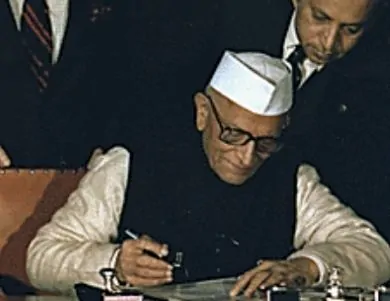
Agreement on Gandhi’s departure did not automatically identify her successor. Consultations involving Jayaprakash Narayan and J. B. Kripalani helped produce consensus around Morarji Desai, who was unanimously selected as Janata’s parliamentary leader on 24 March. Jatti swore him in as prime minister that day, completing the immediate transfer of executive leadership. Formal unanimity emerged from negotiations among competing leaders, making Desai’s appointment the product of parliamentary settlement rather than a direct national vote for him personally.
The installation of the remaining ministers on 26 and 28 March made clear that forming the successor administration was itself a process. Desai inherited institutions whose powers and procedures had been altered during the preceding twenty-one months, requiring further decisions about what would be retained or reversed. The separate proclamation associated with the 1971 external Emergency remained briefly in force until its revocation on 27 March, while ending the June 1975 Emergency did not automatically repeal the legislation enacted during it. Changes to constitutional arrangements likewise required action beyond the replacement of ministers. Granville Austin’s constitutional history helps locate the transfer within this longer work of institutional repair, distinguishing the recovery of electoral competition from the reconstruction of safeguards damaged under Emergency rule. The Election Commission’s successful registration of an adverse result demonstrated that important procedures had remained capable of producing an outcome the incumbent did not control. Officials working within the state had administered a contest that displaced the party directing it. That achievement deserves recognition alongside the failures examined earlier, since the same political order contained both instruments of coercion and an electoral mechanism through which control of those instruments could change hands.
For the first time since independence, the central government passed from Congress to a different political formation. The transition established that the organization which had dominated national office could be required to surrender it through parliamentary elections. Its significance rested on the completion of that change, with the defeated leadership leaving office and a successor assuming responsibility under constitutional procedures. But understanding the scale and limits of the judgment that produced it requires examining where Congress lost its representation and where voters continued to sustain it.
The Uneven Geography of Rejection
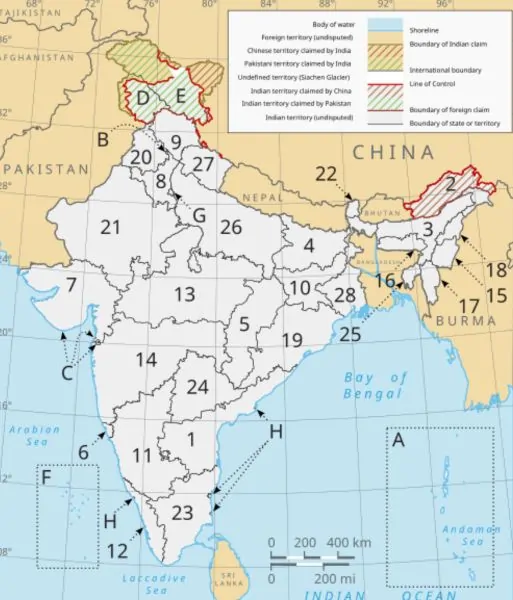
Congress’s defeat was concentrated most heavily in the northern states, while parts of southern India returned substantial parliamentary delegations committed to keeping the party in office. It won none of Uttar Pradesh’s 85 seats or Bihar’s 54, and Delhi also elected an entirely opposition delegation. Andhra Pradesh, by contrast, returned 41 Congress members from 42 constituencies, while Karnataka elected 26 from 28. These differences demand an explanation of how the same national government became electorally unacceptable across extensive territories while maintaining commanding positions elsewhere.
Regional Congress organizations provide an essential starting point. James Manor’s examination of the states in which Congress survived challenges interpretations that treat the party’s relationship with society as an extension of decisions taken in New Delhi. National centralization had advanced considerably under Gandhi, yet state leaders still operated through political relationships with histories and purposes of their own. In Karnataka, Chief Minister Devaraj Urs had used the opportunities created by the Congress split to broaden the governing coalition beyond established concentrations of influence. Atul Kohli describes a political arrangement that incorporated groups previously excluded from the older ruling alliance, combining the distribution of patronage with a commitment to visible redistributive measures. Kohli also emphasizes the limitations of these reforms, which prevents an electoral explanation from becoming an uncritical celebration of Urs’s government. The relevant point is that Congress could possess a recognizable regional record through which claims about welfare acquired practical meaning. Voters encountered the national party through a state administration whose leadership had cultivated reasons for continued allegiance. Congress received more than half the valid votes in both Karnataka and Andhra Pradesh, making its strength in these states considerably more substantial than a favorable distribution of narrow constituency victories would suggest. Their support requires attention to the persistence of Congress’s regional constituencies alongside the collapse of its authority elsewhere.
Administrative variation also affected how national initiatives entered everyday life. Christophe Jaffrelot and Pratinav Anil emphasize differences in the independence of chief ministers and their susceptibility to pressure from the central leadership, helping explain why Emergency government did not operate with equal severity throughout India. The authority available to a regional leader could influence how demands were implemented and whether local objections secured a response. Southern administrations participated in coercive practices. The Shah Commission recorded complaints presented in December 1976 that teachers and other employees in Tamil Nadu faced disciplinary action for failing to meet family-planning recruitment targets; the Health Secretary subsequently instructed the state to withdraw threatening circulars and restore affected employees. This episode exposes both the existence of administrative intimidation and an attempt to reverse it, directing comparison toward the extent of pressure and the possibilities of obtaining relief.
Tamil Nadu’s parliamentary contest was shaped by rivalries that gave the Emergency a different electoral setting from the one prevailing in Uttar Pradesh or Bihar. Gandhi’s government had dismissed the Dravida Munnetra Kazhagam ministry in January 1976, and the DMK experienced detention and restrictions on political activity. Its experience supplied substantial grounds for campaigning against the central government. Yet the opposition to Congress confronted an alliance headed locally by the All India Anna Dravida Munnetra Kazhagam, the organization established by M. G. Ramachandran after his break with the DMK. The AIADMK won 17 parliamentary seats, Congress won 14, and the Communist Party of India won three, giving their combination 34 of the state’s 39 constituencies. This outcome made the electoral standing of the principal Dravidian rivals indispensable to any explanation of Congress’s success. Support for an AIADMK candidate could reflect attachment to Ramachandran or hostility toward the DMK, while Congress benefited from arrangements that concentrated allied support behind agreed candidates. The arithmetic also illustrates the dangers of comparing isolated party percentages across states. Congress’s 22.27 percent share of Tamil Nadu’s valid votes was lower than its 24.99 percent in Uttar Pradesh, where it won no seats, but Congress contested only 15 Tamil Nadu constituencies under its alliance agreement. Its supporters could vote for allied candidates in the remaining constituencies without appearing in the Congress vote total. Tamil Nadu presents a distinct interpretive problem, because a parliamentary victory for Gandhi’s allies incorporated political preferences whose immediate objects extended well beyond her government.
Kerala supplied another form of electoral resilience, with the parties of the governing front taking all 20 parliamentary seats. Congress won 11, while its partners included the CPI, the Muslim League, Kerala Congress, and the Revolutionary Socialist Party. During the Emergency, the state ministry had been headed by C. Achutha Menon of the CPI, with Congress’s K. Karunakaran holding the Home portfolio, so the governing record belonged to a coalition with several organized constituencies. Its victory shows how an established state alliance could remain electorally effective while Congress was losing its capacity to assemble a national parliamentary majority.
The results outside these southern states further unsettle a division of India into two opposing political regions. In Maharashtra, Congress retained 20 of 48 parliamentary seats and received 47.02 percent of the valid votes, a performance that combined a serious loss of representation with substantial continuing support. Assam returned Congress members in 10 of its 14 constituencies, demonstrating that the party’s electoral survival extended beyond the south. West Bengal presents a different qualification, concerning the political ownership of opposition success. Congress won only three of its 42 seats, but the Communist Party of India (Marxist) secured 17, compared with 15 for candidates returned under the Bharatiya Lok Dal designation used by the Janata combination. The Marxist left brought an established organizational presence to the contest, giving the defeat of Congress a regional political direction distinct from Janata’s predominance across much of northern India. Counting every opposition victory as an expression of the same emerging party allegiance would obscure these differences. The parliamentary majority that removed Gandhi was assembled through contests in which voters confronted different principal adversaries and different plausible successors. A common national outcome could emerge from regional struggles whose participants retained separate commitments about who should govern afterward.
These comparisons place limits on explanations that move directly from the documented intensity of coercion to the distribution of parliamentary seats. Malte Pehl’s reassessment of the election draws attention to opposition coordination and the preexisting strength of Congress, both of which complicate attempts to isolate the electoral effects of Emergency abuses. Administrative statistics create another difficulty, since the number of sterilizations performed cannot establish how many involved threats, and a state’s aggregate vote cannot identify how those affected subsequently voted. A convincing regional explanation must bring such figures into contact with evidence about local implementation and the political relationships through which citizens sought assistance. The geographical pattern supports an interpretation in which coercion could destroy governing authority, while specifying the circumstances that made such destruction electorally decisive. Congress remained competitive where regional leadership and established alliances sustained persuasive reasons to support its candidates, leaving the national repudiation powerful in its institutional effect and uneven in its social foundations.
Investigating the Emergency after Its Defeat
Removing Congress from office left unresolved the question of how responsibility for Emergency abuses should be established. On May 28, 1977, the Janata government appointed a commission under the Commissions of Inquiry Act of 1952, placing former Chief Justice of India J. C. Shah at its head. Its terms covered misconduct by public servants and others associated with their actions, while also requiring recommendations to prevent recurrence. The investigation gave allegations previously advanced through opposition campaigning an institutional setting in which specific decisions could be examined and explanations demanded from those involved.
The Commission’s work depended on connecting complaints with records that could establish how administrative action had developed. It received 48,500 complaints, a substantial body of material that required sorting before investigation could proceed. Some submissions fell outside its mandate, while others were referred to central or state authorities; selected cases were investigated through the Commission’s own machinery. Public hearings concentrated on instances that appeared to involve blatant abuses, making the resulting record a deliberately assembled collection rather than a representative survey of Indian experiences. Oral hearings began on September 29, 1977, and most sessions were open, although some witnesses were examined privately. Official correspondence could be placed beside recollections of meetings, allowing investigators to compare the reasons originally recorded for an action with explanations offered after the government’s defeat. Dates acquired considerable significance because they could reveal whether an administrative justification preceded a decision or had been supplied afterward. The Commission also sought testimony from individuals implicated in the matters under examination, creating opportunities to expose disagreements within the official account. Through these procedures, conduct previously obscured by restricted publicity became available for sustained examination, and accusations could be developed into accounts of identifiable administrative decisions.
Statements collected after the transfer of power still emerged under circumstances that encouraged fresh forms of self-protection. Officials who had previously demonstrated responsiveness to the Emergency leadership now had reasons to describe themselves as reluctant instruments of superior authority. Some such explanations could be accurate, but their plausibility depended on corroboration rather than the mere assertion that pressure had existed. Alexander Lee’s discussion of Emergency archives identifies contrasting incentives affecting documents produced under the regime and material subsequently assembled for investigating it. Earlier records could conceal failures or reproduce officially approved explanations, while the later inquiry encouraged attention to misconduct attributable to prominent political figures. Historians have to examine how each document came into existence, weighing retrospective claims against contemporary correspondence and the accounts of people subjected to the actions described.
Procedural disputes presented a further challenge that cannot be dismissed simply because Gandhi had strong political reasons to resist the investigation. She contested the Commission’s methods and rejected its authority to question her in the manner proposed, while Shah defended a procedure that distinguished preliminary fact gathering from a subsequent inquiry into individual conduct. This distinction affected when people whose reputations were at stake could exercise their statutory rights to respond and cross-examine witnesses. Sections 8B and 8C of the governing legislation provided protections for such individuals, making the timing of those safeguards a substantive legal issue. In a judgment delivered on December 20, 1979, the Delhi High Court found that these requirements had not been observed in the proceedings concerning Gandhi and Pranab Mukherjee. It quashed prosecutions arising from their refusal to take an oath or answer questions before the Commission. That decision concerned the legality of those proceedings and the resulting prosecutions; it did not determine that every allegation documented in the reports was false. Its significance extends beyond the immediate advantage it offered Gandhi, since the investigation’s public purpose could not remove its obligations toward those it examined. An institution established to expose arbitrary government had compelling reasons to demonstrate respect for procedural rights in its own work. Recognizing this failure makes the historical assessment more exacting, requiring the documentary findings and the legality of the investigative process to be evaluated on their respective merits.
Three reports appeared in 1978, supplying findings that could inform administrative action and further investigation. Their publication did not itself establish criminal guilt, since the Commission could neither convict defendants nor impose criminal sentences. The Home Ministry’s annual report subsequently recorded that a special Central Bureau of Investigation cell had registered nineteen first information reports by February 20, 1979, indicating the opening of criminal cases rather than completed prosecutions. The distance between exposing wrongdoing and obtaining a practical remedy remained substantial for people whose losses could not be reversed by an official account.
For historians, the Commission’s organizing assumptions are as important to recognize as the material it preserved. Gyan Prakash argues that the investigation helped consolidate an interpretation of the Emergency as a departure from ordinary government, with its abuses presented as exceptional transgressions. Such a framework could direct attention toward identifiable offenders while giving less prominence to practices and ambitions that had developed before 1975. The mandate permitted recommendations against recurrence, so structural criticism was possible, but an emphasis on specific misconduct could still narrow the explanation of how that misconduct became administratively feasible. The reports also require careful placement within the chronology of the election. Findings published in 1978 can establish circumstances surrounding earlier actions without demonstrating that voters possessed the same information in March 1977. Their value for explaining the defeat lies partly in clarifying the experiences from which grievances arose, while campaign evidence and contemporary testimony remain necessary for investigating how those grievances informed electoral choices. The inquiry substantially enlarged the historical record, leaving the meaning of its discoveries open to interpretation and the political future of those it investigated unresolved.
Defeat without Political Extinction, 1977–1980
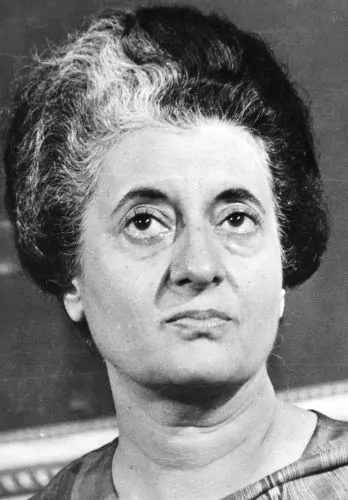
Gandhi emerged from the 1977 election without a parliamentary seat, yet she remained a national political figure with substantial resources for rebuilding her position. Congress’s surviving organizations offered connections through which supporters could continue to mobilize, while her identification with the party retained an appeal that defeat had damaged without destroying. Restored political competition also protected her opportunity to campaign against the government that had replaced her. Her prospects depended increasingly on whether Janata could turn the authority acquired through opposition into a convincing record of administration.
Reconstruction involved a struggle over who would command Congress after its removal from national office. Gandhi’s relationship with other party leaders deteriorated as disagreement developed over the organization’s future and her place within it. In January 1978, she and her supporters established a separate organization, subsequently recognized by the Election Commission as Congress (I), with the identifying initial making her leadership explicit. This development divided the forces that had previously governed together, while allowing her followers to distinguish their allegiance from that of Congress politicians seeking greater distance from her. The split gave Gandhi an organizational vehicle through which to contest both Janata and rival claimants to the Congress inheritance. Her victory in the Chikmagalur parliamentary by-election in November 1978 supplied a further demonstration that she could still attract an electorate prepared to return her to representative office. That recovery remained contested, since the Lok Sabha expelled her the following month after parliamentary privilege proceedings. Her supporters could use such confrontations to present their leader as the object of punitive treatment, directing attention toward the conduct of her successors. Electoral activity and the consolidation of a separate party worked alongside this claim of political persecution. Gandhi’s revival required sustained intervention in the altered political landscape, including the recruitment of followers willing to make her leadership the basis of Congress’s reconstruction.
The government confronting her undertook reforms that would outlast its parliamentary majority. The Maintenance of Internal Security Act was repealed in 1978, removing an instrument extensively employed against political opponents during the Emergency. The Forty-fourth Amendment tightened the constitutional conditions for proclaiming an Emergency, replacing the expansive category of internal disturbance with armed rebellion and requiring the Union Cabinet’s decision to be communicated in writing. It also excluded Articles 20 and 21, protecting against certain abuses of criminal punishment and safeguarding life and personal liberty, from the rights whose judicial enforcement could be suspended under Article 359. These changes preserved emergency powers while restricting their operation, giving the experience of 1975–77 an enduring place in constitutional revision.
Janata’s difficulties arose from disagreements about the purposes of government as well as competition among its senior leaders. Susanne Hoeber Rudolph and Lloyd I. Rudolph locate these tensions within struggles over social representation, including the growing claims of agrarian interests against established priorities associated with urban and industrial development. Charan Singh’s political standing rested heavily on his identification with cultivators, giving disputes over economic direction a constituency beyond the Cabinet. The controversy surrounding the continued association of former Jana Sangh members with the Rashtriya Swayamsevak Sangh raised another substantive question about the commitments of the governing party. Critics regarded those connections as incompatible with Janata’s assurances of secular government and equal citizenship for minorities, while their defenders rejected that interpretation. Such differences made the management of the party inseparable from disputes about whose interests it represented and what its public commitments required. Leadership rivalries sharpened these divisions, repeatedly turning disagreements into contests over ministerial authority and succession. Economic deterioration then increased the costs of governmental instability. As Vijay Joshi and I. M. D. Little explain, the severe drought of 1979 and renewed increases in international oil prices contributed to an inflationary crisis, alongside domestic monetary and fiscal pressures. These conditions prevent a fair assessment from attributing every hardship to factional conflict, but they also explain why visible indecision became politically damaging. Households facing higher prices had immediate reasons to judge the administration by its capacity to respond, placing Janata’s performance under an increasingly unfavorable comparison with its promises.
The parliamentary crisis of 1979 gave Gandhi opportunities to influence events before another election occurred. Morarji Desai resigned in July, and Charan Singh became prime minister with support from Congress (I). Gandhi’s party withdrew that support before the confidence motion scheduled for August 20, prompting Singh’s resignation without the proposed parliamentary test taking place. The Lok Sabha was dissolved on August 22, with Singh remaining in a caretaker capacity until a new government could be formed. Gandhi had helped determine the circumstances in which voters would next choose between her leadership and the divided parties that had displaced her.
Congress (I)’s subsequent campaign placed governmental competence at the center of the contest, emphasizing inflation and the restoration of effective administration. A contemporary American embassy assessment recorded Gandhi’s attention to prices and law and order, identifying priorities that differed from the defense of Emergency rule. The final election returns gave her party 353 seats and 42.69 percent of the valid vote, while Janata secured 31 seats and Janata (Secular) 41. Congress (I)’s recovery extended into areas where Congress had suffered its most striking losses three years earlier, including Uttar Pradesh, where it now won 51 of 85 constituencies. These results represented a substantial renewal of support, although opposition fragmentation increased the parliamentary advantage obtained from it. Gandhi resumed the premiership on January 14, 1980, through an election conducted within the competitive system restored after her defeat. Her success demonstrates the limits of interpreting 1977 as the beginning of an inevitable retreat from political life. It also makes the leadership she offered an indispensable part of the explanation, since dissatisfaction with Janata could become a Congress victory only through choices favoring her candidates and their commitments.
The restored majority changed the distribution of power without settling the historical meaning of the earlier election. Diego Maiorano’s analysis emphasizes that Congress’s recovery continued the personalization and weakening of party institutions, qualifying any assumption that renewed electoral dominance recreated the older Congress system. Gandhi had recovered office through an organization increasingly identified with her own authority. That rehabilitation was politically substantial, yet the electorate of 1980 faced a governing record and a configuration of parties different from those presented in 1977. Returning her to power authorized a new administration without supplying a precise retrospective judgment on each Emergency policy. The sequence leaves an interpretation in which citizens could impose a severe electoral sanction and subsequently reconsider the available leadership, while the constitutional response to the Emergency survived the government that enacted it. Explaining those changes requires attention both to the grievances that made Gandhi removable and to the limitations of the political alternative that first benefited from them.
A Verdict against Coercion or a Victory of Electoral Coordination?
The following video from Sansad TV is a history of India’s Emergency under Indira Gandhi:
An electoral alliance can change who wins office without producing a corresponding transformation in voters’ political beliefs. Applied to 1977, this possibility challenges an interpretation that makes opposition to coercion the principal explanation for Congress’s removal. People who had long opposed Gandhi could support an agreed candidate through established party loyalties or local political relationships, with little change in their underlying preferences. The strongest alternative account would locate the decisive development in the organization of competition, treating the result primarily as the success of parties that had previously weakened one another by competing separately.
Malte Pehl’s reassessment identifies opposition coordination as the most important proximate explanation of Congress’s defeat. Comparing twenty-two states and union territories, he finds stronger associations between opposition unity and Congress’s losses than between those losses and the available indicators of arrests or sterilization. His argument includes changes in voting, since a coordinated alternative could persuade citizens that its candidates could win and its leaders could govern. On this interpretation, unification attracted additional voters while concentrating support already available. The official returns illustrate why the distinction matters. Congress’s national share of valid votes fell from 43.68 percent in 1971 to 34.52 percent in 1977, while its parliamentary representation declined from 352 seats to 154. Its loss of support was substantial, but the fall in seats was much sharper than the movement in vote share. Congress had itself secured a commanding parliamentary majority in 1971 with considerably less than half the valid vote, demonstrating how effectively a leading party could benefit from the distribution of competing support. Treating the subsequent parliamentary outcome as a direct measurement of popular hostility would overlook the changed conditions under which votes acquired their effects. An explanation centered on Emergency abuses must account for the opposition’s organizational achievement instead of allowing the scale of Congress’s defeat to stand as sufficient proof of its cause.
The decline in Congress’s vote share still presents a difficulty for an account confined to pooling established opposition support. Myron Weiner, who recognized the importance of Janata’s formation, also emphasized steep falls in Congress support in northern constituencies. Such losses show that something more occurred than the reassignment of unchanged preferences to fewer candidates. They establish the need to explain why Congress lost support, although the electoral figures alone cannot determine whether grievances against the government, greater confidence in its challengers, or their combined influence supplied the decisive incentive.
Distinguishing these explanations requires reconstructing the sequence that produced both the opposition alliance and the change in voting. Rakesh Ankit’s examination of negotiations beginning before the Emergency demonstrates that cooperation cannot be derived entirely from repression after June 1975. Leaders already had ambitions and strategic reasons for challenging Congress, and the pursuit of a common organization involved bargaining that required purposeful decisions. The Emergency could intensify those incentives and make existing divisions more costly without creating the opposition’s interests from nothing. Pehl himself acknowledges repression as a catalyst for unification, leaving room for coercion and coordination to operate through an interconnected process. His comparative findings also require assessment against the limits of the evidence. The exclusion of Delhi as an outlier is defensible for comparison, but restricts what the analysis can establish about a central case examined here. More broadly, a state’s recorded administrative activity provides an imperfect measure of coercion’s political reach, since an incident could influence relatives and neighbors who never appeared among its direct victims. Citizens exposed to such reports could also continue supporting Congress because they preferred its candidates or distrusted the alternatives. Correlations between electoral concentration and Congress’s losses identify an important relationship without independently reconstructing this sequence of judgments. Campaign appeals connecting accounts of mistreatment with requests for electoral support help establish how opposition organizations pursued that relationship, while leaving its reception among different audiences open to investigation. Grievance and coordination belong within the same causal inquiry, with neither assumed to supply a complete account of the other.
The main argument requires a narrower formulation in light of this challenge. Emergency coercion furnished serious grievances and helped alter the conditions of opposition cooperation, while the construction of an effective electoral alternative gave those grievances a route to governmental change. This interpretation leaves space for voters motivated by longstanding allegiances and for those whose support depended on the practical credibility of Congress’s opponents. It also distinguishes opposition to official intimidation from a comprehensive commitment to every principle associated with liberal democracy. What the result establishes most firmly is that Congress’s record, when exposed to effective competition, failed to secure the parliamentary authority Gandhi sought. The significance of 1977 rests on citizens’ ability to enforce that rejection through the choices available to them, with electoral coordination forming part of the explanation for how the government became removable.
Conclusion: What Political Silence Could Not Prove
The Emergency placed a government’s claim to serve the public in conflict with the insecurity produced by its exercise of authority. Developmental intentions could offer little reassurance to people who lacked a dependable means of challenging what officials required of them. Where assistance became conditional on submission, or appeals failed to arrest harmful action, administrative success could be experienced as the loss of protection. The relationship between government and citizen changed because those exercising power increasingly reserved for themselves the authority to define what counted as a benefit and whether its intended recipients could reasonably object.
Campaigning allowed such experiences to enter a public argument about the government’s continued fitness to hold office. Opposition organizations connected complaints that had emerged under different circumstances, giving them national political significance without eliminating their local meanings. Voters approached the contest through existing allegiances and judgments about the candidates available to them, so the outcome cannot be reduced to a shared account of what the Emergency represented. The credibility of the opposition mattered because dissatisfaction acquired greater practical force when another government appeared possible. Electoral coordination formed part of this process, influencing both the attractiveness of opposition candidates and the parliamentary effect of their support. Yet the resulting choice also belonged to a form of accountability that required less agreement about individual wrongdoing than a formal investigation would demand. Electors did not have to establish criminal liability or reconstruct every chain of command before deciding whom they wished to remove. Measures authorized by law could still become grounds for rejecting the administration that employed them, just as claims of beneficial intentions remained open to political judgment. This distinction helps explain why the later recovery of documentary evidence enlarged knowledge of the Emergency without creating the authority through which Congress had already been displaced. Citizens could withdraw confidence from a government without first securing its agreement that their grievances were justified.
Geographical variation and Gandhi’s return in 1980 establish the boundaries of this interpretation. The electorate that removed her government contained enduring Congress constituencies, and the choices available to citizens changed as Janata’s administration faltered. Her recovery demonstrates that responsibility for the Emergency did not become an insurmountable obstacle to obtaining another mandate, although renewed support cannot be assigned a single retrospective meaning. Electoral accountability allowed a former prime minister to seek rehabilitation while preserving the significance of the earlier decision to replace her.
Political quietness was evidence whose interpretation depended on the conditions under which it occurred. Some citizens approved of the government, while others accommodated demands because objection threatened interests they could scarcely afford to endanger. The absence of an effective public challenge could leave these different relationships to authority outwardly indistinguishable, especially when officials were rewarded for reporting successful implementation. Historians must resist interpreting that ambiguity as either general acceptance or universal concealed opposition. What the Emergency weakened was the public capacity to test official claims through sustained criticism and accessible redress, depriving those in power of dependable opportunities to encounter objections they had reasons to discount. The election exposed the importance of those opportunities by allowing disagreement to acquire an institutional effect that administrative assurances had failed to anticipate. Congress’s defeat demonstrated how precarious a claim to public approval became when its supporting evidence had been gathered under restrictions on public expression. The difficulty of expressing disagreement under the Emergency could never establish that the government had earned the approval it claimed.
Bibliography
Affiliate disclosure: Amazon links on this site are paid links. As an Amazon Associate I earn from qualifying purchases.
- Anderson, Edward, and Patrick Clibbens. “‘Smugglers of Truth’: The Indian Diaspora, Hindu Nationalism, and the Emergency (1975–77).” Modern Asian Studies 52:5 (2018), 1729–1773.
- Ankit, Rakesh. “Janata Party (1974–77): Creation of an All-India Opposition.” History and Sociology of South Asia 11:1 (2017), 39–54.
- —-. “Jayaprakash Narayan and Indira Gandhi, 1966–74: Before the Rivalry.” Studies in History 37:2 (2021), 213–234.
- Austin, Granville. Working a Democratic Constitution: A History of the Indian Experience. New Delhi: Oxford University Press, 1999.
- Bombay High Court. Binod Rao v. Minocher Rustom Masani. Judgment of February 10, 1976. 78 Bombay Law Reporter 125.
- Chandra, Bipan. In the Name of Democracy: JP Movement and the Emergency. New Delhi: Penguin Books, 2003.
- Connelly, Matthew. “Population Control in India: Prologue to the Emergency Period.” Population and Development Review 32:4 (2006), 629–667.
- Dhar, P. N. Indira Gandhi, the “Emergency,” and Indian Democracy. New Delhi: Oxford University Press, 2000.
- Dhital, Pragya. “Media Satyagraha in the Broadcast Age: Underground Literature and Populist Politics during the Indian Internal Emergency of 1975–1977.” Interventions 21:7 (2019), 942–958.
- Election Commission of India. Report on the Sixth General Elections to the Lok Sabha and General Elections to the Kerala Legislative Assembly 1977. Vol. 1. Delhi: Election Commission of India, 1978.
- —-. Statistical Report on General Elections, 1977, to the Sixth Lok Sabha. Vol. 1. New Delhi: Election Commission of India, 1978.
- “The Elephant Can Run.” Yojana 19:12 (July 15, 1975), 4–5.
- Frankel, Francine R. India’s Political Economy, 1947–2004: The Gradual Revolution. 2nd ed. New Delhi: Oxford University Press, 2005.
- Gandhi, Indira. “Emergency to Stop Subversion of Democracy and Development.” Yojana 19:11 (July 1, 1975), 3.
- —-. “P. M. Outlines the New Economic Programme.” Yojana 19:12 (July 15, 1975), 6.
- Gwatkin, Davidson R. “Political Will and Family Planning: The Implications of India’s Emergency Experience.” Population and Development Review 5:1 (1979), 29–59.
- India. Bonded Labour System (Abolition) Act, 1976. Act 19 of 1976.
- —-. Lok Sabha Secretariat. Journal of Parliamentary Information 23:2 (April–June 1977).
- —-. Lok Sabha Secretariat. Journal of Parliamentary Information 23:3 (July–September 1977).
- —-. Maintenance of Internal Security Act, 1971. Act 26 of 1971, as amended.
- —-. Ministry of Information and Broadcasting. White Paper on Misuse of Mass Media during the Internal Emergency. Delhi: Controller of Publications, 1977.
- —-. Shah Commission of Inquiry. Interim Report. New Delhi: Government of India, 1978.
- —-. Shah Commission of Inquiry. Second Interim Report. New Delhi: Government of India, 1978.
- —-. Shah Commission of Inquiry. Third and Final Report. New Delhi: Government of India, 1978.
- Indian National Congress. 1977 Congress Election Manifesto. New Delhi: All India Congress Committee, 1977.
- Jaffrelot, Christophe, and Pratinav Anil. India’s First Dictatorship: The Emergency, 1975–1977. London: Hurst, 2020.
- Janata Party. Election Manifesto, 1977. New Delhi: Janata Party, 1977.
- Kaviraj, Sudipta. “Indira Gandhi and Indian Politics.” Economic and Political Weekly 21:38/39 (1986), 1697-1708.
- Kohli, Atul. The State and Poverty in India: The Politics of Reform. Cambridge: Cambridge University Press, 1987.
- Lee, Alexander. “The Library of Babel: How (and How Not) to Use Archival Sources in Political Science.” Journal of Historical Political Economy 2:3 (2022), 499–526.
- Manor, James. “Where Congress Survived: Five States in the Indian General Election of 1977.” Asian Survey 18:8 (August 1978), 785–803.
- Noorani, A. G. “Janata—The Way It Was Born.” The Illustrated Weekly of India, November 26, 1978, 19–23.
- Pehl, Malte. “Democratic Backlash? Revisiting Competing Explanations for the 1977 Post-Emergency Electoral Verdict in India.” Asian Journal of Political Science 16:3 (2008), 303–331.
- The Pen in Revolt: Underground Literature Published during the Emergency. New Delhi: Press Institute of India, 1978.
- Prakash, Gyan. Emergency Chronicles: Indira Gandhi and Democracy’s Turning Point. Princeton, NJ: Princeton University Press, 2019.
- Puri, Balraj. “Era of Indira Gandhi.” Economic and Political Weekly 20:4 (1985), 148-150.
- Raghavan, Srinath. Indira Gandhi and the Years That Transformed India. New Haven, CT: Yale University Press, 2025.
- Roy, Ajit. “The Failure of Indira Gandhi.” Economic and Political Weekly 19:45 (1984), 1896-1897.
- Roychowdhury, Adrija. “Indira Gandhi Endgame: What Impelled Her to Call Elections?” Indian Express, June 30, 2025.
- Shah, Ghanshyam. “The 1975 Gujarat Assembly Election in India.” Asian Survey 16:3 (1976), 270–282.
- Steinberg, Blema S. “Indira Gandhi: The Relationship between Personality Profile and Leadership Style.” Political Psychology 26:5 (2005), 755-789.
- Supreme Court of India. Additional District Magistrate, Jabalpur v. Shivkant Shukla. Judgment of April 28, 1976. (1976) 2 SCC 521.
- —-. Indira Nehru Gandhi (Smt.) v. Raj Narain and Another. Judgment of June 24, 1975.
- Tarlo, Emma. Unsettling Memories: Narratives of the Emergency in Delhi. Berkeley: University of California Press, 2003.
- United States. “India: Present Scene, Future Prospects.” Interagency Intelligence Memorandum 76–021, May 24, 1976. In Foreign Relations of the United States, 1969–1976, vol. E–8, Documents on South Asia, 1973–1976, document 229.
- United States Embassy in India. “Morarji Desai Launches Janata Party Campaign.” Telegram 1400, January 31, 1977. In Foreign Relations of the United States, 1977–1980, vol. XIX, South Asia, document 61.
- —-. “Telegram from the Embassy in India to the Department of State.” January 19, 1977. In Foreign Relations of the United States, 1977–1980, vol. XIX, South Asia, document 59.
- Wallace, Paul. “Sikh Militancy and Non-violence.” In Sikhism in Global Context, edited by Pashaura Singh, 85–101. Delhi: Oxford University Press, 2011.
- Weiner, Myron. “The 1977 Parliamentary Elections in India.” Asian Survey 17:7 (1977), 617–626.
- Williams, Rebecca Jane. “Storming the Citadels of Poverty: Family Planning under the Emergency in India, 1975–1977.” Journal of Asian Studies 73:2 (2014), 471–492.
Originally published by Brewminate, 11.12.2026, under the terms of a Creative Commons Attribution-NonCommercial-NoDerivatives 4.0 International license.
About the Author